Introduction
The red turpentine beetle (RTB), Dendroctonus valens LeConte (Coleoptera: Curculionidae, Scolytinae), is a pine-killing invasive beetle in China (Yan et al., Reference Yan, Sun, Owen and Zhang2005) while it is considered a secondary pest in its native range of North America (Smith, Reference Smith1971). Since its first outbreak in Shanxi Province in 1999, over six million Pinus tabulaeformis Carriére and other pine trees, such as the endangered P. bungeana Zucc et Endi, have been killed (Miao et al., Reference Miao, Chou, Huo, Wang, Fang and Zhao2001).
RTB, as an alien species, has to colonize in the new habitat; and, after locating susceptible hosts, the most important task is to contend with the resin defense of new hosts in China during the course of establishment. Bark beetles utilize a complex array of volatile chemical cues to locate hosts upon which they can feed, mate and reproduce (Wood, Reference Wood1982). For tree-killing bark beetles, synchronous mass attack is essential to overcome the tree resin defense, and this aggregation is usually directed by pheromones (Pureswaran et al., Reference Pureswaran, Sullivan and Ayres2006). From this perspective, it is precisely during the colonization process that the mechanisms of volatile biosynthesis and release are crucial to the survival of the RTB dispersing population. Furthermore, elucidating the biosynthetic pathway of volatiles in RTB might ultimately provide some biorational cues to manage this invasive pest in China. Since Hughes (Reference Hughes1973) reported that male RTB in North America were able to produce cis- and trans-verbenol after exposure to α-pinene and myrtenol following the exposure to β-pinene, no information has been updated on the volatile biosynthesis of RTB up to now.
RTB not only utilize some host odors, such as 3-carene, to locate susceptible hosts (Erbilgin et al., Reference Erbilgin, Mori, Sun, Stein, Owen, Merrill, Campos Bolaños, Raffa, Méndez Montiel, Wood and Gillette2007) but also produce and release their volatiles. Recent studies demonstrated that the hindguts of RTB contained five compounds, cis- and trans-verbenol, myrtenal, myrtenol and verbenone, and documented their effects on its colonization behavior (Zhang & Sun, Reference Zhang and Sun2006; Zhang et al., Reference Zhang, Sun and Clark2006, Reference Zhang, Erbilgin and Seybold2008). Earlier studies of volatile production in RTB, from natural attacks in pine stumps, examined paired adults and ovipositing females of uncertain age (Zhang & Sun, Reference Zhang and Sun2006). However, previous evidence has shown that both feeding and pairing could influence the quantity and composition of the pheromones produced by bark beetles (Zhang et al., Reference Zhang, Birgersson, Schlyter and Chen2000; Pureswaran & Borden, Reference Pureswaran and Borden2003). For this reason, these previous results might not represent the full volatile system of RTB.
In the current study, we quantified the volatiles produced by RTB adults both before and during attack initiation under controlled conditions in the laboratory. Secondly, 13C-labeled substrates that are possible biosynthetic precursors and exposure of virgin RTB adults to host monoterpene have been applied to determine the mechanisms of volatile biosynthesis of RTB in China.
Materials and methods
Insects
According to the methods reported by Pureswaran et al. (Reference Pureswaran, Hofstetter and Sullivan2008), newly emerged beetles dispersing from overwintering sites were collected daily from the traps baited with the standard RTB lure ((+)-α-pinene:(−)-β-pinene:(+)-3-carene=1:1:1). The blend was released at 110 mg day−1, using a 15-ml plastic polyethylene bottle (Zhang & Sun, Reference Zhang and Sun2006). All the chemicals in the RTB lure were obtained from Aldrich, and their chemical purities were 99, 98 and 97%, respectively. The trapping was conducted in a P. tabulaeformis stand at Tunlanchuan Forest Farm (37°48′N, 111°44′E; average elevation 1400 m), Gujiao City, Shanxi Province. Sexes were separated based on the stridulation of males (Lyon, Reference Lyon1958) and were kept separately in Petri dishes with moist filter paper at 4°C. Beetles were utilized within seven days after capture. Fresh bolts from uninfested Chinese pine trees (ca. 20 cm in diameter, 50 cm long) were cut and the cut surfaces were immediately sealed with paraffin at both ends after being transported to the local laboratory on the same day.
Experimental treatments
Quantification of volatiles associated with RTB at different attack phases
According to the procedures described by Pureswaran & Borden (Reference Pureswaran and Borden2003), beetles were sampled in five treatments: (1) newly emerged males; (2) newly emerged females; (3) feeding females alone in log for 48 h; (4) paired females; and (5) paired males. These treatments were classified into three attack phases as landing (1 and 2), boring to construct nuptial chamber (3) and males admitted (4 and 5) on Zhang et al. (Reference Zhang, Birgersson, Schlyter and Chen2000). Females were introduced singly into predrilled holes (80 mm in diameter, 10 cm between two adjacent holes) in the bolts and were then secured with wire mesh (mesh size, 2.0 mm). Each treatment has at least three replicates. Only beetles that entered the drilled holes and expelled frass within one day after introduction were used for treatments 4 and 5. The females that had singly attacked the bolt for 24–32 h were supplied each with one male. Unpaired females were excised after 48 h, while paired males and females were excised after 96 h in the bolts.
The hindguts of 7–15 beetles in each replicate were dissected and immediately put individually into a 2 ml glass vial with 1 ml hexane containing 4.25 ng μl−1 heptyl acetate as an internal standard (Pureswaran et al., Reference Pureswaran, Sullivan and Ayres2006). The extracts were filtered through a Pasteur pipette column containing 15 mm Na2SO4 (Barkawi et al., Reference Barkawi, Francke, Blomquist and Seybold2003) to remove water and stored at −20°C before the chemical analyses.
RTB volatile biosynthesis
Labeling studies
Individual unfed RTB were injected between the abdominal sternites (Barkawi et al., Reference Barkawi, Francke, Blomquist and Seybold2003) with 40 μg (1–13C) mevalonolactone or (1–13C) sodium acetate (both from Aldrich Chemical Co.) dissolved in 1 μl saline (0.15 M aqueous sodium chloride) using a 10 μl syringe with a 33-gauge beveled needle (Gaoge Co., Shanghai). Saline (1 μl) without 13C-labeled precursors was injected in the controls. Before or after the injection of possible 13C-labeled precursors to RTB, two separate types of treatments were conducted as follows.
1. Topical application of juvenile hormone III (JH III). Because JH III had been demonstrated to stimulate pheromone production in newly emerged bark beetles (Tillman et al., Reference Tillman, Lu, Goddard, Donaldson, Dwinell, Tittiger, Hall, Storer, Blomquist and Seybold2004), JH III (Sigma-Aldrich Inc.) was used as a stimulus to volatile production here. Before the injection of 13C-labeled precursors, JH III (3.0 μg per beetle) was dissolved in distilled acetone (Beijing Chemical Works) and topically applied (0.6 μl per beetle) to the cuticle of the ventral abdominal. Distilled acetone (0.6 μl) was applied in the controls for JH III treatments. The dose of JH III, incubation period following treatment and detailed procedure were adapted on Barkawi et al. (Reference Barkawi, Francke, Blomquist and Seybold2003). Twenty to 25 beetles were treated at a time, five replicates for every treatment of each sex.
2. Feeding on host phloem. The effect of P. tabulaeformis phloem feeding on volatile biosynthesis in RTB was examined. There were two different treatments below, control applications consisted of topical treatment with 1 μl saline without 13C-labeled precursors. (i) Feeding on P. tabulaeformis phloem prior to 13C-labeled precursor injection: before the injection of 13C-labeled precursor, RTBs were allowed to feed on P. tabulaeformis phloem in a plastic 18×12 cm (length×width) microwave oven case for 48–72 h. (ii) Labeled precursor injection without phloem feeding experience: newly emerged beetles were injected with the 13C-labeled precursor and then were allowed to feed on P. tabulaeformis phloem in the microwave oven case for 48 h. After injection, each RTB female and male was immediately placed into the case. Sixty to 70 individuals were used in these two treatments, two replications for every treatment of each sex. The detailed procedures see Tillman et al. (Reference Tillman, Lu, Goddard, Donaldson, Dwinell, Tittiger, Hall, Storer, Blomquist and Seybold2004), and the extracts were made as before.
Volatile production of RTB after exposure to vapors of host monoterpene R-(+)-α-pinene and S-(−)-α-pinene
Ten newly-emerged bark beetles of each sex were sealed in separate 50 ml colorless glass bottles with moist filter paper, containing a 1 ml centrifuge tube with 10 μl R-(+)-α-pinene or S-(−)-α-pinene, for 18–20 h (Byers et al., Reference Byers, Wood, Browne, Fish, Piatek and Hendry1979). The centrifuge tubes contained some glass wool and had small holes poked in the cap to allow the slow dispersion of host monoterpene. Each glass bottle was coated with aluminum foil to block light. The same quantity of distilled water replaced host monoterpene in the controls. Each treatment has three replicates. After 18–20 h, the extracts were made as above.
Sample analysis
All the extracts were analyzed on a Hewlett-Packard (HP) 6890 gas chromatograph-mass spectral detector (GC-MS) equipped with DB-5MS column (30 m length by 0.25 mm ID by 0.25 μm; J&W Scientific, Folsom, CA). The temperature program was 50°C for 2 min, 5°C min−1 to 200°C, and then 10°C min−1 to 220°C and held for a final 5 min. The flow of helium was 1.0 ml min−1. Aliquots of extracts (2 μl) were injected splitless at 250°C. The compounds with known behavioral activity were identified by comparing retention times and mass spectra of synthetic standards. The detected volatiles were quantified against a standard curve of detector responses to known concentrations of synthetic pheromones by comparing the relative abundance of diagnostic ions in analytes to the internal standard. The data were transformed by log10(x+1) and analyzed by one-way ANOVA (SPSS 11.5). On Tsfadia et al. (Reference Tsfadia, Azrielli, Falach, Zada, Roelofs and Rafaeli2008), SIM mode of GC-MS was applied to scan the characteristic ions of analytes to check up if each volatile has incorporated the 13C label.
Results
Quantification of hindgut volatiles of RTB at different attack phases
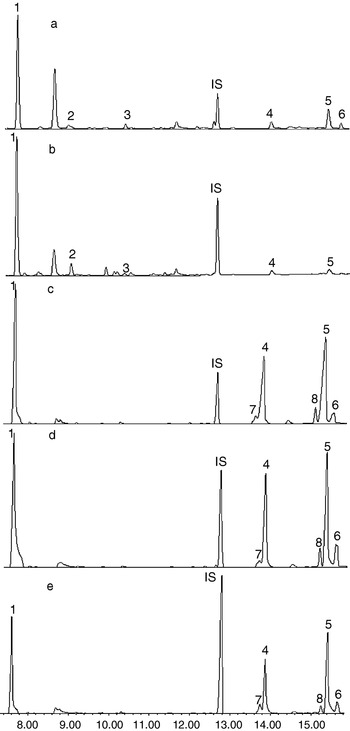
Five volatile compounds, cis- and trans-verbenol, myrtenal, myrtenol and verbenone, were identified and quantified from the extracts of both male and female hindguts. No qualitative differences in production of the hindgut volatiles were found between males and females. Representative gas chromatograms from male and female adults in different attack phases are given in fig. 1.
Gas chromatograms from hindguts extracts of Dendroctonus valens adults at different attack phases: (a) newly emerged male, (b) newly emerged female, (c) females alone in log, (d) females from paired beetles and (e) males from paired beetles; heptyl acetate (IS, internal standard) was added into each hindgut extract. Volatiles identified in the hindguts of female and male adults as follows: 1, α-pinene; 2, β-pinene; 3, 3-carene; 4, trans-verbenol; 5, myrtenol; 6, verbenone; 7, cis-verbenol; and 8, myrtenal.

Myrtenol and trans-verbenol were the major compounds produced by single females, paired females and males from pairs in galleries. The average amount of myrtenol was ca. 260.65 ng per female, compared to trans-verbenol at ca. 110.29 ng per female. The quantity of cis-verbenol, myrtenal and verbenone of beetles from the three different attack phases ranged from 7.65 to 33.21 ng per beetle.
cis-Verbenol (F 4, 11=36.860, P<0.001) and myrtenal (F 4, 11=10.193, P<0.001) were not detected in guts of male and female adults upon emergence, while trans-verbenol (F 4, 11=11.491, P<0.001), myrtenol (F 4, 11=14.771, P<0.001) and verbenone (F 4, 11=9.564, P<0.001) only existed at trace level. Two days after females were introduced singly into the bolts, the quantity of the five identified chemicals was significantly higher than those from newly emerged females. No significant difference in the volatile production was detected between single and paired females after being paired with males. Similar qualitative and quantitative variation pattern of volatile production was also found in males, i.e. after being paired with females, volatile production also increased dramatically (table 1).
The amounts (means±SD, ng) of hindgut volatiles isolated from hindguts of Dendroctonus valens adults at different attack phases.

Different letters in each row indicate significant differences in volatile production from RTB adults at different attack phases. N, total number of beetle treated for each phase.
RTB volatile biosynthesis
None of the five volatiles was found from JH III or acetone-treated beetles that had been injected with (1–13C) mevalonolactone or (1–13C) sodium acetate. However, both fed male and female RTB that had been injected with 13C precursors produced the five volatile components without the incorporation of 13C into the headspace and in hindgut extracts.
Trace amount of cis-verbenol, myrtenal, myrtenol and verbenone were detected in the extracts from the RTB adults that had been exposed to S-(−)-α-pinene for 18–20 h. Simultaneously, the extracts from the RTB adults under exposure of R-(+)-α-pinene contained trans-verbenol, myrtenal, myrtenol and verbenone (table 2). These results indicated that male and female RTB produced the volatiles through oxidation of the major monoterpene of host but not by de novo.
Hindgut volatile production of Dendroctonus valens after exposure to (S)-(−)-α-pinene and (R)-(+)-α-pinene for 18–20 h.

− or+delegates the absence or presence of a specific volatile in the abdomen extractions from RTB, respectively; M, male; F, female.
Discussion
Fed RTB adults produced the five volatile compounds, cis-verbenol, trans-verbenol, myrtenal, myrtenol and verbenone, which were consistent with the previous reports from China (Zhang & Sun, Reference Zhang and Sun2006). Among the five compounds identified from RTB in China, myrtenol and trans-verbenol were the most abundant components. However, RTB in North America produced trace quantities of frontalin but no myrtenal and myrtenol (Luxova et al., Reference Luxova, Graves, Gries, Hamud and Seybold2007). Whether or not the geographic variation of volatile production has happened in RTB between native and invasive range remains to be proved later.
Our results suggest that RTB emerge with trace amounts of volatiles and that their production increases once they begin feeding. Zhang & Sun (Reference Zhang and Sun2006) found that trans-verbenol or myrtenol in combination with host volatiles significantly increased RTB trap catch. The production and release of these two compounds by RTB entering the phloem may synergize the attractiveness of the host volatiles released during the beetle attack. The release of myrtenol and trans-verbenol by both sexes also could serve to speed up the attack process while subsequently responding RTB would assist the pioneers in overcoming the tree defenses. This beetle aggregation could facilitate the aggressive behavior observed for RTB in China.
Verbenone has been demonstrated to be effective in interrupting the response of RTB to its host volatiles (Sun et al., Reference Sun, Gillette, Miao, Kang, Zhang, Owen and Stein2003). However, verbenone acted as a volatile with dosage effect, which was attractive at low concentrations but inhibitory at high ones (Zhang et al., Reference Zhang, Sun and Clark2006). In table 1, we found that the concentration of verbenone was 11.78% in the volatiles from males, which was about twice that in the females (6.28%). As colonization of a tree by RTB progresses with more RTBs arrival, the more verbenone was released. Therefore, it can be speculated that when its concentration arrives at a critical threshold that inhibits the attack, the later-arriving beetles would switch to attack the adjacent trees, limiting competition for larval feeding. That is, RTB might regulate the attack density on the same host by variations in the concentration of verbenone in its volatile plume.
It is generally accepted that bark beetle pheromones may be conversion products of host terpenes, be simply sequestered from the hosts or synthesized de novo (Seybold et al., Reference Seybold, Huber, Lee, Graves and Bohlmann2006). In this paper, we discovered the five volatile components of the volatile system of RTB in China, cis- and trans-verbenol, myrtenal, myrtenol and verbenone, were all synthesized through oxidation of the major host monoterpene α-pinene, not synthesized de novo. Compared with de novo pathway, this pathway involves fewer steps and lower metabolic costs, and so it may provide a relative faster release. Generally speaking, as the elapsed time between host recognition and pheromone release decreases, the probability for survival of the dispersing population should increase (Wood, Reference Wood1982). Furthermore, rapid production of aggregation volatiles can lower the time of exposure to predators and adverse environmental conditions and reduce energy expenditure. Therefore, the volatile biosynthesis of RTB could facilitate its successful invasion and dispersion in China.
To summarize, our data showed that feeding significantly enhanced the volatile production of RTB in China. After joining females, males were able to release large quantities of the same volatiles as females. As a result, we proposed that male RTB could accelerate the aggregation of conspecifics to trees undergoing attack by emanating the same aggregation semiochemicals as females. Furthermore, we also demonstrated that the five identified volatiles were synthesized through oxidation of the host monoterpene, not by de novo.
Acknowledgements
We are very grateful to the workers at the Forest Farm of Tunlanchuan and Mr Zhen-Wang Miao at the Forest Pest Control Station in Shanxi Province for their help in collecting the beetles in the field. We also sincerely thank Drs Zhu-Dong Liu, Qing-He Zhang, Stephen R. Clarke and Nancy E. Gillette for their advice to improve the manuscript. This study was funded by the National Natural Science Foundation of China (30525009, 30621003) and National Basic Research Program (2009CB119200).