Multidrug-resistant gram-negative bacteria (MDRGN) are associated with considerable morbidity, mortality, and excess hospital costs.Reference Lautenbach and Perencevich 1 Limited therapeutic options to treat MDRGN infections and the paucity of novel antimicrobials targeting MDRGN further increase the public health risk posed by these pathogens.Reference Lautenbach and Perencevich 1 In the past decade, it has become evident that nursing home residents are among the major reservoirs of MDRGN with up to 20%–40% of residents colonized or infected with MDRGN.Reference O’Fallon, Kandel, Schreiber and D’Agata 2 , Reference O’Fallon, Pop-Vicas and D’Agata 3 Furthermore, frequent hospitalizations among this patient population provide a constant influx of MDRGN into the hospital setting with spread to other patents.Reference Pop-Vicas, Tacconelli, Gravenstein, Lu and D’Agata 4
Recent studies have identified residents with advanced dementia as having a 3-fold higher risk of harboring MDRGN than other residents in nursing homes.Reference Pop-Vicas, Mitchell, Kandel, Schreiber and D’Agata 5 Residents with advanced dementia have minimal verbal ability, are incontinent of urine and feces, and have lost basic motor skills. Thus, their poor functional status and need for increased contact with healthcare workers substantially increases their likelihood of both acquiring and spreading MDRGN. Furthermore, residents with advanced dementia are frequently exposed to antimicrobials, with 66% receiving at least 1 course of antimicrobials in an 18-month period.Reference D’Agata and Mitchell 6
Studies of the molecular epidemiology of multidrug-resistant organisms in nursing homes have shown transmission between residents and contamination of common rooms and healthcare workers as modes of spread.Reference O’Fallon, Schreiber, Kandel and D’Agata 7 – Reference Lee, Bartsch and Wong 9 These studies, however, did not specifically address residents with advanced dementia. In September 2009, a 5-year cohort study (Study of Pathogen Resistance and Exposure to Antimicrobials in Dementia [SPREAD]) was initiated to quantify the prevalence, acquisition of, and risk factors for multidrug-resistant organisms.Reference Mitchell, Shaffer and Loeb 10 In the SPREAD study, 362 residents with advanced dementia were followed up for as long as 1 year. Forty-six percent of residents were colonized with at least 1 MDRGN species at baseline and 36% acquired at least 1 MDRGN during the 12-month study period.Reference Mitchell, Shaffer and Loeb 10 In the present study, we report the findings of the molecular epidemiology of MDRGN transmission within and between nursing homes and characterize MDRGN colonization among residents with advanced dementia.
METHODS
Study Design
Residents with advanced dementia were recruited as part of the SPREAD study. The detailed method of SPREAD has been previously published.Reference Mitchell, Shaffer, Kiely, Givens and D’Agata 11 Briefly, criteria for subject eligibility included (1) 65 years of age or older, (2) length of stay in nursing home greater than 30 days, (3) dementia of any type, (4) formally or informally appointed proxy available and able to communicate in English, and (5) a Global Deterioration Scale score equal to 7. A Global Deterioration Scale score of 7 requires very severe cognitive dysfunction, limited verbal ability (<5 words), incontinence of urine and stool, and loss of basic motor skills.Reference Reisberg, Ferris, de Leon and Crook 12 Resident assessments were performed every 3 months for up to 1 year or death. Assessments included the collection of demographic and clinical data and rectal swab samples. Demographic variables included age, sex, race, etiology of dementia, and comorbid conditions. The Bedford Alzheimer’s Nursing Severity-Subscale score was used as a measure of functional disability, with a higher score representing increased disability. The Test for Severe Impairment, another measure of disability, was also documented, with lower scored indicating greater cognitive impairment. Nursing home characteristics were collected using the Centers for Medicare and Medicaid Nursing Home Compare website, provided by Medicare. 13 These characteristics included number of beds, presence of special care dementia unit, and number of healthcare worker hours, by type, per resident per day. Exposure to antimicrobials was classified as appropriate if minimal criteria for the initiation of antimicrobials for a suspected infection were met, per the modified Society of Healthcare Epidemiology of America guidelines.Reference Loeb, Bentley and Bradley 14 To increase the likelihood of identifying transmission events, only those nursing homes in which MDRGN isolates were recovered from more than 1 patient and in which at least 1 acquisition event occurred were included in this study. Acquisition was defined as a negative baseline rectal specimen for MDRGN and at least 1 positive follow-up specimen.
The institutional review board at Hebrew Senior Life and the clinical committee of investigation at Beth Israel Deaconess Medical Center approved the conduct of this study.
Microbiological Methods and Molecular Typing
MDRGN were isolated from specimens by plating rectal swabs on McConkey media, supplemented with 2 μg of ciprofloxacin/mL or 2 μg of ceftazidime/mL to minimize the recovery of pansusceptible gram-negative bacteria. Species identification and susceptibility testing were performed as previously described.Reference Mitchell, Shaffer, Kiely, Givens and D’Agata 11 All isolates were stored at −70°C. MDRGN isolates included those from the family Enterobacteriaceae and were defined as gram-negative bacteria resistant to 3 or more of the following antimicrobials or antimicrobial classes: ciprofloxacin, extended-spectrum penicillins (ampicillin/sulbactam or piperacillin/tazobactam), meropenem, gentamicin, and third-generation cephalosporins (ceftazidime or ceftriaxone). Molecular typing of MDRGN isolates was performed using pulsed-field gel electrophoresis, as previously described.Reference Mitchell, Shaffer, Kiely, Givens and D’Agata 11 Indistinguishable or closely related strains, defined as strains differing by 3 or fewer bands, were considered clonally related per the criteria of Tenover et al.Reference Tenover, Arbeit and Goering 15
RESULTS
Resident and Nursing Home Characteristics
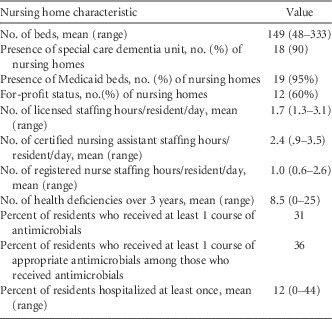
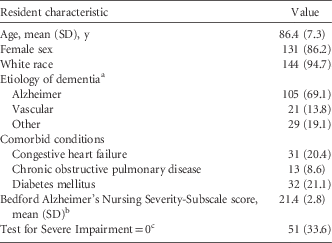
At least 1 acquisition event occurred in 22 (62.8%) of the 35 nursing homes enrolled in the SPREAD study. Nursing home characteristics for 20 of these 22 nursing homes are shown in Table 1. Two nursing homes closed soon after completion of data collection and therefore characteristics from the Nursing Home Compare website were no longer available. Resident characteristics are presented in Table 2.
Characteristics of 20 Nursing Homes Participating in the SPREAD Study With at Least 1 Multidrug-Resistant Gram-Negative Bacteria Acquisition Event

NOTE. Data were unavailable for 2 nursing homes. SPREAD, Study of Pathogen Resistance and Exposure to Antimicrobials in Dementia.
Baseline Characteristics of 152 Nursing Home Residents With Advanced Dementia

NOTE. Data are no. (%) unless otherwise indicated.
a Total exceeds 100% because some residents had more than 1 type of dementia.
b Possible range 7–28; higher scores indicate more functional disability.
c Possible range 0–24; lower scores indicate greater cognitive impairment; dichotomized to 0 vs >0.
MDRGN Isolates
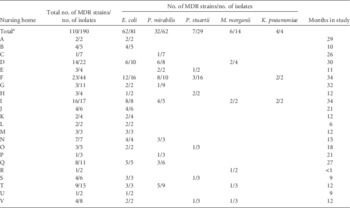
A total of 190 MDRGN isolates from 152 residents, residing in 22 nursing homes, were included in the analyses. A total of 28 residents (18.4%) were colonized with more than 1 different MDRGN species (4 residents were colonized with 3 different MDRGN species and 24 were colonized with 2 different MDRGN species). MDRGN species, recovered by nursing homes, are shown in Table 3. MDR-Escherichia coli and MDR-Proteus mirabilis were the most common species, recovered from 42.6% and 32.6% of residents, respectively. Susceptibility profiles to individual antimicrobials or antimicrobial classes are shown in Table 4. A total of 168 (88.4%), 20 (10.5%), and 2 (1.0%) of MDRGN were resistant to 3, 4, and 5 antimicrobials or classes, respectively. The most common 3-drug resistant pattern was resistance to ciprofloxacin, gentamicin, and extended-spectrum penicillins, present in 125 of 168 isolates (74.4%), followed by resistance to ciprofloxacin, extended-spectrum penicillins, and third-generation cephalosporins, present in 39 (23.1%) of 169 isolates. All 20 4-drug resistant MDRGN isolates were resistant to ciprofloxacin, extended-spectrum penicillins, third-generation cephalosporins, and gentamicin.
No. of Multidrug-Resistant (MDR) Strains and Species per no. of Isolates for Each Enrolled Nursing Home

NOTE. E. coli, Escherichia coli; K. pneumoniae, Klebsiella pneumoniae; M. morganii, Morganella morganii; P. mirabilis, Proteus mirabilis; P. stuartii, Providencia stuartii.
a Total number of strains is less than if all strains per individual nursing home are added, since some strains were recovered from ≥2 nursing homes.
Antimicrobial Resistance Profiles of Multidrug-Resistant (MDR) Gram-Negative Bacteria Recovered From 22 Nursing Homes

NOTE. 3G or 4G, third- or fourth-generation; E. coli, Escherichia coli; K. pneumoniae, Klebsiella pneumoniae; M. morganii, Morganella morganii; P. mirabilis, Proteus mirabilis; P. stuartii, Providencia stuartii.
Pulsed-Field Gel Electrophoresis Typing of MDRGN Isolates
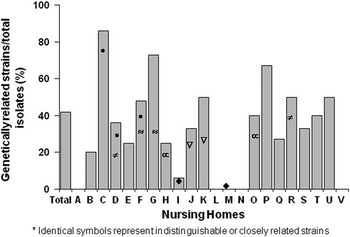
Genetically related MDRGN strains, recovered from different residents, were detected in 18 (82%) of the 22 nursing homes. The percent of clonally related strains in these nursing homes ranged from 0% to 86% (average, 35%). More than 50% of strains were clonally related in 3 nursing homes (Table 3). Genetically related MDRGN strains were also identified in different nursing homes. Three indistinguishable MDR-P. mirabilis strains and MDR-Providencia stuartii, each, were recovered from residents residing in 3 different nursing homes (nursing homes C, D, and F, and nursing homes H, O, and S, respectively). Two sets of 2 indistinguishable strains of MDR-E. coli were recovered from nursing homes F and G. Two indistinguishable strains of MDR-E. coli were also recovered from nursing homes J and K, and nursing homes I and M. Lastly, 2 indistinguishable strains of Morganella morganii were recovered from nursing homes D and R (Figure 1).
Percent of clonally related strains of multidrug-resistant gram-negative bacteria within and between nursing homes among residents with advanced dementia.

DISCUSSION
In this prospective study, we characterized the transmission dynamics of MDRGN among residents with advanced dementia residing in 22 nursing homes. The main findings were (1) cross-transmission of MDRGN was frequently identified both within nursing homes and between nursing homes, (2) antimicrobial resistance to 4 and 5 different antimicrobials or antimicrobial classes was present among 11.5% of MDRGN isolates, and (3) almost 1 in 5 residents were colonized with more than 1 different MDRGN species.
Transmission of multidrug-resistant organisms within long-term care facilities has been well characterized.Reference O’Fallon, Schreiber, Kandel and D’Agata 7 – Reference Lee, Bartsch and Wong 9 , Reference Hudson, Reynolds and Spratt 16 , Reference Fisch, Lansing and Wang 17 In this study, we show that cross-transmission among residents with advanced dementia also contributes to the spread of MDRGN in this healthcare setting. Although these residents by definition are nonambulatory, increased need for healthcare worker assistance and frequent antimicrobial exposure leads to a subset of long-term care facility residents at high risk of both acquiring and spreading MDRGN. Furthermore, residents with advanced dementia spend numerous hours every day in common rooms during which time they interact with both advanced dementia and non–advanced dementia residents. These interactions could provide opportunities for direct resident-to-resident transmission and environmental contamination. Future studies aimed at characterizing the transmission dynamics of MDRGN and quantifying the impact of infection control strategies in nursing homes should include analyses targeted to this high-risk group.
Transmission of clonal MDRGN strains between residents with advanced dementia, residing in multiple different nursing homes, was also documented. Possible routes include overlapping hospital stays among residents with advanced dementia from different nursing homes and healthcare workers cross-covering multiple nursing homes. Several multicenter nursing home studies of multidrug-resistant organisms among all residents have also implicated overlapping hospital stays as a contributor to the interfacility spread of these organisms.Reference Lee, Bartsch and Wong 9 , Reference Hudson, Reynolds and Spratt 16 , Reference Mortensen, Trivedi and Rosenberg 18
The extent of cross-transmission varied among different nursing homes. The reasons are likely multifactorial and may include varying rates of compliance with hand hygiene, number of healthcare workers, and use of antimicrobials. In 2014 a study by Cochard et alReference Cochard, Aubier, Quentin and van der Mee-Marquet 19 showed that the prevalence of multidrug-resistant Enterobacteriaceae was associated with lower rates of hand hygiene, less frequent use of gloves and protective clothing, as well as lower rates of appropriate waste management. The implementation of multifaceted infection control interventions, however, can reduce the spread of multidrug-resistant organisms. A nationwide intervention to prevent the spread of carbapenem-resistant Enterobacteriaceae in Israel, which included periodic onsite evaluations of infection control policies, development of national guidelines involving active surveillance, and contact isolation of colonized residents, as well as cross-sectional surveys of colonization rates, significantly decreased the rate of carbapenem-resistant Enterobacteriaceae.Reference Ben-David, Masarwa, Adler, Mishali, Carmeli and Schwaber 20
We did not address the extent of MDRGN transmission from residents with advanced dementia to nursing home residents without advanced dementia. It is likely that the former contribute to the acquisition of MDRGN by other residents during overlapping exposure in common rooms, contact with the same healthcare worker, and environmental contamination. Some nursing homes provide special care wards for residents with advanced dementia and whether these types of nursing homes have lower rates of transmission to nursing home residents without advanced dementia, requires further investigation.
Another important finding of this study was the substantial number of residents with advanced dementia who were colonized with MDRGN that were resistant not only to 3, but to 4 and 5 different antimicrobials or antimicrobial classes. The paucity of novel anti–gram-negative agents being developed by industry and the current limited therapeutic options to treat residents with MDRGN infections further emphasize the urgent need to limit MDRGN spread.
Lastly, we showed that co-colonization with multiple different MDRGN species was frequent among residents with advanced dementia. A study by Snyder et alReference Snyder, O’Fallon and D’Agata 21 also showed that among all residents in nursing homes, 25% were co-colonized with multiple MDRGN species and that markers of advanced dementia were significantly associated with co-colonization. The high rate of co-colonization has important infection control implications. At present, screening cultures for MDRGN, if performed, target only 1 type of MDRGN species. However, since residents can be colonized with more than 1 different MDRGN species, identifying only 1 MDRGN species may lead to inadequate cohorting of colonized residents.
This study has several limitations. First, the duration of follow-up for each nursing home varied and therefore more transmission events may have been identified in those nursing homes with a longer duration of follow-up. Second, we did not quantify the contribution of horizontal gene transmission in the acquisition and spread of MDRGN because it was beyond the scope of this study.Reference Doi, Adams-Haduch, Peleg and D’Agata 22 Third, only residents with advanced dementia who participated in this study were screened for MDRGN and other nursing homes residents were not included in this epidemiologic investigation. Thus, the full extent of MDRGN transmission within nursing homes was not characterized. Fourth, we did not address the dynamics of MDRGN colonization within individual residents and how they may fluctuate over time. Thus, the presence or absence of colonization may reflect changes in the dynamics of the flora. Lastly, characteristics of nursing homes, including antimicrobial exposure and resident hospitalizations, were described but differences among nursing homes and hospitalizations and their potential association with extent of transmission could not be analyzed owing to a small sample size.
The ongoing rise of MDRGN within nursing homes raises serious concerns for improving the clinical outcome of these residents.Reference Hughes, Tunney and Bradley 8 , Reference Sengstock, Thyagarajan, Apalara, Mira, Chopra and Kaye 23 Only 50% of nursing home residents in whom MDRGN are recovered from clinical cultures during a hospitalization return to their nursing home, with the remainder requiring a higher level of care or dying.Reference Sengstock, Thyagarajan, Apalara, Mira, Chopra and Kaye 23 Ongoing efforts to curb the acquisition and spread of MDRGN among residents of nursing homes, especially those with advanced dementia, are crucial.
Acknowledgments
We thank the SPREAD data collection and management team (Ruth Carroll, Margaret Bryan, and Elaine Bargmen), all the staff at the participant nursing homes, and the residents and families who have generously given their time to this study.
Financial support. National Institutes of Health, National Institute on Aging (grant R01 AG032982 to this study and K24AG033640 to S.M.).
Potential conflicts of interest. All authors report no conflicts relevant to this article.