I. INTRODUCTION
The Rietveld refinement is an application of the weighted least-squares method to experimentally observed powder diffraction intensity data, based on the model for the crystal structure, peak profile, and background intensities. In principle, the errors in optimized values of crystallographic parameters such as unit-cell constants, atomic positions, etc., can be evaluated by the Rietveld method, if the experimental errors are known quantities. However, we often encounter too small statistical errors in the output of Rietveld programs, particularly in the cases: (i) strong X-ray source, (ii) long measurement time, (iii) high-resolution optics, (iv) high-sensitivity detectors, and (v) samples with high crystallinity and large scattering cross section. It means that the assumed experimental errors tend to be underestimated in those cases. Then the solution should simply be the use of appropriate values for the assumption of experimental errors.
It has already been suggested that the statistical variance in observed powder diffraction intensities is dominantly caused by the finite number of particles that satisfy the diffraction condition, when the size of crystallites is not small enough (Alexander et al., Reference Alexander, Klug and Kummer1948). This effect is referred to as “particle statistics” (de Wolff, Reference De Wolff1958), and it has experimentally been confirmed (Ida et al., Reference Ida, Goto and Hibino2009) that the observed statistical variance σj2 can be modeled as the sum of counting statistical variance (σc)j2 approximated by the expected value of the number of counts y(2Θj) at the diffraction angle 2Θj, and particle statistical variance (σp)j2, that is,
 $$\sigma _j^2 \approx \lpar \sigma _{\rm c} \rpar _j^2+\lpar \sigma _{\rm p} \rpar _j^2$$
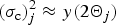 $$\lpar \sigma _{\rm c} \rpar _j^2 \approx y\lpar 2\Theta _j \rpar$$
The particle statistical variance (σp)j2 can be formulated by (Alexander et al., Reference Alexander, Klug and Kummer1948; De Wolff, Reference De Wolff1958; Ida et al., Reference Ida, Goto and Hibino2009)
 $$\lpar \sigma _{\rm p} \rpar _j^2 \approx \displaystyle{{C_{\rm p} [ y\lpar 2\Theta _j \rpar - b_j \rsqb ^2 \sin \Theta _j } \over {\lpar m_{{\rm eff}} \rpar _j }}$$
where C p is an unknown proportionality factor, b j is the background intensity, and (m eff)j is the effective multiplicity for reflection, defined by
 $$\lpar m_{{\rm eff}} \rpar _j \equiv \displaystyle{{[ y_1 \lpar 2\Theta _j \rpar +\cdots+y_m \lpar 2\Theta _j \rpar \rsqb ^2 } \over {[ y_1 \lpar 2\Theta _j \rpar \rsqb ^2+\cdots+[ y_m \lpar 2\Theta _j \rpar \rsqb ^2 }}$$
when m different reflections contribute to the observed intensity as follows:
 $$y\lpar 2\Theta _j \rpar =b_j+y_1 \lpar 2\Theta _j \rpar +\cdots+y_m \lpar 2\Theta _j \rpar$$
It is quite likely that the statistical error proportional to the observed intensity also affect the statistical properties of the measured data, as suggested by Toraya (Reference Toraya1998, Reference Toraya2000). We then have assumed a three-term model for the statistical errors,
 $$\sigma _j^2 \approx \lpar \sigma _{\rm c} \rpar _j^2+\lpar \sigma _{\rm p} \rpar _j^2+\lpar \sigma _{\rm r} \rpar _j^2$$
 $$\lpar \sigma _{\rm r} \rpar _j^2=C_{\rm r} [ y\lpar 2\Theta _j \rpar \rsqb ^2$$
where C r is an unknown proportionality factor in the statistical model for the observed powder diffraction intensity data.
The unknown parameters C p and C r in the statistical model cannot be optimized by the Rietveld method, but can be estimated from the experimental data by applying a “maximum likelihood estimation” as an alternative to the least-squares method. In this article, the concept of the new methodology for analysis of powder diffraction data based on maximum likelihood estimation is described, and the results of analyses on fluorapatite Ca5(PO4)3F, anglesite PbSO4, and barite BaSO4 are demonstrated.
II. MAXIMUM LIKELIHOOD ESTIMATION
Suppose that diffraction intensities {Y 1, ..., Y N} observed at diffraction angles {2Θ1, ..., 2ΘN} are normally distributed around an appropriate model y(2Θj) with a statistical error of {σj} at each data point. Then, the probability P that this dataset should be realized is given by
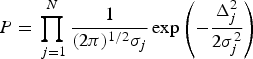 $$P=\prod\limits_{\,j=1}^N {\displaystyle{1 \over {\lpar 2{\rm \pi }\rpar ^{1/2} \sigma _j }}} \exp \left({ - \displaystyle{{\Delta _j^2 } \over {2\sigma _j^2 }}} \right)$$
where Δj ≡ Y j − y(2Θj) is the deviation of the observed intensity Y j from the average intensity y(2Θj). The maximum likelihood estimation denotes the optimization of the statistical model to maximize the probability P, which is exactly equivalent to the minimization of the “unlikelihood estimator” U defined by
 $$U \equiv - 2\ln P - N\ln \lpar 2{\rm \pi }\rpar =\sum\limits_{\,j=1}^N {\left({\displaystyle{{\Delta _j^2 } \over {\sigma _j^2 }}+\ln \sigma _j^2 } \right)}$$
Note that the Rietveld method is nothing but the minimization of weighted sum of squared deviation S, given by
 $$S=\sum\limits_{\,j=1}^N {\displaystyle{{\Delta _j^2 } \over {\sigma _j^2 }}}$$
and the values of {σj} should always diverge to infinity, if they are allowed to be varied.
The plots shown in Figure 1 schematically illustrate the capability of maximum likelihood estimation to optimize the error model, simplifying the behavior of the unlikelihood estimator as a function of σ2, U = Δ2/σ2 + lnσ2. It should be noted that the unlikelihood U has a minimum at a finite value of σ2.
Illustration to demonstrate the capability of maximum likelihood estimation to optimize statistical variance σ2. The unlikelihood function U=Δ2/σ2+lnσ2 always has a minimum value at a finite value of σ2.

III. ANALYTICAL PROCEDURES
The optimization of the overall statistical model by the maximum likelihood estimation can be divided into the following two steps (Ida and Izumi, Reference Ida and Izumi2011):
(i) Structure refinement by the Rietveld method with the user-defined errors {σj}, where σj = Y j1/2 is assumed at the initial stage.
(ii) Estimation of errors {σj}, determined by C p and C r, by the minimization of the unlikelihood indicator U(C p, C r), applying the deviations {Δj} = {Y j − y(2Θj)}, individual model peak profile {y k(2Θj)} and background intensities {b j}, calculated by the former Rietveld refinement.
The above steps (i) and (ii) are repeated until convergence, which typically needs 3–4 iterations.
IV. APPLICATIONS TO X-RAY POWDER DIFFRACTION DATA
In this section, the applications of the new structure refinement method based on the maximum likelihood estimation to fluorapatite Ca5(PO4)3F, anglesite PbSO4, and barite BaSO4 are demonstrated. Further details about the analytical results have been described elsewhere (Ida and Izumi, Reference Ida and Izumi2011).
A. Fluorapatite, Ca5(PO4)3F
CuKα X-ray powder diffraction data of fluorapatite, Ca5(PO4)3F, were originally attached to the DBWS Rietveld program package developed by Young et al. (Reference Young, Sakthivel, Moss and Paiva-Santos1995), and are currently available as an example dataset in the RIETAN-FP package (Izumi and Momma, Reference Izumi and Momma2007). The space group of fluorapatite is P63/m (No. 176).
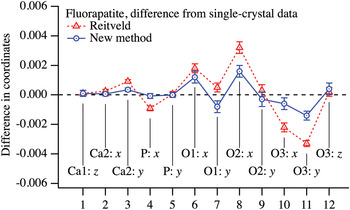
The differences in atomic coordinates between the structure refined from the powder and single-crystal diffraction data (Sudarsanan et al., Reference Sudarsanan, Mackie and Young1972) are plotted in Figure 2. All the atomic fractional coordinates optimized by our new method are closer to the single-crystal data than those obtained by the Rietveld method.
Deviations of the fractional coordinates of fluorapatite optimized by the Rietveld (triangles) and new (circles) methods from those obtained by X-ray analysis of a synthetic single crystal by Sudarsanan et al. (Reference Sudarsanan, Mackie and Young1972).

B. Anglesite, PbSO4
CuKα X-ray powder diffraction data of anglesite, PbSO4, supplied for a Rietveld refinement round robin (Hill, Reference Hill1992), were reanalyzed. The data are available as an example file in the FullProf package (Rodríguez-Carvajal, Reference Rodríguez-Carvajal1993). The space group of anglesite is Pnma (No. 62).
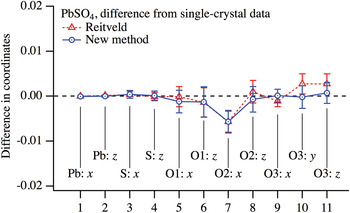
The differences in atomic coordinates between structure refinements from the powder and synthetic single-crystal diffraction data (Miyake et al., Reference Miyake, Minato, Morikawa and Iwai1978) are plotted in Figure 3. The atomic coordinates optimized by the new analytical method are almost unchanged from the results obtained by the Rietveld method. It should be noted that the results of the Rietveld method have already been in good agreement with the single-crystal data within the experimental errors. It is suggested that the powder diffraction data were collected almost under ideal condition for the Rietveld structure refinement. This example shows a rather favorable behavior of the new analytical method, to the point that it does not cause unwanted modification to the satisfactory results of the Rietveld method.
Deviations of the fractional coordinates of anglesite optimized by the Rietveld (triangles) and new (circles) methods from those obtained by single-crystal X-ray structure analysis by Miyake et al. (Reference Miyake, Minato, Morikawa and Iwai1978).

C. Barite, BaSO4
CuKα1 X-ray powder diffraction data of barite, BaSO4 are available as an example in the RIETAN-FP package (Izumi and Momma, Reference Izumi and Momma2007). The space group of barite is Pnma (No. 62), and is isostructural to anglesite.
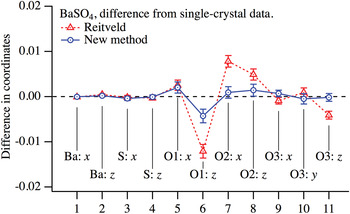
The differences in atomic coordinates between structure refinements from the powder and synthetic single-crystal diffraction data (Miyake et al., 1978) are plotted in Figure 4. This example shows significant improvements in agreement with the single-crystal data by applying the new analytical method. It should be emphasized that the results of the new analytical method are closer to the single-crystal data than those obtained by the Rietveld method, even though the Rietveld and new analytical methods are applied exactly to the same powder diffraction data, while the sample for single-crystal analysis is different from what is used in the powder diffraction experiment. The improved agreement with single-crystal data may be ascribed to lower probability to satisfy the diffraction condition because of the use of monochromated X-ray source on collection of the powder diffraction intensity data of BaSO4.
Deviations of the fractional coordinates of barite optimized by the Rietveld (triangles) and new (circles) methods from those obtained by single-crystal X-ray structure analysis by Miyake et al. (1978).

V. CONCLUSION
A new method based on the maximum likelihood estimation for structure refinement from powder diffraction data has been developed. A model for statistical errors affected by particle statistics in experimental data can be optimized by the method. The method has been applied to the powder diffraction data of fluorapatite, anglesite, and barite. The structures refined by the new method show improved agreement with single crystal data, as compared with those obtained by conventional Rietveld refinements. The new method can be used as an alternative to the Rietveld method for structure refinement.