I (Kim Halford) was invited to write this review paper in 2018 after I completed a national workshop tour teaching couple therapy for the Australian Association of Cognitive and Behaviour Therapy and gave an invited address at the association's national conference in Brisbane. The workshop tour and invited address were part of my final year of working as a clinician, researcher and academic teacher before I retired at the end of 2018. I invited Dr Chris Pepping to co-author this article because he has great knowledge and skill in the field of couple therapy practice and research, and it has been my privilege to work closely with him for the last decade. The article is a final joint statement he and I make about the couple therapy field as I pass the responsibility for future research and leadership to Chris and the other talented younger people in the couple therapy field.
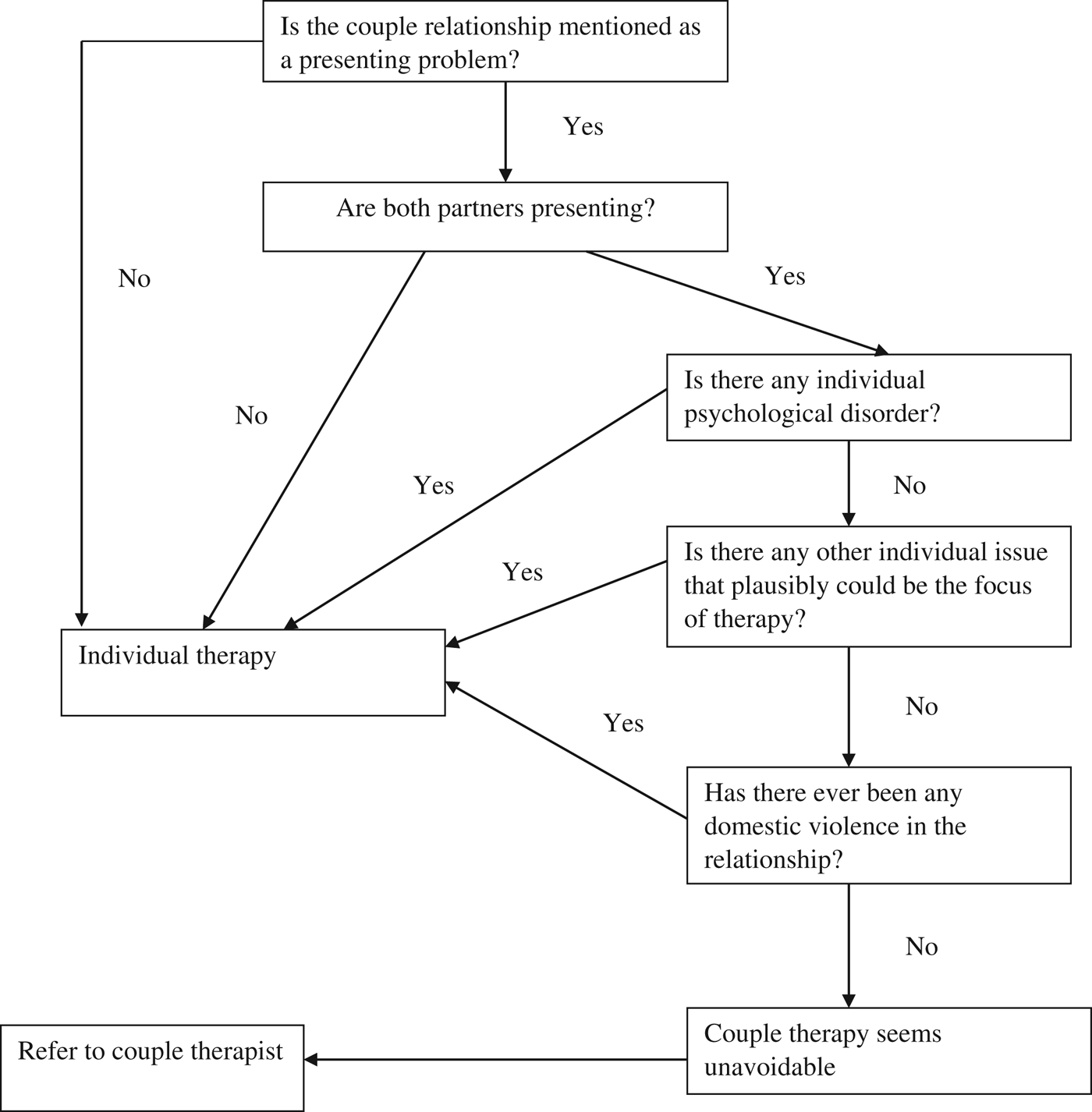
In many years of practice, we (WKH and CP) each have found that many of our clinical colleagues seem to dislike seeing couples. Even experienced therapists often seem to use a flowchart — something like the one presented in Figure 1 — to avoid doing couple therapy. We offer this flowchart, only half in jest, as we think some of the decisions portrayed in the flowchart really do happen, and we think these decisions reflect mistaken assumptions. Part of each of us is grateful that many colleagues prefer individual rather than couple therapy; we each have had enjoyable — and lucrative — practices working with couples, founded on referrals from our couple-avoidant colleagues. However, part of us also feels regret that work with couples is not an integral part of routine clinical work in Australia. In this invited paper, we take the opportunity to present the evidence on the relevance and effectiveness of couple interventions in the work of all clinicians.
The couple therapy avoidance flowchart.

Significance of Couple Relationships and Couple Therapy
The desire to be in a committed, mutually satisfying couple relationship is so pervasive across countries and cultures that many psychologists have argued that such pair bonding reflects an evolutionary imperative (e.g., Buss, Reference Buss1994; Fletcher, Simpson, Campbell, & Overall, Reference Fletcher GJ, Simpson, Campbell and Overall2015). Across most Western countries, more than 85% of adults marry at least once in their lifetime (Weston, Qu, & Hayes, Reference Weston, Qu, Hayes, Noller and Karantzas2012). A modest but increasing proportion of the population choose not to get married, but most become involved in a committed cohabiting couple relationship at least once in their lifetime (Australian Bureau of Statistics, 2016). In most Western countries, such as Australia, New Zealand, the United States, United Kingdom and western European countries, there has been an increased rate of divorce relative to the 1960s and 1970s (Weston et al., Reference Weston, Qu, Hayes, Noller and Karantzas2012). There also has been an increasing rate of cohabitating couples having children together, with 30% of first-time parents being cohabiting rather than married in Australia and the United States (Australian Bureau of Statistics, 2016; Pew Research Center, 2018). So, while the particular forms of couple relationships have changed somewhat, being in a committed relationship remains central to the majority of adults’ lives.
A stable, mutually satisfying couple relationship is a very powerful predictor of positive health and wellbeing in adults (Diener, Suh, Lucas, & Smith, Reference Diener, Suh, Lucas and Smith1999; Robeles, Slatcher, Trombello, & McGinn, Reference Robles, Slatcher, Trombello and McGinn2014). In contrast, relationship problems are stressful and associated with a broad spectrum of risks for adults, including problems with individual adjustment, physical health, and financial wellbeing (Amato, Reference Amato2000; Coie et al., Reference Coie, Watt, West, Hawkins, Asamow, Markman and Long1993; Umberson, Williams, Powers, Liu, & Needham, Reference Umberson, Williams, Powers, Liu and Needham2006). Given this strong association of the couple relationship with the health and wellbeing of partners, it is not surprising that clinical presentations often involve both individual problems and couple relationship problems.
For children, growing up in a stable home with parents in a satisfying relationship promotes mental, physical, educational and peer-related adjustment (Halford, Rhoades, & Morris, Reference Halford, Rhoades, Morris, Sanders and Morawska2018). In contrast, parental conflict, distress and divorce are risk factors for child depression, withdrawal, conduct disorder, poor social competence, health problems and academic under-achievement (Amato, 2010; Grych, Oxtoby, & Lynn, Reference Grych, Oxtoby, Lynn, Fine and Fincham2013). Given this strong association of the couple relationship with the health and wellbeing of children, it is not surprising that clinical presentations often involve child or parenting problems in combination with couple relationship distress (Cummings & Davies, Reference Cummings and Davies2010).
Studies of presentations for therapy suggest couple relationship problems are common presentations in many clinical settings. For example, couple relationship problems are reported as the most common presenting concern among those seeking assistance from professional counsellors (Kulka, Veroff, & Douvan, Reference Kulka, Veroff and Douvan1979), and one of the top three presenting problems in those attending Employee Assistance Programs (Shumway, Wampler, Dersch, & Arredondo, Reference Shumway, Wampler, Dersch and Arredondo2004). The pervasiveness of relationship help-seeking is reflected in the millions of websites and thousands of self-help books that are used by millions of people (Stewart, Bradford, Higginbotham, & Skogrand, Reference Stewart, Bradford, Higginbotham and Skogrand2016).
It is likely that many more people would like professional help with their relationship problems, except that clients often perceive a lack of expertise among helping professionals about relationship issues (Stewart et al., Reference Stewart, Bradford, Higginbotham and Skogrand2016). Individuals in distressed relationships are greatly overrepresented among those seeking mental health services, yet they usually do not report marital distress as a primary complaint (Lin, Goering, Offord, Campbell, & Boyle, Reference Lin, Goering, Offord, Campbell and Boyle1996), possibly because they do not perceive mental health professionals as able to address relationship issues. Professionals are perceived as particularly lacking in expertise in addressing the relationships needs of minorities like same-sex couples (Pepping, Lyons, Halford, Cronin, & Pachankis, Reference Pepping, Lyons, Halford, Cronin and Pachankis2017). In heterosexual couples, female partners are more likely to initiate couple relationship help-seeking than male partners (Doss, Simpson, & Christensen, Reference Doss, Simpson and Christensen2004), perhaps highlighting the need to pay particular attention to barriers to male partner help-seeking.
The Scope of Couple Therapy
Stuart (Reference Stuart1969) published one of the first descriptions of a behavioural approach to treating couple relationship problems. Based upon the premise that the exchange of behaviours between partners defines a couple relationship, behavioural couple therapy (BCT) began as the application of behavioural contracting to enhance reciprocal positive reinforcement between spouses to enhance relationship satisfaction. In the intervening five decades, BCT has evolved to incorporate numerous conceptual advances in what is included in therapy, such as communication skills training, cognitive change strategies, and promoting acceptance (Halford & Doss, Reference Halford and Doss2016). The breadth of application of couple therapy has extended beyond the presenting problem of relationship distress, with adapted forms of BCT effectively treating a range of psychological disorders (Baucom, Whisman, & Paprocki, Reference Baucom, Whisman and Paprocki2012). Moreover, BCT-based education can promote positive adaptation to major life challenges, such as becoming parents or balancing work and family (Halford, Reference Halford2011); or conjointly coping with crises such as when major health problems affect a spouse (Baucom, Porter, Kirby, & Hudephol, Reference Baucom, Porter, Kirby and Hudepohl2012).
When is Couple Therapy Appropriate?
Returning to our assertion that Figure 1 implicitly contains some myths about work with couples, consider the top box that poses the question, ‘Is the couple relationship mentioned as a presenting problem?’ If the question is answered ‘No’, this leads to individual therapy. We suggest that many clinicians we have worked with follow this guideline. However, there is now a wealth of evidence that the quality of the couple relationship reciprocally interacts with a wide range of psychological disorders, including depression, anxiety disorders and substance abuse (Whisman & Baucom, Reference Whisman and Baucom2012). Moreover, couple therapy is sometimes more effective than individual therapy for treatment of psychological disorders (Baucom, Whisman, & Paprocki, Reference Baucom, Whisman and Paprocki2012). This does not mean that couple therapy is universally appropriate, but it does suggest that clinicians should consider whether a couple-based approach might be relevant, even when the initial presentation is by an individual reporting a psychological disorder. To evaluate the appropriateness of a couple-based approach, clinicians need to do a careful assessment — for all people in a couple relationship — of how the presented individual problem(s) interact with the couple relationship, and negotiate with the client as to whether some focus on the couple relationship is advisable. When the presentation is initially for an individual problem, sensitively introducing the salience of attention to the couple relationship is important. For example, the therapist might comment: ‘Often people with the issues you have described feel it interacts with their relationship with their partner.’ This initial opening can be followed up with questions like the following: ‘How would you describe your relationship with your partner?’ ‘How does your problem show to your partner, and how does she/he react?’
Similarly, consider the second top box ‘are both partners presenting’, which, if answered ‘No’, leads to the arrow toward ‘individual therapy’. There is now quite a deal of research on how to engage the non-presenting spouse with couple therapy (e.g., Ducher et al., Reference Dutcher, Anderson, Moore, Luna-Anderson, Meyers, Delaney and Smith2009; Halford, Price, Kelly, Bouma, & Young, Reference Halford, Price, Kelly, Bouma and Young2001). Therefore, if the assessment suggests the couple relationship is salient, then we should at least explore with the client the option of a conjoint couple approach to therapy. If the presenting client is uncertain about the willingness of the partner to attend therapy, or even suspects resistance, it can be worth exploring where, when and in what circumstances the presenting client might issue an invitation to the partner to participate in therapy. Helping the presenting client to have a form of words that positively expresses their desire to involve the partner in attempts to improve things for both partners can be quite effective in engaging the other partner.
A number of other potential ostensible reasons for not considering couple therapy are described in Figure 1. For instance, interpartner violence (IPV) of any kind has sometimes been seen as a contra-indication for conjoint couple therapy; however, considerable research shows that for many couples with some IPV, couple therapy is the most effective option available (Salis & O'Leary, Reference Salis, O'Leary, Sullivan and Lawrence2016).
The mode of presentation and the initial stated concern can reflect a crisis, or simply chance events. For example, patients have described to us that a drink-driving conviction or an embarrassing binge-drinking episode precipitated them seeking assistance with drinking. In other cases, couples have reported that a severe argument (e.g., a statement by one spouse that they plan to leave the relationship, or an argument that escalated to violence) led them to seek therapy. We have also have patients report that a media article or comment from a friend or acquaintance about the value of a particular treatment precipitated their seeking that sort of help. In all the diversity of possible precipitants and initial presentation, couple therapy often might be helpful, irrespective of whether an individual or couple initially presents, or whether the couple relationship is initially mentioned as the presenting problem.
Initial Presentation and Couple Therapy
Table 1 presents a conceptualisation of a range of circumstances in which couple interventions are likely to be relevant to therapy for adults. The top left quadrant represents what is usually meant by couple therapy: the couple report a distressed relationship, there is no psychological disorder in either partner, and the agreed focus of therapy at the time of presentation is the distressed couple relationship. The majority of research on couple therapy has focused on presentations of this sort (Fischer, Baucom, & Cohen, Reference Fischer, Baucom and Cohen2016; LeBow, Chambers, Christensen, & Johnson, Reference Lebow, Chambers, Christensen and Johnson2012). However, as we argued previously, couple interventions have broad utility in adult therapy, not just when a distressed couple relationship is nominated as the presenting problem.
Couple Interventions in Adult Therapy

The bottom left quadrant of Table 1 represents where there are coexisting relationship and individual problems, which is a very common clinical scenario. People with coexisting individual and couple problems can present for assistance in diverse ways. The mode of presentation (individual or couple), or the initial statement of the presenting problem, does not necessarily provide clear guidance as to whether couple therapy or individual therapy (or some combination of both) is likely to be most helpful. To illustrate, consider the example of heavy alcohol consumption: in about 40% of couples presenting with relationship problems, one of the partners is drinking at hazardous levels (Halford & Osgarby, Reference Halford and Osgarby1993); relationship dissatisfaction predicts future alcohol use disorders (Whisman, Uenelacker, & Bruce, Reference Whisman, Uebelacker and Bruce2006); and there are very high rates of relationship problems in people who seek treatment for alcohol misuse (Fals-Stewart, Lam, & Kelly, Reference Fals-Stewart, Lam and Kelley2009). I (WKH) have seen people suffering from both alcohol abuse and relationship problems present for assistance alone (either the drinker or the spouse) or as a couple, with some patients initially presenting the primary concern as the relationship and others focusing on the drinking. I have also seen people with both drinking and relationship problems present their primary concern as other issues, such as work or parenting stress. The mode of presentation and the initial stated concern need not reflect where therapy might best be focused.
The two right-hand quadrants of Figure 1 represent situations when the relationship is not distressed and the relationship is unlikely to be a presenting problem, but couple-based interventions might well be useful. The bottom right quadrant represents when there is individual psychological disorder, but the couple relationship is not distressed. In such instances, the partner of the individual with the identified disorder can often usefully be enlisted as an important part of therapy. For example, in couples in which one partner has a major psychiatric disorder, psychoeducation provided to the couple about the nature of the disorder, and the medical and psychological aspects of management, can allow the couple jointly to cope with the disorder more effectively (Mueser & Brunette, Reference Mueser, Brunette, Snyder and Whisman2003).
The top right-hand quadrant refers to situations when neither partner has a disorder, and the relationship is not distressed, but the couple might benefit from conjoint assistance to manage a difficult life stressor. As examples, couple psychoeducation around parenthood enhances adjustment of couples making the transition to parenthood (Petch, Halford, Creedy, & Gamble, Reference Petch, Halford, Creedy and Gamble2012), and couples in which a partner is recently diagnosed with a major health problem (e.g., cancer) benefit from psychoeducation about the diagnosis, medical treatment, psychological coping strategies, and promoting mutual partner support (Scott, Halford, & Ward, Reference Scott, Halford and Ward2004).
Conceptualisation of Couple Relationships
It is critical that therapists have a framework for understanding the determinants of couple functioning, as this has direct relevance to treatment planning and intervention. Here we present our ecological model of factors that influence couple relationship functioning (Halford, Reference Halford2011; Halford & Pepping, Reference Halford and Pepping2017). As displayed in Figure 1, there are a range of variables that predict relationship outcomes (e.g., relationship satisfaction and stability), and these variables fall into four major categories: context, life events, individual characteristics of each partner, and the couple interaction.
At the outer level, context refers to features of the environment in which couples live that have influence on the relationship. For instance, cultural background affects one's relationship standards, referring to the beliefs about behaviours that are important to have a good relationship (Hiew, Halford, Van den Vijven, & Liu, Reference Hiew, Halford, van de Vijver and Liu2015a). The endorsement of some standards as important is associated with high relationship satisfaction (e.g., that frequent expression of caring and love are important), while endorsement of other standards are associated with low satisfaction (e.g., that sex must always be extremely good; Hiew, Halford, Van den Vijven, & Liu, Reference Hiew, Halford, Van de Vijver and Liu2015b). Relationship satisfaction is also predicted by agreement between the partners on some other standards (e.g., the degree of closeness and involvement with extended family; Hiew et al., Reference Hiew, Halford, Van de Vijver and Liu2015b). Another contextual factor relevant to relationship functioning is socioeconomic status; social disadvantage is associated with higher risk of relationship break-up (Orbuch, Veroff, Hassan, & Horrocks, Reference Orbuch, Veroff, Hassan and Horrocks2002). Context may also include the level of support and acceptance for one's relationship. For instance, among same-sex couples, societal stigma and minority stress are associated with poor relationship functioning (e.g., Pepping & Halford, Reference Pepping and Halford2014).
Life events refer to situations and circumstances that have an impact on the couple and/or individual partners. Stressful life events predict poor couple satisfaction over time (Lederman, Bodenmann, Rudaz, & Bradbury, Reference Ledermann, Bodenmann, Rudaz and Bradbury2010; Neff & Karney, Reference Neff and Karney2009), and major life events such as the birth of a child (Doss, Rhoades, Stanley, & Markman, Reference Doss, Rhoades, Stanley and Markman2009) and losing one's job (e.g., Howe, Levy, & Caplan, Reference Howe, Levy and Caplan2004) can affect both the individual partner and the couple relationship.
Individual characteristics refer to relatively stable individual differences in each partner that have an impact on the couple relationship. For instance, individual partner psychopathology is a risk factor for the couple relationship; similarly, attachment insecurity and some personality variables (e.g., neuroticism) are associated with couple relationship outcomes (Bradbury & Karney, Reference Bradbury and Karney2004; Karney & Bradbury, Reference Karney and Bradbury1995).
Finally, the couple interaction component of the model refers to the cognitive, affective, and behavioural processes that occur when partners are together. For instance, shared and realistic relationship expectations are associated with positive relationship outcomes, whereas unrealistic relationship expectations, such as expecting that partners will never disagree with each other, predicts poor relationship outcomes (see Halford, Reference Halford2011). Similarly, relationship self-regulation, which refers to the extent to which partners work to maintain a satisfying romantic relationship, is associated with relationship satisfaction (Wilson, Charker, Lizzio, Kimlim, & Halford, Reference Wilson, Charker, Lizzio, Halford and Kimlin2005) and predicts relationship satisfaction over time (Halford, Lizzio, Wilson, & Occhipinti, Reference Halford, Lizzio, Wilson and Occhipinti2007). High negative emotion can contribute to problematic couple interactions, including mutual blaming and escalating conflict, which predicts poor relationship satisfaction and heightened risk of separation (Christensen & Heavey, Reference Christensen, Heavey, Oskamp and Costanzo1993; Gottman, Reference Gottman2015; Greenberg & Johnson, Reference Greenberg and Johnson1988). One particularly common pattern of interaction is the demand-withdraw cycle, whereby one partner communicates a desire for change in a critical and sometimes blaming manner, and the other partner responds with defensiveness and withdrawal (Christensen & Heavey, Reference Christensen and Heavey1990, Reference Christensen, Heavey, Oskamp and Costanzo1993). Much evidence demonstrates that negative couple communication is associated with low relationship satisfaction (Woodin, Reference Woodin2011).
As depicted in Figure 1, the association between couple interaction processes and relationship outcomes can be moderated by the other factors, namely individual characteristics, life events, and context. For example, much evidence highlights that withdrawal from conflict predicts low relationship satisfaction in couples from Western cultural backgrounds (Woodin, Reference Woodin2011), whereas withdrawal can be a culturally valued approach to avoiding relationship conflict in Chinese cultures (Park & Kim, Reference Park and Kim2008). Similarly, although withdrawal from conflict is generally associated with poor couple outcomes, among socioeconomically disadvantaged couples, male withdrawal can be beneficial rather than harmful (Ross, Karney, Nguyen, & Bradbury, Reference Ross, Karney, Nguyen and Bradbury2018). Regarding life stressors, negative communication predicts low couple satisfaction when discussing minor life stressors, but predicts increased satisfaction when discussing major life stressors (McNulty & Russell, Reference McNulty and Russell2010). Finally, regarding individual characteristics, those with a history of depression may be more sensitive to criticism, and criticism may thus have a greater impact on couple satisfaction for these individuals (Baucom et al., Reference Baucom, Whisman and Paprocki2012). Further, those with an insecure attachment style tend to interpret their partner's behaviour in ways that confirm their unhelpful beliefs about relationships, and these information processing biases lead to maladaptive behaviour that undermines relationship functioning (Mikulincer & Shaver, Reference Mikulincer and Shaver2016).
The ecological model of couple relationships has implications for the practice of couple therapy. Specifically, a thorough assessment of the couple's interactions, individual characteristics, contextual factors and life events is needed to adequately conceptualise the couple relationship. To illustrate, consider an intercultural lesbian couple who present reporting one partner drinks heavily; the other partner is somewhat depressed; one of their two preschool age children has some behaviour problems; one of them recently was retrenched from their work, which is placing financial stress on their family; and the couple relationship is characterised by a lack of intimacy, conflict and misunderstanding. An effective intervention is likely to take into account the context of cultural differences between the partners and how that might affect their relationship standards and couple interaction. There is also a need to attend to the effect of living in an often homophobic environment on a same-sex couple and their interactions, as experiences of homophobia are common and negatively affect individual and couple functioning (Pepping & Halford, Reference Pepping and Halford2014). The job loss and the financial stress being experienced and how they manage this stress individually and together as a couple are also relevant. The therapist and couple need to explore individual characteristics that lead one partner to drink and the other to be depressed, as well as how each of these problems covaries with the couple interactions.
Evolution of Behavioural Couple Therapy
In the Beginning was Behaviour Change
Behavioural couple therapy began, and largely has remained, as conjoint therapy that targets change in the couple's interactions. Based upon the premise that a relationship is defined by the exchange of behaviours between partners, BCT began as the application of behavioural contracting to the treatment of relationship problems. Couples were trained to monitor their partners’ behaviour and, based on such assessments, contingency contracts were developed to reduce displeasing, and increase pleasing behaviours within the relationship (e.g., Azrin, Naster, & Jones, Reference Azrin, Naster and R Jones1973; Stuart, Reference Stuart1969; Weiss, Hops, & Patterson, Reference Weiss, Hops, Patterson, Hamerlynck, Handy and Mash1973).
Behavioral contracting initially stressed tightly structured ‘quid pro quo’ agreements, in which spouses were taught systematically and immediately to reward desired behaviour from the partner (Azrin et al., Reference Azrin, Naster and R Jones1973; Stuart, Reference Stuart1969). This was later replaced by unilateral ‘good faith’ contracts in which partners were asked to undertake positive change for the good of the relationship (e.g., Weiss, Birchler, & Vincent, Reference Weiss, Birchler and Vincent1974). Subsequently, emphasis was placed on each partner actively seeking out information in order to self-select and implement self-change goals to enhance the relationship (Halford, Sanders, & Behrens, Reference Halford, Sanders and Behrens1994; Weiss & Halford, Reference Weiss, Halford, Van Hasselt and Hersen1996), which was intended to enhance attributions that behaviour change was being done as a positive contribution to the relationship. The details of the procedures have been refined, but an emphasis on changing relationship behaviours remains an important element of BCT.
In the early 1970s, a second element was added to BCT: communication and problem-solving skills training. Based on early observational studies that distressed couples showed very negative communication (Gottman, Markman, & Notarius, Reference Gottman, Markman and Notarius1977; Wills, Weiss, & Patterson, Reference Wills, Weiss and Patterson1974), couples were trained to use new communication behaviours. These skills were conceptualised as providing couples with the means to enhance intimate communication, and resolve their current and future sources of conflict (Jacobson & Margolin, Reference Jacobson and Margolin1979; Weiss et al., Reference Weiss, Hops, Patterson, Hamerlynck, Handy and Mash1973). In most applications of BCT, the communication skills targeted in training were identified by the therapist, based upon contrasting the couple's current communication with a model of adaptive marital communication. The models of adaptive marital communication were derived in large part from research contrasting the communication behaviours of maritally distressed and non-distressed couples in problem-solving interactions within research laboratories (see Heyman, Reference Heyman2001; Weiss & Heyman, Reference Weiss, Heyman, Halford and Markman1997, for reviews of this literature). Often BCT would teach couples a relatively fixed curriculum of skills (e.g., paraphrasing, asking open-ended questions, behavioural pin pointing), based on the assumption that each of these skills were adaptive as communication skills.
As with behaviour exchange, communication training procedures have undergone some refinement across time. Based on the research that what constitutes adaptive communication might well vary across socioeconomic groups, culture and topic of discussion, Halford (Reference Halford2001, Reference Halford2011) suggested that teaching people to communicate using a particular set of skills was not desirable. Instead, he proposes self-directed communication change, where each partner is encouraged to review their current communication behaviour, and with the guidance of the therapist, to self-select possible communication behaviour changes.
Adding Cognitive Change
When the development of BCT got to the point where it included behaviour exchange and communication training, it was focused almost exclusively on change in observable couple interactions. However, as some of the earliest research on couples showed, observable behaviour accounted for only a modest proportion of the variance in relationship satisfaction (Wills et al., Reference Wills, Weiss and Patterson1974). Although BCT included recognition of the importance of internal mediators of external experience from its earliest writings (Weiss, Reference Weiss, Hahlweg and Jacobson1984), research in the 1980s led to greater emphasis on measuring and changing cognitive processes in couples.
Epstein and Eidelson (Reference Epstein and Eidelson1981) were among the first to directly assess cognitions in couples with their Relationship Beliefs Inventory. They found that distressed couples were more likely to endorse beliefs such as ‘all disagreement is destructive’ or ‘change in my relationship is not possible’ than were satisfied couples (Eidelson & Epstein, Reference Eidelson and Epstein1982). Attributions made by partners about the causes of their spouse's behaviour also became a major focus of research into couple relationships (Bradbury & Fincham, Reference Bradbury and Fincham1990). Distressed couples often attribute relationship difficulties largely to stable, global and negative aspects of their partner's behaviour whereas satisfied couples were more likely to attribute similar negative behaviours to transient, situational factors (Bradbury & Fincham, Reference Bradbury and Fincham1990, Reference Bradbury and Fincham1992).
The third element of BCT, which developed in the 1980s, was a focus on altering cognitions of individual partners. Many of the strategies incorporated in BCT were standard cognitive therapy procedures applied to relationship problems. For example, self-instructional strategies were used to modify negative attributions (Baucom & Lester, Reference Baucom and Lester1986) or control anger (Schindler & Vollmer, Reference Schindler, Vollmer, Hahlweg and Jacobson1984), and guided discovery, Socratic dialogue and behavioural experiments were used to challenge irrational relationship beliefs (Baucom & Epstein, Reference Baucom and Epstein1990). BCT in its 1990s form consisted of the three components: behaviour exchange, communication training, and cognitive restructuring.
Adding Acceptance
In the last two decades, the concept of acceptance has become a guiding principal in a ‘third wave’ of cognitive behaviour therapy. In individual treatments (e.g., Hayes, Strosahl, & Wilson, Reference Hayes, Strosahl and Wilson2016; Neacsiu & Linehan, Reference Neacsiu, Linehan and Barlow2014), acceptance techniques encourage clients to tolerate and even mindfully embrace negative feelings (e.g., sadness, anxiety) and the situations that create those negative feelings. Couple relationship acceptance has been defined as ‘an adaptive and constructive affective-cognitive reaction to an event, usually a behaviour by the partner’ (Doss & Christensen, Reference Doss and Christensen2006, p. 289). In contrast to traditional behavioural couple interventions that target changing the behaviour of a perpetrator, acceptance techniques target the reactions of the recipient of that behaviour. Cognitive-behavioural and acceptance techniques are typically used in concert with each other to promote improved relationship functioning.
The combination of acceptance and cognitive-behavioural approaches has been labelled integrative behavioural couple therapy (IBCT; Christensen, Wheeler, Doss, & Jacobson, Reference Christensen, Wheeler, Doss, Jacobson and Barlow2014). IBCT includes two primary acceptance interventions: unified detachment and empathic joining. In unified detachment, the therapist works to help the couple reduce emotional reactivity to a problem by developing an intellectual understanding of that problem. Essentially, this is an interactive form of psychoeducation for couples, which is similar to psychoeducation used in many forms of individual therapy. The aim of the education is to promote a different understanding of the couple's relationship issues, which promotes greater acceptance of the spouse behaviour. For example, new parents might be engaged in discussion with the therapist about the challenges of the transition to parenthood, where information can be provided on common many challenges for new parents. Halford, Petch, and Creedy (Reference Halford, Petch and Creedy2015) provide information for therapists on common parenting challenges, such as how parents share the many hours of work that having an infant adds to the couple household; the effects of sleep deprivation on new parents; managing infant sleeping, crying and feeding problems; and re-establishing the couple's sexual relationship after birth.
Empathic joining involves discussions of a core couple problem so it becomes a vehicle for emotional intimacy. In these therapist-guided discussions, partners are encouraged to reveal previously unshared and emotionally vulnerable information about the behaviours the partner views as problematic. A major focus in such discussion is encouraging expression of emotion and vulnerability. In such discussions in IBCT, the DEEP framework is used, which stands for Differences, External Events, Emotions, and Patterns of Interaction. For example, suppose the mother in a new parent couple is angry and resentful about her partner working long hours and leaving her feeling unsupported with the infant while she is on maternity leave. Suppose also the father feels resentful that his hard work to support the family financially is not appreciated. The therapist would encourage expression of underlying needs, such as the desire of the mother to spend time with her partner, of the sense of isolation many young mothers feel, of her feeling sad about loss of intimacy through not having quality time together, and perhaps concerns that the hard working spouse is disengaging from the relationship. The therapist would also encourage exploration of the father’ emotions, and then explore how these unexpressed emotions might lead to different patterns of interaction (possibly requests for intimacy and closeness rather than angry interchanges about balancing work and family).
Empirical Status of Couple Therapy
There is a well-recognised distinction in psychotherapy research between research efficacy and clinical effectiveness (Nathan, Stuart, & Dolan, Reference Nathan, Stuart and Dolan2000). Efficacy refers to treatment effects observed in randomised controlled trials, whereas effectiveness refers to treatment effects in routine practice. Below we consider efficacy and effectiveness research on couple therapy for relationship distress. We can only discuss efficacy research on couple therapy for treatment of adult and child problems, as there is almost no effectiveness research available.
Efficacy Research on Couple Therapy for Relationship Distress
Previous reviews show that several approaches to couple therapy produce statistically and clinically significant reductions in relationship distress (e.g., Lebow et al., Reference Lebow, Chambers, Christensen and Johnson2012; Snyder & Halford, Reference Snyder and Halford2012). In a review of previously published meta-analytic studies, Shadish and Baldwin (Reference Shadish and Baldwin2003) reported a large mean effect size of d = 0.84 for couple therapy, which they noted was similar to the effect sizes of the most effective psychological and pharmacological treatments available for individual psychological disorders. There is little evidence of differential effectiveness across different theoretical orientations to couple therapy, particularly once other covariates (e.g., reactivity of measures) are controlled (Shadish & Baldwin, Reference Shadish and Baldwin2003). Moreover, data from follow-up at six months or longer showed that the positive effects of couple therapy were generally maintained, though there was evidence that treatment effects gradually attenuated across time.
Other than BCT, the only other approach to couple therapy replicated in multiple trials to be effective is emotion-focused couple therapy (EFCT), which combines an experiential, intrapsychic focus on inner emotional experience, with an emphasis on cyclical, self-reinforcing interactions (Johnson, Hunsley, Greenberg, & Schindler, Reference Johnson, Hunsley, Greenberg and Schindler1999). In four randomised trials, EFCT was superior to a wait-list control in reducing relationship distress, with a weighted mean effect size of d = 1.31 (Johnson, Reference Johnson and Sprenkle2002). The mean effect size is notably larger than reported for other therapies. However, couples in EFCT studies tend to be less distressed than couples in most other studies, and the larger effect size seems to reflect the greater responsiveness of moderately distressed couples to therapy, rather than EFCT being a more effective form of couple therapy (Shadish & Baldwin, Reference Shadish and Baldwin2003).
In addition to BCT and EFCT, which have been evaluated in multiple clinical trials, there are three other couple therapies that have been evaluated in just one trial each. First, Snyder and Wills (Reference Snyder and Wills1989) found that insight-oriented couple therapy (IOCT), which emphasises the interpretation and resolution of conflictual emotional processes related to developmental issues and maladaptive relationship patterns, showed similar gains to BCT in relationship satisfaction compared to a wait-list control group; however, four years later, IOCT seemed to have better maintenance of effects on some outcomes than BCT (Snyder, Wills, & Grady-Fletcher, Reference Snyder, Wills and Grady-Fletcher1991). Second, Goldman and Greenberg (Reference Goldman and Greenberg1992) compared integrated systemic couple therapy (ISCT) and EFCT to each other and a wait-list control. ISCT sought to disrupt repetitive, self-perpetuating negative interactional cycles by changing the meaning attributed to these cycles; changes in meaning were promoted by restructuring interactions and reframing the problems. ISCT and EFCT were both superior to the control condition and equally effective in alleviating relationship distress. Finally, there was an evaluation comparing integrative behavioural couple therapy (IBCT) to more traditional BCT focused just on change strategies (Jacobson & Christensen, Reference Jacobson and Christensen1996). Both treatments produced similar levels of clinically significant improvement at the end of treatment (Christensen et al., Reference Christensen, Atkins, Berns, Wheeler, Baucom and Simpson2004), and, despite some attenuation, showed continuing benefit at 5-year follow-up (Christensen, Atkins, Baucom, & Yi, Reference Christensen, Atkins, Baucom and Yi2010).
In summary, two forms of couple therapy — BCT and EFCT — have been demonstrated to be effective in multiple randomised controlled trials. There is no replicated evidence of differential efficacy between approaches to couple therapy. Across all evaluated approaches to couple therapy there is a noteworthy minority of 25–30% of couples who show no improvement from these therapies. In addition, all couple therapies show some attenuation of gains at follow-up. Specifically, assessment at two years or longer after termination indicates significant deterioration in up to 45% of successfully treated couples (Christensen et al., Reference Christensen, Atkins, Berns, Wheeler, Baucom and Simpson2004; Jacobson, Schmaling, & Holtzworth-Munroe, Reference Jacobson, Schmaling and Holtzworth-Munroe1987; Snyder et al., Reference Snyder, Wills and Grady-Fletcher1991).
Effectiveness Research on Couple Therapy for Relationship Distress
Some 25 years ago, a large-scale survey of the effectiveness of psychotherapy suggested that consumers reported couple therapy was less effective than individual psychotherapy (Seligman, Reference Seligman1995). The study had significant limitations methodologically, including only being a retrospective report by a convenience sample of clients of their overall impressions of therapy. However, it sparked some controversy about just how effective couple therapy was in practice. Subsequently, seven published effectiveness trials have evaluated change longitudinally across the course of couple therapy in routine clinical practice (Baucom et al., Reference Baucom, Kirby, Fischer, Baucom, Hamer and Bulik2017; Doss et al., Reference Doss, Rowe, Morrison, Libet, Birchler, Madsen and McQuaid2012; Hahlweg & Klann, Reference Hahlweg and Klann1997; Hewison, Casey, & Mwamba, Reference Hewison, Casey and Mwamba2016; Klann, Hahlweg, Baucom, & Kroeger, Reference Klann, Hahlweg, Baucom and Kroeger2011; Lundblad & Hannson, Reference Lundblad and Hansson2006). In these effectiveness trials, effect sizes of treatments varied from small (Klann et al., Reference Klann, Hahlweg, Baucom and Kroeger2011) to large (Hewison et al., Reference Hewison, Casey and Mwamba2016). Overall, the typical effect sizes of the earlier studies were much smaller than the mean effect size reported in the meta-analyses of efficacy trials (Halford, Pepping, & Petch, Reference Halford, Pepping and Petch2016), although more recent studies showed larger effect sizes (e.g., Baucom et al., Reference Baucom, Kirby, Fischer, Baucom, Hamer and Bulik2017; Hewison et al., Reference Hewison, Casey and Mwamba2016). However, the effectiveness trials all had substantial attrition, with more than 50% of couples failing to complete the study in each trial (Doss et al., Reference Doss, Rowe, Morrison, Libet, Birchler, Madsen and McQuaid2012; Hahlweg & Klann, Reference Hahlweg and Klann1997; Klann et al., Reference Klann, Hahlweg, Baucom and Kroeger2011). If an intention to treat analysis is applied, the effect size of routine couple therapy is small and much less than half of the large effects reported in couple therapy efficacy trials (Halford et al., Reference Halford, Petch and Creedy2015). A recent review of evidence concluded the gap probably reflects some distinctive challenges in conducting couple therapy (Halford et al., Reference Halford, Petch and Creedy2015), which we consider later in the current article.
Efficacy of Couple Interventions to Address Adult and Child Problems
Earlier in the current article we argued that couple interaction, and adult and child adjustment, all reciprocally influence each other. These reciprocal influences suggest that enhancing any of these mutually influencing factors might induce positive change in other factors, which raises the question of how effective are couple-based interventions in addressing these complex multiproblem couple and family systems?
Treatment of adult problems
The strong association of couple relationship distress with individual psychological disorder provides a rationale for applying couple therapy to treat those individual issues. Moreover, even when couple relationship distress is not present, couple-based interventions can help partners collaborate in the treatment and management of an individual psychological disorder in one spouse (Mueser & Brunette, Reference Mueser, Brunette, Snyder and Whisman2003).
Baucom and colleagues (Reference Baucom, Whisman and Paprocki2012) differentiate couple therapy that addresses a psychological disorder in one of the partners from couple therapy for relationship distress. Couple interventions for individual psychological disorders sometimes do focus on treatment of relationship distress, based on the premise that relationship distress is a major stressor that contributes to the development or maintenance of an individual psychological disorder. However, often the couple therapy is adapted to address the specific challenges of the particular disorder. There are two forms of adaptations of couple therapy for treatment of individual disorders. First, disorder-specific interventions focus on changing couple interactions that influence either the individual disorder or important components of its treatment. For example, BCT to address alcohol abuse specifically targets having the couple modify alcohol availability in their home, increasing couple and family activities not associated with drinking, spouse support of the drinking partner's attempts to modify his or her drinking, and reducing conflict about the drinking that ironically often precipitates drinking (O'Farrell & Fals-Stewart, Reference O'Farrell and Fals-Stewart2006). Second, there are partner-assisted interventions in which the spouse serves as a support and coach in assisting the other partner with individual problems. For example, Baucom et al. (Reference Baucom, Whisman and Paprocki2012) provide excellent clinical descriptions of couple-based interventions for obsessive-compulsive disorder in which the partner assists in the conduct of exposure and response prevention.
A meta-analysis (Powers, Vedel, & Emmelkamp, Reference Powers, Vedel and Emmelkamp2008) and a more recent comprehensive review (O'Farrell & Clements, Reference O'Farrell and Clements2012) of disorder-specific couple therapy for the treatment of alcohol abuse found it was more effective than individual behavioural treatment of alcohol abuse in reducing alcohol problems. Moreover, only couple therapy, and not individual therapy, enhanced relationship satisfaction. Thus, when there is coexisting couple relationship distress and/or alcohol abuse in a partner, couple treatment is the treatment of choice as it is overall more effective than individual treatments. Moreover, when the partner of a problem drinker seeks help, there has been some success in working with this partner to prompt the problem drinker to present for treatment (O'Farrell & Clements, Reference O'Farrell and Clements2012)
A meta-analysis of couple treatment of depression based on eight randomised controlled trials found it was equally effective in reducing depression as individual therapy, but only couple therapy enhanced relationship satisfaction (Barbato & D'Avanzo, Reference Barbato and D'Avanzo2008). When depression is treated with individual evidence-based treatments, relationship distress predicts poor treatment outcome (Denton et al., Reference Denton, Carmody, Rush, Thase, Trivedi, Arnow and Keller2010). Even when individual treatment successfully treats depression, this typically does not resolve relationship distress (Snyder & Whisman, Reference Snyder and Whisman2003), and ongoing relationship distress predicts relapse in those people successfully treated (Denton et al., Reference Denton, Carmody, Rush, Thase, Trivedi, Arnow and Keller2010). Thus, when there is coexisting couple relationship distress and depression in a partner, couple treatment is the treatment of choice as it is equally effective as individual treatment of the depression and provides the added value of enhancing the couple relationship at the same time. The combined effect of couple treatment on both depression and relationship satisfaction is likely to be of importance in the maintenance of treatment effects, as ongoing relationship distress predicts relapse after individual treatment of depression (Whisman, Johnson, Be, & Li, Reference Whisman, Johnson, Be and Li2012).
One caveat on the general proposition that couple-based treatment is the treatment of choice for alcohol and depression is that there has been no research on how acceptable couple-based treatment is to clients presenting with alcohol or depression as their key individual concern. Clearly, a couple approach to therapy has to be acceptable to both the client with the individual problems and their spouse, and the effectiveness research has been limited to couples in which couple therapy approach is acceptable to both partners. Nonetheless, we would argue that since the evidence favours couple-based treatment as more effective than individual treatment, it would be unethical for therapists not to discuss the option of couple-based treatment with clients.
Treatment of child and parenting problems
Consistent with the proposition that parenting issues can influence the couple relationship, behavioural parenting programs (Zemp, Milek, Davies, & Bodenmann, Reference Zemp, Milek, Davies and Bodenmann2016) and parenting discussion and education groups (Cowan, Cowan, Ablow, Johnson, & Measle, Reference Cowan, Cowan, Ablow, Johnson, Measelle, Cowan, Cowan, Pape, Ablow, Johnson and Measelle2005) that enhance child adjustment also improve couple relationship satisfaction. Conversely, couple-based interventions that enhance the couple relationship also enhance parenting and child adjustment (Bodenmann, Cina, Ledermann, & Sanders, Reference Bodenmann, Cina, Ledermann and Sanders2008; Cowan, Cowan, & Barry, Reference Cowan, Cowan and Barry2011; Cowan, Cowan, Pruett, Pruett, & Gillette, Reference Cowan, Cowan, Pruett, Pruett and Gillette2014). So, are parenting- or couple-focused interventions preferable? Bodenmann, Cina, Ledermann, and Sanders (Reference Bodenmann, Cina, Ledermann and Sanders2008) compared the Positive Parenting Program (Triple P) with Couple Coping Enhancement Training (CCET). Both Triple P and CCET enhanced the couple relationship, and parenting and child adjustment. Perhaps not surprisingly, the Triple P parenting-focused intervention produced somewhat larger changes in parenting and child adjustment than CCET, while the couple relationship-focused CCET produced larger change in couple relationship functioning than Triple P. In other words, each of these evidence-based programs had the most effect on the targets of intervention (parenting or the couple relationship respectively), but also had some smaller effects on other outcomes. Cowan and colleagues (Reference Cowan, Cowan and Barry2011) also compared a couple- and parenting-focused intervention. They found sustained effects 10 years after intervention only for the couple-focused intervention. Further research is needed to test whether it is replicable that couple relationship-focused intervention reliably produces more long-term improvements than parenting-focused interventions.
Dadds, Schwartz, and Sanders (Reference Dadds, Schwartz and Sanders1987) did a very early study showing that adding a brief couple intervention enhanced the maintenance of effects of behavioural parenting training on child adjustment, but only for families in which the parents reported couple relationship distress. To the best of our knowledge, this study has not been replicated, but it does point to the possibility that attention to the parental couple relationship might be of particular importance when that relationship is distressed or conflictual. A useful direction for future research is identifying which parent couples seem to benefit most from intervention focused on the couple relationship.
Distinctive Challenges in Working With Couples
Couple Relationship Commitment
In community practice, at least one partner in about one-third of couples presenting for therapy for relationship problems state their goal is to clarify whether or not to remain in the relationship (Owen, Duncan, Anker, & Sparks, Reference Owen, Duncan, Anker and Sparks2012). In such cases, couple therapy to enhance the relationship often does not progress well. In the current authors’ experience, trainee couple therapists often report couples with relationship commitment ambivalence fail to carry out suggested homework tasks, or report couple therapy is not working.
In cases of relationship commitment ambivalence, it is often appropriate to do a mix of conjoint and individual sessions with spouses. These sessions explore the partners’ individual contributions to the relationship problems, discuss the likely positive and negative consequences of separation for the partners and others (e.g., children, extended family, friends), and help partners to decide whether they wish to attempt to enhance or end the relationship (Doherty, Harris, & Wilde, Reference Doherty, Harris and Wilde2016; Halford, Reference Halford2001). As therapists, we often then seek initial commitment from partners just to complete one or two sessions of assessment to understand the relationship strengths and challenges through this process, rather than seeking commitment to the relationship per se. If the couple decide to separate, then the therapist can assist with helping them negotiate a low conflict separation — which is important for the adult partners, and critical to the welfare of children (Morris & Halford, Reference Morris and Halford2014). Alternatively, if the couple are open to trying to enhance their relationship, we might then seek commitment to two or three sessions to enhance the relationship to test whether couple therapy seems likely to result in a relationship acceptable to both partners.
Couples participating in efficacy trials often have to undertake a range of assessments before accessing therapy, and agree to undertake the course of therapy being evaluated. We suspect these processes often screen out many of the couples who are ambivalent about the future of their relationship, and hence responding to relationship commitment is not addressed in most of the couple therapy efficacy research (Doherty et al., Reference Doherty, Harris and Wilde2016; Halford et al., Reference Halford, Petch and Creedy2015).
Triadic Consensus
Early discontinuation of couple therapy is common in community practice; in effectiveness trials, it is common for more than half of couples to attend only three or fewer sessions (Halford et al., Reference Halford, Petch and Creedy2015). In individual therapy, it is well established that a lack of consensus between the therapist and patient on the key problems therapy needs to address and/or lack of consensus on the approach being taken is associated with early termination of therapy (Swift & Greenberg, Reference Swift and Greenberg2012). In couple therapy, there is the additional challenge that we need three people to agree. The two partners and the therapist need to develop a triadic consensus about the key presenting problems to be addressed in therapy, and the approach to be taken. When partners disagree on the key presenting concerns they are more likely to drop out from couple therapy, or not to improve, than couples in which partners agree (Biesen & Doss, Reference Biesen and Doss2013). When partners rate the therapeutic alliance as poor — which includes ratings of whether each partner feels understood, and whether therapy is addressing their key concerns — couples are less likely to improve across the course of couple therapy (Anker, Owen, Duncan, & Sparks, Reference Anker, Owen, Duncan and Sparks2010; Davis, LeBow, & Sprenkle, Reference Davis, Lebow and Sprenkle2012).
In couple therapy efficacy studies, systematic assessment of couples is routine. Such assessment usually includes systematic feedback of assessment results to build triadic consensus on the nature of relationship problems (Halford et al., Reference Halford, Petch and Creedy2015). It seems likely that systematic assessment enhances outcomes by clarifying partner concerns, which by itself might empower clients to make change, and may also enhance therapist understanding of key issues that otherwise might be missed (Halford et al., Reference Halford, Petch and Creedy2015). Assessment, feedback, and goal setting have been shown to be an effective couple intervention in their own right (Cordova et al., Reference Cordova, Flemming, Morrill, Hawrilenko, Sollenberger, Harp and Wachs2014; Halford, Osgarby, & Kelly Reference Halford, Osgarby and Kelly1996). However, the majority of couple therapists do not use standardised assessment instruments in their practice (Lavee & Avisar, Reference Lavee and Avisar2006), and that omission likely contributes to the modest effectiveness of couple therapy in practice.
Therapeutic Approach and Therapy Quality
There is widespread use of non-evidence-based approaches to couple therapy in community practice, and the largest effect sizes have been reported in effectiveness studies with a particular evidence-based couple therapy approach being required in that setting (e.g., Baucom et al., Reference Baucom, Kirby, Fischer, Baucom, Hamer and Bulik2017; Hewison et al., Reference Hewison, Casey and Mwamba2016). In addition, there is a lack of quality control procedures in routine delivery of couple therapy in many clinical settings relative to research settings. For example, most efficacy studies include intensive training and supervision of therapists in the couple therapy approach being evaluated. In contrast, in routine service delivery, levels of training and supervision of therapists tend to be modest in scale, if they are available at all (Halford et al., Reference Halford, Petch and Creedy2015). It is noteworthy that the larger effect sizes reported in routine community service occurred when extensive training and supervision of therapists were practised (e.g., Baucom et al., Reference Baucom, Kirby, Fischer, Baucom, Hamer and Bulik2017; Hewison et al., Reference Hewison, Casey and Mwamba2016). Thus, it seems likely that greater attention to training and supervision enhances the effective use of evidence-based couple therapy.
In the context of evidence that training and supervision in evidence-based couple therapy is important, it is striking that in postgraduate clinical psychology training in Australia accreditation guidelines do not require training in work with couples, although the guidelines for training of counselling psychologists do (Australian Psychology Accreditation Council, 2019). We suggest that many psychologists and other professionals providing couple therapy have not had adequate training to provide effective couple therapy.
Diversity in Couple Relationships
During the mid-to-late 20th century, research was largely focused on couple therapy and education for married, or soon to be married, couples. More recently, the pathways into and out of relationships have become more diverse (Hayes, Weston, Lixia, & Gray, Reference Hayes, Weston, Lixia and Gray2010), and rates of cohabitation as a prelude or alternative to marriage have substantially increased in developed countries (Kennedy & Bumpass, Reference Kennedy and Bumpass2008). Similarly, couple interventions have traditionally been developed and evaluated with heterosexual couples of European ancestry (Halford & Bodenmann, Reference Halford and Bodenmann2013). However, increased awareness of couple diversity has led to the development of tailored interventions that acknowledge this diversity (e.g., Beach et al., Reference Beach, Hurt, Fincham, Franklin, McNair and Stanley2011; Buzella, Whitton, & Thompson, 2012). Here we outline some of the recent efforts to tailor and modify couple interventions to reflect couple diversity.
Same-sex couples
In recent years there has been increased recognition of the importance of tailored couple interventions for same-sex couples (e.g., Pepping & Halford, Reference Pepping and Halford2014; Scott, Whitton, & Buzzella, Reference Scott, Whitton and Buzzellain press). The determinants of same-sex couple relationship satisfaction are more similar than they are different to opposite sex relationships (Kurdek, Reference Kurdek2004), and it is likely that established couple interventions can also benefit same-sex couples. Nonetheless, researchers (Scott et al., 2018), clinicians (Whitton & Buzzella, Reference Whitton and Buzzella2012), and same-sex couples themselves (Pepping et al., Reference Pepping, Lyons, Halford, Cronin and Pachankis2017) have highlighted the need for appropriate tailoring of couple interventions to be inclusive, and to ensure that specific challenges facing this population are incorporated.
Lesbian, gay, and bisexual individuals are often faced with discrimination and prejudice, and these experiences can have an impact on the relationship. For instance, some may experience challenges in being open to others about their relationship and sexual orientation, which may be particularly difficult when there are discrepancies between partners in comfort with being out (Pepping et al., Reference Pepping, Lyons, Halford, Cronin and Pachankis2017). In addition, internalised stigma, which refers to the internalisation of negative societal attitudes toward sexual minorities, predicts low relationship satisfaction in same-sex couples (Frost & Meyer, Reference Frost and Meyer2009). Examples of internalised stigma may include avoidance of disclosure to friends and family, discomfort with public displays of affection, and criticising one's partner for being too masculine or feminine. Finally, there are some additional relationship differences that relate to sexuality. For instance, sexually open relationships are more common among gay male couples than lesbian or opposite sex couples (Bailey, Gauli, Agyei, & Gladue, Reference Bailey, Gaulin, Agyei and Gladue1994; Lyons & Hosking, Reference Lyons and Hosking2014). Such non-monogamous relationships are not associated with poor relationship outcomes in gay male couples (Bricker & Horne, Reference Bricker and Horne2007), though it is crucial that couples have a shared understanding of the rules and expectations of such arrangements (Hosking, Reference Hosking2013a, Reference Hosking2013b). Therefore, at least for some couples, it may be helpful to include content pertaining to the abovementioned issues, such as coping with discrimination as a couple, negotiating levels of outness, managing internalised stigma, and negotiating open relationships (see Pepping et al., Reference Pepping, Lyons, Halford, Cronin and Pachankis2017).
To date, there has been only one published trial of couple therapy (Fals-Stewart, O'Farrell, & Lam, Reference Fals-Stewart, O'Farrell and Lam2009), and three trials of relationship education (Buzzella et al., Reference Buzzella, Whitton and Tompson2012; Newcomb et al., Reference Newcomb, Macapagal, Feinstein, Bettin, Swann and Whitton2017; Whitton et al., Reference Whitton, Scott, Dyar, Weitbrecht, Hutsell and Kuryluk2017) for same-sex couples. In a study of behavioural couple therapy provided to same-sex couples in which one partner had an alcohol use disorder, Fals-Stewart, O'Farrell et al. (Reference Fals-Stewart, O'Farrell and Lam2009) found that couple therapy was more effective than individual treatment of alcohol use disorders, and also led to relationship improvements. All three published relationship education interventions have shown promise for increasing various aspects of functioning in same-sex couples (Buzzella et al., Reference Buzzella, Whitton and Tompson2012; Newcomb et al., Reference Newcomb, Macapagal, Feinstein, Bettin, Swann and Whitton2017; Whitton et al., Reference Whitton, Scott, Dyar, Weitbrecht, Hutsell and Kuryluk2017), though the sample sizes were generally small, relatively short-term follow-up periods were assessed, and not all improvements were maintained at follow-up. Thus, there is a great need for further research on couple interventions for same-sex couples.
Intercultural couples
Couple interventions may require tailoring and adaptation to be appropriate for specific cultural groups (Huang, Reference Huang2005). For instance, there are cultural differences in relationship standards, referring to the beliefs about what makes for a positive and fulfilling relationship (Hiew et al., Reference Hiew, Halford, van de Vijver and Liu2015a), and couple interventions will likely need to account for these. For example, Chinese adults tend to view responsibility to extended family as more important in the context of their relationship compared to Westerners (Hiew et al, Reference Hiew, Halford, van de Vijver and Liu2015a). Discrepancies in relationship standards between partners can predict low relationship satisfaction (Hiew et al., Reference Hiew, Halford, Van de Vijver and Liu2015b), though Western-trained couple therapists may not always be aware of important relationship standards held by members of other cultural groups. One example of a culturally tailored couple intervention was a relationship education program for African-American couples living in the southern states of the United States (Beach et al., Reference Beach, Hurt, Fincham, Franklin, McNair and Stanley2011). Given that religion is important to many African-American couples, the intervention included shared prayer sessions, and this was well received by participants.
Separation and co-parenting
A number of couple therapists have highlighted that, for some couples, clarifying the decision to separate, and providing assistance in negotiating a separation, can be a valid and positive clinical outcome (e.g., Halford, Reference Halford2001; Lebow, Reference Lebow and Lebow2008). Consistent with this idea, a large survey of couple therapists found that approximately a third of clients presenting for couple therapy eventually separated, though therapists frequently viewed this as a successful outcome (Stanley, Lobitz, & Markman, Reference Stanley, Lobitz and Markman1989). It may therefore be helpful for therapists to assess at intake whether each partner's goal is to enhance their relationship, or clarify whether or not they wish to end the relationship (Halford et al., Reference Halford, Petch and Creedy2015).
Nearly all separating adults experience some degree of psychological distress during separation, and a substantial proportion of separated parents report co-parenting conflict (Halford & Sweeper, Reference Halford and Sweeper2013; Morris & Halford, Reference Morris and Halford2014), which is predictive of problems in children's adjustment (Amato, 2010). Separation education programs have been widely implemented in many Western countries including Australia, although most offered programs have not been evaluated within randomised controlled trials (Fackrell, Hawkins, & Kay, Reference Fackrell, Hawkins and Kay2011; Morris & Halford, Reference Morris and Halford2014). At least three randomised controlled trials have shown that some co-parenting programs can reduce co-parenting conflict and stress (Whitehurst, O'Keefe, & Wilson, Reference Whitehurst, O'Keefe and Wilson2008; Wolchick et al., Reference Wolchick, Sandler, Millsap, Plummer, Greene, Anderson and Haine2002; Zhou, Sandler, Millsap, Wolchik, & Dawson-McClure, Reference Zhou, Sandler, Millsap, Wolchik and Dawson-McClure2008). In addition, family mediation, which involves a trained mediator negotiating a co-parenting agreement, helps many parents to resolve parenting disputes (Morris, Halford, & Petch, Reference Morris, Halford and Petch2018). In brief, providing assistance to couples who are separating, or who have separated, may reduce potential distress experienced by both partners, lower conflict between the partners, and potentially buffer the effects on children's well-being.
Couple Therapist Competencies
As discussed earlier, therapists often feel unequipped to work therapeutically with couples. Here we provide an overview of some of the core therapist competencies in the field of couple therapy.
Development of a couple-based formulation
Formulations are an integral component of all evidence-based interventions, though it is critical that formulations take a dyadic perspective when working with distressed couples. A useful formulation will highlight the factors that contributed to the couples’ relationship distress and those factors that maintain or perpetuate this distress (Celano, Smith, & Kaslow, Reference Celano, Smith and Kaslow2010; Halford, Reference Halford2011). As described earlier, and displayed in Figure 1, the factors that contribute to and perpetuate relationship distress will typically include broad contextual factors, life events and circumstances, individual characteristics of each partner, and aspects of the couple interaction. In behavioural couple therapy, the process of assessment and feedback often serves a useful therapeutic function by providing a form of psychoeducation to a couple that reduces partner blame and enhances partner acceptance of the other.
Building a couple-based therapeutic alliance
A particular challenge in clinical work with couples is that the therapist needs to form a therapeutic alliance with each partner individually, as well as with the couple as a dyad. This can be challenging, as each partner may hold distinct perspectives on their relationship challenges, and siding with one particular partner's viewpoint is unlikely to be beneficial; both partners’ positions need to be understood and validated (Anker et al., Reference Anker, Owen, Duncan and Sparks2010; Davis et al., Reference Davis, Lebow and Sprenkle2012). Similarly, reframing the couple's challenges in a non-blaming and non-judgmental manner is especially important. For instance, a therapist might frame the couple's conflict in terms of negative cycles of interaction, such as the demand-withdraw cycle described earlier, which serves to externalise the problem to some extent, and helps each partner feel validated and understood in their particular position (e.g., Johnson, Reference Johnson2004).
Managing couple conflict in session
When working with distressed couples, it is not unusual for conflict to escalate within the context of the therapy session. Conflict can take a variety of forms, and the specific content underlying the conflict varies widely (Fincham, Reference Fincham2003). Simply allowing couples to ‘vent’ about their criticisms of the other partner is unlikely to lead to constructive change. Rather, therapists should strive to create a setting in which the chances of escalation are minimised, for example, by setting ground rules for discussing potentially difficult topics, and assisting couples to develop the skills needed to effectively de-escalate conflict (Halford, Reference Halford2011). Assisting couples to develop effective conflict resolution skills is likely to prevent such episodes from occurring in session. Finally, should conflict escalate to an unhelpful level in session, therapists must intervene to contain the situation, ensure psychological and physical safety of each partner, and prevent further escalation (Halford, Reference Halford2011). Therapists may need to practise assertiveness and interrupt potentially destructive escalation, and then provide skills training to the couple to facilitate effective conflict resolution.
Fostering intimacy, communication, and security
A proportion of couple therapy is often focused on skills training designed to assist partners to communicate more effectively, and to provide support to one another. From a cognitive-behavioural perspective, skills training may focus on teaching partners how to listen more effectively, and how to communicate one's understanding of what has been said (Halford, Reference Halford2011). Similarly, therapists will likely assist partners to share their concerns, thoughts and feelings in a way that does not blame or attach the other person. In addition, many cognitive-behavioural couple therapists will assist couples to understand the different types of support and to determine which type of support may be most helpful in a given moment (Halford, Reference Halford2011). Finally, couple therapists explore ways to increase relationship intimacy by, for instance, focusing on joint couple-based activities that may strengthen the couple bond and thus facilitate relationship experiences that are characterised by positive emotion.
Conclusions
Behavioural couple therapy has evolved from its origins as a behaviour change focused approach to enhancing relationship satisfaction, to encompass change and acceptance. Applications of BCT have broadened beyond the sole focus of couple relationship distress to be a treatment option for individual partner and child problems, particularly when those individual problems are strongly influenced by the couple's interactions. There are some distinctive challenges for therapists in conducting couple therapy effectively. However, these challenges can be addressed with a thorough couple assessment and development of couple therapy process skills. We hope this article might encourage more therapists to consider the salience of the couple relationship in providing effective assistance to those who seek their help.