Introduction
Biological systems in nature have achieved various intelligent processes and properties during the long course of evolution, and several of these have inspired the development of functional materials.Reference Jiang and Feng1 A fundamental and important property is wettability, which provides many unique functions for biological systems.Reference Liu, Zheng, Zhai and Jiang2,Reference Sun, Feng, Gao and Jiang3 Examples include the self-cleaning property of lotus leaves,Reference Blossey4 the superior water-walking ability of water striders,Reference Gao and Jiang5 the directional adhesion of butterfly wings,Reference Zheng, Gao and Jiang6 the antifogging functionality of mosquito eyes,Reference Gao, Yan, Yao, Xu, Zhang, Zhang, Yang and Jiang7 the antireflection of superhydrophobic cicada wings,Reference Lee, Jin, Yoo and Lee8 water collection observed in the desert beetle,Reference Parker and Lawrence9 spider silk, and cactus,Reference Zheng, Bai, Huang, Tian, Nie, Zhao, Zhai and Jiang10,Reference Ju, Bai, Zheng, Zhao, Fang and Jiang11 as well as the self-cleaning ability of fish scales.Reference Liu, Wang, Wei, Song and Jiang12 Recent biomimetic studies reveal that the cooperation of unique multiscale structures of biological surfaces with intrinsic materials properties plays a crucial role in achieving the desired wettability and other functionalities.Reference Xia and Jiang13 These versatile biological surfaces have further inspired people to design and create novel interfacial materials with special wettability properties, such as superantiwetting surfaces—superhydrophobic (surfaces with water contact angles larger than 150°) and superamphiphobic (surfaces with water and oil contact angles larger than 150°) surfaces in air and superoleophobic (surfaces with oil contact angles larger than 150°) interfaces in water—smart switchable surfaces, and water collecting surfaces.Reference Feng, Li, Li, Li, Zhang, Zhai, Song, Liu, Jiang and Zhu14–Reference Liu and Jiang16
To date, bioinspired surfaces with special wettability have been widely studied and have attracted a broad range of researchers. The design of bioinspired surfaces typically involves five steps: (1) discovery of a unique wetting phenomenon in nature; (2) illustration of the correlation between multiscale structures and wettability; (3) design and synthesis of functional molecules; (4) design of heterogeneous and multiscale interfaces; and (5) fabrication of a cooperative complementary interface via weak interactions and bi-stable states.Reference Jiang and Feng1,Reference Xia and Jiang13 Based on these principles, we can mimic the special wettability of biological surfaces and design corresponding smart interfacial materials. Finally, we might eventually exceed nature in some aspects.
In this review, we primarily discuss the rational design of bioinspired multiscale surfaces with special wettability, from natural to artificial, from tri-phase systems to multi-phase systems, and from 2D systems to 1D systems. Examples of unique wetting phenomena in nature and correlated structure effect models are presented. Recent progress in wettability of 1D systems such as fibers and ion channels will also be discussed.
Special wettability in biological systems
With the discovery of unique wetting phenomena in nature, the field of wettability has been greatly broadened, from air/liquid/solid systems (liquid wettability on a solid surface in air) to liquid/liquid/solid systems (liquid wettability on a solid surface in a liquid), and from 2D surfaces to 1D fibers and channels. Superhydrophobic surfaces are no longer confined to the property of low adhesion. High adhesion and directional adhesion superhydrophobic surfaces also have been developed. As shown in Figure 1, every kind of special wettability has its representative examples in nature.
Multiscale structures in biological surfaces with special wettability. Several interesting wetting properties can be found in nature: (a) Low-adhesion superhydrophobic surfaces: lotus leaf,Reference Feng, Li, Li, Li, Zhang, Zhai, Song, Liu, Jiang and Zhu14 cicada wings,Reference Xia and Jiang13 and mosquito compound eyesReference Gao, Yan, Yao, Xu, Zhang, Zhang, Yang and Jiang7 (from left to right); (b) high-adhesion superhydrophobic surfaces: gecko feetReference Autumn, Liang, Hsieh, Zesch, Chan, Kenny, Fearing and Full18 (the white box shows where the high magnification below was taken) and rose petals;Reference Feng, Zhang, Xi, Zhu, Wang, Xia and Jiang19 (c) directional-adhesion superhydrophobic surfaces: rice leaf,Reference Feng, Li, Li, Li, Zhang, Zhai, Song, Liu, Jiang and Zhu14 water strider legs,Reference Gao and Jiang5 and butterfly wingsReference Zheng, Gao and Jiang6; (d) superoleophobic water/solid interfaces: shark skin,Reference Ball21 fish scales,Reference Liu, Wang, Wei, Song and Jiang12 and clam shellsReference Liu, Zhou, Xue, Gao, Meng, Wang and Jiang22 (the pallial line separates the internal shell into two regions: the glossy edge region: region 1—shown in the middle image—and the white and coarse inside region, region 2, shown in the bottom image); and (e) water collecting surfaces: beetle’s back (2D)Reference Parker and Lawrence9 (middle image: the black area within the white outline shows where the high magnification below was taken), spider silk (1D),Reference Zheng, Bai, Huang, Tian, Nie, Zhao, Zhai and Jiang10 and cactus spines (1D).Reference Ju, Bai, Zheng, Zhao, Fang and Jiang11 In each case, the first row shows a photograph of the biological feature, while the second and third rows show scanning electron microscopy images of corresponding micro- and nanometer-scale structures. Note: 2β, apex angle of the barbs.

Lotus leaves and cicada wings are low adhesion superhydrophobic surfaces.Reference Lee, Jin, Yoo and Lee8,Reference Barthlott and Neinhuis17 Water droplets on their surfaces are almost spherical and can roll off easily at small inclinations, which results in the ability to self-clean. In a highly humid environment, mosquitoes can maintain excellent vision, which is attributed to the strikingly low adhesion superhydrophobic and antifogging properties of their eyes (Figure 1a).Reference Gao, Yan, Yao, Xu, Zhang, Zhang, Yang and Jiang7
Compared to low adhesion surfaces, gecko feet, an example of a high adhesion surface, are superhydrophobic but can firmly attach to specific types of surfaces.Reference Autumn, Liang, Hsieh, Zesch, Chan, Kenny, Fearing and Full18 Rose petals are another kind of superhydrophobic surface with high adhesion to water (Figure 1b).Reference Feng, Zhang, Xi, Zhu, Wang, Xia and Jiang19 Tiny raindrops landing on rose petals are almost spherical but resist rolling off the flower.
Besides isotropic adhesion on natural superhydrophobic surfaces, directional adhesion can also be seen in nature. For example, rice leaves, water strider legs, and butterfly wings offer a robust model to regulate fluid (Figure 1c).Reference Zheng, Gao and Jiang6,Reference Feng, Li, Li, Li, Zhang, Zhai, Song, Liu, Jiang and Zhu14,Reference Hu, Chan and Bush20 On these surfaces, water droplets can usually easily roll off in one direction but can have difficultly moving or can even be pinned in another direction.
Sharkskin, fish scales, and clam shells can keep their surfaces clean because they exhibit anti-bioadhesion in a water environment (Figure 1d).Reference Liu, Wang, Wei, Song and Jiang12,Reference Ball21–Reference Jung and Bhushan23 These biological surfaces show superoleophobicity and low adhesion under water.
The back of a desert beetle can collect moisture from air such that they can survive in extreme drought areas.Reference Parker and Lawrence9 In contrast, some 1D biological materials such as spider silks and cactus spines can also harvest water from humid air (Figure 1e).Reference Zheng, Bai, Huang, Tian, Nie, Zhao, Zhai and Jiang10,Reference Ju, Bai, Zheng, Zhao, Fang and Jiang11 All of these unique and intriguing wetting properties in nature can inspire the creation of functional interfacial materials.
Effect of multiscale structures
All biological surfaces with special wettability discussed previously have multiscale structures (Figure 1). Discovering the correlation between multiscale structures and special wettability is a key issue for designing bioinspired materials. The study of the lotus effect led to a better understanding for constructing superhydrophobic surfaces. Micro- and nanoscale hierarchical structures (i.e., branch-like nanostructures on top of micropapillae, which are hair-like projections) were found on the surface of a lotus leaf (Figure 1a).Reference Blossey4 An air layer exists between the lotus leaf and water, which can prevent water from wetting the surface, thereby showing superhydrophobic properties (Figure 2a).Reference Chen, Chen, Han, Zhai, Zheng and Jiang24,Reference Zheng, Han, Zhai and Jiang25 Theoretical studies show that the critical distance between two microstructures to generate superhydrophobicity is 100 nm, and this was confirmed by studies on the superhydrophobic property of water strider legs and the compound eyes of mosquitos.Reference Lum, Chandler and Weeks26 Ribbed nanoneedle arrays with oriented nanogrooves that mimic water strider legs can help in the design of dynamic stable superhydrophobic surfaces (Figure 2a), which may have applications in robust antifouling and non-wettable coatings.Reference Yao, Chen, Xu, Li, Song, Gao, Quere and Jiang27
Multiscale structure effect on surface wettability. (a) Low adhesion model inspired by a lotus leafReference Zheng, Han, Zhai and Jiang25 (top) and water strider legsReference Yao, Chen, Xu, Li, Song, Gao, Quere and Jiang27 (bottom); air is trapped in solid structures. (b) High adhesion model inspired by gecko feet (left), air sealed in nanotubes can provide negative pressure; rose petals (right) where water partly wets microstructures while air is kept in nanostructures.Reference Xia and Jiang13 (c) Directional adhesion model inspired by butterfly wings; two wetting states can be tuned.Reference Zheng, Gao and Jiang6 (d) Superoleophobic water/solid interfaces inspired by fish scales; wettability of liquid/liquid/solid triphase system, where a repulsive liquid phase is introduced into solid structures.Reference Liu, Wang, Wei, Song and Jiang12 (e) Driving of water droplets on 1D fiber inspired by spider silk; wettability of a 1D system.Reference Zheng, Bai, Huang, Tian, Nie, Zhao, Zhai and Jiang10 Note: θA and θR, advancing and receding angles of a water drop on spider silk, respectively; l1, liquid 1; l2, liquid 2; S, solid; R 0, drop radius; R 1, radius of the joint; R 2, radius of spindle knot; TCL, three-phase contact line.

The remarkable adhesive ability of gecko feet arises from the millions of nanoscale foot hairs on its feet (Figure 1b).Reference Autumn, Liang, Hsieh, Zesch, Chan, Kenny, Fearing and Full18 Although high adhesion of gecko feet happens on a solid-solid interface, this phenomenon can also inspire fabrication of superhydrophobic surfaces with high adhesion to water. To mimic a gecko’s foot, we designed structures with nanoscale pores that could trap air isolated from the atmosphere (Figure 2b). In this case, the negative pressure induced by the volume change of sealed air as the droplet is pulled away from the surface can produce a high adhesive force.Reference Liu, Zheng, Zhai and Jiang2,Reference Lai, Gao, Zhuang, Lin and Jiang28
In contrast, rose petals show a different adhesive model. Detailed scanning electron microscopy (SEM) images show that a periodic array of micropapillae is compactly arranged on the rose petal, and additionally there exist nanoscaled cuticular folds on top of the micropapillae (Figure 1b).Reference Feng, Zhang, Xi, Zhu, Wang, Xia and Jiang19 A water droplet on the petal surface is expected to penetrate into the microscale grooves, but air gaps are present in the nanoscale folds, thus forming a partial wetting state (Figure 2b). Water sealed in micropapillae clings to the petal’s surface, resulting in strong adhesion between the solid surface and liquid. These two biomimetic approaches can help with the fabrication of high-adhesion superhydrophobic surfaces.
It is generally recognized that directional liquid-solid adhesion—anisotropic adhesion when liquid droplets move on solid surfaces along different directions—is ascribed to the arrangement and orientation of micro- and nanostructures. For example, ordered multiscale structures exist on butterfly wings. Flexible nanotips are directionally arranged on the top of ridging nanostrips, and microscales overlap on the wings at the one-dimensional level (Figure 1c). Two distinct contact modes of a water droplet coexist on the orientation-tunable microstructured surface and thus produce directional adhesion (Figure 2c).Reference Zheng, Gao and Jiang6
Examples from nature in air rather than in water environments have attracted the attention of biomimetics researchers. For example, seabirds with superhydrophobic surfaces, rather than fish, are endangered by pollution from spilled oil, such as from a shipwreck. We recently reported an interesting phenomenon of fish keeping their surfaces clean in oil-polluted water.Reference Liu, Wang, Wei, Song and Jiang12 A fish is covered with sector-like scale arrays. SEM images revealed that oriented micropapillae with fine nanoscale roughness on the fish scales are arranged in the radial direction (Figure 1d). It was found that the superoleophobic fish surface originates from water-wetted micro/nanohierarchical structures (Figure 2d). Other underwater organisms’ structures, such as the clam shell, have similar properties (Figure 1d).Reference Liu, Zhou, Xue, Gao, Meng, Wang and Jiang22 A new area of wettability, surface wetting in liquid/liquid/solid tri-phase systems (Figure 2d), has recently opened up.Reference Liu, Xue, Liu and Jiang29
Water collection in nature, where plants and animals living in an arid environment have surfaces that can harvest water from the humidity in the air, is a dynamic process that is different from the study of static contact angles, for which a water droplet is simply placed on solid surfaces. During the water collecting process, small water droplets need to be propelled by the surface and further merged into larger droplets. Recently we reported directional water collection on wetted spider silk.Reference Zheng, Bai, Huang, Tian, Nie, Zhao, Zhai and Jiang10 The spider silk is found to be composed of two main-axis fibers covered with periodic puffs of nanofibers. After a structural wet-rebuilding process (the structures of dry spider silk can be changed when tiny water drops condense on it), a unique multiscale fibrous structure can form, which is characterized by periodic spindle knots made of random nanofibrils and separated by joints made of aligned nanofibrils (Figure 1e). Two driving forces of propelling water droplets, a surface energy gradient between the spindle knots and the joints and a difference in Laplace pressure—the pressure difference between the inside and outside of a droplet—result from these structural features. With both factors acting together, water drops are continuously condensed and directionally collected around spindle knots (Figure 2e).
Switching between two extreme wetting states
Learning from multiscale effects on natural surfaces is helpful for designing superantiwetting surfaces. By simply combining low surface energy materials with micro/nanostructures, superhydrophobic surfaces can be easily achieved.Reference Jiang, Zhao and Zhai30–Reference Xie, Xu, Feng, Jiang, Tang, Luo and Han32 For example, the preparation of a lotus leaf-like porous microsphere/nanofiber composite film of polystyrene, a cheap industrial polymer, by a simple electrohydrodynamics technique, which afforded superhydrophobicity without any modifications, has been reported.Reference Jiang, Zhao and Zhai30 It is worth noting that natural systems are “smart.” They can tune their output performance based on different environmental cues. Smart-responsive artificial materials are of great interest and have attracted much attention because they can switch between bi-stable states via multi-weak-interactions triggered by external stimuli.Reference Xia and Jiang13 Many responsive materials with their surface free energy or morphology sensitive to the external environment are being used to alter the surface wettability.Reference Ichimura, Oh and Nakagawa33
If a molecule can alter its surface energy between hydrophobic and hydrophilic by introducing a multiscale structural effect, a smart surface whose wettability can be modulated reversibly between superhydrophobic and superhydrophilic, or even superoleophobic and superoleophilic, can be obtained (Figure 3a).Reference Sun, Wang, Feng, Liu, Ma, Jiang and Zhu34,Reference Liu, Liu, Ding, Wei, Zhu and Jiang35 In contrast, if the molecule can alter its polarity but seldom changes the surface energy by introducing a multiscale structure effect, a superantiwetting surface with switchable solid-liquid adhesion can be obtained.Reference Li, Guo, Jiang, Hu, Li, Cao, Yang, Song, Ma and Jiang36 The mobility of a liquid droplet on such surfaces can be controllably switched from rolling to a pinned state (Figure 3b). Based on this strategy, various kinds of smart-responsive materials, such as polymers, liquid crystal molecules, and semiconducting inorganic oxides can be used to fabricate wettability switches that are controlled by external stimuli, such as temperature, light, electric field, magnetic field, mechanical forces, and pH.Reference Feng and Jiang15,Reference Feng, Feng, Jin, Zhai, Jiang and Zhu37–Reference Liu, Nie, Wei, Song and Jiang39
Photos of water droplets, obtained by a contact angle machine, on smart surfaces that can switch between two extreme states by external stimuli. (a) Reversible switching between superhydrophobicity and superhydrophilicity.Reference Feng, Feng, Jin, Zhai, Jiang and Zhu37 Left, a water droplet on the surface displays a spherical shape with a contact angle larger than 150°. Right, the water droplet spreads on the surface with a contact angle of 0°; (b) reversible switching of liquid-solid adhesion while keeping a superhydrophobic state. A water droplet can be switched between rolling and pinned states on solid surfaces.Reference Li, Guo, Jiang, Hu, Li, Cao, Yang, Song, Ma and Jiang36 Left, the water droplet rolls off the solid surface; right, the water droplet can be pinned on a vertical surface and reversed on a solid surface (top right corner). Note: The volume of all of the water droplets is 2–5 μL.

Liquid-infused multiscale surfaces
The wetting/antiwetting behavior of liquid droplets on a solid surface sometimes involves multiple phases. Making surfaces that are repellent to organic liquids is much more difficult than preparing superhydrophobic surfaces. This is because organic liquids are usually polar and have a low surface energy.Reference Tsujii, Yamamoto, Onda and Shibuichi40 From fish scale inspired liquid/liquid/solid tri-phase systems, researchers have learned that superoleophobicity can be achieved by introducing another repulsive liquid phase into multiscale structures.Reference Liu, Wang, Wei, Song and Jiang12 Recently, Aizenberg et al. reported a slippery liquid-infused porous surface (SLIPS) with exceptional liquid- and ice-repellence, pressure stability, and enhanced optical transparency.Reference Wong, Kang, Tang, Smythe, Hatton, Grinthal and Aizenberg41 This slippery surface is modeled after Nepenthes pitcher plants, whose self-cleaning effect is different from the lotus effect. Pitcher plants combine well-matched solid and liquid surface energies with microtextural roughness, creating a highly stable liquid-infused film that is effective in catching insects that step on it.Reference Bohn and Federle42 Inspired by this idea, researchers used micro-/nanostructured substrates to lock the infused lubricating fluid in place (Figure 4a). SLIPS shows almost perfect slipperiness, where liquids slip on the surface without any hysteresis, toward practically everything: pure liquids, complex liquids such as blood and oil, and even solid materials such as ice, dust, and insects. SLIPS has broad applications in the self-cleaning, anti-bioadhesion, anti-fogging, and anti-icing coatings. The wettability of liquid-infused surfaces involves an air/liquid/liquid/solid four-phase system. Different from traditional superhydrophobicity caused by an air/solid composite surface, the omniphobic liquid-infused surfaces arise from a liquid/solid composite surface.
Liquid-infused multiscale surfaces. (a) Schematic showing the fabrication of a slippery liquid-infused porous surface by infiltrating a functionalized porous/textured solid with a low surface energy, chemically inert liquid to form a homogeneous lubricating film on the surface.Reference Wong, Kang, Tang, Smythe, Hatton, Grinthal and Aizenberg41 Liquids A and B are two immiscible liquids. (b) Patterns left by coffee drops (initial diameter of 5 mm) after evaporation on a plastic (textured or not, left) and on a slippery liquid-infused material (right).Reference Lafuma and Quéré43

Quéré et al. also studied the slip properties of liquid-infused surfaces using the classical behavior of evaporating coffee drops.Reference Lafuma and Quéré43 As shown in Figure 4b, on solid/air composite surfaces, no matter the roughness, particles are redistributed after evaporation in a ring within the area where the contact line initially formed. In contrast, on liquid-infused surfaces, the drop continuously retracts and eventually leaves a small homogeneous cluster of particles, without any trace beyond. This experiment illustrates another application of slippery surfaces, which can be used for concentrating solid particles in a localized place after evaporation. This may help to pattern nanoparticles at high resolution based on printing.Reference Lafuma and Quéré43
Wettability of 1D systems
A fiber and channel are two kinds of representative 1D materials. Inspired by spider silk, a series of functional fibers with special wettability have been fabricated by either creating special structures on the fiber surface, or modifying it with responsive molecules. For example, we fabricated artificial nylon fibers that mimic the structural features of wet-rebuilt spider silk by a dip-coating method.Reference Zheng, Bai, Huang, Tian, Nie, Zhao, Zhai and Jiang10 The artificial silk has periodic spindle knots similar to those of the wetted spider silk (Figure 5a). The artificial joints have a stretched porous structure, such as aligned nanofibrils, and the artificial spindle knots exhibit random porous surface structures (Figure 5b–d). Not only the structures but also the water collection ability of artificial silk are similar to that of wetted spider silk. When the artificial silk was exposed to a mist, small droplets started to condense randomly on it, the droplet volume increased, and those located on joints moved toward spindle knots (Figure 5a). Furthermore, by optimizing the interplay of curvature, chemical, and roughness gradients on the fiber surfaces, tiny water droplets (tens of picoliters) could be driven controllably in one direction (i.e., “toward” or “away from” the knot).Reference Bai, Ju, Zheng and Jiang44,Reference Bai, Tian, Zheng, Ju, Zhao and Jiang45
Artificial spider silk that mimics the structure and water collection capability of natural spider silk. (a)–(j) Images of spindle knot/joint structure and directional water collection.Reference Zheng, Bai, Huang, Tian, Nie, Zhao, Zhai and Jiang10 These structural features can give rise to a surface energy gradient and a difference in Laplace pressure. (k) Spindle knot structure enhances solid-liquid adhesion on bioinspired fibers that can capture larger water droplets (right), compared to smooth fibers (left and middle).Reference Tian, Chen, Zheng, Bai and Jiang47 Note: H, diameter of the spindle knot; λ, distance between two spindle knots.

Except for the controllable direction, the water collecting efficiency of bioinspired silk can be tuned by the size and geometry of the spindle knots. From the volume of the water droplets on the bioinspired fibers at different collection times, it is found that bioinspired fibers with larger spindle knots collect more water than those with smaller ones.Reference Bai, Ju, Sun, Chen, Zheng and Jiang46 Compared to smooth fibers, bioinspired fibers with periodic spindle knots have much stronger water hanging ability, which is based on the maximum volume of water that hangs on the fibers, due to the enhanced liquid-solid adhesion. As shown in Figure 5, the fiber with a larger diameter exhibits a stronger hanging ability. However, when a thinner fiber is fabricated with spindle knots, the maximum volume of water hung on it exceeds that on the smooth fiber with a larger diameter (Figure 5b).Reference Tian, Chen, Zheng, Bai and Jiang47 It is believed that a spindle knot structure induces an unusual three-phase contact line on the fiber surface and makes it more stable through tuning the slope and curvature of the spindle knot. As a result, the solid-liquid adhesion has been greatly enhanced.
For practical applications, it is necessary to fabricate bioinspired fibers on a large scale at low cost. Jiang et al. thereby developed a fluid-coating method to continuously fabricate bioinspired fibers with periodic spindle knots.Reference Bai, Sun, Ju, Yao, Zheng and Jiang48 These bioinspired functional fibers may have applications in many fields, such as water collection, smart catalysis, and sensing.
Ion channels in biological systems are usually nanoscale in size and play significant roles in maintaining normal living conditions.Reference Martin and Siwy49,Reference Branton, Deamer, Marziali, Bayley, Benner, Butler, Di Ventra, Garaj, Hibbs, Huang, Jovanovich, Krstic, Lindsay, Ling, Mastrangelo, Meller, Oliver, Pershin, Ramsey, Riehn, Soni, Tabard-Cossa, Wanunu, Wiggin and Schloss50 Artificial nanochannels that can reproduce the function of ion channels in nature will have potential applications in many fields, such as biosensing, sequencing, and energy conversion.Reference Martin and Siwy49,Reference Wen, Hou, Tian, Nie, Song, Zhai and Jiang51 Recent progress in microfabrication technology allows preparing single nanochannels or multi-nanochannels in organic or inorganic membranes, which provide a suitable platform to design bioinspired smart nanochannels through surface engineering.Reference Hou and Jiang52
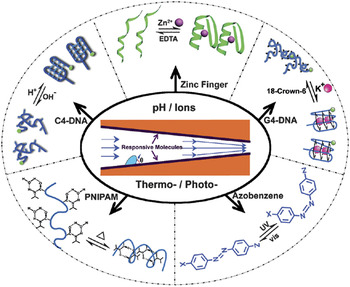
The bioinspired strategy of fabricating 2D surfaces can be extended to build 1D smart nanochannels. By tuning the inner surface wettability of nanochannels, controllable ion movement can be achieved. For example, a responsive surface that can switch among stable superhydrophilic, metastable superhydrophobic, and stable superhydrophobic states based on pH responsive C4-DNA molecules has been developed.Reference Wang, Liu, Liu, Ma, Fang and Jiang53 When this type of smart surface is extended to the nanoscale, a synthetic nanopore-DNA system can be realized by immobilizing the C4-DNA onto the inner wall of the nanopore by a two-step chemical reaction. The single solid-state conical nanopores can be reversibly gated by folding and unfolding of the C4-DNA molecules immobilized inside the nanopores. High (on-state) and low (off-state) conductance states were found within this nanopore-DNA system corresponding to the single-stranded and i-motif structures of the attached DNA motors, which are DNA that can switch their structures under external stimuli.Reference Xia, Guo, Mao, Hou, Xue, Xia, Wang, Song, Ji, Qi, Wang and Jiang54 Furthermore, a potassium-responsive nanochannel system has been realized, where G4-DNA molecules, which have a different molecular structure from C4-DNA, were immobilized into a synthetic nanochannel and underwent a potassium-responsive conformational change so as to obtain a nonlinear response to potassium ions.Reference Hou, Guo, Xia, Nie, Dong, Tian, Wen, Wang, Cao, Yang, Xue, Song, Wang, Liu and Jiang55 These gating properties closely mimic the gating mechanism of biological ion channels; one such example found in nature is acid-sensing ion channels.Reference Jasti, Furukawa, Gonzales and Gouaus56 Since there are so many examples of smart interfacial materials that are suitable candidates for designing nanochannel systems, various bioinspired smart gating nanochannels are built by using responsive molecules, such as light, pH, ion and thermal, and protein, instead of DNA molecules (Figure 6).Reference Wen, Hou, Tian, Nie, Song, Zhai and Jiang51
Scheme of smart gating of micro/nanochannels based on control of surface wettability.Reference Wen, Hou, Tian, Nie, Song, Zhai and Jiang51 Center: Smart nanochannel systems. Blue arrows represent the direction of fluid travel from the base side of the conical channel to the nanochannel, the tip side of the conical channel. The two purple lines in the modified channel wall represent the functional molecules, which results in the changes of the surface properties, such as contact angle in the microchannel and the smart gating in the nanochannel. Surroundings: Typical responsive molecules that can switch their conformations, molecular dipole, charge distribution, and atomic arrangement due to external stimuli, such as light, temperature, and ionic content. Note: PNIPAM, poly(N-isopropylacryamide); EDTA, ethylenediaminetetraacetic acid; θ, liquid contact angle on the solid surface.

Conclusion
In this review, we have mainly discussed the bioinspired design of smart interfacial materials with special wettability. Biological systems utilize multiscale effects of molecular structures, nanostructures, and microstructures to create functional surfaces with special wettability. Taking inspiration from nature, the design of material systems should not be confined to engineer bulk materials or synthesize new molecules, but also should be applied to control the structures of materials over multiple scales. That is, materials can exhibit unusual macroscopic properties when the structures extend from the molecule to molecular clusters to micro- and nanostructures. Although significant progress has been achieved in the special wettability field, there are still many challenges. Future perspectives include new fundamental theories of explaining the special wettability phenomena, biocompatible superhydrophobic surfaces and exploring their applications in biomedical fields, ultrafast responsive surfaces, and multifunctional surfaces. For practical applications, low cost and facile strategies are necessary. Enhancing the mechanical stability, robustness, durability, and self-healing ability of superhydrophobic and superoleophobic surfaces is also important.
Acknowledgments
This work was supported by the National Research Fund for Fundamental Key Projects (2012CB933800, 2011CB935700, 2012CB933200), National Natural Science Foundation (21175140, 20974113, 21121001), and the Key Research Program of the Chinese Academy of Sciences (KJZD-EW-M01). The Chinese Academy of Sciences is gratefully acknowledged.