Introduction
Older adults are disproportionately affected by disasters. While older adults comprised only 15% of the population of New Orleans (USA) prior to Hurricane Katrina, 71% of those who died because of the hurricane were elderly.Reference Aldrich and Benson 1 Weather emergencies also adversely affect seniors. Nearly 70% of the deaths related to the 1995 heat wave in Chicago (Illinois USA) were among those 65 and older. 2 The Center for Disease Control and Prevention (Atlanta, Georgia USA) underscores that individuals with chronic diseases, conditions, or disabilities have unique needs. 3 This special population includes the frail elderly, who are especially vulnerable during and after disasters. While many older adults do not consider themselves to be vulnerable, those with multiple chronic conditions, disabilities, dementia, cognitive impairments, or who live in a long-term care facility (ie, nursing home) are among the highest risk.Reference Rothman and Brown 4 The Institute of Medicine (Washington DC, USA) recognizes the need for health professionals to participate in emergency planning and to develop the skills necessary to care for vulnerable populations in disasters.Reference Cooper 5
Disasters come in many forms and range from severe weather events and earthquakes, to attacks on civilian populations, technological catastrophes, and pandemics. Severe weather events include extremes of heat or cold, snow, drought, tornadoes, hurricanes, floods, landslides, and catastrophic fires. Awareness of the issues surrounding care of vulnerable populations in disasters has been increasing since the significant impact and duration of the emergency caused by Hurricane Katrina in 2005. Gaps in the literature surrounding research, policy, and best practices for the elderly in disasters have been noted.Reference Chan and Burkle 6
Purpose
The purpose of this systematic, integrative review of the literature was to describe the system-wide knowledge and skills that multi-disciplinary health care providers need to provide appropriate care for the elderly during domestic-humanitarian and disaster-relief efforts. An integrative review of the literature identifies, analyzes, and synthesizes information from different types of studies to describe what is known about a topic. These types of reviews are summaries and analysis of previous studies and incorporate not only experimental studies, but also nonexperimental research and theoretical literature. Integrative reviews are systematic and require rigor and replicability.Reference Bibb and Wanzer 7 The identifying, organizing, and synthesizing strategy details the steps and tools required to accomplish this systematic, integrative review.Reference Bibb and Wanzer 7
Methods
This project was approved as an exempt study from Institutional Review Board review at the Uniformed Services University of the Health Sciences (USUHS; Bethesda, Maryland USA) under protocol number HU-GSN-61-2551-01.
To ensure consistency in this review, “the elderly” are defined as individuals aged 65 and over, “frail elderly” are those 65 and over with chronic comorbidities, disabilities, or those who require assistance from others for some part of their care. “Knowledge” and “skills” include information from any level of the multi-tiered, interconnected, disaster system of care that multi-disciplinary health care providers might require while providing the complex care of the elderly.
Data Collection/Literature Search
In order to provide a current picture of the skills and knowledge that comprise the state of elderly-focused disaster care, the scope of literature reviewed ranged from 2006 to the present. The 2006 date was selected to capture publications covering Hurricane Katrina, when the impact of natural disasters on the elderly rose to the level of national discourse. A survey of earlier literature did not reveal unique resources prior to 2006 that would necessitate an expanded search timeframe.
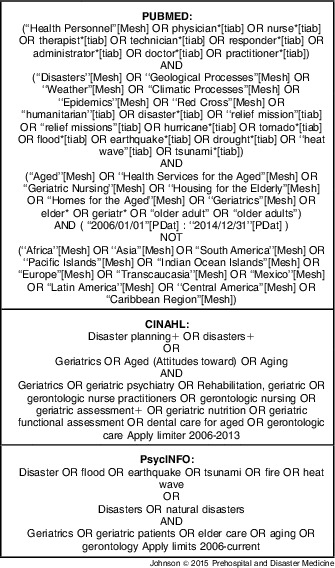
The authors developed a search algorithm in consultation with a research librarian at the USUHS. Searches of PubMed (National Center for Biotechnology Information; Bethesda, Maryland USA) and Cumulative Index of Nursing and Allied Health Literature (CINAHL; EBSCO, Ipswich, Massachusetts USA) databases were conducted on two separate occasions within a 24-hour period. The PsycINFO (American Psychological Association; Washington DC, USA) database was searched on two separate occasions within a 4-day period. All databases were searched twice within a finite period of time to ensure replicability and to protect against longitudinal bias. The searches yielded the same number of citations. Table 1 outlines the search terms, limiters, and strategy used to search the databases.
Search Terms and Strategy

Inclusion Criteria
The review included all primary and secondary articles, summaries, and case reports related to skills, knowledge, and medical conditions encountered relating specifically to the care of the elderly in domestic disasters and humanitarian relief/recovery. Clinical experiences, clinical needs, public health, health care organization, and disaster/humanitarian systems operations were incorporated.
Exclusion Criteria
Articles that dated earlier than the 2006 time frame, that lacked specifics or empirical evidence, that were purely editorial or theoretical, and articles pertaining exclusively to medical services rendered solely by foreign countries or that were not published in English were excepted.
Search Strategy and Final Population
Searches of the databases yielded 311 articles from PubMed, 64 from CINAHL, and 150 from PsycINFO. After initial database review of titles and abstracts, 99, 31, and 26 articles (respectively) met the criteria for further review. Following review of the titles, abstracts, and full text of the articles, 46 met inclusion criteria.
Data Evaluation
After reviewing each of the articles, pertinent information and relevant data regarding clinical skills and knowledge were highlighted and summarized. Each article was reviewed by at least two of the authors. The articles were stratified based on the hierarchy of evidence recommended by Fineout-Overholt and colleagues.Reference Fineout-Overholt, Melnyk, Stillwell and Williamson 8 This hierarchy ranks the type of evidence from I to VII: (I) is considered the strongest evidence from systematic reviews or meta-analyses; (II) randomized controlled trials; (III) nonrandomized controlled trials; (IV) case control or cohort studies; (V) systematic reviews of qualitative or descriptive studies; (VI) qualitative or descriptive studies; and (VII) is considered the lowest level of evidence, opinion or consensus.Reference Fineout-Overholt, Melnyk, Stillwell and Williamson 8
Analysis and Interpretation
Following retrieval and evaluation of the articles, the data were synthesized and placed in a spreadsheet with the article citation on the vertical axis and the pertinent data on the horizontal axis. As each new topic arose, it was added to the table and tallied in the appropriate column. Initially, the data were categorized under seven major groupings for ease of analysis: general information and physical well-being, mental health, supplies and resources, disease process and treatment skills, dwellings, shelter issues, and communication and disaster planning.
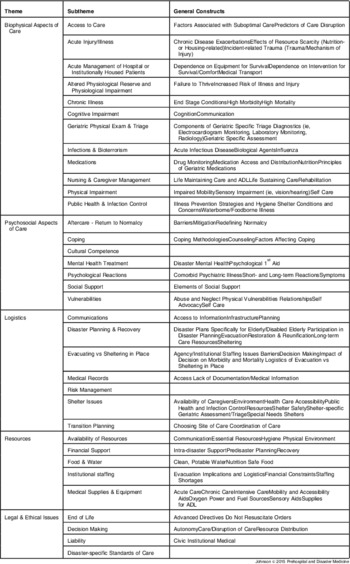
After all of the data were categorized, the tables were further analyzed for themes, subthemes, and general constructs. As operationalized in this analysis, general constructs were recurrent, relevant, and specific examples cited within an article. Next, similar constructs were grouped into subthemes and the subthemes were organized into over-arching themes. Overlap was seen among themes. Various articles referred to issues related to sheltering; for example, sheltering in long-term care facilities versus care provided in shelters set aside for disaster. When overlap and categorization issues arose, the authors’ judgment determined the best fit for each concept. All data analysis and interpretation were achieved through team consensus.
Results
This integrative review included a final cohort of 46 articles. The articles spanned the hierarchy of evidence from V through VII. One article was level V,Reference Shenk, Ramos, Kalaw and Tufan 9 systematic review of qualitative and descriptive studies; 30 were level VI,Reference Dosa, Grossman, Wetle and Mor 10 - Reference Petinaux and Yadav 40 qualitative or descriptive studies; and 15 were category VII,Reference Rothman and Brown 4 , Reference Lamb and O'Brien 41 - Reference Kaldy 54 evidence from the opinion of authorities and/or reports of expert committees. Following further analysis and interpretation by the team, five major themes emerged: biophysical aspects of care, psychosocial aspects of care, logistics, resources, and legal/ethical issues. Each theme had four to 12 subthemes built upon the general constructs. The findings below are a summation from the analysis.
Biophysical Aspects of Care
By far, the most predominant theme of the literature was biophysical aspects of care, and it was found in 42 of the 46 articles.Footnote * This theme contained 12 subthemes, with 34 general constructs (Table 2). The aspects of care spanned a continuum from acute care through chronic disease management. This theme addressed a variety of health care delivery systems, ranging from inpatient or institutional care to informal or community-based care, including public health management.Footnote † Dehydration, acute illness/injury, exacerbations of chronic disease including diabetes, heart disease, and the care/dialysis of elders with end-stage renal disease (ESRD) were the most frequently-cited concepts.Footnote ‡ Cognitive impairment, defined as the inability to follow directions and communicate needs or identity, along with physical and sensory impairments, such as reduced mobility, visual, and hearing deficits, were cited as obstacles to care.Footnote § Geriatric medication principles, need for caregivers, assistance with activities of daily living (ADL), fall risk, assessment, and triage of the elderly were also cited frequently.Footnote **
Themes, Subthemes, and General Constructs

Abbreviation: ADL, activities of daily living.
Psychosocial Aspects of Care
While biophysical aspects of care dealt solely with health care for the body, psychosocial aspects of care addressed care of the mental, emotional, and social essentials unique to this population (Table 2).Footnote †† The seven subthemes and 17 general constructs spoke to mental health needs, vulnerabilities, and psychosocial characteristics of the elderly before, during, and after the event. Coping was one of the major concepts described.Footnote ‡ Adequacy of support systems, self-efficacy, and maintaining social connections were important for overall ability to cope.Reference Shenk, Ramos, Kalaw and Tufan 9 , Reference Brown, Cherry and Marks 12 , Reference Roberto, Henderson, Kamo and McCann 16 , Reference Cherry, Brown and Marks 19 , Reference Henderson, Roberto and Kamo 21 , Reference Powell 53 Religion and charitable works (volunteering) were two common types of coping.Reference Shenk, Ramos, Kalaw and Tufan 9 , Reference Brown, Cherry and Marks 12 , Reference Roberto, Henderson, Kamo and McCann 16 , Reference Cherry, Brown and Marks 19 , Reference Henderson, Roberto and Kamo 21 , Reference Kamo, Henderson and Roberto 39 Stress, posttraumatic stress, depression (sadness), and anxiety were the most frequently-cited psychological responses to disaster.Footnote §§
Logistics
Logistics had similar representation in the literature as psychosocial aspects of care with 33 citations (Table 2).Footnote *** The seven subthemes and 27 general constructs outlined decision-making strategies along with execution and procedures for communication and coordination. Lack of adequate medical records and current medication lists were identified as being significant barriers to care.Reference Rothman and Brown 4 , Reference Christensen, Brown and Hyer 20 , Reference Laditka, Laditka, Xirasagar, Cornman, Davis and Richter 30 , Reference Lamb and O'Brien 41 - Reference Polivka-West and Berman 45 , Reference Adelman and Legg 48 , Reference Kaldy 54 Community, hospital, and long-term care facilities recognized that policies and guidance concerning evacuating versus sheltering in place were lacking.Footnote †††
In some instances, facilities were forced to evacuate with little notice and reported higher morbidity and mortality than if they had sheltered in place.Reference Dosa, Grossman, Wetle and Mor 10 , Reference Castro, Persson, Bergstrom and Cron 14 , Reference Dosa, Hyer and Thomas 15 , Reference Blanchard and Dosa 18 , Reference Christensen, Brown and Hyer 20 , Reference Dosa, Hyer, Brown, Artenstein, Polivka-West and Mor 46 Communication and lack of access to information, issues surrounding development and implementation of disaster shelters, and participation of the elderly in disaster planning were among the most often mentioned logistical issues.Footnote ‡‡‡
Resources
Whereas logistics addressed plans and how to execute them, resources spoke to what was needed on individual, community, organizational, and systems levels (Table 2).Footnote §§§ This category encompassed five subthemes and 21 general constructs. Among the topics in this category were: sensory aids, such as eyeglasses and hearing aids, financial resources with needs spanning predisaster planning through recovery, medical supplies to include availability of power sources and supplemental oxygen, ensuring adequate staffing while working within evacuation constraints, and accessibility of safe food and water.Footnote ****
Legal and Ethical
Finally, legal and ethical issues were interspersed among the sample of articles.Footnote †††† The four subthemes and eight general constructs ranged from institutional to individual autonomy and touched on disaster-specific standards of care and resource distribution (Table 2). Some of the specific examples from this category were implications of “do not resuscitate” (DNR) orders and other advance directives, allocation of care and triage in the elderly, and liability at all levels and places of care.Reference Christensen, Brown and Hyer 20 , Reference Somes and Stephens Donatelli 42 , Reference Donatelli and Somes 43 , Reference Polivka-West and Berman 45 , 50 , Reference Powell 53
Discussion
While the authors sought to understand the issues surrounding care of the elderly in public health emergencies, the breadth, depth, and scope of topics discovered in this integrative review were considerable. There was one cross-cutting observation relative to age versus functional capacity. The population definition of the elderly is historically based on age and not function or impairment. Additionally, impairments occur on a continuum. While seniors have been identified as vulnerable based on a population prevalence of impairments and frailty, care considerations should be based on functional capacity, capability, or impairments rather than age. For example, a child with hearing impairment may have similar needs to a frail adult with hearing deficits. Similarly, a 35-year-old with multiple sclerosis and an older adult with functional limitations may both be wheelchair-bound and require mobility assistance. Plans and policies typically focus on age-based needs. Going forward, more emphasis should be placed on functional needs as opposed to chronology.
When moving from global observations to specific themes and subthemes, meaning was derived pragmatically and from common context. With that understanding, there was significant overlap among constructs, with multiple, potential-thematic assignments. For example, staffing issues crossed multiple themes and subthemes. Staffing during disaster response is a legal and ethical issue with biophysical, logistical, and resource implications. Staff members of long-term care facilities are more likely to report to work and remain at work if their family members and pets are permitted to shelter with them. This allows for sheltering in place, transportation, and continuity of care. Overlaps of this nature were managed through the practical application of logic as it might apply to real-life situations.
Biophysical Aspects of Care
As mentioned previously, biophysical aspects of care was the broadest category with many major revelations and reinforcements regarding the care of the elderly across systems and the continuum of care. Emergency planning for biophysical aspects of care incorporates three factors: disease management, staffing resources, and fiscal resources. An example that comprises all three of these aspects is ESRD care requiring dialysis. This low-frequency, high-impact, resource-intensive disease process was mentioned with unexpected frequency. This type of condition requires trained caregivers who can support care delivery across locations, including shelters, and the fiscal resources to do so.Footnote ‡‡‡‡
In addition to chronic disease management, the literature identified a need for policies and education regarding geriatric-specific triage, medication principles, and physiology in a resource constrained environment.Footnote §§§§ For example, in routine care of hypertension, not having adequate medications may be urgent, but not critical. In austere environs, limited medications and interruption of the supply chain may have life-threatening consequences. Contingency plans must be in place to mitigate and prevent these circumstances. Emergency responders must also have an understanding of the physiological aspects of aging to offset potential complications of emergent care; for example, limiting use of back boards and neck braces to reduce debility and skin breakdown in elders with fragile skin and musculoskeletal systems.Reference Rothman and Brown 4 , Reference Somes and Stephens Donatelli 42
Understanding disaster-specific health conditions and chronic disease associated with aging are vital for public health planning and preparedness to minimize morbidity and mortality. They are also required for improving shelter conditions and planning for food and water preparation.Reference Rebmann, Carrico and English 32 , Reference Jenkins, McCarthy, Kelen, Sauer and Kirsch 36 , Reference Polivka-West and Berman 45 Responders need to appreciate the vast range of differential diagnoses possible in a public health emergency, which range from trauma to influenza to tularemia.Footnote *****
Using home health aides/nurses as part of the emergency response team to help identify and plan for community-dwelling elders is an interesting concept. For example, home health aides have been used to triage at-risk individuals who may not need significant assistance day-to-day, but who need help when there is infrastructure disruption, such as loss of power or in implementation of evacuation plans.Reference Laditka, Laditka, Cornman, Davis and Chandlee 28 Caregivers and home health aides can maintain/sustain life support and assistance with ADLs in a variety of settings, but not without risk.Footnote ††††† For instance, assisted bathing and toileting in a shelter that is not designed for frail elderly can be a safety and health concern for both the elder and the caregiver.Reference Rothman and Brown 4 , Reference Christensen, Brown and Hyer 20 , Reference Henderson, Roberto and Kamo 21 , Reference Hogan, Holmes and Rapacki 34 , Reference Lamb and O'Brien 41 , Reference Claver, Dobalian, Fickel, Ricci and Mallers 44
All of this comes at a cost, and who pays for the services, supplies, personnel, and resources is not inconsequential. Duplicate prescriptions may be required to replace items lost or misplaced during the disaster. Overtime costs for trained caregivers and staff can easily overwhelm agencies and budgets. The ability to bill insurance for care provided during an emergency must be considered in fiscal planning for emergency response.Reference Dosa, Grossman, Wetle and Mor 10 , Reference Castro, Persson, Bergstrom and Cron 14 , Reference Laditka, Laditka, Xirasagar, Cornman, Davis and Richter 30 , Reference Kaldy 54
Psychosocial Aspects of Care
Unlike the breadth of biophysical care, psychosocial care was much more focused on emotional resilience and coping. Stress reactions and vulnerability impact seniors, but elders may not consider themselves to be vulnerable. In addition, when surveyed, elders demonstrated superior coping mechanisms compared to their younger counterparts.Reference Shenk, Ramos, Kalaw and Tufan 9 , Reference Cherry, Brown and Marks 19 , Reference Pietrzak, Van Ness, Fried, Galea and Norris 24 , Reference Laditka, Laditka, Cornman, Davis and Richter 29 , Reference Kamo, Henderson and Roberto 39 However, it is still imperative to understand psychological responses and physical and financial vulnerabilities that impact disaster recovery in this population. Elders physically dependent on someone else for their total care are especially vulnerable to fraud, abuse, and neglect during these times. The responsibility to mitigate vulnerabilities does not just fall on the trained caregiver, but to family, friends, and neighbors. One suggestion for minimizing risk is simply getting to know and watching out for neighbors. 57
Emergency response planners should be aware of cultural differences and expectations and include elders in the planning process, as this population knows what resources they want during response and recovery. Among recommendations by the elderly is to reconstitute community centers and churches early as they improve social connectedness and offer opportunities for self-efficacy, coping through volunteerism, and the ability to contribute to the rebuilding of the community.Footnote ‡‡‡‡‡
Logistics
Preparation and response come prior to community rebuilding. Logistical considerations and preparations are critical for a timely and sufficient disaster response. Lack of planning or mock response drills were the primary underpinnings of the logistics theme. Planners may risk worsening the disaster through poor planning and preparedness. This was evident by delayed disaster response and prolonged recovery in many instances. Moreover, supply chain forecasting and delivery methods during emergencies should be part of disaster planning.
In addition to supplies, geographic logistics need to be considered, specifically whether to shelter in place or evacuate. Guidance on timing, decision making, liability, and impact on morbidity and mortality associated with evacuating versus sheltering in place was found to be deficient.Footnote §§§§§ Transporting elders from point A to point B safely and efficiently with appropriate modes of transportation has been problematic.Footnote ****** During lengthy transports, elders request access to evacuation route resources to include food, shelter, and bathroom facilities.Reference Langan and Palmer 31 In addition, shelters must provide functionally-appropriate bathing and toileting facilities, sleeping arrangements, elevators, air conditioning, and heat. Equally as important is the need to plan to disseminate information about supplies, evacuation, and sheltering to a population that is not always technologically savvy.
Resources
The sheer magnitude of financial, physical, and human capital resources needed to properly execute disaster response and recovery was daunting. Employers had little recourse or resources to entice staff to report to work or to evacuate with patients when the staff felt the need to care for their own families.Reference Dosa, Grossman, Wetle and Mor 10 In addition, the competition for nurses and ancillary staff during disaster response and recovery caused many to leave their predisaster position for better pay and benefits. This left facilities without the financial or human capital means to hire or train new staff.
Medical and nonmedical supplies and medications were among the many physical resources required. Several factors influenced availability during disaster: short notice, lack of planning, and human oversight. This begs the question of where missing supplies and medications will come from. Obtainability of a pair of dentures or hearing aids, for example, during disaster response and recovery is significant. Disinfecting items potentially contaminated during the disaster, such as ice machines, water, and cooking facilities, can mitigate public health consequences. Cooking and hygiene amenities, including laundry, require fuel and power. While basic fuel and supplies may be required as part of a disaster plan, how much and how it will be resupplied must also be considered.
Legal and Ethical
Legal and ethical issues spanned every time, location, and facet of disaster care for the elderly. The need for disaster-specific standards of care for this population was evident and would clarify matters relating to interruptions and disruptions of care during disasters, as well as who should or shouldn't receive care in a resource-constrained environment. Implications of “DNR/do not intubate” orders during disasters would also benefit from well-defined standards. Health care providers and caregivers have used frailty and DNR orders as rationale to euthanize or murder the vulnerable, frail elderly.Reference Charatan 49 During disaster recovery, vulnerable and desperate elders fell victim to unscrupulous contractors, fakes, and frauds who promised to help seniors with reconstruction, insurance, or financial assistance.Reference Langan and Palmer 31 Liability was a concern for long-term care facilities and shelters during and after evacuation.Reference Blanchard and Dosa 18 , Reference Claver, Dobalian, Fickel, Ricci and Mallers 44 , Reference Dosa, Hyer, Brown, Artenstein, Polivka-West and Mor 46 Predisaster clarification of liability matters, in addition to disaster-specific standards of care, were lacking and are needed going forward.
Limitations
A limitation of this review is the lack of articles with higher levels of evidence. Understandably, randomized controlled trials are difficult to perform in disasters. The authors relied on the descriptive evidence currently available. PubMed, PsycINFO, and CINAHL were selected as the most-relevant databases and were used to conduct the literature search. Other databases may have led to additional resources. Similarly, excluding non-English journals and articles that address care exclusively provided by other countries is a limitation. Errors in search terms or strategies may have led to primary sources being missed or dismissed, and the review and analysis strategy could have led to data being excluded or incorrectly coded. Absence of details or differences in reporting of data could have caused the authors to make assumptions and code data incorrectly. Finally, lack of data stratification in the manuscripts might have resulted in nongeriatric information being interpreted as geriatric data. However, given the paucity of elderly-specific guidelines and systematic reviews, this project fills a critical gap in the understanding of best practices for this population.
Recommendations
While nationally there have been efforts to improve disaster planning, recent disasters have demonstrated there is still room for significant growth. The data collected in this review suggest that tenets of elderly-focused disaster planning should be developed in order to set the framework for how communities and organizations move forward in disaster preparation. Functional capacity, capabilities, or impairments, rather than age, should be considered in disaster preparation as impairment occurs across a continuum and cannot be defined solely by age. However, when considering these populations, tenets of disaster planning should address biophysical aspects of care, psychosocial aspects of care, logistical considerations, the availability and requirement of resources, and legal and ethical implications. Decisions will need to be made regarding what is considered adequate preparation and training versus what is an over utilization of resources. It may be a fine line between what is satisfactory preparation and what is insufficient given the likelihood of an event occurring in any given community or state.
Thought must also be given to how resources can be combined or shared in an effort to ensure widest possible dissemination and utilization of information. The literature conveys that the elderly have skills and population-specific knowledge that would be beneficial to the disaster planning process. Initiatives to incorporate their input and point of view need to be considered. In addition, evacuation planning and shelter forecasting and design should be performed by personnel with appropriate training and credentials to understand the specific needs of this population. The evacuation or shelter needs of a 78-year-old person with ESRD and significant debility are vastly different than that of a healthy 45-year-old person with no impairments. These differences must be considered in evacuation and shelter planning in order for the needs of a vast array of individuals to be met.
Lack of staffing availability and human resources were emphasized in the literature as a barrier to adequate care during times of disaster or emergency. As highlighted previously, this was a multifaceted problem. Potential solutions could include policies or regulations that limit competition between employers for staff services during times of disaster in order to reduce unfair competition. In addition, consideration should be given to eliminating barriers to practice for health professionals and volunteers during times of disaster so that those willing to serve are not limited by state jurisdictions or licensing requirements.
From a legal and ethical standpoint, clarification is needed as to whether or not standards of care are different during times of disaster. This integrative review suggests that the answer is yes. As such, consideration needs to be given as to how best delineate what it means to have disaster-specific standards of care, including how and by whom these are determined. Additionally, elucidation needs to be sought regarding liability during all disaster phases.
Conclusions
This review provides a critical step in addressing preparation for, and delivery of, care to the elderly during a disaster. A multifaceted approach to planning and conveyance should include the biophysical and psychosocial aspects of care, ethical and legal considerations, along with logistics and resources. A foundational tenet must be that functionality and impairment are as critical a consideration as age. Finally, given the scarcity of quality research regarding the system-wide knowledge and skills that multi-disciplinary health care providers need to provide appropriate care for the elderly during disaster-relief efforts, research is needed regarding what systems may or may not work in promoting adequate disaster planning, response, and recovery for this population.
Disclaimer
The views expressed are those of the authors and do not reflect the official policy or position of the USUHS, the Department of the Defense (Washington DC, USA), or the US government.