1. Introduction
The development of automated robots requires the development of related fields such as motion planning and automation control. Therefore, the design of automated mobile robots has a wide range of dimensions [Reference Roth and Batavia1]. In each of these areas, many researchers are researching and working [Reference Dalla and Pathak2, Reference Dalla and Pathak3]. The control of autonomous underwater vehicles (AUV) is one of the active debates in this field.
In past decades, due to the expansion of human activities in the seas, the problems and costs of research in water have increased the use of underwater vehicles. Meanwhile, the AUV has been considered for greater maneuverability than other underwater vehicles [Reference Tabataba’i-Nasab, Moosavian and Khalaji4]. Modeling and control of these vehicles are discussed in most research. One of the challenging issues in control is fault and malfunctioning in actuators. Thrusters can cause undesired AUV operation and their inability to continue. Hence, the design of a tolerant controller is an effective way against defects that can be used to provide sustainability and the ability of the AUV to continue to work.
Fault-tolerant systems are systems in which the design of the controller is carried out in such a way that the stability of the system is preserved when there is a defect, using the redundancy in the system and its efficiency is as close as possible to its performance before the defect occurs.
A most common method [Reference Corradini, Monteriu and Orlando5] is the calculation of the residual errors between the observers-presented computed AUV states and the sensors-given real AUV states, and then detecting, isolating, and identifying thruster faults according to the residual error. This type of diagnostic procedure, however, requires threshold values, but there is difficulty in their determination theoretically. A further usual method [Reference Chu and Zhang6] is the direct estimation of the thruster fault impact by reconstruction of the fault, which is studied here [Reference Liu, Zhang and Yao7]. Some articles are used to accurately estimate errors from different methods, such as fuzzy method [Reference Chen, Li, Xiao, Li and Zhou8], robust control [Reference Du, Yang, Zhao and Tan9], sliding mode theory [Reference Hao, Zhang, Yue and Li10], Adaptive Control [Reference Guo and Chen11–Reference Li, You, Wang and Guan15] and neural network [Reference Liu and Jiang16].
In fault reconstruction investigation, a summary of the major processes can include: initially, a sliding mode observer is made with finite-time convergence for estimating the system states, after which the calculated value of the fault impact is obtained by the notion of “equivalent output injection” [Reference Rahme and Meskin17]. In investigations by Alwi et al. [Reference Alwi, Edwards and Marcos18] and Yan and Edwards [Reference Yan and Edwards19], the problem of reconstructing the fault was examined for a linear parameter varying system or a nonlinear system with bounded uncertainty in a fixed feedback controller, in which the construction of a sliding mode observer was according to the signature term and proportion term of the calculated output error. Moreover, reconstructing the fault was examined by combining a sliding mode observer and a high-gain observer for nonlinear systems [Reference Veluvolu, Defoort and Soh20], in which, fixing the control input, the fault impact was not dependent on the control input. For the improvement of the fault reconstruction accuracy, the system states were estimated by applying other observers with quicker convergence speed. The development of a thruster fault reconstruction technique by Chu and Zhang [Reference Chu and Zhang6] was based on the terminal sliding mode observer structure [Reference Tan, Yu and Man21], and the unidentified action in the AUV model in the entire procedure of reconstructing the fault was estimated using the Radial Basis Function (RBF) neural network. The RBF neural network contains an input layer, a hidden layer (containing Gaussian transfer functions), and an output layer. Furthermore, Moreno and Osorio used a super-twisting algorithm to present a second-order sliding mode observer [Reference Moreno and Osorio22]. Shrivastava and Dalla [Reference Shrivastava and Dalla23] presented failure control approaches for space robots.
Due to the widespread nominal controller use of the AUV, the use of the fault-tolerant control system is essential to achieve reliability, safety, sustainability, and optimal performance.
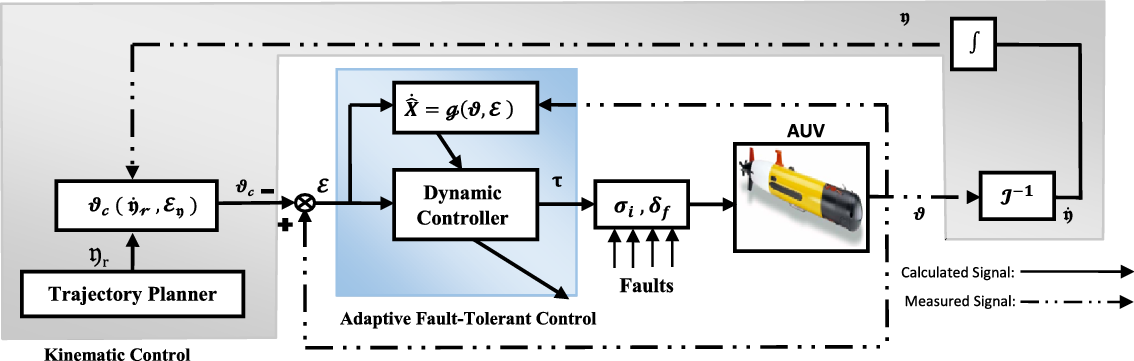
Therefore, the purpose of this study is to employ an adaptive controller to design a fault-tolerant control against the AUV actuator faults. The proposed control scheme in this paper is based on the separation of kinematic and dynamic equations. The kinematic control law is extracted using kinematic equations. Then, using the adaptive controller theory and dynamic equations of the AUV, the design of the dynamic control laws is discussed. The proposed dynamic controller structure is based on feedback linearizing and a matching mechanism to compensate for the effect of the fault. The accuracy of the method’s performance with simulations has been shown. The main achievements of this paper are:
-
1. A nonlinear kinematic controller is designed for the AUV to stabilize system tracking errors;
-
2. An adaptive controller is presented to control the AUV in the presence of actuator faults and external disturbances at the dynamics level;
-
3. Using the Lyapunov direct method, the stability of the suggested controller is proven;
-
4. Comparing the performance of adaptive fault-tolerant dynamic controller with feedback linearizing dynamic controller, adaptive dynamic controller, and sliding mode dynamic controller in the presence of actuator faults.
The paper is organized into the following sections. Following the Introduction in Section 1, the second part deals with the kinematic model and the kinematic controller in Section 2. In Section 3, the healthy dynamic model of the AUV is discussed. The modeling of the actuator fault and the design of the adaptive fault-tolerant controller in the presence of a faulty dynamic model is proposed in Section 4. The results of the simulation of the algorithm AFTDC and other controllers are shown in Section 5. Finally, the conclusion is drawn.
2. Kinematic controller design
In this section, first, a kinematic model is investigated. Then kinematic control rules are designed according to kinematic equations.
2.1. Kinematic model
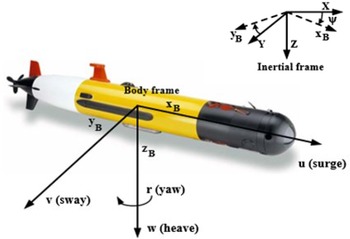
In this study, the AUV’s movement has been considered in four directions: surge (motion along longitude x-direction), heave (motion along depth z-direction), sway (motion along transverse y-direction), and yaw (rotation about the vertical z-direction).
Remark 1. In this paper, the AUV is considered with metacentric returning forces to stabilize roll and pitch angles. Therefore, pitch (rotation in the y-direction) and the roll (rotation in the x-direction) are negligible [Reference Karras, Loizou and Kyriakopoulos24].
Thus, the kinematic model of AUV can be written as
 \begin{equation}\dot{\mathfrak{h}}=\mathcal{J}(\mathfrak{y})\vartheta\end{equation}
where
 $\mathfrak{y}=\left[x\, y\, z \,\psi \right]^{T}$
denotes the three position coordinates and the yaw orientation of the AUV in the inertial frame, respectively,
 $\vartheta =\left[u\, v \,w\, r \right] ^{ T}$
denotes the corresponding velocity of the AUV in the body frame, and
 $\mathcal{J}(\mathfrak{y})$
is the transformation matrix between the body and the inertial frame.
 \begin{equation}\mathcal{J}(\mathfrak{y})=\left[\begin{array}{c@{\quad}c@{\quad}c@{\quad}c} \cos \psi & -\sin \psi&0&0 \\ \\[-8pt] \sin \psi & \cos \psi& 0&0 \\ \\[-8pt] 0 & 0 &1&0 \\ \\[-8pt] 0 & 0 &0&1 \end{array}\right]\end{equation}
2.2. Kinematic controller
One of the goals of automatic robot control is tracking the route. In such cases, we expect the AUV to reach a desired path in the Cartesian space starting from a specified initial condition, and to follow it with a specific timetable. Therefore, the design of the control rules should be such that the tracking error converges to zero. Thus, controller design is partitioned into kinetics and kinematics parts. The controller is designed such that if the position and velocity errors are stabilized, the robot would track the reference trajectory.
In this section, the position errors are controlled using the kinematics equations. In the following sections, using appropriate kinetics control laws, the convergence of velocity errors towards zero is studied. Position and velocity tracking errors are defined in (3) and (4).
 \begin{equation}\mathcal{E}_{\mathfrak{y}}=\mathfrak{y}_{r}-\mathfrak{y}\end{equation}
 \begin{equation}\mathcal{E}_{\vartheta }=\vartheta _{c}-\vartheta\end{equation}
where
 $\mathfrak{y}_{r}$
is the desired position and
 $\vartheta _{c}$
is the command velocity, which is designed using kinematic control laws.
The purpose of this section is to design the
 $\vartheta _{c}$
so that the position error converges to zero. In this regard, feedback linearizing kinematic control is proposed for the control of the AUV at the kinematic level.
Now,
 $\vartheta _{\textrm{c}}$
(commanded velocities) is defined as follows
 \begin{equation}\vartheta _{{c}}=\mathcal{I}^{-1}(\mathfrak{y})\{\dot{\mathfrak{y}}_{{r}}-k_{\mathfrak{y}}\mathcal{E}_{\mathfrak{y}}\}\end{equation}
where
 $k_{\mathfrak{y}}$
is a diagonal matrix with positive diagonal elements.
Thus, Eq. (4) can be rewritten as follows:
 \begin{equation}\mathcal{E}_{{v}}=\mathcal{I}^{-1}(\mathfrak{y})\left\{\dot{\mathcal{E}}_{\mathfrak{y}}+k_{\mathfrak{y}}\mathcal{E}_{\mathfrak{y}}\right\}\end{equation}
where
 \begin{equation}\dot{\mathcal{E}}_{\mathfrak{y}}=\dot{\mathfrak{y}}_{{r}}-\dot{\mathfrak{y}}\end{equation}
It should be noted that the asymptotic convergence of the velocity errors to the origin is guaranteed based on Eq. (5). Since matrix
 $\mathcal{I}^{-1}(\mathfrak{y})$
is nonsingular, in fact
 $\left| \mathcal{I}^{-1}(\mathfrak{y})\right| =1$
, so the term
 $\dot{\mathcal{E}}_{\mathfrak{y}}+k_{\mathfrak{y}}\mathcal{E}_{\mathfrak{y}}$
converges to the origin as well. Hence, it can be obtained that
 \begin{equation}\dot{\mathcal{E}}_{\mathfrak{y}}=-k_{\mathfrak{y}}\mathcal{E}_{\mathfrak{y}}\end{equation}
Proposition 1. The commanded velocity (5) for the kinematic model (1) converges the tracking errors (3) to zero.
Proof: The candidate Lyapunov function used is selected as in Eq. (9).
 \begin{equation}V_{\eta }=\frac{1}{2}\mathcal{E}_{\mathfrak{y}}^{T}\mathcal{E}_{\mathfrak{y}}\end{equation}
Differentiating the candidate Lyapunov function yields
 \begin{equation}\dot{V}_{\eta }=\mathcal{E}_{\mathfrak{y}}^{T} \dot{\mathcal{E}}_{\mathfrak{y}}\end{equation}
Substitutin (8) into (10), one obtains
 \begin{equation}\dot{V}_{\eta }=-\mathcal{E}_{\mathfrak{y}}^{T} k_{\mathfrak{y}}\mathcal{E}_{\mathfrak{y}}\end{equation}
The time derivative of the chosen Lyapunov candidate function is negative definite, hence with the designed common velocity the tracking errors will converge to zero.
3. AUV dynamic model
The nonlinear dynamic system (Fig. 1) can be expressed as [Reference Moosavian, Khalaji and Tabataba’i-Nasab25]
 \begin{equation}\tau =\mathcal{M}\dot{\vartheta }+\mathcal{C}(\vartheta)\vartheta +\mathcal{D}(\vartheta)\vartheta\end{equation}
where
 $\mathcal{M}$
is the mass inertia matrix,
 $\mathcal{C}(\vartheta)$
corresponds to the Coriolis and centripetal matrix,
 $\mathcal{D}(\vartheta)$
denotes the damping matrix and
 $\tau$
is the controller force input, which are all defined as follow:
 \begin{equation*} \mathcal{M}=\left[\begin{array}{c@{\quad}c@{\quad}c@{\quad}c} m-X_{\dot{u}} & 0 &0&0 \\ \\[-7pt] 0 & m-Y_{\dot{v}}&0 &0 \\ \\[-7pt] 0 & 0 & m-Z_{\dot{w}} &0 \\ \\[-7pt] 0 & 0 & 0& {I_{z}}-N_{\dot{r}} \end{array} \right] \end{equation*}
 \begin{equation*} \mathcal{C}(\vartheta)=\left[\begin{array}{c@{\quad}c@{\quad}c@{\quad}c} 0 & 0 & -\left(m-Y_{\dot{v}}\right)v & 0\\ \\[-7pt] 0 & 0 & \left(m-X_{\dot{u}}\right)u & 0\\ \\[-7pt] -\left(m-Y_{\dot{v}}\right)v & \left(m-X_{\dot{u}}\right)u& 0&0 \\ \\[-7pt] 0 & 0 &0&0 \end{array}\right] \end{equation*}
 \begin{equation*} \mathcal{D}(\vartheta)=-\left[\begin{array}{c@{\quad}c@{\quad}c@{\quad}c} X_{u} & 0 & 0 &0\\ \\[-7pt] 0 & Y_{v} &0&0\\ \\[-7pt] 0 & 0 & Z_{w} & 0\\ \\[-7pt] 0 & 0 &0 & N_{r} \end{array}\right] \end{equation*}
 \begin{equation*} \tau =\left[\begin{array}{c} \text{surge force }\\ \\[-7pt]\text{sway force} \\ \\[-7pt]0\\ \text{heave force} \end{array}\right] \end{equation*}
Where,
 $m$
is AUV’s mass,
 $I_{z}$
is the AUV’s moment of inertia about the z-axis,
 $X_{\dot{u}}, Y_{\dot{v}}, Z_{\dot{w}},$
and
 $N_{\dot{r}}$
are the hydrodynamic augmented mass terms in the surge, the sway, the heave, and the yaw directions, respectively, also
 $X_{u}$
,
 $Y_{v}$
,
 $Z_{w}$
, and
 $N_{r}$
are the linear damping terms. The hydrodynamic terms of higher-order are negligible.
4. Actuator fault model
One of the most common defects that affect the function of the system is reducing the effectiveness of an actuator or failing to complete it [Reference Hamayun, Edwards and Alwi26–Reference Yu and Jiang30].
Reducing the effectiveness of the actuator can be caused by lowering the voltage of the power supply, increasing its resistance, etc. Complete operator failure can also result from mechanical breakdowns, wire cutouts, external barriers, and so on.
The failure in the actuator can be modeled in different ways. One of the most commonly used methods is as follows [Reference Kamel, Yu and Zhang31].
 $f$
is faulty system and the actuator loses its control efficacy.
 \begin{equation}\tau _{i}^{f}(t)=(1-\gamma _{i})\sigma _{i}\tau _{i}(t)+\overline{\unicode{x03B4} }_{fi}\end{equation}
Here
 $i$
= system actuators in x, y, and z directions,
 $\gamma _{i}\in \left\{0,1\right\}$
is an index reflecting whether the actuator loses its effectiveness completely or not,
 $\gamma _{i}=$
0 corresponds to the function of the actuator in a non-fault state and
 $\gamma _{i}=1$
models the complete failure of the stimulus,
 $\sigma _{i}\in \left[-1,1\right]$
is the coefficient that shows the effectiveness of the sensor and
 $\overline{\unicode{x03B4} }_{f}$
is the unknown friction value.
Therefore, the AUV faulty dynamic model is as follows:
 \begin{equation}\tau _{i}^{f}(t)=\left(1-\gamma _{i}\right)\sigma _{i} \mathcal{M}\dot{\vartheta }+\left(1-\gamma _{i}\right)\sigma _{i}\mathcal{C}(\vartheta)\vartheta +\left(1-\gamma _{i}\right)\sigma _{i}\mathcal{D}(\vartheta)\vartheta +\overline{\unicode{x03B4} }_{f}\end{equation}
5. Dynamic controller design
As mentioned in the Introduction, in passive methods, robust controller theory and principles are employed. As they might be used in active methods but each robust controller is not necessarily fault tolerant. Thus, in this section, conventional law controls used in AUV control are designed. Then, the proposed controller when AUV faces actuator failure is presented. The purpose is to design an operator for stabilizing tracking errors about the origin. The control strategy in the design of all controllers is shown in Fig. 2.
Underwater vehicle (REMUS 100).

Adaptive fault-tolerant control scheme.

5.1. Feedback linearizing dynamic control (FLDC)
To represent the first controller of the dynamic section, the FLDC controller is used.
To this end, tracking error is defined as follows
 \begin{equation}\mathcal{E}_{\vartheta }=\vartheta _{c}-\vartheta\end{equation}
In which
 $\vartheta _{c}$
is a kinematic input vector obtained from the kinematic controller design. The control law is obtained as follows.
 \begin{equation}\unicode{x03C4} =\mathcal{M}\dot{\vartheta }_{c}+\mathcal{C}(\vartheta)\vartheta +\mathcal{D}(\vartheta)\vartheta +\mathcal{MK}\mathcal{E}_{\vartheta }\end{equation}
In which
 $\mathcal{K}$
is the system’s gain matrix.
Proposition 2. Control law of Eq. (16) for dynamic system stabilizes tracking error of system velocities about origin asymptotically according to Eq. (4).
Proof: The candidate Lyapunov function used to ensure the stability of the closed-loop system is selected as in Eq. (17).
 \begin{equation}V_{\text{FLDC}}=\frac{1}{2}\mathcal{E}_{\vartheta }^{T}\mathcal{E}_{\vartheta }\end{equation}
The time derivative of the selected Lyapunov function is described in Eq. (18).
 \begin{equation}\dot{V}_{\text{FLDC}}=\mathcal{E}_{\vartheta }^{T}\dot{\mathcal{E}}_{\vartheta }=\mathcal{E}_{\vartheta }^{\textrm{T}}\left(\dot{\vartheta _{c}}-\dot{\vartheta }\right)\end{equation}
Equation (19) is obtained by replacing dynamic equations of Eq. (12) and applying control inputs of Eq. (16).
 \begin{equation}\dot{V}_{\textrm{NDC}}=\mathcal{E}_{\vartheta }^{T}\!\left(\mathcal{M}^{-1}\left\{\tau -\mathcal{C}(\vartheta)\vartheta -\mathcal{D}(\vartheta)\vartheta -\mathcal{MK}\mathcal{E}_{\vartheta }\right\}-\mathcal{M}^{-1}\{\tau -\mathcal{C}(\vartheta)\vartheta -\mathcal{D}(\vartheta)\vartheta \}\right)\end{equation}
Simplifications yield
 \begin{equation}\dot{V}_{\textrm{NDC}}=-\mathcal{E}_{\vartheta }^{T}\mathcal{K}\mathcal{E}_{\vartheta }\end{equation}
Therefore, to realize system stability and convergence of the velocity errors, the derivative of the positive definite Lyapunov function should be negative. Hence, coefficients
 $\mathcal{K}$
should be positive.
5.2. Sliding mode dynamic control (SMDC)
Sliding mode control has features like being robust against structural and parametric uncertainties and its transient response is proper discriminating it from other control methods.
PI filtered tracking error as the sliding surface is defined as in Eq. (21) in which
 $\mathcal{K}$
is the gain matrix of the integrator of the sliding surface.
 \begin{equation}S_{\vartheta }=\mathcal{E}_{\vartheta }+\mathcal{K}\int _{0}^{t}\mathcal{E}_{\vartheta }(\tau)d\tau\end{equation}
Consider SMDC control law as in Eq. (22).
 \begin{equation}\unicode{x03C4} =\mathcal{M}\dot{\vartheta }_{c}+\mathcal{C}(\vartheta)\vartheta +\mathcal{D}(\vartheta)\vartheta +\mathcal{MK}\mathcal{E}_{\vartheta }-\mathcal{K}_{s}S_{\vartheta }-W_{s}\textrm{sgn}\left(S_{\vartheta }\right)\end{equation}
In which
 $\mathcal{K}_{s}, W_{s}$
is the control gain of the system.
Proposition 3. Control law of Eq. (22) for dynamic system stabilizes tracking error of system velocities about origin asymptotically according to Eq. (4).
Proof: Function of Eq. (23) which is positive definite is considered as the Lyapunov function.
 \begin{equation}V_{\text{SMDC}}=\frac{1}{2}S_{\vartheta }^{T}S_{\vartheta }\end{equation}
The time derivative of this function is represented in Eq. (24).
 \begin{equation}\dot{V}_{\text{SMDC}}=S_{\vartheta }^{T}\dot{S}_{\vartheta }=S_{\vartheta }^{\textrm{T}}\left(\dot{\mathcal{E}}_{\vartheta }+\mathcal{K}\mathcal{E}_{\vartheta }\right)\end{equation}
By applying the control input of Eq. (22), and dynamic model Eq. (12) can be simplified as in Eq. (25).
 \begin{equation}\dot{V}_{\text{SMDC}}=S_{\vartheta }^{\textrm{T}}\left(-\mathcal{K}_{s}S_{\vartheta }-W_{s}\textrm{sgn}\left(S_{\vartheta }\right)\right)\end{equation}
Therefore, to realize system stability, the derivative of the positive definite Lyapunov function should be negative. Hence, coefficients
 $\mathcal{K}_{s},W_{s}$
should be positive.
5.3. Adaptive nonlinear dynamic control (ANDC)
In this section, an adaptive robust controller for the AUV is presented. Calculation and proof of ANDC control laws are given in [Reference Tabataba’i-Nasab, Keymasi Khalaji and Moosavian32]. Here, the ANDC control law is described only.
 \begin{equation}\unicode{x03C4} =\mathcal{M}\dot{\vartheta }_{c}+\mathcal{C}(\vartheta)\vartheta +\mathcal{D}(\vartheta)\vartheta +\mathcal{MK}\mathcal{E}_{\vartheta }+\mathcal{M}\textrm{sgn}\left(\hat{\rho }_{i}\left\| \vartheta \right\| ^{i-1}(i\in \mathcal{N}=\left\{1,2,3\right\})\right)\end{equation}
accompanied with the subsequent adaptive rules is used to obtain the unknown parameters
 \begin{equation}\dot{\hat{\rho }}_{1}=\beta _{0}\left\| \mathcal{E}_{\vartheta }\right\|, \dot{\hat{\rho }}_{2}=\beta _{1}\left\| \mathcal{E}_{\vartheta }\right\| \left\| \vartheta \right\| ^{1}, \dot{\hat{\rho }}_{3}=\beta _{2}\left\| \mathcal{E}_{\vartheta }\right\| \left\| \vartheta \right\| ^{2}\end{equation}
Hence, the
 $\hat{\rho }_{i}$
is adaptive rules and
 $\beta \gt 0,$
are controller gains. The
 $\beta$
is selected using the trial and error method.
5.4. Adaptive fault-tolerant dynamic control
Usually, it is very difficult to predict and prevent the occurrence of faults. The fault impact range varies on system performance. The occurrence of a fault sometimes causes a brief decrease in system performance and at times can lead to system failure. Hence, in this section, the AFTDC algorithm is proposed.
To this end, dynamic velocities tracking error is defined as follows
 \begin{equation}\dot{\mathcal{E}}_{\vartheta }=\dot{\vartheta }_{c}-\dot{\vartheta }\end{equation}
Substituting (13) into (12) yields
 \begin{equation}\dot{\vartheta }=\mathcal{M}^{-1}\tau _{i}^{f}+\mathcal{M}^{-1}\unicode{x03B4} _{fi}-\mathcal{M}^{-1}\mathcal{C}(\vartheta)\vartheta -\mathcal{M}^{-1}\mathcal{D}(\vartheta)\vartheta\end{equation}
The time derivative of the system error in (5) becomes
 \begin{equation}\dot{\vartheta }_{c}=\dot{\vartheta }_{c}\left(\mathfrak{y}, \mathfrak{y}_{r},\dot{\mathfrak{y}}_{r},\ddot{\mathfrak{y}}_{r} \right)\end{equation}
Then, substituting (29) and (30) into (28) yields
 \begin{equation}\dot{\mathcal{E}}_{\vartheta }=\dot{\vartheta }_{c}-\mathcal{M}^{-1}\sigma _{i}\tau -\mathcal{M}^{-1}\overline{\unicode{x03B4} }_{fi}+\mathcal{M}^{-1}\mathcal{C}(\vartheta)\vartheta +\mathcal{M}^{-1}\mathcal{D}(\vartheta)\vartheta\end{equation}
An AFTDC method will be designed to maintain acceptable performance even in the presence of the actuator’s fault. The compensable faults in (13) and (14) can be divided into the following three groups.
-
I. No-fault: when the actuator works healthily, namely,
 $\gamma _{i}=0, \sigma _{i}=1, \overline{\unicode{x03B4} }_{fi}=0$
-
II. Faulty: when the actuator loses its control efficacy partially, namely,
$\gamma _{i}=0, \sigma _{i}\in (0,1), \overline{\unicode{x03B4} }_{fi}=0$
-
III. Actuator loss: when the actuator loses its control efficacy completely, namely,
$\gamma _{i}=1$


Let’s consider that all
 $\sigma _{i}(\textrm{t})$
is a diagonal matrix with
 $\sigma _{i}(\textrm{t})\in (0,1] $
for actuators of the system, which are piecewise constant but unknown. Thereupon, a corresponding nominal control signal is designed as
 \begin{equation}\tau ^{*}=\chi (i)\tau _{d}\end{equation}
where
 $\tau _{d}$
is a control signal to be designed and
 $\chi (i)=\frac{1}{\sigma _{i}(\textrm{t})},$
which are unknown.
Let
 $\hat{\chi }(i)$
denote the estimates of
 $\chi (i)$
and
 $\hat{\unicode{x03B4} }_{f}$
denote the estimates of
 $\overline{\unicode{x03B4} }_{f}$
. Then, the adaptive dynamic control law is designed as
 \begin{equation}\tau =\hat{\chi }(i)\tau _{d}\end{equation}
 \begin{equation}\tau _{d}=\mathcal{M}\left\{\dot{\vartheta }_{c}-\mathcal{M}^{-1}\widehat{\overline{\unicode{x03B4} }}_{f}+\mathcal{M}^{-1}\mathcal{C}(\vartheta)\vartheta +\mathcal{M}^{-1}\mathcal{D}(\vartheta)\vartheta +\mathcal{K}\mathcal{E}_{\vartheta }\right\}\end{equation}
accompanied with the subsequent adaptive rules is used to obtain the unknown parameters
 \begin{equation}\dot{\hat{\unicode{x03C7} }}=-\textrm{c}_{\textrm{i}}\unicode{x03C4} _{\textrm{d}} \mathcal{E}_{\vartheta }^{\textrm{T}}\mathcal{M}^{-1}\end{equation}
 \begin{equation}\dot{\widehat{\overline{\unicode{x03B4} }}}_{fi}=Q_{i}\mathcal{M}^{-1}\mathcal{E}_{\vartheta }\end{equation}
The estimation errors are defined as follows
 \begin{equation}\tilde{\chi }(i)=\chi (i)-\hat{\chi }(i)\end{equation}
 \begin{equation}\widetilde{\overline{\unicode{x03B4} }}_{fi}=\overline{\unicode{x03B4} }_{fi}-\widehat{\overline{\unicode{x03B4} }}_{fi}\end{equation}
It is noteworthy that adaptive rules are designed to compensate for the actuator loss of AUVs.
Therefore, the error dynamic in (31) becomes
 \begin{equation}\dot{\mathcal{E}}_{\vartheta }=\dot{\vartheta }_{c}-\mathcal{M}^{-1}\sigma _{i}\tau ^{*}-\mathcal{M}^{-1}\sigma _{i}(\tau -\tau ^{*})-\mathcal{M}^{-1}\overline{\unicode{x03B4} }_{fi}+\mathcal{M}^{-1}\mathcal{C}(\vartheta)\vartheta +\mathcal{M}^{-1}\mathcal{D}(\vartheta)\vartheta\end{equation}
Substituting (32)–(34) into (12) yields
 \begin{align}\dot{\mathcal{E}}_{\vartheta }&=\dot{\vartheta }_{c}-\left\{\dot{\vartheta }_{c}-\mathcal{M}^{-1}\hat{\unicode{x03B4} }_{f}+\mathcal{M}^{-1}\mathcal{C}(\vartheta)\vartheta +\mathcal{M}^{-1}\mathcal{D}(\vartheta)\vartheta +\mathcal{K}\mathcal{E}_{\vartheta }\right\} \nonumber \\[3pt] & \quad-\left\{\mathcal{M}^{-1}\sigma _{i}\!\left(\chi -\hat{\chi }\right)\tau _{d}\right\}-\mathcal{M}^{-1}\unicode{x03B4} _{fi}+\mathcal{M}^{-1}\mathcal{C}(\vartheta)\vartheta +\mathcal{M}^{-1}\mathcal{D}(\vartheta)\vartheta \nonumber \\[3pt] &=-\mathcal{K}\mathcal{E}_{\vartheta }+\mathcal{M}^{-1}\widetilde{\overline{\unicode{x03B4} }}_{f}-\mathcal{M}^{-1}\sigma _{i}\tilde{\chi }\tau _{d}\end{align}
Proposition 4. Control law of Eq. (29) and the adaptation rules (31, 32) stabilize tracking errors of system velocities about origin asymptotically according to Eq. (4).
Proof: Consider the following Lyapunov function candidate:
 \begin{equation}V_{\textrm{AFTC}}=\frac{1}{2}\mathcal{E}_{\vartheta }^{T}\mathcal{E}_{\vartheta }+\frac{1}{2}\widetilde{\overline{\unicode{x03B4} }}_{f}^{T}Q_{i}^{-1}\widetilde{\overline{\unicode{x03B4} }}_{f}+\frac{1}{2}\sigma _{i}c_{i}^{-1}{\tilde{\chi }}^{2}\end{equation}
By differentiating (37),
 $V_{\vartheta }$
can be calculated as
 \begin{equation}\dot{V}_{\textrm{AFTC}}=\mathcal{E}_{\vartheta }^{T}\dot{\mathcal{E}}_{\vartheta }+\widetilde{\overline{\unicode{x03B4} }}_{f}^{T}Q_{i}^{-1}\dot{\widetilde{\overline{\unicode{x03B4} }}}_{f}+\sigma _{i}c_{i}^{-1}\tilde{\chi }\dot{\tilde{\chi }}\end{equation}
With (40), the time derivative of Lyapunov function (42) can be calculated as
 \begin{equation}\dot{V}_{\textrm{AFTC}}=-\mathcal{E}_{\vartheta }^{T}\mathcal{K}\mathcal{E}_{\vartheta }\lt 0\end{equation}
6. Results and discussion
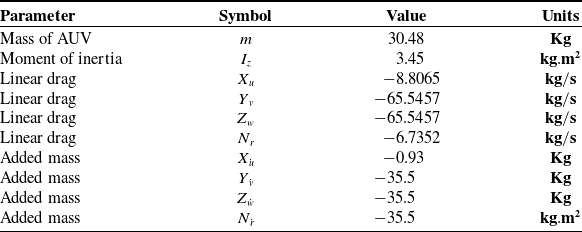
In this section, we will evaluate the performance of the controller proposed in this paper. The selected control laws for the actuator forces given in the previous section are applied to the nonlinear system described by the AUV’s model in Eqs. (1) and (12), and the performance is evaluated through some comparative results. In these analyses, a practical AUV called the REMUS AUV is considered. The actual values of the REMUS AUV parameters are reported in Table I.
The Remus model parameters.

The considered reference trajectory is
 \begin{equation}x=10\sin \left(\frac{t}{8}\right);\ \ y=10\cos \left(\frac{t}{8}\right);\ \ z=10\sin \left(\frac{t}{4}\right)\end{equation}
To investigate the performance of the proposed method in fault detection, the proposed AFTDC controller is compared to the other controllers such as FLDC, SMDC, and conventional ANDC.
The parameters of these controllers are reported in Table II.
Selected parameters of the four controllers.

In the early moments of the beginning of the movement, it is assumed that the system is operated in normal working conditions with the assumed uncertainties and disturbances. Then, the fault-tolerant capability of these controllers is considered. To model the effects of system faults, it is assumed that the following fault functions and external disturbances exist in the system:
Case study 1:
Surge force:
 $\begin{cases} \begin{array}{cc} \unicode{x03C4} =\tau _{d} & 0\leq t\lt 25 \end{array}\\ \\[-8pt] \begin{array}{cc} \unicode{x03C4} =0.1\tau _{d} & 25\leq t \end{array} \end{cases}$
Sway force:
 $\begin{cases} \begin{array}{cc} \unicode{x03C4} =\tau _{d} & 0\leq t\lt 35 \end{array}\\ \\[-8pt] \begin{array}{cc} \unicode{x03C4} =0.2\tau _{d} & 35\leq t \end{array} \end{cases}$
Heave force:
 $\begin{cases} \begin{array}{cc} \unicode{x03C4} =\tau _{d} & 0\leq t\lt 45 \end{array}\\ \\[-8pt] \begin{array}{cc} \unicode{x03C4} =0.15\tau _{d} & 45\leq t \end{array} \end{cases}$
The external disturbances are assumed as follows:
 \begin{equation}{d}=\left[\begin{array}{c} 0.1\,\sin \left(\dfrac{\textrm{t}}{5}\right)\\ \\[-11pt]0.05 \sin \left(\dfrac{\textrm{t}}{15}\right)\\ \\[-11pt]0.65\cos \left(\dfrac{\textrm{t}}{15}\right) \end{array}\right]^{\textrm{T}}(\mathfrak{u}_{s}\left(t-60\right)-\mathfrak{u}_{s}\left(t-80\right)\!)\end{equation}
where
 \begin{equation*} \mathfrak{u}_{s}(t)=\left[\begin{array}{c@{\quad}c} 1,&\textrm{t}\geq 0\\ \\[-8pt]0,&\text{ otherwise} \end{array}\right. \end{equation*}
It means that a sudden fault (
 $\begin{array}{cc} \unicode{x03C4} =0.1\tau _{d} & 25\leq t \end{array}$
) occurs in the first actuator from t ≥ 25 s, while the second and third actuators’ losses 80% and 85% of their efficiency from the time t ≥ 35 s and t ≥ 45 s, respectively.
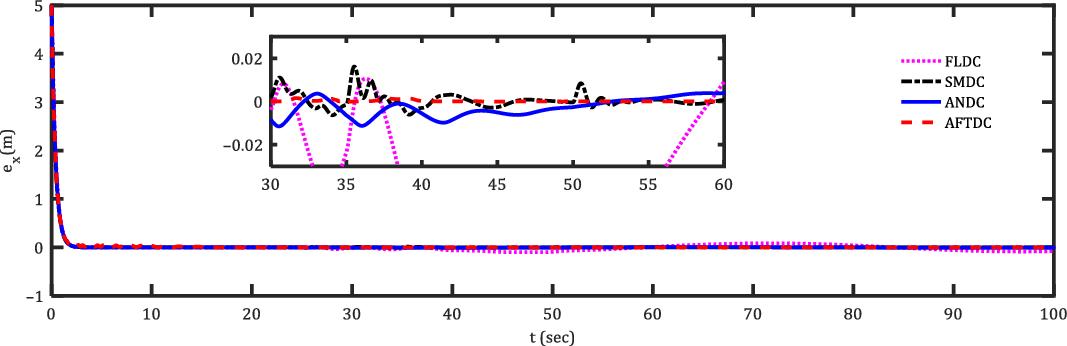
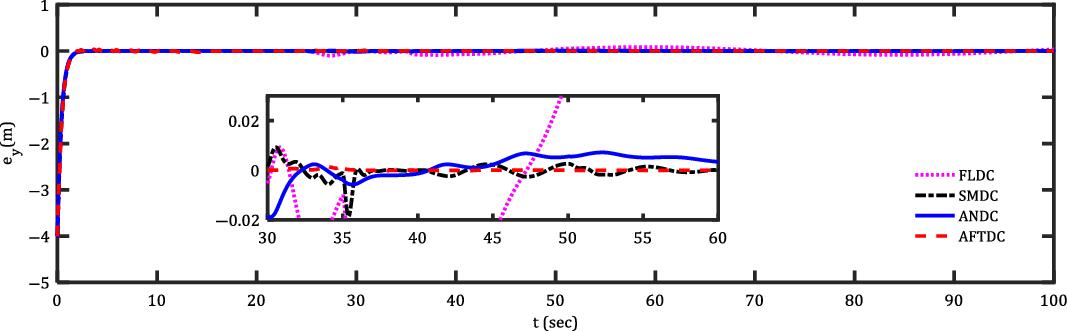
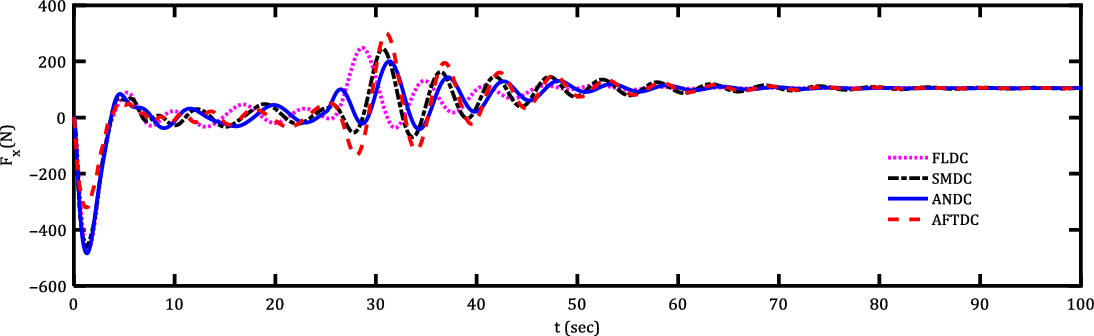
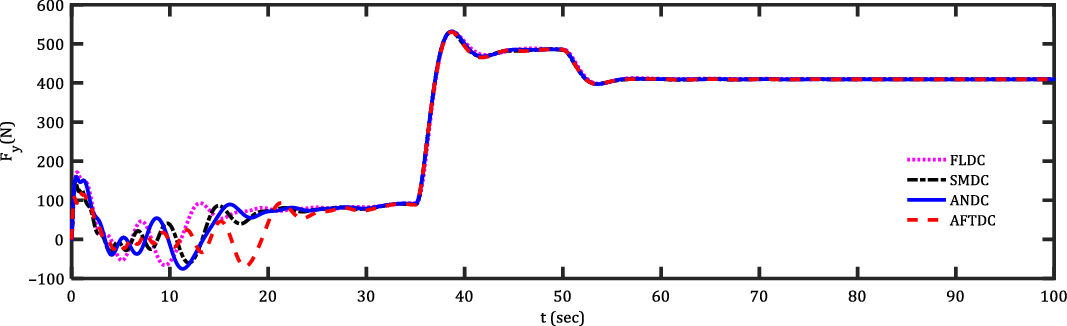
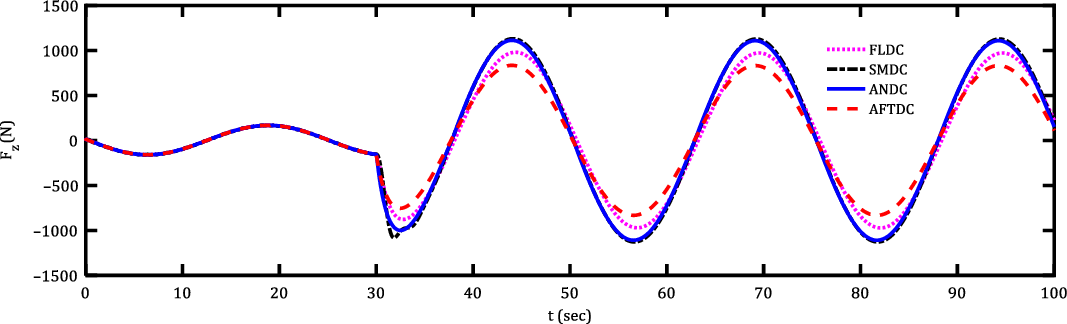
According to Figs. 3–5, the FLDC has poor performance in the face of faults and disturbances. However, other controllers after the occurrence of the fault, by increasing the amplitude control signal (Figs. 6–8), have somewhat remedied the fault. The reason for this is the relative fault tolerance property of robust controllers. However, AFTDC display better performance.
Position errors in the x-direction for the four compared controllers, 1st case study.

Position errors in the y-direction for the four compared controllers, 1st case study.

Position errors in the z-direction for the four compared controllers, 1st case study.

The surge forces of the AUV for the four compared controllers, 1st case study.

The sway forces of the AUV for the four compared controllers, 1st case study.

The heave forces of the AUV for the four compared controllers, 1st case study.

Next, we consider the fault-tolerant capability in the presence of higher faults. to consider the outcomes of the fault in the system, we suppose that the following fault function subsists in the system.
Case study 2:
 $\gamma _{i}=0, \sigma _{i}=1$
 $\textrm{for}$
 $t\lt 30$
 $\gamma _{i}=0, \sigma _{i}=10^{-5}$
 $\textrm{for}$
 $t\geq 30$
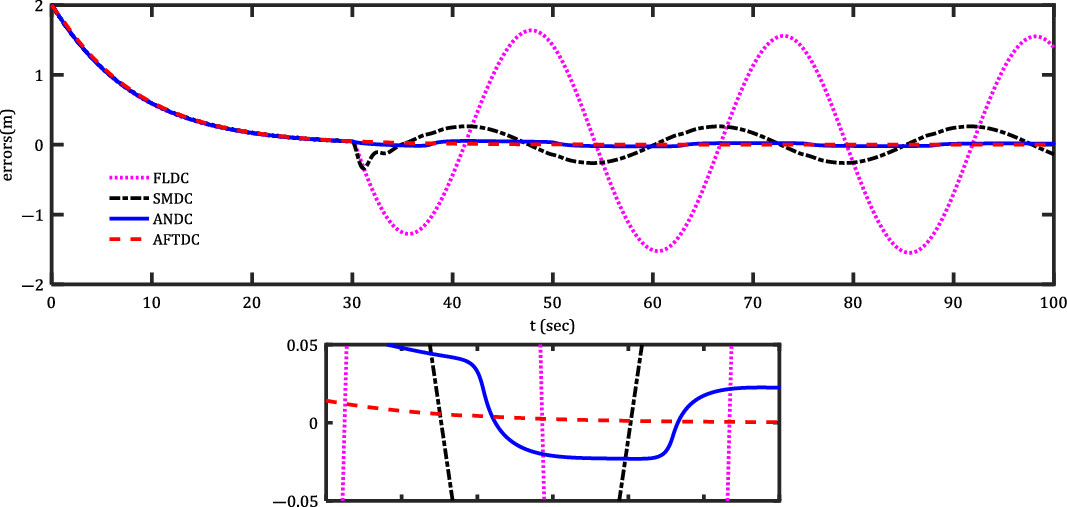
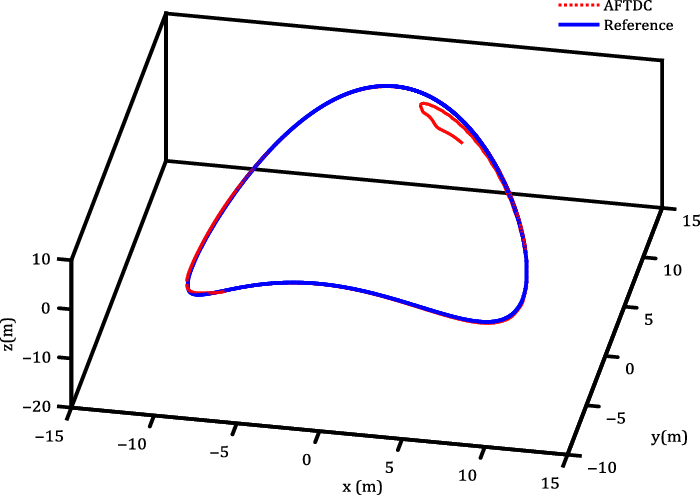
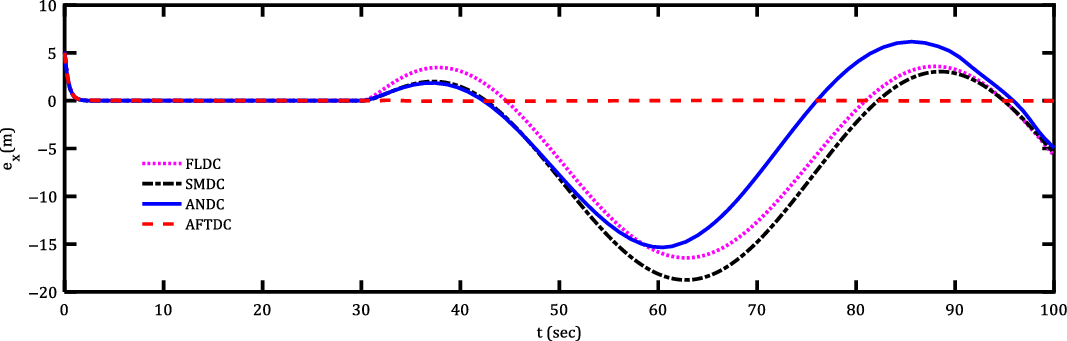
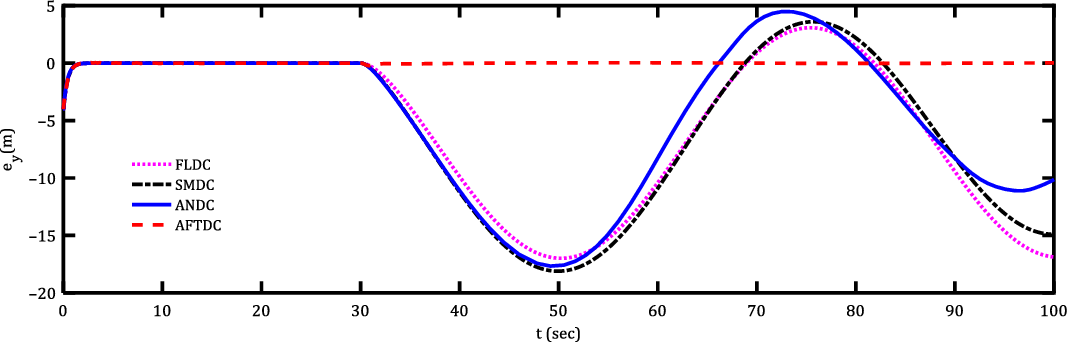
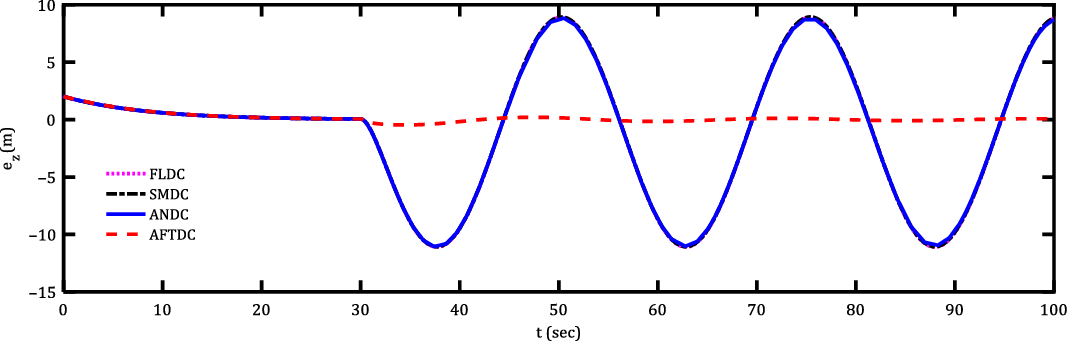
According to Figs. 9–12, the FLDC, SMDC, and ANDC have poor performance in the face of large faults. Still, the best performance is related to the AFTDC. adaptive rules are used as online estimation to compensate for malfunctions in robot performance. Therefore, the designed controller is resistant to the effects of fault due to the use of adaptive estimators, and as expected the controller fully compensates for the effects of faults. The range of magnitude, numerical values, and oscillations of the control forces are in a suitable margin, and robot actuators can produce them.
AUV paths with the proposed controller.

Position errors in the x-direction for the four compared controllers, 2nd case study.

Position errors in the y-direction for the four compared controllers, 2nd case study.

Position errors in the z-direction for the four compared controllers, 2nd case study.

7. Conclusions
In this paper, the fault-tolerant controller is proposed for AUV with external disturbance and actuator fault. To reduce computational complexity, the controller is designed in two parts: kinematics and dynamics. In the dynamic model, the loss of a part of the fault is considered to be the system’s effectiveness. To compensate for the effects of the actuator fault and to attenuate the disturbance, an AFTDC scheme is suggested. The comparison of the obtained results of the AFTDC and other controller algorithms shows the superiority of the AFTDC in the presence of actuator faults and external disturbances. Therefore, the proposed method has good fault tolerance capability.
Author contributions
The authors contributed equally to this work.
Conflicts of interest
None.
Financial support
This research received no specific grant from any funding agency, commercial, or not-for-profit sectors.