Introduction
Adaptive planning radiation for head and neck cancer has the potential to spare dose to critical normal structures. During the treatment, weight loss from the treatment-induced pain and difficulty swallowing causes significant changes in patient anatomy compared to pre-treatment planning images. The goal of the adaptive planning is to modify the radiation plan, mid-treatment and without interruption, to more accurately reflect current patient anatomy and provide both better tumour targeting and sparing of critical structures. While there are reports on describing this strategy,Reference Wu, Chi and Chen1–Reference Hunter, Fernandes and Vineberg4 there is very limited data on the effectiveness of this approach utilising TomoTherapy treatment delivery systems, which offer a high degree of freedom in beam arrangements; they can also achieve superior dose conformity to tumours and to normal tissue sparing. Also, little attention has been paid to the intra-treatment disease regression as a potential marker for clinical outcome, particularly now in the era of dose de-escalation. The goal of this study was to report dosimetric outcomes in normal tissue sparing with plan adaptive approaches and evaluate whether intra-treatment regression of the primary or nodal gross tumour volume (GTV) can be utilised as a potential clinical prognostic marker.
Materials and Methods
Patients with locally advanced oropharyngeal cancer treated with 70 Gy to GTV with concurrent chemoradiation (CCRT) on TomoTherapy® with re-planning during their treatment course from 2008 to 2015 and the follow-up with response positron emission tomography–computed tomography (PET-CT) and laryngoscopy were identified. HPV status, smoking history, local/distant recurrence and survival were recorded.
Treatment planning and re-planning
The ‘high-risk’ neck was the ipsilateral neck of involved nodes, typically levels II–III and including one level above or below grossly involved nodes. The ‘low-risk’ neck typically was the ipsilateral low neck, level IV and contralateral, uninvolved neck levels II–IV. The uninvolved oropharynx was covered to 60 Gy as the standard practice, as were lateral retropharyngeal nodes. The initial planning included a diagnostic PET-CT or MRI fusion with an IV contrast planning scan. Contouring was performed in the Eclipse planning system, and the majority of planning was done with TomoTherapy.
Re-planning during the treatment was triggered by >10% weight loss, anatomic changes visible on treatment [megavoltage CTs (MVCTs) with volumes outside the skin] or dose changes predicted by proprietary software of the planning system of 2% or greater.
Re-planning entailed a second planning CT, non-contrast, fused with the initial planning CT and diagnostic images, with recontouring of target volumes and organ at risk (OAR). Repeat diagnostic imaging was not obtained at the time of re-plan. The re-plan used the same target priorities initially as the finalised version of the initial plan, but did not utilise the initial plan sinogram as a starting template. The time from re-plan CT acquisition to re-plan initiation was three fractions or less in 35 patients, and four fractions or less in 7 patients. Cumulative dose volume histogram views (DVHs) were constructed prior to plan approval.
Method of plan comparison
Dosimetric comparisons were made between the re-plan-delivered dose and a ‘hybrid plan’. This ‘hybrid plan’ was constructed by applying the original plan sinogram (beam angles and intensities) to a TomoTherapy-generated MVCT obtained on the same day as the patient’s re-plan-CT due to technical limitations prohibiting the direct fusion of the sinogram to the re-plan-CT. By this method a dose cloud and dose volume histograms were calculated, which reflected changes in patient anatomy and target structures but based on the original plan’s beam arrangement and intensities. This ‘hybrid plan’ dose cloud was then fused via rigid registration with the re-plan-CT to ensure that target volume and OAR were accurately delineated. The comparison was made between the hybrid plan and the delivered adaptive plan. Thus for a comparison of target coverage, the target volume used represented the accurately delineated re-contoured mid-treatment anatomy, and the comparison in dose represented differences between the initial and mid-plan beam sinograms, both accurately calculated for the mid-treatment point anatomy.
Statistical methods
Statistics were performed using Stata software (STATA, College Station, Austin, TX, USA). The correlation of quantitative values was measured by the Pearson method. Univariate and multivariate linear regression models were employed to describe the impact of factors on dosimetric changes. A competing risk analysis was constructed with ‘death without disease progression’ as the competing event. Categorical variables for stage code with stage III, stage IVA and stage IVB (AJCC 7th was used in this sample with both HPV positive and negative disease for model simplicity), and a separate variable for HPV (positive, unknown, negative), were defined. The multivariate analysis was done by the Fine/Gray method with p<0·05 set as significant. Survival was assessed by Kaplan–Meier.
Results
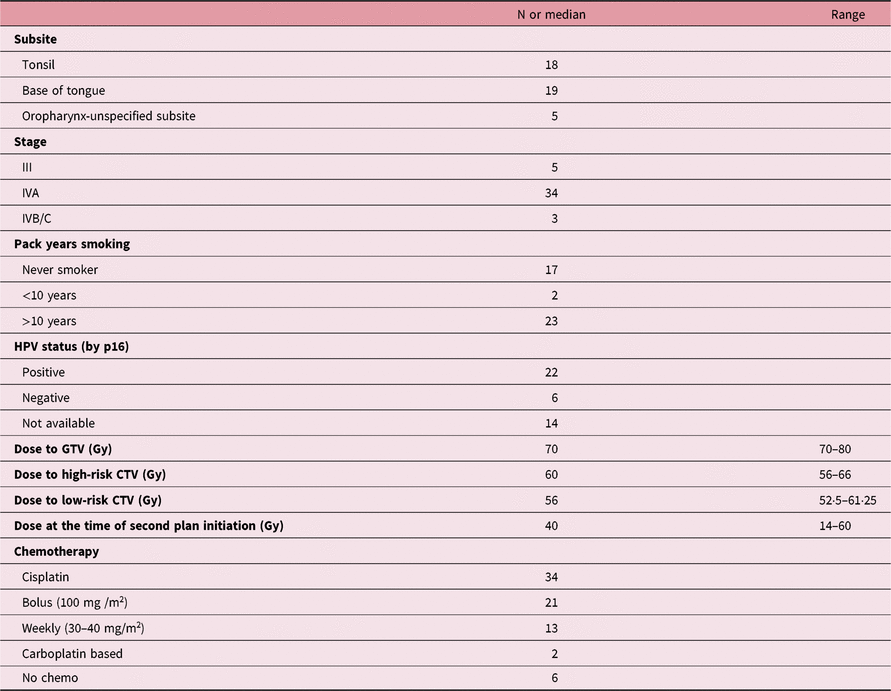
Forty-two patients were identified with median overall survival of 29·6 months (6–77 months) (Table 1). Median follow-up with laryngoscopic exam was 28 months. Forty-one patients received staging PET-CTs. Median weight loss during the treatment was 8 kg (range 4–14 kg).
Patient characteristics

Target volume changes
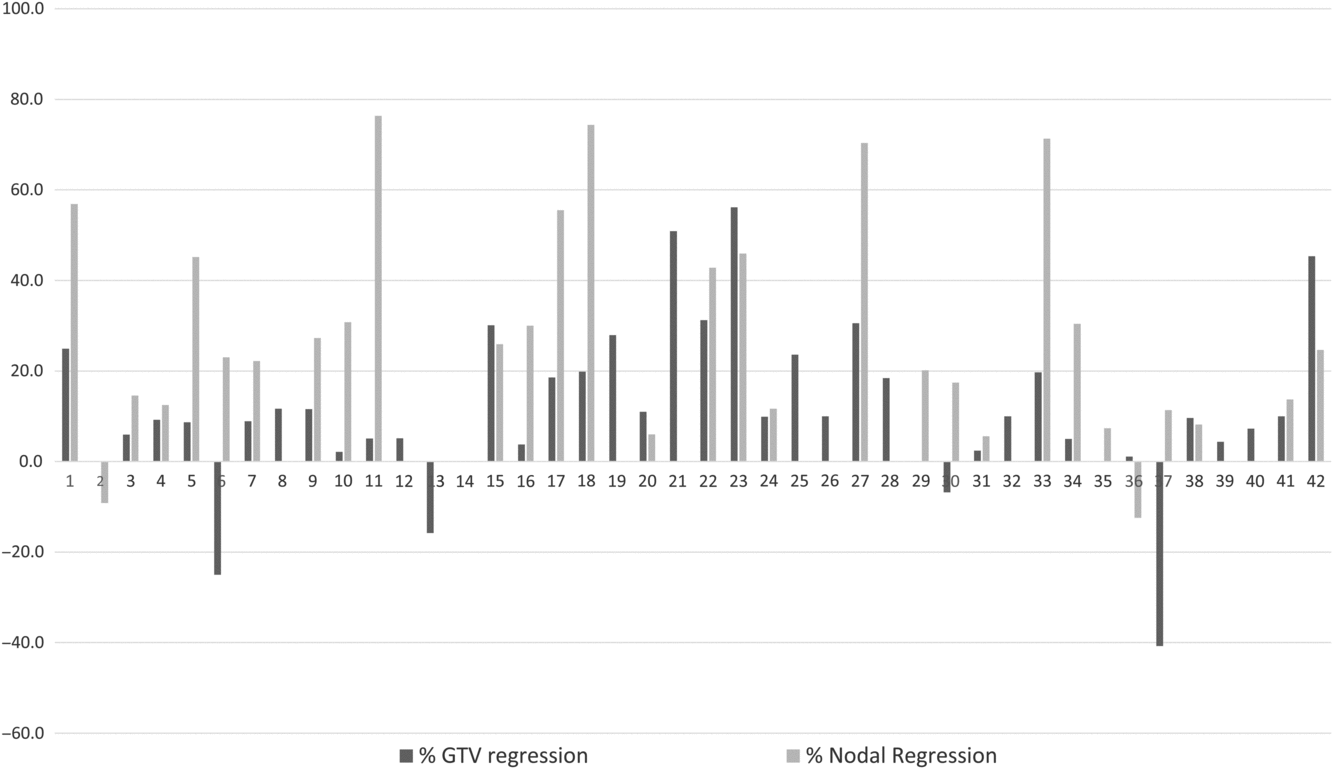
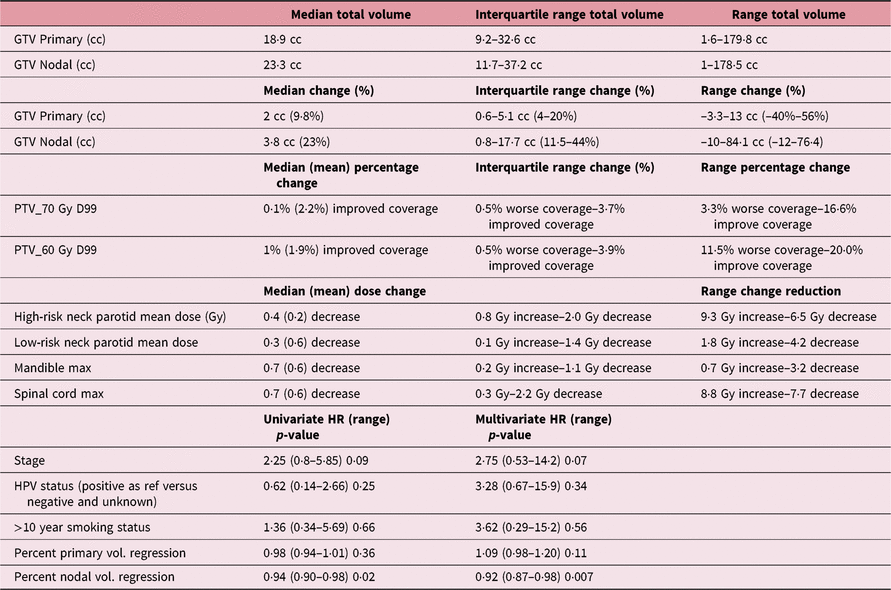
The median primary and nodal GTV at the start of treatment was 18·9 and 23·3 cc, respectively. At the time of re-plan, there was greater intra-treatment regression in the nodal compared to primary GTV with median changes of 23 and 9·8%, respectively (Figure 1). Four patients had enlarged GTVprimary volumes at re-plan, all of whom were HPV positive. Two patients had enlarged GTVnodal volumes at re-plan. The extension of the PTV 70 Gy volume outside the body occurred in 16 patients, with median volume 0·8 cc (0·1–3·3 cc).
GTV_primary and GTV_nodal regression as a percentage of initial volume at the time of re-plan CT per patient. Negative values indicate increased size of the volume.

Dosimetric outcomes
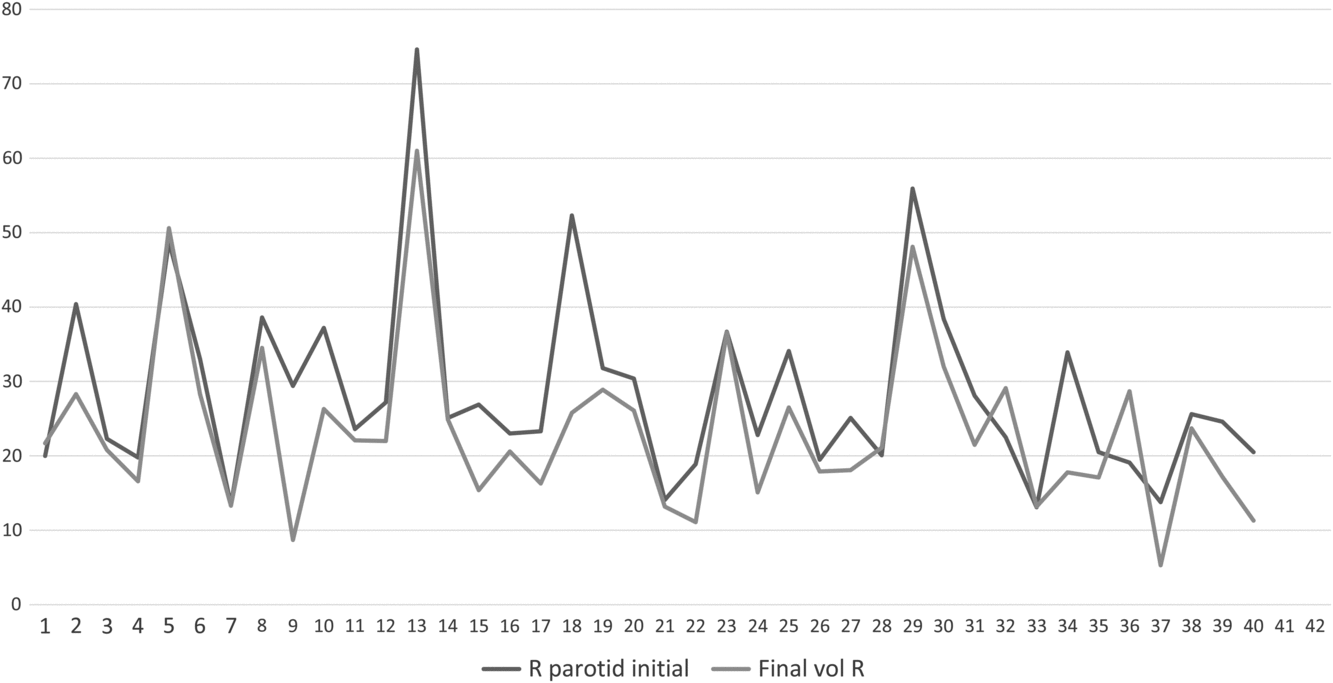
Of 41 patients with at least one intact parotid gland at the time of treatment, 7 (11 of 81 individually contoured glands) had increased parotid volume at the time of re-planning (Figure 2). The vast majority displayed volume contraction with a median change for the entire cohort of 5 cc decrease [10 cc (50%) increase to 28 cc (72%) decrease]. Changes in mean parotid dose with re-planning compared to the hybrid plan varied greatly (Table 2). Four patients had significant worse mean parotid doses in the high-risk neck with re-plan which skewed results (net increases of 3, 5·5, and 9 Gy, respectively). Re-plans that were initiated after 25 fractions of treatment (n = 10) had minimal dosimetric impact on the parotids, with mean dose changes of magnitude 1 Gy or less in this group. There was no significant difference in the direction or magnitude of parotid dose changes when comparing the high risk/involved versus the elective neck (median change 0·4 Gy versus 0·3 Gy reduction with re-plan respectively, p = 0·54, t-test).
Representative right parotid volume (in absolute cc) at initial CT (solid line) and at the time of re-plan CT (dotted line) per patient.

Dosimetric and clinical outcomes

The coverage of PTV70 and PTV60 with 99% of the prescribed dose also varied. Three patients had minimally worse PTV_70 Gy coverage with re-planning (3·3 and 2·8%), and two had worse PTV_60 Gy coverage (11 and 4·4%). The spinal cord showed the most consistent benefit from re-planning, with only five patients having an increased dose by re-planning, and the entire interquartile range (IQR) showing enhanced dose sparing.
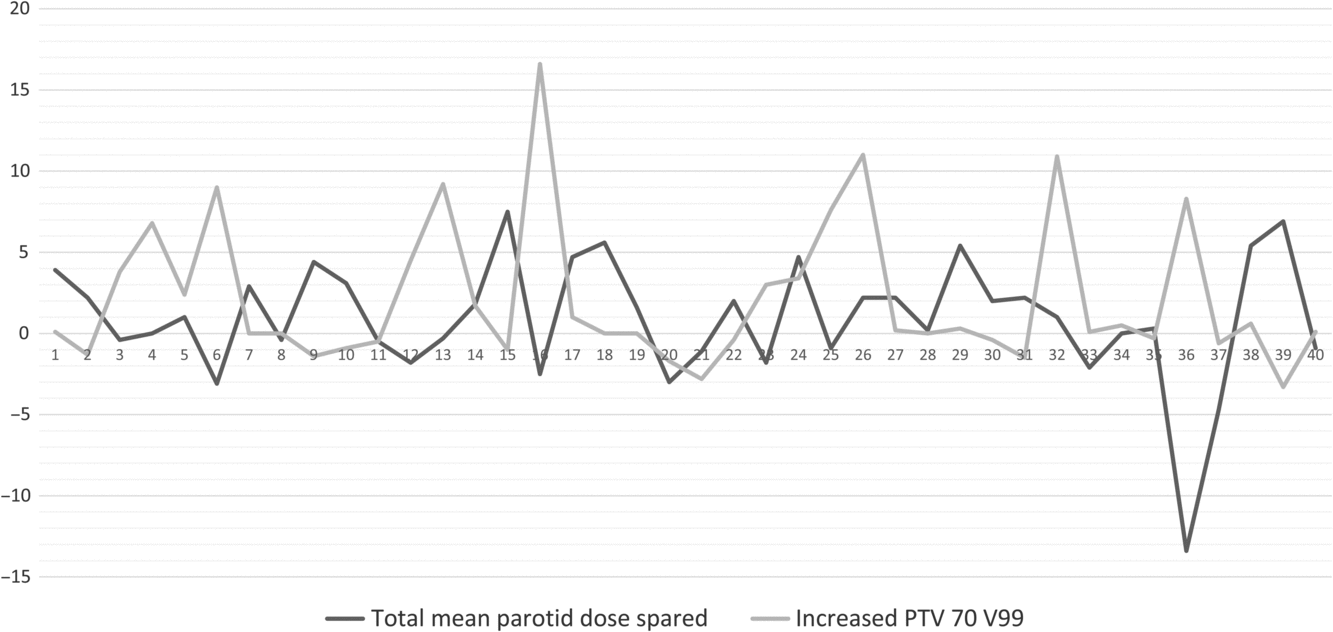
The identification of factors to predict parotid dose sparing was undertaken. In single-factor linear regression, neither greater intra-treatment weight loss (R = 0·3, p = 0·2) nor increasing nodal regression as a percentage (R = 0·04, R 2 = 12, p = 0·07) was significantly correlated with the increasing parotid dose sparing. Increasing PTV_70 Gy V99 coverage significantly correlated with the less parotid dose sparing in single variable linear regression (coef = –0·2, R 2 = 0·10, p = 0·05) (Figure 3). Increasing parotid gland volume shrinkage as a percentage correlated with the increased parotid dose sparing in a similar model (R = 0·04, R 2 = 0·12, p = 0·37). The patient with the largest parotid dose increase in this series also had the greatest change in parotid volume (a total increase of 9 Gy with re-planning and an intra-treatment volume increase of 50%). In a multivariate regression model including these variables, the overall model was significant with R 2=0·33 and p = 0·02.
Total mean parotid dose changes in Gy (positive values indicate dose spared by re-plan) per patient and changes in PTV_70 V99 in percentage (positive values indicate improved coverage of target volume with 99% of the dose).

To evaluate the overall impact of re-planning, an individual patient composite score for dosimetric changes to the PTVs, parotids, spinal cord and mandible dose was calculated with a simple scale of +0·5 if re-planning achieved a dosimetric benefit for the specific structure (increased coverage for PTV, decreased dose for OAR), and an additional +0·5 if the benefit was of a magnitude >5% either in increased coverage for target volumes or decreased delivered dose for an OAR. Conversely, a score of –0·5 was assigned if the dosimetric changes resulted in worse PTV coverage or higher OAR dose, and an additional –0·5 of that was >5% in magnitude. Overall, the score range was from –2 to 5, with the IQR from 0 to 3. Six patients had a negative composite score, 5 patients had a score of 0, and 31 patients had a positive composite score, indicating the majority had a net benefit from adaptive planning.
Clinical outcomes
One patient had local failure alone, two had local and distant failures and five had distant failures alone with a 2-year progression free survival of 80%. There was a significant difference in GTV_Nodal intra-treatment regression (32 versus 9%, p = –0·03) but not GTV_Primary (13 versus 5%, p = –0·31) among patients free from disease progression compared to those who did by two sample t-tests. In a competing risk model, the magnitude of intra-treatment nodal regression was significantly associated with freedom from disease failure (Table 2). The crude two-year disease progression rate for patients with >10% primary regression versus <10% nodal regression was 11% versus 26%. The crude two-year disease progression rate for patients with >25% primary regression versus <25% nodal regression was 0% versus 37%. Cut-off values were chosen to match the median values.
Discussion
Despite the premise that re-planning to account for anatomic changes should allow the most accurate delineation of current anatomy, and thus superior radiation plans, studies have reported variable dosimetric changes that are mostly based on predicted plans from CTs without the workflow of implementing a new plan mid-treatment. One early study based on scheduled CT scans found that the parotids could experience the most potential change and reported that without re-planning the delivered Dmean would be 10% greater than predicted by the initial plan, DVH.Reference Wu, Chi and Chen1 A subsequent study using weekly CT predictions reported that with weekly re-planning, a reduction of 5 Gy in the parotid Dmean is achievable, and otherwise 60% of glands are overdosed without re-planning.Reference Castelli, Simon and Louvel2 An additional series predicting benefits also utilising weekly CT scans reported a net benefit due to a combination of parotid and target volume coverage, with somewhat less parotid sparing than the previous series.Reference Ahn, Chen and Ahn3, Reference Hunter, Fernandes and Vineberg4 One prospective study performed daily cone beam computed tomography (CBCT) and planning CT fusion to calculate more anatomically accurate actual delivered doses, and then sought to correlate these findings clinically by measuring with salivary output. This study also reported that most, but not all, patients during the course of the treatment had higher delivered doses by this calculation method than that originally planned, though when plotted with actual salivary flow measurements there did not seem to be a clinical impact.Reference Hunter, Fernandes and Vineberg4 The patients on these studies were treated with the linear accelerator-based intensity-modulated radiation therapy (IMRT). Another series using volumetric modulated arc therapy performed a similar analysis and found that with a ‘standard’ 0·5 cm margin OAR dose was higher than first predicted due to anatomy changes, but that decreasing margins to 0 cm would promote OAR sparing of 1 Gy/mm if implemented.Reference Van Kranen, Hamming-Vrieze and Sonke5 This was also reported in another series of simulated re-plans, confirming that if the margin is reduced, OAR sparing can be enhanced.Reference Liu, Liang and Yan6
There are fewer reports on the dosimetric changes when a new plan is implemented mid-treatment. One series evaluated the changes realised by superimposing different combinations of the first and ‘boost’ plans on either the initial or re-plan CT, and reported overall parotid sparing and improved target coverage with adaptive planning with an ipsilateral mean parotid dose sparing of 2·9 Gy.Reference Surucu, Shah, Roeske, Choi, Small and Emami7
Our series provides a practical measurement of outcomes when the process of recontouring, re-planning/optimising and approving a complex IMRT plan occurs in a hastened time interval, and we have also identified factors that influence the effectiveness of a practical plan adaptive workflow. First, re-planning that occurs after 25 fractions had little dosimetric benefit. One practical explanation was that too little dose remained to be delivered for the adjustment of the plan to make a significant impact and that a time point prior to this, such as 15–20 fractions, may be a reasonable cut-off point. Second, while some parotid glands shrink, not all glands respond similarly, and in this series there was a significant correlation between shrinkage and parotid sparing. It should be noted that these contours were drawn in planning CTs and approved by the treating physician, and thus are a degree more accurate than that contoured on a CBCT. The parotid volume expansion during the treatment is a patient-specific factor that can be mitigated but not ameliorated with adaptive strategies. Third, maintaining target volume coverage, as shown by the increased coverage with re-planning, works against dose sparing of OARs. It may be that global shrinkage of the neck target volume creates new and disadvantageous spatial relationships.
A more robust marker for re-plan implementation may be needed. One novel approach reported in theory, but not yet used in the clinic (to the best of our knowledge), is by reconstructing the external surface contour based on CBCT, and then calculating the distance from the treatment isocentre to the new external contour.Reference Gros, Xu and Surucu8 This would be more accurate than weight loss, though it may not address the re-arrangement of internal structure relationships that follows. In this series, increasing weight loss alone was poorly predictive of the amount of OAR sparing. Other series have also reported weight loss to be insufficient in simulated re-plans based on CBCTs.Reference Ho, Marchant and Slevin9
Another clinical inquiry with little data available is whether adjusting the gross target volumes mid-treatment leads to increased local failures. Certainly if true adaptive planning is performed followed by recontouring of gross disease, particularly in the neck, then this becomes a relevant topic. We acknowledge that this is a relatively small series, but with a single local failure which was not a ‘marginal miss’, it does support that the modification of target volumes during the treatment does not substantially induce the risk of local recurrence. Surucu et al.Reference Surucu, Shah, Roeske, Choi, Small and Emami7 also reported a single local failure in 34 patients who had mid-treatment re-contouring, though in a more heterogeneous group of primaries.
While the individual composite score provided a simple numerical scale quantifying and verifying that re-planning with TomoTherapy produces a dosimetrically advantageous plan overall in most patients, it also demonstrated that the magnitude of benefit is small and spread over different structures, which may not be clinically meaningful. Specifically, the dose changes to the brainstem and mandible were of very small magnitude. It is difficult to advocate if these changes are clinically meaningful—no patient had a brainstem dose above tolerance, and osteonecrosis of the mandible has a poorly understood dosimetric relationship.Reference Lee, Koom and Cha10 Two patients in this series experienced osteonecrosis, which occurred in one of the patients after a dental procedure, for a rate of 5% which is consistent with that reported in the literature.
Intra-treatment disease response as measured by GTV changes may have a prognostic value. One previous report evaluated lymph node changes during the treatment and found variable behaviour though the clinical correlation was not established,Reference Sanguineti, Ricchetti and Wu11 whereas Surucu et al.Reference Surucu, Shah, Roeske, Choi, Small and Emami7 did show differences in the outcome with regression of disease 35% or higher. The vast majority of patients demonstrated measurable anatomic shrinkage of gross disease in this series, with nodal volumes showing the greatest changes. Nodal volume changes were more pronounced in magnitude, and at least in part this is explained by easier visualisation due to their location in the neck. Recontouring of the primary GTV was most significantly changed when an exophytic portion of the tumour shrank, whereas visualisation of the endophytic changes was limited on repeat planning CT scans and did not change significantly in review. Thus with variable behaviour, a measurable data point and correlation in a multivariate model, intra-treatment changes may be an appropriate metric used for potential radiation changes. Tumour regression may have value in dose de-escalation protocols, as an additional marker for dosing to 60 Gy beyond the identification of HPV positive favourable patients.Reference Chera, Amdur and Tepper12 This may be a preferable marker compared to induction chemotherapy which is also being investigated.Reference Marur, Li and Cmelak13, Reference Chen, Felix and Wang14 These strategies utilise a more systemic therapy than is typically administered in the current standard of care, and thus may not represent true dose de-escalation. On the other hand, for HPV negative disease this could be a marker for dose-escalation to gross disease, where local control is much less robust.
Further work is needed, however. First, mid-treatment diagnostic imaging may give a more accurate picture of intra-treatment disease status of the primary tumour, which with limited changes was not a significant marker in this series, and this population had a low failure rate with the majority of failures outside the radiation field. While incorporating the intra-treatment response would increase complexity, the harm of improperly identifying oropharyngeal patients for dose de-escalation is clear: surgical salvage after definitive chemoradiation leads to poor functional outcomesReference Lee, Chan and Bekelman15 or poor survival resultsReference Kostrzewa, Lancaster and Iseli16 depending on the series. Re-irradiation also has suboptimal outcomes with substantial normal tissue toxicity.Reference Tan, Giger and Auperin17
We acknowledge the limitations of this report, including the retrospective nature, relatively small case numbers and the absence of HPV results for all patients. There is also a small degree of uncertainty in the accuracies of the dose cloud with our method of comparison since this was calculated based on an MVCT fused with a planning CT without deformable registration, though scans were obtained the same day and often within one hour of each other.
Conclusions
Adaptive planning with TomoTherapy treatment delivery does consistently produce a superior plan; however, there are variable dose changes achieved to the parotids, which are not consistently spared in this series. Greater intra-treatment nodal regression is associated with superior outcomes in this small series and requires further study as a prognostic factor.
Author ORCIDs
Michael A. Cummings 0000-0002-9872-5100
Acknowledgements
We thank Mrs. Laura Finger for editorial assistance.
Funding
This research did not receive any specific grant from funding agencies in the public, commercial, or not-for-profit sectors.
Conflicts of interest
None.