Introduction
According to the International Union for Conservation of Nature (IUCN), Przewalski's horses are currently considered an endangered subspecies of the extinct Equus ferus (King et al., Reference King, Boyd, Zimmermann and Kendall2017). Nowadays, in situ populations are restricted to some limited areas in Mongolia and China, while ex situ populations are located in Hortobágy National Park (HNP, Hungary), Askania Nova Biosphere Reserve, Chernobyl Exclusion Zone (CEZ, Ukraine), Cevennes National Park (France) and others.
Przewalski's horses were introduced in HNP in 1997, with the primary goal of managing the landscape in the Pentezug area inside the national park. Nowadays, the number of individuals is around 300, and besides the Przewalski's horse, a herd of domestic cattle (Bos primigenius taurus), carefully bred to phenotypically resemble reconstructed aurochs (Bos primigenius), use this area for common grazing (Zimmermann et al., Reference Zimmermann, Brabender and Kolter2009; Kerekes et al., Reference Kerekes, Ozogány, Sándor, Vegvari, Czető, Nyírő, Szabados, Széles and Barta2019). The Pentezug population is managed without human interference or routine parasite control. Thus, deworming is only occasionally performed – for instance, during the translocation of specific individuals.
In equids, nematodes are responsible for a greater diversity of parasitic infections when compared to cestodes or trematodes – for instance, Parascaris spp., pinworms (Oxyuris equi) and many strongylids, all members of the superfamily Strongyloidea, except Trichostrongylus axei from Trichostrongyloidea (Lichtenfels et al., Reference Lichtenfels, Kharchenko and Dvojnos2008). Furthermore, the number of parasites present is very relevant and defines whether a health problem exists. For instance, to evaluate the level of infection, it is usual to consider the following guide: lower than 500 eggs per gram (EPG) represents a low infection, 500 to 1000 EPG a moderate infection and higher than 1000 EPG a high infection (Soulsby, Reference Soulsby1986; Madeira de Carvalho, Reference Madeira de Carvalho2008; Madeira De Carvalho, Reference Madeira De Carvalho2014).
In Przewalski's horses, some gastrointestinal (GI) parasitological studies have been performed ex situ (Slivinska et al., Reference Slivinska, Dvojnos and Kopij2006; Kuzmina et al., Reference Kuzmina, Zvegintsova and Zharkikh2009, Reference Kuzmina, Zvegintsova and Zharkikh2017; Zvegintsova et al., Reference Zvegintsova, Zharkikh and Kuzmina2019) and in situ (Sharkhuu et al., Reference Sharkhuu, Ulanbayar, Sh, Sunjidmaa, Nyamosor, Dolgorsuren and Tungalag2000; Elias et al., Reference Elias, Sterregaard, Baumgartner, Walzer, Slotta-Bachmayr, Ganbataar, Bajalagmaa, Isenbügel and Deplazes2002; Painer et al., Reference Painer, Kaczensky, Ganbaatar, Huber and Walzer2011; Liu et al., Reference Liu, Li and Hu2016). The majority of them were based on determining the presence or absence of specific parasite agents and calculating nominal levels of infection by the EPG (Kuzmina et al., Reference Kuzmina, Zvegintsova and Zharkikh2017). Moreover, most of the studies were performed under seminatural conditions, based in smaller populations and using an in vivo deworming method before the collection (Slivinska et al., Reference Slivinska, Dvojnos and Kopij2006; Kuzmina et al., Reference Kuzmina, Zvegintsova and Zharkikh2009, Reference Kuzmina, Zvegintsova and Zharkikh2017; Zvegintsova et al., Reference Zvegintsova, Zharkikh and Kuzmina2019), which was not done in this study.
In the social organization of the Przewalski's horses, as in other equids, strong dominance hierarchies are essential for the formation of a harem. The establishment of the harem space is crucial to reduce the aggressive episodes mainly between harem stallions, grouped stallions and bachelors (Keiper & Receveur, Reference Keiper and Receveur1992). In contrast, this Przewalski's horse population has a different organization. Even though the harems are considered single stallion, they are close to each other, forming a big group in the 2388 hectares of the Pentezug reserve. This social structure is not commonly described in different populations of the subspecies, but it has been described in Camargue horses (Duncan, Reference Duncan1992; Brabender et al., Reference Brabender, Zimmermann and Hampson2016).
Consequently, the main goal of this study was to perform a survey of the GI parasites of the Przewalski's horses from the Pentezug Wild Horse Reserve, at the HNP, in Hungary, through the collection of faecal samples. Additionally, we tried to understand if there were any critical differences between age, sex, social groups, harems and other individual factors to better understand the health status of this ex situ population.
Materials and methods
Plan and objectives
The main goal of this study was to conduct a detailed survey of the GI parasites of the Pentezug population as a tool for future parasite regular monitoring plans of these Przewalski's horses. From the 79 collected samples (79 of the 280 horses, meaning 28% of the population), 62 were members from identified harems, two were from identified bachelors and 15 were from unknown bachelors. Moreover, it was possible to obtain samples from 24 of the 29 harems. This study was performed between September and November 2018.
The nomenclature used in our study is similar to the one used by other feral horses studies (Rubenstein & Hohmann, Reference Rubenstein and Hohmann1989). In the following paragraph we present the categories used, the number of samples collected (n) and the approximate total number of horses from that social group (t). Considering harem members, infant males (n = 5; t = 12) and females (IF; n = 2; t = 8) are less than one year old; young males (n = 6; t = 20) and females (n = 1; t = 15) are one to three years old; stallions (n = 12; t = 29) are mature males more than three years old that lead harems; non-lactating females (n = 28; t = 42) are adult females more than three years old; lactating females (n = 8; t = 20) are adult females more than three years old, having a lactating foal. Bachelors (n = 17; t = 130) are mature male horses, non-members of any harem. Fluctuations between social groups were possible due to harems changes. In some cases, when infants and young horses are studied together, the term juvenile (n = 16) (less than three years old) is used in comparison with adults (n = 63) (more than three years old).
Individual identification and sample collection
The identification was possible for most individuals due to the strong harem connections and proximity that defines the wild horses (Rubenstein & Hohmann, Reference Rubenstein and Hohmann1989). The identification process occurred while horses were defecating in a range of 50–100 m, mainly at resting moments. Sampling was performed on a convenience basis. When an animal started defecating, the animals surrounding it were observed, the harem was determined. Then, using binoculars if necessary, it was possible to sex it and watch its body details, identifying the individual. However, most of the bachelors were not likely to be identified since they do not establish strong connections (as found between harem members), which leads them to have irregular positions surrounding distinct harems. Subsequently, a small piece of fresh faeces belonging to each horse was collected from the middle of the faecal material, using individual identified plastic bags and held at 4–5°C until reaching the laboratory. The analysis started immediately after the arrival.
Coprological methods
To assess the EPG and evaluate the level of parasite infection, we used the McMaster Technique (Madeira de Carvalho et al., Reference Madeira de Carvalho, Sousa, Cernea, Cernea, Arias and Paz-Silva2014). The Willis flotation and natural sedimentation methods were performed afterwards to identify the light and heavy parasite eggs present in the samples, respectively (Madeira de Carvalho, Reference Madeira de Carvalho2001). Coprocultures were performed in order to obtain infective third-stage larvae (L3), which allow the differentiation of parasites of this group. To determine the proportion of infection by Strongylinae, Cyathostominae and Trichostrongylidae, a total of 100 L3 larvae were counted and identified in each sample in order to obtain the percentages of each mentioned family, subfamilies, genera and species, whenever possible, of the order Strongylida. Cyathostomum sensu lato (s.l.) L3 morphotypes were identified. Published identification keys and guides were used for these purposes (Madeira de Carvalho et al., Reference Madeira de Carvalho, Fazendeiro and Afonso-Roque2004, Reference Madeira de Carvalho, Fazendeiro and Afonso-Roque2007, Reference Madeira de Carvalho, Fazendeiro and Afonso-Roque2008; Santos et al., Reference Santos, Madeira de Carvalho and Molento2018).
Data analysis
For descriptors regarding parasites prevalence, we used the definitions of Bush et al., Reference Bush, Lafferty, Lotz and Shostak1997.
For descriptive statistics, we used Microsoft Excel 365®, and for statistical inference analyses, IBM SPSS Statistics 25® was the chosen program (Abbott, Reference Abbott2011). Since the data distribution was not normal, Kruskal–Wallis and Mann–Whitney tests were performed to evaluate the faecal egg counts (FEC) in different groups and categories. Our observations are independent, since one observed defecation corresponds to each collected sample and to one particular result. Regarding the coprocultures, the presence or absence of specific genera/species of parasites was evaluated with the Pearson Chi-square test and Fisher's exact test. When one or more cells in the cross-table had less than five cases, only the values of the Fisher's exact test were considered due to the limitations of the Chi-square test in these conditions. Even though there was a limitation on the ‘bachelor’ identification when we compared adults (>3 years old) with juveniles (<3 years old), the whole 79 individuals were considered. In this case, the bachelors are all considered adults, mainly because the dispersion from the natal band occurs after the sexual maturity around 2–3 years of age. Consequently, they can be analysed with the remaining adult individuals. For all the statistical tests, we accepted a confidence level of 95% and a P-value < 0.05.
Results
All the 79 analysed samples/horses were positive for strongyle-type eggs (79/79) in the Willis floatation, meaning a 100% prevalence. From the total, 27.8% were positive for Parascaris sp. (22/79) and 2.5% (2/79) of the analysed wild horses contained O. equi in their expelled faeces. There were no statistically significant associations in Parascaris spp. results between adults and juveniles (P-value = 0.360), according to Fisher's exact test. By the sedimentation method, we found a digenean egg in one horse, 1.3% (1/79).
The average EPG was 1287 (ranging from 250 to 5050) for the whole 79 samples. Furthermore, more than half of the screened population (43/79) revealed a high infection level. The median, standard error and standard deviation were, respectively, 1050, 94.2 and 836.9. Specifically, 11 samples had less than 500 EPG, indicating a low infection level, 25 samples had between 500 and 1000 EPG, a medium level of infection and, finally, 43 samples showed more than 1000 EPG, which is considered a high level of infection.
Statistically, the Kruskal–Wallis test showed no significant differences between the distinct categories presented in fig. 1 (P-value = 0.454). According to the Man–Whitney test, between sexes (P-value = 0.784), adults vs. juveniles (<3 vs. >3 years old) (P-value = 0.985), lactating vs. non-lactating females (P-value = 0.370), bachelors vs. stallions (P-value = 0.183), bachelors vs. members of a harem (P-value = 0.567), there were no statistical differences regarding the EPG values. In the same way, according to the Kruskal–Wallis test, there are no differences in the EPG values between the different harems of the whole group (P-value = 0.238), meaning that their average faecal egg-shedding counts were probably homogeneous.
Average level of infection (EPG) in individuals of different ages, sexes and social role. Abbreviations: IM, immature males, less than one year old; IF, immature females, less than one year old; YM, young males, 1–3 years old; YF, young females, 1–3 years old; F, females, more than three years old; LF, lactating females, more than three years old; S, harem stallions; B, bachelors.

According to the coprocultures, the strongylid infections in these faecal cultures were composed, on average, of approximately 96.3% Cyathostominae, 2.4% Strongylinae and 1.3% Trichostrongylidae. They also provided evidence of parasite infections by multiple genera/species, 15 different strongylids s.l., which was possible to analyse in different social groups (table 1).
Positive cases and prevalence levels of each identified parasite (according to Madeira de Carvalho et al., Reference Madeira de Carvalho, Fazendeiro and Afonso-Roque2004, Reference Madeira de Carvalho, Fazendeiro and Afonso-Roque2007, Reference Madeira de Carvalho, Fazendeiro and Afonso-Roque2008; Santos et al., Reference Santos, Madeira de Carvalho and Molento2018) divided by categories in the population.

B, bachelors; F, adult females, more than three years old; S, harem stallions; J, juveniles, females or males less than three years and members of a harem.
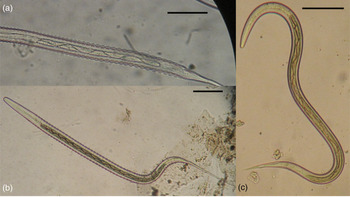
In our study, the L3 of Cyathostomum s.l. type A (fig. 2a) were the most frequent, occurring in 100% of the analysed samples. In the subfamily Strongylinae, Strongylus vulgaris (fig. 2b) was the most common parasite of this group, with a prevalence of 40.5%, followed by Triodontophorus serratus (fig. 2c), with a prevalence of 12.7%. We also found T. axei infective larval stages, a parasite that horses share with ruminants.
Three of the 15 different strongylid L3 found in our study: Cyathostomum sensu lato morpho-type A (a), Strongylus vulgaris (b) and Trichostrongylus axei (c). Cyathostomum sensu latum morpho-type A has eight cells (2 + 6), the first two in a double row and the following six form a single line (medium total size: 812 μm); S. vulgaris has more than 20 cells, well-defined and very dark (medium total size: 936 μm; width: 32 μm); T. axei has a very short tail (it does not have a ‘whip’ form) measuring 115 μm from the anus to the end of the tail (medium total size: 738 μm) (Madeira de Carvalho et. al., Reference Madeira de Carvalho, Fazendeiro and Afonso-Roque2008). Scale bars: 100 μm.

Moreover, two parasites show a significant difference between adults and juveniles: Poteriostomum spp. (P-value = 0.013) and T. serratus (P-value = 0.025), according to the Fisher's exact test. Specifically, 31.3% of the juveniles are positive for T. serratus, comparing to 7.9% of adults. In the same way, Poteriostomum spp. has a prevalence of 56.3% in young horses and 22.2% in adults. In order to correlate the association of T. serratus and Poteriostomum spp. with age (adults vs. juveniles) already mentioned above, we performed a three-way crosstabulation and a Fisher's exact test, and we concluded that there is a significant association between T. serratus and Poteriostomum spp. in the juveniles (P-value = 0.034), that also exists, as previously mentioned, when we consider the entire population (P-value = 0.005), but not specifically in the adults (P-value = 0.307).
Finally, according to the Mann–Whitney test, the EPG values were significantly different between animals positive and negative for S. vulgaris (P-value = 0.001). Animals that were positive for S. vulgaris (n = 32) had an average level of 875 EPG and, contrarily, animals that were not infected by S. vulgaris (n = 47) had a mean value of 1567 EPG (fig. 3).
EPG results according to the presence or absence of Strongylus vulgaris (positive group: mean = 875; min. value = 732; max. value = 1018; N = 32; negative group: mean = 1567; min. value = 1291; max. value = 1843; N = 47).

Discussion
All the 79 analysed Przewalski's horses were infected with GI parasites, and all of them were positive for Strongylidae. Our findings agree with those of Slivinska et al. (Reference Slivinska, Dvojnos and Kopij2006), Kuzmina et al. (Reference Kuzmina, Zvegintsova and Zharkikh2009) and Zvegintsova et al. (Reference Zvegintsova, Zharkikh and Kuzmina2019), who also found a 100% prevalence for this taxonomic order in other Przewalski's horse populations in different Ukrainian regions. Regarding other helminths, 27.8% were positive for Parascaris sp. (22/79). Slivinska et al. (Reference Slivinska, Dvojnos and Kopij2006) presented a similar prevalence for Polish primitive horses (27.4%) in four different regions of Poland. Moreover, 2.5% (2/79) of the analysed wild horses contained O. equi in their faeces.
Kuzmina et al. (Reference Kuzmina, Zvegintsova and Zharkikh2009, Reference Kuzmina, Zvegintsova and Zharkikh2017) also reported high infection levels in populations of the same subspecies. However, EPG level does not always correlate with the worm burden, depending, for instance, on the egg productivity of each adult worm (Carstensen et al., Reference Carstensen, Larsen, Ritz and Nielsen2013). It is essential to consider that the sample collection occurred mainly at the beginning of the autumn, in a time of low quality and quantity of food. These horses were grazing close to the soil, and this behaviour could perhaps increase the ingestion of faecal material and, consequently, the possibility of infection, at least of parasites with a short prepatent period (for instance, cyathostomins or T. axei) (Nielsen & Reinemeyer, Reference Nielsen and Reinemeyer2018).
According to the literature, several social and metabolic factors tend to influence wild horse parasitism. The social status of the individual and its role in the harem is also an influence factor, although complex and distinctive. Dominance behaviours, as group defence, are associated with high testosterone and cortisol levels and energetic costs (Habig & Archie et al., Reference Habig and Archie2015). Testosterone and cortisol can have immunosuppressive effects that can explain the higher FEC of GI nematodes found in dominant harem stallions comparing to the bachelors of a studied population of feral horses in Sable Island, Canada (Debeffe et al., Reference Debeffe, McLoughlin and Medill2016; Jota Baptista et al., Reference Jota Baptista, Sós and Madeira de Carvalho2021). Mares tend to spend more time feeding than other females, increasing the probability and intensity of GI infections (Boyd, Reference Boyd1988). On the other hand, the fecundity of female worms may increase, and the immune expulsion is impaired, due to the progesterone effect. Furthermore, depending on the parasite's species considered, younger horses usually have more parasites than the adults (Kuzmina et. al., Reference Kuzmina, Dzeverin and Kharchenko2016; Slivinska et al., Reference Slivinska, Kharchenko, Wróblewski, Gawor and Kuzmina2016). Nevertheless, these changes were not evidenced in our population. Since the Pentezug population usually grazes and moves together, the pasture area occupied by a harem is frequently confluent with other harems, causing cross-contamination of the food and water resources. Consequently, these horses present a very homogeneous parasite population between the different harems, ages, sexes and other factors, as statistically evidenced. However, to better compare the EPG between different social groups, it would be important to standardize the number of samples collected in each group, proportionally to the total number of animals, allowing a more accurate and detailed analysis. Similarly, a study performed on a feral horse population in North Carolina revealed no differences between stallions and bachelors, between males and females and between lactating and non-lactating females (Rubenstein & Hohmann, Reference Rubenstein and Hohmann1989). Moreover, a study performed in our population reported no differences before and after foaling in the female body condition score, which supports the idea of a low physiological impact of reproduction and lactation in females (Brabender et al., Reference Brabender, Zimmermann and Hampson2016).
Regarding Strongylidae as the most prevalent parasites, the coprocultures showed parasite infections by 15 different strongylids forms. The proportions of Cyathostominae, Strongylinae and Trichostrongylidae (96.3%, 2.4% and 1.3%, respectively) were in accordance with other research performed with domestic horse parasites (Lopes et al., Reference Lopes, Nunes, Sousa, Fabrica, Braz, Freitas Duarte and Lopes da Costa2020).
Cyathostomum type A were the most frequent larvae found, occurring in all the analysed samples. This is in accordance with a post-mortem study in Prezwalski horses, where three species of this morpho-type (Cylicostephanus minutus, Cyathostomum catinatum and Cylicocyclus nassatus) occurred at a prevalence of more than 90%, and C. minutus with 100%, being the most frequent parasites found (Slivinska et al., Reference Slivinska, Dvojnos and Kopij2006). Since these Przewalski's horses are seldom dewormed, or only in some specific situations, this may explain the diversity of Strongylidae genera and species – namely, the wide range of Cyathostomum s.l., with six different morphotypes, as observed in other domestic and feral horse populations with low levels of anthelmintic pressure (Madeira de Carvalho, Reference Madeira de Carvalho2008; Madeira de Carvalho et al., Reference Madeira de Carvalho2008).
Strongylus vulgaris was the most common parasite of the subfamily Strongylinae and the same was found with Przewalski's horses studied by Slivinska et al. (Reference Slivinska, Dvojnos and Kopij2006) and Kuzmina et al. (Reference Kuzmina, Zvegintsova and Zharkikh2009). The evidenced prevalence (40.5%) is in the middle of the prevalence rates described for this nematode in the mentioned studies. This prevalence should be considered as threatening, due to the potentially severe consequences of the larvae migration in the mesenteric arteries (Nielsen & Reinemeyer, Reference Nielsen and Reinemeyer2018). We believe that the relation of S. vulgaris with the horses with low faecal egg shedding (i.e. with lower EPG) can be explained by possible antagonistic relations established by this parasite. In other words, some parasites can induce microenvironmental changes inside the host, turning it unfavourable to other parasites. These changes can be direct, caused by the parasite, or indirect, with the intervention of the immune system (Cézilly et al., Reference Cézilly, Perrot-Minnot and Rigaud2014). A study performed by Poulin (Reference Poulin2001) describes the competitive interactions between helminths – one of them is the numerical response. Numerical responses are essentially the numerical changes in one or more parasite species induced by another one. Possibly, in our population, S. vulgaris is creating a numerical response in some other species of parasites, leading to lower values of EPG in those hosts. However, some equid studies contradict this finding, presenting no negative interactions between strongylid species, but instead some kind of niche partitioning and mutualistic interactions (Bucknell et al., Reference Bucknell, Hoste, Gasser and Beveridge1996; Stancampiano et al., Reference Stancampiano, Mughini Gras and Poglayen2010; Sallé et al., Reference Sallé, Kornaś and Basiaga2018). Specific studies regarding this situation in Przewalski's horses must be performed in order to produce consistent conclusions.
Moreover, 31.3% of the juveniles are positive for T. serratus, compared to 7.9% of adults. A post-mortem study of 134 horses in Victoria, Australia, reported a prevalence of 26% of T. serratus in juvenile horses (less than two years old). This was the age group with the highest prevalence for this parasite in the study, and the difference was also statistically significant (Bucknell et al., Reference Bucknell, Gasser and Beveridge1995). In the same way, Poteriostomum spp. had a higher prevalence in juveniles than in adults. Kuzmina et al. (Reference Kuzmina, Dzeverin and Kharchenko2016) reported that Poteriostomum imparidentatum was more prevalent in animals less than four years old: the group 1.5–4 years old had the highest value (15.7%), followed by the group of equids less than one year old (6.9%). Feasibly, the association of these two species of parasites can be their common propensity to infect younger individuals.
Surprisingly, there was no statically significant difference in Parascaris sp. prevalences between age groups, since this parasite is usually associated with younger horses. In some regions, the prevalence of this parasite can be 100% in foals aged less than one year old (Leathwick et al., Reference Leathwick, Sauermann, Donecker and Nielsen2016; Jota Baptista et al., Reference Jota Baptista, Sós and Madeira de Carvalho2021). However, Liu et al. (Reference Liu, Hu and Li2018) reported a case of a six-year-old Przewalski's horse with a heavy Parascaris sp. infection associated with volvulus and sudden death. As mentioned, the collection was made on a convenience basis. To better evaluate this correlation in Przewalski's horses, a more extensive and proportional sample collection would be needed.
To date, this represents the most detailed parasitological survey performed in the Pentezug population, with a higher number of samples when compared to similar studies conducted in other European populations of Przewalski's horses.
This is a populational study from a single period of sample collection. We believe it represents a non invasive way of evaluating the parasite community of this population. However, similar continuous monitoring during different seasons can characterize possible seasonal trends in strongyles infection, with consequences for local management and possible reintroductions. Regular parasitological surveillance would also reveal the true influence of parasitism on body condition, reproduction status or immune responses, and consequent repercussions at the population level, at both Pentezug and in future reintroduction sites.
Acknowledgements
We wish to thank the Board of the Hortobágy National Park for allowing the collection of Przewalski's horse samples for this study and for all the support given during the fieldwork. Furthermore, we thank the Budapest Zoo and Botanical Garden for allowing the storage and analysis of the faecal samples at the laboratory.
Financial support
This research received no grant from any funding agency, commercial or not-for-profit sectors.
Conflicts of interest
None.
Ethical standards
Not applicable
Author contributions
All the authors contributed equally to this work.