Introduction
Manganese redox cycling in recent settings
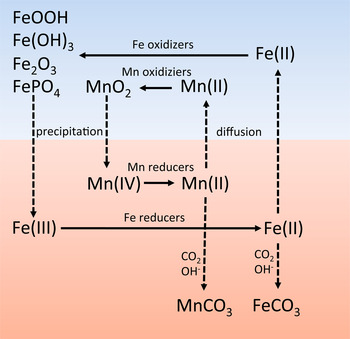
Transition metal redox cycles strongly depend on the redox stratification in the environment. In soils and aquatic sediments, manganese and iron cycling, biogenic as well as non-biogenic, depends on the presence of oxygen (Figs. 1–3). While oxidized manganese compounds are well-known electron acceptors in anaerobic respiration, biogenic oxidation of reduced manganese compounds is still partially enigmatic. Bacterial organisms capable of manganese oxidation appear to be abundant (Tebo et al. Reference Tebo, Bargar, Clement, Dick, Murray, Parker, Verity and Webb2004 and references therein), though it is still not known, if energy is conserved from the (exergonic) manganese oxidation. In contrast to, e.g. iron oxidation, no chemolithotrophic energy-gaining oxidative process of Mn(II) could be proven. Mn(III/IV) are versatile oxidative (Mn(III) also reductive) agents and are mainly generated microbially (Tebo et al. Reference Tebo, Bargar, Clement, Dick, Murray, Parker, Verity and Webb2004; Madison et al. Reference Madison, Tebo, Mucci, Sundby and Luther2013). Until now, other oxidation states (manganese may adopt states between 0 and +7) have not been detected to be of biological relevance.
Manganese and iron minerals involved in redox cycling between oxic and anoxic systems (after Nealson & Saffarini Reference Nealson and Saffarini1994; modified). Reduced iron and manganese are oxidized by microorganisms under oxic conditions, precipitate as oxides and oxyhydroxides in the anoxic sediment, where they are re-mobilized by anaerobic iron and manganese reducers. Mobile Fe(II) and Mn(II) may then diffuse into the oxic zone or precipitate as, e.g. carbonates. Solid lines show (microbial) oxidation and reduction, dashed lines diffusion or precipitation. Besides carbonates, also other poorly soluble reduced compound may precipitate (not shown).

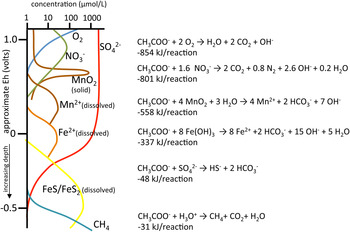
Simplified sequence of microbial redox processes in a stratified sediment (after Konhauser Reference Konhauser2006; Schmidt et al. Reference Schmidt, Behrens and Kappler2010; with modifications). For better comparison, the Gibbs free energy change at standard conditions in kJ/reaction for the complete oxidation of acetate is shown. The approximate redox potentials at increasing sediment depths and concentrations of involved redox partners are indicated. The succession of electron acceptors from oxic (high redox potential) down to anoxic (low redox potential) conditions – oxygen, nitrate, Mn4+, Fe3+, sulphate, protons – leads to lower energy yields.

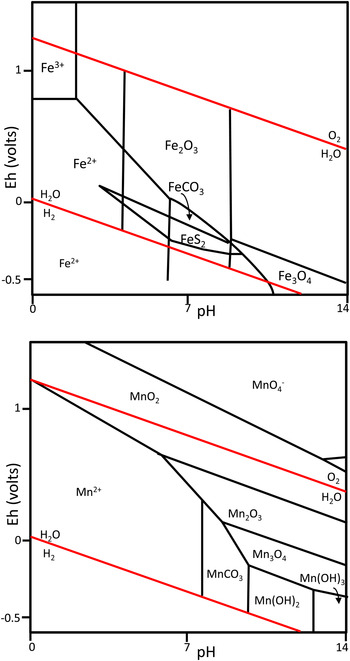
Eh–pH diagram for Fe(III)–Fe(II) and Mn(IV)–Mn(III)–Mn(II) compounds (approximate values). Generally, iron and manganese carbonates precipitate at pH around/above 7 and reducing conditions (Glasby & Schulz Reference Glasby and Schulz1999, with modifications).

Leptothrix discophora has been described as a manganese oxidizer (Boogerd & de Vrind Reference Boogerd and de Vrind1987; Corstjens et al. Reference Corstjens, de Vrind, Westbroek and de Vrind-de Jong1992) and produces, like the iron oxidizing Leptothrix ochracea (Hashimoto et al. Reference Hashimoto, Yokoyama, Asaoka, Kusano, Ikeda, Seno, Takada, Fujii, Nakanishi and Murakami2007), filamentous sheaths that become encrusted upon metal oxidation. In Leptothrix and other – even phylogenetically distinct – manganese-oxidizing bacteria, Mn(II) is oxidized extracellularly, leading to Mn(IV)oxides/hydroxides as virtually insoluble products. The exergonic reaction sustains microbial growth; though the organisms are not autotrophic, mixotrophy appears to be likely. A multi-copper oxidase-related enzyme may be involved in manganese oxidation (Brouwers Reference Brouwers2000). Obviously, L. discophora uses the enzymatically oxidized Mn(IV) for oxidative cleavage of polycyclic compounds; this has been also shown for Pseudomonas putida strains (e.g. Sabivora et al. Reference Sabivora, Cloetens, Vanhaecke, Forrez, Verstraete and Boon2008). Generally, Mn(IV), in addition to Mn(III) as a transient product (Spiro et al. Reference Spiro, Bargar, Sposito and Tebo2010), serve as strong oxidative agents for degradation of recalcitrant organic compounds.
In present-day soil ecosystems, fungi, in particular ascomycetes and basidiomycetes, are the prominent oxidizers of manganese and abiogenic manganese oxidation occurs mainly at high pH values (above pH 8). Enzymes such as manganese peroxidase are important for the degradation of lignin where hydrogen peroxide oxidizes Mn(II) to Mn(III). Chelated Mn(III) acts as an oxidant in lignin degradation. If Mn(III) is not reduced to Mn(II), it is oxidized to Mn(IV), which will accumulate due to its low solubility (Glenn et al. Reference Glenn, Akileswaran and Gold1986). In a redox-stratified water saturated soil, Mn(IV) accumulates just beneath an oxic/anoxic transition zone. Here, fungal hyphae are encrusted by Mn(IV) oxides (Thompson et al. Reference Thompson, Huber, Guest and Schulze2005). Soil Mn(IV) is formed mainly due to microbial activity (in contrast to oxidation of reduced iron, when exposed to the atmosphere).
Zehnder & Stumm (Reference Zehnder, Stumm and Zehnder1988) described the manganese reduction as an abiotic process, neglecting the general awareness that microorganisms use any redox process for gaining energy, as long as it may be conducted under physiological conditions. Since the potential of the Mn(IV)/Mn(II) redox couple lies between the potentials of nitrate reduction and iron reduction, Mn(IV) is an efficient electron acceptor of an anaerobic microbial electron transport chain (Fig. 2). Other than anaerobic sulphate reducers, several Mn(IV) (and also Fe(III)) reducers alternatively use other electron acceptors of high redox potential, including oxygen (Myers & Nealson Reference Myers and Nealson1988; Caccavo et al. Reference Caccavo, Blakemore and Lovley1992; Nealson & Myers Reference Nealson and Myers1992).
Obligate and facultative anaerobic organisms, such as Desulfuromonas acetoxidans, Geobacter metallireducens and Shewanella putrefaciens are well-characterized dissimilatory manganese reducers. Generally, Mn(IV), along with Fe(III) are high redox potential electron acceptors, allowing organisms to gain more energy from anaerobic oxidation of carbon compounds than with, e.g. sulphate. Redox cycling of manganese (and iron) also determines the alteration of solubility. The oxidized products MnO2, FeOOH, FeOH2 and Fe2O3 precipitate and tend to accumulate in the anoxic sediment where they are reduced under anoxic conditions. Fe(II) and Mn(II) have higher solubility, but may again form precipitates as carbonates or, in the case of iron, sulphides (Johnson Reference Johnson1982; Pedersen & Price Reference Pedersen and Price1982; Nealson & Saffarini Reference Nealson and Saffarini1994, Fig. 1).
In the end, redox-stratified ecosystems exhibit many redox cycles conducted by a multitude of microorganisms of distinct metabolic types (Fig. 2). Aerobic bacteria are layered on top of a sediment, followed by denitrifying bacteria, manganese and iron reducers, sulphate reducers and methanogens. The redox pathways of the organisms are interconnected and cycling of oxidized and reduced compounds occurs at microscale. Chemolithotrophs oxidize sulphide, Fe(II), perhaps Mn(II) and ammonia aerobically. At redox potentials (E h) between 0.5 and 0.75, oxidation of sulphide and Fe(II) is also efficient with nitrate instead of oxygen as electron acceptor (nitrate respiration), whereas manganese may be already reduced under these conditions. At lower redox potentials, organic compounds, especially at relatively high concentrations, are mostly fermented (without participation of a respiratory process), but may also be coupled to anaerobic respiration (e.g. sulphate reduction). At these redox potentials, also methanogens are active. Without direct participation of microorganisms, HS− or Fe(II) will be oxidized with Mn(III) as redox partner. Hydrogen carbonate from metabolic reactions may precipitate as CaCO3 or MnCO3 in the respective layers. Figure 2 refers to the situation in marine sediments, where sulphate is not limited. In limnic sediments, methanogenesis predominates. Other variations occur due to the availability of electron donors and acceptors.
Though most of the redox active compounds are recycled at a small scale within the gradient, at least a small portion will be precipitated as insoluble compounds.
Manganese carbonates in recent settings
In recent freshwater sediments, manganese carbonate appears to be an insoluble Mn(II) sink. Deposited MnCO3 (rhodochrosite) is extracted from the redox cycle, as also FeCO3 (siderite) is an insoluble product within the iron redox cycle (Figs. 1 and 3).
In marine systems, the reducing part of the iron and manganese cycle strongly interferes with the sulphur redox cycle, since Mn(IV) is also reduced by sulphide, which is oxidized to elemental sulphur (S0). When sediments are largely aerated, like in the deep seafloor due to low microbial activity and hence little oxygen consumption, manganese is deposited in its higher oxidized state, and manganese concretions, including manganese nodules, may be formed (Glasby Reference Glasby1984). Kutnahorite (CaMn[CO3]2)-rich seasonal varves occur in the Baltic sea Gotland deep anoxic Littorina sequence (Burke & Kemp Reference Burke and Kemp2002). This is explained by the precipitation of microbially reduced manganese as Mn(II)sulphide, which raises alkalinity and favours kutnahorite formation after Mn(IV) reduction by microbial anaerobic manganese respiration. Under steady-state conditions, Mn(II) is continuously mobilized, and accumulates as Mn(IV) near the sediment surface. Disturbance of this cycle during sedimentation leads to stable accumulation of Mn(II) without recycling, which is indicative for sapropel formation (Huckriede & Meischner Reference Huckriede and Meischner1996).
The occurrence of Mn-rich carbonates such as rhodochrosite and kutnahorite in ancient marine sedimentary rocks are known throughout Earth history (overview in Roy Reference Roy1997), e.g. in recent or in Plio/Pleistocene settings (e.g. Meister et al. Reference Meister, Bernasconi, Aiello, Vasconcelos and McKenzie2009), in Ordovician deposits (Fan et al. Reference Fan, Hein and Ye1999) and in early Proterozoic stromatolites (Chocolay Group; Larue Reference Larue1981) as well as in the nearly 3.5 Gyr old Apex and Dresser cherts (see below). Redox conditions in an oxygenated environment, leading to manganese cycling as observed in the presence of oxygen, should not be expected for the early Archean. In the following, we will demonstrate and discuss deposition of manganese carbonates by several microbial processes and we will make some considerations about the biogenic deposition of manganese carbonates in Archean sediments with and without redox cycling.
Methods
Growth media for microorganisms
Pyrobaculum islandicum DSM 4148 was cultivated under anaerobic conditions at 95°C in DSMZ medium 390 (DSMZ, Braunschweig), supplemented with 15 mM MnO2 (Huber et al. Reference Huber, Kristjanson and Stetter1987). The Mn(IV)oxide was prepared by combination of equal volumes of a 0.03 M solution of MnCl2 and 0.02 M solution of KMnO4. The suspension was stirred and pH was adjusted to 7.0 by titration with a 2 M solution of NaOH. The resulting Mn(IV)oxide precipitate was then filtrated through a Büchner funnel and washed with 15 volumes of deionized water. The resulting filtrate was dried at 60°C prior to use.
Idiomarina loihiensis DSM 15497 was grown on BACTO marine broth (DIFCO 2216 medium, Becton Dickinson, New Jersey), supplemented with up to 4 mM MnCl2 and solidified with 1.5% (w/v) bacteriological agar, for up to 2 weeks at 34°C.
Spectroscopy, element analysis and microscopy
Raman spectroscopy was performed according to the procedure given in Kokoschka et al. (Reference Kokoschka, Dreier, Romoth, Taviani, Schäfer, Reitner and Hoppert2015), cathodoluminescence microscopy was performed according to Duda et al. (Reference Duda, Van Kranendonk, Thiel, Ionescu, Strauss, Schäfer and Reitner2016). Preparation of samples for scanning electron microscopy/energy-dispersive X-ray spectroscopy (SEM/EDX) was performed as described in Hallmann et al. (Reference Hallmann, Stannek, Fritzlar, Hause-Reitner, Friedl and Hoppert2013). For transmission electron microscopy (TEM), colonies of Idiomarina cells were embedded as described by Kämper et al. (Reference Kämper, Vetterkind, Berker and Hoppert2004). Ultrathin sections were stained with 4% (w/v) uranyl acetate according to established procedures (Hoppert & Holzenburg Reference Hoppert and Holzenburg1998).
Results and discussion
Microbially induced formation of manganese carbonates in laboratory experiments
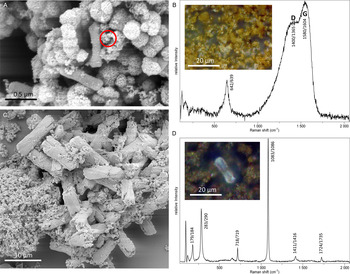
Microbially deposited rhodochosite and other manganese carbonates are microcrystalline deposits in anoxic sediments, and have been observed several times during growth of various prokaryotes, cultured under anaerobic as well as aerobic conditions. The formation of rhodochrosite by pure cultures has been described for Desulfuromonas acetoxidans and S. putrefaciens (Myers & Nealson Reference Myers and Nealson1990; Roden & Lovley Reference Roden and Lovley1993) during dissimilatory anaerobic respiration with Mn(IV). For P. islandicum, a concentrated cell suspension has been shown to reduce manganese, resulting in formation of rhodochrosite, though no growth was reported (Kashefi & Lovley Reference Kashefi and Lovley2000). Here, SEM/EDX analysis and Raman microscopy revealed the presence of single crystals as well as larger aggregates of pyrochroite and rhodochrosite in the sedimented fraction of actively growing Pyrobaculum cultures (Fig. 4). Cells may be associated to mineral phases (pyrochroite; Fig. 4(a) and (b)), but also rhodochrosite minerals without direct contact to cells are visible (Fig. 4(c) and (d)). The structures have never been observed in non-inoculated culture media kept under same conditions.
Hyperthermophilic Pyrobaculum islandicum producing pyrochroite (A circle, B) and rhodochrosite (C, D), as revealed by SEM (EDX data not shown) and Raman spectroscopy. The reduced manganese compounds are sometimes associated with the archaeal cell, resulting in large D and G bands at approximately 1400 and 1580 cm−1, respectively (B). Raman peaks indicative for pyrochroite, D/G bands (B) and rhodochrosite (D) are labelled (measured/expected; expected data according to the RRUF database, University of Arizona, Downs Reference Downs2006). RAMAN spectra were taken from areas depicted in the light micrographs in B and D.

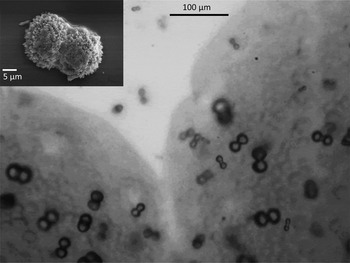
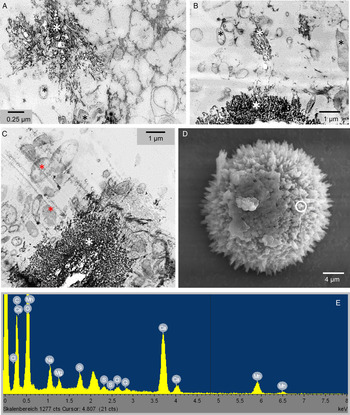
For I. loihiensis, a widespread aerobic marine organism, the formation of kutnahorite CaMn[CO3]2, has been described, when Mn(II) is available (González-Muñoz et al. Reference González-Muñoz, De Linares, Martínez-Ruiz, Morcillo, Martín-Ramos and Arias2008). As long as reduced manganese compounds are present and no competing microbial oxidation occurs, manganese carbonates may be formed as by-products in calcite formation, inside colonies of Idiomarina (Figs. 5 and 6), visible as dumbbell-shaped crystals. In colonies of 14 days old cultures of Idiomarina, numerous crystals of this kind were observed. These crystals came up upon cultivation after 3 days and their number increased during the following 10 days. Scanning and transmission electron microscopy of these crystals reveal the occurrence of precipitates with an irregular spiky surface (Fig. 6(d)). Ultrathin sections show that the precipitates are surrounded by bacterial cells (Fig. 6(a)–(c)). Organic and mineral phases are close to or directly attached to each other.
Ca–Mn kutnahorite crystals (dumbbell shaped) in colonies of Idiomarina loihiensis. Inset: SEM of a crystal.

Formation of manganese carbonates by Idiomarina loihiensis. Precipitates (marked by white asterisks in ultrathin sections of microbial colonies A–C; D, scanning electron micrograph), intermixed with bacterial cells and cell debris (marked by black or red asterisks in A–C) are enriched in manganese (E, EDX spectrum of the marked area in D), when up to 4 mM Mn(II) is offered in the growth medium.

These findings and other considerations may help to explain some manganese-rich carbonates in Archean settings (cf. Duda et al. Reference Duda, Van Kranendonk, Thiel, Ionescu, Strauss, Schäfer and Reitner2016). Redox conditions, however, considerably differed from those in a (partially) oxygenated environment and different microbial pathways of manganese carbonate precipitation must be considered.
Manganese redox cycling in the Archean
The reducing water body of the early Archean ocean contained relatively high amounts of dissolved iron (as Fe2+), manganese (as Mn2+) and hydrogen sulphide, compared to today's oceans (Saito et al. Reference Saito, Sigman and Morel2003; Zerkle et al. Reference Zerkle, House and Brantley2005). Along with the redox state, the overall bioavailability of the metal ions changed. After the great oxygenation event (GOE) 2.4 Gya ago, the onset of oxidative weathering of terrestrial sulphide minerals increased the concentrations of sulphate in the oceans and provided a new attractive electron acceptor for microbial anaerobic respiration. Sulphate reducers produced large amounts of sulphides, resulting in a ‘sulphidic’ ocean during the Proterozoic (Canfield Reference Canfield1998; Anbar & Knoll Reference Anbar and Knoll2002). The slow rise in oxygen and the increase in sulphide concentration mainly affected the availability of iron during the Paleo- and Mesoproterozoic. The concentration decreased by two orders of magnitude, whereas manganese concentration in seawater was much less affected (Zerkle et al. Reference Zerkle, House and Brantley2005). Cobalt, nickel and molybdenum also decreased by several orders of magnitude, as well as zinc and copper, the latter at a much lower initial concentration. Generally, the slight decrease in availability of reduced manganese, along with the tremendous decrease in iron and the increase in oxygen concentration affected all other redox cycles. Oxidized sulphur compounds (mainly sulphate, dissoluted in sea water) and also nitrate/nitrite became available close to an oxic/anoxic transition zone between the surface and the deep ocean (Fennel et al. Reference Fennel, Follows and Falkowski2005; Li et al. Reference Li, Cheng, Algeo and Xie2015). Thus, after the GOE also Mn(IV)oxides must have been generated by various microbial processes, with oxygen or with nitrate as electron acceptors. It is known that microbial nitrate-dependent oxidation of manganese is possible, though hitherto widely unexplored (e.g. Hulth et al. Reference Hulth, Aller and Gilbert1999). Thus MnO2 and its derivatives are readily available for anaerobic respiration. Interestingly, it could be detected that the intermediate oxidation state Mn(III), generated either by oxidation of Mn(II) or by reduction of Mn(IV) is relatively stable and may be an important redox carrier in suboxic water bodies (Trouwborst et al. Reference Trouwborst, Clement, Tebo, Glazer and Luther2006). The strong oxidant Mn(III) may be involved in many electron transfer reactions, e.g. the oxidation of reduced sulphur compounds. Thus, in a sulphidic Proterozoic ocean, manganese instead of and in addition to iron redox cycling might have been of major importance.
The Archean ocean, in contrast, was anoxic and strongly influenced by hydrothermal vents (e.g. Roy Reference Roy1997; Golding et al. Reference Golding, Duck, Young, Baublys, Glikson, Kamber, Golding and Glikson2011) though it is speculated that oxygen was produced in ocean waters long before an oxygenated atmosphere, and Mn(IV) oxides as electron acceptors for anaerobic respiration may have been formed long before the redox stratified Proterozoic ocean (Fig. 7). Hoashi et al. (Reference Hoashi, Bevacqua, Otake, Watanabe, Hickman, Utsunomiya and Ohmoto2009) found indications for earliest oxygen production 3.46 Ga ago. Though this finding has been debated controversially (Li et al. Reference Li, Czaja, Van Kranendonk, Beard, Roden and Johnson2013), several reports date back the occurrence of oxygen roughly 0.5 Ga before the GOE (e.g. Planavsky et al. Reference Planavsky2014). Specific fractionation of chromium isotopes was interpreted as an indicator for manganese oxidation in paleosols approximately 3 Ga ago (Crowe et al. Reference Crowe, Døssing, Beukes, Bau, Kruger, Frei and Canfield2013). Hence, the presence of ‘oxygen oases’, i.e. local areas with high biogenic oxygen production has to be considered for Archean settings (Kasting Reference Kasting1993; Anbar et al. Reference Anbar2007; Olson et al. Reference Olson, Kump and Kasting2013; Riding et al. Reference Riding, Fralick and Liang2014). In addition, biogenic pathways for manganese oxidation without the presence of oxygen might be possible.
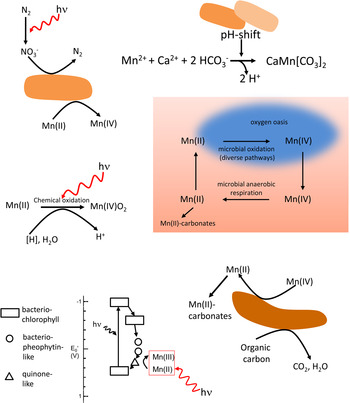
Putative microbially induced manganese redox cycling under reducing conditions in Precambrian atmospheres. The images show – counterclockwise, beginning with the upper left sketch – the oxidation of manganese with nitrate, which has been generated under influence of lightning, the chemical oxidation in UV light, the photosynthetic oxidation with UV-activated Mn(II), the formation of Mn(II) by anaerobic respiration, the manganese redox cycling in oxygen oases and manganese carbonate precipitation by microbially induced pH shift (alkalinization, e.g. due to ammonia production). Orange ovals represent prokaryotic cells.

An intriguing (but still hypothetical) way of manganese oxidation was proposed by Johnson et al. (Reference Johnson, Webb, Thomas, Ono, Kirschvink and Fischer2013). They considered that Mn(IV)oxide derived, under anoxic conditions of the early Archean, from pre-oxygenic photosynthesis with Mn(II) as an electron donor. Irradiation by ultraviolet (UV) light may have facilitated the redox reaction. Manganese redox cycling will then continue by reduction of Mn(IV) to Mn(II) (leading to MnCO3 precipitation) by anaerobic respiration (Fig. 7). The putative photosynthetic manganese-dependent redox cycling is a reasonable derivative of analogous recent cycles with iron and sulphur compounds, which are oxidized by anoxygenic photosynthesis (producing biomass) and are reduced by anaerobic respiration (Fisher et al. Reference Fisher, Hemp and Johnson2015). Presently, no photosynthetic process with Mn(II) as an external electron source is known. However, protein-bound manganese ions at different redox stages are forming the reactive centre of the water splitting, oxygen-evolving complex and it is reasonable to assume that free reduced manganese ions have been the electron donors for a proto-oxygen evolving complex (Johnson et al. Reference Johnson, Webb, Thomas, Ono, Kirschvink and Fischer2013; Fisher et al. Reference Fisher, Hemp and Johnson2015).
Nitrate, as another strong oxidative agent may have been involved in manganese oxidation as well. A biogenic nitrification/denitrification requires an oxygen-dependent redox cycling and became relevant, according to isotopic data, in the late Archean (Godfrey & Falkovski Reference Godfrey and Falkovski2009). In addition, nitrate-dependent (microbial) manganese oxidation was possible, when NO x were produced from atmospheric N by flashes of lightning (Fig. 7), which has been calculated to be a major resource of NO x in today's global nitrogen fixing budget (Liaw et al. Reference Liaw, Sisterson and Miller1990). Phylogenetic comparison of cytochrome oxidases imply that respiratory chains for high redox potential electron acceptors evolved in prokaryotes long before the GOE or the onset of oxygenic photosynthesis (Castresana et al. Reference Castresana, Lübben, Saraste and Higgins1994; Castresana & Moreira Reference Castresana and Moreira1999) and also nitrate reductases are of ancient origin (Cabello et al. Reference Cabello, Roldán and Moreno-Vivián2004). In today's microbial habitats the highly oxidized compounds are attractive electron acceptors. As long as they were available – even at low concentration – in an Archean environment, they were used in a microbial metabolism. Therefore, besides other oxidative processes, microbially driven, nitrate-dependent manganese oxidation, and, in consequence manganese redox cycling was possible even under anoxic conditions of the early Archean. However, microbially induced manganese carbonate formation is also explainable by carbon dioxide (hydrogen carbonate) production at an increased pH level, which shifts the chemical equilibrium towards carbonate precipitation, as shown for Idiomarina (see above).
Microbially induced formation of manganese carbonates in Archean settings
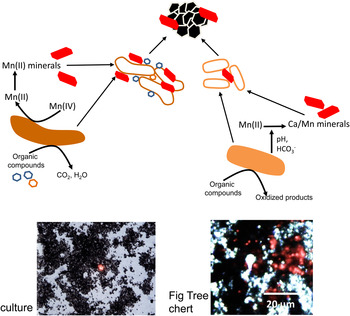
One or several of the above mentioned processes might explain the occurrence of very small high luminescent Mn-rich carbonates associated to organic matter in black and grey Archean cherts (Figs. 4 and 8; Duda et al. Reference Duda, Van Kranendonk, Thiel, Ionescu, Strauss, Schäfer and Reitner2016). Raman spectroscopy and cathodoluminescence microscopy, along with SEM/EDX revealed that the association between rhodochrosite crystals and organic matrix in culture precipitates appears at first glance similar to rhodochrosite associated to organic flakes in putative microbial mats from these ancient cherts (Fig. 8). Rhodochrosite from sediments in an oxygenated atmosphere, e.g. from recent sediments or from Upper Jurassic Molango orebody are depleted in δ13Ccarb (−12.9 to −5.5‰), which is indicative for microbial organic matter oxidation by Mn-reduction (e.g. Okita et al. Reference Okita, Maynard, Spikers and Force1988; Meister et al. Reference Meister, Bernasconi, Aiello, Vasconcelos and McKenzie2009). Strelley Pool Chert bulk organic matter exhibited δ13Corg values at −35‰ (Marshall et al. Reference Marshall, Love, Snape, Hill, Allwood, Walter, Van Kranendonk, Bowden, Sylva and Summons2007; Duda et al. Reference Duda, Van Kranendonk, Thiel, Ionescu, Strauss, Schäfer and Reitner2016), which is typical for carbon dioxide fixation by photoautotrophs (Schidlowski Reference Schidlowski1988; Mojzsis et al. Reference Mojzsis, Arrhenius, McKeegan, Harrison, Nutman and Friend1996; see also Tice & Lowe Reference Tice and Lowe2004).
Tentative scheme for the formation of kerogen-associated flakes in Archean cherts. Microorganisms use oxidized manganese for anaerobic respiration (left) or Mn(II) is precipitated due to pH shift and hydrogen carbonate production (right). Mn(II)carbonates are deposited inside a microbial biofilm, which contributes the organic matter (kerogeneous material) to ancient cherts. Small figures depict a sample from a Pyrobaculum islandicum culture (cf. Fig. 4) and a thin section from the 3.4 Ga old Fig Tree Chert . Carbonate minerals emit red cathodoluminescence (cf. Duda et al. Reference Duda, Van Kranendonk, Thiel, Ionescu, Strauss, Schäfer and Reitner2016).

Kerogeneous organic matter might be interpreted as a residual dense biomat, including putative organic substrates (Noffke et al. Reference Noffke, Christian, Wacey and Hazen2013; Duda et al. Reference Duda, Van Kranendonk, Thiel, Ionescu, Strauss, Schäfer and Reitner2016). Instead of an in situ grown mat, the organic flakes may have also derived from marine snow, generated, e.g. under participation of anoxygenic phototrophs. Organic matter would attract heterotrophic bacteria, which degrade, among other compounds, amino acids (as also shown for Idiomarina, cf. Hou et al. Reference Hou2004), leading to further alkalization of a marine snow flake and hence precipitation of (manganese) carbonates, associated with organic matter (González-Muñoz et al. Reference González-Muñoz, De Linares, Martínez-Ruiz, Morcillo, Martín-Ramos and Arias2008). However, also abiotic formation of organic matter cannot be excluded (e.g. van Zuilen et al. Reference van Zuilen, Lepland and Arrhenius2002; McCollom Reference McCollom2003; Brasier et al. Reference Brasier, Green, Lindsay, McLoughlin, Steele and Stoakes2005; Lindsay et al. Reference Lindsay, Brasierb, McLoughlinb, Greenb, Fogelc, Steelec and Mertzmand2005; McCollom & Seewald Reference McCollom and Seewald2006) and may interfere with the formation of biofilms and/or may add non-biogenically produced organics to the sediment. Processes analogous to Fischer–Tropsch-synthesis (FT, Fischer & Tropsch Reference Fischer and Tropsch1925) are being discussed proposing abiogenic formation of methane and also longer chain hydrocarbons. McCollom & Seewald (Reference McCollom and Seewald2006) could show that during hydrothermally driven FT-synthesis carbon isotope fractionation of around −30‰ is possible. Lindsay et al. (Reference Lindsay, Brasierb, McLoughlinb, Greenb, Fogelc, Steelec and Mertzmand2005) have used this model and proposed that abiogenic organic matter greatly contributed to Apex and other cherts from this region. The structural analyses of the kerogenous material of early Archean cherts have shown characteristic polycyclic products (PAH) (McCollom Reference McCollom2003; Marshall et al. Reference Marshall, Love, Snape, Hill, Allwood, Walter, Van Kranendonk, Bowden, Sylva and Summons2007, Reference Marshall, Emry and Marshall2012). In FT, only linear (but no cyclic) compounds are generated; hence McCollom (Reference McCollom2003) assumes that cyclic compounds in cherts were formed during the thermal decomposition of siderite. Van Zuilen et al. (Reference van Zuilen, Lepland and Arrhenius2002) have described this process occurring in the ca. 3.8 Ga rocks of the Isua Supracrustal Belt from southern West Greenland. Even these recalcitrant abiogenic organics were attractive substrates for heterotrophic, alkane and aromatics degrading microorganisms (Agrawal & Grieg Reference Agrawal and Grieg2013; Suarez-Zuluaga et al. Reference Suarez-Zuluaga, Weijma, Timmers and Buisman2015).
It is not unlikely that both, biogenic and abiogenic processes were important for the formation of black chert organic matter. Raman analyses have shown that the kerogenous matter of the black cherts underwent a strong thermal maturation (Bower et al. Reference Bower, Steele, Fries and Kater2013) and is nearly graphite. However, these organic flakes differ from abiogenic carbon in cherts, as revealed by Raman spectroscopy (Marshall et al. Reference Marshall, Edwards and Jehlicka2010). It is reasonable to assume that any organic matter, either generated microbially or abiogenically, was used as substrate for microbial metabolism and induced microbial growth and biofilm formation. Hence, though part of the organic matter of the black cherts was probably formed abiotically, it was mixed with microbial biomass. Manganese carbonates may have been deposited after anaerobic respiration and/or as by-products of a microbial process. The latter may have been induced by a shift of the chemical equilibrium by production of carbon dioxide (from metabolic processes) and increase in pH at microscale. pH increase may have been a result of, e.g. reduction of sulphur compounds by anaerobic respiratory processes or protein degradation.
Conclusions
Several pathways may have led to manganese carbonates in a reducing atmosphere of the early Archean. Though redox cycling might have been possible in an anoxic environment, and microorganisms may took benefit from manganese reduction in anaerobic respiration, the amount of strong oxidants and hence oxidized manganese (Mn(IV)) must have been considerably lower than in a fully oxygenated water body. In addition to microbial redox processes, Mn(II) may have been incorporated in kutnahorite by microbially induced shift in the carbonate chemical equilibrium but without redox cycling. The observed distribution of small rhodochrosite particles and its association with organic flakes may be easily explained by a biogenic origin of the manganese carbonates.
Acknowledgements
Generous support of the Göttingen Academy of Sciences and Humanities, in particular with respect to the working group ‘Origin of Life’ is gratefully acknowledged.