Introduction
For the past decade, over a third of adults in the US have been considered to be obese. Obesity is a precursor of several chronic diseases, including cardiovascular disease (CVD) (Truesdale et al., Reference Truesdale, Stevens, Lewis, Schreiner, Loria and Cai2006), type II diabetes (Gregg et al., Reference Gregg, Cheng, Cadwell, Imperatore, Williams and Flegal2005), stroke (Caterson et al., Reference Caterson, Hubbard, Bray, Grunstein, Hansen and Hong2004), breast cancer (Carmichael & Bates, Reference Carmichael and Bates2004), endometrial cancer (Kaaks et al., Reference Kaaks, Lukanova and Kurzer2002) and ovarian cancer (Pan et al., Reference Pan, Johnson, Ugnat, Wen and Mao2004). Individuals with central adiposity, a form of obesity where excess fat accumulates in the abdominal area, experience increased risk of CVD and diabetes (Ding et al., Reference Ding, Visser, Kritchevsky, Nevitt, Newman, Sutton-Tyrrell and Harris2004).
Several studies have documented associations between neighbourhood poverty and obesity (Lee, Reference Lee2011; Fuller-Rowell et al., Reference Fuller-Rowell, Evans and Ong2012; Rooks et al., Reference Rooks, Xu and Williams2014). In the United States, race-based residential segregation has contributed to the contemporary patterning of neighbourhoods, with non-Hispanic Blacks (NHBs) and Hispanics being more likely to reside in high-poverty neighbourhoods than non-Hispanic Whites (NHWs) (Jargowsky, Reference Jargowsky2013). The disproportionate representation of NHBs and Hispanics in neighbourhoods with high concentrations of poverty may contribute to racial disparities in obesity (Boardman et al., Reference Boardman, Onge, Rogers and Denney2005; Do et al., Reference Do, Dubowitz, Bird, Lurie, Escarce and Finch2007; Bleich et al., Reference Bleich, Thorpe, Sharif-Harris, Fesahazion and Laveist2010).
There are multiple pathways through which neighbourhood poverty may affect obesity, including associations with characteristics of the physical and social environment. There is substantial evidence linking neighbourhood poverty to limited access to healthy foods (Powell et al., Reference Powell, Slater, Mirtcheva, Bao and Chaloupka2007; Franco et al., Reference Franco, Diez Roux, Glass, Caballero and Brancati2008; Larson et al., Reference Larson, Story and Nelson2009), and to physical environmental characteristics associated with reduced physical activity (Schulz et al., Reference Schulz, Kannan, Dvonch, Israel, Allen III and James2005; Troped et al., Reference Troped, Wilson, Matthews, Cromley and Melly2010; Sallis et al., Reference Sallis, Floyd, Rodríguez and Saelens2012; Kwarteng et al., Reference Kwarteng, Schulz, Mentz, Zenk and Opperman2013), both of which are associated with obesity (Morland et al., Reference Morland, Diez Roux and Wing2006; Lovasi et al., Reference Lovasi, Hutson, Guerra and Neckerman2009; Sallis & Glanz, Reference Sallis and Glanz2009). Jackson and Knight (Reference Jackson and Knight2006) theorized that under stressful living conditions, individuals may engage in behaviours associated with poor health, including smoking, alcohol and overeating. Furthermore, they (Jackson et al., Reference Jackson, Knight and Rafferty2010) found evidence that engaging in unhealthy behaviours may alleviate symptoms of stress and the associated biological cascade that can lead to mental disorders. Conversely, they found evidence to suggest that these unhealthy behaviours, over the life course, have a detrimental effect on physical health. For example, unhealthy behaviours such as overeating of comfort foods (i.e. high-fat, high carbohydrate), while potentially protective of mental health, can lead to increased risk of obesity (Jackson et al., Reference Jackson, Knight and Rafferty2010).
Social environments that are conducive to psychosocial stress – that is, environments that are perceived as harmful, threatening or bothersome (Lazarus & Folkman, Reference Lazarus and Folkman1984) – may also be associated with obesity. Physiological responses to stressful environments may cause metabolic changes that, in turn, influence the distribution of fat in the body (Björntorp, Reference Björntorp1987; Dallman et al., Reference Dallman, La Fleur, Pecoraro, Gomez, Houshyar and Akana2004; McEwen & Seeman, 2006). Specifically, these physiological changes can lead to fat deposits in internal, visceral adipose tissues (Björntorp, Reference Björntorp1987, Reference Björntorp1997; McEwen & Seeman, 2006; Koch et al., Reference Koch, Sepa and Ludvigsson2008; Brydon, Reference Brydon2011; Wardle et al., Reference Wardle, Chida, Gibson, Whitaker and Steptoe2011).
Several studies have demonstrated associations between perceived discrimination, one indicator of psychosocial stress (Williams et al., Reference Williams, Yan Yu, Jackson and Anderson1997) and adverse physical and mental health outcomes, including hypertension, depression and cardiovascular disease (Schulz et al., Reference Schulz, Israel, Zenk, Parker, Lichtenstein, Shellman-Weir and Klem2006; Williams et al., Reference Williams, Neighbors and Jackson2008; Williams & Mohammad, Reference Williams and Mohammed2009; Hunte & Williams, Reference Hunte and Williams2009; Albert et al., Reference Albert, Cozier, Ridker, Palmer, Glynn and Rose2010; Lewis et al., Reference Lewis, Aiello, Leurgans, Kelly and Barnes2010; Albert & Williams, Reference Albert and Williams2011; Hunte, Reference Hunte2011; Hickson et al., Reference Hickson, Lewis, Liu, Mount, Younge and Jenkins2012). As noted above, one pathway through which these effects may operate is through physiological as well as behavioural responses to stress, which contribute to central adiposity. Early studies of perceived discrimination and central adiposity have been primarily cross-sectional, and have reported mixed findings (Vines et al., Reference Vines, Baird, Stevens, Hertz-Picciotto, Light and McNeilly2007; Gee et al., Reference Gee, Ro, Gavin and Takeuchi2008; Hunte & Williams, Reference Hunte and Williams2009; Lewis et al., Reference Lewis, Kravitz, Janssen and Powell2011; Hickson et al., Reference Hickson, Lewis, Liu, Mount, Younge and Jenkins2012). Longitudinal studies have more consistently reported positive associations between discrimination and central adiposity (Cozier et al., Reference Cozier, Wise, Palmer and Rosenberg2009, Reference Cozier, Yu, Coogan, Bethea, Rosenberg and Palmer2014; Hunte, Reference Hunte2011; Cunningham et al., Reference Cunningham, Berkman, Kawachi, Jacobs, Seeman, Kiefe and Gortmaker2013).
The findings of cross-sectional studies of associations between discrimination and obesity have varied by race/ethnicity and gender. Hunte and Williams (Reference Hunte and Williams2009), using cross-sectional data from the Chicago Community Adult Study, reported positive associations between perceived ethnic discrimination and high-risk waist circumference for ethnic NHWs (i.e. Polish, Irish) but not other Whites, NHBs or Hispanics. Hickson and colleagues (Hickson et al., Reference Hickson, Lewis, Liu, Mount, Younge and Jenkins2012) reported a positive association between perceived discrimination and visceral fat among NHB women but not NHB men in a cross-sectional sample in Jackson, Mississippi. Finally, Vines and colleagues (Vines et al., Reference Vines, Baird, Stevens, Hertz-Picciotto, Light and McNeilly2007), using cross-sectional data from African-American women who participated in the National Institute of Environmental Health Sciences Uterine Fibroid Study, reported a negative association between perceived racism and central adiposity.
Cozier and colleagues (Cozier et al., Reference Cozier, Wise, Palmer and Rosenberg2009), using longitudinal data from the Black Women’s Health Study (BWHS), found a positive association between racial discrimination and weight change. However, the BWHS sample was not representative of US Black women, and is not generalizable to Black women with less than a college education (Cozier et al., Reference Cozier, Wise, Palmer and Rosenberg2009, Reference Cozier, Yu, Coogan, Bethea, Rosenberg and Palmer2014; Hunte, Reference Hunte2011). Hunte (Reference Hunte2011) analysed the Midlife Development in the United States (MIDUS) cohort of predominantly White adults and found a positive association between interpersonal discrimination and central adiposity. Cunningham and colleagues (Cunningham et al., Reference Cunningham, Berkman, Kawachi, Jacobs, Seeman, Kiefe and Gortmaker2013), using the US CARDIA study, reported a positive association between racial discrimination and central adiposity among NHB women, but not NHB men or NHWs.
Only one longitudinal study examined how discrimination operates in conjunction with neighbourhood context. Cozier and colleagues (Cozier et al., Reference Cozier, Yu, Coogan, Bethea, Rosenberg and Palmer2014) reported a positive association of racial discrimination with incident obesity, irrespective of segregation levels (Cozier et al., Reference Cozier, Yu, Coogan, Bethea, Rosenberg and Palmer2014). They also reported that women who lived in neighbourhoods in the highest quartile of percentage African-Americans were significantly more likely to become obese over time.
Despite a substantial literature linking neighbourhood poverty with obesity (Boardman et al., Reference Boardman, Onge, Rogers and Denney2005; Black & Macinko, Reference Black and Macinko2008; Diez Roux & Mair, Reference Diez Roux and Mair2010), none of the studies described above (Hunte et al., 2009; Lewis et al., Reference Lewis, Kravitz, Janssen and Powell2011; Hickson et al., Reference Hickson, Lewis, Liu, Mount, Younge and Jenkins2012) examined the associations between perceived discrimination and concentration of poverty on obesity over time in the same models. This paper examines two pathways over time that may influence increases in central adiposity: neighbourhood poverty and everyday unfair treatment (a measure of perceived discrimination). The use of multilevel models can help to disentangle the effects of neighbourhood poverty and discrimination, as an individual-level indicator of stress on obesity. The longitudinal design can determine the direction of the association: that is, whether individuals who experience higher discrimination are more likely to become obese, or whether individuals who are obese experience higher levels of discrimination. Thus, this study extends previous research by examining the effects of neighbourhood poverty and discrimination on central adiposity in a multi-ethnic sample over time.
Methods
A prospective 6-year follow-up study design drawing on three data sources was used: The Healthy Environments Partnership (HEP) Wave I (2002/2003) and Wave II (2007/2008) Community Surveys and the 2000 Decennial Census. The HEP Wave I Community Survey was conducted in 2002/2003 with a stratified two-stage probability sample of occupied housing units in Detroit. The survey was designed for 1000 completed interviews of NHB, NHW and Hispanic adults aged ≥25 years. At each household unit, a listing of eligible residents was completed, and one eligible adult was selected randomly for inclusion in the study. The final sample consisted of 919 people: face-to-face interviews were completed with 75% of households in which an eligible respondent was identified (919 of 1220), and 90% of households in which an eligible respondent was contacted (919 of 1027) (Schulz et al., Reference Schulz, Kannan, Dvonch, Israel, Allen III and James2005). Sample weights were constructed to adjust for differential selection and response rates, allowing estimation of population effects from the HEP sample.
The 2007/2008 HEP Wave II community survey (n=460) was a follow-up survey in which interviews were conducted with current residents of housing units included in the Wave I survey. Of these, 219 were re-interviews of participants included in the 2002/2003 sample and 241 were new residents of the housing unit. The 219 participants were nested within 62 census block groups (Schulz et al., Reference Schulz, Kannan, Dvonch, Israel, Allen III and James2005).
Measures
Dependent variable
The dependent variable was a continuous measure of ‘waist circumference’ in centimetres, as assessed by HEP survey interviewers in 2002/2003 and 2007/2008.
Individual-level independent variables
The construct of perceived discrimination was operationalized with the measure of ‘everyday unfair treatment’, where it was not inadvertently suggested that discrimination is to be interpreted solely as racial discrimination. ‘Everyday unfair treatment’ was a continuous measure of discrimination at baseline, constructed as a mean scale of five items from 1 to 5 (i.e. ‘How often have any of the following things happened to you?’: 1. You are treated with less courtesy or respect than other people; 2. You receive poorer service than other people at restaurants or stores; 3. People act as if they think you are not smart; 4. People act as if they are afraid of you. 5; You have been threatened or harassed in the previous 12 months) (range: 1=never, 5=always) (Cronbach’s α=0.77) (Williams et al., Reference Williams, Yan Yu, Jackson and Anderson1997). The subsequent question, not used for this analyses, asked participants what they thought the unfair treatment was due to, and responses included a wide range of factors, including race, gender, weight, socioeconomic status, language and others.
Individual-level control variables
Controls consisted of a dummy variable representing time (0=2002, 1=2008), age (years), gender (1=female, 0=male); two dummy variables representing self-reported race/ethnicity (NHB, Hispanic; NHW=reference); education (<12 years, 12 years, ≥12 years=reference); the ratio of income-to-poverty (PIR) (Fisher, Reference Fisher1992), calculated by dividing the household income by the federal poverty threshold for the related family size (a dichotomous version of this variable was used, with PIR>1 indicating household income greater than poverty level and PIR≤1 (reference) indicating household income at or below the poverty level); marital status (1=married, 0=single, widowed, or divorced); car ownership (1=owns or leases car, 0=no car); home ownership (1=owns home, 0=does not own home); and Body Mass Index (BMI) (≥30). Age and BMI varied over time, while the other controls were invariant over time.
Behavioural control variables were included in the final models to assess whether neighbourhood poverty exerted an effect on central adiposity above and beyond the effect of health behaviours. Behavioural control variables included ‘alcohol use’ (Block et al., Reference Block, Coyle, Hartman and Scoppa1994), which was constructed from the mean daily frequency intake of alcoholic beverages (beer, red wine, wine and liquor) reported using the modified Block 98 Questionnaire, a semi-quantitative food frequency questionnaire (Block et al., Reference Block, Coyle, Hartman and Scoppa1994). For the four alcoholic beverages, reported intake frequencies, ranging from never to every day, were converted into the number of drinks per month ranging from 0 to 300. Because the variable was skewed, with 50% indicating zero drinks in the last month, the variable was converted to a binary variable that represented individuals with less than 1 drink per month=0 and individuals with 1 or more drinks per month=1 (Schulz et al., Reference Schulz, Mentz, Lachance, Johnson, Gaines and Israel2012). ‘Current, never or former smoker’ (Frazier et al., Reference Frazier, Franks and Sanderson1992) (e.g. ‘Do you currently smoke cigarettes?’) was constructed by using the self-report of whether the individual smoked (1=current, 0=never smoked, or 2=formerly smoked). The ‘Healthy Eating Index (HEI)’ (Kennedy et al., Reference Kennedy, Ohls, Carlson and Fleming1995) was constructed by taking the sum of mean daily frequency of intake of grains, meat, milk, vegetables, fruit, fat, saturated fat, sodium and cholesterol, as reported on the modified Block 98 Questionnaire. For the ten food categories, reported intake frequencies, ranging from never to six or more times per day, were converted to daily frequencies using the following weights: ‘never or less than once a month’=0, ‘1–3 times a month’=0.1, ‘4–6 times a month’=5/7, ‘1 time every day’=1, ‘2–3 times every day’=3, ‘4–5 times every day’=5, and ‘6 or more times every day’=6. The study used a modified version of the HEI, which included a composite measure of five food groups and four nutrients related to daily servings that are widely used as an overall indicator of dietary quality. The final modified HEI ranged from 0 to 90, with a higher number representing a healthier consumption of foods. ‘Physical activity’ was captured by asking how many days and the amount of time an individual reported moderate-intensity activities (vacuuming, gardening or anything else that causes small increases in breathing or heart rate) or vigorous activities (such as fast walking, running, dancing or participating in strenuous sports that cause large increases in breathing or heart rate) in a usual week for at least 10 minutes at a time (Ainsworth et al., Reference Ainsworth, Wilcox, Thompson, Richter and Henderson2003). The ‘Metabolic Equivalent of Task (MET)’, in minutes of physical activity per week, was calculated for participants for whom data were available. The frequency and duration of physical activity was scaled (divided) by the standard deviation to create a standardized physical activity (PA) score (range 0–4.2), utilizing guidelines based on the International Physical Activity Questionnaire (Ainsworth et al., Reference Ainsworth, Wilcox, Thompson, Richter and Henderson2003).
Neighbourhood-level independent variables
To assess whether living in neighbourhood poverty at baseline was associated with changes in waist circumference over time, the time-invariant independent variable ‘neighbourhood percentage poverty’ (i.e. percentage poverty) was derived from the 2000 census and categorized into quartiles at the census block group level: Quartile 1, 0–20%, Quartile 2, 20–30%, Quartile 3, 30–40% and Quartile 4, >40%.
Statistical analysis
Weighted three-level hierarchical linear regression models (HLM) for a continuous outcome were estimated to account for the longitudinal and nested structure of the data. Pregnant or breast-feeding (n=23) individuals, and those missing a measure for waist circumference (n=60) were removed from the analysis. In addition, since HLM cannot handle unbalanced data for the time-varying measures, individual (Level 2) and neighbourhood (Level 3) levels with missing data were removed from the analysis (n=5). The final models included the remaining 314 repeated measures (Level 1), nested in 157 individuals (Level 2), and 56 census block groups (Level 3) (i.e. clusters of blocks that generally contain between 600 and 3000 people in the same census tract). The 241 individuals without repeated measures were excluded from the analyses.
To examine whether neighbourhood percentage poverty was significantly associated with waist circumference, multilevel models were analysed. The neighbourhood percentage poverty quartile measure (QUART2, QUART3, QUART4) was added to the Level 3 intercept. Level 2 adjusted the model for gender (FEMALE), race/ethnicity (HISPANIC, WHITE), education (LESS12, YEARS12), ratio of income-to-poverty (PIR), marital status (MARRIED), car ownership, home ownership, alcohol use, smoking, healthy eating (HEI) and physical activity (MET). To assess the longitudinal nature of this association, Level 1 was adjusted for time (TIME1) (Brenner et al., Reference Brenner, Zimmerman, Bauermeister and Caldwell2013). In addition, in the final models age was allowed to vary over time within individuals, resulting in a better fit of the model, as demonstrated by a larger intra-class correlation coefficient (Model 1). Model 2 additionally adjusted for BMI. Model 1 is given by:
 $$\eqalignno{ Waist\;{\rm }Circumference\!\!\;{{_{ijk}}} {\rm \,{\equals}} \,\gamma _{{000}} {\plus}\gamma _{{001}} {\times}{\rm QUART2}_{k} {\plus}\gamma _{{002}} \cr {\times}{\rm QUART3}_{k} {\plus}\gamma _{{003}} {\times}{\rm QUART4}_{k} {\plus}\gamma _{{010}} {\times}{\rm PIR}_{{jk}} {\plus}\gamma _{{020}} \cr {\times}{\rm CAROWNERSHIP}_{{jk}} {\plus}\gamma _{{030}} {\times}{\rm FEMALE}_{{jk}} {\plus}\gamma _{{040}} {\times}{\rm HISPANIC}_{{jk}} \cr {\plus}\gamma _{{050}} {\times}{\rm WHITE}_{{jk}} {\plus}\gamma _{{060}} {\times}{\rm OTHER}_{{jk}} {\plus}\gamma _{{070}} {\times}{\rm MARRIED}_{{jk}} \cr {\plus}\gamma _{{080}} {\times}{\rm HOMEOWNERSHIP}_{{jk}} {\plus}\gamma _{{090}} {\times}{\rm ALCOHOL}_{{jk}} {\plus}\gamma _{{0100}} \cr {\times}{\rm SMOKING}_{{jk}} {\plus}\gamma _{{0110}} {\times}{\rm HEI}_{{jk}} {\plus}\gamma _{{0120}} {\times}{\rm MET}_{{jk}} {\plus}\gamma _{{0130}} {\times}{\rm LESS12}_{{jk}} \cr {\plus}\gamma _{{0140}} {\times}{\rm YEARS12}_{{jk}} {\plus}\gamma _{{100}} {\times}{\rm AGE}_{{ijk}} {\plus}\gamma _{{200}} {\times}{\rm TIME1}_{{ijk}} {\plus}r_{{0jk}} {\plus}u_{{00k}} {\plus}e_{{ijk}} $$
Model 2 is Model 1+BMI. Finally, multilevel models were run to examine the effects of neighbourhood poverty and everyday unfair treatment in the same model (Model 3). Everyday unfair treatment was added to the Level 2 intercept controlling for the same controls included in Models 1 and 2. All models were grand mean centred. Model 3 is Model 2+everyday unfair treatment.
Additional models were tested to assess the sensitivity of the results in models with and without behavioural controls. The inclusion of these variables produced a better fit for the model so the final models included behavioural controls. Additional models adjusting for time-varying covariates, such as everyday unfair treatment, physical activity (MET), smoking and alcohol use at baseline and follow-up, were also tested; these covariates were not statistically significant in the models. Moreover, their inclusion did not affect the fit of the models (results not shown).
Results
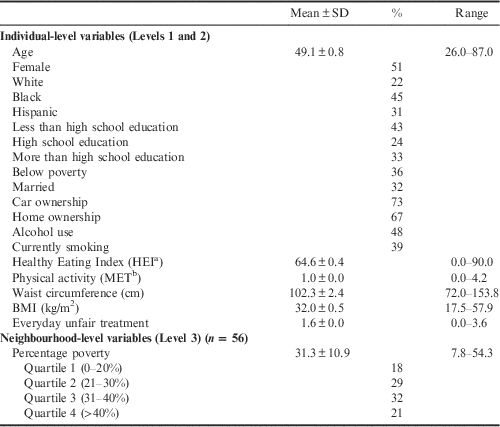
Complete data were available for 157 participants. The descriptive characteristics of the sample in 2002/2003 are presented in Table 1. The mean waist circumference was 102.3 cm (SD=2.36), the mean level of everyday unfair treatment was 1.6 (SD < 0.01) and the mean neighbourhood poverty level was 31.3 (SD=10.90).
Weighted descriptive characteristics for individual- and neighbourhood-level variables, Healthy Environments Partnership Community Survey, Detroit, 2002/2003, N=157

a HEI: Healthy Eating Index.
b MET: Metabolic Equivalent Task; 1 MET=1 kcal/kg.h=4.184 kJ/kg.h.
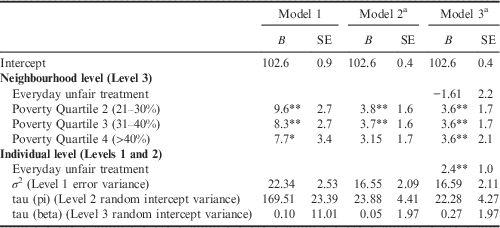
In Table 2, Model 1 shows the results for the first research question, ‘Is neighbourhood poverty at baseline associated with change in central adiposity over time?’ Participants who lived in neighbourhoods in the second (B=9.58, p<0.001), third (B=8.25, p=0.004) and fourth (B=7.66, p=0.030) quartiles of poverty had greater increases in central adiposity over time, compared with those in the lowest poverty quartile.
Waist circumference regressed on neighbourhood poverty and everyday unfair treatment, N=157
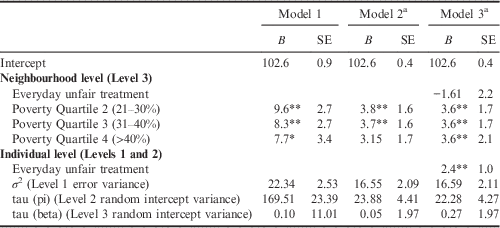
Control variables include individual age, gender, race/ethnicity, education, ratio of income-to-poverty, marital status, car ownership, home ownership, alcohol use, current, never or former smoker, modified Healthy Eating Index (HEI) and physical activity (MET).
a Models 2 and 3 adjust for BMI.
*p<0.05; **p<0.01.
Model 2 in Table 2 shows the findings for the second research question, ‘Is neighbourhood poverty at baseline associated with change in central adiposity over time after adjusting for BMI?’ The results show that neighbourhood poverty at baseline is associated with greater change in central adiposity over time among participants who lived in neighbourhoods in the second (B=3.79, p=0.025) and third (B=3.73, p=0.024) quartiles, compared with those in the lowest poverty quartile. Increases in central adiposity were marginally significantly greater for those in neighbourhoods in the fourth quartile (B=3.15, p=0.074), compared with those in the lowest poverty neighbourhoods.
Model 3 of Table 2 shows the findings for the last research question, ‘Are perceived discrimination and neighbourhood percentage poverty associated with changes in waist circumference?’ The results show that everyday unfair treatment at baseline and neighbourhood poverty each are associated with changes in waist circumference over time. When discrimination was included in the models, residents of neighbourhoods in the second (B=3.62, p=0.039), third (B=3.640, p=0.044) and fourth (B=3.61, p=0.048) quartiles of neighbourhood poverty were more likely than those in the lowest poverty neighbourhoods to have greater increases in waist circumference over time. Everyday unfair treatment was positively associated with changes in central adiposity over time (B=2.36, p=0.020) above and beyond the effects of neighbourhood poverty, in fully controlled models. The patterns were similar for models controlling for BMI at baseline.
Discussion
This analysis yields three main findings. First, it adds to the body of evidence suggesting associations between neighbourhood poverty and increases in central adiposity over time. In particular, residents of neighbourhoods in which 20% or more of residents had household incomes below the poverty line were more likely to experience greater increases in central adiposity over time. Second, residents of neighbourhoods in which 20% or more of households had incomes below the poverty line were more likely to experience greater increases in central adiposity over time, even after adjusting for BMI at baseline. Finally, neighbourhood poverty and everyday unfair treatment were independently associated with increases in central adiposity.
A substantial body of evidence links neighbourhood poverty to reduced access to healthy foods (Powell et al., Reference Powell, Slater, Mirtcheva, Bao and Chaloupka2007), contributing to dietary practices linked to obesity (Lovasi et al., Reference Lovasi, Hutson, Guerra and Neckerman2009), and there is some evidence that neighbourhoods with higher rates of poverty may be more likely to be less conducive to physical activity (Estabrooks et al., Reference Estabrooks, Lee and Gyurcsik2003; Schulz et al., Reference Schulz, Kannan, Dvonch, Israel, Allen III and James2005; Kwarteng et al., Reference Kwarteng, Schulz, Mentz, Zenk and Opperman2013), another important contributor to obesity. However, this study’s findings suggest that neighbourhood poverty is associated with increased risk for central adiposity over time, above and beyond individual health-related behaviours (i.e. alcohol use, smoking, healthy eating and physical activity). These results suggest that pathways linking neighbourhood poverty and central adiposity are not limited to effects on behavioural pathways. They are consistent with the hypothesis that effects of neighbourhood poverty on obesity risk may extend beyond these behavioural influences. Several studies have suggested that neighbourhood poverty is associated with exposure to social and economic environments that are conducive to psychosocial stress (Fuller-Rowell et al., Reference Fuller-Rowell, Evans and Ong2012; Schulz et al., Reference Schulz, Mentz, Lachance, Johnson, Gaines and Israel2012; Williams Shanks & Robinson, Reference Williams Shanks and Robinson2013). For example, living in a high-poverty neighbourhood is associated with a range of negative factors, from pollution and environmental toxins to violence exposure and over-policing (Evans, Reference Evans2004). The associations between neighbourhood poverty and change in central adiposity over time shown in these models are significant after accounting for behavioural indicators associated with obesity, lending credence to pathways that include factors above and beyond those that shape health-related behaviours, such as those associated with psychosocial stress.
Together, the findings reported here are consistent with the theory that both social and economic environments shape obesity risk. They add to a small but growing body of evidence suggesting positive associations between perceived discrimination and obesity (Cozier et al., Reference Cozier, Wise, Palmer and Rosenberg2009, Reference Cozier, Yu, Coogan, Bethea, Rosenberg and Palmer2014; Hunte, Reference Hunte2011), and extend previous research by showing that, when included in models together, neighbourhood poverty and perceived discrimination are each associated with increased central adiposity. These findings suggest that urban populations that experience both higher rates of neighbourhood poverty (i.e. 20% or above) and higher levels of perceived discrimination may be particularly at risk of increases in central adiposity and its associated adverse health outcomes over time. Furthermore, the results suggest that these effects travel through distinct pathways, suggesting that efforts to intervene should consider both routes.
This paper has several limitations. First, it focused on the independent associations between neighbourhood percentage poverty and everyday unfair treatment and central adiposity. It is possible that other measures of neighbourhood context, such as neighbourhood racial composition, may further help to characterize pathways to increased risk of obesity among urban populations over time. Future studies should consider additional measures that may influence these associations. In addition, not all potential pathways linking neighbourhood poverty to central adiposity were measured. Future studies may consider accounting for food and physical activity environments, as well as contexts contributing to psychosocial stress, in order to disentangle the pathways through which neighbourhood poverty influences central adiposity over time
In conclusion, concentrations of poverty and perceived discrimination at baseline were each found to be positively associated with increased central adiposity over time in this multi-ethnic sample in Detroit, MI, USA, in models that included both measures. These findings suggest that both social and economic environments influence the patterning of central adiposity and underscore the importance of addressing the factors that contribute to high concentrations of poverty and heightened experiences of discrimination in taking action to address obesity. Efforts to address high concentrations of neighbourhood poverty and discrimination are imperative to reduce persistent disparities in central adiposity. In addition to their many other social and economic benefits, interventions that improve economic environments and reduce high concentrations of poverty in predominantly NHB and Hispanic neighbourhoods in US cities, and that address the social forces that contribute to interpersonal discrimination, can contribute to decreases in central adiposity in communities who currently experience a high risk of obesity and related adverse health outcomes.
Acknowledgments
The Healthy Environments Partnership (HEP) (www.hepdetroit.org) is a community-based participatory research partnership affiliated with the Detroit Community-Academic Urban Research Center (www.detroiturc.org). The authors thank the members of the HEP Steering Committee for their contributions to the work presented here, including representatives from Detroit Department of Health and Wellness Promotion, Detroit Hispanic Development Corporation, Friends of Parkside, Henry Ford Health System, Warren Conner Development Coalition, University of Michigan School of Public Health and community members. The study and analysis were supported by the National Institute of Environmental Health Sciences (NIEHS) (R01ES10936, R01ES014234), the Promoting Ethnic Diversity in Public Health Research Education Project (5-R25-GM-058641-11), the Rackham Merit Fellowship, Rackham Graduate School, University of Michigan, and a Summer Mentored Writing Award through the Rackham Faculty Allies program at the University of Michigan. The results presented here are solely the responsibility of the authors and do not necessarily represent the views of NIEHS, the Promoting Ethnic Diversity in Public Health Research Education project, Rackham Merit Fellowship or the Rackham Faculty Allies program. This analysis was also supported by the Aetna Foundation, a National Foundation based in Hartford, Connecticut, that supports projects to promote wellness, health and access to high quality health care for everyone. The views presented here are those of the authors, and not necessarily those of the Aetna Foundation, its directors, officers or staff.