Introduction
When, in the summer of 2018, the United States of America threatened to leave the World Health Organization in opposition to a resolution promoting natural breastfeeding, the director of the Global Health Centre in Geneva asked rhetorically: ‘if you can't agree on health multilateralism, what can you agree upon?’Footnote 1 The international disagreement indicated how far participants were from any kind of consensus on ‘health multilaterialism’. Although motivated by commercial milk-formula corporations with interests in other countries, some US representatives also argued that the natural breastfeeding movement shames working mothers who need to contribute to the modern economy. In other words, the material culture of child-rearing intersects with commercial interests and cultural habits; political and cultural factors complicate the mutability of medical standards regarding infant nutrition. A century ago, US missionaries pioneered an early form of ‘health multilateralism’ through the introduction of better baby contests, which were in turn adapted by Chinese Christians and government officials. These contests aimed to set new public-health standards that would usher China into an era of modernity, but just as often ran into cultural sensitivities and social norms. In many cases, ‘modern’ industry and journalism were even more likely than politics to facilitate the continued valuation of plump boys as the ideal standard.
With the introduction of new scientific information in the early twentieth century, notions of child-rearing began to converge in unusual ways around the world. Given the transnational nature of Shanghai's International Settlement, it was a conducive place for the intersection of different ideas. Just a few city blocks between the International Settlement and the Chinese city could signal the cultural difference among continents.Footnote 2 Shanghai's political jurisdictions thus created distinct ethnic enclaves, and yet modern trends began to cut across lines of empire and race. In the 1920s, at the same time as British mothers photographed their bonny lasses in Shanghai to send to a contest across the British empire, Chinese mothers were also carrying their little treasures to better baby contests hosted by ‘the Chinese Y’. Most histories of the YWCA reference in passing the popularity of better baby contests but, with few notable exceptions, better baby contests in China have been understudied, especially as a subject of modern child-rearing in cross-cultural contexts.Footnote 3
Better baby contests were part of a transnational effort to ‘save children’ in the context of high infant mortality rates across the globe in the early twentieth century. As early as the 1910s, Western missionaries introduced baby contests to China for many of the same reasons that motivated ‘child savers’ in the United States of America—especially to encourage more hygienic child-rearing practices and to ameliorate high infant death rates. YWCAs and other mission organizations used these contests to spread Western medical knowledge about infant and maternal health in China. Whereas child savers in the United States of America were implicitly, rather than explicitly, Protestant, Western missionaries introduced the contests in a larger effort to ‘Christianize’ Chinese society more generally. Implicit in that schema was the need for modern, Anglo-American, hygienic practices and the Western commercial goods (like milk powder and toothbrushes) that would provide the material conditions deemed necessary for a modern childhood.
Missionaries, milk-powder companies, news outlets, charity organizations, and government agencies all brought their own special concerns to baby contests, which were sometimes reflected in their different evaluative criteria and categorizations of ‘infant’, ‘toddler’, and ‘child’. As a general pattern, one might see the ‘well-baby’ or ‘better baby’ contests as sites of medical intervention and preventative measures, and the ‘child-health contests’ as public displays of health and vigour; however, both combined the appeal of youth with modern scientific information about healthcare and a new spirit of democratic competition. Attention to childhood, as a site of scientific and democratic improvement, was informed by trends stressing the importance of ‘New Youth’ in the New Culture Movement. In the aftermath of the New Culture and May Fourth Movements in 1915 and 1919, and in the construction of Nationalist Party control over the Republic of China after 1927, Chinese reformers introduced their own political and cultural goals to better baby contests. Chinese elites held their own better baby contests under the auspices of the National Child Welfare Association (NCWA)—an organization founded by Chinese converts and funded at first by US Christians. The NCWA incorporated contests and other child-hygiene programmes into their establishment of a new holiday: Children's Day.Footnote 4 With strong ties to the YMCA, Chinese reformers in the Mass Education Movement also began to convene better baby contests in the countryside as part of their larger effort to reform rural areas.Footnote 5 When newly constructed municipal departments of public health (衛生局 weishengju) hosted better baby contests, public officials often omitted mention of the missionary origins of the contests. Instead, advertisements promoted preventative healthcare and positive nourishment as forms of Chinese nationalism. Patriotic rhetoric pervaded both commercial and charity better baby contests and increased as China entered into military conflict with Japan.
In the process of China's transformation from empire to nation state in the early twentieth century, the case of better baby contests is relevant, and at the intersection of universalizing claims of public health and the rising push of Chinese nationalism. Like many other modernizing reforms, better baby contests married these two impulses, of the ‘scientific’ and the ‘political’. This article examines the indigenization of better baby contests, and the ways in which they mediated between universalizing (or perhaps also racializing) scientific principles and nationalistic (as well as humanistic) political impulses. Beginning with the importation of the contests, by missionaries, from abroad, the article then explores the contributions of multiple actors, with different agendas, before and during the Second World War. In terms of method, the article examines evaluation schema as a reflection of new values of modern childhood, which also reflect a larger context of the increased value of the category of infancy and childhood in nationalist rhetoric as well as social reform. Even more clearly than other arenas of reform, childhood, I claim, defined the realm of future-oriented potential and reflected hopes for the nation's survival.
Missionary origins and the social gospel
When members of Shanghai's diverse international community attended a health exhibit, co-hosted for the first time by the YMCA and YWCA in 1929, they encountered a wealth of information in a variety of formats, from posters, to lectures, to plays. Entering Martyrs Memorial Hall in the ‘Chinese’ YMCA on Sichuan Road, some might have been struck by one particular poster: at the end of the Opium Wars, a British general forcing a Qing official at gunpoint to sign the Treaty of Nanjing, granting cession of Hong Kong in 1842, and the Treaty of Tianjin in 1858, which included the provisions establishing semi-colonial treaty ports like Shanghai's International Settlement. Although British subjects criticized the inclusion of the posters (sponsored by the Anti-Opium Society), Christian evangelism owed a great deal to the Western military supremacy in Asia, especially in a context in which Westerners tried to associate their culture with scientific and technological progress. The early history of Western attitudes toward Chinese medicine profoundly impacted subsequent public-health campaigns like the one at the Y. According to Ari Heinrich, even before the unequal treaties, Jesuits discussed Chinese smallpox inoculation in ways that anticipated the stereotype of the ‘sick man of East Asia’.Footnote 6 By pathologizing the Chinese body, missionaries justified intervening in not just public health, but also Chinese society more generally.Footnote 7 Western victories in the Opium Wars lent credence to the notion of their superior physical training and military education. Once missionaries won, through concessions gained in the Treaty of Tianjin, the ‘right’ to evangelize in China, they established hospitals, schools, and churches to circulate their notions of health and civilization. Accompanying Western imperialists, missionaries inflicted what scholars today call the ‘epistemic violence’ of dismantling Chinese traditions, especially in treaty ports.Footnote 8
In the late nineteenth and early twentieth centuries, missionaries interpreted Confucian ideology and patriarchy as the lynchpin of systemic injustice and even pervasive maladies. Missionaries condemned Confucianism for privileging male offspring as those uniquely able to offer sacrifices to ancestors along the patrilineal line of descent. Many missionaries argued that Confucian-style education unnecessarily stunted the growth of Chinese boys (thus resulting in the ‘sick man of Asia’); Confucian patriarchs also purportedly neglected girls. In other words, missionaries generally described a metonymy between either the bound female foot or the hunched child's body with the oppression of Confucian patriarchy.Footnote 9 Missionaries prescribed not only Christian salvation, but also Western medical science, for Chinese bodies and souls.
By the time of the 1929 health exhibit, medical missionaries had convinced at least the leaders of the Chinese Y that Western metrics were applicable to the Chinese population. Returning to the event, we find that there was something for everyone. Mothers, in particular, were invited to go to the Child Health Centre, set up temporarily in the directors’ room, where babies were measured by nurses from the Margaret Williamson Hospital. The nurses then gave mothers little gifts of soap, talcum powder, and baby foods. Mothers could then enter a large lecture room where doctors explained hygienic childcare practices. Women could also watch sewing and cooking demonstrations or buy subsidized samples of ‘hygienic clothing’ at only five coppers each. The diverse crowd bustled as individuals sought out entertainment, knowledge, services, or free and/or commercial samples.Footnote 10 The event displayed, in miniature, Chinese Christians’ circulation of new knowledge as ‘both intellectual venture and lived experience’.Footnote 11
Missionaries could see the value of women's contributions to scientific interventions in domestic life—and understood that, ideally, such work should be undertaken by mission-trained Chinese women doctors like Hü King Eng (1865–1929) or Mary Stone (1873–1954). Taboos against female missionaries lessened especially after the US Civil War.Footnote 12 The anti-Christian Boxer Uprising of 1900 spurred Americans to support evangelical missions ‘in a campaign for American influence’.Footnote 13
When the revolution of 1911 overthrew the Manchu Qing dynasty, missionaries further articulated the connexions between personal well-being and national uplift for the new republic. Elizabeth Littell-Lamb has noted that medical critiques of traditional Chinese practices were even more pointed when directed at women; by liberating Chinese women from foot-binding and emancipating them to enter public life, missionaries argued that they would potentially uplift Chinese society as a whole.Footnote 14 As one analogous example, missionary and patriotic narratives of foot-binding, Rebecca Karl notes, have subordinated women's liberation to national interests; Karl instead examines ‘how everyday practices came to be reconstrued, discursively and materially, as a historical problematic in the global context of China's colonial modernity’.Footnote 15 Likewise, better baby contests illustrate how everyday practices, like feeding and bathing infants, were reinterpreted according to scientific metrics of public health in an imagined international competition to achieve modernity.
When YWCA women brought better baby contests to China, they were tapping into larger global trends to address the concerns of industrialization and its ill effects especially on public health and infant mortality.Footnote 16 Those Christians most influenced by the progressive era developed a notion of the ‘social gospel’—a ‘this-worldly’, post-Millenarian movement to improve the material welfare of the poor. The social gospel was readily adopted by the YMCA in China, especially its Chinese members.Footnote 17 In addition to the influence of the progressive era and social gospel, better baby contests may also be viewed in the context of a longer-term, and more widespread, ‘social engineering approach to Christian work’ that sought to improve physical conditions as a means of spiritual uplift.Footnote 18
In the missionary context, better baby contests were deeply intertwined with campaigns for personal and public health. The YWCA incorporated better baby contests into ‘baby welfare exhibits’.Footnote 19 As early as the fourth anniversary of the Tianjin YWCA in 1917, Abby Mayhew, the national secretary of physical education of the YWCA in China, hosted a series of talks on child welfare and public health, and launched a health club that hosted better baby contests.Footnote 20 Elizabeth Littell-Lamb has placed Mayhew in the context of the emergence of a modern physical culture for the ‘new woman’.Footnote 21 In addition to inviting Chinese women into public life, missionaries converted women as a means to gain entry into the Chinese home.Footnote 22 As Helen Schneider has shown, household management assumed new political dimensions as China's ‘new women’ sought to help run the ‘nation's house’.Footnote 23 Amy O'Keefe analyses ‘the Home Movement’, organized by the transnational and ecumenical National Christian Council, to illustrate the diversity of approaches (beyond the purely political or state-centric) that progressive reformers could employ to improve the material conditions of domestic life.Footnote 24
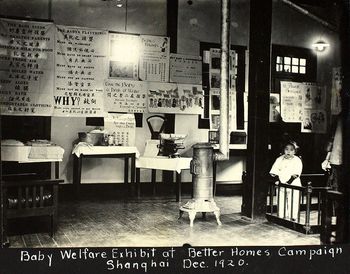
Better baby contests allowed doctors and nurses to publicize medical information and offer free medical services, especially as a part of a larger effort to attract converts.Footnote 25 As early as 1912, the Shanghai YWCA hosted lectures, given by local doctors, about public health.Footnote 26 The Women's Committee of the YWCA used better baby contests, as a part of ‘better baby week’, to attract women to join mothers’ clubs.Footnote 27 In 1920, The Association Progress (青年進步 Qingnian Jinbu), the official journal of the Chinese YMCA, reported on better baby contests as a facet of public-health campaigns.Footnote 28 There was always an instructional element of the better baby contests, especially when held at Western-style midwifery schools.Footnote 29 As we can see from a photograph in the archive of a Western YWCA missionary (see Figure 1), posters, with bilingual slogans, reminded parents and nurses of modern child-rearing techniques as they weighed children and played with them. Moving pictures, lantern slides, and lectures were an important part of missionary innovations in public-health campaigns.Footnote 30 By 1933 in Chengdu, under the auspices of the YMCA, the YWCA, the Red Cross Society, and the local board of health, three days of National Health Week were ‘devoted to women and children’ and included a baby contest, in which mothers were shown models of the proper food, clothing, and furniture for infants and toddlers.Footnote 31 These displays were clearly aimed at welcoming newcomers. The YWCA's weekly clinics were ‘open to all mothers whether members of the YWCA or not’.Footnote 32 In keeping with the rising popularity of the social gospel among Chinese converts, the YWCA circulated scientific knowledge, which was increasing in value as an emerging political trope.
‘Baby welfare exhibit at Better Homes Campaign, Shanghai, Dec. 1920’. Source: Box 2, Martha Job Collection, Hoover Institution Archives.

Meanwhile, the First World War had helped to reinvigorate the social gospel around the world.Footnote 33 For example, the American Red Cross organized hygiene exhibitions to impart ‘scientific living’ to the ‘mothers of France in the care of their children’.Footnote 34 These trends were reported by Rachel Louise Fitch of the American YWCA. Although seemingly far away, the First World War also influenced efforts to modernize the Chinese countryside, especially those connected to international Christian organizations. The YMCA hired Chinese-educated youth like Yan Yangchu (1893–1990, English name James Yen) to minister to the 140,000–200,000 Chinese labourers in France. Yurou Zhong has examined Yan's new literacy programme among Chinese labourers, and the workers’ subsequent essay-writing contest; contests were integral to self-help and national uplift directed by modern, Western-educated ‘semi-colonial’ elites. As with other forms of competition, such as sports and better baby contests, middle-class Chinese reformers sought to instruct and even enlighten the Chinese lower classes but, as Zhong shows, their lessons could unleash conflicting valuations of the Western ‘Enlightenment’.Footnote 35 Because of the prominence of Yan in the rural-reform movement, which helped to popularize better baby contests, it is also possible that these networks helped to transmit and even generate new ideas and techniques for better baby contests.Footnote 36 At the very least, better baby contests would become an important practice in the Mass Education Movement in the Chinese countryside.
Christian converts also brought better baby contests, along with other reforms, to the Chinese countryside. For example, Fukien (Fujian) Christian College required students to attend a civic welfare course and to fulfil a community-service credit. In 1922, the college cooperated with the local hospital to hold a baby contest in a nearby local village.Footnote 37 The students also used the opportunity to start local Boy Scout troops and to evangelize among the men. They also sought to improve housing conditions for increased ventilation and more properly distributed bathrooms in their homes.Footnote 38 These efforts mirror those of the urban YMCA in China,Footnote 39 but were introduced in terms of agricultural outreach. This context is perhaps the closest to the American better baby contests, as they had originally appeared in Midwestern state fairs. Better baby contests had probably originated with new methods of agricultural science, as were introduced in US state fairs and urban exhibitions.Footnote 40 American farmers were admonished that child-rearing was just as important as breeding livestock—and thus required impartial scientific methods of evaluation and improvement.Footnote 41 In keeping with the eugenic concern for ‘better stock’, judges tended to reward Caucasian traits.Footnote 42 According to Gerald Thomson and Alisa Klaus, American contests were part of a larger eugenic struggle against ‘racial suicide’ to curb the effects of immigration.Footnote 43 Given this background, it might at first seem odd that US missionaries would introduce the contests to non-Caucasian peoples, but it is important to acknowledge that reformers may have extracted techniques from their original contexts.
Social gospellers potentially combined and coordinated amalgams of reforms and outreach. While Fukien Christian College provides an example of mobilizing men, agricultural outreach also sought female mobilization. Helen Schneider shows that extension projects also included a dimension of domestic science.Footnote 44 In 1930, the International Mission Council founded the Agricultural Missions Foundation, which subsidized and facilitated improvements to the rural family. This organization published a variety of pamphlets, written by missionaries. For example, Irma Highbaugh's pamphlet, ‘A tool used in investigating Chinese family relationships’, included a list of questions to ask parents at Christian rural health stations.Footnote 45 Many aspects of these contests—such as domestic hygiene and data collection—were, meanwhile, adopted and adapted by further efforts, on the part of the Chinese public, to indigenize the contests.
Scientific child-saving and interventions in child-rearing
Sparked by then-president of the republic, Yuan Shikai (1859–1916), and his reinstitution of Confucian-style imperial rituals in 1915, the New Culture Movement has often been considered a watershed moment in which Chinese elites rejected Confucian traditions and embraced modernization via ‘Mr Science’ and ‘Mr Democracy’. As one example, the slogan ‘Save the children!’ integrated both the scientific modernization of child-rearing (Mr Science) with the increase in the political status of children (Mr Democracy).Footnote 46 The ethos of ‘New Culture’ was so pervasive that scholars have begun to recognize the diversity of social actors who engaged with new ideas and institutions in the 1920s.Footnote 47 Elizabeth Forster has suggested redefining the New Culture Movement as a ‘buzzword’, popularized after 1919, instead of a coherent ideology, precisely because it would allow us to recognize, further, the fluidity of New Culture ideas across a wide political spectrum, even before 1915.Footnote 48 In the May Fourth Movement of 1919, ‘New Youth’ took to the streets to protest against proposed incursions into Chinese sovereignty at the Treaty of Versailles; students helped to further popularize the notion that the young, rather than their elders, would save the Chinese nation.Footnote 49 Western Y women and, to an even greater degree, Chinese Christians appropriated some of these ideas—especially regarding Chinese nationalism, New Youth, and modern science—and synthesized them with social-gospel tactics to survey and improve China's material conditions.
In keeping with the need for ‘Mr Science’ in the New Culture Movement, better baby contests introduced Chinese women to new definitions of health. In concrete terms, that meant eschewing traditional practices of nurture in favour of new metrics of nutrition. Protestant missionaries had tried to persuade Chinese mothers against feeding an infant until its stomach was at maximum capacity.Footnote 50 Here, missionaries followed then-current American trends in child-rearing. In the United States of America, ‘baby health contests shockingly alerted mothers that more fat did not mean better health’; in fact, feeding a child too much cream would build only fat, rather than bone and muscle.Footnote 51 By rewarding the most statistically average child rather than the largest child, better baby contests helped to dispel the correlation between size and health.Footnote 52 US better baby contests thereby challenged popular norms favouring plump infants. Jia-chen Fu has shown that focus on childhood health coincided with the introduction of scientific metrics in China.Footnote 53 Modern doctors challenged the folk wisdom of grandparents and, as Susan Glosser has demonstrated, political visions shifted from the (idealized, if not always actualized) multigenerational, extended family to the Western-style conjugal family, or ‘small family’ (小家庭 xiao jiating).Footnote 54
Although the focus of the ‘small family’ was on the conjugal family unit, rather than small numbers of family members per se, by the 1920s, some Chinese elites began to consider family planning as a marker of modernity. For example, when birth-control advocate Margaret Sanger (1879–1966) spoke in Shanghai in 1922 and 1936 during tours of East Asia, she helped to galvanize support for population control.Footnote 55 She spoke at the Shanghai YWCA and may have influenced the relatively progressive organization to distribute information about birth control to factory women.Footnote 56 These pro-contraceptive notions dovetailed with neo-Malthusian trends among Chinese intellectuals in the 1920s. Many blamed China's overpopulation for economic, social, and even political problems.Footnote 57 Even child advocates on the Shanghai International Settlement's Child Labour Commission (1922–24) identified China's ‘large birth rate’ as a contributing factor to child-labour abuses, since ‘the population ever tended to outstrip the means of substance’ and families needed to rely upon the economic contributions of children.Footnote 58 This context motivated the perceived need for positive eugenics via increased investment in scientifically informed child-rearing.
This context encouraged Chinese Christians (like Chinese more generally) to embrace Darwinian and neo-Lamarckian notions in an effort to ‘save the nation’. Juliette Chung has demonstrated that the Chinese eugenics movement, supported by the Shanghai YWCA, generally emphasized nurture over breeding as a means of improving the Chinese folk; she thus argues that the Chinese eugenics movement should be evaluated within an East Asian context (including Japan), outside of the trends of Euro-America.Footnote 59 These statements could also be attributed to the widespread popularity of Darwin and social Darwinism in China more generally.Footnote 60 The YWCA journal The Green Year (青年 Qingnian, also connoting ‘youth’) introduced the ideas of Darwin and Freud to Chinese women as methods for racial and national advancement. For example, in those pages, Wu Hanyong began an essay on the Second Nanjing Baby Contest in 1930 with the statement ‘we cannot willingly continue to accept’ the humiliation of the sick man of East Asia; reforms, such as physical education in elementary schools, displayed the ‘spirit of our folk’, but only started in the ‘middle of the road’. Wu continued: if one wanted to truly improve the ‘innate character of the folk’ (民族的本質 minzu de benzhi), one needed to begin with infants from birth (自然要從才由母親脫胎出來的嬰孩入手 ziran yao cong cai you muqin tuotai chu lai de ying'hai rushou).Footnote 61 As Wu Hanyong's words illustrate, it was to start with preventative health and positive nourishment for children.
Better baby contests introduced scientific rather than aesthetic criteria (which might equate cuteness with baby fat).Footnote 62 Whereas beauty contests prized conventionally pretty children, baby contests scientifically measured medically healthy children. A photograph of a better baby contest depicts a YWCA woman carefully weighing an infant in a wicker basket as Chinese women look on (see Figure 2); such scientific measurements as weight and length brought quantitative metrics to the evaluation of children. These priorities were reflected in stated evaluative criteria. For example, on scorecards in Anhui, the highest accolade was ‘healthy and complete’ (jianquan), and the next highest designation was ‘healthy and beautiful’ (jianmei), followed simply by ‘healthy’ (jian).Footnote 63 The organizers therefore prioritized ‘completeness’ over ‘beauty’ as an evaluative criterion. These criteria reflect larger trends to value ‘healthy beauty’ over pale-faced ‘sickly beauty’ in not only children, but also women, as Yunxiang Gao has noted in her study of female athletes and sporting culture in China. Gao shows that this new culture of female athleticism was celebrated in contemporary film and visual culture to reinforce the message that women should embrace exercise and strength.Footnote 64 It stood to reason that such women should also encourage a strong, hearty kind of health in their offspring.
‘A missionary weighs an infant at a better baby contest’. Source: Box 6, Folder: Album 2, Martha Job Collection, Hoover Institution Archives.

Notwithstanding the emergence of this new culture of athleticism, it was very difficult to discard traditional standards of beauty. As was also often the case with public-health campaigns, images did not always appropriately reinforce medical content.Footnote 65 Photographs of contest winners, in both the United States of America and China, often showcased plump, traditionally attractive children. Chinese journals also reproduced photographs of fat, cheerful American children when circulating information about US better baby contests.Footnote 66 American models thus tended not to challenge traditional norms about overfeeding as much as missionaries or reformers might sometimes have supposed (or as much as their texts purported). One reason these images spread so widely was that the winners were so ‘charming’ and ‘beautiful’.Footnote 67 Given that the conventional attractiveness of the children elicited interest, it was perhaps difficult for the contests to overturn, completely, prevailing assumptions about what constituted good health, especially in terms of visual appeal.
The contests also helped to introduce new standards for emotional well-being and healthy behaviour, especially in the context of a new culture of youthful vigour in China.Footnote 68 Upon arriving in China in the nineteenth century, Western visitors had been impressed by the ‘blank, dead-wall Chinese stolidity’ among adults, which children (with the benefit of Western education) might yet escape.Footnote 69 This staid sociability was rooted in Cheng-Zhu Confucian traditions of stifling emotion at its root, and also of praising children for assuming mature qualities. The founder of the journal New Youth, Chen Duxiu, likewise criticized Confucian parents for suppressing the rambunctious liveliness of childhood.Footnote 70 Instead, as Mingwei Song has shown, Chen insisted that youth should have the qualities of vigour necessary to save the nation.Footnote 71
Better baby contests helped to promote a modern culture of ‘lively’ childhood in China, in ways that intersected with the movement for ‘new youth’ in China. For example, rural reformer Zhang Huaiqing (1874–1951) hoped to awaken the ‘liveliness and intelligence’ (活潑聰明 huopo congming), as well as the ‘innocence and sentiment’ (天真浪漫 tianzhen langman) of Chinese children.Footnote 72 Such statements echo the proclamations of China's revolutionary ‘New Youth’. Thus, Zhang shared New Culture rhetoric about the problems of Confucian culture and the need to reorient Chinese society toward youth. However, in appropriating Western notions, Zhang sentimentalized the innocence of childhood in ways that resonated more particularly with American-oriented coastal Chinese elites.Footnote 73 Better baby contests illustrate the ways in which Chinese child savers and Christians echoed May Fourth discourse concerning modern childhood.
‘Liveliness’ as an evaluative criterion was both distinctly modern (fitting transnational norms for a happy childhood) and distinctly Chinese (as an especially new cultural value). In contrast to the suppression of ‘liveliness’ in Cheng-Zhu Confucianism, ‘liveliness’ often numbered among the categories of evaluative criteria at better baby contests in China.Footnote 74 New Culture political discourse thus introduced an important difference between American and Chinese baby contests. According to Annette Dorey, US baby contests instead recognized calm infants who were more compliant in the examination process.Footnote 75 These qualities would also be rewarded in America's new, large ‘Lancasterian’ schools (which reduced costs through peer-tutoring in a single large room), so it behoved US parents to train their children to sit still.Footnote 76 In contrast, missionaries had criticized the Confucian educational system for its overemphasis on erudition, memorization, and pressure; therefore, they had recommended physical education, creative play, and competitive sports as antidotes. With the founding of the republic, Chinese sought ‘rejuvenation’. It was thus China's unique political situation that called for youngsters to be less stolid, or even well-behaved. The perceived value of mischievousness probably had its limits, even in the context of the (limited) kindergarten movement along the model of the United States of America. Nevertheless, the stated emphasis on children's ‘liveliness’ surely resonated more deeply with Chinese domestic political concerns, about encouraging vim and vigour among China's youth than with American models.
Better baby contests also subtlety challenged traditional Chinese biases in favour of boys. Just as primary-school educators often required girls to have natural (rather than bound) feet,Footnote 77 judges of contests could also promote the notion that natural feet were healthy and normative. Organizers explicitly noted that parents were more likely to enrol boys than girls into contests. For example, at a better baby contest in Shandong in 1932, 565 children participated, 60.1 per cent of whom were boys and 39.1 per cent of whom were girls.Footnote 78 The fact that more boys participated in contests than girls could be a function of sex selection at birth, as well as a reflection of general cultural bias in favour of boys. The YMCA and YWCA, as well as Chinese elites, espoused the need to correct patriarchal norms favouring male children, who had traditionally been considered uniquely able to carry on the family line and to sacrifice to the family ancestors. By awarding prizes to girls, contest holders reinforced new gender norms promoting the status of girls.
Better baby contests targeted mothers who might consider themselves not only the ‘new woman’ in China, but also, indirectly, the somewhat less respectable ‘modern girl’. In the United States of America, child savers found, to their surprise, that flappers expressed interest in learning how to raise healthy babiesFootnote 79; so, too, in China, fashionable young women were amenable to instruction in scientific child-rearing. For example, in 1930, the Shanghai YWCA awarded the first-place prize to a baby girl, Chen Yingbao, and her mother, Mao Yue'e, a woman with a permed bob.Footnote 80 Likewise, the second Nanjing better baby contest also awarded a young girl whose mother shared her baby-doll bobbed hair.Footnote 81 Given that perms were, in some areas of China, an indication of prostitution,Footnote 82 it was remarkable that the YWCA celebrated the ‘modern girl’ as an image of ideal motherhood for consumption across the Sinophone world.Footnote 83
In both China and the United States of America, better baby contests help to illustrate the surprising ways in which the social gospel intersected with the rise of a new consumer culture. Although rejecting crass materialism, in their dedication to providing welfare, social gospellers ‘helped ease the transition from Protestant Victorianism to a secular consumer culture’.Footnote 84 Likewise, another undercurrent of better baby contests was to promote the material conditions and commercial goods deemed necessary to create the ideal physical environment for infants. For example, social gospellers criticized industrialization but also relied upon manufactured goods, like detergents, to help improve public health. In the United States of America, social gospellers like Mary McDowell (1854–1936) argued that domestic hygiene was among the ‘fundamental essentials of civilized life’, and required ‘clean air, clean food, clean streets and alleys, and homes that are more than shelters’.Footnote 85 The focus on modern hygiene in a comfortable home was a marker of middle-class sociability and upward mobility.
Like Western missionaries, New Culture reformers also saw modern materiality—indicators like ‘clean air, clean food, clean streets’—as manifest measures of modernity. Although reformers might have codified materiality in neat categories, Wen-hsin Yeh shows that, in the bustling economy of Shanghai, the fusion of material cultures created something vibrant and new—something less easily defined as either Western or Eastern, modern or traditional—but appealing, nevertheless, to consumers.Footnote 86 In other words, another implication of market forces was that commercial interests (and sometimes traditional values and aesthetics) competed with New Culture ideals of science and democracy. Drawing on the theoretical contributions of Henri Lefebvre and Harry Harootunian, the editors of the compilation Everyday modernity in China contend that ‘the subjectivity [that] modernity works to create is constantly attempting to prefect it, constantly denying or deferring recognition of the impossibility of modernity’.Footnote 87 These tensions are readily apparent in better baby contests, especially with the advent of commercial sponsorship and the need to satisfy consumer expectations of conventional health, but also to increase parental anxiety for children and subsequent willingness to invest in material goods to safeguard their health.
Sponsors with specific aims
Commercial sponsorship and contests as a platform for advertising
Missionaries were not the only foreigners to introduce or influence better baby contests; foreign businesses and international corporations competed to unlock the elusive ‘China market’ and to create demand for manufactured children's goods. As historian Lo Shuk Ying notes, with the introduction of economic sponsorship from milk-powder companies in the mid-1920s, commercialization ‘diversified’ baby contests.Footnote 88 Foreign milk companies, like the Vitamin Milk Company, the Quaker Oats Company, Nestlé's milk, and the Palmolive Peet Company, donated their own commercial goods as prizes to award at better baby contests.Footnote 89 Lo argues that the US corporation, the Mo-milk company, had lower medical standards and did less to disseminate scientific information—and more to advertise the salutary effects of their own manufactured products.Footnote 90 There could very well be tensions between corporate sponsors and medical experts. In the United States of America, judges noted that too much sugar in baby formulas could fatten infants without truly nourishing them.Footnote 91 It would be harder to make this point at an event sponsored by a milk-powder corporation.
Milk corporations and even print media sponsored baby contests as a means to increase their own publicity and revenue. Newspapers strategically placed notices for better baby contests alongside advertisements for sponsored products.Footnote 92 More importantly, flashy photographs often depicted the contest winners grinning widely with their prizes, thus subtly associating the children's health and happiness with the consumption of specialty products. As in the United States of America, baby contests thus served as platforms to promote a new market for children's products, such as small wicker chairs, dolls, toys, and baby carriages.Footnote 93 Around the world, manufacturers helped to reinforce the notion that a happy and healthy childhood required a certain level of (middle-class and modern) material comfort.
Child savers, including the YWCA, willingly cooperated with corporate businesses advertising their own products of somewhat dubious nutritional value. One reason baby contests so effectively demonstrated the benefits of powdered milk was that, in the context of a child-health exhibit, advertisements could incorporate some of the aesthetic and informational features of health posters. For example, in a photograph saved by a missionary (see Figure 3), a Chinese woman, carrying her infant, looks at a milk advertisement showcasing a fat, happy child. Although better baby contests were intended to address some of the problems associated with high infant mortality, these photographs showcased images of health and success according to traditional Chinese norms; such advertisements may not have adhered strictly to scientific rubrics, but they held an appeal that was conducive to popularizing the contests. Corporate sponsorship also helped to lower costs (by eliminating entrance fees and thus barriers to enter the contests, and so on).
‘A woman reads a Lactogen advertisement at a better baby contest’. Source: Box 6, Folder: Album 2, Martha Job Collection, Hoover Institution Archives.

Japan also influenced patterns of corporate sponsorship for child-health campaigns. Mark Jones has shown that, in Japan, department stores held child-health exhibits to promote new information about child health, as well as to persuade parents to consume clothing, food, and other specialty products for children, readily available for purchase on display nearby.Footnote 94 Through returned Chinese students from Japan, as well as through Y connexions, some of these ideas for visual displays may have also reached China.Footnote 95 As Ling-ling Lien has demonstrated, the Sincere Department Store brought Japanese marketing strategies to Shanghai by creating an actual ‘children's market’, complete with streets, and so on, within the store. The Sincere Department Store further ‘elected’ the children of prominent Chinese politicians as leaders of the ‘children's market’.Footnote 96 These measures, alongside the general ethos of the New Culture Movement, helped convince politicians that childhood was an issue of political importance.
The patriotic rhetoric of childhood, in turn, reinforced business interests. Susan Fernsebner shows that the Chinese ‘national goods movement’ helped to spur support for Chinese manufacturing of children's toys.Footnote 97 By aligning national goods with children's education, Andrew Jones demonstrates, New Culture elites sometimes conflated the production of ‘national products’ with the construction of modern Chinese childhood.Footnote 98 As the case of Wu Hanyong illustrates above, it was not just beneficial for one upwardly mobile family to offer its progeny an advantage; it was imperative to uplift the Chinese nation as a whole.
Notwithstanding the commercial dimensions of sponsored contests, the focus on commercial goods as prizes was actually meant to demonetize the contests. In the United States of America, reformers had replaced cash prizes with shields to reshift focus onto their children rather than the rewards.Footnote 99 Chinese organizers picked up on these currents. For example, when the mayor of Nanjing and the president of National Central University judged a baby contest in 1936, the first-prize winner received a silver shield, a bed, and a doll—materials to be enjoyed by the child rather than the parents.Footnote 100 This child-centred focus was especially important regarding the elevated status of childhood in the New Culture Movement. A so-called ‘modern’ childhood was distinctively ‘priceless’, requiring economic investment rather than yielding financial gain.Footnote 101
Print media also capitalized on the circulation of children's images in better baby contests. In 1937, The China Press solicited photographs for a better baby contest to be published and adjudicated through its pages. The China Press partnered with photography studios in order to lower the cost of admission for the contest. Readers could clip a coupon for a free portrait session for their children at one of six studios in the International Settlement, some in the vicinity of the Park Hotel and the YMCA.Footnote 102 The contest thus functioned to advertise both the paper and the studios among the Western-oriented cosmopolitan population, as well as to reinforce stereotypes that such parents (and readers) were raising their children in the correct, scientifically modern way. In addition to the majority of Chinese children, a Caucasian child occasionally entered the competition. Newspaper readers could vote on the most attractive child, identified by both name and number. With promises that the photographs would be seen by Hollywood agents, parents were urged to wonder: ‘Who knows but some Shanghai Shirley Temple, Baby LeRoy or Spankey MacFarland may be discovered!’Footnote 103 Surely, such messages of fame and fortune ran counter to the intentions of the original organizers of better baby contests, who had emphasized child health over profit; nevertheless, the intermingling of child health and parental reward was perhaps symptomatic of larger rhetorical trends to justify children's health as a means for other ends, such as national salvation. The ‘priceless child’ may have increased in value in the Republic of China, but was still valuated at a national cost (and also potentially numerically measured in contests).
Chinese charities, the public good, and the aim of data collection
Often lauded as the first organization of its kind in China, the NCWA was founded in 1928 by then-Minister of Industry Kong Xiangxi (1881–1967, English name H. H. Kung), who was also a Christian convert, a descendant of Confucius, and brother-in-law to Chiang Kai-shek, Sun Yet-sen, and TV Soong.Footnote 104 Lo attributes the popularization of baby contests to the NCWA.Footnote 105 The NCWA brought a much greater degree of scientific authority (through the commission of Chinese medical doctors and child experts) and political legitimacy (through cooperation with central government politicians and local government organs) to better baby contests, far beyond missionary evangelism or commercial events. As early as 1929, the NCWA, with US funding, included better baby contests in their own health campaigns for children, which included mass vaccinations and kite-flying.Footnote 106 Thus, as with YMCA events, the NCWA offered a variety of social activities to attract participants. Prizes and public demonstrations helped to enliven the atmosphere. The NCWA's journal Child Welfare Monthly (慈幼月刊 Ciyou yuekan) often reported on its better baby contests.Footnote 107
The NCWA eventually transformed these public-health campaigns, aimed at the poor, into a broader holiday: Children's Day. With the backing of its members, some of whom were prominent politicians like Kong Xiangxi, the association successfully lobbied local municipal governments, starting in Shanghai, to recognize Children's Day as a holiday. As a result of such lobbying, local zoos and movie theatres also provided free admission to children on Children's Day. The association thus helped to facilitate the possibility that factory workers, rather than simply the leisured class, could join the activities and benefit from the charitable aspects of the holiday, such as free baths and vaccinations. Children's Day was an extravaganza to celebrate and promote childhood with better baby contests, sporting competitions, Boy Scout marches, and other activities. These events thus put on public display the vigour of the rising generation as examples of positive nourishment and training.
Intertwined with a new consumer culture conducive to positive, scientifically driven child-rearing, Children's Day contained an element of extending or imposing middle-class values onto the poor. On Children's Day, elite children were encouraged to give red envelopes of cash to poor neighbours.Footnote 108 Children's textbooks and fashionable magazines depicted Children's Day as normalizing middle-class childhoods of leisure and consumption. Journals like the colourful Liangyou displayed winners of baby better contests as successful models for its middle-class readers.Footnote 109 Likewise, the NCWA's journal Modern Parents (現代父母 Xiandai fumu) celebrated middle-class child-rearing practices, and even reproduced the family portraits of influential politicians and businessmen (many of whom also donated to the charity).Footnote 110 The wives of prominent politicians often handed out prizes at better baby contests.Footnote 111 As with the Sincere Department Store's ‘children's market’, politically prominent families were projected as leaders.
Despite this seeming emphasis on positive models of nourishment, Chinese judges tended to interpret data collected from baby contests as indicating China's backwardness. As Jia-chen Fu has demonstrated, Chinese medical researchers continued to use height (as a form of size) to negatively evaluate Chinese schoolchildren relative to those of other nations, especially Japan.Footnote 112 Among Chinese evaluations of older children: ‘A normal, not deficient, Chinese body was a rare occurrence.’Footnote 113 Maura Cunningham has also shown that better baby contests frequently demonstrated the inadequacy of Chinese parents.Footnote 114 In contrast, YWCA medical doctors generally awarded high averages to infants and children.Footnote 115 After all, assigning a woman's child low marks (in front of her) was a delicate matter. This indicates that Christian judges were perhaps more motivated to give high scores when they wanted to build social relationships with mothers, as opposed to non-evangelical contests, where judges proposed to direct state policies.
Especially given government support for Children's Day, municipal and provincial Chinese governments soon began to support better baby contests.Footnote 116 Central planning could help standardize the events. The Ministry of Education planned events for Children's Day, such as the singing of national songs in its ceremonies, and also drafted the forms to evaluate children's health and wellness, as well as information about their families and backgrounds.Footnote 117 Government organizations helped to streamline the public events, which seem to occur on a relatively large scale. An early example of a state-sponsored better baby contest, the second annual better baby contest in Nanjing in 1930, clarified some of the logistical challenges and problems inherent in the event. Families flooded the hall. Chinese doctors evaluated not only infants and children (often in two ‘classes’ or groups based on their ages), but also their medical records. Chinese judges evaluated the children individually, and the process was lengthy. Even after two days, the judges had still not finished and extended the contest for another day. Parents protested that it was ‘unhygienic’ for the children to remain in such crowded conditions until sundown.Footnote 118 Issuing accusations of biased judging, some disgruntled parents walked out of the contest.Footnote 119 (Likewise, in the United States of America, parents also often complained about ‘immense crowds’ at baby contests, especially since such conditions seemed to contradict prevailing assumptions about the need for ventilation.Footnote 120)
In China, newspapers editorialized that the event required more organization and preparation in future years. Perhaps because of the unruliness of such events, Chinese organizers began to circulate announcements to prepare parents for the contests. Educational journals conscientiously explained the goals and evaluative criteria. Often, better baby contests devoted particular days and times to evaluating children of distinct age categories. Such arrangements reduced the waiting time necessary for the children and their families. In Nanjing in 1932, over 700 people registered to attend the better baby contest.Footnote 121 Thus, despite their frustration two years prior, parents continued to enrol in better baby contests, and responded positively to increased preparations for the events. The Nanjing Department of Public Health held, in conjunction with the Central Ministry of Social Affairs, 24 meetings to plan child-health contests in the period 1933–37.Footnote 122 Public-health administrators worked with the Central University of China to hold the contests in the university gymnasium and issued red ribbons to participants.Footnote 123 As Chieko Nakajima has noted, the Nationalist's Bureau of Medicine modelled their own public-health campaigns after those of the YMCA,Footnote 124 and this influence probably also included better baby contests.
From the mid-1920s to the 1930s, baby contests proliferated, especially in urban centres. Lo counts 23 contests, held by different actors, in Shanghai in the years 1928–37, or the decade the Nationalists were in power before the war. When the Shanxi Provincial Government held a better baby contest in Xi'an in 1934, more than 2,000 women brought their children to compete and 500 prizes were awarded.Footnote 125 Around the world, these contests allowed greater medical surveillance and population records.Footnote 126 Already in 1914, the head of the US Census Bureau exaggeratedly claimed: ‘Unless the American people wake up, China and Turkey will have satisfactory data for infant mortality long before the United States.’Footnote 127 This statement was of course intended to incite US domestic fear of Chinese and Turks, but the salient point was that government agents considered the contests an important technique for both data collection and national uplift.
Better baby contests were especially good venues for collecting information about rural families, who might be otherwise difficult to survey. Parents offered some resistance to the inquisitiveness of reformers. In the Shandong Mass Education Journal, organizer Liang Rongruo reported that many parents were angered by the lengthy interview process. Because many peasants were illiterate, organizers took turns interviewing parents in order to fill out all the necessary paperwork.Footnote 128 The forms included information not only about the feeding habits, medical histories, birth order, and biomedical details of the babies, but also about the ages and socio-economic backgrounds of their parents. While acknowledging some problems with survey data, organizers drew sociological conclusions after tallying the data. Reformers thus used better baby contests as a tool to research Chinese society.
By the 1930s, better baby contests had become a widespread technique for rural reform. The purpose of better baby contests was to improve children's health and elevate awareness of children's problems. For example, when a group of rural reformers vaccinated village people near Yutang, they saw the children were snivelling, covered in dirt, and bundled in heavy masses of clothing. Their immediate response was to organize a better baby contest and to use their vaccination tour as a promotional venue to inform villagers about the upcoming contest.Footnote 129 One can thus see how reformers often coordinated reforms, leveraging one activity (a mobile vaccination tour, perhaps more convenient for parents) as a vehicle to encourage another (a better baby contest, which required travel to the contest site). Kate Merkel-Hess has contextualized better baby contests as parallel to other reforms within the rural-reform movement.Footnote 130 Merkel-Hess rejects reformers’ arguments about the difficulties of intruding into home life without the benefit of the better baby contests; she persuasively argues that baby contests were more popular than other reforms (specifically regarding marriage selection), not because they were less intrusive, but because they employed better incentives.
Nevertheless, reformers themselves distinguished between intervention as information retrieval and intervention as decision-making. Better baby contests provided data that could be used sequentially for more interventionist reforms. For example, one organizer found that the traditional practice of pairing younger grooms with older brides was most prevalent in agricultural communities in the countryside.Footnote 131 Thus, the reformers used information, collected from the better baby contest, to justify the need for closing age gaps among parents. The aim to match the ages of spouses reflected a eugenic concern for better breeding, but was more intrusive to local match-making traditions and also less popular among villagers than better baby contests. In other words, baby contests were primarily a reform technique rather than a reform itself. Even the most basic baby contest was a means for administering medical exams. Although parents somewhat resisted lengthy questioning, baby contests eased access to sociological information, required to understand and then reform the Chinese family, whether that be improved nutrition, gender equality in families, or more even age pairing among parents. In other words, better baby contests celebrated the beauty and vitality of the young while potentially championing a number of different possible methods to achieve that good health.
Wartime and post-war baby contests
Nationalistic and patriotic justifications for better baby contests increased as China defended its territory against Japanese incursions. After the bombing of Shanghai in 1932, for example, Chinese reformers organized ‘Children's Year’ for a period spanning 1935–36.Footnote 132 With the outbreak of the War against Japan in 1937, the Republic of China revamped its efforts to connect children's health with national strength. Better baby contests had become a popular tool for a wide variety of social reformers, but the war helped to expose important differences in the symbolic meaning of childhood among different wartime communities.
The meaning of children's health was not fixed as better baby contests were held across the political spectrum, even under treaty-port and collaborationist regimes. For example, during the Second World War, the Shanghai Child Relief Association held a better baby contest that included 20 infants from refugee camps funded by the Federation of Charity Organizations.Footnote 133 The health of refugee babies ‘proved the good work being done by charity bodies’.Footnote 134 In other words, these examinations allegedly demonstrated, through transparent and scientific standards, whether or not charity organizations had adequately met the needs of refugees. At the same time, during the wartime occupation, the Japanese community in Shanghai also held baby contests, much as the British had in the International Settlement.Footnote 135 Thus, better baby contests helped to justify various different political regimes and raise the morale of a number of discrete communities.
The nationalist government also helped to form municipal preparatory committees for child-health contests, which communicated with government officials regarding the contests.Footnote 136 In a report to the Minister of Education Chen Lifu on the 1938 children's health contests in Wuhan, educational psychologist Zhou Shang emphasized the meaning and importance of the child-health contests, including the need to employ Japanese standards.Footnote 137 The government also regulated the qualifications of medical examiners, who were generally divided into those specifically for students and others for the masses.Footnote 138 In addition to normalizing evaluative forms, different levels of the Ministry of Education also circulated information about childhood development resulting from these contests, such as the distribution of height and weight by age for boys and girls.Footnote 139
Baby contests are a lens on the wartime intensification of concerns over China's potential racial extinction, as well as the increased intervention of the central government and Nationalist Party. For example, in 1939, the Nationalist Party of Tengheng county (in Yunnan province) published a book on child-health contests. Publishing the special edition in April to coincide with Children's Day, the authors alluded to both the Ellen Key's ‘century of the child’ and the Republic of China as authorities. The authors explained that, in ‘remote areas’ (邊區 bianqu), it was necessary to use child-health contests to disabuse parents of their ‘conservative’ notions that children were ‘private property’ (自己的私有物 ziji de siyouwu).Footnote 140 Like the NCWA, the county headquarters promoted children's health and happiness (幸福 xingfu).Footnote 141 These sentiments were repeated throughout the edited volume. At the same time, when the hosts of the child-health contests described the engagement of the entire population in total war, it was clear that the contests gained a sense of urgency because of the threat of national slaughter in wartime.Footnote 142
These fears of racial extinction helped to reinforce the dark side of criticizing China's ‘conservative’ parents and traditional practices. For example, in ‘The Better Baby Contest: Raising the Nation's Foundation’, government-sponsored journal editors in 1939 blamed China's backwardness among nations for its failure to protect the health and development of infants.Footnote 143 The same issue included a chart of infant mortality by nation, with China's as the highest, as well as Cheng Meiyu's recommendations for proper nutrition by age (with breastfeeding recommended once every four hours for infants within the first year of life).Footnote 144 Journalists routinely reported that most babies failed to meet basic standards of health.Footnote 145 Within the Women's Advisory Committee, the Department of Child Welfare taught women about infant care and used baby contests as means to inspect infants and educate mothers. Like the early missionaries, these government officials took as their stating point a criticism of Chinese traditions, especially among the poor, ‘remote’, and ‘conservative’ populations.
Also like evangelists, government-sponsored child savers needed to prove that their methods were more effective for successful child-rearing. Like treaty-port elites, the central government used child-health contests to demonstrate the success of their efforts to aid children. For example, from October to December 1939, the Ministry of Education showed an exhibit of the educational accomplishments of ‘warphans’ (難童 nantong), or orphans and displaced children, and held a child-health contest as further proof of their abilities.Footnote 146 These demonstrations helped to provide a standard against which farmers and other private citizens should strive; in the minds of reformers, they proved the effectiveness of Western medicine and science.
During the war, better baby contests continued to allow healthcare professionals, especially those of foreign extraction or training, to intervene in family life in China. As Franz Michael (1907–92), then a professor at National Zhejiang University, described in his memoir: ‘It is not easy to induce a Chinese farmer's wife to let her child be examined by a foreign-trained doctor; but things become different if there is a “health competition” with prizes for the healthiest children.’Footnote 147 Michael explained that the university medical staff ‘rewarded’ children with treatment for the widespread eye infections that they discovered. In other words, ‘foreign-trained doctors’ (or doctors of Western medicine) appeared far less threatening when complimenting children, rather than curing them. These measures were successful as a means for gaining greater access to infants and children. For example, in Guilin on Children's Day in 1941, over 600 participants registered for a baby contest.Footnote 148 The central government incorporated better baby contests into other public parades to increase morale during the long years of war. Baby contests continued to celebrate the health of young infants, even when they were used as leverage to treat disease. Images of healthy, robust children reassured the Chinese people that their children, as symbolic of China's ‘future’, could survive the war.
Conclusion: childhood as national territory
Better baby contests are an interesting and historically unique case study for the limits of early twentieth-century ‘health transnationalism’, especially in terms of the assumed universal nature of public health. Although creating local rubrics for their own cultural valuations, Chinese nevertheless placed their own children on a spectrum alongside those of foreign children around the world. They agreed that children could be measured and their health assigned a number. Especially because of the context in which Chinese reformers and government officials adopted such measures as a reaction to fears of national slaughter and invasion, we might also expect that bias to appear in evaluations of Caucasian versus non-Caucasian children. After all, US scorecards rated hereditary characteristics like the size and shape of the nose and lips in ways that favoured Caucasian featuresFootnote 149 and we might expect, here, to find some clues to contemporary East Asian preferences for light skin, and so on. However, few contests in China pitted Chinese children against white children (or even Han Chinese children against China's own minorities). Nevertheless, as Jia-chen Fu finds, Chinese reformers put Chinese children on an international scale that showed them to be behind their peers. They attributed negative discrepancies to poverty and neglect rather than inherent racial differences. In some sense, baby contests indicate a belief in the mutability of child nature. They reveal attitudes toward the symbolic meaning of childhood as the embodiment of folk and natural or primitive space—what organizers sometimes called ‘remote areas’.Footnote 150
Better baby contests promised the possibility of scientific intervention to improve upon ‘nature’ and ‘tradition’. Across a wide spectrum of institutions, from the YWCA and US milk-powder corporations to the Nationalist Party, central and provincial governments, Chinese charities especially the NCWA, the Mass Education Movement, and even Japanese organizations during wartime, reformers promoted better baby contests as a means for improving the health and hygiene of children and their families. These contests differed in their scientific rigour, and sometimes in their categorization and evaluation of childhood, but they generally walked a fine line between condemning the practices of the past and celebrating hope for the future. These reformers had collected alarming statistics regarding infant mortality, especially as a result of industrialization in cities. Across the globe, better baby contests were used as a platform to promote child protection. Better baby contests encouraged parents to invest in their children. Likewise, in China, baby contests gained popularity in part by celebrating good health rather than necessarily condemning parents for neglect. Likewise, baby contests could also be a face-saving technique for the Chinese politicians, who provided public-health services while also championing children as the embodiment of a robust future for China. Thus, the meaning of better baby contests could be flexible—from indicating the need for middle-class elites for intervening in the child-rearing practices of the poor to the success of elites in managing refugee camps during the war.
When the judges of US better baby contests tended to celebrate the clean, open air of the rural American West as particularly conducive to child health,Footnote 151 they were unconsciously channelling some of the assumptions of the agrarian ideal, or the ‘myth of the garden’, upon which Frederick Jackson Turner later built his frontier thesis.Footnote 152 William Cronon notes that ‘[a]ccording to Turner, the West was a place where easterners and Europeans experienced a return to a time before civilization when the energies of the race were young’.Footnote 153 This notion of rejuvenation belies the ‘unresolved contradictions of innocence’ wrapped up in the agrarian myth—one that both celebrated and subjugated the primitive.Footnote 154 More recent historians of the West have challenged these national myths in a number of ways, especially by studying native populations and demystifying settler populations. According to Donald Worster: ‘Far from being a child of nature, the West was actually given birth by modern technology and bears all the scars of that fierce gestation, like a baby born of an addict.’Footnote 155 If the agrarian myth denied the reality of early agribusiness, better baby contests—with their pairing of improved breeding of livestock and scientific measurement of children—implicitly countered that myth, especially with the emphasis on modern hygiene and manufactured goods.
If we explore one final example, from the post-war capital of Nanjing in 1945, we can see some of these tensions created by both industry and economic necessity. The contest organizers had learned from the original debacle in 1930 about how to run a contest. The organizers allowed infants and children, between six months and six years of age, to be evaluated by medical personnel in designated clinics and hospitals in the weeks leading up Children's Day, thus alleviating congestion on the holiday and perhaps also facilitating more medically sound and thorough examinations. The organizers provided standardized forms for all medical personnel, thus also streamlining the process of data collection. In order to further facilitate ‘good hygiene’ during the holiday, registration information also included reminders for parents to bring diapers and to keep their infants in good order while primarily learning about health check-ups and vaccinations.Footnote 156 However lively children were supposed to be, the contests needed to be run with discipline.
The 1945 contest also illustrates the ongoing complications of corporate sponsorship. The Children's Day Preparatory Committee solicited donations from 129 corporations, government departments, and community organizations (some of which, such as the NCWA, had representatives on the committee) and circulated a notice soliciting prizes and their cash equivalents. Most of the 59 organizations that responded donated cash or provided requested items like milk powder and eggs, but some, like publishing houses, donated their own products as a form of publicity. Although candy was not on the list of solicited items, the Tianyi Food Company donated of their own grape candies—and that prize was eventually accepted by the committee. Especially given widespread malnutrition during the war, perhaps any food, even candy, had a value to sustain life beyond its vitamin content.Footnote 157
Better baby contests were a technique rather than a reform effort, since they could potentially reward any number of possible traits in children. The contests also represent a means, rather than an end, because they were vehicles to collect information about the Chinese population and to disseminate information—sometimes in the form of evangelism or advertising—to them. Sponsors—from missionaries to industry to the Chinese state—had their own aims for promoting scientific child-rearing, which could often compromise stated goals for a Chinese vision of priceless, or at least costly, childhood.