Introduction
Assume, for the sake of argument, that democracy sometimes exists not only within states, in the sense that citizens are free and equal in the making of binding decisions. Assume that it also exists internationally, in the sense that borders, decisions, authorities, and other outcomes of international politics are shaped through processes in which individuals participate, or are represented, as free and equal persons. What can remain of existing general theories of international politics under that assumption? How does it alter explanations of empirical phenomena in the field, for example, patterns of conflict and cooperation among states? What consequences does it lead researchers to expect of major international transformations, for example, the rise of China and the emergence of a global civil society?
It is about time to start asking these questions. In academic research, democracy is no longer limited to domestic politics. It is conceptualised and observed also as a feature of politics beyond individual states.Footnote 1 More generally, academic International Relations (IR) is no longer, if it ever was, confined to struggles for survival among states. Law, institutions, and civil society activism are constitutive of the field as well. Still, research on democracy beyond the state (DBS) has so far not addressed the main concern in IR, namely, how to explain international politics as is. The last decades have seen increasingly specialised analyses of the meaning, desirability, and empirical relevance of DBS, but no analyses that explore its effects or implications for positive research in general.Footnote 2
To overcome these limitations in earlier research, this article takes a first step towards an explanatory IR theory that is sensitive to the prevalence and consequences of DBS. It seems important to do so for two reasons, one normative and one positive. Let me explain them in order.
In normative research it has long been argued that globalisation, ongoing in the decades after the Second World War and accelerating after the Cold War, has turned domestic politics into a straightjacket for democracy.Footnote 3 Globalisation has limited the autonomy and democratic inclusiveness of individual states in ways that establish a permanent crisis of political legitimacy.Footnote 4 Life conditions anywhere on earth are shaped by international factors and decisions beyond the control of domestic politics.Footnote 5 Unilateral actions by states, for example, to pull out from international cooperation or to close borders to migrants and trade, may attempt to restore a sense of national identity or sovereignty, but they also illustrate that domestic politics is often not sufficient to satisfy even the people included in it, let alone the people it excludes. For these reasons, serious efforts to further democracy in today’s politics must include an account of how it works, or fails to work, not only within states but also in politics beyond the state. Hence, there are strong normative reasons to develop an explanatory theory sensitive to the prevalence and consequences of DBS.
At the same time in positive IR, that is, in the branch of the discipline occupied with international politics as is, not with how it should be, DBS remains a name for utopian thinking rather than an object for serious research. Seminal expositions of major research paradigms, such as realism, liberalism, and constructivism ignore the concept.Footnote 6 Alternately in positive IR, democracy is limited by definition to domestic regimes with international repercussions.Footnote 7 Empirical studies of discursive persuasion,Footnote 8 transnational advocacy,Footnote 9 diplomatic arguing,Footnote 10 norm contestation,Footnote 11 and politicisation of world politicsFootnote 12 may implicitly describe DBS and its consequences, but do not specify the relationships in theory. For example, Jennifer Mitzen extends Habermasian normative reasoning to international politics and uses it to explain peace and war, but without addressing DBS.Footnote 13
This neglect of DBS and its consequences appear to be a missed opportunity to explain political outcomes. Democracy as we know it from the study of domestic politics has significant effects: Foreign trade,Footnote 14 food security,Footnote 15 human rights,Footnote 16 international peace, Footnote 17 and many other phenomena seem to depend on it. While in some sense there may be less democracy internationally than domestically, the reasons for believing that democracy makes a difference for political outcomes hold regardless of political level. When a relatively large group of people decide together (as in democratic politics), the interests, norms, and insights reflected in the political outcomes are generally different than if a decision is made (less democratically) by a small and arbitrary selection of the same people. Different life conditions and experiences produce different interests and insights, so two political processes that include different groups of people, for example, the many and the few respectively, will typically not create outcomes that reflect the very same interests and insights. Hence, there are good reasons to think that democracy, or the lack thereof, in politics beyond individual states will make a difference for political decisions and outcomes. Therefore, the time has come to develop explanatory IR theory sensitive to the consequences for political outcomes of DBS.
The purpose of this article then is to outline a theoretical framework, termed ‘democratism’, that allows scholars of IR to examine and reflect upon the prevalence and causal importance of DBS, or the lack thereof, across a broad range of political problems. The intention at this point is not to defend a particular set of hypotheses or explain particular events, but to motivate and specify new questions and ways of thinking about causal relationships in this field.
More specifically, the article makes three contributions. First, it provides a brief definition of the most central concept in democratism, namely DBS. The problem is to formulate an idea of democracy that is consistent at the conceptual level with commonly held descriptive assumptions about international politics, for instance, that such politics is sometimes anarchic and populated by states. Second, the article reconstructs two concepts that have often been used to distinguish research paradigms in IR, namely, the structure and the subjects of international politics.Footnote 18 It creates democratic versions of those IR concepts useful for theorising consequences of varying international political phenomena, for example, power transitions and civil society activism in global politics, as well as to compare democratism with other isms in IR. Third, the article briefly illustrates the usefulness of the earlier developed concepts by indicating how problems of international conflict can be explained, in general terms as well as more specifically in relation to the global decline of inter-state wars between 1945 and 2010 and the return of higher levels of conflict in later years. The challenge is to explain these events without assuming an eclectic and perhaps incoherent combination of theories. Specifically, international conflict is suggested to occur, not primarily because of differences in ideology, interests, or cultures among people, but because people lack sufficiently democratic political procedures and ways of social interaction to resolve the disagreements that inevitable emerge from their interaction. The conclusion sums up the argument.
The quality of this contribution should be looked for in the interest of the questions and hypotheses that it draws attention to, not in the proven validity of its empirical predictions.Footnote 19 If candidates for general theories had to be proven right at their time of conception, the process of theorising would recede into a reification of empirical observations, even trivialities, with little capacity to expand the boundaries of what we know or can learn. However, to construct interesting questions and hypotheses is not a simple exercise of original speculation, but a fundamental part of the demanding work to create knowledge. Originality does play a role in making a question or hypothesis interesting but is far from sufficient. Interesting questions and hypotheses must be rich in their implications and motivated by reasons and concepts that are coherent, unified, generally applicable, consistent with existing knowledge, transparent in their normative dimensions, or at least satisfy some of these criteria to a reasonable degree. Such is the method for analysing theoretical problems adopted in this article. That said, empirical validation has some role to play also in theory construction, namely to ensure that the resulting arguments are sufficiently clear and plausible to deserve attention in the first place. Empirical examples are used for those purposes here, to clarify the content and applicability of theoretical concepts in the first and second sections, and to probe their plausibility in the third section.Footnote 20
Conceptualising DBS
DBS is a specific kind of democracy composed by people from more than one state or by people who do not belong to any state at all. It is typically manifested not in any unified and fixed international political system but in a variety of changing norms, practices, and institutions that, depending on contextual factors, promote rule by the largest group (and therefore also political equality and freedom among individuals, see below). The concept applies to international units of analysis, such as bilateral relationships, regional organisations, global supply chains, or the international system as a whole. It can be used to make and evaluate empirical claims, for instance, that the international system was relatively more democratic in one period, say 1990–2001, than in another, say 1918–39, and then to generate and test expected consequences of such differences.Footnote 21
A preliminary illustration
To get an immediate preliminary glimpse of what DBS looks like in practice, it is useful to revisit a case sometimes invoked to illustrate the opposite idea, that DBS is absent or insufficient. That argument has been made on a number of occasions by pointing to the politics of power stations in border areas.Footnote 22 A recurring example is the decision by Sweden to place a nuclear power plant in the village of Barsebäck close to the Danish border and visible in good weather from Denmark’s capital Copenhagen.Footnote 23 The standard interpretation in normative research is that territorial borders often create undemocratic situations in which some people (here Danes) are affected by a decision (here to be exposed by the risks of nuclear power) that they had no equal opportunity to influence.Footnote 24
However, there is more to the politics of locating nuclear reactors than normative democratic theorists have tended to reveal, namely that democratic political influence occurs across borders already and affects decisions made. From this perspective, it is interesting to note that the last nuclear reactor in Barsebäck was closed in 2005. The decision had been demanded for many years by a large and stable majority of ordinary citizens as well as political representatives in Denmark. The Swedish public opinion had in previous years been significantly more positive to nuclear energy. After an incident at the power plant in 1992, 83 per cent of the population in Copenhagen was, according to opinion polls, against nuclear power, and 82 per cent of all Danes wanted to pressure Sweden to close it.Footnote 25 At the same time in the nearby Swedish city of Malmö, 81 per cent of the respondents in a small survey were pronuclear while 72 per cent expressed understanding and appreciation of the Danish concerns.Footnote 26 The majority of people in support of the decision to close the last reactor in Barsebäck appear to have been constituted in the largest part by Danes and Danish interests, while they were represented in the political process by the Swedish government, which made the decision. What the politics of nuclear power illustrates, therefore, is not only that DBS is sometimes lacking in practice, as commonly argued in normative theory, but more surprisingly how DBS can emerge in reaction to the lack of it.
What made approximation to DBS possible in this case? To anticipate some broader arguments, individuals in the two countries were relatively similar in domestic and international powers.Footnote 27 Their publics and media-structures were relatively sensitive to the interests in the other state.Footnote 28 And citizens of both states were free to move across their common borders for political purposes, for example, to campaign, to collect information, and to lobby for their interests or values.Footnote 29 Absent democratic institutions such as general elections across the two countries, these factors could still realise the formation of public opinion and responsiveness of politicians to a sufficient degree for important decisions to reflect the views of the largest group of people internationally, in this case to close the nuclear reactor. In the broader literature, suggestions of practices that facilitate DBS in this sense also include: transparency and majoritarian decision-procedures in international organisationsFootnote 30 (as, to some extent, in the European Parliament and the General Assembly of the UN); public accountability of multinational companies to transnational stakeholder groupsFootnote 31 (as, to some extent, in companies that have joined the Global Compact of the UN); and protection of individual rights by a cosmopolitan international lawFootnote 32 (as, to some extent, through international conventions on human rights).
A conceptual challenge and resolution
Using the term ‘democracy’ to describe international politics (and not merely to specify a normative ideal that is relevant but different from it) will from some perspectives seem conceptually incoherent. Insofar as international politics is anarchicFootnote 33 while democracy implies a sovereign communityFootnote 34 or a constitutional order,Footnote 35 the concepts of democracy and international politics exclude each other on logical grounds alone. The term DBS, defined so as to involve people from more than one state, would then highlight a contradiction in terms that is necessarily empty of empirical content and unproductive for explanatory theory.
However, looking at democracy and international politics as mutually exclusive categories misses important theoretical possibilities and the actual use of these terms in contemporary research. First, not every viable conception of international politics contradicts the notion of political order inherent in many conceptions of democracy. Oftentimes, international relations are described in terms of governance,Footnote 36 hierarchy,Footnote 37 and constitutionalism,Footnote 38 variation between anarchy and hierarchy.Footnote 39 These conceptions of international politics do not equally exclude the possibility of democracy understood as a sovereign community. Second, not every conception of democracy contradicts the notion of anarchy inherent in many notions of international politics. Democracy can be imagined and practiced in processes that have little prospect of ever being constitutionally regulated, even under the express condition of there being no central government.Footnote 40
Specifically, three assumptions about the meaning of DBS should be made in order for it to apply with maximal breadth. First, the concept should not be limited in space to the people within a single political community (contra most normative studies of DBS, which limit democracy, for example, to the people affected by,Footnote 41 or subjected to,Footnote 42 the same political decisions). Instead, the definition should allow democracy to be seen also in politics across political borders and communities however defined.Footnote 43 Second, the concept should not, by definition, be limited in time to political orders or communities that are already constituted (contra most empirical studies of democracy in existing states).Footnote 44 Instead, democracy should be seen as possible also in political processes that undermine, create, or reconstitute states or political orders more generally.Footnote 45 Third, the concept of democracy should not be limited in content to the making of binding decisions in the form of laws, public policy, and binding agreements (contra standard theories of democracy).Footnote 46 Instead, it should be applicable also in the study of processes that create ideas (for example, ‘sustainable development’), non-binding norms (for example, ‘conflicts should be resolved peacefully’), and practices (for example, migration, violence). It follows that the concept of rule used in many definitions of democracy should be understood broadly, namely to include the production of binding as well as non-binding decisions or outcomes in general that shape collective and individual life.
Rule by the largest group, conceptual limitations
Once the meaning of ‘democracy’ has been relaxed on the points noted above (space, time, and content), the conceptual challenge is to specify the term without adding assumptions that impair its applicability in empirical studies of international politics. For this purpose, it is useful to observe how the term was defined before nation-state experimentations with democratic institutions began and they started to influence its conceptual meaning. The perhaps most prominent ancient discussion of democracy, by Pericles in his funeral oration over the first Athenian victims in the Peloponnesian War, understood the term as referring to rule by the manyFootnote 47 or, more distinctively, as rule by the largest group. That is the basic definition of democracy that steers all other conceptions and illustrations of the term in this article. To address international problems, the people constitutive of the largest group are seen most coherently as unbounded in principleFootnote 48 or inclusive of all human beings.Footnote 49 Rule by the largest group can still be delimited into rule by the largest group within some smaller groups, for example, a nation or state citizenry. The delimitation may be done analytically and for research purposes (for example, to construct data that allow comparative studies of democracy across territorial states) or in practice and for normative reasons (for example, to allow self-government within separate states if demanded by the largest group of people who show some interest in the matter). Still, state borders drawn by a single person or a powerful few against the will of any larger group of people contradict democracy as defined here.
The primary purpose of defining democracy as rule by the largest group is to get a simple and widely applicable idea that allows construction of causal hypotheses across a broad range of cases. Before proceeding to hypothesis construction, however, it should be noticed that rule by the largest group contains other ideas in democratic theory that limit the application of the concept. Three of them will be discussed here, namely majority rule, political equality, and individual freedom (an extended discussion might also cover, for instance, deliberation, constitutionalism, and minimal justice). In light of these implications, rule by the largest group should appear as a demanding ideal-type unlikely ever to be completely attained in practice. The concept may be used not only to hypothesise effects in explanatory IR, but also to inform empirical tests of normative claims that DBS is valuable in light of its consequences. For example, a normative argument that promotion of DBS is valuable because it should enhance social justice in the distribution of economic resources is amendable to empirical testing on the concept of DBS proposed here.Footnote 50
First, rule by the largest group implies majority rule. While a minority by definition is constituted by fewer persons than a majority, unanimity rule is not an option since it undermines the possibility of the largest group to change status quo.Footnote 51 For instance, the European Parliament scores higher on DBS than the Council of the European Union (EU) because the Parliament, but not the Council, decides by simple majority. Still, it broadens the empirical applicability of democratic theory to see majority rule as an implication, not as an exhaustive definition, of DBS. Depending on the number and sizes of counter groups, as well as on deliberative and learning capacities among the participants, rule by the largest group may translate into support, for example, by 25, 55, or 85 per cent of the whole. To observe elements of democracy in such cases, the idea of rule by the largest group is preferable to that of majority rule.
Second, rule by the largest group implies political equality among individuals and representatives.Footnote 52 The largest group of people cannot be identified unless individuals count equally.Footnote 53 Again, the European Parliament illustrates a higher level of DBS than the Council of Ministers does, this time because the Parliament is elected by citizens with more equal voting powers. As with majority rule, however, it facilitates international applicability of DBS to think of political equality as an implication, not as the very definition, of DBS. Political equality refers to the distribution of power among citizens,Footnote 54 while rule by the largest group can be observed also among representatives whose relationships to the represented individuals are unknown. For example, rule by the largest group, but not political equality, allows conclusions that, other things equal, majority voting in the General Assembly of the UN is more democratic than decision-making under the veto powers in the Security Council, or that influence of large civil society gatherings around UN summits is more democratic than the same influence of smaller gatherings around G20 or the World Economic Forum. Other things equal, political influence by a larger group is more democratic than political influence by a smaller group.
Third, rule by the largest group implies freedom of individuals and minorities to contest decisions and to form public opinion.Footnote 55 An individual or representative who lacks opportunities to make and disagree with political decisions, or who is not treated equally with others, is excluded from political ruling and thereby his or her lack of status contradicts the possibility of rule by the largest group by definition. Hence, rule by the largest group as defined here does not allow any majority to decide that particular persons or groups should not have those same opportunities as other groups or individuals have. However numerable, a political subject that deprives individuals from their political freedom and equal standing undermines the possibility to practice rule by the largest group over time. Of particular importance for application to international politics, the freedom of individuals and minorities inherent in rule by the largest group can be protected by constitutional rights, but also through non-legal social norms and practices. Again, the concept of rule by the largest group does not challenge existing values in democratic theory as much as it unifies them under a single concept while extending the field of enquiry in which the realisation or compromising of those values can be observed.
Structures and subjects in democratism
This section develops the implications of democracy as defined in the previous section for the structure and subjects of international politics. There are two reasons that motivate this conceptual move. First, it facilitates comparisons between democratism and traditional research paradigms in IR – which have often been based on similar concepts.Footnote 56 Second, it specifies the meaning of democracy while not limiting its application to politics within borders, to already constituted powers, or to the politics of making binding decisions – thus meeting the three criteria for conceptions of democracy to be broadly applicable noted in the previous section. DBS requires that both subjects and structures of international politics are democratic. But while neither the concept of subjects nor that of structures captures a sufficient condition for DBS, discussing the two concepts one at the time – as in the following sections – will facilitate the presentation.
The concept of structure in democratism
The term ‘structure’ is used widely in social science to denote any matter that enables and/or constrains individual action. Human beings may change structures in the long run but not significantly in the short run. For international politics, it has been suggested that structures consist, for example, in the relative power of states (realism), domestic regimes and international institutions (liberalism), and the norms and habits of state and non-state actors (constructivism).Footnote 57 To this debate democratism adds a new idea of what shapes and determines agency, namely the distribution of political power among individuals within and across states.
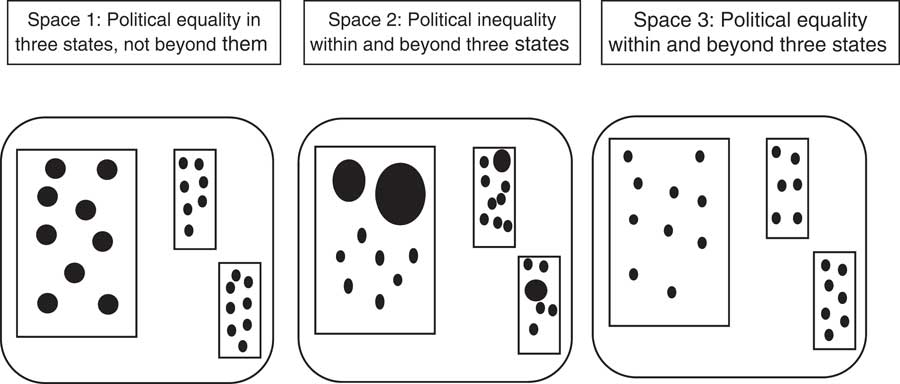
In democratic theory, this specification of political structure should be seen as orthodox. It simply transposes the conventional idea of political equality into a general cause and effect proposition, namely that international political outcomes depend on the proximity of politics to the democratic ideal of equality of political power among individuals. But for empirical and explanatory research in IR, the idea may be more challenging, especially when used to generate expectations. The greater the approximation to political equality among people within a political space – whether manifested in territorial states, a single world state, or other kinds of governance – the greater the likelihood that political outcomes will reflect the interests, norms, preferences, and insights shared by the people within that space.
Figure 1 illustrates different structures of international politics in democratism. There are three political spaces in rounded squares (1–3) in which the three rectangles symbolise different states with varying international power in proportion to their size. Each state has a number of individuals symbolised by the dots or small filled circles whose international powers are represented by their sizes.Footnote 58 While the models are ideal-types, Space 1 may for heuristic reasons be illustrated by NAFTA, Space 2 by the Arab League, and Space 3 to some extent by the EU. More definitely, a neorealist analysis would suggest that the relevant power structure is the same in all three spaces, as the states are equal in number and power, which exhausts the neorealist conception of structure. Various liberal theories, for example, democratic peace theory, recognise differences between Space 2, on the one hand, and Spaces 1 and 3 on the other. But liberal theories do not distinguish between Spaces 1 and 3 in which all individuals have the same power in domestic politics, which suggests that both spaces approximate domestic democracy. Democratism, by contrast, highlights an equally significant difference between Spaces 1 and 3: individuals are unequal with regard to their international political power in Structure 1, but not in Space 3. In comparisons with these research paradigms, democratism can be used to generate structural explanations of international outcomes that depend on the distribution of power among individuals within as well as among states.Footnote 59
Three political spaces and their different structures.

The distribution of political power among individuals can be used to explain which political subjects emerge internationally, their predispositions for action, and political outcomes. If power is divided equally among individuals worldwide, it is reasonable to assume that the predispositions for political action in the global political system will be biased towards the interests and identities (or other subjective features that influence action) shared by the largest group of human beings. Political structures supported by few rather than many individuals should be expected to start changing as soon as individuals get equal power to reshape them.
If power is divided unequally among individuals, on the other hand, it is reasonable to expect that predispositions for political action will be biased towards the particular interests and identities held exclusively by the relatively more powerful group, for instance a particular class or nation. Hence, the groups of people expected to make or support political decisions are likely to be larger in Space 3 than in Spaces 1 and 2. It is only in Spaces 1 and 2 that the power distribution allows particular (non-universal) groups of individuals to benefit from policies that reflect self-interests or identities unique to them. And in turn, the varying size or inclusivity of groups also explains their action predispositions. No group or political subject – however inclusive and politically equal its decision-procedures – is likely to protect the interests or accord with the norms of persons who successfully seek exclusion from it. A political subject will promote the identities or interests shared by the individuals who constitute it.
Three applications: the ICC, rise of China, and politics of NGOs
To understand the concept of structure in greater depth (not testing its predictive accuracy), consider first the establishment of the International Criminal Court (ICC) in 2002. In a world led by state or class interests alone, this event would appear unlikely, even anomalistic. Despite the many weaknesses and failures of the ICC to live up to its own standards, it is unique among global institutions to recognise individual persons as legal subjects. Why should state leaders protect human right even in other states by subjugating themselves to an international body empowered to prosecute themselves? From the perspective of democratism, a structure likely to promote such an institution would distribute power relatively equally among individuals across states. The action to recognise individual persons as legal subjects can then be interpreted, for example, as a reflection of a human-wide interest to seek protection from political oppression and violence by others. Some approximation to a democratic international structure in that sense could be observed in the global civil society campaign, which was in fact important for the establishment of the ICC.Footnote 60
If, on the other hand, a more exclusive group with relatively more powerful individuals mobilises around their own interests, the expected effect should be that the relative power of the globally more inclusive group is reduced. This theoretical possibility may be illustrated by the ultimate decision by the US not to ratify the ICC treaty.Footnote 61 In democratic terms, the decision not to ratify meant that a global minority (partially united within the US) sought private benefits and exploited its superior power for its own advantage. Counterfactually, the US may be expected to be more likely to ratify the ICC treaty would its constituting citizens at some point in the future become less powerful in global comparisons. If the population of the US doubles while its international power remains as of today, individual US citizens will have less relative power internationally; the US government will be expected to offer each of them less protection internationally (the government will have more, and more diversified, individuals to protect); and the individual citizens should then have greater incentives to push for ICC ratification also by the US.
Not relying so much on hypotheticals, the distinction between power distributions among individuals and states respectively can be illustrated by the ‘rise of China’ and its expected consequences for international security. The standard worry among offensive realistsFootnote 62 and power transition theorists,Footnote 63 inspired generally by the consequence of the German rise before the two world wars, is that the rise of China will increase international tension and conflict levels. As with Germany, a rising China is expected to challenge the international privileges of the existing international powers, force them to balance against China, and thereby to create a security dilemma and to increase the conflict level.Footnote 64 From the perspective of democratism, however, there are, so far, significant differences between the German and the Chinese cases that suggest less bellicose outcomes today than a hundred years ago. The German citizens rose in global power from an already high level of international power. The Chinese citizens have so far been rising from a lower level of international power. The rise of China, therefore, has so far largely been an equaliser of global power among individuals, while the rise of Germany exacerbated an already existing inequality among individuals internationally.
But why may this distinctiveness of the Chinese case be expected to promote peace? Equality in power over a shared resource, for example, international security or a global economy, should motivate individuals to establish or support institutions that protect their common interest to manage these resources.Footnote 65 In the absence of shared resources, individuals with relatively equal political powers still have a common interest to draw on the resources not only of their own states, but of all states that can reach, and be reached by, those individuals. Such individual interests can be promoted by states who are sensitive to domestic publics (not necessarily democracies); by transnational actors that target governments worldwide creating boomerang effects and transnational norm diffusion;Footnote 66 and directly by private initiatives to create and strengthen forums and institutions for regulating transnational issues. On these assumptions, greater political equality among individuals should be expected, among other things, to strengthen structures of regional and global governance, and the embeddedness of states in such structures is a noted reason why China – contra influential realists – has risen peacefully and not become more assertive in its foreign policy so far.Footnote 67 Hence, the concept of democratic structures can be used to subsume a common explanation of the so far peaceful rise of China. Beyond this particular case, it follows from democratism that security dilemmas, where states create conflicts by promoting their own security,Footnote 68 are no universal predicaments of international politics but depend on the international distribution of power among individuals.
In more specific terms, a distribution of power may be constituted by particular institutions and legal rights,Footnote 69 by material resources and levels of education,Footnote 70 by opportunities to influence policymaking,Footnote 71 by knowledge of language and common discourses,Footnote 72 and other non-actions with consequences for actions. Each kind of resource – information, rights, finance, etc. – is potentially constitutive of specific structures that – depending on how far they approximate political equality – account for the emergence of specific subjects, their action predispositions, and political outcomes.Footnote 73 To illustrate the usefulness of specifying structures in these ways, recall an often-heard argument that NGOs are normatively motivated actors, or forces for good, that protect human rights by collecting and disseminating information on human rights violations.Footnote 74 Against this argument it is commonly objected that NGOs have no natural tendency to pursue moral aims but are just as concerned with their material self-interests as other actors, even to the point where their normative aims are compromised.Footnote 75 Information gathering by NGOs is then seen to have no effects in general, or even opposite effects if the collected information would become accessible to national intelligence services or private militia. The unresolved problem then is whether information politics of NGOs should in general be expected to protect human rights or not.
Democratism explains diverse effects of collecting and spreading information by differentiating structures of power across collections of information. The hypothesis in this case would be that information that approximates equality of political power among persons will facilitate human rights protection, while information with a different power structure will not. Information may be seen to distribute power equally among individuals if the largest group of people wants to share it, as perhaps with information on human rights violations, and unequally if most people want to keep the information private, as perhaps with information about the social and political connections of the victims of human rights violations. A refined more generally acceptable hypothesis about the effects of information politics by NGOs can then be summarised as follows: political actors who collect and spread information on human rights have a general tendency to protect those rights if and only if the structure of power in the information approximates equality among individuals, as indicated by the willingness of the largest group of people to share that information. More generally, this discussion illustrates that the relevance of democratism for explaining outcomes can be strengthened in relation to some fields of research by formulating the concept of political structure in context-specific terms, such as the distribution of power inherent in certain information collections, legal rights, and financial resources.
The concept of political subject(s) in democratism
A political subject is here defined as a collective of individuals with the capacity to act in ways that depend on an intention, interest, identity, or some other ‘subjective’ quality.Footnote 76 Evidently, expectations of political outcomes in international politics depend on what we take the subject in question to be. To illustrate, from the identity of being a state, it follows that there are territorial borders, a government, and often some kind of written constitution. If, in addition, the state is self-interested, whether by nature, socialisation or selection, it has aims not necessarily shared with other potential political subjects (for example, private firms, peoples, or classes) to protect the attributes essential for its identity (territorial borders, a government, and a constitution). The political content of international politics – such as patterns of conflict and cooperation – will then be seen to depend on how such subjects develop and interact on the basis of these or some other predispositions for action.
What then is the subject of democratic politics in terms that apply internationally? A democratic political subject is a group of individuals with opportunities to form public opinion and which allow the largest group of people to make political decisions (binding or non-binding) in case of internal disagreement. Political outcomes accepted by the largest group can be implemented jointly as well as individually. So defined, the political subject is one that is capable of action also in the absence of centralised decision-making institutions. A technocratic or religious network, for example, may steer collective action through the commitment of individual persons to it.Footnote 77 When the political subject has effective and centralised decision-making institutions to its disposal, individuals may accept rule by the largest group because of expected positive or negative sanctions. When such institutions are not in place, rule by the largest group may still be accepted out of moral convictions and cognitive habits shared by all individuals constitutive of the political subject.
Favourable empirical circumstances for the emergence of political subjects in this sense internationally are likely to include opportunities of communication (for example, through movement of people across borders, news and social media, shared languages and translation technologies); methods to represent preferences in the public (for example, opinion polls, election outcomes, physical meeting places, self-appointed public spokespersons); and senses of trust among individuals towards political actors and processes transcending individual states (for example, cosmopolitan attitudes and willingness to sacrifice national interests for internationally shared ones). At least some of these conditions appear to have been present in the Denmark/Sweden example of DBS suggested earlier. However, other empirical cases, say Palestine/Israel, or the whole of the international system, may be used to develop other potential ‘operational indicators’ of democratic political subjects. The discussion of how theoretical concepts in democratism should be operationalised for empirical research across different contexts is yet far from concluded.
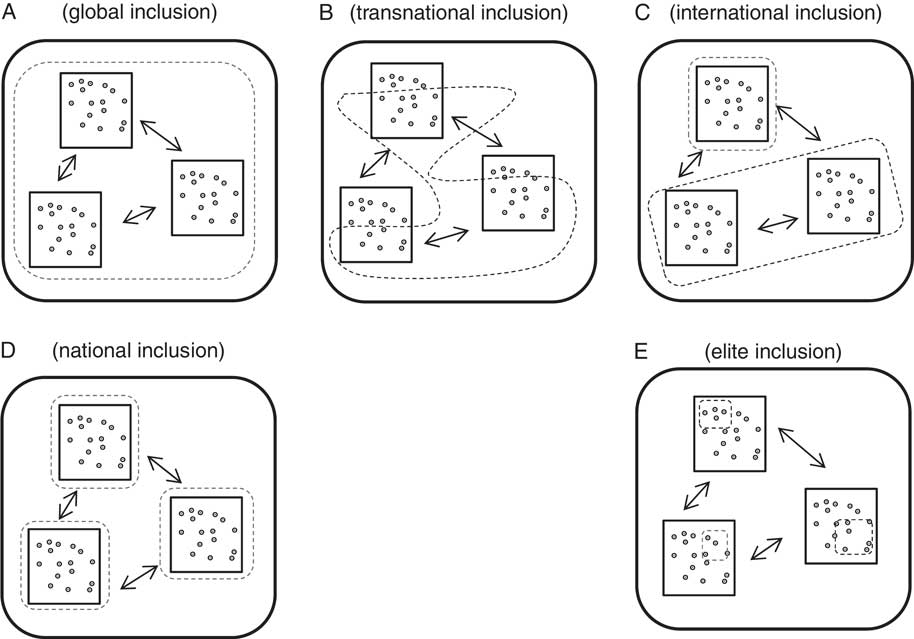
Nonetheless, to illustrate the theoretical difference between democratic and other conceptions of the political subject, Figure 2 shows five different political spaces (A to E), each constituted by three states (the three squares) and a set of individuals (dots). The individuals encircled by dashed lines illustrate internally democratic political subjects while their global inclusiveness varies from complete (A) to minimal (E).
Five international spaces with three states in each and their different political subjects (the dashed areas).
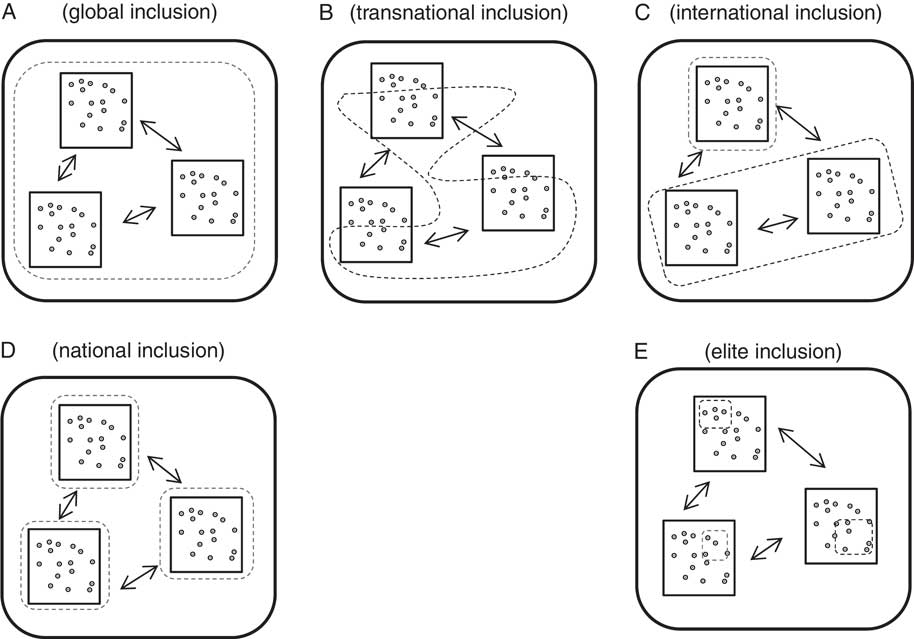
D and E illustrate international politics that is likely to be driven primarily by state interests. D is domestically democratic; E is not. European politics at different points in time between the First and the Second World Wars may illustrate both situations. When the people of two states act democratically among themselves, while excluding the people of a third state, international politics can be described as in C. The relationship between NATO-members and Russia in today’s international politics may somewhat illustrate the situation. When based on the interests or norms of a transnational group, international politics may instead approximate B. Issue-specific stakeholders, for instance climate change activists, or members of a particular social class, may illustrate or at least attempt to create that situation. In A, finally, the group of people who can actively support or disagree with any political outcome includes a larger proportion of all individuals than in any of the other models. Perhaps the model is approximated by the Scandinavian international relations among contemporary Denmark, Sweden, Norway, and Finland (or more so than in the other examples).
As illustrated by the differences of A to E in Figure 2, what ultimately matters for political outcomes in democratism is the proportion of individuals in an international political space that has approximately the same power over international political outcomes and which are communicating to solve common problems. Other IR theories can be helpful to explicate parts of this insight, while the logic of democratism is distinct and not reducible to those of other theories. Theories that limit political subjects to territorial states (for example, liberalism and realism in most variants) will lead scholars to deny the differences from D to A in Figure 2. Among theories that accommodate the possibility of political subjects beyond individual states, Marxism is too limited to account for presence or variation in democracy as illustrated in the figure. It necessitates that subjects are generated by particular classes, as in model B but not in models A or D. Constructivism, on the other hand, is both more and less limited than democratism, and deserves more attention.
Constructivism easily subsumes the differences specified in Figure 2 by treating the emergence of political subjects and their interests as an empirical and historically contingent matter. However, the defining assumptions of constructivism are too unlimited to provide a priori reasons to make and expect significant effects of those differences in the first place.Footnote 78 It is possible, but not necessary, that the norms analysed in constructivism manifest or approach DBS.Footnote 79 More critically though, democratism is also more inclusive than constructivism. In democratic theory, preferences and norms are both endogenous (in deliberative procedures, for example, debating) and exogenous (in aggregative procedures, for example, voting) while a core feature of constructivism is to see preferences and norms as endogenous to social interaction.Footnote 80 In a similar vein, explanations based on democratic theory can refer to alleged objective or subjective matters (for example, the objective feature of political equality among individuals as well as the subjective feature of normative commitment to that condition) while explanations in constructivism do not refer to objective matters alone.
So why is inclusivity of a ruling group expected to make a difference for political outcomes in the first place? There is a range of widely applicable arguments available for specification and testing in relation to international politics. Insofar as individuals are the best judges of their own interests,Footnote 81 participation or representation of a larger group of people in political procedures should promote political outcomes that better satisfy the preferences of that group. Insofar as all groups develop interests of their own out of experiences and social conditions unique to them,Footnote 82 political outcomes made by elites should be expected to reflect different interests or norms than outcomes made through procedures inclusive of larger groups. Insofar as there is an objectively best solution to a given social problem and that people on average are more likely to be right than wrong, inclusion of more people in the political process increases the probability for selecting the decision-alternative that is best or closest to truth.Footnote 83
Three applications: Convergence, bifurcation, and unpredictability in foreign policy
In light of the earlier discussion, the most important question in theory is no longer whether relatively more democratic political subjects affect outcomes, which should be fairly obvious. The more important question is how and under what conditions it happens. Usefully for this purpose, normative debates on DBS present alternative interpretations of the political subject that in turn suggest different predictions and enabling conditions of DBS. Influential alternatives include those of the people,Footnote 84 the multitude,Footnote 85 the stakeholder community,Footnote 86 humanity,Footnote 87 transnational collective identities,Footnote 88 and performative as well as compositional interpretations of the demos.Footnote 89 In terms of Figure 2, these concepts suggest specific and alternative interpretations of model A. Unlike concepts like states and classes, they are not stretched by assuming that ever more people are included in them.Footnote 90 Their points of empirical discrimination lay elsewhere, namely, where a smaller group gains superior power in comparison with a larger group (for no good reasons stipulated differently by the different conceptions). Despite that common ground, however, these conceptions inspire very different accounts of how DBS affects international politics. They explain different foreign policies and generate competing expectations about the effects of democratising international politics. Three examples will follow.
The political subject of humanity or mankind is constituted and held together – to the extent that it exists at all – by the interests and norms shared broadly by individual human beings. If we think of the political subject as humanity, we should therefore expect democratisation, in the sense of empowering this subject relative to other subjects (for example, classes or nations), to increase convergence and coordination of foreign policies among states in order to meet their common goals. To illustrate, convergence of foreign policies among the members of the EU can be explained by a greater role of human-wide interest and norms in this region.
Stakeholder communities, on the other hand, refer to a group of people who are significantly affected by particular decisions and which mobilise to control or influence them. In principle, each foreign policy decision may engender a new stakeholder community. If the political subject is a stakeholder community, therefore, international democratisation will push the field of foreign policy into different policy streams that are generally not coordinated across different fields, such as trade and security for instance. For example, an erosion of the difference between high and low politics in diplomacy and the ensuing possibility of leading economic and security policies by different interests and aims, can be explained by a greater political role of stakeholder groups. It allows foreign policies to bifurcate.
The multitude, to take a final example, is an anonymous and unbounded group of irreducibly singular individuals that rebel against dispersed structures of power, most commonly but not necessarily associated with capitalism and sovereignty. Democratisation in the sense of empowering a multitude is therefore likely to produce an increasing tendency among states to break with the customs, agreements, and fundamental principles of foreign policy conduct at unpredictable moments in time. If one would dare interpret the international order emerging under the influence of current (2017) populist and nationalist political leaders as an outcome of democratic practices and not only as a backlash against democracy (accepting the rhetoric of Donald Trump in the US, Victor Orban in Hungary, Boris Johnson in Britain, and others), the subject of democratic politics is conceived most conveniently as a multitude. It would explain the unpredictability and ridicule of existing norms in foreign policy that has been emblematic at least for the early days of Donald Trump’s presidency in the US.Footnote 91
These alternative conceptions of the democratic political subject are intended to expand the explanatory scope and generate competing predictions of foreign policy within democratism. The role of the theory then is to define the outer borders of relevant arguments while being agnostic on which more specific interpretation of the political subject is most fruitful. The external validity of democratism, on the other hand, requires testing of the argument that foreign policies depend on DBS in the first place, against state- and class-centric arguments for instance. The following section illustrates the research needed for that purpose.
Peace and conflict in democratism
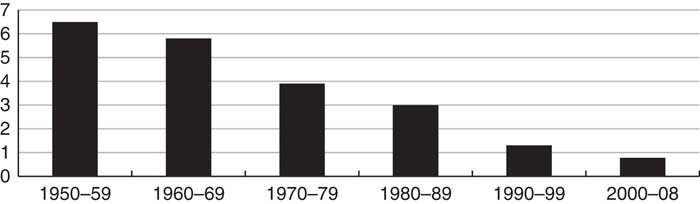
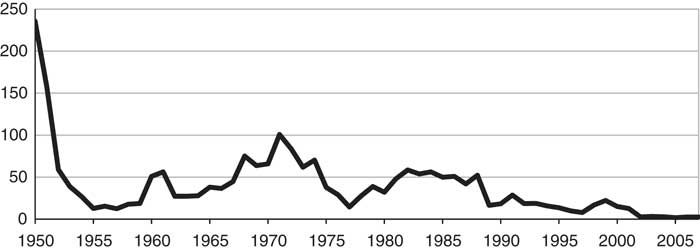
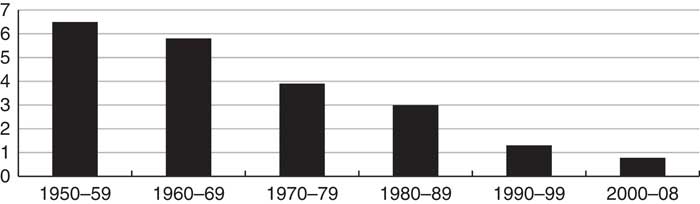
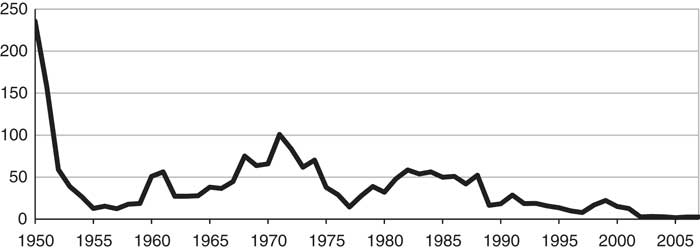
The emergence and resolution of international conflict – involving governments or people from more than one state, and ranging from political disagreement to total war – remains a key problem of study in IR. To examine what democratism may contribute to its explanation, let me address an issue that yet has to find its explanation in a coherentFootnote and generally applicable theory, namely the decline in international conflict globally from 1945 to 2010 or, specifically, the decline in wars (Figure 3) as well as battle deaths (Figure 4) during this time.Footnote 93
Average number of international conflicts per year (interstate and colonial).92
Battle deaths per year (x-axis) per world population (millions) (y-axis).96
A common explanation of the decline in conflict is that the distribution of power among states changed from a bipolar to a unipolar world in 1990. However, the changes long before and after 1990 are beyond the scope of that explanation.Footnote 94 Economic globalisation and the increasing costs of war is another commonly suggested explanation of the trend, but is difficult to reconcile with the many colonial wars among states with very high degrees of economic interdependence fought during this time period. Focusing instead on domestic politics, democratisation has been highlighted as the main cause behind the development. However, domestic democratisation does not explain why conflicts have declined also where authoritarian states are involved, for example, in relation to risings powers like China. Looking again to international level factors, the norm of peaceful conflict resolution may have been reinforced as a reaction to the Second World War and been diffused gradually since then. However, in the face of an arms race including nuclear weapons that occupied the minds of leading actors during most of the period, the assumption of a reinforced peace norm appears empirically problematic.
Confronted with these similar problems, scholars may seek to expand the explanatory scope of their theories by combining explanations, and then typically downplay the importance of coherence and unification in theory. Alternatively, the scope of the explanation may be delimited, for instance addressing ‘only’ the East Asian peace from the 1980s,Footnote 95 while neglecting the bigger global picture and causal pathways.Footnote A still different Footnote reaction is to continue searching for an idea that explains the original observation by invoking a coherent, unified, and generally applicable theory. Let me proceed along this third path to illustrate the plausibility and added value of democratism.
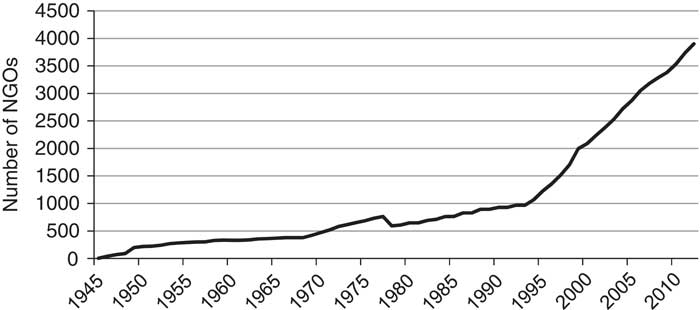
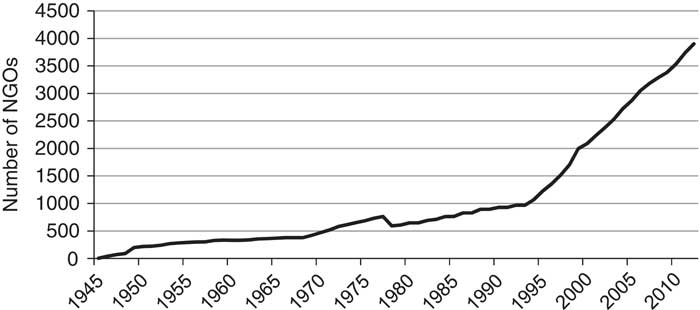
The international development from 1945 to 2010 can be seen as an uneven but gradual increase in DBS at the global level. The normative problem of insufficient democracy in global politics may have deepened during this time, as the powers exercised globally may have grown more than DBS expanded. Still, significant changes towards more DBS can be observed from different perspectives of what democracy means in practice. In light of the so-called cosmopolitan model of democracy, the universal inclusion of states in the UN, the use of majority voting in the General Assembly, the emergence of an international human rights regime, and the growing number and powers of international institutions within the UN system since 1945 all amount to a strengthening of democracy in the structures of international politics.Footnote 98 Looking at international politics instead from the perspective of the so-called stakeholder theory of democracy, the key observation is similar: politically affected individuals and their organisations have gained opportunities to mobilise politically and seek direct involvement in global politics increasingly over the relevant time period (Figure 5).Footnote 99
Number of NGOs in consultative status with the Economic and Social Council (ECOSOC) of the UN, by year.97
What then are the likely consequences, if any, for levels of international conflict of the uneven while gradual shift towards more DBS between 1945 and 2010? While DBS may in principle lead to conflict (the largest group may be less rational than elites are, elites may be ready to protect their privileges by force) two causal mechanisms with an opposite effect apply more broadly.
First, higher levels of DBS should promote outcomes that are satisfactory to more people simply because DBS allows a larger group to influence outcomes.Footnote 100 As a subcomponent of the added political satisfaction, DBS should be expected to diminish also the dissatisfaction that might otherwise have escalated into conflict. This causal process can be studied across many different cases, such as the promotion of human rights by ‘unrecognised peoples’ in global governance that should reduce the risk of ethnic violence,Footnote 101 or the ability of the UN Security Council to restrain suggested international military action (for example, against Syria since 2012) or diminish war coalitions (for example, against Iraq 2003). Second, the more inclusive political subject of DBS should facilitate for governments and other actors to know the inclinations of their potential adversaries to fight, and thereby to avoid wars based on strategic misinformation.Footnote 102 Such information effects can materialise through, and by studied in, transnational mobilisation and communications (in stakeholder theory) or (in cosmopolitan theory) through reactions by the UN to conflicts. Both processes can signal that a threat of war is serious.Footnote 103
Can these arguments explain conflict levels in particular cases or is the explanation limited to systemic effects? A brief look at the casualty numbers in the two US wars against Iraq and Vietnam respectively suggest that DBS may indeed explain conflict levels also in individual cases. According to one early estimate, 1,500,000 persons in Vietnam and 125,000 persons in Iraq died as a direct consequence of war actions.Footnote 104 The hypothesis then is that the lower number of causalities in the Iraq war depends to some degree on the relatively higher levels of democracy in the international relations of the US at this time. That suggestion seems plausible. For example, the attack on Iraq in March 2003 was preceded by which seem to have been the biggest globally coordinated street protests in history, including but not limited to 3,000,000 people in Rome and 1,500,000 in London marching against the war plans.Footnote 105 In contrast, the biggest protest against the Vietnam War assembled around 500,000 people in Washington, DC, 15 November 1969.Footnote 106 That is, a significantly smaller group of people in one country alone protested at a significantly later point in time (as measured from the beginnings of the wars) in the case of the Vietnam War. While obviously the international protests against the plans to attack Iraq in 2003 did not stop that war (and are but one of the many components of DBS to which earlier sections of this article motivate attention), their intended effects to restrain violence are worth further analyses. As the death toll in Vietnam suggests, the situation in Iraq could have been more conflictual.Footnote 107
However, if an increase of DBS since 1945 explains the diminishing levels of conflict observed until 2010, what explains the slightly increasing conflict levels observed from 2010 to 2014?Footnote 108 To clarify the puzzle, it is helpful to notice that the change is constituted primarily by events in Syria and Iraq, including the Islamic State. The political process that led to the war against Iraq in 2003 was, within the post-1989 context of strong multilateralism, widely perceived as a low point in terms of DBS and cosmopolitan principles. According to leading democratic theorists at the time, unusually little notice was taken of international law, diplomatic protests, and world public opinion, when the US and its coalition planned, decided and implemented the military policies.Footnote 109 Alienating large groups of people from the political process should in turn be expected to diminish the legitimacy of the Iraqi state as well as the threshold for individuals to resort to military or terrorist violence, which ultimately spread to Syria.Footnote 110 Hence, the increasing violence globally after 2010 may be explained by the decreasing level of democracy a few years earlier in the international relations of the Middle East (including actions taken by the US and the coalition it led in the region). Hence, the general hypothesis worth testing in future research remains: DBS lessens international conflict, and decreasing DBS increases it.
Conclusion
This article has attempted to construct an analytical framework – democratism – that is sensitive to the possibility and prevalence of DBS when analysing causes and consequences in IR. The first step was to establish an understanding of DBS that may describe international politics without contradicting fundamental assumptions about this matter in the literature. For much research in IR and democratic theory, the construction of such an understanding represents a theoretical problem in its own right. As I have shown, however, it can be overcome by defining democracy as rule by the largest group within as well as across state borders, before as well as after the founding of territorial states, and pertaining to binding decisions as well as to the making of non-binding political outcomes.
For theorists, this understanding of democracy is useful to generate and examine new interpretations of traditional concepts in explanatory and empirical IR, such as the structures and subjects of international politics and the ways in which they interact. The democratic versions of those concepts are different from, and on critical points incompatible with, the conceptions supported by approaches such as realism, liberalism, constructivism, and Marxism. An international political structure is democratic if it distributes political power equally among individuals in a political space that includes more than one state. An international political subject is democratic if it includes, in the formation and implementation of political will, all individuals in a political space that includes more than one state. For empirical researchers, these definitions provide criteria against which international politics should be assessed in the processes of explaining political outcomes or testing hypothesised effects (in fn. 107).
In this vein, the global decline in inter-state conflict between 1945 and 2010 was discussed to illustrate that the suggested democratic theory concepts are both empirically applicable and generative of empirically accurate predictions. To clarify some more limited points, the possibility to explain five other issues were illustrated more tentatively: first, the so far peaceful transition of relative power (resources) from the US to China as well as the stability of Chinese foreign policy in this period; second, the establishment of the ICC and its lack of ratification by the US; third, the choice by some NGOs to collect and disseminate information that enhances human rights protection despite absent self-interest to do so, and the possibility that other NGOs and organisations act differently; fourth, the intensification of political conflict and transnational terrorism centred in the Middle East around 2010; and fifth, the likelihood for a preponderant power, like the US in Iraq as well as in Vietnam, to declare victory and to pull out sooner rather than later from an ongoing conflict.
Furthermore, the capacity of democratic theory to generate explanations was illustrated by suggesting different foreign policy trajectories for states whose international relations undergo democratisation. Alternative specific conceptions of the political subject in democratic politics, including humanity, the multitude, and stakeholder communities, account for dramatically different political outcomes and generate competing empirically testable expectations. As demonstrated, they can be used to explain foreign policy convergence, for example, within the EU; systematic unpredictability, for example, of the US under Donald Trump; and differentiation of the national interest across subfields in foreign policy, as for example, in security (former high) and economic (former low) policy. It is fair to conclude, therefore, that democratic theory offers plenty of opportunities for researchers to explain and to test competing expectations about standard problems in IR. For future research, it appears worthwhile for scholars of IR to construct explanations of political problems based on democratic theory concepts, to deduce propositions from those explanations that are testable against empirical evidence, to collect new or reorganise old data, and to pursue in-depth analyses of those democratic theory propositions.
Acknowledgements
For their helpful comments on earlier versions of this article, I thank Idris Ahmedi, Richard Beardsworth, Linus Hagström, Tyra Hertz, Charlotte Friedner Parrat, Ronnie Hjort, Maria Jansson, Björn Jerdén, Sofia Näsström, Aaron Maltais, Tarek Oraby, Mathias Koenig-Archibugi, Jonathan Kuyper, Tom Lundborg, Magnus Reitberger, Thomas Sommerer, Jonas Tallberg, and the anonymous reviewers. For financial support, I thank Riksbankens Jubileumsfond.