The Organizational Citizenship Behavior concept (OCB), defined as “individual behavior that is discretionary, not directly or explicitly recognized by the formal reward system, and that in the aggregate promotes the effective functioning of the organization” (Organ, Reference Organ1988, p.4), has been studied at an entrepreneurial level (Podsakoff, MacKenzie, Paine, & Bachrach, Reference Podsakoff, MacKenzie, Paine and Bachrach2000; Podsakoff, Whiting, Podsakoff, & Blume, Reference Podsakoff, Whiting, Podsakoff and Blume2009) and, more recently, at an educational level (DiPaola, Tarter, & Hoy, Reference DiPaola, Tarter, Hoy and Hoy2005; DiPaola & Tschannen-Moran, Reference DiPaola and Tschannen-Moran2001; Oplatka, Reference Oplatka2006; Oplatka & Stundi, Reference Oplatka and Stundi2011; Somech & Drach-Zahavy, Reference Somech and Drach-Zahavy2000; Yilmaz & Taşdan, Reference Yilmaz and Taşdan2009).
Initially proposed by Organ (Reference Organ1988), the concept refers to the individual behavior and actions of an employee that objectively benefit organizational effectiveness but cannot be expected from the employee, due to not being part of their formal job description, nor fostered, due to the lack of a formal reward system for it (Organ,1990). It is positive employee behavior which strongly contributes to organizational performance and efficiency (Kidwell, Mossholder, & Bennett, Reference Kidwell, Mossholder and Bennett1997; Organ, Reference Organ1988, Reference Organ, Staw and Cummings1990; Podsakoff et al., Reference Podsakoff, MacKenzie, Paine and Bachrach2000; Podsakoff et al., Reference Podsakoff, Whiting, Podsakoff and Blume2009).
Studies in this field have focused more on the identification of antecedent and consequence factors of OCB rather than on the clarification of the nature and dimension of the construct. With regards to the antecedent factors, variables have been identified which are related to personality characteristics (Borman, Penner, Allen, & Motowidlo, Reference Borman, Penner, Allen and Motowidlo2001), personal motivation (Dávila & Finkelstein, Reference Dávila and Finkelstein2010; Rioux & Penner, Reference Rioux and Penner2001), job attitudes (Organ & Ryan, Reference Organ and Ryan1995), task characteristics (Cardona, Lawrence, & Bentler, Reference Cardona, Lawrence and Bentler2004; Chiu & Chen, Reference Chiu and Chen2005; Passos & Caetano, Reference Passos and Caetano2000), context characteristics (Jex, Adams, Bachrach, & Sorenson Reference Jex, Adams, Bachrach and Sorenson2003), and leadership types (Podsakoff et al., Reference Podsakoff, MacKenzie, Paine and Bachrach2000), among others. As regards the consequence factors, studies have shown the relationship between OCB and organizational performance measures, such as productivity, efficiency, cost reduction, client satisfaction and turnover (Podsakoff et al., Reference Podsakoff, Whiting, Podsakoff and Blume2009).
As of yet, there is no consensus on the dimensionality of OCB, nor is the relationship between the construct and its dimensions clearly defined, although it is consensual that it is a multidimensional construct (Law, Wong, & Chen, Reference Law, Wong, Chen and Turnipseed2005). Various configurations and multiple instruments for evaluation of the OCB structural dimension have been proposed (Graham, Reference Graham1991; Organ, Reference Organ, Staw and Cummings1990; Podsakoff & MacKenzie, Reference Podsakoff and MacKenzie1994; van Dyne, Graham, & Dienesch, Reference van Dyne, Graham and Dienesch1994; van Dyne & LePine, Reference van Dyne and LePine1998; van Scotter & Motowidlo, Reference van Scotter and Motowidlo1996; Williams & Anderson, Reference Williams and Anderson1991). Of those proposed two main types stand out: those that associate behavior according to its nature (Organ, Reference Organ1988; Podsakoff, MacKenzie, Moorman, & Fetter, Reference Podsakoff, MacKenzie, Moorman and Fetter1990) and those that associate behavior according to its objective (Skarlicki & Lathan, Reference Skarlicki and Lathan1995; Williams & Anderson, Reference Williams and Anderson1991).
In the first instance, although in literature specific to the field more than 30 possible types of OCB are identified (Podsakoff et al., Reference Podsakoff, MacKenzie, Paine and Bachrach2000), the five dimensional structure initially proposed by Organ (Reference Organ1988) is the most consensual (Rego, Reference Rego2002). These dimensions incorporate behavior of different natures and include: altruism (behavior with the intention of helping a specific work colleague); conscientiousness (behavior that goes beyond the minimum role requirements of the organization, e.g. break management); courtesy (behavior aimed at preventing work-related conflicts); sportsmanship (tolerance to less-than-ideal circumstances without complaining) and civic virtue (behavior indicating concern and active interest in the life of the organization).
In the second instance, Williams and Anderson (Reference Williams and Anderson1991) present OCB as a bi-dimensional construct where each dimension is structured according to whom the behavior was directed at: 1) OCBI or behaviors that immediately benefit other specific individuals; 2) OCBO or behaviors that benefit the organization as a whole.
With regards to educational institutions, literature suggests that in schools that function in an adequate and effective fashion, the teaching staff do not restrict their activities to those strictly necessary but foster others that, not being of a compulsory nature, make a difference because they have an impact in student performance (DiPaola & Hoy, Reference DiPaola and Hoy2005). As a matter of fact, in order to achieve their objectives, schools depend on the availability of the teachers to make significant efforts, beyond the formal requirements of their function (Bogler & Somech, Reference Bogler and Somech2004; Somech & Bogler, Reference Somech and Bogler2002). Studies have shown the positive consequences OCB have had on schools, namely as regards: discipline and the fostering of a positive response from superiors, students and colleagues (Oplatka, Reference Oplatka2009); the success of students (DiPaola & Hoy, Reference DiPaola and Hoy2005; Oplatka, Reference Oplatka2009); civic behavior and help of the students (Oplatka, Reference Oplatka2009); coordination of activities between staff members and their contribution for the creations of a more pleasant workplace (Podsakoff et al., Reference Podsakoff, MacKenzie, Paine and Bachrach2000); a positive relationship with the school image and a cooperative and collegial school environment (Oplatka, Reference Oplatka2009).
Although OCB are considered to be extra-role behaviors, the difficulty in defining what is or is not part of one’s function is notorious when it comes to teaching career (DiPaola & Neves, Reference DiPaola and Neves2009). In educational organizations, the role of a teacher encompasses a wide spectrum of tasks and responsibilities (in and out of the classroom) and it is therefore difficult to objectively define the boundaries of the profession, depending mostly on individual representations regarding the essence of the teaching career, or in other words professionalism (Gimeno, Reference Gimeno and Nóvoa1995). Teaching is a field of activity with a strong emphasis on helping other individuals; therefore some aspects of OCB may eventually overlap with teaching responsabilities (DiPaola & Neves, Reference DiPaola and Neves2009; DiPaola & Tschannen-Moran, Reference DiPaola and Tschannen-Moran2001; Jimmieson, Hannam, & Yeo, Reference Jimmieson, Hannam and Yeo2010).
In any case, studies focusing on OCB in an educational context are scarce (Jimmieson et al., Reference Jimmieson, Hannam and Yeo2010; Oplatka & Stundi, Reference Oplatka and Stundi2011) which makes the nature of the construct in an educational environment neither very clear nor consensually operationalized. Many of the studies have attempted to identify OCB antecedents in relation with other variables (Jimmieson et al., Reference Jimmieson, Hannam and Yeo2010; Somech & Ron, Reference Somech and Ron2007; Yilmaz & Taşdan, Reference Yilmaz and Taşdan2009). Among the studies attempting to clarify and measure the concept in an educational environment, two tendencies stand out: one that considers OCB as a three dimensional construct and another that presents OCB as one dimensional. In the first instance, the three dimensions are organized according to whom the behavior is directed at (Christ, Van Dick, Wagner, & Stellmacher, Reference Christ, Van Dick, Wagner and Stellmacher2003; Oplatka, Reference Oplatka2006; Somech & Drach-Zahavy, Reference Somech and Drach-Zahavy2000) and include: (1) behavior directed at the students; (2) behavior directed at colleagues; and (3) behavior directed at the organization as a whole. Based on this model, Somech and Drach-Zahavy (Reference Somech and Drach-Zahavy2000) developed the first instrument designed specifically for application in an educational environment (Extra Role Behavior-Schools).
The one dimensional perspective (DiPaola & Tschannen-Moran, Reference DiPaola and Tschannen-Moran2001) is based on the nature of the educational institutions. A school is an organization structured to help by which the distinction between helping the student or the school is artificial, seeing that all behaviors have the same objective: helping the students in being successful. With this assumption in mind, the authors developed an unifactorial scale on OCB for schools (OCBSS) of which the more parsimonious version (OCB-Scale: DiPaola et al., Reference DiPaola, Tarter, Hoy and Hoy2005) was translated into various languages and adapted for use in various countries (DiPaola & Neves, Reference DiPaola and Neves2009; Yilmaz & Taşdan, Reference Yilmaz and Taşdan2009).
In addition, and due to the lack of consensus regarding the construct in an educational environment, that the OCB may have a different operationalization due to cultural differences (Farh, Zhong, & Organ, Reference Farh, Zhong and Organ2004), makes even more pertinent its inter-cultural clarification as well as validation of the instruments used in those evaluations.
The objective of the work presented here is to contribute towards the clarification of the OCB concept in Portuguese schools, and in so doing validates an instrument of measure specifically designed to collect data regarding this subject.
Method
Participants
The sample under study includes 321 teachers of students between 10-15 years old at 59 schools in urban and rural areas of Central Portugal. The sample includes teachers who teach in 26 of the 28 discipline groups. Not represented are 3rd cycle basic education teachers in Agricultural Science and Music. The average age of the participants is 40.3 (SD = 8.3), of which 70 (21.8%) are male and 251 (78.2%) female. From this sample 79.5% of the teachers have permanent work contracts and 20.2% have temporary work contracts. The average duration of employment is 14.93 years and 82.2% have more than seven years of experience in the profession.
Measures
The Organizational Citizenship Behavior Questionnaire for Schools (OCBS) (Neves, Reference Neves2010, see Annex 1) is a questionnaire that is completed by the individual, with 16 items arranged in Likert type (classification of 1 to 6) ordinal scale, which registers the perception each teacher has about the OCB at his/her school and allows it, through data aggregation to be studied at an organizational level. This instrument was developed based on items from OCB-Scale (DiPaola et al., Reference DiPaola, Tarter, Hoy and Hoy2005) and ERB Schools (Somech & Drach-Zahavy, Reference Somech and Drach-Zahavy2000) and rests on the conception of OCB as a four dimensional construct referenced to the nature of behaviors, to note: (1) altruism, which is a component of helping peers who directly or indirectly improve their performance (items 1, 2, 10, 14, and 16); (2) conscientiousness, which encompasses behaviors relating to work effort, such as, for example, effective time management in order to maximize the effectiveness of tasks (items 3, 5, 11, and 13); (3) civic participation, which encompasses behaviors relating to participation in tasks with the objective of promoting organizational interests as a whole (items 7, 8, 12 and 15); courtesy, which includes behavior aimed at preventing problems by planning ahead and devising solutions for predictable changes (items 4, 6 and 9).
Procedures
The data was collected at different schools by teachers studying for post-graduation and master degrees at the Escola Superior de Educação de Coimbra, once they had been briefed on how to uniformly administer the instrument.
Sensitivity of the items was studied taking into consideration asymmetry and kurtosis coefficients. For the reliability study Cronbach’s alpha index was applied to each of the factors and, for the total scale, a standardized alpha since it was considered to be a better estimator of true reliability (Kamata, Turhan, & Darandari, 2003). Factorial validation and the second-order order structural hierarchy were studied using AMOS 20 software. In this analysis, the following adjustment indexes were used χ2 /gl; Comparative Fit Index (CFI); Goodness of Fit Index (GFI), Root Mean Square Error of Approximation ( RMSEA). The quality of the modified models and of the second- order factor structure was also evaluated and compared using Akaike Information Criterion(AIC),Bays Information Criterion (BIC) and Browne-Cudeck criterion (BCC information criteria. The criterion used were: χ2/gl between 1 and 2; CFI and GFI greater than .9 RMSEA lower than .5: it was assumed in the information criteria lower values indicated a better adjustment to the model (Byrne, Reference Byrne2010).
Results
Temporal stability
Temporal stability was assessed by means of retesting of a sub-sample of 187 teachers within 3 weeks of the first test. The data showed the following correlations between dimensions: Altruism .62 (p < .01); Conscientiousness .68 (p < .01); Civic Participation .58 (p < .01); Courtesy .57 (p < .01) and .69 (p < .01) on the global scale score, by which the temporal stability is considered to be acceptable (Robinson, Shaver, & Wrightsman, Reference Robinson, Shaver and Wrightsman1991).
Sensitivity
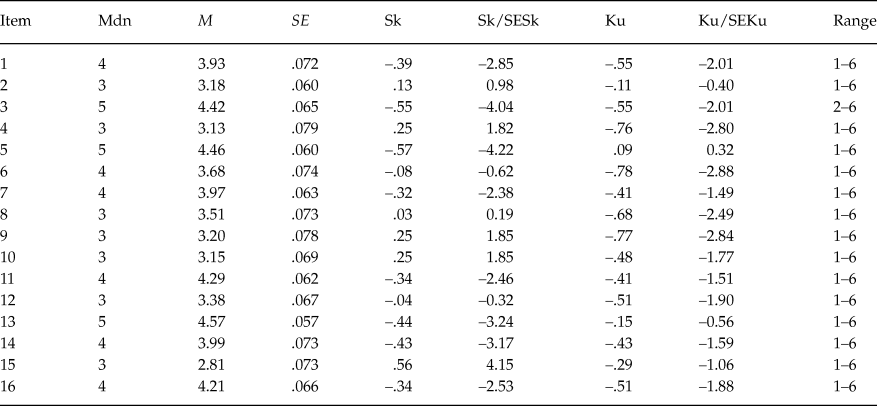
The sensitivity of the 16 items was evaluated using asymmetry and kurtosis coefficients and respective critical ratios (Table 1). Asymmetry and kurtosis coefficients with absolute values greater than 1 were not identified, therefore, it is considered that there are no sensitivity or significant deviations from normal (Maroco, Reference Maroco2003). Because all manifest variables presents asymmetry and kurtosis near zero the assumption of multivariate normality is plausible (Maroco, Reference Maroco2010).
Sensitivity of the 16-item CCOE-R item

Note:
Mdn=Median; M=Mean; SE= Standard Error; Sk=Asymmetry; Ku= kurtosis; Sk/SESk = Skcritical ratio; Ku/SEKu = Kucritical ratio.
Factorial validity
The factorial validity of the instrument was tested on four models: model 1 (unifactorial), model 2 (four first-order factors), model 3 (four modified first-order factors) and model 4 (four modified first-order factors with 1 second-order factor). The sample size and plausibility of the normality justify the use of the estimate method of maximum likelihood (ML) because its produces results that are more efficient and consistent and is more robust to violation of the assumption of normality if the asymmetry and flattening of the manifest variables are not too large (Maroco, Reference Maroco2010).
The confirmatory factor analysis of model 1 showed adjusted fit indexes of poor or unacceptable factorial validity indicating the existence of more than one factor (Table 2).
Adjustment indexes for each proposed model

The confirmatory factor analysis of the second model (four first-order factors) showed questionable adjustment of fit indexes (Table 2), although the standardized factor values of all the items are greater than .5. The reliability of the first-order factors was assessed using Cronbach’s alpha internal consistency coefficient and presents the following values: altruism .83; conscientiousness .77; civic participation .75; courtesy .76. The total scale presents a standardized alpha of .90.
The identification of a questionable factorial validity value justified the adjustment of the original model in accordance with the modification indices supplied by the program. In the third model (four modified first-order factors), items 10 and 16 relating to altruism, item 5 relating to conscientiousness and item 12 relating to civic participation, were removed because the modification indices suggested the saturation of these items on factors other than those suggested initially. The final modified scale presents the same four factors but with three items in each one. The adjustment of fit indexes for model 3 range between good and very good (Table 2). The factors are all positively correlated: altruism is positively correlated with conscientiousness (r = .85; p < .001), with civic participation (r = .69; p < .001) and with courtesy (r = .78; p < .001); conscientiousness correlates with civic participation (r = .68; p < .001) and with courtesy (r = .66; p < .001); and finally, civic participation correlates with courtesy (r = .60; p < .001).
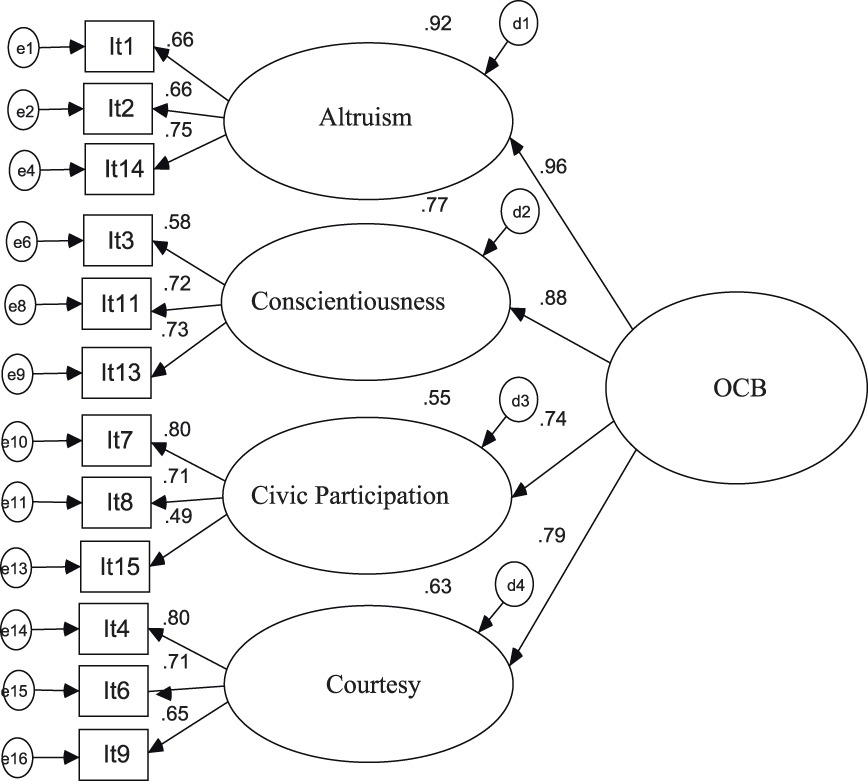
The theoretical framework considered (Organ, Reference Organ1988) and the high correlation between factors pointed to the existence of a second-order factor, by which the hypothesis was tested. For this new model (model 4: four modified first-order factors with 1 second-order factor), organized hierarchically, the OCB are depicted as a second-order factor (Figure 1) with adjustment of fit indexes ranging between good and very good (Table 2) indicating a high factorial validity for this revised scale.
Four modified first-order factors with one second-order factor, including the standard factor influences for each of the items and R2 values for each of the first-order factors.

In this hierarchical model the second-order factors altruism, conscientiousness, civic participation and courtesy (each with three items) present alpha values of .73; .71, .70 and .76 respectively. The global scale presents a standardized alpha of .87.
In comparison with the OCBS proposed in the second model tested this new structure, which we will call Escala de Comportamentos de Cidadania Organizacional em Escolas – Revista (CCOE-R) (Organizational Citizenship Behavior Scale in Schools – Revised) (Figure 1), presents a significantly better and parsimonious adjustment [Δχ2(48) = 169.5; p < .001] since the AIC, BIC and BCC criteria present lower values than in the original scale (ΔAIC = 190; ΔBIC = 227.2; ΔBCC = 191.4).
Thus, the OCB can be considered a second-order factor with estimated numerical indexes based on the factorial scores. The standardized values of the OCB levels are calculated based on the following expression (1):
OCB = .037It9+.05It6+.075It4+.021It15+.047It8+.082It7+.112It13+.098It11+.054It3+.138It14+.116It2+.098It1. (1)
The scores for the four sub-scales are obtained by expressions (2), (3), (4) and (5):
Altruism = .130It1+.153It2+.182It14 (2)
Conscientiousness =.96It3+.173It11+.198It13 (3)
Civic Participation =.358It7+.206It8+.09It15 (4)
Courtesy=.326It4+.218It6+.162It9 (5)
Discussion
The nature of the OCB construct and the instruments used to study it in an educational environment are not, yet, consensual and this may be related with its low level of study (Jimmieson et al., Reference Jimmieson, Hannam and Yeo2010). In this article we studied OCBS characteristics on the Portuguese teacher population and propose an instrument of measure to evaluate the perceptions of teachers regarding the application of OCB in schools.
The four factor structure, introduced in the initial version of the instrument (Neves, Reference Neves2010), held up and was expanded to a second-order hierarchical structure, which fitted the data better.
The multi-factorial four factor structure fits the taxonomy subgroup that organizes the OCBs based on the nature of behavior and identifies itself more closely with Organ’s initial proposal (1988) for the business environment. The global similarity between the two structures shows that, although the teaching profession has specific characteristics, what may be described as extra-role behavior may be of an equivalent nature to any other profession. In other words, “activities that support the social and psychological environment in which task performance takes place” (Organ, Reference Organ1997, p.95) may be carried out by teachers using behavior that, although specific to the teaching profession, are equivalent, in their nature, to those of any other profession.
For any scale of measure all the items should measure the same construct, with a determined margin of error. In a multi-dimensional construct, the dimensions represent their different materializations in which case the construct is defined by the amount of correlated variance shared by the dimensions (latent non-observable variables), underlying a set of observable indicators (Jarvis, MacKenzie, & Podsakoff, Reference Jarvis, MacKenzie and Podsakoff2003, Reference Jarvis, MacKenzie and Podsakoff2012). The model presented shows the OCB conception as a latent construct with four factors (altruism, conscientiousness, civic participation and courtesy), resulting from different forms of expression of the same construct. In this manner, it can be assumed that we stand before a set of first level latent factors (dimensions), with observable indicators (variables / items) which, in turn, are themselves the observable indicators for the underlying second level construct (OCB). Although the construct may also be viewed as an aggregate model (Law et al., Reference Law, Wong, Chen and Turnipseed2005), the conceptualization of the OCB as a latent model is the most used, establishing itself as a good way to conceptualize and describe the relations between the dimensions of the OCB construct.
Finally, the CCOE-R presents itself as an instrument that allows for the collection of information directly at teacher level, not at their superior’s level, regarding their perception of OCB application in the schools where they work. Since it does not collect specific teacher information, it allows a valid index to be obtained that expresses the shared perceptions of the teachers regarding the levels of OCB of schools, making possible studies at an organizational level.
Items of the scale comportamentos de cidadania organizacional em escolas - CCOE (Neves, Reference Neves2010)
Instructions for filling in: Indicate to what extent you disagree or agree with the following statements about your current school.
1. Os professores ajudam voluntariamente os novos professores
2. Os professores oferecem-se para integrar novos grupos de trabalho
3. Os professores chegam pontualmente ao trabalho e às reuniões
4. Quando necessitam de ser substituídos (faltas, atestado…) os professores tomam a iniciativa de se apresentarem aos professores substitutos e de os ajudarem
5. Os professores iniciam prontamente os trabalhos e fazem uma utilização eficaz do tempo de aulas
6. Os professores avisam com antecedência os colegas sobre alterações de horário ou calendário (faltas…)
7. Os professores apresentam sugestões inovadoras para melhorar a qualidade global da escola
8. Os professores organizam atividades sociais para a escola
9. Os professores preparam os materiais a utilizar pelos professores que os vão substituir
10. Os professores ajudam os colegas que estão mais sobrecarregados
11. Os professores participam ativamente nas reuniões
12. Os professores oferecem-se para desempenhar papéis e tarefas não obrigatórias
13. Os professores esforçam-se por adquirir novas competências em matérias que contribuem para o seu trabalho
14. Os professores oferecem aos seus colegas materiais que prepararam para as suas aulas
15. Os professores apoiam a direção nos seus tempos livres
16. Os professores trabalham em colaboração com os colegas (planificação, projetos…)