Implications
Supplementation with high-quality fresh forage to growing lambs consuming decreasing levels of total mixed ration (TMR), increased nutrient intake, related to a positive effect on feeding behavior. Based on the results, the use of mixed diets combining TMR with fresh forage alternately throughout the day, can be an interesting tool for lambs raised in semi-intensive systems in order to increase growth rates. Further studies are necessary to assess feedstuff preferences of lambs fed mixed diets.
Introduction
Grazing systems are considered economically advantageous (Jacques et al., Reference Jacques, Berthiaume and Cinq-Mars2011), environmentally friendly (Soder and Rotz, Reference Soder and Rotz2001) and promoters of animal welfare (Rushen et al., Reference Rushen, de Passillé, von Keyserlingk and Weary2008). On the other hand, animal products (meat and milk) obtained from animals fed fresh forage have desirable composition characteristics (Steen and Porter, Reference Steen and Porter2003; Mendoza et al., Reference Mendoza, Cajarville and Repetto2016). For these reasons, there has been renewed interest worldwide with regard to the use of fresh high-quality pastures. However, the use of this type of pastures have disadvantages, which are mainly related to availability fluctuations throughout the year, and limitations of energy intake by animals (Kolver, Reference Kolver2003). Conversely, the use of TMR facilitates an accurate nutrient balance and therefore to achieve the target production level.
The combined use of TMR and fresh high-quality pastures hypothetically would allow exploiting the advantages of grazing and confinement systems, stabilizing the feed supply throughout the year, and maintaining the benefits of the use of fresh pastures. This feeding system, with alternating periods of fresh high-quality pasture access and TMR consumption throughout the day, has been proposed for dairy cows by Bargo et al. (Reference Bargo, Muller, Varga, Delahoy and Cassidy2002) and was named partial mixed ration. Wales et al. (Reference Wales, Marett, Greenwood, Wright, Thornhill, Jacobs, Ho and Auldist2013), reviewing the available information about the partial mixed ration system in dairy cows, stated that pasture intake levels higher than 25% in the diet led to lower dry matter intake (DMI), feed conversion efficiency and milk production. Santana et al. (Reference Santana, Cajarville, Mendoza and Repetto2016), working with growing heifers, concluded that the use of combined diets with 30% fresh forage achieved similar feed intake than a TMR diet, but improved N utilization and metabolism compared with pasture-only diets.
For sheep, there is a paucity of information available regarding the use of diets combining fresh pasture and TMR under different management systems, and studies have basically assessed the carcass composition of animals obtaining interesting results. Some authors (Murphy et al., Reference Murphy, Loerch, McClure and Solomon1994; Carrasco et al., Reference Carrasco, Ripoll, Panea, Álvarez-Rodríguez and Joy2009) observed that with similar growth rates, the muscle of lambs fed fresh pasture had higher protein and lower fat concentrations, and others (Aurousseau et al., Reference Aurousseau, Bauchart, Faure, Galot, Prache, Micol and Priolo2007) observed that the fatty acid composition of lipids was healthier for humans because of the higher content in conjugated linoleic acid and polyunsaturated fatty acids. The less-developed fat depot, was associated with limited energy intake, and several authors concluded that this was the main limiting factor of pasture-based systems (Murphy et al., Reference Murphy, Loerch, McClure and Solomon1994; Carrasco et al., Reference Carrasco, Ripoll, Panea, Álvarez-Rodríguez and Joy2009). However, in none of these studies, nutrient intake was measured. To our knowledge, the effect of decreasing levels of TMR together with high-quality fresh forage supplementation on intake and digestion has not been studied in sheep, although these factors could explain some of the results obtained in the aforementioned studies.
Based on the information obtained in sheep (e.g., Murphy et al., Reference Murphy, Loerch, McClure and Solomon1994), it would be necessary to know whether decreasing levels of TMR in the diet would lead to an increase of consumption or as suggested for dairy cows by Wales et al. (Reference Wales, Marett, Greenwood, Wright, Thornhill, Jacobs, Ho and Auldist2013) and for growing heifers by Santana et al. (Reference Santana, Cajarville, Mendoza and Repetto2016), increasing levels of pasture in the diet would lead to lower intake. The objective of the current study was to evaluate the effect of replacing TMR with fresh alfalfa on feed intake, diet digestibility and rumen fermentation in growing lambs.
Material and methods
The study was completed at the Experimental Farm of the Veterinary Faculty of UdelaR, Uruguay (San José Department, GPS coordinates: latitude S 34 40.652, longitude W 56 32.349). All procedures involving animals were approved by the Bioethics Committee of the Veterinary Faculty (Facultad de Veterinaria-UdelaR, Uruguay).
Animals, diets and experimental design
In total, 24 Corriedale×Milchschaf lambs (age: 4 months), with an average BW (measured on day 21) of 25.2±3.67 kg, and fitted with permanent rumen catheters, were individually housed in metabolism cages. Lambs were blocked by BW (six blocks) and randomly assigned to one of four treatments: TMR100: TMR offered ad libitum; TMR75: TMR at a level of 0.75 of the potential intake complemented with fresh forage without restriction of quantity; TMR50: TMR at a level of 0.50 of the potential intake complemented with fresh forage without restriction of quantity; and TMR0: fresh forage ad libitum. The experiment was a randomized complete block design, with 39 days of experimental period (21 days of adaptation and 18 days of collection). For all treatments, TMR was prepared daily and offered at 0900 h (hour 0), without restriction in amount for animals in TMR100 treatment. The level of TMR for TMR75 and TMR50 was fixed according to the potential intake and provided in one meal. Potential intake was individually estimated by measuring voluntary intake during a previous period of 15 days and each animal was supplied 0.75 or 0.50, according to the treatment, of their respective individual intake.
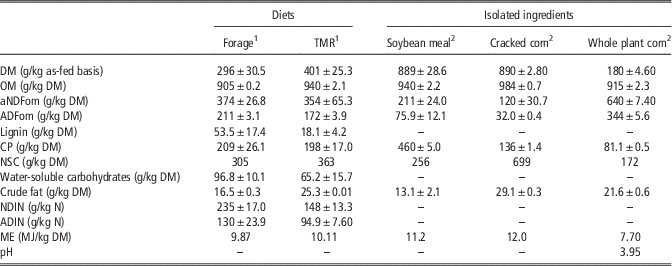
The TMR (Table 1) was formulated to meet requirements of growing lambs with an estimated daily gain of 300 g according to National Research Council (NRC) regulations (2007), and contained 250 g/kg DM of pelleted soybean meal, 120 g/kg DM of cracked dry corn grain, 600 g/kg DM of whole plant corn silage, 12 g/kg DM of sodium bicarbonate (0.99 purity), 10 g/kg DM of calcium carbonate (0.985 purity), 5 g/kg DM of ammonium chloride (0.996 purity) and 2 g/kg DM of a mixture of salts and vitamins (iron, copper, magnesium, manganese, calcium, phosphorus, zinc, sodium chloride, vitamins A, D3, E, B1, B2, B6, B12, nicotinamide and calcium pantothenate).
Chemical composition of the experimental feeds

TMR=total mixed ration; DM=dry matter; OM=organic matter; aNDFom=NDF assayed with a heat stable amylase, sodium sulfite and corrected for blank and ash-free content; ADFom=ADF corrected for blank and ash-free content; NSC=nonstructural carbohydrates; NDIN=neutral detergent insoluble nitrogen; ADIN=acid detergent insoluble nitrogen; ME=metabolic energy.
1 Mean values±SD from samples taken during day 22 to day 31 (n=10/feed).
2 Mean values±SD from samples taken during day 1 to day 2 (n=2/feed).
The forage (Table 1), mostly alfalfa (Medicago sativa), was collected from one paddock at vegetative stage with an initial herbage mass above cutting height of 1475 kg DM/ha (botanical composition: 792 g/kg DM of alfalfa, 156 g/kg DM of Lolium multiflorum, 10 g/kg DM of Lotus corniculatus and 42 g/kg DM of senescent forage and herbs). In order to use plants at vegetative stage and with similar forage quality throughout the experiment, the paddock was divided and sequential cuts were performed before and during the experiment. Forage was cut daily at 1300 h with a disc mower (5-cm height from the ground). An unrestricted amount of this fresh forage was offered, beginning at hour 5 after the morning feeding, and continuously throughout the day to animals in TMR0 treatment. Animals in treatments TMR75 and TMR50, received an unrestricted amount of fresh forage after they finished the TMR ingestion. The continuous supply of feed was assured by observing feeders each 30 min, and adding by more feed if necessary. Drinking water was freely available.
Measurements and sampling
Daily intake of TMR and forage was measured on days 22 to 31 of the experimental period by weighing the amount offered and refused. Samples of the offered feeds were collected daily, frozen at −20°C, dried in a forced-air oven at 60°C for DM analysis, ground to pass a 1-mm screen (Fritsch GmbH, Idar-Oberstein, Birkenfeld, Germany) and analyzed individually for chemical composition. Orts were daily collected, weighed, sampled immediately before hour 0 for all treatments and analyzed for DM (60°C). Although no selection for any particular ingredient was observed, if exceeding 0.20 of the offered amount, orts were also sampled for a complete chemical analysis.
Feeding behavior was individually evaluated by visual examination on day 23 using a regular 5-min interval observation technique for 24 h (Galvani et al., Reference Galvani, Pires, Wommer, Oliveira and Santos2010). Four trained observers categorized animal behavior as eating (i.e., search feeds, grasping, chewing), ruminating (i.e., chewing regurgitated boluses of feed) and resting (i.e., not showing any of the other two activities). The length of each activity (total minutes) was calculated as the number of observations multiplied by 5. In addition, the time spent eating, ruminating and resting per kg of DM and NDF assayed with a heat stable amylase, sodium sulfite and corrected for blank and ash-free content (aNDFom) intake was calculated as the time spent in each activity per kg of DM or aNDFom ingested. The amount of nutrients ingested during the 24 h of the same day of the measurement was used for this calculation.
To measure the rate of intake, TMR and forage were sampled each hour for 12 h/day from the beginning of the ingestion of TMR (hour 0, day 32) and dried in a forced-air oven at 60°C, and the DM of each feed ingested per hour was calculated.
Digestibility was measured by weighing individual fecal excretion from day 23 to day 28. Samples of feces from each lamb were collected, frozen at −20°C, dried in a forced-air oven at 55°C, ground to pass a 1-mm screen and pooled within lambs for analysis. For calculation, each individual daily nutrient intake data obtained during this period was used.
The estimation of particulate-phase passage through the gastro-intestinal tract was performed using chromium mordant fiber (CMF) prepared according to Udén et al. (Reference Udén, Colucci and Van Soest1980). The CMF was orally administered to the lambs with a single dose of 20 g on day 33. Fecal samples were collected directly from the rectum at 0, 12, 24, 30, 34, 38, 42, 48, 60, 72, 96 and 120 h after CMF administration, frozen at −20°C, dried in a forced-air oven at 55°C, ground to pass a 1-mm screen and stored for further analysis.
Ruminal fluid samples were collected using the permanent rumen catheters, hourly from hour 0 to 12 after the morning feed and at hours 16 and 20 from day 38 to day 39. Ruminal pH was immediately measured using a digital pH meter (eChem Instruments Pte., Oakton, Singapore). Two samples of each extraction (1 ml) were mixed with 0.02 ml of sulfuric acid (50%, v/v) and with 1 ml of percloric acid (0.1 M) and stored frozen for later determination of NH3–N and volatile fatty acid (VFA) concentrations.
Chemical analysis and calculations
Feed samples (offered and refused) and fecal pools were analyzed for DM, organic matter (OM) and N according to Association of Official Analytical Chemists (AOAC, 1990, methods ID 934.01, ID 942.05 and ID 984.13, respectively); aNDFom and the ADF corrected for blank and ash-free content (ADFom) were analyzed according to Robertson and Van Soest (Reference Robertson and Van Soest1981) using a Tecnal fiber analyzer (TE-149, Tecnal, Piracicaba, SP, Brasil) and were expressed without residual ash and corrected for blanks as recommended by Mertens (Reference Mertens2003). The aNDFom was analyzed using sodium sulfite and amylase. Intake of nutrients was calculated as g offered−g rejected. Dry matter intake was expressed as total amount and as g/kg BW, using the BW value measured before sampling. Digestibility coefficients of DM, OM, aNDFom, ADFom and N were calculated as (g ingested−g excreted)/g ingested. Feed samples were also analyzed for the sulfuric acid lignin content (AOAC, 1990, ID method 973.18), neutral and acid detergent insoluble N contents (Licitra et al. (Reference Licitra, Hernandez and Van Soest1996), expressed based on the total N content), crude fat content (Nielsen (Reference Nielsen2003), using a Goldfisch fat extractor (Goldfisch, Labconco 35001, Texas city, TX, USA) under a petroleum ether reflux at 180°C for 3 h) and water-soluble carbohydrates content (Yemm and Willis, Reference Yemm and Willis1954). In addition, the nonstructural carbohydrates (NSC) and energy contents of feeds were calculated. The NSC was calculated as 100−(aNDFom (g/100 g)+CP (g/100 g)+crude fat (g/100 g)+ash (g/100 g)), according to Sniffen et al. (Reference Sniffen, O’Connor, Van Soest, Fox and Russell1992). The digestible (DE) and metabolizable (ME) energy contents (MJ/kg DM) were estimated using the equations proposed by Fonnesbeck et al. (Reference Fonnesbeck, Christiansen and Harris1981, DE=3.76−(0.024×aNDFom)) and by Garrett et al. (Reference Garrett, Meyer and Lofgreen1959, ME=DE×0.827), respectively.
Chromium in feces was analyzed according to Czarnocki et al. (Reference Czarnocki, Sibbald and Evans1961), and particle passage kinetics were estimated by analysis of individual curves of fecal Cr excretion according to the mathematical model proposed by Grovum and Williams (Reference Grovum and Williams1973).
 $$Y\,{\equals}\,A{\times}e^{{-k1{\times}(t{\minus}{\rm TT})}} -A{\times}e^{{{\minus}k2{\times}(t{\minus}{\rm TT})}} ,$$
where ‘Y’ is the marker concentration at time ‘t’ (h); ‘A’ the marker concentration adjusted in the fecal DM; ‘k1’ and ‘k2’ (h−1) the turnover rates from rumen and cecum–colon, respectively; and ‘TT’ the calculated time to the first time of feces marker appearance (transit time). The mean retention time in both compartments (h) was calculated as (1/k1+1/k2), and the total mean retention time (h) was calculated as mean retention time+TT.
The NH3–N concentration in ruminal samples was analyzed by spectrophotometry according to Weatherburn (Reference Weatherburn1967) using a spectrophotometer (BEL Photonics®, S-2000, SP, Brazil), and the VFA concentrations (acetate, propionate and butyrate) were analyzed according to Adams et al. (Reference Adams, Jones and Conway1984) using HPLC (Dionex Ultimate® 3000, Waltham, MA, USA) with an Acclaim Rezex Organic Acid H+ (8%) and a 7.8×300 mm column at 210 nm. Volatile fatty acid concentrations were expressed in absolute terms (mM) and total VFA concentration was calculated as acetate+propionate+butyrate concentrations.
Statistical analysis
Data were analyzed using the MIXED procedure of SAS (version 8.2; SAS Institute, Cary, NC, USA). For feeding behavior, intake, digestibility and passage kinetics, the model used was
 $$Y_{{ijk}} \,{\equals}\,\mu {\plus}T_{i} {\plus}B_{j} {\plus}e_{{ijk}} ,$$
where Y ijk is the dependent variable, µ the general mean, T i the fixed effect of the treatment (i=TMR100, TMR75, TMR50 or TMR0) in k animal replicates (n=6 lambs), B j the random effect of the block (j=6 blocks) and e ijk the residual error.
The rate of intake, pH and VFA, and NH3–N concentrations were analyzed as repeated measures, with the lamb as the subject of the repeated measurements, according to the model
 $$Y_{{ijkl}} \,{\equals}\,\mu {\plus}T_{i} {\plus}B_{j} {\plus}t_{k} {\plus}\left( {T{\times}t} \right)_{{ik}} {\plus}e_{{ijkl}} ,$$
where Y ijkl is the dependent variable, µ the general mean, T i the fixed effect of the treatment (i=TMR100, TMR75, TMR50 or TMR0) in l animal replicates (n=6 lambs), B j the random effect of the block (j=6 blocks), t k the fixed effect of the time (k=0, 1, 2, 3, 4, 5, 6, 7, 8, 9, 10, 11, 12, 16 and 20 h), (T×t) ik the interaction between treatment and time, and e ijkl the residual error. In addition, when repeated measures were used, the hourly differences were separated by Tukey’s test. The covariance structure was the autoregressive AR (1) for evenly spaced data (rate of intake), and spatial power law (SP (POW)) for unevenly spaced data (pH, VFA and NH3–N concentrations).
The effect of decreasing levels of TMR in the diet (1.0, 0.75, 0.50 and 0.0) on the average values was evaluated by linear and quadratic regression.
Significant differences were declared if P⩽0.05 and 0.05<P<0.10 were considered to be trends of significant differences.
Results
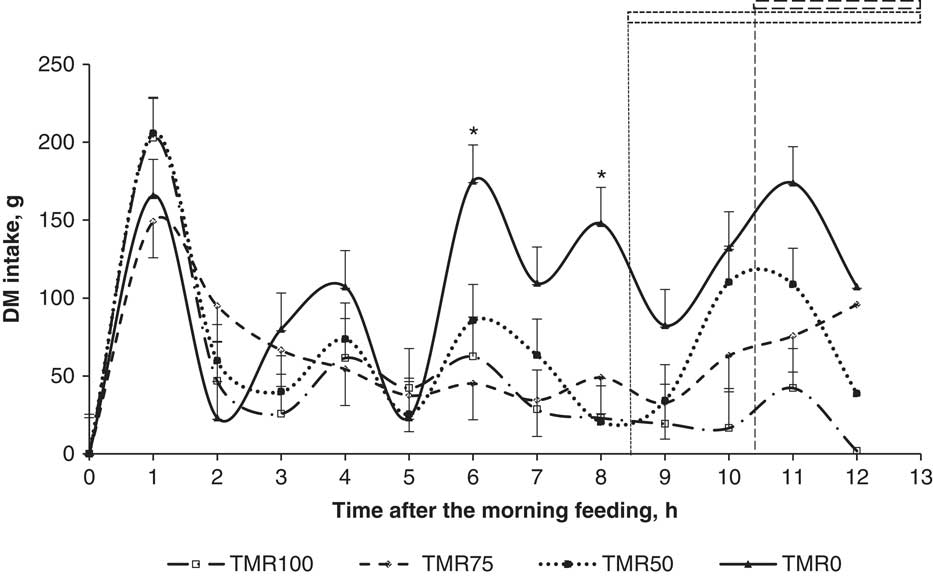
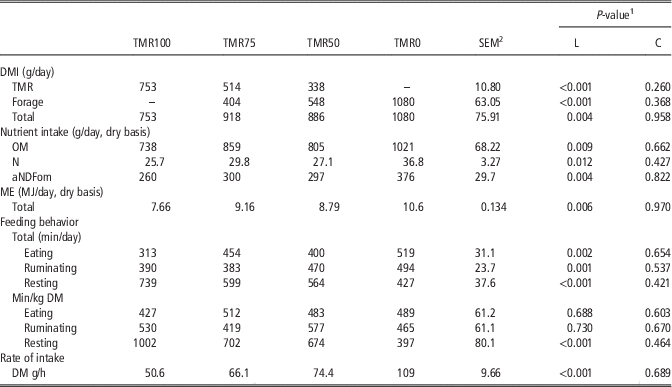
Daily forage and total DMI linearly increased as the level of TMR decreased (P=0.004, Table 2). The mean total DMI values, expressed as g/kg BW, were 30 (TMR100), 37 (TMR75), 35 (TMR50) and 43 (TMR0) (SEM=2.80, P=0.004). Based on actual TMR and forage intake, the dietary TMR and forage ratios were 56 : 44 and 38 : 62 for TMR75 and TMR50, respectively. Nutrient ingestion followed the behavior of DM (a linear increase in OM, N, aNDFom and ME ingestion with the rise of forage in the diet). The higher amounts of forage intake achieved by lambs fed lower levels of TMR were related to higher eating and ruminating and lower resting times (Table 2). The rate of intake (kg of DM/h) also increased as the level of TMR dropped (P<0.001, Table 2), and the shape of the rate of intake curves was also affected by the treatments as there were significant interactions between treatment and time (P=0.003, Figure 1). Animals fed only fresh forage sharply increased their rate of intake at hour 6 after the morning feeding, immediately after fresh cut forage was supplied (Figure 1). However, when behavioral activities were expressed as total min/day relative to the amount of ingested DM, there were no differences detected between treatments. Only the resting time, expressed as min/kg DM (Table 2) significantly decreased as the level of TMR decreased.
Rate of intake (total dry matter intake (g/h)) during the first 12 h after the morning feeding (hour 0) to lambs fed TMR (TMR100), TMR 0.75 and fresh forage (TMR75), TMR 0.50 and fresh forage (TMR50) or only fresh forage (TMR0). The dotted lines and top bars indicate the period of time in which animals fed TMR75 and TMR50 had access to the forage. Means±SEM; *P⩽0.05. TMR=total mixed ration.

Nutrient intake, feeding behavior and rate of intake in lambs fed TMR (TMR100), TMR 0.75 and fresh forage (TMR75), TMR 0.50 and fresh forage (TMR50) or only fresh forage (TMR0)

TMR=total mixed ration; DMI=dry matter intake; OM=organic matter; aNDFom=neutral detergent fiber assayed with a heat stable amylase, sodium sulfite and corrected for blank and ash-free content; ME=metabolic energy.
1 Significance level: linear effect (L) and quadratic effect (C) of decreasing level of TMR in the diet.
2 n=6/treatment.
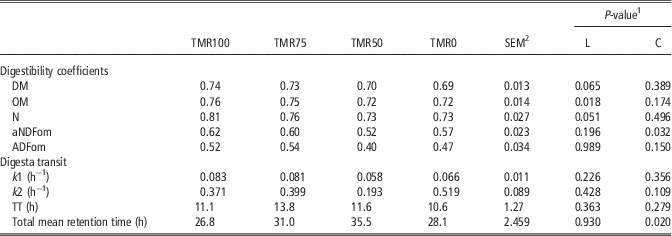
The OM digestibility linearly decreased and the DM and N digestibility tended to be lower as the level of TMR decreased (Table 3). The aNDFom digestibility showed a quadratic response (P=0.032), with higher values for lambs fed only TMR (TMR100). In addition, no differences in the rumen and cecum–colon turnover rate (k1 and k2, respectively) were observed (Table 3), but the total mean retention time varied quadratically with the treatment (P=0.020), with lower retention times in pure diets (TMR100 and TMR0).
Apparent digestibility coefficients and kinetics of passage in lambs fed TMR (TMR100), TMR 0.75 and fresh forage (TMR75), TMR 0.50 and fresh forage (TMR50) or only fresh forage (TMR0)

TMR=total mixed ration; DM=dry matter; OM=organic matter; aNDFom=NDF assayed with a heat stable amylase, sodium sulfite and corrected for blank and ash-free content; ADFom=ADF corrected for blank and ash-free content; k1 and k2=output rate of particles through rumen and cecum–colon, respectively; TT=transit time.
1 Significance level: linear (L) and quadratic (C) effects decreasing the level of TMR in the diet.
2 n=6/treatment.
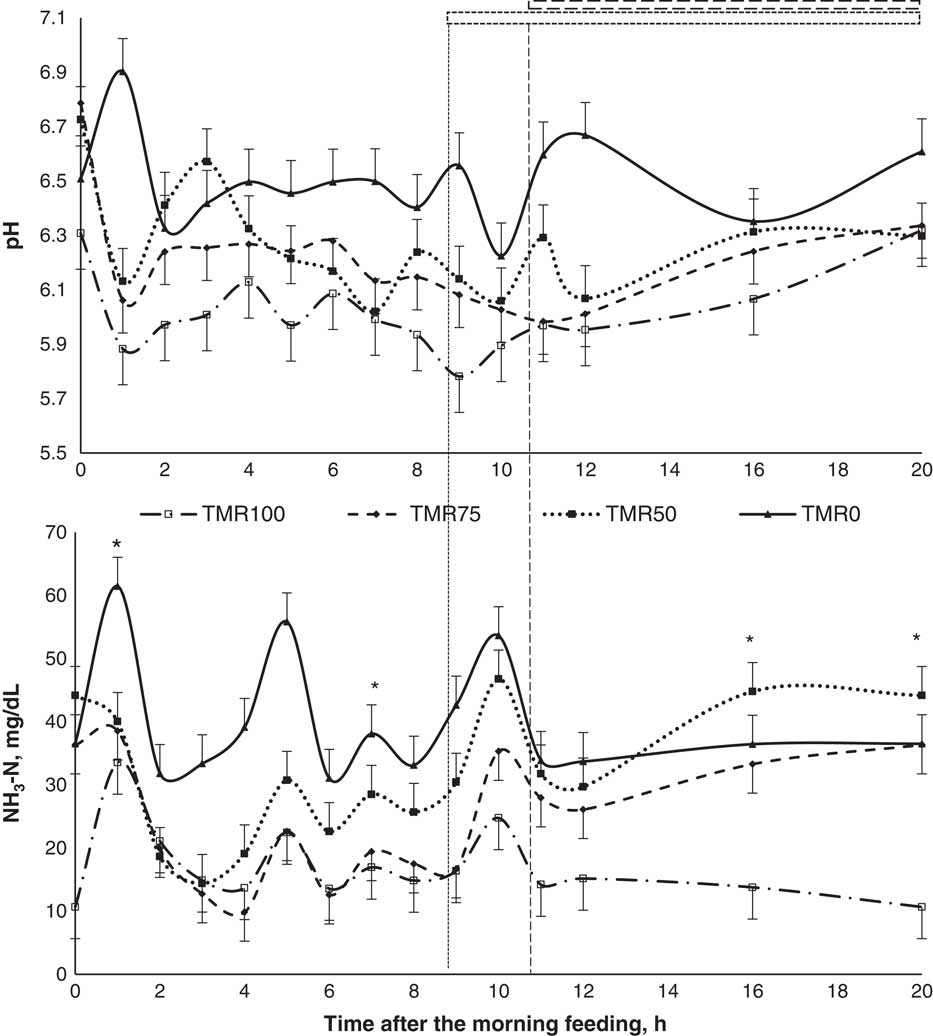
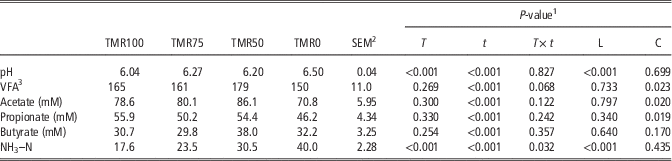
The mean ruminal pH values linearly increased with the TMR decrease (Table 4), without significant interactions between treatment and time (P=0.827, Figure 2). Generally, VFA presented a quadratic response; the total VFA and acetate concentration were higher and the propionate level was lower if lambs consumed mixed diets (TMR50 and TMR75, Table 4). The ruminal NH3–N concentration linearly increased with the TMR decrease (Table 4), with significant interactions between treatment and time and a greater variability in animals fed mixed diets than animals fed only TMR or only forage (P=0.032, Figure 2).
Ruminal dynamics of the pH and NH3–N concentrations in lambs fed total mixed ration (TMR) (TMR100), TMR 0.75 and fresh forage (TMR75), TMR 0.50 and fresh forage (TMR50) or only fresh forage (TMR0). The dotted lines and top bars indicate the period of time in which animals fed TMR75 and TMR50 had access to the forage. Means±SEM; *P⩽0.05. TMR=total mixed ration.

Mean pH, volatile fatty acid (VFA) concentrations (mM) and NH3–N concentration (mg/dl) in the ruminal liquor of lambs fed TMR (TMR100), TMR 0.75 and fresh forage (TMR75), TMR 0.50 and fresh forage (TMR50) or only fresh forage (TMR0)

TMR=total mixed ration.
1 Significance level of treatment (T), time (t), interaction treatment×time (T×t); linear (L) and quadratic (C) effects of decreasing the level of TMR in the diet.
2 n=6/treatment.
3 Total VFA concentration (acetate+propionate+butyrate) (mM).
Discussion
The level of intake of lambs was high regarding the expected range for the BW category, which ranged from 29.3 to 30.4 g/kg according to NRC (2007). However, the most remarkable result was that, for each unit of decrease in TMR supply, lambs ingested on average 1.5 units of forage DM, leading to a higher intake, increasing the intake for all nutrients, even energy, as the TMR decreased. Although it is well known that intake increases with the rise of digestibility (Forbes, Reference Forbes2005), in the present study, there was a simultaneous increase of intake and reduction of digestibility. Therefore, digestibility does not explain the higher intake observed with the increase of forage.
Even more, fiber intake increased with the decrease of TMR in the diet, indicating that the fiber level did not act as a limiting factor for intake, even at aNDFom intake levels that ranged from 320 to 340 g/kg of the total diet. Maybe this response was due to the quality of fiber included in the TMR, which could have limited intake. In this sense, whole plant corn silage (the main source of fiber of the TMR) was harvested at a late vegetative stage with little grain, and therefore, although well conserved, had high fiber and very low DM content. This result could also be related to the high palatability of fresh alfalfa (Burns et al., Reference Burns, Mayland and Fisher2005; Brito et al., Reference Brito, Tremblay, Lapierre, Bertrand, Castonguay, Bélanger, Michaud, Benchaar, Ouellet and Berthiaume2009). Although no differences were detected in the output rate of particles, the slight decrease in the OM digestibility as the proportion of forage in the diet increased may be related to the increase on intake level.
The ruminal pH and NH3–N concentration increased as the intake of forage increased, which is consistent with the higher fiber and CP content of forage. The lower total VFA and acetate concentrations in animals fed only forage cannot be readily explained but it could be related to the higher intake that was associated with lower total mean retention time and lower fiber digestibility. However, it is necessary to point out that concentrations of VFA at a given time were measured and not total amount produced daily. It is known that rumen VFA concentration depends on their production, but also on their passage rate in the fluid to the omasum and their absorption through the rumen wall (Dijkstra et al., Reference Dijkstra, Boer, Van Bruchem, Bruining and Tamminga1993).
The increase on intake, as the decrease of TMR in diet, was not related with a higher digesta transit, contrary to what could be expected. Even considering the relatively high standard errors observed, and the fact that only particulate passage was measured, none of the digesta transit variables were significantly altered. Moreover, with the increase of intake and forage proportion in the diet, the observed means are not consistent with a higher transit. The differences observed on intake could be related to the feeding preferences of lambs, as they were consistent with the changes observed on feeding behavior and on the rate of intake. In this sense, although this experiment was not designed to evaluate preferences, the increase of the intake rate observed at the moment of forage supply can suggest that lambs preferred fresh forage over TMR, and this behavior could be related to the higher sugar concentration of the forage. In fact, the preference of ruminants for feeds with a higher sugar concentration has already been described by others (Jones and Roberts, Reference Jones and Roberts1991; Fisher et al., Reference Fisher, Mayland and Burns1999), and several authors also described a higher intake of forages with higher sugar concentrations (Burns et al., Reference Burns, Mayland and Fisher2005; Brito et al., Reference Brito, Tremblay, Lapierre, Bertrand, Castonguay, Bélanger, Michaud, Benchaar, Ouellet and Berthiaume2009). It is noticeable that lambs consuming only forage markedly increased their rate of intake when new forage was provided, that is, at hour 1 after the morning feeding (when the refusals were weighed and lambs received forage from previous day harvest) and at hour 6 (when fresh cut forage was supplied). It seems that the supply of new forage was a strong stimulus for intake, even higher than that observed when one type of feed was changed to another, in animals fed TMR75 and TMR50.
Various authors (Murphy et al., Reference Murphy, Loerch, McClure and Solomon1994; Aurousseau et al., Reference Aurousseau, Bauchart, Faure, Galot, Prache, Micol and Priolo2007; Carrasco et al., Reference Carrasco, Ripoll, Panea, Álvarez-Rodríguez and Joy2009) have hypothesized that the limited energy intake in animals fed fresh forages could cause less-developed fat deposits than in the animals fed only TMR, although energy intake was not measured in those studies. In the present study, the CP : energy ratio increased as the level of energy intake increased (the mean values of the CP : energy ratio were 21 (TMR100), 20.3 (TMR75), 19.3 (TMR50) and 21.7 g CP/MJ of ME (TMR0)). A higher CP : energy ratio in the diet, among other factors, can lead to leaner carcasses according to Blome et al. (Reference Blome, Drackley, McKeith, Hutjens and McCoy2003).
Undoubtedly, in the present work, the effect of treatments on nutrient intake, which was consistent with the high palatability of fresh forage (mainly due to alfalfa), led to the effects found in the ruminal environment and digestion. Therefore, in order to maximize productivity, palatability of feeds is a key factor to consider when providing high-quality foods in sufficient amounts.
Conclusions
The decrease in the level of TMR, led to an increase of forage intake, exceeding this increase the amount of TMR removed. This resulted in a higher DM and nutrient intake in lambs. These results suggest that under similar conditions it is possible to include high-quality fresh forage in a combined diet with TMR without negative consequences on nutrient intake, digestion and rumen environment in lambs.
Acknowledgments
The authors’ thank Carla Bonifacino (Biochemistry), Jacinta Ubilla, Daniela Silva, Santiago Gonnet, Matías Morales, Bruno Oudrí, Marcos Padilla, Matías Muniz, Germán Gonçalvez, Martín Estramil, Pia Arrieche, Elisabeth Artigas and Santiago Ultra (Veterinary students) for their assistance with animal management and contribution to taking samples.