In 2015 Christchurch Art Gallery Te Puna o Waiwhetū had just re-opened after nearly five years of being closed due to the 2010/11 earthquakes. At that moment in the gallery's history, the attitude was distinctly gung-ho: we had emerged from one of the darkest periods, during which we had thought hard about what is and is not important across all our activities and emerged into a bright new dawn where everything seemed possible; in fact where everything seemed certain.
At the time of writing, three years after the re-opening, that optimism and self-assurance has diminished and we are squarely back in the real world where everything is provisional, uncertain, contingent and difficult. It therefore now seems more important than ever to share this experience and to receive others’ responses on this one aspect of our open-closed-open again narrative.
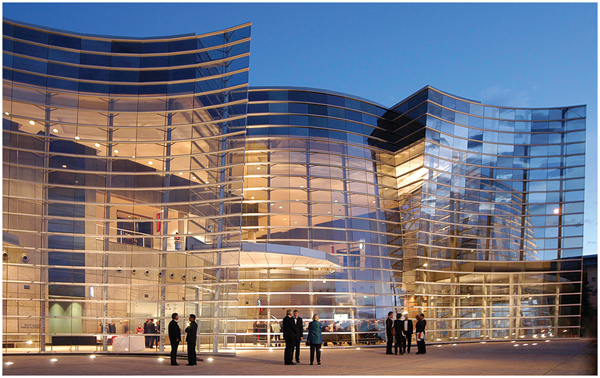
Christchurch Art Gallery Te Puna o Waiwhetū, (Fig. 1) a small but significant, publicly funded art museum began its audiotour story in 2003. This was a highly developed one-way story of local art, following a set route through the collection. References to works already described made it hard to deviate from the prescribed route. It included licensed music and was professionally edited and produced. It was in fact more like a radio documentary and was difficult and expensive to edit. It required proprietary software and a proprietary device.
Christchurch Art Gallery Te Puna o Waiwhetū by night. Photo: Brendan Lee.

In 2005 the change was made to a much simpler, painting by painting, curatorial commentary, recorded by New Zealand actors Sam Neill and Miranda Harcourt. This allowed commentary on any work to be heard in any order, or in isolation. These were, essentially, wall labels read aloud. Delivery was via loaned iPods, which were very much easier to edit and reorganize, as works were moved around or returned to storage.
In 2011 the gallery was all set to upgrade from iPods to iPads. This would allow for a more comfortable audio and video visitor experience and the management of each device would be the same.
Pause
Between 2011 and 2015 everything changed. Not only was the gallery closed because of the earthquakes (first occupied as a Civil Defence headquarters, then subject to structural repairs and refurbishment) but its staff had the motive and the opportunity to re-consider most aspects of its service.
As far as providing a visitor audio experience was concerned, we knew that by 2015 86% of New Zealanders have a smartphone. Civil Defence, whose occupation of our gallery had been so painful, left behind a very fine wifi system that reached into every corner of the gallery. These two simple facts told us that whatever the content was, the final delivery mechanism was now not likely to be on a device provided and maintained by us, but on a device that everyone has in their pocket anyway.
The next question was how to connect our visitors’ devices to whatever content we might provide. We trialled different types of beacons and looked at their deployment in other museums– mostly, to be candid, because we felt we should – but ended up far from happy with their endurance, sensitivity, proneness to theft or loss. We even bought a vWand – used to great acclaim at the Whitney Museum – but their cost and complexity ruled them out for an operation of our size.
In studying both beacons and data gathering pens we realized that both made you look down at your device, or down at the floor for the next beacon. The more we thought about possible delivery mechanisms, the more we thought:
We are not a museum. You do not, by and large, interact with our art – you just look at it. You do not generally sit on it, ride it, make it go, watch it move or activate it in any way so anything that gets in the way of just looking is to be deprecated. The only thing you do in an art gallery like ours is look.
This perfectly obvious fact took us back to basics and allowed us to say: let's look at the art we have and consider if it has sound within it already. Not curators describing the art, but material that can be delivered as audio; audio that emerges from the painting, print or photograph itself
Curatorial commentary is of course vital but we were keen to avoid it in this situation and instead to consider poetry, music, the sounds of a painting, an artist's own voice as being inherent in the work, rather than applied to it.
Maybe this is not a breakthrough for you, but for us it was. We had never really had the time and the opportunity to ask the question ‘What is the point of audio in art gallery spaces?’ and, now we did, we found this new area to explore. We were, in effect, now not going to have an audiotour at all: some works would have audio, some would not. A lesser-known work might have an audio component, a star work might have nothing.
With the type of content now clear and delivery onto visitors’ own phones over the web also settled, we still had to pick a way of triggering that final link between visitor and content. Something auto-triggered, such as beacons, was unsatisfactory, something visitors had to activate themselves (a number, a QR code, an NFC tag…) was not necessarily intuitive and could be visually unattractive. All options, it seems, had pros and cons and our final decision (NFC tags and QR codes) was, by necessity, a compromise.
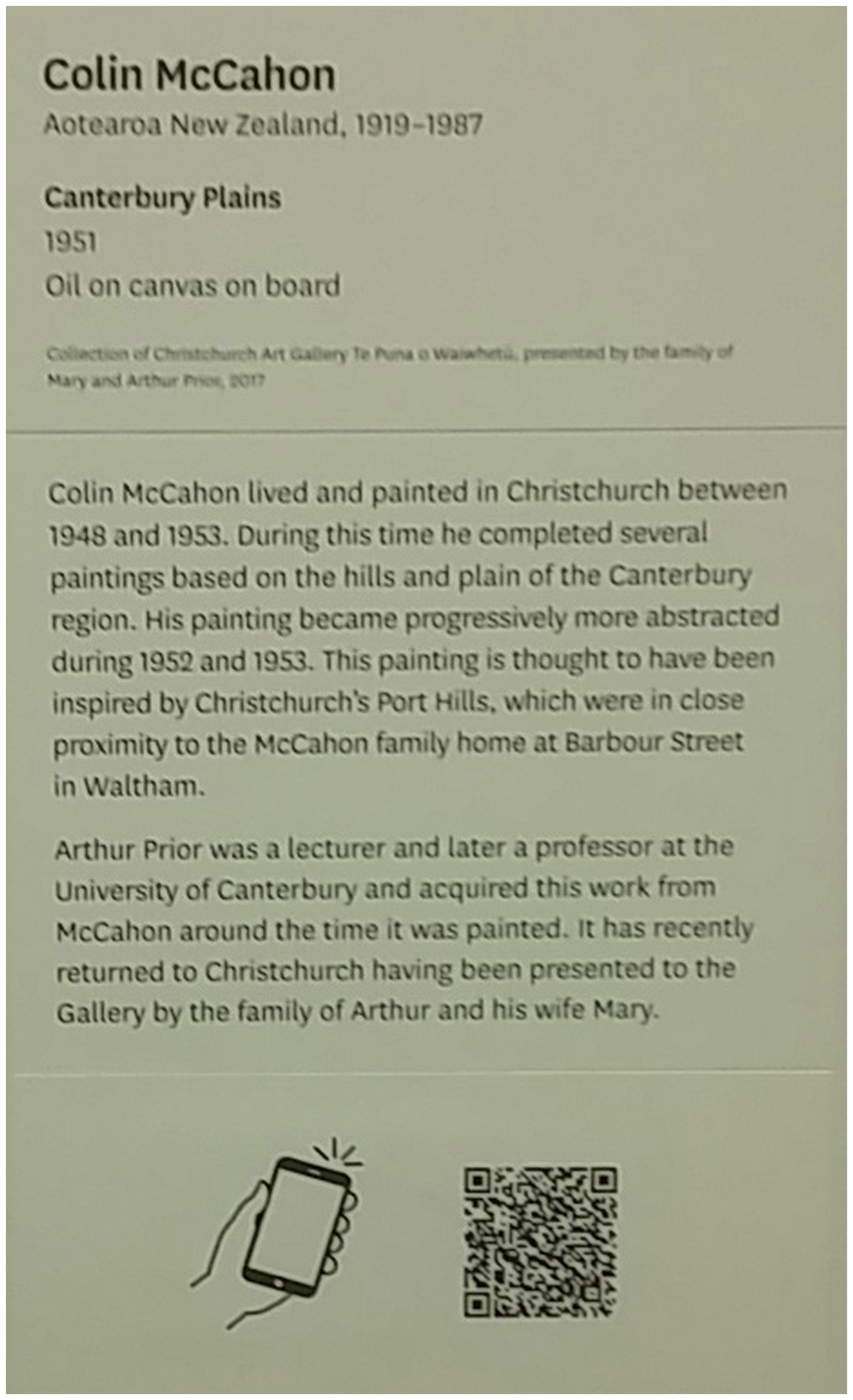
For the small number of visitors who wanted audio, but had no phone, we would buy ten of the cheapest phones we could find, remove their SIM card, disable everything, and lend them free of charge. We also bought 100 of the cheapest headphones we could find and have been happy to give these away, aeroplane style (Fig. 2).
Caption for Colin McCahon's Canterbury Plains, with visible QR code/NFC tags. Photo: Tim Jones.

Some examples of the works of art which seemed to us to ‘contain’ audio content are a painting of the 1953 royal visit to Christchurch for which archival radio commentary of the event was offered, various wood engravings based on poetry to which the poems themselves were professionally read and a painting of a notable local industrial workshop, to which the workshop's own brass band provided musical accompaniment. Artists speaking about the creation of the works on display were sourced and licensed from sound archive collections. These included LS Lowry, Colin McCahon and William Sutton, all of which are gathered here via the website: christchurchartgallery.org.nz/multimedia/
This then was the situation that applied in 2015: research done and the whole knotty problem solved. Audio would originate within the work, we would have as much or as little as was appropriate, and we would deliver it to visitors’ phones using NFC tags and QR codes. Our curators began contemplating whole exhibitions based on music, poetry or sound – in different styles, for different age groups and in different languages! Three years have now passed and the gallery has resumed its regular cycle of exhibition openings and closings - not to mention its regular cycle of budget rounds and fund-raising events – and things seem by no means so simple.
Fast-forward
We are not a large gallery and, in devising exhibitions, our curators are masters at making a small and variable collection go a very long way. The consequent changeovers of works means that the amount and type of audio available is always changing. Although this is very easy to manage, it means that the visitor's audio experience varies from month to month. Audio content quite rightly dictates neither the exhibition programme nor the selection of works for display, so at times audio all but disappears altogether. Curators have been unenthusiastic about recycling audio content from one exhibition to the next since each show has a distinctive voice or rationale which existing audio may not support – which it may indeed contradict. A library of endlessly reusable audio seemed like a good idea, but this has not proved to be practicable.
The curatorial preference is for specially commissioned research, including audio and video elements, linked directly to a specific exhibition. A 2018 show entitled ‘Closer’ examined just six favourite works and produced mini-documentaries about each, including audio and video from a range of sources, both freshly commissioned and sourced from the archives. All of it was professionally scripted, directed and edited. These mini-documentaries featured extensive curatorial analysis and commentary, lightly applied to be sure, but unmistakable. Visitor feedback was very positive. It was noted though that in ‘Closer’ the attention of brightly lit, animated video, drew visitors’ attention away from the immediately adjacent works.
Playback
This gallery's experience of providing visitors with an audio component to their visits has therefore gone almost full circle. From lavishly produced symphonic tours featuring only our starriest works, to a more eclectic assortment of inherent sound and music in a wide variety of works, to the deep analysis of very few works. Or if this has not brought us back to where we started, then we can certainly say we have attempted a number of different approaches. None has been obviously more or less successful than another. The vast majority of our visitors do not ask about audio guides and analysis of web traffic gives limited information about who is using them. If the principle of ‘just look at the art’ is pursued with steely logic, then might no audio, indeed no labels, no introductory panels, no exhibition names, be the surest way of enforcing it?
We have arrived quite cheerfully at this point of ambiguity, having once naively thought that bliss it was in that dawn to be alive. Neither content nor style are settled and even the delivery mechanism now seems anything like so easy to create or select. Beacons have got better, NFC tags have not become common, and QR codes remain clunky and obtrusive. Proprietary software – now in the form of phone apps – has improved vastly but remains expensive.
I make no apology for finishing this article in such uncertainty and perhaps the best we can say is that we remain alert to developments in this area.
This is an edited text of a paper originally presented at the 2018 ARLIS/ANZ Conference: Expanding Our Reach, National Portrait Gallery and National Gallery of Australia, Canberra, October 2018.