

Introduction
China is deemed to become an economic superpower during the twenty-first century. Economic indicators show that China has 1.3 billion people (20 per cent of the world's population), a land area of 9.36 million square kilometres (the third largest country behind Russia and Canada) and a gross domestic product of US$2.6 trillion (fourth in the world behind the USA, Japan and Germany), with 11 per cent GDP growth in 2006.
China's capital markets include two securities exchanges: one in Shanghai and one in Shenzhen. In 1992 there were only 50 listed companies in China, but in recent years China has experienced enormous changes in its capital markets. Consistent with the progressive opening up of its financial markets, its securities markets have become some of the most active markets in the world. By 2007 there were nearly 1,500 companies listed on the Shanghai Stock Exchange and the Shenzhen Stock Exchange, with a market capitalization of around RMB32.7 trillion. This is the fourth highest in the world, after the US, Japanese and British markets.Footnote 1
Since early 2001 the corporate financial scandals involving listed companies in China (for example, Guanxia Industry Co. Ltd, Macat Optics and Electronics Co. Ltd, Sanjiu Pharmaceutical Co. Ltd and Lantian Co. Ltd) prompted policymakers, regulators and officials at the China Securities Regulatory Commission and the State Economic and Trade Commission to make corporate governance a priority issue for their agenda in 2002. The government came under increasing public pressure to improve its policy towards corporate governance structures. Additionally and importantly, according to the WTO entry agreement, China should be committed to capital market liberalization and corporate reform, in particular with respect to state-owned enterprises. An effective and efficient China corporate governance system must coincide with international standards, allowing both domestic companies and foreign companies to enjoy free market competition within a fair economic and policy environment.
Why does China need corporate governance?
A brief history of China's capital markets
China's securities markets have experienced many ups and downs in the last 50 years. The past six decades of the history of China's capital markets since 1949 can be divided into three phases: temporary trials to denials (1949–1956); full denials (1957–1980); and restoration to full development (1981–present).
In June 1949 the re-established Tianjin Stock Exchange marked the start of the Chinese securities market under the communist regime. In 1956, after the completion of the socialist transformation from a capitalist industry system, traditional socialist theories and the centrally planned economic system began to deny and reject the existence of a stock market. In 1957, the socialist planned economic system replaced the transitional economic and Chinese securities markets, and their financial ideas largely disappeared for the next 25 years.
After the Third Plenum of the 11th Communist Party of China Central Committee's adoption of economic reforms, and Deng's Open-Door policy in 1978, China restarted its financial markets in order to drive its economic reforms. The Government issued its first treasury bonds in 1981 to finance its budget deficit. Soon after, many state-owned enterprises issued financial and construction bonds to solve funding shortages, with these funds being urgently needed for the economic reconstruction of the country.Footnote 2 For example, The China International and Investment Corporation ‘privately’ floated JPY10 billion in the Tokyo capital market. In January 1984 the Bank of China issued JPY20 billion worth of public bonds that were given an AAA rating by a Japanese credit rating institution.
The first Chinese company to issue public share certificates (A-shares)Footnote 3 was a joint investment company in Baoan County, Shenzhen in 1983. In July 1984, the first joint-stock company, the Beijing Tianqiao Departmental Store Company, issued shares to the public. In November 1984, the Shanghai Feiyue Hi-Fi Corporation floated 10,000 shares at RMB50 each. Both these issues were handled by a trust and investment company that was a unit of the Shanghai Branch of the People's Bank of China. Two months later, the Yanzhong Realty Company floated 100,000 shares to the public. On 30 November 1990 the Shanghai Vacuum Electronic Devices Co. Ltd became the first Chinese company to issue B-shares.Footnote 4
Secondary markets were established and developed in ‘securities trading centres’ across the country in major provincial cities such as Guangzhou, Changzhou, Wuhan, Harbin and Dalian under Central Government supervision. In April 1990, Central Government approved these trading centres, and provincial officials started designing their own exchanges and applying to Beijing for permission to open them. This idea was supported by legislators in the National People's Congress.Footnote 5 By the end of 1992 there were about 5,000 securities trading centres, spawning the growth of approximately 70 specialized securities companies and 1,000 institutions with securities operations. In 1989, the State Council decided to establish two stock exchanges to allow state-owned enterprises to raise external equity capital from the public. The Shanghai Stock Exchange was the first which opened on 26 November 1990, trading eight kinds of stock with a market value of RMB1 billion. The second, the Shenzhen Stock Exchange, was inaugurated on 3 July 1991 with five listed companies.Footnote 6
Behind these impressive statistics, Paul Pacter points out that the major characteristics of China's capital markets are:
• A minority of shares are actually publicly tradeable.
• The majority of shares are still held by the state.
• Levels of institutional investment are low relative to Western securities markets.
• Only a small minority of the listed companies are audited by international auditing firms.Footnote 7
The challenges after the WTO accession
At the same time as the stock markets were growing, China had been undertaking rapid reform of its corporations. Laws and regulations were established to allow stock-holding companies. The large state-owned enterprises and financial institutions were transformed into such companies. China faced new dynamics following the WTO accession on 11 December 2001. This accession brought in unprecedented international competition, and made the reform of China's financial markets and corporate governance even more urgent.
The WTO accession was not only expected to promote the sustained and healthy development of China's economy, but was also expected to have a positive effect on the long-term development of China's legal system. Randall Peerenboom suggests that reformers will be able to take advantage of the WTO accession for further legal reforms in China, including institutional reforms such as foreign investment policies.Footnote 8 The WTO accession created a vital milestone which enabled China to enter a new phase of opening up and it offered an opportunity of historic significance for the long-term development of its securities markets. Jonathan Reuvid summarizes three great challenges that the WTO accession has brought:
• The entry of foreign securities institutions will generate new tasks for China's securities regulation and supervision regimes. International political and economic factors will have an increased impact on China's financial markets, which will consequently increase the level of difficulty in regulating and supervising the securities markets and in handling any possible crises that may emerge.
• The second challenge results from the great gap that has existed between Chinese securities institutions and their foreign counterparts in terms of the size of capital requirements, level of corporate governance and risk control. Although foreign securities institutions can only enter China's securities market in the form of joint ventures at present, their direct entry into the securities market will inevitably become a reality with the acceleration of the opening up process. If domestic securities institutions are not able to mature quickly, they will eventually be eliminated from the market.
• Domestic listed companies will be subject to the law of the market when competing with international giants on the same stage. China's securities markets need to converge with international practices, which will require major reforms in order to improve market transparency and to crack down on illegal conduct.Footnote 9
The high concentration of state ownership is a major problem in shareholding restructuring for most state-owned enterprises in China, as non-state investors usually have only a limited shareholding in them. Consequently, monitoring of the performance of state-owned enterprises by non-state shareholders has not improved as much as was initially expected under the process of economic reform. Hence, the accountability issue of management remains unresolved and progress in corporate reform is slow.Footnote 10
However, there have been some significant achievements in the Chinese securities market that can be summarized as follows:
• It has become a basic means for allocating economic resources.Footnote 11 Its growth in the last sixteen years has largely caught up with developments in the last 100 years in mature market economies such as the UK and the USA.
• The fast growth of the Chinese securities market has fostered and enhanced the notion of risk-bearing investments in the economy. Based on the China Securities Regulatory Commission's statistics, by 2005 70 million investor accounts had been opened across the country, and roughly 200–300 million Chinese people, directly or indirectly, had invested in and were affected by the stock market.
• The fast growth of the Chinese securities market and the WTO accession have accelerated the rate at which listed companies have established and improved their corporate governance.Footnote 12
• Finally, intensive and extensive Chinese securities market reforms have resulted in an improved regulatory system and a market-oriented appraisal system for initial public offerings, as well as an expanded capital supply to the market.Footnote 13
As China's economy takes off, the role of the securities market will become much more important in the growth of the economy. However, although the rapid development of the securities market has been impressive, it is still a newly developing market. Thus, there is a long road ahead before this market will be mature and stable. Li Rongrong, Head of the State-owned Assets and Administration Commission, has acknowledged that there is still a huge gap between Chinese commercial giants and the world's leading multinational companies in terms of their scale or efficiency of corporate management, or the strength of their profits and innovative capability, or in terms of their internationalization.Footnote 14
What corporate governance system should China adopt?
The legal framework for China's corporate governance
The aim of the Chinese Government was to establish a socialist market-oriented economy, prior to becoming part of the WTO, in order to improve and protect shareholders’ rights, insulate companies’ boards from inappropriate influences, and reduce information asymmetry.Footnote 15 Thus, corporate governance became a pressing issue to enhance Chinese enterprises’ competitive advantage and to eliminate unacceptable practices. Although more than 300 laws and directives concerning the securities and futures markets have been issued since the establishment of the China Securities Regulatory Commission in 1992, in practice the state still owns large shareholdings in many companies, minority shareholders’ rights are sometimes ignored and Chinese companies are liable to have influence exerted over them from a number of different sources. With the objectives of developing a prosperous socialist market-oriented economy and attracting more foreign institutional investors, the government realized that there is a need to create a corporate governance system that protects minority shareholders’ rights and encourages confidence in the corporate structure and operations, and that companies need to provide accurate and timely information.Footnote 16
In China, corporate governance developments involve a number of regulatory bodies, including the China Securities Regulatory Commission, the Ministry of Finance, the Economic and Trade Commission and the People's Bank of China, which is essentially the Central Bank of China.
The key legal framework for corporate governance in China consists of The Company Law promulgated in December 1993 and revised in 2005, The Securities Law promulgated in December 1998 and revised in 2005, and The Code of Corporate Governance for Listed Companies in China (The Code) issued by the China Securities Regulatory Commission and the Economic and Trade Commission in January 2002. The Code is applicable to all listed companies in China, and is the major measuring standard for evaluating whether a listed company has good corporate governance or not. All listed companies are required to act in the spirit of The Code in their efforts to improve corporate governance. With the objective of eliminating the dominant managerial powers of the boards of directors in China's listed companies, the China Securities Regulatory Commission issued The Guidelines for Introducing Independent Directors to the Board of Directors of Listed Companies (The Independent Directors Guidelines) in August 2001, mandating that by 30 June 2003, at least one-third of board members shall be independent directors.
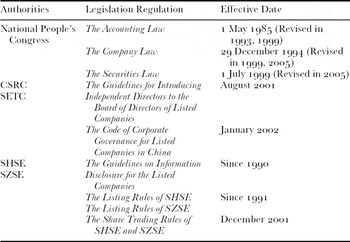
The legal hierarchy framework is presented in Table 1. At the top level of the hierarchy is legislation enacted by China's highest legislative authority, the National People's Congress, which comprises The Accounting Law, The Company Law and The Securities Law. The China Securities Regulatory Commission, on the second level, is responsible for the regulation of securities markets and acts in a dominant role to issue regulations such as The Independent Directors Guidelines and The Code. The Shanghai Stock Exchange and Shenzhen Stock Exchange, on the third level, are responsible for issuing listing rules and guidelines, and for monitoring listed companies in accordance with these rules.
The Legal Framework for Corporate Governance in China

Key: SHSE = Shanghai Stock Exchange, SZSE = Shenzhen Stock Exchange, CSRC = China Securities Regulatory Commission, SETC = Economic and Trade Commission.
The Company Law, which was enacted in 1993 and became effective in July 1994, established the basic legislative provisions and improved corporate governance in China. It was the first attempt to create limited liability companies without regard to the nature of ownership, as part of a modern economic system. With China's accession to the WTO, corporate governance moved to the centre stage of China's economic reform.Footnote 17 The Fourth Plenum of the Communist Party of China's 15th Central Committee held in September 1999 adopted a decision that identified corporate governance as the core of the modern enterprise system.
According to The Company Law, the basic organizational structure of a limited liability company consists of three tiers of control. The first tier is the shareholders’ meeting. In China this is known as ‘the organ of power of the corporation’ as it assumes supreme sovereignty in corporate governance. By statute, shareholders have the power to call meetings, elect and replace directors and supervisors, and approve their reports. They are also conferred with the right to examine corporate financial accounts, decide whether to issue additional shares and make decisions regarding corporate mergers, dissolution and liquidation. However, several problems stem from these shareholders’ powers. First, if shareholders deny the decisions of the board of directors and exercise powers purportedly reserved exclusively to the board, this will result in power struggles between the two parties.Footnote 18 Second, the shareholders’ meeting in reality is often simply a rubber stamp for the wishes of the majority shareholders, and provides little protection for minority shareholders.Footnote 19 Finally, although shareholders are allowed to file a lawsuit individually or jointly with other shareholders against directors or senior managers, class action is excluded as a permitted method due to the courts’ lack of experience or resources to deal with thousands of shareholders in such actions.Footnote 20
The second tier is the board of directors. The boards of directors of Chinese listed companies have the usual breadth of managerial powers comparable to their Western counterparts. Essentially, the board of directors is the critical link between ownership and corporate governance. Majority ownership of shares in listed companies is held by the State since most listed companies come from restructured state-owned enterprises. This dominance of state ownership implies that the government exerts control over managerial appointments and incentives.Footnote 21 In addition, the chairman of the board of directors and the CEO are often combined in China. It may be argued that this CEO duality offers clear direction by a single leadership and a concomitantly faster response to external events. But the CEO duality also results in a high possibility of the board of directors being controlled by ‘insiders’, thus resulting in ineffective board control and weak independence.Footnote 22 In order to bring independence to corporate structure, The Company Law requires that all listed companies have independent directors. Since 2003 The Independent Directors Guidelines further mandates that the boards of listed companies should comprise at least one-third independent directors.
The third tier is the supervisory board. The major responsibility of a supervisory board is to oversee the corporate board of directors. The Company Law (Article 52) places several requirements on the composition and operation of the supervisory board: it shall comprise at least three members; members shall include representatives of shareholders and an appropriate percentage of representatives of the firm's employees; the proportion of representatives of employees shall account for not less than one-third of all members; representatives of employees who serve as members of the supervisory board shall be democratically elected through the meeting of representatives of the firm's employees, shareholders’ meeting or by other means; the supervisory board shall have one chairman, and may have a deputy chairman; and the chairman and deputy chairman shall be elected by more than half of all the members of the supervisory board. Due to the independent nature of the supervisory board, no directors or senior managers may concurrently act as a member.
The duties and responsibilities of a supervisory board have been clarified by The Code (paragraphs 59–63): supervising corporate finance, assessing the legitimacy of directors’, managers’ and other senior managers’ performance of duties; protecting the firm's and the shareholders’ legal rights and interests; having the right to investigate the operating status of the firm, and having the corresponding obligation of confidentiality; receiving necessary corporate information and assistance from management in order to satisfy the supervisors’ rights to be informed about the company's matters; preparing and presenting a report of the supervisory board as an important basis for performance assessment of directors, managers and other senior management personnel; and reporting as a supervisory board, if necessary, directly to securities regulatory authorities and other related authorities. The supervisory board and the board of directors are legally on the same hierarchical level, and so the former has no power to dismiss the management nor does it have the power to report to the shareholders’ meeting on the performance of the company and management.
Analyses of Anglo-American and German-Japanese models
Models of corporate governance can be divided into two major categories: the Anglo-American model and the German-Japanese model.Footnote 23 In the Anglo-American model, the corporate concept is based on the fiduciary relationship between shareholders and managers.Footnote 24 It is characterized by a clear separation between management control and shareholder ownership. Thus, it is also called the outside system of corporate governance.Footnote 25 Based on the concept of market capital, the Anglo-American system is founded on the belief that self-interest and decentralized markets can function in a self-regulating and balanced manner.Footnote 26
In contrast to the Anglo-American system, the German-Japanese model considers not only the interests of shareholders but also the interests of other relevant stakeholders such as society and the community.Footnote 27 It is often believed that the special positions of financial institutions as shareholders and creditors can equip them with better information regarding companies and their financial conditions, thereby leading to more efficient monitoring and lending.Footnote 28 In general, the German-Japanese model is founded on three main characteristics.
The first characteristic is the role of financial institutions. The German-Japanese model does not have an active market for corporate control. Instead, financial institutions play a central role as corporate governance monitors. The most prominent group of stakeholders in German companies are the banks. In Germany individuals have no hostility towards banks, and companies always raise funds from banks rather than from the public sector. Other than their role as creditors, banks hold large stakes in numerous public companies and often have board representation.Footnote 29 Thus, the banks are able to exercise their influence not only by direct ownership of equity but also through their holding of proxy votes.Footnote 30 In Japan, the special relationship between the main banks and large companies forms the core of the main banking system. Within this close relationship, banks take part in corporate governance. The main banks not only intervene to rescue companies in financial distress but also monitor governance.Footnote 31
The second characteristic is the model's highly concentrated ownership structure. The banks’ substantial holdings of equity means that ownership structure of German companies is highly concentrated compared with American companies.Footnote 32 In addition, Germany's lack of both an equity-owning culture and an entrepreneurial culture further result in a weak and illiquid stock market.Footnote 33 In Japan, corporate equity ownership structure is very stable and entails the holding of equity for long periods, without engaging in active trading of shares.Footnote 34
The third characteristic is the two-tier board system. A unique feature of the German–Japanese model is the existence of a mandatory two-tier board system that separates the management board from the supervisory board. The management board is responsible for managing the enterprise and the supervisory board appoints, supervises and advises the members of the management board. To ensure independence, the two boards have absolutely separate functions and the supervisory board cannot undertake any managerial duties.
Much of the criticism of the German model has been directed at the supervisory board. These include insufficient provisions regarding its roles and responsibilities, inadequate management performance reviews,Footnote 35 and opaque disclosure in terms of representatives appointment by the banks. The criticism of the Japanese model has been directed at the main bank system, such as unsatisfactory main bank performance and service,Footnote 36 potential collusive exercise of oligopolistic market power by the large banks,Footnote 37 and purely ceremonial roles for the board of directors and the general shareholders’ meeting.Footnote 38
In contrast, the Anglo-American model possesses three major characteristics that distinguish it from the German-Japanese model. The first characteristic is the nature of its separation of ownership from control. In the early twentieth century, Adolf Berle and Gardiner MeansFootnote 39 identified the separation of ownership from control in American companies. Since then, the rapid growth of American industries has prompted the sourcing of capital funds from widely diverse investors. Such diversified investments have created a class of passive investors who lack the ability, information and incentive to actively monitor the companies they invest in.Footnote 40
The second characteristic is its one-tier board system. With a primary objective of reducing agency costs, the mechanism of a mandatory unitary board structure was introduced to restrain managerial power to ensure that shareholders’ interests are maximized.Footnote 41 The structure of corporate governance in common law countries (for example, the USA and the UK) consists of three organs: shareholders’ meetings, a board of directors (or corporate board) and management. The laws provide that the board shall oversee or monitor the management of the company on behalf of the shareholders. Thus, independent and fair supervision is a vital component of this system. In view of the conflicting roles of the board, it is common practice in American and British companies to appoint a majority of independent directors to the board because it is assumed that they are in a better position to monitor management independently than are executive directors.
The third characteristic is the role of shareholders. Theoretically, shareholders may rely on the courts to ensure that directors fulfil their role as managerial monitors.Footnote 42
However, there are some inherent drawbacks that limit this system's effectiveness in minimizing agency costs. For example, the board may be passive in fulfilling its fiduciary duties, and may not be able to monitor management independently; the market for corporate control does not protect shareholders from incompetent management; and the securities market often does not reflect the true long-term value of the company.
China has adopted the two-tier board structure consisting of a board of directors and a supervisory board.Footnote 43 The feature of the coexistence of a supervisory board and a board of independent directors demonstrates an important characteristic of China's economic and corporate reform, namely its cultural and philosophical approach of ‘crossing the river by touching stones’ (mozhe shitou guohe). This is because China's policymakers and regulators were eager to learn from, and introduce, proven foreign experience, but were unsure which system would be more suitable for China. It is for this reason that we observe both the supervisory board from the German-Japanese model and independent directors from the Anglo-American model being brought into China's corporate governance system.Footnote 44 However, unlike the German structure of the supervisory board, the Chinese board does not have the right to appoint and dismiss executive board directors. More importantly, insufficient resources and no really effective enforcement mechanisms are provided to facilitate the monitoring function of the supervisory board.Footnote 45 Also, in contrast with the Anglo-American system, there is no majority control by independent directors on the board of directors in Chinese listed companies.
In summary, the Anglo-American and the German-Japanese systems of corporate governance put their priorities in different areas. They each have their own merits and flaws. The Anglo-American model is viewed as a vehicle that allows companies to pursue aggressive competition by means of cost advantages and radical innovation. However, the German-Japanese model is a mechanism to encourage companies to compete through enhanced quality and gradual innovation. On Kit Tam presented an exhaustive comparison of the two stylized models and Chinese corporate governance arrangements and concluded that the merits of the Anglo-American and the German-Japanese systems did not dominate, either separately or jointly, in the Chinese model.Footnote 46 However, experience over the past ten years in China has shown a trend of convergence among these patterns, despite differences remaining in many other aspects.Footnote 47 As of 2009, the formation/selection of a corporate governance model suitable to the Chinese situation remains to be further refined.
Key issues surrounding China's corporate governance
It is commonly agreed that the 1997 Asian financial crisis was largely the result of ineffective corporate governance which, in China, had allowed the relatively recently privatized and listed companies to engage in the accounting practices of deferring reported losses and transferring assets out of the company to the disadvantage of minority shareholders and creditors. Thus, over the last several years, China's regulations have actively reviewed and improved corporate governance and transparency. However, problems remain in the Chinese corporate governance system, such as opaque related-party transactions,Footnote 48 weak supervisory boards,Footnote 49 weak independence of the boards of directors,Footnote 50 and a highly concentrated ownership structure.Footnote 51
Opaque related-party transactions. In Chinese companies, majority shareholders are typically very strong and individual minority shareholders are extremely weak and are unable to counter the influence of the majority/controlling shareholders. Related-party transactions between controlling shareholders are often detrimental to minority shareholders, who are often regarded as speculators expecting to gain a ‘free ride’ on the firm's performance.Footnote 52 Thus, China's corporate governance is potentially relatively ineffective in its protection of minority shareholders’ rights.Footnote 53
Shenshi Mei submits that more and more Chinese listed companies have been ‘hollowed’ out by controlling shareholders due to unclear related-party transactions and expropriation of the interests that belong to minority shareholders.Footnote 54 The opaque disclosure of related-party relationships and transactions has also given many listed companies and their controlling shareholders incentives to engage in potentially harmful practices like earnings management, tunnelling and loan guarantees.Footnote 55
One important aspect of protecting minority shareholders’ rights is to disclose more information about related-party relationships and transactions.Footnote 56 Whilst good board governance would demand that both the corporate board and the supervisory board strongly monitor and support related-party disclosures by the company, such disclosures can be sensitive to those board members who directly or indirectly enter business transactions and relationships with the company.
Thomas W. Lin argues that The Company Law, The Securities Law and The Criminal Law are inclined to neglect civil liability and compensation, and have not provided a procedure and specific clauses for enforceable civil actions.Footnote 57 In addition, there is no provision for class action lawsuits under Chinese law and it is very cumbersome for an individual shareholder to sue listed companies for fraud.Footnote 58 In this situation, it is no surprise that a series of corporate scandals were exposed in 2001. These scandals have helped fuel the drive for corporate governance reforms and led to the formulation of The Code, which, as mentioned above, became effective in January 2002.
The Code states three requirements for related-party transactions. First, written agreements shall be entered into for related-party transactions between a listed company and its connected parties. Such agreements shall observe the principles of equality, voluntariness and fair value of compensation. Second, efficient measures shall be adopted by a listed company to prevent its connected parties from interfering with the operation of the firm and damaging the firm's interests by monopolizing purchase or sales channels. Therefore, the company shall fully disclose the basis for pricing for related-party transactions. Third, the firm shall adopt efficient measures to prevent its shareholders and their affiliates from misappropriating or transferring the capital, assets or other resources of the firm through various means. On top of these requirements, the Chinese Accounting Standard for Business Enterprises, ASBE 36, prescribes requirements concerning related-party relationships and transactions disclosures.Footnote 59
Weak supervisory board. The supervisory board in China has played no effective governance roleFootnote 60 because its effectiveness is undermined by its composition.Footnote 61 Under the Chinese system, the supervisory board is small in size and usually has members from labour unions, party members (political officers), leaders of the non-functional trade union, and close friends who are nominated by the board of directors and elected by shareholders.Footnote 62 Unlike the supervisory board in the German model of corporate governance, it has only a loosely defined monitoring role over the board of directors and managers,Footnote 63 and does not have strategic decision-making powers, nor does it have powers to appoint or dismiss the board of directors and management.Footnote 64 In reality, its members can be regarded merely as ‘rubber stamp’ directors.
The key problems of supervisory boards in China can be highlighted as follows. First, the executives not only appoint supervisors but also determine their compensation. Thus there is virtually no independence from management.Footnote 65 Second, the supervisors are not involved in the selection of directors and managers and have no means of disciplining them.Footnote 66 Third, due to the dominant role of corporate board directors and senior managers, many supervisory boards in China are treated as a ‘censored watchdog’, and are not allowed to speak against the management installed by the controlling shareholder or the government.Footnote 67 Fourth, the supervisory board has limited access to corporate information so it is impossible for it to make informed decisions.Footnote 68 Last, almost all supervisors are insiders rather than outsiders who either work directly for, or have close connections with, the firm, its parent firm or its subsidiaries. They thus lack true independence.Footnote 69
In short, it is widely recognized that the supervisory board system in China is a failure in terms of improving corporate governance.Footnote 70 Laura M. Cha, Vice Chairwoman of the China Securities Regulatory Commission, has offered the following conclusion:
It is sometimes argued that more authority should then be given to the supervisory board, which sits on top of the boards of our listed companies. However, experience has shown that this system of supervision is not effective as it is often unclear whose interest is being represented by the supervisory board. In many cases, the supervisory board duplicates the authority of the board itself but without corresponding responsibilities. In fact, the presence of a supervisory board may give the illusion of certain checks and balances in the listed company when none existed.Footnote 71
Weak independence of board of directors. China's corporate governance is characterized by weak independent boards of directors in listed companies.Footnote 72 The key problems of independence are related to the directors and managers of listed companies. Most directors are insiders or executive directors, and few companies have many independent directors. This results in insider control in most Chinese listed companies.Footnote 73
In terms of the nature of independence, Lay Hong Tan and Jiangyu Wang submit that most independent directors in Chinese listed companies are appointed by the board members or majority/controlling shareholders.Footnote 74 Hence they owe their loyalty and patronage to their appointers. Additionally, within the Chinese network of guanxi the appointed independent directors are installed for the ‘giving of face’ (gei mianzi) to their patrons. The independent directors therefore will not act as objective and independent watchdogs, but rather will follow the controlling shareholders and their patrons in order to maintain their secured positions within this network.
The legal framework also generates problems that undermine the effectiveness of independent directors. Jiangyu Wang argues:
The CSRC is certainly aware of the extensively reported problems of high-ownership concentration and key-person control in China's listed companies. Nevertheless, it still imposes no restrictions on the power of the controlling shareholders to nominate independent directors, and grants no special privilege to minority shareholders who are the major victims of the agency problems associated with the key-person control model.Footnote 75
In August 2001, the China Securities Regulatory Commission overhauled insider-controlled board structures by issuing a regulation requiring each listed company to have at least one-third of the board as independent directors by June 2003.Footnote 76
Additionally, since 2001, the China Securities Regulatory Commission has promulgated a series of provisions to confer independent directors with special powers to assemble shareholders’ meetings, recruit or dismiss accounting firms, invite independent auditors, offer independent financial reports from the perspective of their normal duties as board members,Footnote 77 and approve proposed related-party transactions before submission to the board of directors for discussion. It is hoped that independent directors will work more effectively in their duties and responsibilities, and that this will result in greater accountability, transparency and fairness.
Highly concentrated ownership structure. Peter Nolan points out that China has experienced difficulties in achieving the separation of government and enterprise that has been advocated for many years.Footnote 78 China's corporate governance is greatly affected by the highly concentrated ownership structure of Chinese companies.Footnote 79 The current situation in China is that the state is the major shareholder to be found in this highly concentrated ownership structure because of China's partial privatisation.Footnote 80 Currently only individual shares are traded on the securities markets. However, the fact that state shares and legal person shares are not traded on the securities markets means that more than 81.6 per cent of all listed companies were under the direct or indirect control of the state by the end of 2001,Footnote 81 and 60 per cent of the outstanding shares are excluded from the market.Footnote 82 Because of the high rate of savings and the very limited range of investment instruments available in China, minority shareholders are often regarded as ‘free riders’ in the securities market. From the beginning, minority shareholders exhibited a highly speculative tendency with very short investment horizons.Footnote 83 The highly concentrated ownership of the state and legal persons has reduced the liquidity of the secondary market and has become the main obstacle to the efficient operation of the market.Footnote 84
Shenshi Mei argues that as almost all of China's listed companies are former and current state-owned enterprises and most managers are political appointees, the inevitable question must be about the level of political interference.Footnote 85 Although the state wants its companies to operate efficiently, state-owned enterprises are required to implement a wealth maximizing approach for the state, such as by maintaining the unemployment rate at certain levels, and manufacturing unprofitable products for political purposes, instead of the enterprises pursuing a solely profit-maximizing approach.
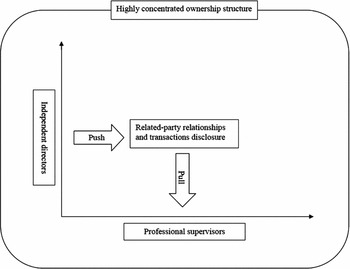
Yuan G. Shan and Dennis W. Taylor analyse the four key problems of China's corporate governance system as discussed above.Footnote 86 They argue that independent directors should be motivated to work in the best interests of shareholders in order to maintain their personal reputations, and to improve corporate disclosure, even in countries that have fewer incentives for transparency. They also argue that the supervisory board should demand high standards of professionalism from its members in order to effectively carry out its role of overseeing the performance of the board of directors and management, and to protect stakeholders’ rights and interests. However, their empirical results reveal that the ratio of independent directors on the board of directors has a positive impact on the extent of related-party disclosure, whereas the credentials of supervisors on the supervisory board, in terms of their qualifications and experience, appear to have a negative effect on related-party disclosure, within this highly concentrated ownership boundary in China. These findings are simply illustrated in Figure 1.
Effect of key issues on China's corporate governance

Some suggested solutions for the observed corporate governance problems
Short-term legal improvement
From a legal perspective, it appears that the moves by the China Securities Regulatory Commission to require improved qualifications and experience of supervisors on supervisory boards of listed companies have not been sufficient to ensure that these boards properly fulfil their roles of independent oversight and public reporting on the performance of the corporate board and management, especially in the sensitive area of related-party transactions. There is a case, it seems, for giving specific externally derived authority to supervisory boards.
Such externally derived authority may emerge in the form of imminent revisions to the international accounting standard, International Accounting Standard 24 Related Party Disclosures (hereafter, IAS 24). In February 2007 the International Accounting Standards Board published an Exposure Draft of these proposed amendments that addressed disclosure requirements for state-controlled entities when they transact with similar entities, and also broadened the definition of a related party. The revised IAS 24 should be issued late in 2009. If these revisions are adopted in Accounting Standards for Business Enterprises 36 (hereafter, ASBE 36), the equivalent accounting standard in China, this would provide a strengthening of the source of external authority for supervisory boards through the appointment of professionally qualified supervisors, thereby boosting the comprehensiveness of related-party disclosures by Chinese listed companies.
As noted earlier, the effectiveness of a typical supervisory board in China is undermined by its composition, and Yuan G. Shan and Dennis W. Taylor have noted the existence of highly concentrated leadership in the hands of either the state or key controlling shareholders.Footnote 87 To overcome these problems, On Kit Tam, and Lay Hong Tan and Jiangyu Wang, have proposed a new model of corporate governance as shown in Figure 2.Footnote 88 Under this new model, new relationships and roles for the board of directors and the supervisory board are established. The independence and autonomy of the board of directors should be established and the present strong levels of intervention by the Party/Government should be eliminated. The election of directors and the appointment of the CEO should comply with the existing set of principles and rules, such as The Company Law, The Securities Law, The Code and other directives and regulations promulgated by the China Securities Regulatory Commission. In order to confer effective power and ensure an active corporate governance role for supervisors, a redistribution of the structure of employees between the board of directors and the supervisory board is needed to more effectively rebalance the responsibilities of the supervisory board.
A new model for China's corporate governance

With respect to the independence of supervisory boards in the new model, the proportion of insiders is proposed to be kept below 20 per cent in order to avoid the presence of a majority of insiders, and it is recommended that a set of functional committees (nomination, remuneration and audit committees) should be established to remove some of the grounds on which insider control has been built. Other than these innovations, changes should be made to The Company Law and The Code. The supervisory board should be given greater power to hire and remove directors. This authority will improve the supervisory board's status within and outside the company. Moreover, The Company Law should prescribe legal responsibilities for the supervisory board so that supervisors will be statutorily obliged to undertake their duties diligently. On the other hand, The Company Law should clarify an obligation of the board of directors to provide supervisors with timely information regarding the firm so that the supervisory board can effectively exercise its monitoring function.
Macro level reforms in China's capital market
On the macro level, the economic reforms in China since 1978 have aimed to transform the centrally planned economy into a market-oriented economy, and have now come to the stage of reforming and reconstructing China's enterprises. The ownership structure in state-owned enterprises differs from that of a modern firm due to a lack of external ownership. Theoretically, the owner of a state-owned enterprise is the state, or ‘the people as a whole’. In fact, there is no such ownership that can physically appear to monitor the firm's management and performance. Practically, ownership rights in a state-owned enterprise are exercised by administrative departments at different levels of government. Therefore, state ownership can be regarded as an absence of direct ownership and operating through the powers of control and supervision.Footnote 89
Chinese policymakers and regulators recognize that this issue has become an obstacle to state-owned enterprises reform. In September 1999, the Fourth Plenum of the 15th Communist Party of China Central Committee defined the major objectives and guiding principles for the reform and development of state-owned enterprises up until 2010 as follows:
• To complete strategic readjustment and restructuring to bring into being a more rational layout and structure of the national economy.
• To establish a well-functioning modern corporate system to improve economic performance.
• To promote scientific and technological development, market competition and risk management.
• To make the state-run economy play a better, less dominant role in the operation of the national economy.
The guidelines imply the continuation of state-owned enterprises as the non-dominant form of corporation, the strategic readjustment of the state economy and the restructuring of state-owned enterprises, the establishment of a modern corporate system, and the fostering of competitive mechanisms. This shows the government's determination to introduce a diversified ownership structure to state-owned enterprises and to encourage market competition. However, such positive expectations can only be realized under an effective corporate governance system.
A rational model of corporate governance can generate better economic efficiency and reduce unnecessary economic costs. China's policymakers and regulators should continue to search for an advanced and workable corporate governance system for existing and future enterprises, and to physically build up such a system within the Chinese legal framework.
Conclusion
Effective corporate governance is crucial to China's development. It involves many issues and has profound policy and practical implications. China's current dual board system of corporate governance has not been effective in improving the performance and accountability of listed Chinese corporations. A far more independent and rigorous set of checks on management is needed. In the process of transition from a centrally planned economy to a market-oriented economy, China has at least embraced the concept of corporate governance and its underlying principles. However, serious deficiencies may be observed in the current system, such that corporate governance problems arising from China's transitional emerging economy have arisen to engage the attention of policymakers, regulators and corporate players.
The development of China's capital market is, to a large extent, determined by the quality of its listed companies, which is closely linked with the efficiency and effectiveness of corporate governance. Further studies of international experience in corporate governance need to be conducted so that China can follow new developments and improve existing practices, and devise the best system of corporate governance to facilitate the efficient development of its growing capital markets. Such a strengthening of corporate governance will play a vital role in ensuring that China's economic reforms lead to it becoming a major international economic superpower.