Introduction
Males account for one-third to one-tenth of eating disorder cases (Hudson et al. Reference Hudson, Hiripi, Pope and Kessler2007; Swanson et al. Reference Swanson, Crow, Le Grange, Swendsen and Merikangas2011), yet the factors that contribute to decreased risk for eating disorders in males are largely unknown. Testosterone may be a key biological mechanism that exhibits protective effects. With a few exceptions (Baker et al. Reference Baker, Lichtenstein and Kendler2009; Lydecker et al. Reference Lydecker, Pisetsky, Mitchell, Thornton, Kendler, Reichborn-Kjennerud, Lichtenstein, Bulik and Mazzeo2012), higher prenatal testosterone exposure (assessed via proxy measures: 2nd to 4th digit ratios or twin type comparisons) has been shown to decrease risk for disordered eating (Klump et al. Reference Klump, Gobrogge, Perkins, Thorne, Sisk and Breedlove2006; Culbert et al. Reference Culbert, Breedlove, Burt and Klump2008, Reference Culbert, Breedlove, Sisk, Burt and Klump2013; Smith et al. Reference Smith, Hawkeswood and Joiner2010; Oinonen & Bird, Reference Oinonen and Bird2012). However, prenatal testosterone's protective effects on disordered eating appear to become evident only after the onset of mid-puberty (Culbert et al. Reference Culbert, Breedlove, Sisk, Burt and Klump2013). Findings indicated no effect of prenatal testosterone on disordered eating in pre–early puberty, whereas elevated prenatal testosterone predicted lower disordered eating symptoms during/after mid-puberty (Culbert et al. Reference Culbert, Breedlove, Sisk, Burt and Klump2013). Lower disordered eating risk in boys after mid-puberty may be due to increases in circulating testosterone and/or pubertal changes in the central nervous system's (CNS) responsiveness to circulating testosterone.
Animal data support both possibilities. Prenatal testosterone's masculinizing (i.e. to make male-like) effects on sex-differentiated eating behavior in rodents (e.g. food intake: males > females) emerge during puberty when circulating levels of testosterone increase and begin to exert activational effects (i.e. transient; only in the presence of the hormone) that facilitate male-typical expression of behavior (e.g. Chai et al. Reference Chai, Blaha, Meguid, Laviano, Yang and Varma1999; Asarian & Geary, Reference Asarian and Geary2006). Nonetheless, the degree of pubertal maturation appears to be important for CNS responsiveness to these activational processes, as the exogenous administration of testosterone fails to activate sex-differentiated behavior (e.g. mating behavior) in pre-pubertal male rodents (Romeo et al. Reference Romeo, Richardson and Sisk2002). Thus, in addition to the rise in testosterone secretion, neural and behavioral responsiveness to testosterone also increase with advancing pubertal development (Romeo et al. Reference Romeo, Richardson and Sisk2002; Schulz et al. Reference Schulz, Richardson, Zehr, Ostek, Menard and Sisk2004, Reference Schulz, Molenda-Figueira and Sisk2009).
A critical next step is to examine the effects of circulating testosterone on disordered eating in boys and whether advancing pubertal maturation is important for the emergence of such effects. The current study examined two plausible, but competing, hypotheses: (1) whether higher levels of circulating testosterone predict lower levels of disordered eating symptoms regardless of relative pubertal development (i.e. main effect of testosterone on disordered eating); or (2) whether testosterone's protective effects on disordered eating in boys become prominent with advancing pubertal development. If data indicate a main effect of testosterone on disordered eating, then mid-puberty could be linked to a lower risk for disordered eating in males merely because it is an indirect marker of increased testosterone levels. If data indicate pubertal moderation of testosterone's effects on disordered eating, then advancing pubertal maturation may have etiological significance. That is, mid-puberty may correspond to the developmental period when neural and behavioral responsiveness to testosterone increases. Several developmental (i.e. age), physical (i.e. adiposity) and psychological (i.e. depression and anxiety symptoms) factors that are associated with disordered eating, puberty and testosterone were controlled for in analyses to ensure that testosterone–disordered eating effects were not accounted for by these potential confounds.
Method
Participants
Participants were 213 male twins [same-sex: monozygotic (n = 86) and dizygotic (n = 62); opposite-sex dizygotic (n = 65)Footnote 1 Footnote †] aged 10–15 years from the Michigan State University Twin Registry (MSUTR) Twin Study of Hormones and Disordered Eating across Puberty (Klump & Burt, Reference Klump and Burt2006; Burt & Klump, Reference Burt and Klump2013). Inclusion criteria included no medication use or medical condition (e.g. diabetes) that could alter hormone functioning. Participants were recruited by the Michigan Department of Community Health through the use of birth records (Klump & Burt, Reference Klump and Burt2006; Burt & Klump, Reference Burt and Klump2013). This recruitment method has resulted in MSUTR samples that are demographically representative of the Michigan population (Culbert et al. Reference Culbert, Breedlove, Burt and Klump2008). Consistent with the recruitment region (www.michigan.gov/mdch), the majority of participants were Caucasian (85%). Caucasian v. non-Caucasian participants did not significantly differ on any variable/covariate (p's = 0.27–0.97).
Measures
Disordered eating symptoms
The Minnesota Eating Behavior SurveyFootnote 2 (MEBS; Von Ranson et al. Reference Von Ranson, Klump, Iacono and McGue2005) and Eating Disorder Examination Questionnaire (EDE-Q; Fairburn & Beglin, Reference Fairburn and Beglin1994) were used to assess a range of disordered eating symptoms. The inclusion of both questionnaires allowed us to investigate whether our findings replicate across commonly used measures. MEBS and EDE-Q total/global scores were, as expected, positively associated (r = 0.75).
The MEBS assesses body dissatisfaction (dissatisfaction with body size/shape), weight preoccupation (preoccupation with dieting, weight and the pursuit of thinness), binge eating (thoughts/behaviors conducive to binge eating) and compensatory behavior (thoughts/behaviors about compensatory behaviors, such as self-induced vomiting). The EDE-Q assesses dietary restraint (restraint over eating), eating concerns (preoccupation with food/eating), shape concerns (preoccupation/dissatisfaction with body shape) and weight concerns (preoccupation with body weight and desire to lose weight). MEBS and EDE-Q total/global scores are computed by summing all items (MEBS) or subscale items (EDE-Q). Higher scores indicate more pathological eating attitudes and behavior.
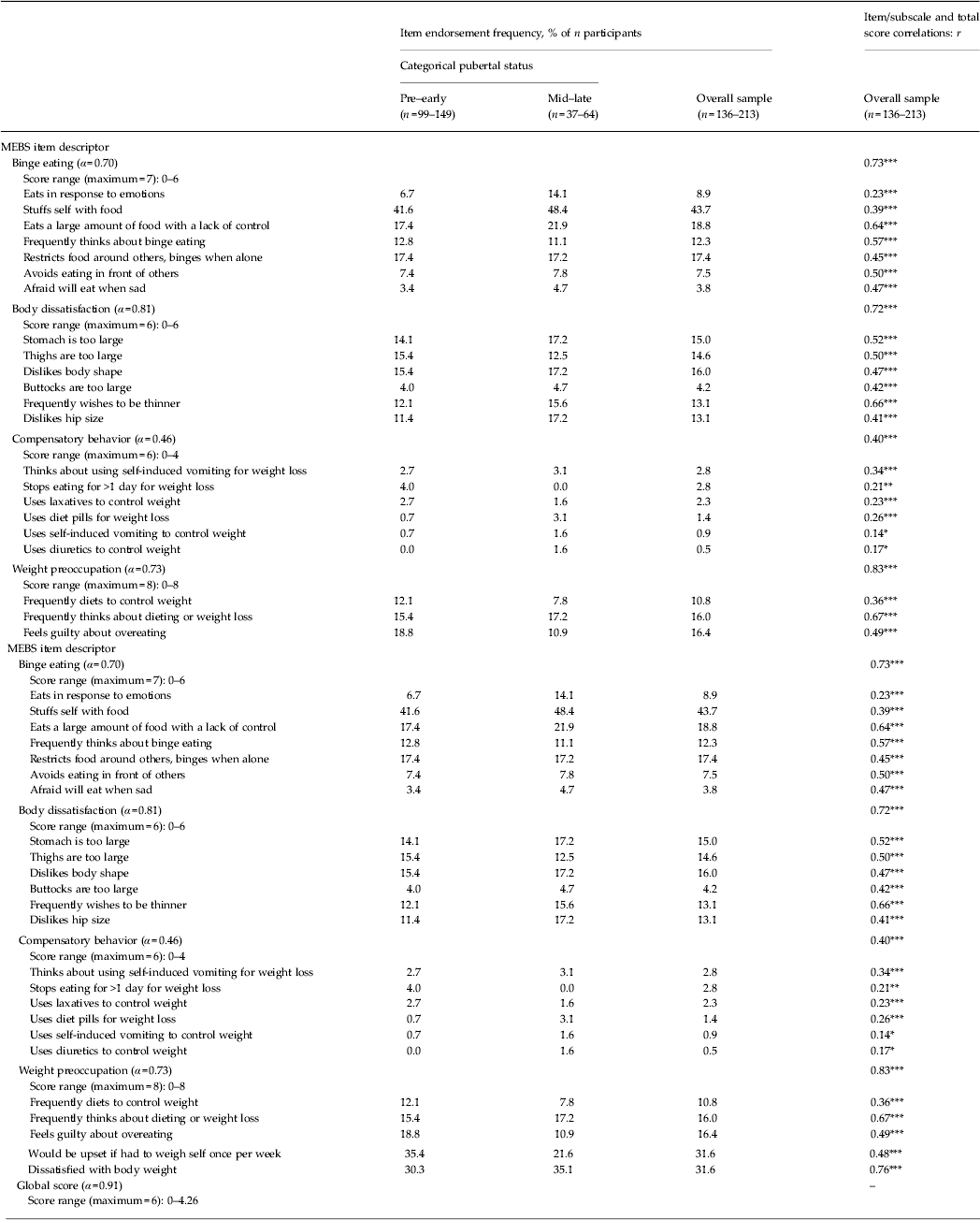
We examined the total/global scores as omnibus measures of disordered eating symptoms because, relative to subscales, these scores have shown stronger psychometric properties (e.g. 3-year stability, internal consistency) and are more robust indicators of disordered eating difficulties in males and children/adolescents (Carter et al. Reference Carter, Stewart and Fairburn2001; Von Ranson et al. Reference Von Ranson, Klump, Iacono and McGue2005; Lavender et al. Reference Lavender, De Young and Anderson2010; Culbert et al. Reference Culbert, Breedlove, Sisk, Burt and Klump2013; A. Marderosian et al. unpublished observations).Footnote 3 The MEBS total score has also been shown to successfully discriminate between girls with an eating disorder v. controls (Von Ranson et al. Reference Von Ranson, Klump, Iacono and McGue2005). In this study, the MEBS and EDE-Q total/global scores demonstrated excellent internal consistency (α = 0.85–0.91; see Table 1) and expected correlations with external correlates [i.e. depression, anxiety, body fat percentage, body mass index (BMI); see Table 2]. Further, the wide range of endorsed symptoms (see Table 1) and no variance differences in symptoms between boys in pre–early v. mid–late puberty (p = 0.65–0.71) demonstrates that the MEBS and EDE-Q total/global scores capture the full spectrum of disordered eating attitudes and behaviors in boys throughout puberty.
MEBS and EDE-Q item endorsement frequencies and item-total correlations a

MEBS, Minnesota Eating Behaviors Survey; EDE-Q, Eating Disorder Examination Questionnaire.
a Only EDE-Q and MEBS item descriptors (not the actual items) are presented above. MEBS items are rated using a true/false format, and thus, endorsement frequency reflects the percentage of ‘true’ ratings. EDE-Q items are rated based on the past 28 days and scored on a seven-point scale, and item endorsement frequencies refer to the percentage of ratings greater than 0 (i.e. endorsement of scores ⩾1). Sample sizes vary across scales because a subset of participants did not complete the full EDE-Q scale.
* p < 0.05, ** p < 0.01, *** p < 0.001.
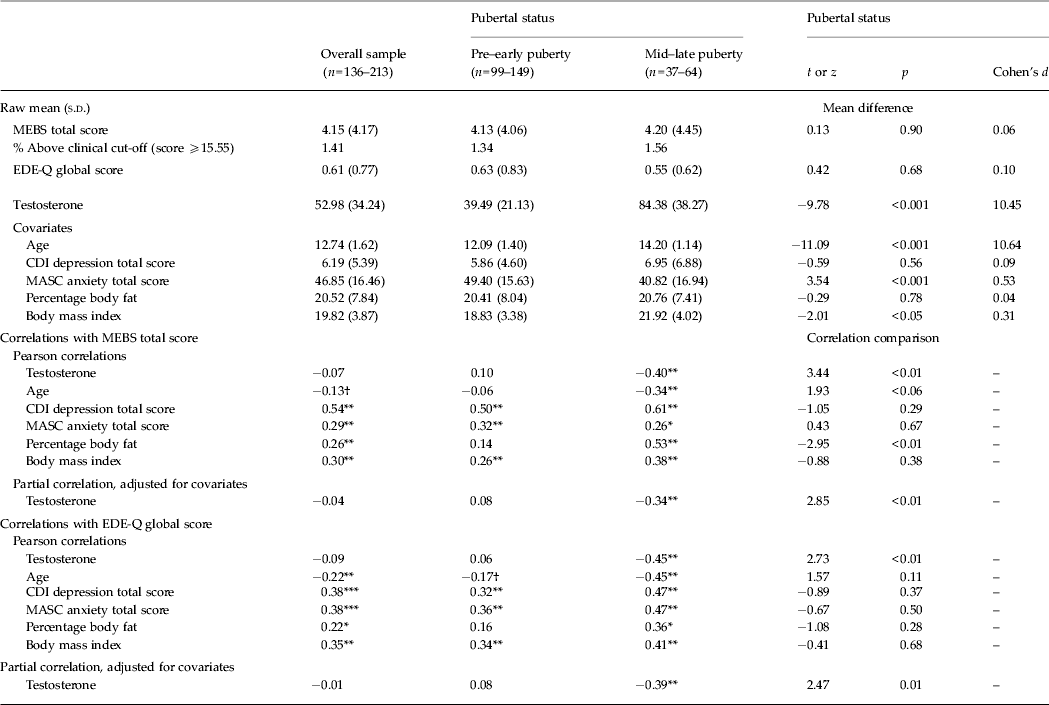
Descriptive statistics, correlations and mean differences between pubertal status groups a

Raw mean, Value not adjusted for any covariate; s.d., standard deviation; MEBS, Minnesota Eating Behavior Survey; EDE-Q, Eating Disorder Examination Questionnaire; CDI, Children's Depression Inventory; MASC, Multidimensional Anxiety Scale for Children.
a Salivary testosterone values are in pg/ml. Mean differences were tested with mixed linear models (t statistic) using Blom-transformed variables. Higher scores on the MEBS, CDI and MASC indicate higher levels of pathological symptoms. Partial correlations reflect associations between testosterone and disordered eating scores, controlling for all other variables: age, depression, anxiety, body fat percentage and body mass index. Pubertal status (i.e. pre–early v. mid–late) differences in the magnitude of correlation coefficients were tested using Fisher's r-to-z transformation.
† p < 0.10, * p < 0.05, ** p < 0.01.
Pubertal development
The Pubertal Development Scale (PDS; Petersen et al. Reference Petersen, Richards and Boxer1988) assessed pubertal status across a range of secondary sex characteristics, including height spurts and body hair, skin, and voice changes. Participants rated items on a continuous four-point scale; development: (1) has not yet begun; (2) has barely started; (3) is definitely underway; and (4) seems complete. Higher scores indicate more advanced pubertal maturation. Data support the reliability and validity of the PDS, including high correlations between self and interviewer (r = 0.70) ratings (Petersen et al. Reference Petersen, Richards and Boxer1988) and excellent internal consistency in the current study (α = 0.87).
Our analyses utilized the continuous pubertal status variable (i.e. average PDS score) in order to estimate testosterone–disordered eating effects across the full range of pubertal maturation. Descriptive statistics (see Tables 1 and 2) are, however, presented for our overall sample and separately for pre-to-early (PDS < 2.5) v. mid-to-late pubertal (PDS ⩾2.5) categories since prior research demonstrates changes in etiological effects on disordered eating during mid–late puberty (e.g. Klump et al. Reference Klump, Perkins, Burt, McGue and Iacono2007, Reference Klump, Culbert, Slane, Burt, Sisk and Nigg2012; Culbert et al. Reference Culbert, Burt, McGue, Iacono and Klump2009).
Testosterone
Circulating testosterone levels were measured via saliva samples. The saliva–serum correlation for testosterone is near unity in male samples (r = 0.91–0.96; Granger et al. Reference Granger, Schwartz, Booth and Arentz1999; Shirtcliff et al. Reference Shirtcliff, Granger, Schwartz and Curran2001); however, the use of saliva was considered advantageous over other biomarkers (e.g. serum, plasma) because it is less invasive and salivary concentrations of testosterone reflect only the unbound hormone, i.e. the biologically active fraction of this steroid (Vining et al. Reference Vining, McGinley and Symons1983; Shirtcliff et al. Reference Shirtcliff, Granger, Schwartz and Curran2001).
Prior to saliva collection, participants refrained from eating and drinking for 4 h and from brushing their teeth and/or chewing gum for at least 30 min. Collection occurred in the laboratory between 13.00 and 17.00 hours since diurnal variations in testosterone are more minimal during the late afternoon as compared with the morning or midday (Grumbach & Styne, Reference Grumbach and Styne1998; Granger et al. Reference Granger, Schwartz, Booth and Arentz1999). Participants passively drooled 4 ml of saliva into a cryovial. Samples were immediately placed in the freezer and stored at −20°C until they were shipped to Salimetrics, Inc. (Pennsylvania State University, College Park, USA) for testing.
Samples were centrifuged at 3000 revolutions per min for 15 min on the day of testing to remove mucins. Clear samples were transferred into testing wells to screen for potential problems with pH. Samples that fell out of the pH range of 4–9 were diluted in phosphate-buffered saline to correct pH prior to testing. Samples were assayed in duplicate using high-sensitive enzyme immunoassays developed by Salimetrics, Inc.
The testosterone assay had a minimum detection limit of 1 pg/ml and average intra- and inter-assay coefficients of variations that were less than 4.60% and 8.25%, respectively. Method accuracy, determined by spike recovery and linearity, was within acceptable ranges (104.4% and 99.9%). Testosterone concentrations in our sample were above the minimum detection limit (range: 9.59–183.05 pg/ml) and similar to levels attained in other studies of adolescent boys (Granger et al. Reference Granger, Shirtcliff, Booth, Kivlighan and Schwartz2004). The salivary testosterone–PDS correlation in our sample (r = 0.69) is also on par with prior research (r's = 0.47–0.62; Granger et al. Reference Granger, Schwartz, Booth and Arentz1999).
Covariates
Age, adiposity, depression and anxiety have been associated with testosterone and/or disordered eating in prior research (Jacobi et al. Reference Jacobi, Hayward, de Zwaan, Kraemer and Stewart2004; Schulz et al. Reference Schulz, Molenda-Figueira and Sisk2009; Ferreiro et al. Reference Ferreiro, Seoane and Senra2011; Culbert et al. Reference Culbert, Breedlove, Sisk, Burt and Klump2013), and, thus, were covaried in analyses to ensure that testosterone–disordered eating associations were not accounted for by their potential confounding effects.
Adiposity
Adiposity was examined using percentage body fat and BMI. Percentage body fat was assessed using hand-to-foot (i.e. whole body) bioelectrical impedance analysis (BIA) and calculated using the Houtkooper formula (Houtkooper et al. Reference Houtkooper, Lohman, Going and Howell1996): percentage body fat = 0.61 × height (cm)2/resistance (Ω) + 0.25 × weight (kg) + 1.31. BIA is a painless procedure that passes an electrical signal through fat, lean mass and water, and has been shown to provide valid and reliable estimates of adiposity (Houtkooper et al. Reference Houtkooper, Lohman, Going and Howell1996). According to the National Institute of Health's guidelines, participants fasted (no food or drink) for 4 h and voided within 30 min prior to their BIA assessment. BMI was calculated as weight (kg)/height (m)2 and adjusted for age. Height and weight measurements were obtained with a wall-mounted ruler and digital scale.
Anxiety and depression symptoms
Total scores from the self-reported Multidimensional Anxiety Scale for Children (MASC; March et al. Reference March, Parker, Sullivan, Stallings and Conners1997) and the Children's Depression Inventory (CDI; Kovacs, Reference Kovacs1985) assessed overall levels of anxiety (e.g. panic, social anxiety, physical symptoms) and depressive symptoms (e.g. sadness, inappropriate guilt/self-blame), respectively. Higher scores on both scales indicate higher levels of anxiety/depressive symptoms. The CDI and MASC have demonstrated excellent psychometric properties in boys (Kovacs, Reference Kovacs1985; March et al. Reference March, Parker, Sullivan, Stallings and Conners1997). Internal consistencies were also good (CDI: α = 0.82; MASC: α = 0.91) in this study.
Statistical analyses
Data preparation
Subscale scores were pro-rated for participants missing ⩽10% of items on the CDI. Data were coded as missing for one participant missing more than 10% of items on the MASC anxiety total score. There were no missing data for the PDS or MEBS scores. Due to protocol changes, the full EDE-Q was administered to only a subset of participants (n = 136; 63.85% of the total sample). Data were also missing for a small subset of participants who did not complete the BIA procedure (n = 17) due to home-based assessments. Project staff conducted home assessments when families were unable to travel to the laboratory (e.g. lack of transportation, childcare constraints, etc.). Participants with v. without complete EDE-Q or BIA body fat percentage data did not significantly differ on any study variable/covariate (p's = 0.20–0.88).
Testosterone, disordered eating, depression and BMI were rank-normalized and Blom-transformed prior to analyses to adjust for slight positive skew (skewness = 1.16–2.03). Blom transformation was selected over square-root or log transformation since it produced skewness values closest to zero (skewness after transformation = 0−0.24).
Statistical models
Mixed linear models (MLMs) were used to examine testosterone–disordered eating associations. The use of MLMs allowed us to control for the non-independence of twin data by nesting a level-1 variable (individual twin) within a level-2 unit (twin pair). Since MLMs provide unstandardized estimates of predictor effects, continuous variables were standardized prior to analysis to allow for the interpretation of unstandardized coefficients as standardized coefficients and to ease interpretation of effect sizes.
Model 1: Main Effect Models
The initial main effect model examined the main effect of testosterone on disordered eating symptoms, adjusting for pubertal status only. This model examined whether higher levels of circulating testosterone predict lower levels of disordered eating when pubertal status is controlled. After fitting this initial model, we tested a covariate model that controlled for age, adiposity, anxiety and depression, in addition to pubertal status, to ensure that any significant testosterone effects were not accounted for by these variables.
In contrast, moderation models aimed to investigate whether the protective effects of circulating testosterone on disordered eating symptoms are dependent upon advancing pubertal development.
Model 2: Moderation Models
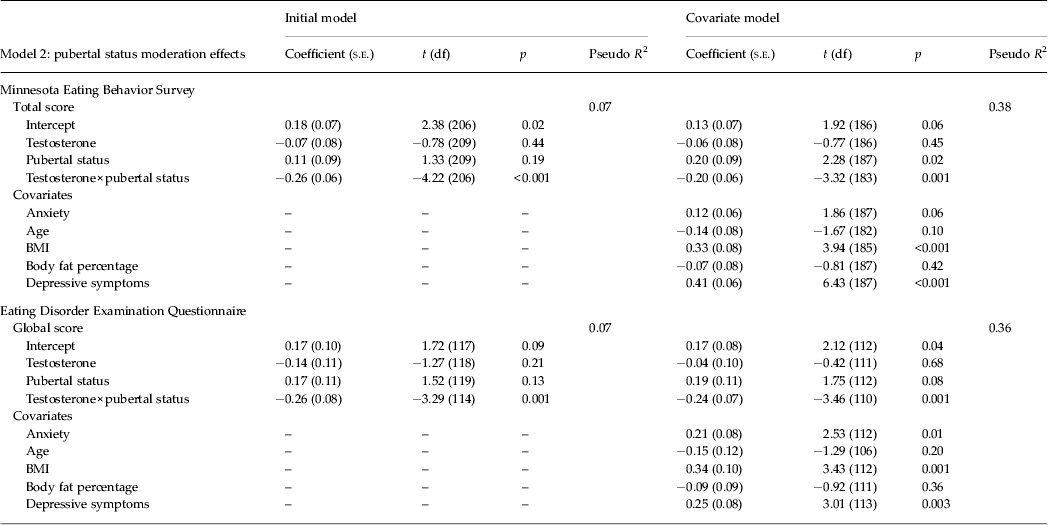
The moderation models examined the effects of pubertal status, testosterone, and the pubertal status × testosterone interaction on disordered eating symptoms. The interaction effect between pubertal status and testosterone was of primary interest since a significant interaction would indicate that the influence of testosterone on disordered eating varies by pubertal maturation (e.g. the magnitude of the association increases with advancing pubertal development). After fitting initial models, covariate models were tested to ensure that observed associations were not due to age, adiposity, anxiety and/or depression.
Results
Descriptive statistics
A total of 1.41% boys scored above the mean clinical cut-off on the MEBS total score (score = 15.55; Von Ranson et al. Reference Von Ranson, Klump, Iacono and McGue2005; see Table 2), but, notably, a full range of disordered eating symptoms were endorsed on the MEBS and EDE-Q by participants falling below this cut-off (see Tables 1 and 2). Thus, the MEBS and EDE-Q scale distributions spanned a spectrum of severity and total/global scores, representative of a variety of disordered eating attitudes and behaviors. Consistent with the majority of prior research (for a review, see Klump, Reference Klump2013), mean levels of disordered eating did not significantly differ between males in pre–early v. mid–late puberty (see Table 2) and pubertal status–disordered eating associations were small and non-significant (r's = −0.03 to 0.004, p's = 0.75–0.95). Mean levels of testosterone were significantly higher for males in mid–late puberty compared with males in pre–early puberty as would be expected (Grumbach & Styne, Reference Grumbach and Styne1998; Table 2). Importantly, disordered eating and testosterone showed adequate variability (see s.d.s in Table 2) in the full sample and within pre–early and mid–late pubertal groups, indicating that this study had ample variability to detect testosterone–disordered eating associations across varying levels of pubertal maturation. Pearson (and partial) correlations provided initial indication for puberty moderation of testosterone–disordered eating associations, as significant inverse associations were evident in mid–late, but not pre–early, puberty (see Table 2).
MLM models
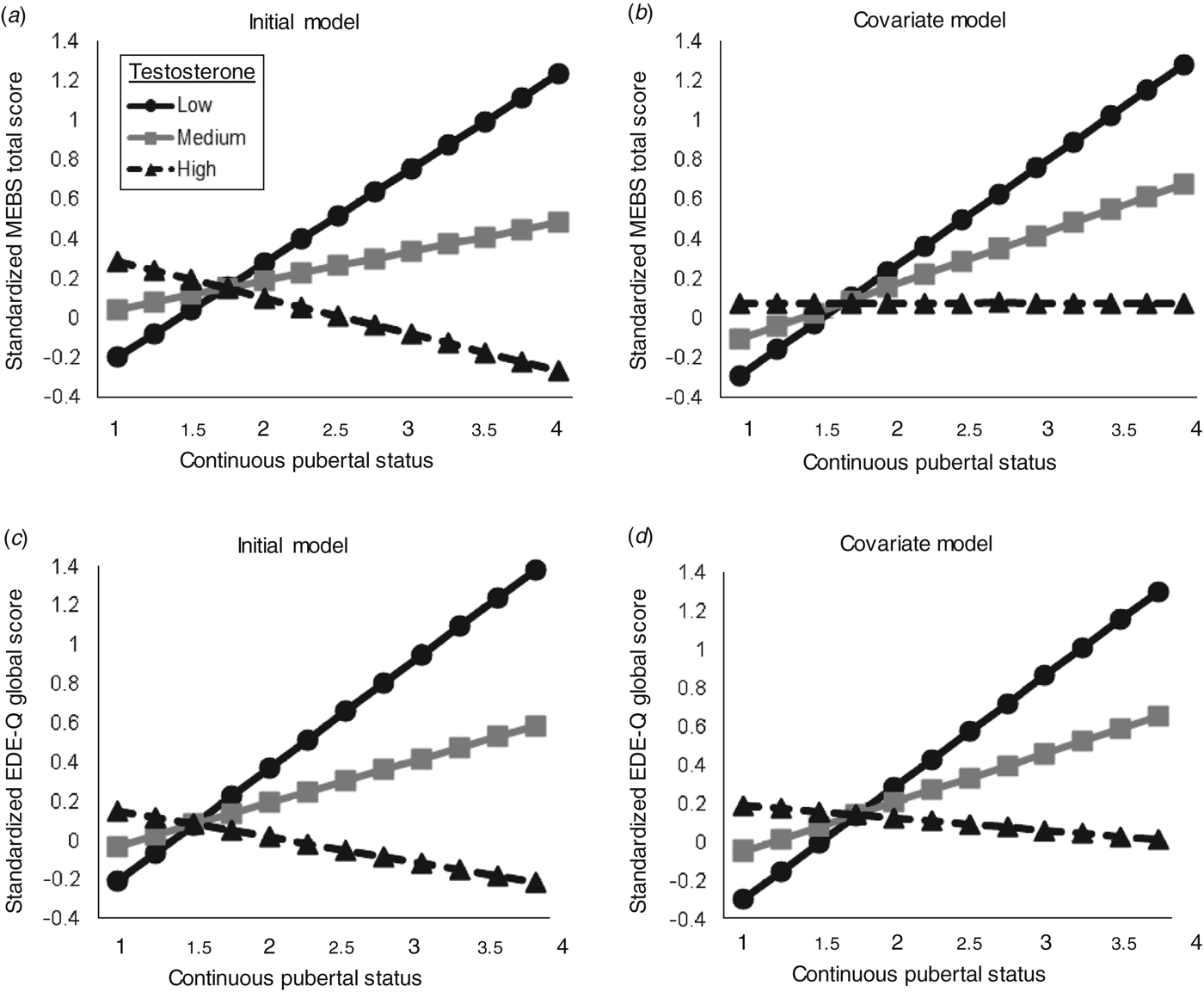
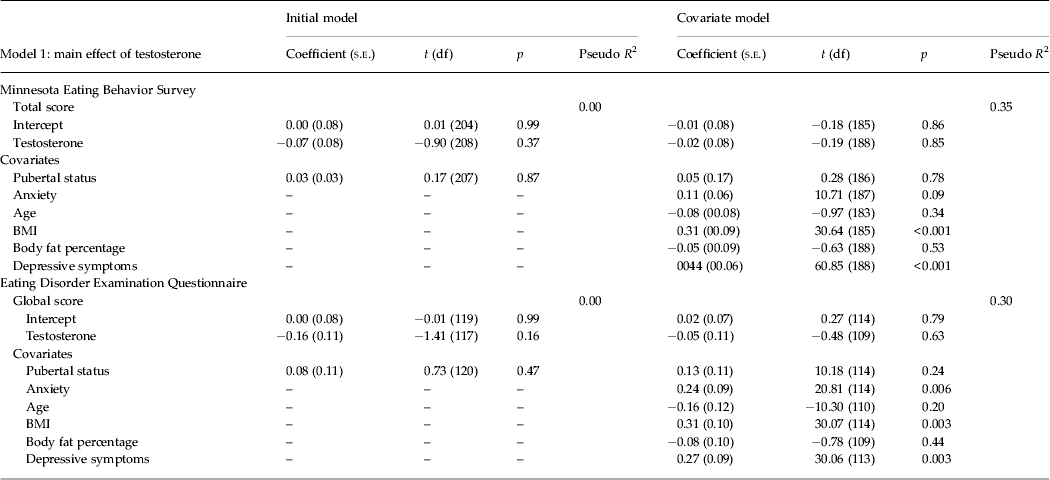
MLM main effect models indicated no significant main effect of testosterone on disordered eating symptoms, when controlling for puberty only or puberty and additional covariates (see Table 3). However, in MLM moderation models, a significant testosterone × pubertal status interaction was observed for disordered eating (see Table 4). Circulating levels of testosterone inversely predicted levels of disordered eating symptoms (i.e. boys with higher levels of testosterone showed lower levels of disordered eating and vice versa), but the magnitude of effects became prominent with advancing pubertal development (see Fig. 1). These effects remained significant even after adjusting for age, adiposity, depression and anxietyFootnote 4 (see Table 4 and Fig. 1). Together, these results demonstrate that pubertal maturation plays an important predictive role in testosterone–disordered eating associations.
Testosterone levels predicting overall levels of disordered eating symptoms during puberty as measured by the Minnesota Eating Behavior Survey (MEBS) total score (a, b) and Eating Disorder Examination Questionnaire (EDE-Q) global score (c, d). Initial models were not adjusted for any covariate. Covariate models were adjusted for depression, anxiety, body fat percentage, BMI and age. Predicted values on the y-axis represent Blom-transformed standardized disordered eating scores. Blom-transformed standardized testosterone levels were plotted according to low (–1 = 1 s.d. below the mean; corresponding untransformed raw value about 23 pg/ml), medium (0 = the mean; corresponding untransformed raw value about 41 pg/ml) and high (1 = 1 s.d. above the mean; corresponding untransformed raw value about 88 pg/ml). Pubertal status scores <2.5 are considered ‘pre-to-early’ puberty, whereas pubertal status scores ⩾2.5 are considered ‘mid-to-late’ puberty.

MLMs examining testosterone main effects on disordered eating symptoms a

MLM, Mixed linear model; s.e., standard error; df, degrees of freedom; BMI, body mass index.
a Initial models were not adjusted for any covariate. Covariate models were adjusted for pubertal status, anxiety, depression, body fat percentage, BMI and age. Variables were standardized prior to analysis to allow for the interpretation of unstandardized coefficients as standardized coefficients. Total variance explained (i.e. R 2) by the MLMs was calculated using pseudo R 2 (Kenny et al. Reference Kenny, Kashy and Cook2006).
MLMs examining testosterone and pubertal status interaction effects on disordered eating symptoms a

MLM, Mixed linear model; s.e., standard error; df, degrees of freedom; BMI, body mass index.
a Initial models were not adjusted for any covariate. Covariate models were adjusted for anxiety, depression, body fat percentage, BMI and age. Variables were standardized prior to analysis to allow for the interpretation of unstandardized coefficients as standardized coefficients. Total variance explained (i.e. R 2) by the MLMs was calculated using pseudo R 2 (Kenny et al. Reference Kenny, Kashy and Cook2006).
Post-hoc analyses were conducted to determine whether observed effects persist across a spectrum of disordered eating severity. We examined if circulating levels of testosterone inversely predict levels of disordered eating in boys at highest risk for an eating disorder, in particular boys scoring above the MEBS clinical cut-off (score ⩾15.55, n = 3; testosterone range = 17.0–29.07 pg/ml), or more broadly, those scoring within the top 5% of the sample (score ⩾14, n = 12; testosterone range = 17.0–98.76 pg/ml). Inverse testosterone–disordered eating associations were detected (MEBS ⩾15.55, r = −0.17; MEBS ⩾14, r = −0.49). Binary logistic regression analyses (MEBS score >14 = 'high risk’, n = 12; MEBS score of 0 = 'low risk’, n = 22) also replicated effects observed in our full sample, such that low levels of testosterone predicted eating disorder risk with advancing pubertal maturation (e.g. testosterone × puberty: coefficient = −1.55, t = –2.40, p = 0.02) even after adjusting for covariates (p < 0.05). Nonetheless, the active engagement in eating disorder symptoms (e.g. dieting, excessive exercise, weight loss) could result in decreased testosterone production, and, consequently, drive the inverse association between testosterone and disordered eating. Additional post-hoc analyses were therefore conducted to ensure that our results were not merely accounted for by the boys at highest eating disorder risk, i.e. scoring above the MEBS clinical cut-off (n = 3) or within the top 5% of the sample (n = 12). Indeed, even after eliminating boys scoring above these cut-offs, results indicated a significant testosterone × pubertal status interaction for disordered eating, independent of covariates (p < 0.01). Together, the findings indicated that puberty moderates testosterone–disordered eating associations across a spectrum of severity and that any potential confounding effects of active engagement in disordered eating on levels of testosterone (e.g. reduced testosterone production) are unlikely to account for the results of this study.
Discussion
This study was the first to investigate testosterone as a biological factor underlying individual differences in risk for eating pathology in boys during puberty. Circulating testosterone did not exhibit a significant main effect on disordered eating symptoms, but, instead, interacted with pubertal maturation to predict disordered eating symptoms. Levels of testosterone inversely predicted disordered eating symptoms with advancing pubertal development, where boys with higher levels of testosterone exhibited significantly lower levels of disordered eating symptoms and vice versa. Our findings indicate that patterns observed in animals for general food intake and other sex-differentiated behaviors translate to disordered eating in boys; puberty appears to be a key developmental period for the emergence of testosterone's activational effects on disordered eating symptoms. Consequently, average to elevated levels of circulating testosterone may therefore exert protective effects and decrease risk for the onset of disordered eating symptoms in males during and after puberty, whereas lower levels of testosterone may increase risk and serve to explain why some, albeit relatively few, males may develop eating disorders.
The fact that adiposity, anxiety and depression did not account for testosterone–disordered eating associations deserves note. It is clear from past research that these variables probably contribute to disordered eating risk (e.g. Olivardia et al. Reference Olivardia, Pope, Mangweth and Hudson1995; Kostanski & Gullone, Reference Kostanski and Gullone1998; McCabe & Vincent, Reference McCabe and Vincent2003). Indeed, they are well-established correlates of, and predictors for, disordered eating and eating disorders across development (Jacobi et al. Reference Jacobi, Hayward, de Zwaan, Kraemer and Stewart2004). However, despite their predictive effects on eating pathology, our findings suggest that these factors do not account for testosterone's activational effects on disordered eating in boys during puberty. The emergence of inverse associations between testosterone and disordered eating with advancing puberty even after excluding males with elevated disordered eating scores (i.e. above clinical cut-offs) also provides evidence that our observed effects were not driven or accounted for by eating disorder sequelae (e.g. low testosterone due to eating pathology). Further, effects were consistent across disordered eating scales even despite the smaller sample size for EDE-Q data. Thus, the predictive effects of testosterone on disordered eating symptoms during puberty appear to be quite robust across the spectrum of eating pathology.
Our findings add to a growing literature that implicates gonadal hormones and puberty as key developmental factors in the etiology of disordered eating symptoms (Baker et al. Reference Baker, Girdler and Bulik2012; Klump, Reference Klump2013). Importantly, testosterone's protective effects on disordered eating in boys may be due to both its organizational (i.e. permanent changes to neural structure/function that persist after hormone exposure) and activational (i.e. transient – only in the presence of the hormone) effects on the CNS and behavior. While the perinatal period has long been identified as a critical period for testosterone-dependent organization and masculinization of the CNS (Breedlove, Reference Breedlove1994), puberty is now recognized as a second developmental window for hormone-driven neural organization/masculinization (Schulz et al. Reference Schulz, Molenda-Figueira and Sisk2009). Exogenous administration of testosterone does not activate adult male-like phenotypes (e.g. sexual behavior) in male rodents before puberty and fails to activate masculinized phenotypes after puberty if rodents are not exposed to testicular hormones during puberty (Romeo et al. Reference Romeo, Richardson and Sisk2002; Schulz et al. Reference Schulz, Richardson, Zehr, Ostek, Menard and Sisk2004, Reference Schulz, Molenda-Figueira and Sisk2009). Thus, testosterone-dependent organization of male-typical phenotypes begins early in life and is completed during puberty, when testosterone refines neural circuits (Schulz et al. Reference Schulz, Molenda-Figueira and Sisk2009). Circulating testosterone subsequently acts upon this organized neural template to ‘activate’ the expression of male-typical behavior (Schulz et al. Reference Schulz, Molenda-Figueira and Sisk2009), such as facilitating low disordered eating symptoms.
Our data cannot directly speak to whether testosterone's effects on disordered eating during puberty are organizational or purely activational. However, it is clear that an activational, main effect of circulating testosterone alone is not enough to facilitate reductions in risk for disordered eating in boys, as testosterone's effects only emerged in the presence of advancing pubertal development. Such findings point to the possibility that pubertal maturation of neural substrates, in conjunction with elevated testosterone, are necessary for low expression of disordered eating. Whether such changes in neural substrates are driven by organizational effects of testosterone and/or occur independent of testosterone (e.g. testosterone-independent cortical changes; Peper et al. Reference Peper, Hulshoff Pol, Crone and Van Honk2011) remains to be elucidated, but our pattern of results is consistent with possible organizational effects since testosterone would first be expected to organize brain circuits and then facilitate reduced disordered eating risk via activation of those circuits.
Further, differences in the magnitude of male-typical behavior as a function of pubertal timing can also point to organizational effects, as sensitivity to testosterone's organizational effects decreases with advancing adolescent age (Schulz et al. Reference Schulz, Molenda-Figueira and Sisk2009). Although we controlled for possible pubertal timing effects (due to sample size constraints) by adjusting for age, exploratory post-hoc analyses indicate that testosterone's protective effects on disordered eating are stronger for boys with relatively earlier pubertal timing. For example, the magnitude of testosterone–disordered eating associations was larger for males who reached mid-puberty earlier (⩽ age 12 years, n = 11; partial r mean = −0.63) than their peers (>age 12 years, n = 53; partial r mean = −0.28), even after adjusting for adiposity, depression and anxiety. These findings corroborate experimental animal data (see Schulz et al. Reference Schulz, Molenda-Figueira and Sisk2009) and indirectly suggest that the brain may be more sensitive to testosterone's pubertal organizational and activational effects on disordered eating at a younger age. Future studies should directly explore whether organizational effects of testosterone during puberty are important for the etiology of disordered eating using translational animal (i.e. hormonal manipulations) and human (e.g. longitudinal examination of puberty hormones, brain development) models.
While findings from this study provide a piece of the puzzle in explaining disordered eating behavior in boys, and are thus quite novel, additional research is needed to replicate our results in larger samples and to improve upon study limitations. First, we aimed to control for the confounding effects of diurnal fluctuations in testosterone by collecting saliva in the afternoon. However, future studies may benefit from collecting samples at other time points (e.g. in the morning when levels are highest) and to capture diurnal variation, as these measurements would allow for the exploration of whether individual differences in testosterone levels and diurnal variations are predictive of disordered eating, as implicated for other phenotypes (e.g. anxiety–depression; Granger et al. Reference Granger, Shirtcliff, Zahn-Waxler, Usher, Klimes-Dougan and Hastings2003). Second, although salivary samples were tested in duplicate, samples were collected on a single day and were only assayed for the primary androgen, testosterone. Future research should replicate and extend our findings by exploring other potent androgens (e.g. androstenedione, dihydrotestosterone) and using hormone samples collected across multiple days to ensure the stability of effects. Third, testosterone concentrations were measured via saliva only. Despite high correlations between salivary and serum testosterone (r's = 0.91–0.96; Granger et al. Reference Granger, Schwartz, Booth and Arentz1999; Shirtcliff et al. Reference Shirtcliff, Granger, Schwartz and Curran2001), the use of saliva has been shown to underestimate hormone–behavior associations (Granger et al. Reference Granger, Shirtcliff, Booth, Kivlighan and Schwartz2004). Examining both salivary and serum samples is an important future direction to ensure effects replicate across methods and assays.
Fourth, disordered eating symptoms were assessed in a community rather than a clinical sample, and the extent to which testosterone is predictive of clinical eating disorder risk is therefore unknown. However, it should be noted that examining our hypotheses in a clinical sample would be costly due to the low prevalence of eating disorders in males and a floor effect in testosterone levels in males with eating disorders, particularly those ill with anorexia nervosa (Beumont et al. Reference Beumont, Beardwood and Russell1972; Crisp et al. Reference Crisp, Hsu, Chen and Wheeler1982; Lemaire et al. Reference Lemaire, Ardaens, Lepretre, Racadot, Buvat-Herbaut and Buvat1983). Nonetheless, now that we have shown this effect in a population sample and demonstrated that our effects are present across a spectrum of severity, the substantial extra cost of assembling a clinical sample of boys may be justified. In the meantime, because a full range of disordered eating symptoms was endorsed in our sample (see Table 1), and extant data indicate strong prospective associations between symptoms assessed in this study (e.g. weight preoccupation, body dissatisfaction) and eating disorder risk (Jacobi et al. Reference Jacobi, Hayward, de Zwaan, Kraemer and Stewart2004), our findings likely have etiological relevance and may speak to a variety of disordered eating symptoms.
Fifth, PDS self-report ratings were used as an indicator of pubertal maturation. Although participants' self-report PDS ratings are highly correlated with parent reports in our data (r = 0.82, p < 0.001) and with interviewer and physician ratings in prior studies (r's = 0.61–0.86; Petersen et al. 1984; Carskadon & Acebo, Reference Carskadon and Acebo1993; Shirtcliff et al. Reference Shirtcliff, Dahl and Pollak2009), future research may benefit from including health professional ratings (Dorn & Biro, Reference Dorn and Biro2011). Finally, our study was cross-sectional, and, thus, we were unable to determine if within-person changes in testosterone predict within-person changes in disordered eating across puberty. Longitudinal studies, which could elucidate when and how testosterone alters individual differences in risk for eating pathology in males, may be warranted based on these data.
In conclusion, our findings contribute to the literature on risk for disordered eating symptoms in adolescent boys and continue to highlight puberty as a key developmental period for the emergence of hormone-disordered eating associations. Moreover, while elevated levels of circulating testosterone may be protective and reduce risk for eating disorders in males during/after puberty, low levels of circulating testosterone may be a biological mechanism that increases eating disorder risk. These data provide a foundation upon which future studies can build. Identifying how testosterone and possibly other androgens contribute to pathophysiology and disordered eating risk will be an important next step. Androgens influence CNS structure and function and regulate several neurotransmitters and neuropeptides via their genomic and non-genomic effects (Rubinow & Schmidt, Reference Rubinow and Schmidt1996), and delineating the role of these biological processes for testosterone's effects on disordered eating risk may eventually point to key neural targets for pharmacological intervention and/or augmentation (Rubinow & Schmidt, Reference Rubinow and Schmidt1996; Miller et al. Reference Miller, Deckersbach, Rauch, Fischman, Grieco, Herzog and Klibanski2004).
Acknowledgements
The research was supported by the National Institute of Mental Health: no. 1R21-MH070542-01 (to K.L.K., C.L.S. and J.T.N.), no. F31-MH084470 (to K.M.C.), no. T32-MH070343 (to K.M.C.), and no. T32-MH082761 (to K.M.C.); the Michigan State University College of Social Science Faculty Initiatives Fund (to K.L.K.), Graduate Student Research Enhancement Award (to K.M.C.), and John Hurley Endowed Fellowship (to K.M.C.); the Academy for Eating Disorders Student Research Grant (to K.M.C.); Blue Cross Blue Shield of Michigan Dissertation Research Award (1412.SAP; to K.M.C.); American Psychological Association Dissertation Research Award (to K.M.C.); American Psychological Foundation Clarence J. Rosecrans Scholarship (to K.M.C.). The content is solely the responsibility of the authors and does not necessarily represent the official views of these granting agencies. All authors had full access to the data and take responsibility for the integrity of the data and accuracy of the data analysis.
Declaration of Interest
None.