In 1619, the English East India Company signed a treaty with Shah Abbas I of Persia. This treaty was formulated in order to remove the Portuguese from the island city of Hormuz, giving the Shah control of the Gulf Littoral on his southern border and granting the Company expansive trading privileges in the Safavid realm. These rights, the Shah promised, would be granted to the Company in a Farmān. The treaty negotiated between the Shah and Edward Monnox in 1621 was somewhat grand in its scope, and concerned the military targets of the campaign. The major terms of the treaty concerned the division of the spoils of the city of Hormuz should it be taken:
Then by the Power of God the Country of Jeroone [Hormuz] shall be possessed by the Subjects of His Majestie of Persia whatsoever monnies, Goods, treasures &c, shall bee taken and surprized from the city, castle, shipps, howses the one moyety shall bee ours and the other the English Companys.Footnote 1
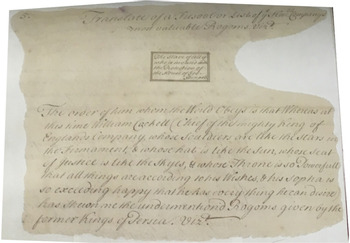
The Shah also requested that any Portuguese possessions in India that were subsequently taken be divided between himself and the Company, despite how unlikely any such acquisitions might be.Footnote 2 The agreements between the Company and the Shah for the division of spoils and later the sharing of customs laid the foundation for the Company’s interaction with Persia and set the tone of the future relationship. After the capture of Hormuz in April 1622, the treaty was replaced by the promised Farmān, in which the relationship between the Company and the Shah was formalized in a list of specific terms (See Figure 1).
The translation of the Intitulatio, Narratio, Arenga and Dispositio of the Farmān of Shah Soltan Husayn, granted in 1697.
Source: IOR/H/628 ff. 19‒33v. Image courtesy of the British Library.

The text of this treaty and some of the other terms granted to the Company have been known to historians thanks to the work of R.W. Ferrier on documents found in the Harley Collection at the British Library, this is by no means a complete chronology.Footnote 3 While the Company’s Persian copies of the subsequent Farmān are sadly lost, the Company kept multiple translations in their factory records for the Gulf.Footnote 4 These translations are held in the India Office Records at the British Library, though they have only recently been catalogued. These copies, which encompass the original treaty of 1619 until the final grants and privileges given by Nader Shah in February 1747, shortly before his death, give a clear impression of how the Anglo-Persian relationship developed. The text of the Farmān in the English sources is a gateway to understanding not just what the Company wanted from its relationship with the Persian state, but also what Persian officials and rulers expected in return. The mutual nature of this relationship, as well as the mutability of the agreement is a feature of Farmāns in India; however, unlike in India, where there was a constant tension between local government and the center, in Persia it was an ongoing state concern.Footnote 5
The first English East India Company ship entered the Gulf in 1616 and anchored off the Persian port of Jask where the Gulf of Oman joins the narrows of the Persian Gulf. The James carried a supply of woolen cloth, which the Company hoped would sell better in the cooler climate of the Iranian plateau than it had in the tropical climate of India. In turn, its crew hoped to secure a cargo of Persian silk to sell in Europe. The lure of Persian silk, along with the demand for European cloth in the East, made the Safavid Empire particularly attractive to the Company as a place to do business. The voyage of the James proved modestly profitable and paved the way for a continuing trading relationship secured through the establishment of political connections between the Company and the Persian state. This trading relationship was the means through which the Safavids and the Company came to understand each other’s mutual antipathy to the Portuguese.
The Company’s entrance into the Gulf took place in the latter years of the reign of Shah Abbas I (r. 1588‒1629). This Persian ruler reformed the Safavid Empire into a more coherent state after a lengthy period of war and unrest following the death of Shah Tahmasp I in 1576. During his reign, Abbas I successfully fought off internal rivals, as well as scoring significant victories against the Uzbeks and Ottomans, the two great territorial rivals of the Safavids. This success left the Shah free to secure the Gulf Coast and Hormuz from the Portuguese, a campaign in which he was to solicit directly the help of the East India Company. In 1622, according to Italian traveler Pietro Della Valle writing to his friend Mario Schipano, Shah Abbas I was aggrieved at the aggressive territorial growth of the Portuguese within his empire.Footnote 6 According to Della Valle, the Shah moved against the Portuguese carefully, and was quick to befriend the English in 1617 in recognition of their naval capability.Footnote 7
The remainder of the seventeenth and the eighteenth century was a period of significant change and divergent fortunes for both Persia and the Company. The Company moved from strength to strength at the end of the seventeenth century, after a difficult period during the English Civil War and Glorious Revolution, not to mention vigorous competition from the Dutch East India Company (VOC). The Dutch were slowly subordinated to the English in Europe, thus weakening them to an extent elsewhere, though the VOC effectively maintained an almost complete monopoly over trade with the Spice Islands of the Indonesian Archipelago. In Persia, both companies competed over resources and favor throughout the seventeenth century, with the renewal of Farmāns cementing these relationships.
One of the major changes that increased the importance of Persia in the Company’s trade came with the stipulation in the Company’s charter of 1693, that it was required to export £100,000 of English goods annually.Footnote 8 This meant that Persia, one of the few areas where English cloth was in demand, was of renewed interest and importance in the Company’s wider view of its own trade. Commerce was facilitated by the re-issuing of all the Company’s privileges by Shah Soltan Husayn in 1697. Elsewhere, the Company’s gaze was shifting westward from the Spice Islands to the Coromandel Coast of India, where cotton cloth, widely in demand throughout both Europe and Asia, was produced. The early eighteenth century also saw a major change in the Company’s fortunes with the amalgamation of the “New” and “Old” East India Companies in 1708. This brought an end to competition within London itself and generated a huge increase in the Company’s profitability.Footnote 9
Persia, on the other hand, suffered from economic difficulty caused by the expatriation of bullion, civil unrest and a series of less than competent rulers.Footnote 10 In the decades from 1700 to 1750 the Safavid Empire ceased to be the dynamic state that Abbas I had formed and ruled. The collapse in 1722 during the rule of Shah Soltan Husayn, which was brought about by an unforeseen Afghan regional uprising and subsequent invasion, resulting in the overthrow of the dynasty. A series of civil struggles between the Afghan occupiers, Safavid loyalists and other foreign and domestic interests ensued. The Ottomans and Russians both occupied Persian provinces, while Baluchi raiders attacked towns and settlements along the Gulf littoral, including Bandar Abbas.Footnote 11 Tahmasp II (r. 1729‒32) and his infant son, Abbas III (b. 1732, d. 1740) ruled under the sway of Tahmasp’s leading general, Tahmasp Qoli Beg, who is better known by his regnal title, Nader Shah. He dispensed with the fiction of Safavid rule in 1736 and assumed the throne until his murder in 1747. Nader Shah’s reign (1736‒47) represents the most dynamic period in the Anglo-Persian relationship since 1622 and was built upon the recognition of the Company’s demonstrated potential as a military partner and a means by which Persian commerce and diplomacy could be transacted and stimulated.
A Farmān was a royal decree from an Islamic ruler, conferring certain rights upon an individual, community or, in this case, Company. Previously, the English had encountered a similar system of decrees in their trade with the Ottoman Empire, where a set of “Capitulations” were passed onto the Company by the Soltan in a document called an “Ahdnameh.”Footnote 12 The English had been given an Ahdnameh by the Ottomans in 1580,Footnote 13 while in 1618 a Farmān was granted by the ruler of Sana’a in the Yemen, establishing the Company in the coffee trade.Footnote 14 The Company was granted limited privileges by various regional governors in the Mughal Empire, though any grant for the whole empire was not forthcoming in this period.Footnote 15 In common with these other examples, the Company’s Farmān from Shah Abbas was mostly concerned with trade and commerce, building upon the treaty transacted for the capture of Hormuz, the terms of both of which are as follows:
The Treaty with Abbas I: December 1621‒22Footnote 16
-
1. That for the assistance of the English ships against the Portuguese at Hormuz and Kishme (who exacted upon both nations) half the spoils of Hormuz (when taken) should be divided to the English and half to the Persians.
-
2. That the castle at Hormuz should be garrisoned by half English and half Persians.
-
3. That the ports and castles in India should be divided equally.
-
4. All English and Persian ships bound for India should be customs free.
-
5. All strangers’ customs should be forever equally split between the English and the Persians.
-
6. That Christian captives should be handed to the English and Muslims to the Persians except for the captains of Kishm and Hormuz who are to be handed over to the Persians.
-
7. All expense of ammunition etc. to be split equally.
-
8. Neither side should entertain those who change religion to that of the other.
-
9. Any ships left to defend the Gulf should be paid for by Persia.
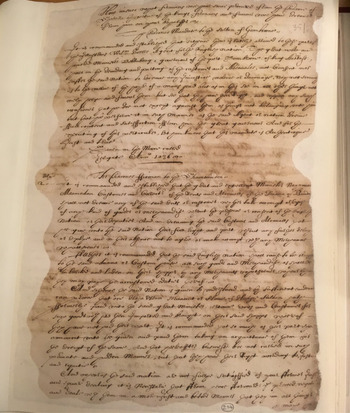
The Farmān of Abbas I: 1629 (See Figure 2) Footnote 17
-
1. Undated—Farmān to Mullayam Beg fixing the rates at which he is to receive goods for silk.
-
2. June 1627—Farmān conferring all previous grants.
-
3. June 1627—Farmān to Mullayam Beg directing performance of the commercial contract with Mr. Burke.
-
4. June 1627—Farmān to the Khan of Shiraz ordering that the English have their full share of customs.
-
5. June 1627—Farmān to the Khan of Shiraz commanding that the English and their goods be protected.
-
6. June 1627—“Mandall” to the Shahbandar of Gombroon commanding fair division of the customs with the English.
-
7. June 1627—Khan of Shiraz’s Farmān commanding that all customs should be received in the presence of the English, that they receive their full share and that no pass be granted without their permission.
-
8. June 1627—Khan of Shiraz’s Farmān giving Mr. Burke permission to build a house.
-
9. June 1627—Khan of Shiraz’s Farmān ordering his officers to provide guards and security for the Company’s people, goods, debts etc.
-
10. June 1627—Certificate of customs paid by Cogiah Hassan.
Text of the Farmān of Shah Safi I Granted in 1629.
Note: This copy appears to be contemporary with the delivery of the Farmān, but appears in a list compiled in 1736. Source: IOR/G/29/5 ff. 350‒351 List of Rogums granted to the Company in Consultation on 12 August 1736. Image courtesy of the British Library.

According to Shah Abbas’ Farmān, the Company was to assist in the administration of customs and tolls at Bandar Abbas for a share of those same revenues,Footnote 18 at first negotiated as half the total take, but subsequently reduced to 1,000 toman.Footnote 19 Despite this promising beginning and the success of the undertaking, the Company was rarely to receive its full share. In the 1720s and 1730s the Afghan and Persian authorities found it necessary to renegotiate with the Company at Bandar Abbas from the original positions that had been laid down in the Farmān issued by Shah Abbas and its subsequent renewals under Shah Safi I and Shah Soltan Husayn. These negotiations and the way in which the Farmān was used by both sides across the period after 1700 make it a living agreement referred back to and renegotiated by both parties on multiple occasions.Footnote 20 Rather than either abandoning the agreement or reneging on its stipulations, both sides found compromises in order to protect the other clauses of the whole document.
The Farmān of Abbas I included the right for English merchants to trade in silk throughout Persia free of customs charges and rahdari.Footnote 21 This right was most important to the English at the time of the treaty as it allowed them to purchase and transport the valuable silk produce of Gilan and Mazandaran on the Caspian littoral in the north of Persia via Qazvin, Isfahan and Shiraz to Bandar Abbas for shipment. This put them in an advantageous position when compared to their Dutch rivals, whose own agreement with the Safavid crown required for them to buy fixed quantities of silk at fixed prices.Footnote 22 The English therefore gained materially over the long term, though not as much as they had initially expected, due to the costs of the Hormuz campaign. This was only possible having achieved this legitimacy through being useful in the eyes of the Safavid crown in securing their interests, the patronage of which would last until the end of the dynasty and beyond.
There is a clear link showing continuity with the Farmān granted by Shah Abbas I in 1627 through subsequent Farmāns into the seventeenth century. These iterations of the agreement are equally vital to our understanding of the Company’s place and influence in Persia, though they too have received relatively little scholarly attention until now. In the India Office Records (IOR/G/29), there are translations of the Farmān granted between Shavval 1036AH and Muharram 1036AH (1627‒29 AD) by Shah Safi I; the renewal given by Shah Soltan Husayn in Shavval 1108AH (1697‒98 AD), and finally those grants made by Shah Tahmasp II and Nader Shah throughout the 1730s and 1740s. After the Afghan invasion, the Company was also granted all its former privileges by the new regime with no negotiation necessary.Footnote 23 The text of these Farmāns alters relatively little; however the amendments that are made are indicative of important changes and trends in the Company’s interests and those of the Persian government. When considering the importance of the Company to the Persian state one should note that edicts like the Farmān normally ended with the death of the granting ruler. That the Farmān existed for over 100 years is therefore highly significant, demonstrating the importance of the Company’s presence to subsequent rulers, but also its desire to retain its privileges within the empire and thereby continue trading there.
The renewal granted by Shah Safi I in 1629 is documented and recorded in the consultations as an addendum to the original Farmān from Abbas I, Shah Safi’s direct predecessor.Footnote 24 Shah Safi’s Farmān, while granting all the previous rights enjoyed by the Company, adds a list of new ones. The Company was given ownership of its house at Bandar Abbas, rather than only having the right to reside in the town. Another issue of ownership addressed in the Farmān is the return of the effects of a deceased Company merchant to Bandar Abbas by the Khan of Lar.Footnote 25 This shows that the Company was becoming settled in Persia on a permanent footing, but also suggests that the Shah was sensitive to the Company’s anxiety about the status of its property in his kingdom. This is again addressed by an undertaking from the Shah to right any wrongs done to the Company through remuneration for goods lost or their retrieval, as well as a promise to punish anyone attempting to defraud the Company.Footnote 26 Shah Safi removed all rahdari from the Company, whereas previously the original Farmān from Abbas I set a specific rate for this duty, rather than removing it, silk remained specifically exempt. The Farmān of Safi I retained previous agreements but importantly added the consideration of systems of justice to maintain the Company’s standing and protect its business.
Farmān of Shah Safi I Footnote 27
11. May 1628—Letter from the Shah to the Company.
12. May 1628—Farmān to Mullayam Beg to receive the Company’s goods on the same terms as the Dutch.
13. May 1628—Farmān to Mullayam Beg to receive certain goods on the Shah’s behalf from Mr. Burke and pay the charges thereon.
14. June 1628—Letter from Mullayam Beg to the agent announcing the coronation of Shah Safi I. All English and Dutch privileges confirmed.
15. August 1629—Farmān to Mullayam Beg to deliver silk in return for ¾ goods and ¼ specie.
16. August 1629—Farmān clearing the Company of paying rahdari.
17. August 1629—Farmān for the transportation of nine horses yearly.
18. August 1629—Farmān to rectify former abuses of the Company’s privileges.
19. June 1630—Confirmation of the Company’s ownership of the factory of Gombroon.
Khan’s Farmāns confirming all the above royal Farmāns.
Following the renewal of the Farmān by Shah Safi I (r. 1629‒42) there were no documented renewals throughout the reigns of Abbas II (r. 1642‒66) and Suleiman I (r. 1666‒94). However, Shah Soltan Husayn (r. 1694‒1722) renewed the Farmān in 1697; though many of the privileges remained the same, provisions were added for more social concerns, such as the grant that any child of an Englishman and a local woman would be given over to the care of the English.Footnote 28 These concerns reflect how settled the Company had become and that there were clearly pastoral issues that needed addressing along with those of trade. While the Mughal Farmān from 1618 allows for a degree of extraterritoriality, this provision concerning the offspring of the English and not just their persons is notable as a sign of the Company’s increasingly settled status in Persia.
Farmān of Shah Soltan Husayn 1697 Footnote 29
11. RogumFootnote 30 for the Company’s house in Shiraz wherein it is ordered that no officers in Shiraz do presume to meddle with the said house or give the English the least trouble about it but continue in the quiet possession of it.
12. A rogum ordering all officers, rhadars (Collector of the Road Toll “Rahdari”) etc. that whenever a caphilaFootnote 31 belonging to the English goes from Spahaun to Gombroon in case there is any danger in the road from rogues that the said officers shall supply the English or their servants with guards if they desire it and not suffer any damage to happen either to their goods or persons.
13. A rogum ordering the English shall have liberty to export twelve horses annually and that in case they send less one year they may transport so many more the next.
14. A rogum ordering the Vizier of Shiraz to permit the English to make drink and export what quantity of wine they please and notwithstanding among the Musselmen it is not allowed yet the English are at full liberty to do it.
15. A rogum ordering that the English are free of Rhaddarage all over the kingdom mentioned as a present to the Chief of Isfahan.
16. A rogum ordering that all goods belonging to the English that come to Spahaun are free of Sad-yeck and Havoy Footnote 32 and they may bring them into their house and disperse of them without the least molestation.
17. A copy of a rogum ordering the English twelve jareebs (“Jerib” a unit of land measurement, approximately a hectare) of ground in what part of Gombroon they please and that no officers presume to molest or hinder them on this score.
18. A rogum ordering all governors, viziers, darughas Footnote 33 and other officials all over the dominions of Persia for this reason that there is a perfect harmony between the King of England and me and the English are my guest and whenever they have business with the aforesaid officers that they do not refuse but do them justice and not ask any the least gratuity for such services of them.
19. A rogum ordering the Shahbandar and his officers to treat the English and merchants civilly that they may promote and increase the trade of Gombroon and I have likewise ordered another Shahbandar and directed him to do as the English desire and the English may be assured of my favor and make the merchants content that they shall likewise receive the same and that afterwards nobody shall treat them ill that they may trade and make the port flourish.
20. A rogum ordering the English their house in Spahaun and that the Meerob or Head of the Waterways does not prevent the water coming to their garden.
21. A rogum ordering that nobody presume to force the chief or his servants to sell goods to them and if the English chief etc. sell any goods that he or they shall receive ready money for them and if any presume to act contrary to this order, they shall be severely punished.
22. A rogum ordering that one house belonging to the linguist be free of the Jizya Footnote 34 and all duties and assessments.
23. A rogum ordering that six banians (A generic term for traders from the Indian Subcontinent) and a broker be free of Jizya and all duty and assessments.
24. A rogum ordering that the English be treated with respect all over the dominions and that no khans or officers presume to use any the least force nor ask anything from them or injure them on any account or manner whatever, but assist them about their affairs.
25. A rogum ordering that whereas the English banians in Gombroon and Spahaun have nothing of their own and what is in their hands belongs to the Company, nobody presume to force or take anything from them and if any person owes them anything he shall pay it back again.
26. A rogum ordering that the English are permitted to one hundred loads of silk in Gilan at the current price free of all duties whatever.
27. A rogum ordering that if the English servants commit any faults the governor or darughah of such place those crimes are committed shall send them to the English to be punished and not ask anything at all of them.
28. A rogum ordering that the English are permitted to buy 2,000 maundsFootnote 35 Kandahar of hing free of all duties (added in 1730).
29. A copy of a rogum attested by the Sheikh-ol-Eslam ordering that the English are free of customs and all manner of duties whatever.
Through the Farmān of Abbas I and all subsequent renewals the Company was entitled to half the customs duty for goods landed at Bandar Abbas; the Persians never consistently rendered what was owed. The Company’s servants demanded payment through the Farmān, including a demand for payment of arrears by the time of the renewal of 1697.Footnote 36 This was only partially successful, with the Company eventually setting up a system of consulage (a duty paid by merchants for the Company’s protection of their goods while abroad). Again, this shows the Farmān as a barometer of the Company’s priorities, as well as an acknowledgement on the Persian side that a share of the customs was still owed to the Company. The main factor where this version of the Farmān is different, however, is the addition of clauses for the production and exportation of wine and freedom to buy and export Kerman wool. Significantly, by 1680 silk is no longer listed separately by the Company in its lists of privileges, though the provision for its duty-free purchase and transportation persists.Footnote 37 The continued presence of the silk privileges is no longer demonstrative of the Company’s aspirations; its desire to purchase silk in any quantity had lapsed in the 1630s, while the Dutch, in recognition of an ongoing contract with the Persians had continued to buy silk, but to an ever decreasing commercial advantage.Footnote 38 Instead, the maintenance of this privilege was most likely an attempt by the Persian authorities to stimulate the silk trade, which was an important source of income to the state. This policy of using the Company’s Farmāns to reflect Persian interests is clearly illustrated during the Afghan occupation, when in 1726 Shah Ashraf announced the renewal of all the Company’s privileges as a measure to stimulate trade, this same tactic would be employed by Nader Shah. It seems unlikely that this manipulation was the invention either of Nader Shah or the Afghans, but is more likely a continuation of an entrenched system and understanding between the Company and its Persian interlocutors on the local and national level.
The last list of privileges received by the Company comes from 1736, after Nader Shah had taken over effective control of the Persian Empire. Nader Shah sought to reformulate the Company’s relationship with Persia, as he did with many of the empire’s other allies and subject peoples. He attempted to do this at first through force or threat, but found this relatively ineffective, even going so far as to have the Company’s Armenian translator beaten and subjected to extortion.Footnote 39 Nader Shah had begun to rely on the Company increasingly for naval support and assistance in the Gulf. Previously, the Company had provided ships to chase down renegade Afghan and Sunni rebels on the coasts and islands of the Gulf, in addition, the Shah demanded the use of Company ships to carry embassies to India.Footnote 40 Nader Shah had failed to properly recompense the Company for these services, so they had petitioned Tahmasp II, leading Nader Shah to change his approach yet again.
Nader Shah began to flatter the Company through his puppet, Shah Tahmasp II.Footnote 41 The following quote is taken from the prolix to the renewal of the Company’s Farmān granted by Tahmasp II in 1736; “and desired that I would renew the same, I that am King of Persia do order in consideration of the great service that the English have done and their friendship with me is entire and without blemish”.Footnote 42
Regardless of this cordial tone, this renewal was not all it seemed, as extra stipulations were added concerning the sale of goods, the production of which had been made a royal monopoly.
Unlike the perceived beneficence of Tahmasp II, Nader Shah’s approach during his own direct reign was far more robust. Indeed, Nader Shah used the granting of the Company’s individual privileges (rogum) as a means of controlling the Company and gaining tactical military support and supplies from Company ships. By manipulating the Company through the Farmān, adding or removing individual rogums, Nader Shah was demonstrating his perception of the importance of these privileges to the Company. This also indicates how careful the Company was to try and keep naval support at arm’s length from trade considerations and how important projecting naval power was to the Shah. Ogborn has suggested that the use of the written word was a significant tool in the European mastery of Asia, but as Nader Shah’s tactical use of the Farmān demonstrates, this was evidently a double-edged sword.Footnote 43
The Farmān was very much a living document, referred to consistently by the Company and by its Persian interlocutors in order to solidify their ongoing working relationship. The Persians on numerous occasions used the privileged position given to the Company’s trade as a political lever, forcing the Company to undertake military expeditions in the Gulf, and carry Persian diplomatic missions further afield.Footnote 44 Being able to use the Company to fulfill these maritime functions was of significant value to the Persians, with a precedent being set in 1622 with the agreement to capture the island and city of Hormuz from the Portuguese.Footnote 45
During the reign of Nader Shah, the Persian state attempted to use the Company as a means of economic stimulation, firstly through a plan to ship Persian goods on Company ships on the Shah’s account, then by a system of enforced purchases of “hing”.Footnote 46 Hing (asafoetida) was a recognized commodity in Asia, it is a common ingredient in South Asian cuisine and grows in the highlands of Khorasan and Afghanistan. Nader Shah had clearly been informed that hing, along with cheap Persian copper, had been bought and shipped by the Company in the past and sought to take advantage of this existing trade.Footnote 47 His opening gambit clearly failed, as later the Company’s employees were informed that their Farmān had been adjusted, with a new clause allowing for the exportation of hing duty-free.Footnote 48 By changing the Farmān, Nader Shah was evidently trying to manipulate the Company into selling hing where he had been unable to. While this change might have made the trade more tempting, the Company found that all supplies of hing had been bought up by the Shah and his officials and could now only be purchased for 50 Shahis a maund.Footnote 49 Finding that even this had not been enough to spur the Company into buying his newly monopolized product, the Shah ordered that the Company’s broker be forced to buy 500 maunds of hing, thereby hoping to force the Company to come to his relief.Footnote 50 While unsuccessful, like attempts to add competition to the silk trade, and somewhat heavy-handed, this example demonstrates an appreciation by the Persian authorities of the Company’s ability to stimulate trade and production. Other measures, such as banning the shipping of bullion, had also failed to adequately prop up the Persian economy.Footnote 51
The terms of the Farmān show that the Persians were dictating the relationship with the Company, while the Company itself can only make requests on the privileges granted to it. The story of the Farmān is the vital foundation to understanding the Company's establishment as a trading and maritime power in the Gulf. The Company had certain advantages in trade granted through the Farmān, such as the right to cash payments from the customs of Bandar Abbas and freedom from taxation. The Farmān provided the Company with the stability to operate profitably over a huge territory with a small establishment, while maintaining relationships with the third most powerful regime in the region. The Company tried and failed to gain similar agreements in India, China and Japan until its Farmān with the Mughal Empire in 1717. The Company’s relationship with Persia, unlike with the Mughals, was maintained directly through the person of the Shah, as enshrined in the Company’s Farmān. This meant that the Company had a direct link to the highest authority in Persia. In Mughal India, China and Japan, no such high-level connection could be procured, with either regional terms being negotiated, or none at all. The Company was able through the Farmān to access all the potential markets, goods and wealth of Persia and while this may not have been at the same scale as the fabulous riches of India, it was nonetheless politically and economically attractive and expedient.