When, in 1735, a slim volume entitled Systema Naturae was published in Holland it attracted little attention outside the scientific world. Yet what the author, the aspiring young Swedish scientist Carl Linnaeus (1707–1778), proposed here was the beginnings of a new method of classifying the natural world, a taxonomical system which would be adopted by scientists around Europe by the end of the eighteenth century. Although botany was at the heart of the new system, the animal world was included from the start. Within the order Quadrupedia (four-legged animals) Linnaeus also listed man himself, Homo. As such, this was not revolutionary, already Aristotle had claimed that humans in a classificatory sense belonged to the animal world. Linnaeus also divided the genus Homo into four varieties (varietates) according to the four continents and characterised by skin colour: Europaeus albesc. (whitish European), Americanus rubsesc. (reddish American), Asiaticus fuscus (dark coloured Asian), and Africanus nigr. (black African).Footnote 1
During Linnaeus's lifetime, the Systema Naturae would appear in multiple, ever enlarged editions, at the same time augmenting Linnaeus's scientific prestige and international fame. What Linnaeus initiated was an enormous, global project of collecting and knowledge gathering, involving his own students, Swedish and foreign collectors, and an enormous network of correspondents. The dependence on various groups of informants and collaborators, the “co-production” of botanical knowledge in particular, and the processing of information have been the foci of recent scholarly literature on Linnaeus and his project.Footnote 2 In contrast, this article narrows the lens, to focus on one species only, namely Homo.
The classification of humans, with Homo divided into varieties according to the four continents and characterised by skin colour, remained unchanged in subsequent editions of the Systema. It was only in the seminal and ground-breaking tenth edition of 1758–9 that changes were introduced. It was in this edition that Linnaeus systematically assigned a binominal nomenclature to the animal world. This novelty was consequently applied to man himself, now called Homo sapiens. This species was still divided into the four varieties, but additional description of each variety was given: physical characteristics, stature, clothing, but also temperament, governance, and ways of living. The skin colour of each variety was kept, with one exception: the complexion of the Homo asiaticus was changed, from fuscus to luridus. The more detailed description of the varieties was not the only novelty, as Linnaeus rather sensationally suggested that Homo sapiens was not the only species of humans, but proposed a new species, Homo troglodytes, also called Homo nocturnus (“night man”) as these humans were said to be active during the night only. The night people were said to reside mainly in the “East-Indies,” and in an academic dissertation Linnaeus later gave a detailed description of this intermediary species, a “missing link” between Homo sapiens and primates.Footnote 3
This article does not attempt to revisit Linnaeus's classification of humans from within his taxonomical theories, theology, or moral philosophy.Footnote 4 Instead, it interrogates the classification of man in the context of the new knowledge of Asia and its inhabitants which was transmitted to Sweden during the years leading up to the publication of the 1758 edition of the Systema. Two cases will be looked at in detail, namely the variety Homo asiaticus and the new species Homo troglodytes.
The 1758 edition of the Systema Naturae was published after a period of intense contact between Sweden and Asia, enabled by the Swedish East India Company (Svenska Ost-Indiska Compagniet, SOIC). Founded in 1731, the SOIC rode on a new wave of economic optimism in Sweden following decades of political instability and war. Several of the founders of the company were of non-Swedish origin and had previous experience of East India trade through the failed Oostende Company. The Swedish ships had initially attempted to trade in India, but resistance from the increasingly assertive English East India Company meant that Canton remained the main destination for the company's fleet.Footnote 5 Within the Canton system the SOIC made profits mainly by reselling cargoes of tea to England. The second charter (octroi), 1746–66, was the most frantic and prosperous period for the company, and historians have described the SOIC as the most successful company in Swedish history. Still, the economic gains for the country were modest in comparison with the enormous profits made by Europe's big chartered East India companies, the Dutch and the English. The cultural influence of the China trade was, however, considerable, as a wealth of Chinese objects, porcelain, silk, and not least, information about China, would pour in to Sweden around mid-century.Footnote 6
It is well known that Linnaeus strongly believed in and developed the idea of travel as a scientific method.Footnote 7 Ideas about travel as knowledge were not new, but rooted in a European apodemic tradition, now put into practice with unbridled enthusiasm. Linnaeus's calls for the necessity of scientific travel, originating in his own early travels in Swedish Lapland, were further developed his dissertation Instructio Peregrinatoris, instructing travellers about what to look for and how to describe it. Most importantly, a useful traveller had to be trained in the new system and nomenclature. Linnaeus was tireless in his lobbying to obtain travel funding for his own students, whom he issued with memorials, instructions on what to observe, collect, and bring back.Footnote 8 During their travels he insisted on being sent letters, reports, and collections, while he also acted as a publicist, arranging for letters from his travelling disciples to be published in Swedish periodicals.Footnote 9 After their return he nagged the men to publish their reports and often reviewed their work himself.
Linnaeus's travelling students, sent out by the master to the four corners of the world to collect zoological and botanical specimens, have long attracted the attention of both scholars and a general readership.Footnote 10 An argument has also been made that Linnaeus was primarily driven by patriotic economic motives, not purely scientific goals.Footnote 11 It then became necessary for the Linnaean traveller not only to collect and observe the natural world, but also to report on the inhabitants of far-flung countries, their manufactures, agriculture, ways of life, to accumulate all sorts of knowledge which could be tried out and ultimately benefit Sweden. In this way, humans became part of Linnaeus's global project of mapping the natural world.
Linnaeus and Knowledge of Asia
Having initially studied at the Universities of Lund and Uppsala, the young Carl Linnaeus (later ennobled von Linné) travelled to Holland for further study in the early 1730s. In Holland he not only published the first edition of the Systema Naturae but crucially it was here that he acquired much of the knowledge of the non-European world he would later use in his publications. Due to Dutch trading activities in Asia and South America, Holland had become a global centre for the gathering of botanical knowledge. One of the directors of the Dutch East India Company (VOC), the Anglo-Dutch businessman George Clifford, was intensely interested in tropical plants and had established extensive hothouses on his estate, where he invited Linnaeus to work as a curator. This work resulted in an academic dissertation on the banana plant, Musa Cliffortiana, as well as Hortus Cliffortianus (1738), a catalogue of the tropical plants in Clifford's hothouses, where the frontispiece depicted a seated Flora receiving gifts from representatives of Africa, Asia, and America.Footnote 12 In Holland Linnaeus had access to herbaria and collections associated with Holland's foremost botanists Herman Boerhave and Johan Fredrik Gronovius. He also established close contacts with the botanists Nicolas and Johannes Burman, father and son, who at the time worked on their Thesaurus Zeylanicus (1737), a flora of Ceylon.Footnote 13
After visiting England for six months Linnaeus returned to Sweden, despite Dutch offers of travel opportunities to South America. He took up a chair in medicine at the University of Uppsala in 1741, after which he did not leave his native country. For new knowledge of the inhabitants of Asia he then had to rely on his extensive international networks of correspondents, travel literature and other publications available in Sweden, and on information brought back by travelling Swedes. Although these contemporary observations by fellow Swedes would inform much of his descriptions of Homo asiaticus and Homo troglodytes, it is necessary to note Europe's knowledge of Asia at this time.
The natural history of the Indian subcontinent was little known before the end of the eighteenth century, when the British initiated an accumulation of knowledge which was closely intertwined with their advance as a territorial power. By mid-century, information about India and its inhabitants was still limited, and transmitted mainly through Jesuit accounts.Footnote 14 The main botanical work was Hortus Malabaricus (1678–1703, 12 folio volumes) by Hendrik Adriaan van Rheede tot Draakenstein (1637–1692), which also contained economic and medicinal information on the Malabar coast of India. Linnaeus had seen these splendid, richly illustrated volumes in Holland.Footnote 15 Back in Sweden, however, the only copy of this expensive work had been destroyed in a fire in 1702. Only in 1756 did Linnaeus commission one of his associates in Germany to buy a copy of Hortus Malabaricus for the Uppsala library.Footnote 16
In contrast, richer information was available on the region now referred to as Southeast Asia. Linnaeus knew of a zoological and botanical treatise entitled De medicina Indorum, compiled by Jacob de Bondt (Bontius), a Dutch physician working for the Dutch East India Company (VOC) in Batavia in the 1620s.Footnote 17 Illustrated by rather course woodcuts, Bondt for the first time depicted and described the physical appearance and behaviour of the animal “Orang-Outang.” Linnaeus also made references to publications by Georg Everard Rumpf (Rumphius, 1627–1702), a Dutch official who lived for decades on the East Indonesian island of Ambon, and whose Herbarium amboinense or Het Amboinsche kruid-boek (6 vols., 1741–1750), would become the main source of information on East Indian flora and fauna.Footnote 18 Rumphius's works were only published posthumously after many delays, as the Dutch were reluctant to allow publication of information about their possessions in Asia. Europeans had, however, access to early publications generated by Portuguese and English trading expeditions to Southeast Asia, and pre-VOC Dutch travel accounts published in the early seventeenth century were still widely read. In addition, the eighteenth century saw the publication of a string of travel books written by Germans working for the VOC.
Travel accounts describing the East Indies had also been published in Sweden in the seventeenth century. The close economic links between Sweden and Holland at the time led to thousands of Swedes taking employment with the VOC, many as surgeons and medics.Footnote 19 Herman Niclas Grim (1641–1711), a longtime medic in the service of the VOC, is said to have donated large collections of Asian naturalia to the Collegium Medicum in Stockholm, and so was almost certainly known to Linnaeus.Footnote 20 The best-known publication was authored by Nils Matson Kiöping, who had travelled across Asia as a VOC employee for many years.Footnote 21 Kiöping's Een kort beskriffning uppå trenne resor och peregrinationer, sampt konungarijket Japan (1667) is rich in information about the flora, fauna, and peoples of Asia. The publication of this work was at least partly a result of the political ambitions of Sweden at the time, but it was republished several times, known by Linnaeus since his school days, and mentioned in his early lectures at Uppsala.Footnote 22
Much has been said and written about the role of Linnaeus's own travelling students, whom he sometimes referred to as his “apostles,” sent out by the master to work for the promotion of “Flora's Empire.”Footnote 23 Many of these scientific expeditions were disappointments for Linnaeus and a disaster for the traveller himself. Carl Friedrich Adler travelled in Java, but his extensive collections were destroyed by insects. The first student sent out on an SOIC ship, Christopher Tärnström, died on an island off the coast of Vietnam and never reached China. Fredrik Hasselquist, one of Linnaeus's most promising students, made it to Palestine and Egypt but died after a short period of frantic collecting.Footnote 24 But many of the students returned.Footnote 25 Writing to the Englishman Peter Collinson in 1756, while working on the tenth edition of the Systema, Linnaeus gave an enthusiastic report on his students: Daniel Rolander was expected to appear in Uppsala, having just returned from Surinam; Pehr Kalm's second volume describing his travels in America had just been published; Pehr Osbeck's journal from China and Hasselquist's (posthumous) description of Palestine were both in press. Another student, Per Löfling, was in still Mexico, but had not been heard of.Footnote 26 Everyone was on the move.
Linnaeus's relentless support for his travelling students would have had personal motives, but there was also another, national, agenda at play. At this time, Sweden had lost is position as one of Europe's great powers, and could no longer compete with other nations in the political and economic arena. Within science, however, Sweden could become a global leader, and it was with this thinking that Linnaeus promoted scientific travel. Here, the East Indies (a term used for Asia including and beyond the Indian subcontinent) were a scientific blank page, and Linnaeus wrote in 1746, “May God let the Academy send out the first man to Bengal, which is overflowing of rare plants, but where no one yet have botanised with open eyes, even less done anything for Zoology.… I had never imaged that the Swedish nation would have the honour of describing all the rarities of this place.”Footnote 27
The “Academy” was the Royal Swedish Academy of Sciences (Kungliga Svenska Vetenskapsakademien) initiated in 1739 with Linnaeus as a founding member.Footnote 28 The Academy would take an active role in the accumulation of information about Asia: sailors, captains, supercargoes, and chaplains on board the SOIC ships compiled journals and reports on hydrography and meteorology, descriptions of manufacturing and agriculture in China, and extensive collections of naturalia, much of which was sent directly to the Academy. The SOIC with its headquarters in Gothenburg, the Academy in Stockholm, and Linnaeus in Uppsala have sometimes been described as forming a “trinity” which propelled Swedish science in the mid-eighteenth century, although recent scholarship has re-examined the collaborative nature of Linnaeus's botanical work and his travelling informants.Footnote 29
Varieties of Homo sapiens
Whereas it was not uncontroversial to classify humans within the animal world, Linnaeus's 1735 division of humankind into varieties was not new. In the 1680s the French traveller and writer François Bernier had proposed four main varieties, or “races,” of humans. The first included the inhabitants of Europe, North Africa, Egypt, India, and certain parts of Southeast Asia. Difference in skin colour within this first group was explained through varying degrees of exposure to the sun. This race was mainly white, while parts of the East Indies were inhabited by “beautiful brunettes.” Africans, with thick lips and smooth and oily skin constituted the second race. They differed from the first race in that their blackness was not caused by sun, as their skin colour did not change in less sunny regions. The third race, of a “truly white” skin colour, consisted of the inhabitants of China, “Tartary,” and Central Asia. The Lapps, described as ugly “wretched animals,” formed an isolated fourth race. Bernier wrote that the “olive coloured” Americans could “probably” not be seen as a separate species, whereas the blacks of the Cape of Good Hope, in Europe called Hottentots, to Bernier “seemed to be” of a different race than other Africans.Footnote 30 Bernier had himself travelled in India, and his classification was, despite lack of commitment to racial divisions, firmly grounded in European travel literature. Other schemes proposed at this time leaned mainly on old literature and classical writers, not modern travellers.Footnote 31 This would change with the publication of Montesquieu's The Spirit of the Laws (1748), an influential treatise on human diversity, richly referenced with recent travel books and making a strong case for environmental explanations for cultural and physical variation. National character as well as physical appearance, Montesquieu argued, had been shaped by climate.Footnote 32
In comparison with these more sophisticated systems, Linnaeus four varieties seem simplistic and uninformed. Linnaeus must have known Bernier's work, and he certainly knew Montesquieu. Notwithstanding, he did not develop his scheme for decades. His division of Homo is repeated in subsequent editions of the Systema, with Homo europaeus listed first.
The tenth edition of the Systema Naturae, published in two volumes in 1758–9, has been described as an almost entirely new work. Linnaeus now replaced the order Quadrupedia with Mammalia, Anthropomorpha is replaced with Primates, and the binominal system is extended to the animal world. Man, now Homo sapiens, is still divided into the four varieties, but in addition to the more detailed description, there is another novelty, often neglected by scholars arguing for Linnaeus as the creator of racial hierarchies: the Homo americanus is now in fact listed first, above the europaeus.Footnote 33
Apart from the order in which they appear, discussants of Linnaeus's assumed “invention” of racial hierarchies have made much of “positive” or “negative” characterization.Footnote 34 For the americanus, now the “top” race, the evaluation was mixed: the American was described as red, choleric (jaundiced, referring to bile, anger), upright, with black, straight, thick hair, wide nostrils, round face, he was tenacious (firm, stubborn), cheerful, free, paints himself with labyrinthine red lines, and is ruled by habit (custom).Footnote 35 Much of this can be found in early travel literature (body painting, tattooing) and there is clearly also an element of the “noble savage.” Already in his journals made during his expedition to Lapland in 1732 Linnaeus had described the Laplanders, sami, as noble savages of the North, with comparisons being made between North American Indians and Laplanders, both living simple and “innocent” lives. In the seventeenth century, Swedish contact with America had intensified through the colony of New Sweden in Delaware. In his Kort beskrifning om provincien Nya Swerige uti America (A short description of the province New Sweden in America, 1702) Thomas Campanius Holm had portrayed the Americans as a free people, living in harmony with nature, a contrast to the European way of life.Footnote 36 Most of all, however, Linnaeus seems to have leaned on the positive and appreciative characterizations of America's indigenous peoples presented by one of his most trusted students, Per Kalm, who had travelled widely in America and Canada in the late 1740s, collecting naturalia and observing both native and European inhabitants of the New World. Kalm's Resa til Norra America (A journey to northern America) was published in three volumes in 1753–61 and was soon translated into several European languages.Footnote 37
Would the demotion of the European to second place reflect disillusionment with the European variety? The description of the Homo europaeus follows a template set by the americanus: Europeans were described as white, sanguine (enthusiastic, active, social), muscular, with yellow long hair, blue eyes, light, thin, very intelligent, inventive, and dressed in tight clothes. Europeans were also said to be ruled by “rituals.” This Latin term could also be translated into the Swedish moder, meaning arbitrary changes, and it has indeed been suggested that this reflected Linnaeus's mood, his disillusion with Sweden and its changeable political system at this particular time of disaster, with famine, war with Russia, and a coup attempt in 1756.Footnote 38 The physical characteristics corresponded entirely to the Nordic ideal as created by Olof Rudbeck, although Linnaeus, contrary to Bernier, included the Lapps in this variety.Footnote 39
At the bottom of the list we find the African variety, now called afer (a synonym with the earlier africanus), described as black, “phlegmatic” (relaxed and peaceful), loose (relaxed), with black (frizzled) tangled hair and smooth (“silky”) skin, flat nose, swollen lips, women without shame, with spreading breasts which give milk abundantly. The African was also said to be crafty (subtle), slow (lazy), neglectful (careless, unconcerned), anointing himself with grease, and ruled by judgement (caprice). This clearly reflected the stereotypes of Africans which emerged in the beginning of the eighteenth century, and had been reinforced by travel literature generated by the Dutch presence in the Cape.
Homo asiaticus
Below the American and the European varieties the Homo asiaticus was described as “melancholic” (analytical, wise, and quiet), rigid, with black (tawny) eyes, serious (sober, strict, austere), proud, greedy (eager), dressed in loose clothes and ruled by opinion (belief). These characterizations follow the scheme set in descriptions of the other varieties, but the novelty was the change in skin colour assigned to the Asian variety: the earlier fuscus (dark, swarthy) had been changed to luridus.
Scholars have attempted to interpret this change as the creation of the idea of the Chinese as a “yellow” race, which would initiate and pave the way for later European hierarchical concepts of race.Footnote 40 Much of this discussion has revolved around the interpretation of the word luridus. In order to link the term to later European ideas about a “yellow race,” a recent study has argued that Linnaeus used this versatile term to indicate illness such as jaundice, or meaning sallow, pallid, “pale yellow.”Footnote 41 It is well known, however, that despite the fact that Linnaeus constantly wrote in Latin, his understanding of the nuances of the language was limited.Footnote 42 More importantly, however, the key to this change seems to be the word from which the skin colour of the Homo asiaticus was changed, that is, fuscus.
As outlined above, Southeast Asia, the region where Europeans had traded and travelled for centuries, was better known in Europe than both the Indian subcontinent and China. Europe's source of information on China was largely limited to the Jesuit historian Jean-Baptiste du Halde's Description géographique, historique, chronologique, et physique de l'Empire de la Chine (1735), to which Linnaeus also referred in other works.Footnote 43 In contrast, a number of European travel accounts describing the inhabitants of Southeast Asia, especially with regard to Malacca, Java, and the Moluccas, were known to Linnaeus. As will be seen below, he put much trust in the published journal of his countryman Nils Matson Kiöping. Overall, Europeans made much of comparisons of skin colour between ethnic groups, prompted by the ethnic diversity of the region.Footnote 44 There was, however, one characteristic on which there was relative consensus among European observers: although some people were lighter, most were brown, dark, or swarthy.
It could then be claimed that the new designation of skin colour to the Homo asiaticus was brought about by new information about China reaching Linnaeus. Since his return to Sweden, he had seen the usefulness of the SOIC for the promotion of science in Sweden.Footnote 45 He actively worked for his own students to be appointed as chaplains on board the Swedish ships, but also eagerly read reports by other company employees. One of the first of these was Israel Reinius, who published his travel journal in 1749. Other Swedish observers of China in the 1740s were Carl Johan Gethe, who produced a richly illustrated journal which was given in to the Academy in Stockholm, and Gustaf Fredrik Hjortberg, who also supplied the Academy with illustrated journals seen by Linnaeus.Footnote 46
As a footnote to his 1758 Systema Linnaeus listed students who had informed his work. Two of these had visited China, Pehr Osbeck and Olof Torén. Christopher Tärnström, who died off Vietnam on the outward journey, is also mentioned, as Linnaeus had managed to get hold of Tärnström's journals from his widow.Footnote 47
Linnaeus's key informant on the flora and fauna of China, as well as its inhabitants, was Pehr Osbeck (1723–1805), a student of Linnaeus who sailed as chaplain on the East India ship Prins Carl in the early 1750s.Footnote 48 During his time in China Osbeck corresponded with Linnaeus, who later was deeply engaged in the publication of Osbeck's journal, Dagbok öfwer en ostindisk resa (Diary from a journey to the East Indies, 1757).Footnote 49 Appended to Osbeck's account were seven letters sent to Linnaeus from China by Olof Torén (1718–1735), one of Linnaeus's most promising students, who sailed to Canton and also along the Bay of Bengal, where he visited Kedah and Malacca on the Malay Peninsula.
Osbeck's volume was soon translated to German, English, and French. Appended to these translations was the journal by the perhaps best informed of all Swedish observers of China, Carl Gustaf Ekeberg, who had captained numerous Swedish East India ships over a period of thirty-six years. Ekeberg's account had been published in Swedish in 1757; he also produced a treatise on Chinese agriculture for the Academy of Sciences in Stockholm.Footnote 50 Another East India publication to appear in 1758 was written by Johan Brelin (1734–1782), who had travelled with the SOIC in the mid-1750s, and whose Beskrifning öfver en äfventyrlig resa til och ifrån Ost-Indien, (A description of an adventurous journey to and from the East Indies) provided a colourful description of Chinese life, cuisine, architecture, and religion.Footnote 51 Linnaeus also received botanical collections from other SOIC officials, and was able to describe a multitude of new Chinese plants in works such as Species Plantarum.Footnote 52 He was also in correspondence with company directors, and it is known that he personally interviewed returning East India travellers.Footnote 53
In all, the 1750s was a period of intense Swedish reporting from China. Like other Europeans, the Swedes were restricted in what they could do or where they could move in and around Canton, which meant that physical descriptions of the Chinese were patchy. There was, for example, no real consensus in Swedish reporting on skin colour. Osbeck wrote that some Chinese are “completely white,” whereas the inhabitants of the south were “very brown” due to exposure to the sun.Footnote 54 Torén reported that “the men have a yellowish skin; the ladies are fair, but the common are tawny.”Footnote 55 Taken altogether, Swedish reports clearly acknowledge that there were differences in skin colour between classes and genders. Some commented on the difference between regions, north and south, due to climate, something not acknowledged or discussed by Linnaeus. Crucially, however, the complexion of the Chinese is clearly seen as lighter than that of other Asians.
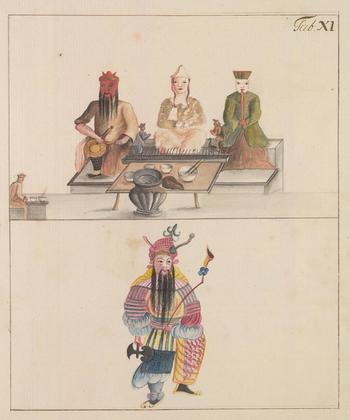
Studies of Swedish writing on China have pointed out that, overall, the Swedish image of the Chinese was contradictory; much of what was said pictured Chinese society as both utopia and dystopia.Footnote 56 This ambivalence towards the Chinese clearly was at least partly a result of day-to-day situations. Many saw the Chinese as happy, hardworking, and polite, all characteristics that Sweden could learn from. Others had nothing but contempt for the Chinese people. Olof Torén described the Chinese as greedy, lazy, and selfish, jealous, prone to lying and stealing; they furthermore lacked curiosity (a serious fault in Swedish minds).Footnote 57 These negative characterizations clearly emerged from a context of trade and commerce. The overall picture then is not clear-cut, and this is reflected in Linnaeus's characterization of Homo asiaticus. Osbeck pointed out that there was a lack of feeling of common good and respect for government (Linnaeus: “ruled by opinion”). Linnaeus's “loose clothing” is found in several of the Swedish accounts: Osbeck wrote that the Chinese wear wide coats of silk or cotton, “like our long night gowns,” Brelin described the clothing of the higher classes as cassocks (“koftaner”), which were both wide and long.”Footnote 58 The “looseness” of Chinese dress was clearly visible in drawings of Chinese people in journals such as Gethe's (Figure 1).
Drawing by Carl Johan Gethe from the manuscript Dagbok hållen på en resa till Ostindien (Journal from a journey to the East Indies), 1746–1749. Courtesy of the Royal Library, Stockholm, Sweden.

In contrast, Swedish reports from the Sunda Strait, Java and other places in Southeast Asia where the SOIC ships anchored en route to China described the inhabitants as naked, relaxed, and chatty, the very opposite of the rigid and serious Homo asiaticus.
Homo troglodytes
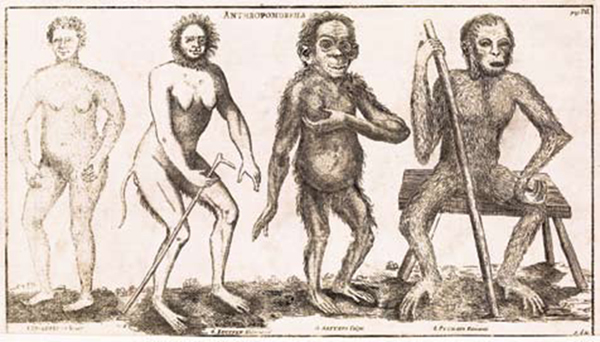
The most sensational novelty presented in the 1758 edition of the Systema was the suggestion that mankind was not one species, but two, as Linnaeus proposed a new species of humans, Homo troglodytes, also named Homo nocturnus, “night man.” As a counterpoint Homo sapiens was also referred to as Homo diurnus, “day man.” In the Systema the new species was only briefly mentioned, but Linnaeus would return to the Homo troglodytes in more detail some years later, in the dissertation Menniskans cousiner (Cousins of man), written in Swedish and defended at Uppsala in 1766 by the Russian nobleman C. E. Hoppius and further published in Latin in Amoenitates Academicae in 1763.Footnote 59 In this dissertation, Linnaeus suggested that Homo caudatus, the tailed man, which in the Systema had been seen as a variety of troglodytes, should be seen as a separate human species. The dissertation further described man's closest relatives, Simia pygmaeus and Simia satyrus, two species of tailless apes where the line between man and beast is crossed. The dissertation is accompanied by an engraving depicting the four “cousins of man.”Footnote 60 (Figure 2).
Engraving accompanying the dissertation Anthropomorpha, in Amoenitates Academicae, vol. 6 (1763). Published by permission of the Syndics of Cambridge University Library.

In the dissertation, Linnaeus provided a detailed description of the Homo troglodytes: these “people” were small, “white as snow,” with short and curly hair, they live in caves, and have peculiar eyes which cannot endure daylight. They only appear at night, when they come down to human settlements and steal from “people.” They have their own language, which consists of hissing sounds and is therefore difficult to learn, but have been known to be kept as servants. The habitat of the troglodyte was described as the island world of Southeast Asia, with the addition of “the mountain Ophir near Malacca.” The tailed man was said to live in “some islands closer to the south pole of the East Indies,” in the Nicobar islands and on Java.Footnote 61
Commentators on Linnaeus's classification of humans have explained this new species of humans from within Linnaeus's own taxonomical theories. It has also been observed that the troglodyte was a figure assembled from several sources: classical authors, mediaeval myths, European ideas about the Wild Man, and secondhand reports about albinos. Linnaeus's reference to Bondt has led scholars to see the troglodyte mainly as a misinterpretation of the orang-utan.Footnote 62 The figure in the engraving was clearly based on Bondt's woodcut, which depicted a female “ourang-outang” (as Europeans only captured female orang-utans), and some scholars have dismissed Linnaeus's new species as a curious “hairy woman.” The most thorough investigation of Linnaeus's classification of man, Gunnar Broberg's 1975 Homo sapiens L., added Swedish mythical folklore to Linnaeus's sources, arguing that Linnaeus relied on “travel lies” and “confused details of higher apes,” which would help to explain the Asian connection.Footnote 63
It was no coincidence that the habitat of the two new species of humans largely coincided with Dutch possessions in the East Indies. By tracing the image of the troglodyte through lineages of early modern European knowledge about Southeast Asia it becomes clear that Linnaeus's troglodyte indeed was a composite creation.Footnote 64 One of the components was clearly the “orang-outang,” a figure around whom the often heated eighteenth-century debates about the relationship between man and beast revolved. The term was, confusingly, also used for African chimpanzees. Numerous travellers in Africa and Asia had described the humanlike behaviour of primates in Java and other parts of Southeast Asia, but the most influential description of the behaviour of an “orang-outang” was Bondt's treatise.
In his description of the Homo troglodytes, Linnaeus quoted Bondt's long passage about the humanlike behaviour of this being almost verbatim, but for one detail: Linnaeus told his readers that, according to the Javanese, the orang-utan could speak. Bondt commented that this was ridiculous, but this was omitted by Linnaeus. Linnaeus also referred to Pliny, who had described troglodytes as Ethiopian cave dwellers who lived on snakes and “have no voice, but only make squeaking noises being entirely devoid of intercourse by speech.”Footnote 65 It was common for early modern reports from Southeast Asia to claim that the curious animal “orang-outang” could indeed speak, as it was also widely reported that this figure was the result of a the mixing of a human female and an ape.Footnote 66 Speech would remain one of the main themes in Enlightenment discussions about the relationship between primates and humans, making extensive use of these older, then outdated travel accounts describing African and Asian apes.Footnote 67
The main characteristic of the Homo troglodytes was the white skin colour and blindness during the day. Among his sources quoted, Linnaeus referred to a speech given by Olof von Dalin to the Academy in Stockholm where Voltaire's description of an African albino exhibited in Paris in 1744 was quoted.Footnote 68 Crucially, however, commentators pointing to Linnaeus's uncritical acceptance of “travel lies” have failed to acknowledge that sightings of “white people,” cases of albinism, had been reported by European travellers to Southeast Asia for centuries. The Dutch referred to these people as kakerlakken, cockroaches, as they avoided daylight. In Malacca they were said to appear at night, when they came out to steal from the people of the city.Footnote 69 The “cockroaches” had also been observed at royal courts in Java, reflecting a long tradition for rulers of the Malay world of keeping deformed people, hunchbacks, and albinos in the royal entourage. Linnaeus must have known some of these stories, but then they could easily, as so much else in travellers' tales from the region, be taken as remnants of classical and mediaeval images of a marvellous East, inhabited by fabulous creatures and monsters. So, what made him think that the region housed actual societies of troglodytes?
Already in Holland, Linnaeus had taken an interest in the white people of the East Indies, and interviewed a Dutchman who had claimed to have seen white people with orange eyes in Java. Linnaeus wrote that the man had been able to confirm what travel accounts had said about the white people of Java, but also that the teeth of these creatures were not apart, which meant that it was not an ape.Footnote 70 Linnaeus also pointed out that Rumphius, a fellow naturalist, had kept a troglodyte in his house in Ambon for eight years, although a detailed description of the creature was not available.Footnote 71
It seems, however, that it was only after receiving a fresh eyewitness report from Southeast Asia by a countryman trained in his own method that Linnaeus obtained the final confirmation of the existence of a “different” species of humans. In the dissertation Menniskans cousiner he quoted at length the Swedish traveller Nils Matson Kiöping, who had described how a strange female had been held on board a Dutch ship. Kiöping did not mention skin colour, but wrote that the woman was unable to see during the day and was used to perform easier tasks on board.Footnote 72 Linnaeus also, crucially, wrote that his countryman C. H. Braad had recently had returned from the East Indies, and had been able to confirm the existence of groups of troglodytes.
Christopher Henrik Braad (1728–1781) was a longtime employee of the SOIC, and had acted as a supercargo on numerous ships.Footnote 73 He was not a student of Linnaeus, but he was an interested and well informed observer of the natural world and would later correspond with numerous scientists in Europe. Braad submitted reports from China to the SOIC and the Academy in Stockholm, but his longest and most detailed reports were generated on the shores of the Indian Ocean. During a time when the SOIC still nourished plans to expand its activities on the Indian subcontinent, Braad was asked to act as an industrial spy, and he spent seven years travelling in India and around the Bay of Bengal, partly disguised as a scientist sent out by the Academy of Sciences in Stockholm.Footnote 74
Braad's travels in India took him to Kedah and Malacca on the west coast of the Malay Peninsula in 1751 and again in 1754.Footnote 75 A long manuscript composed by Braad is entitled Historiske Anmärkningar om Bengala; Dess invånare, och närvarande Tillstånd (Historical remarks about Bengal, its inhabitants and present state), dated 1754. The report found its way to the Uppsala University Library and is addressed to a certain but unnamed gentleman, presumably Linnaeus. In a true Linnaean spirit Braad described the flora and fauna of places visited, and also inhabitants, governance, and ways of life. Always keen to point out that his information was impartial and independent, Braad wrote that he chose not to dwell on often-repeated facts about Malacca, but set out to give a thorough description of the city, its topography, population, and trade as he had seen it for himself.Footnote 76 He thus did not mention the day-blind kakerlakken of earlier writers, but instead provided a description of a “peculiar sort of people,” “wild humans” who were sometimes seen in Malacca. These people were said to be naked and have short hair. They had no government or religion, but lived in the jungle, where they collected resins and other jungle produce. Significantly, they were unable to understand Malay, the language of the people of Malacca.Footnote 77
What Braad described were the ethnically different tribal groups living in the interior of the Malay Peninsula, reflecting the fact that both the mainland and the islands of the Indonesian archipelago were inhabited by two ethnically distinct and physically different groups, between which there was little contact. The inland people were regarded by the coastal Malays as primitive savages, often despised and associated with magical powers, but there was also mutual dependence, as only the tribes had knowledge of and access to the jungle and its produce, which they traded on the coasts. In the eighteenth century, Europeans still had very little knowledge about these peoples of the interior, now referred to as orang asli. In the nineteenth century, these groups would become the focus of emerging anthropological research in the region. By then, theories of race and debates about racial genealogy revolved around the fact that some of these groups have frizzy hair. In the engraving accompanying the dissertation Menniskans cousiner, the figure of the troglodyte is clearly a copy of Bondt's woodcut, but with one significant alteration: the flowing mane has been replaced with tightly curled hair.Footnote 78
It appears that Braad had provided Linnaeus with further information about Malacca and its curiously different people in actual conversation.Footnote 79 Linnaeus does not seem to have known Braad in the early 1750s, but by the 1760s the two were personally acquainted.Footnote 80 Curiously, reference to oral communication is found in the writings of the Scottish judge James Burnet (Lord Monboddo), who had taken an intense interest in the relationship between man and beast, especially the development of language and humans with tails. Having read the Latin version of the dissertation Anthropomorpha, Monboddo wrote to Linnaeus with questions about Nils Matson Kiöping's travel account. In a footnote to his rather eccentric work Origin and Progress of Language (1771) Monboddo quoted a reply from Linnaeus, mentioning Braad as someone who had provided him with information about Malacca and its “cockroaches,” in colloquia familiari.Footnote 81 Homo troglodytes then becomes a composite figure, emerging from recent eyewitness reports of both the curious people of the interior and the white people of Malacca who could only see in the dark.Footnote 82
Linnaeus's belief in the curious half-human species would not waver. In the 1760s he pleaded with the king of Sweden for assistance to catch further specimens in their natural habitat. He also approached the SOIC, with the result that the company directors issued orders for all outgoing Swedish ships to obtain troglodytes “with good words and money.” Could they not be obtained in Canton, they should be sent for from elsewhere in Asia.Footnote 83 No troglodytes were caught, and many remained sceptical. The captain Gustaf Ekeberg wrote home from Canton: “I will be delighted to present you these novelties from afar when I return, if only they exist. The archiater L. has commanded me to catch a troglodyte, if ever they exist, except in travel descriptions.”Footnote 84 But Linnaeus did not give up. Some years later he had word from London that a troglodyte girl from Jamaica had been captured. Through his contacts in England Linnaeus had the girl examined, providing strict instructions about what to look for, especially her speech and what her eyes looked like. It turned out that she could not see in the dark at all, but spoke English perfectly well.Footnote 85
Conclusion
Two case studies have been used here to illustrate the ways in which Swedish contact with Asia informed Linnaeus's classification of humans in the years leading up to the 1758 edition of the Systema Naturae. I have attempted to show that Linnaeus's “Asians,” Homo asiaticus and Homo troglodytes, were to a great extent based on new information transmitted to Linnaeus through written and oral reports generated by Swedish trading activities in China. As a consequence, Homo asiaticus came to describe the Chinese, whereas this variety earlier had referred to the inhabitants of South and Southeast Asia.
It has long since been pointed out that one of the paradoxes of Linnaean anthropology is the “two faces” of Linnaeus.Footnote 86 On the one hand he uncritically accepted curiosities and fable. He was, for example, fascinated by a mermaid allegedly captured in Denmark and dwelt at length on the wonderful creatures of Swedish folklore. But he was also the Enlightenment scientist, with a mission to tidy up the natural world, to demystify, determine, and classify, and to do away with the fabulous and unbelievable. Early editions of the Systema listed the group Paradoxa, which included mythical creatures such as the siren, hydra, dragon, Scythian lamb, and phoenix. The siren still appears in the later editions of Systema as a final note to the animal class, but with a question mark. It is within this thinking that the troglodyte has been hitherto explained; Linnaeus had simply been “led astray” by myth, superstition, and fabulous “travel stories.”Footnote 87 Following from this, it has been asked, how could there be “Enlightenment” in eighteenth-century Sweden if Linnaeus himself believed in men with tails?Footnote 88
There are, however, twists to the tail stories, illustrating the methodological unpredictability of eighteenth-century anthropology. Linnaeus's Homo caudatus, the tailed man, was said to be found mainly in the Nicobars and Andamans.Footnote 89 These remote islands had since antiquity been associated with tailed people, but for Linnaeus, the main informant was (again) the old trusted Swedish traveller Kiöping, who had provided a long and detailed account of his encounter with men with long tails in the Nicobars. By tracing the genealogy of European knowledge about these remote islands it is possible to trace the origins of the famous tails to actual ritual attire worn by the Andaman islanders.Footnote 90 Stories about orang-utans able to speak were derived from local folklore, as were traveller's claims that orang-utans were the result of sexual encounters between apes and humans. These stories had been read by Linnaeus, but within his own theories on the fixity of species it was impossible for two separate species to produce offspring. It became necessary to make only selective use of “travel lies.”Footnote 91
The new species of humans would become a source of embarrassment for Linnaeus and do not appear in subsequent editions of the Systema. Later anthropological descriptions of the inhabitants of the Andaman Islands had the specific aim of dispelling the claim that they were equipped with tails, one suggesting that it was the bark clothing used by the natives which had been misinterpreted by Linnaeus. Examinations were undertaken, but “no sort of projection whatever on the os Coccygis of either sex” could be found.Footnote 92
The Homo troglodytes was ridiculed already in Linnaeus's lifetime. Buffon, like many others, dismissed the Homo nocturnus as a misunderstanding of descriptions of apes, of which he had seen several, who “neither spoke nor hissed,” and he suggested that Linnaeus had described the African albino, seeing albinism simply as a disease.Footnote 93 Later in the eighteenth century Linnaeus's troglodyte was speedily whisked into the field of pathology as anthropologists began to see albinism as a defect which could only affect individuals. In reports from Southeast Asia, the issue of the white people was debated in several of the first volumes of the proceedings of the Batavian Academy. Observers of the region went to great length to show that the whiteness was a deformation and a disease, and any mention of troglodytes forming societies was by now thoroughly outdated.Footnote 94 In the 1780s the German anthropologist Johann Friedrich Blumenbach, otherwise an admirer of Linnaeus, criticised him on this point, calling the troglodyte and the tailed men “bizarre and mythical creatures” doomed to be reduced to “curious historical footnotes.”Footnote 95
Still, the curious troglodyte has a place in the history of eighteenth-century science in that it initiated debate and created themes for the emerging discipline of anthropology. Within a decade after Linnaeus's death Blumenbach would propose a racial classification which was largely built on Linnaeus's earlier scheme: four main races were proposed, one of which was named the Caucasian. In 1795, Blumenbach introduced an additional fifth human race, the Malay. This new assignation, which included the Pacific Islanders, was again a result of a European travel boom, this time the frantic exploration of the Pacific which had taken off after the Cook voyages. Blumenbach leaned heavily on writings by Johann Reinhold Forster, who through his familiarity with Linnaeus's method and taxonomy had been chosen to accompany Cook to the Pacific in the mid-1770s. In Forster's theories of race, the hair texture of certain tribes would constitute a crucial marker of racial origin.Footnote 96
Forster developed his theories based on his own observations, his “fieldwork,” which would ultimately lead to polygenetic theories and systematic anthropological research. For Linnaeus in the 1750s, individual eyewitness reports by his countrymen were crucial. Linnaeus wrote that Nils Matson Kiöping was one of “our men,” and so more trustworthy than foreign reporters, and his rather uncritical use of Kiöping's account was imbued with the patriotism which was the hallmark of Linnaeus's understanding of human diversity.
By the mid-eighteen century, Linnaeus's informants travelling out to Asia were trained in his own nomenclature and method. This enabled a systematic accumulation of botanical material and collaborative botanical publishing, a process which has amply been acknowledged by scholars.Footnote 97 In contrast, encounters with the human inhabitants of China were unsystematic, limited, and often contradictory. Homo asiaticus of 1758 might have described the Chinese, but Swedish reporters had only limited access to the inhabitants of China, and evidence concerning the crucial issue of the influence of climate and environment was inconclusive.Footnote 98 Homo asiaticus can then be seen as a product of the trading encounter, illustrating the difficulties of systematic and “scientific” analyses of the ethnic diversities which made up Asia.Footnote 99
Linnaeus's obsession with eyewitnessing was later ridiculed by his own countrymen. However, for the species Homo he was dependent on the specific form of knowledge that was travel.Footnote 100 Linnaeus himself never saw China, but wrote to Per Osbeck that his description of China was so detailed that “I seem myself to have travelled with you, and to have examined every object you saw with my own eyes.”Footnote 101 Minute detail and systematic observation was useful and indeed necessary in determining plants and animals; the classification of humans would remain an elusive task.