

Introduction
The number of disasters continues to increase.Reference Bissell, Pinet, Nelson and Levy1 Personal preparedness is advocated widely by many governmental and non-governmental agencies, including the (US) Federal Emergency Management Agency, US Centers for Disease Control and Prevention, and the American Red Cross. Despite this national focus, investigators report that few citizens have prepared their homes for a potential disaster.Reference Diekman, Kearney, O’Neil and Mack2–4 Even Los Angeles County, a region prone to numerous events due to natural hazards including earthquakes, floods, and fires, observed that 36% of survey respondents reported that they were not very or not at all prepared for a large-scale disaster.Reference Eisenman, Wold and Fielding3,4 Many recognize Los Angeles County, in particular the ports, as a possible terrorist target.Reference Eisenman, Wold and Fielding3 These cases clearly underscore a fundamental gap in personal preparedness that may undermine disaster preparedness.
During a disaster, it is assumed that healthcare facilities will have adequate and appropriate staff and resources to care for the injured/ill and their families. By law, healthcare facilities are required to have emergency plans in the event of a disaster, and must drill at least twice each year.5 However, it is unclear if staff will report to or remain at work when a disaster occurs. Qureshi et al explored the concepts of willingness and ability to respond among healthcare workers, and determined some barriers to willingness and ability, including dependent care and concerns for personal and family safety.Reference Qureshi, Gershon and Sherman6 Another report addressed at-home preparedness and concluded that healthcare workers who lacked at-home preparedness plans were at significant risk for distraction at work during a disaster.Reference Blessman, Skupski and Jamil7 The purpose of the current study was to determine the willingness of pediatric healthcare personnel to respond in the event of a disaster.
Methods
Study Design and Population
The Institutional Review Board approved the study. The study was conducted in an academic, tertiary hospital in Los Angeles, California March–September 2008. A link to the survey was mailed electronically to all 4,036 employees of the hospital, representing each of the departments. For employees without access to e-mail managers were provided with a paper version to distribute to their employees. Two reminder e-mails were sent to employees seven and 14 days after the initial e-mail. The survey instrument was based on previously validated public health surveys and expert opinions.Reference Qureshi, Gershon and Sherman6,Reference Graham, Shirm, Liggin, Aitken and Dick8–Reference Qureshi, Merrill, Gershon and Breckheimer10 The 24-item survey was used to collect information about demographics, dependents, job status, disaster preparedness experience, and training. Age, number of dependents, and number of miles in commute were open-ended questions, while the rest of the questions were either “yes/no” or multiple choice. Questions about level of preparedness for different types of disasters, and willingness to respond in the event of a disaster were measured using a five-point Likert scale, with 1 indicating “not willing” and 5 indicating “completely willing.” The distribution of variables was analyzed, and outliers were excluded (one outlier was excluded for an incorrect commuting distance, and one was excluded for an incorrect age entry).
Outcome Variables
Two questions asked about employees’ willingness to report to work during different types of disasters: man-made or natural. To determine overall willingness, a binary variable that was a composite from the two willingness questions was created. Respondents who marked either a “4” or “5” on both questions, indicating that they were willing to respond to a disaster caused by natural and man-made hazards, were classified as willing.
Statistical Processing
The frequency distribution of demographic variables including age, sex, ethnicity, and employment title, was examined. Odds ratios (ORs) and 95% confidence intervals (CIs) of willingness to respond were estimated by unconditional multiple logistic regression with and without adjustment for potential confounders. All models were adjusted for gender (categorical) and age (continuous). Marital status (categorical) and education (continuous) were adjusted in the models indicated. Employment title (categorical) was included as a dummy variable. Employees also were surveyed about their personal preparedness for certain disasters, which was treated as a binary variable (yes/no). Trend tests for dose-response relationships were conducted by treating categorical variables as the ordinal values and p-values were obtained using chi-square tests. All statistical tests were performed using SAS v9.2 (Cary, NC), and all p-values were two-sided. A p-value of <0.05 was considered statistically significant.
Results
During the six-month period, 888 employees responded to the survey, yielding a 22% response rate. Physicians had the highest response rate (72%) while “other” healthcare staff had the lowest (9%). Eleven people did not answer any of the survey questions. Two hundred five employees omitted the question about willingness to respond. Of the 672 (17%) employees who completed the willingness questions, 318 (47%) were “willing” to respond in the event of either a man-made or natural disaster, and 351 (53%) were “not willing”.
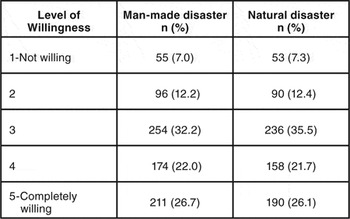
The willingness to respond to either a disaster caused by human-made or natural hazards were combined because the distribution of willingness was similar in both types of disasters (Table 1).
Willingness to respond to a disaster by disaster type

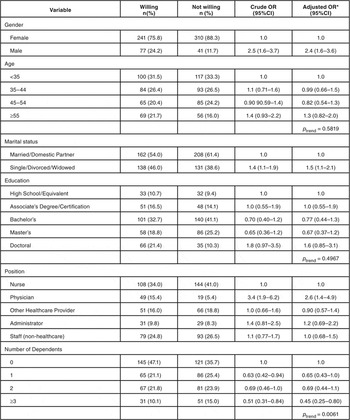
Of the total respondents, more females than males participated. The ages of respondents ranged from 20–86 years, with the average age being 43 ±12 years of age. More than 60% of participants were ≥35 years of age, and approximately 60% were married. More than 70% had at least a Bachelor’s degree, and approximately 40% had no dependents. Of all positions, nurses had the highest participatory percentage (37%; Table 2).
Association between selected demographic characteristics and willingness to respond to a disaster.

*Adjusted for age and gender
*CI = confidence interval; OR = odds ratio
In the sample, males were more than two times as likely to be willing to respond in the event of a disaster than were females (OR = 2.4; 95%CI = 1.6–3.6; Table 2). Moreover, respondents who were not married or living with a domestic partner were one and one-half times more likely to be willing to respond than respondents who were married or living with a domestic partner (OR = 1.5; 95%CI = 1.1–2.1). Physicians were the most willing to respond as compared to nurses (OR = 2.6; 95%CI = 1.4–4.9). There were no differences in association between age or education and willingness to respond.
The number of dependents ranged from 0–9. An increased number of dependents was inversely associated with willingness to respond to a disaster (OR = 0.45; 95%CI = 0.25–0.80, ≥3 dependents compared to 0 dependents as the reference group). There also was a dose-response relationship between number of dependents and willingness to respond (p trend = 0.0061; Table 2).
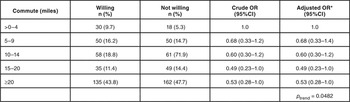
There was a marginally inverse association between commuting distance and willingness to respond (OR = 0.53; 95%CI = 0.28–1.0, commuting ≥20 miles compared to the reference group of >0–4 miles; Table 3). However, an inverse dose-response relationship was detected (p trend = 0.0482), indicating that the greater the commuting distance, the less willing the employee was to respond in the event of a disaster.
Association between commuting distance and willingness to respond in the event of a disaster.

*Adjusted for age and gender
*CI = confidence interval; OR = odds ratio
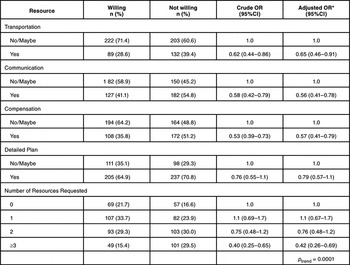
Employees who responded that they needed transportation, communication devices, and compensation were less willing to respond to a disaster than were employees who answered that they “did not” or “might not” need such resources. In addition, a dose-response relationship between the number of resources needed and willingness to respond was observed (Table 4). Employees who responded that they needed ≥3 resources were less willing to respond in the event of a disaster compared to employees who responded that they did not need any resources (OR = 0.42; 95%CI = 0.26–0.69, p trend = 0.0001).
Association between type and number of requested resources and willingness to respond to a disaster.

*Adjusted for age, gender, education, and marital status,
*CI = confidence interval; OR = odds ratio
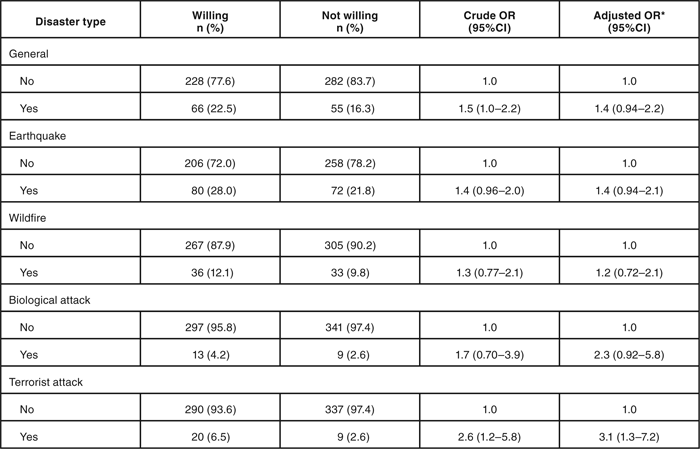
Associations between respondents feeling prepared for a general disaster, earthquake or biological attack were observed (Table 5). Respondents who felt that they and their family were prepared for a terrorist attack were more than three times willing to respond than those who did not feel prepared (OR = 3.1; 95%CI = 1.3–7.2).
Association between personal preparedness for selected types of disasters and willingness to respond.
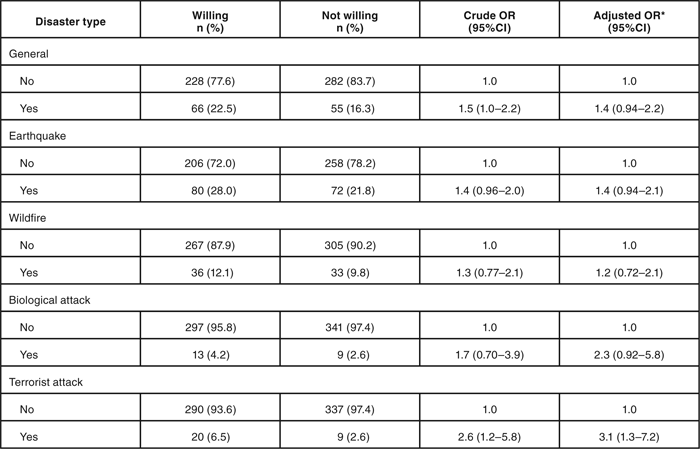
*Adjusted for age, gender, education, and marital status
*CI = confidence interval; OR = odds ratio
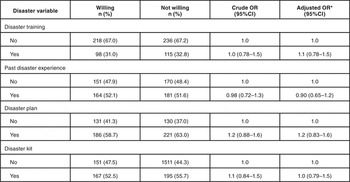
Two hundred thirteen employees (38.6%) had previous disaster training, and 345 (61.4%) had past disaster experience. There was no association between disaster training, past personal disaster experience, having a personal disaster plan, or having a personal disaster kit (Table 6).
Association between previous disaster training, past personal experience and having a personal disaster plan or kit and willingness to respond in the event of a disaster.

*Adjusted for age and gender
*CI = confidence interval; OR = odds ratio
Discussion
The findings of this study suggest the factors that may inhibit the disaster response of pediatric healthcare workers. Previous studies projected a 17% overall reduction in workforce for a mass-casualty incident,Reference Martens, Hantsch and Stake11 and a 43% reduction for a biological agent.Reference Masterson, Steffen, Brin, Kordick and Christos12 The results of the current study are consistent with the latter study, as a potential 50% reduction in employees willing to report to work in the event of any type of disaster was reported. Men were more willing to respond than women, which is similar to the findings of several other studies.Reference Qureshi, Gershon and Sherman6,Reference Irvin, Cindrich, Patterson and Southall13,Reference Shapira, Marganitt, Roziner, Shochet, Bar and Shemer14 In addition, the number of dependents was inversely associated with willingness to respond. Several studies demonstrated that family and child care play a significant role in a healthcare workers’ decision to respond.Reference Qureshi, Gershon and Sherman6,Reference Qureshi, Merrill, Gershon and Breckheimer10,Reference Banks, Shah and Richards15–Reference Young and Persell17 One study estimated that 38% of staff may be absent from work due to the impact of child care and school closure in the event of an influenza pandemic.Reference Dalton, Durrheim and Conroy16 Another study of healthcare workers found that 21% of respondents believed that employees without children should be primarily responsible to care for influenza patients during a pandemic.Reference Ehrenstein, Hanses and Salzberger18 A survey of emergency personnel found commitment rates that ranged from 18–84%, depending on the scenario provided. Any treatment dissemination method excluding providers’ family members led to decreases in commitment rate, as did agents identified to be transmissible. Offering on-site treatment of providers’ family increases commitment to work. These factors should be considered in emergency planning.Reference Syrett, Benitez, Livingston and Davis19 Several reports documenting that provisions made by hospitals for their families has led to successful treatment,Reference Maripolsky20 and/or evacuationReference Thomas and Lackey21 of patients during hurricanes.
In the current study, employees who were married or had a domestic partner were less likely to be willing to respond than were employees who were single, widowed, or divorced. Qureshi et al found that healthcare workers married to first responders were both more able and willing to report to duty than were healthcare workers who were not married to first responders, as they are likely more aware of the necessity for workplace personal emergency planning. Qureshi et al also reiterated the importance of having a family emergency plan.Reference Qureshi, Gershon and Sherman6 However, in the current study, having a family disaster plan and willingness to respond were not associated. Interestingly, it was observed that employees who felt prepared for a terrorist attack were more willing to respond. This may be because these employees were more likely to feel prepared for any type of disaster, and thus more willing to respond. It was expected that pediatric healthcare workers would be willing to respond, since they may feel a sense of responsibility to their patients’ needs. However, the low percentage may be attributed to the lack of training and feeling of preparedness.
Studies have differentiated between disasters caused by natural and man-made hazards, and found varying results.Reference Qureshi, Gershon and Sherman6 In the current study, there was little difference in employees’ willingness to respond to either type of disaster. The lack of a difference in this study may be because specific examples that fall into each category were not provided. Therefore, employees’ personal definitions of both types of events may have influenced their responses.
Out of all the positions surveyed, doctors were the most willing to respond to a disaster. Other studies found similar results, namely, that individuals in patient care positions felt a greater responsibility to respond.Reference Shapira, Marganitt, Roziner, Shochet, Bar and Shemer14,Reference Ehrenstein, Hanses and Salzberger18 Several studies detected an association between disaster training and willingness to respond. A survey of Hawaiian physicians and nurses found that previous bioterrorism preparedness training was associated with knowledge-based test performance in both groups and overall willingness to report, correlated with respondents’ sense of their ability to provide adequate care to the victims.Reference Katz, Nekorchuk, Holck, Hendrickson, Imrie and Effler22 A study of family physicians found that those who had received bioterrorism preparedness training were more likely to report having the skills and knowledge to respond to a bioterrorist attack.Reference Chen, Hickner, Fink, Galliher and Burstin23 In a study of pediatric surgeons, Chokshi et al found that 77% felt “definitely” responsible for assisting during a disaster, but only 24% of respondents felt “definitely” prepared to respond to a disaster. Most felt they needed additional training, with 74% stating that they definitely or probably needed to do more training.Reference Chokshi, Behar, Nager, Dorey and Upperman9 Overall, healthcare workers’ perceptions are relevant,Reference Blumenthal, Gokhale, Campbell and Weissman24 and indicate that they require additional training in order to feel fully prepared to respond. Although, in the current study, employees were asked if they had received disaster training, but no questions about the type or quality of training were asked. Therefore, no association between disaster training and willingness was identified, because employees did not feel that they had received sufficient disaster training to fully prepare them to respond effectively. Efforts to provide education about disasters to employees might foster a greater sense of readiness.Reference Alexander and Wynia25
Among the strengths of the present study are its relatively large sample size and comprehensive survey data. Nevertheless, there are several limitations inherent in the study. Since only healthcare workers from one pediatric hospital in Los Angeles were surveyed, these findings may not be generalizable to healthcare-worker populations in other hospitals, or in other geographic areas. Bias would occur if there were differential misreporting of demographic and disaster-related information by willingness status. Unfortunately, there are no data to assess the direction and magnitude of the potential bias. Non-participation and unwillingness of some participants to provide answers to questions may lead to selection bias. In order for this bias to occur, the association between willingness to report and selection would have to differ for employees who were willing and not willing. Because of the low response rate, selection bias may be present in this study, particularly self-selection.Reference Eysenbach and Wyatt26 Characteristics of the non-responders could not be assessed directly, which is a common issue in survey research.Reference Everett, Zaoutis, Halpern, Strom and Coffin27 However, equal distributions of baseline characteristics among responders and non-responders do not preclude bias.Reference Vestbo and Rasmussen28 The survey was administered online, which reduces socially desirable responses and allows for the collection of sensitive information.Reference Rhodes, Bowie and Hergenrather29
Conclusions
There was an association between healthcare worker gender and number of dependents, position, and willingness to respond to a disaster. Surprisingly, there was no association between disaster experience or training and willingness. Many of the observed barriers to response, such as concern for transportation, communication equipment, and compensation, are amenable to interventions and may be eliminated. Facility leadership should actively counsel employees on personal preparedness plans and couple this counseling with describing the institutional disaster plan. Healthcare facilities must clearly communicate their disaster plans as well as any provisions they may make for their employees’ families in order to improve willingness among hospital employees to respond to a disaster.
Abbreviations:
None.
This work was supported by Health & Human Services (HFPEP070014-01-00)(JSU).