











1. Introduction
The classical Hardy–Littlewood–Sobolev inequality that was obtained by Hardy and Littlewood [Reference Hardy and Littlewood36] for $n = 1$ and by Sobolev [Reference Sobolev50] for general $n$
 states that

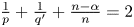
with $1< p,\,q'<\infty,\, 0<\alpha < n$ and $\frac {1}{p}+\frac {1}{q'}+\frac {n-\alpha }{n}=2$
 .
Lieb [Reference Lieb39] employed the rearrangement inequalities to obtain the existence of the extremal functions of inequality (1.1). Furthermore, they also classified extremals of the inequality (1.1) and computed the sharp constant $C_{\alpha,n,p}$ only when one of $p$
 and $q'$
 is equal to $2$
 or $p=q'$
 .
Through the inequality (1.1), we can deduce many important geometrical inequalities such as the Gross logarithmic Sobolev inequality [Reference Gross31] and the Moser–Onofri–Beckner inequality [Reference Beckner1]. It is also well-known that if we pick $\alpha =2,\, p = q' = {2n}/{(n+2)}$ , then the Hardy–Littlewood– Sobolev inequality is in fact equivalent to the Sobolev inequality by Green's representation formula. By using the competing symmetry method, Carlen and Loss [Reference Carleman8] provided a different proof from Lieb's of the sharp constants and extremal functions in the diagonal case $p = q' = {2n}/{(n+\alpha )}$
 and Frank and Lieb [Reference Frank and Lieb25] offered a new proof using the reflection positivity of inversions in spheres in the special diagonal case. Frank and Lieb [Reference Frank and Lieb26] further employed a rearrangement-free technique developed in [Reference Frank and Lieb27] to recapture the best constant of inequality (1.1). Folland and Stein [Reference Folland and Stein24] extended the inequality (1.1) to the Heisenberg group and established the Hardy–Littlewood–Sobolev inequality on Heisenberg group. Frank and Lieb [Reference Frank and Lieb27] classify the extremals of this inequality in the diagonal case. This extends the earlier work of Jerison and Lee [Reference Jerison and Lee38] for sharp constants and extremals for the Sobolev inequality on the Heisenberg group in the conformal case in their study of CR Yamabe problem. Furthermore, Han et al. [Reference Han, Lu and Zhu34] established the double-weighted Hardy–Littlewood–Sobolev inequality (namely, Stein–Weiss inequality) on the Heisenberg group and discussed the regularity and asymptotic behaviour of the extremal functions. Recently, Chen et al. [Reference Chen, Lu and Tao13] used the concentration-compactness principle to obtain existence of extremals of the Stein–Weiss inequality on the Heisenberg group for all indices. We also mention that when $p = q' = {2n}/{(n+\alpha )}$
 , Euler–Lagrange equation of the extremals to the Hardy–Littlewood–Sobolev inequality in the Euclidean space is a conformal invariant integral equation. The inequality (1.1) and its extensions have many applications in partial differential equations. Some remarkable extensions have already been obtained on the upper half space by Dou and Zhu [Reference Dou and Zhu22], on compact Riemannian manifolds by Han and Zhu [Reference Han and Zhu35] and the reversed (weighted) Hardy–Littlewood–Sobolev inequality in [Reference Chen, Liu, Lu and Tao10, Reference Dou and Zhu23, Reference Ngô and Nguyen48, Reference Ngô and Nguyen49]. For more results about the (weighted) Hardy–Littlewood–Sobolev inequality, the general weighted inequalities and their corresponding Euler–Lagrange equations, refer to e.g. [Reference Beckner2, Reference Brascamp and Lieb3, Reference Chen, Liu and Lu9, Reference Chen and Li15–Reference Dai and Liu20, Reference Gao, Liu, Moroz and Yang28, Reference Han and Lin32, Reference Hu and Liu37, Reference Lieb and Loss42–Reference Lu and Zhu45, Reference Moroz and Van Schaftingen47, Reference Stein and Weiss51] and the references therein.
Recently, Gluck [Reference Gluck30] proved the following sharp Hardy–Littlewood–Sobolev inequality with extended kernel in the conformal invariant case ($p=\tfrac {2(n-1)}{n+\alpha -2}$ , $q'=\tfrac {2n}{n+\alpha +2\beta }$
 )

where $K$ is a kernel of the form

and $\alpha$ , $\beta$
 satisfy $\beta \geq 0$
 , $0<\alpha +\beta < n-\beta$
 ,

In fact, for $\alpha =0$ , $\beta =1$
 , the kernel $K_{\alpha,\beta }$
 is the classical Poisson kernel. Hang et al. [Reference Hang, Wang and Yan33] derived the Hardy–Littlewood–Sobolev inequality with the Poisson kernel and proved the existence of extremals for this inequality by the concentration-compactness principle [Reference Lions40, Reference Lions41]. For the conformal invariant case, they classified the extremal functions of the inequality, and computed the sharp constant. Integral inequality with the Poisson kernel is highly related to Carleman's proof of isoperimetric inequality in the plane (see [Reference Carleman7]). For $\alpha \in (0,\,1)$
 , $\beta =1-\alpha$
 , the kernel $K_{\alpha,\beta }$
 is related to the divergence form operator $u\mapsto {\rm div}(x_n^{\alpha } \nabla u)$
 (the poly-harmonic extension operator) on the half space. Chen [Reference Chen14] established sharp Hardy–Littlewood–Sobolev inequality (1.2). He also generalized Carleman's inequality for harmonic functions in the plane to poly-harmonic functions in higher dimensions. Dou and Zhu [Reference Dou and Zhu22] studied the sharp Hardy–Littlewood–Sobolev inequality on the upper half space and the existences of extremal functions for $\beta =0$
 . Dou et al. [Reference Dou, Guo and Zhu21] investigated the integral inequality (1.2) in the special index through the methods based on conformal transformation for $\beta =1$
 . Different from Dou et al. [Reference Dou, Guo and Zhu21], Chen et al. [Reference Chen, Lu and Tao12] derived the Hardy–Littlewood–Sobolev inequality to all critical index for $\beta =1$
 . Furthermore, Chen et al. [Reference Chen, Liu, Lu and Tao11] extended it to the weighted Hardy–Littlewood–Sobolev inequality.
In this paper, we extended the Hardy–Littlewood–Sobolev inequality with extended kernel in the conformal invariant case to all critical index. That is,
Theorem 1.1 Let $n\geq 2,$ $1< p,\, q'<\infty,$
 $\beta \geq 0,$
 $\alpha +\beta >1$
 and suppose that $\alpha,$
 $\beta,$
 $p,$
 $q'$
 satisfy

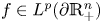
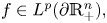
Then there is a constant $C_{n,\alpha,\beta,p}>0$ such that for any nonnegative functions $f\in L^{p}(\partial \mathbb {R}_+^{n}),$
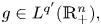
 $g\in L^{q'}(\mathbb {R}_+^{n}),$

We remark that the constant $C_{n,\alpha,\beta,p}$ above can be considered as the least one such that the above inequality holds for all nonnegative functions $f\in L^{p}(\partial \mathbb {R}^{n}_+)$
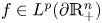 , $g\in L^{q'}(\mathbb {R}^{n}_+)$
 . This constant $C_{n,\alpha,\beta,p}$
 is often referred as the best constant for the Hardy–Littlewood–Sobolev inequality with extended kernel.
Define

Throughout this paper, we always assume that $q$ and $q'$
 are conjugate numbers. That is, $q$
 and $q'$
 satisfy $\frac {1}{q}+\frac {1}{q'}=1$
 . By duality, it is easy to verify that the inequality (1.4) is equivalent to the following two corollaries.
Corollary 1.2 Assume that $n\geq 2,$ $\beta \geq 0,$
 $\alpha +\beta >1,$
 $1< p<\frac {n-1}{\alpha +\beta -1},$
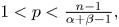 and

Then there is a constant $C_{n,\alpha,\beta,p}>0$ such that

Corollary 1.3 Assume that $n\geq 2,$ $\beta \geq 0,$
 $\alpha +\beta >1,$
 $1< q'<\frac {n}{\alpha +\beta },$
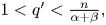 and

Then there is a constant $C_{n,\alpha,\beta,q'}>0$ such that

Once we establish the Hardy–Littlewood–Sobolev inequality with extended kernel, it is natural to ask whether the extremal functions for inequality (1.4) actually exist. To answer this question, we turn to consider the following maximizing problem

where $p$ , $q$
 satisfy

It is not hard to verify that the extremals of inequality (1.5) are those solving the maximizing problem (1.7). We use the rearrangement inequality to prove the attainability of maximizers for the maximizing problem (1.7).
Theorem 1.4 Let $n\geq 2,$ $1< p,\, q<\infty,$
 $\beta \geq 0,$
 $\alpha +\beta >1,$
 and suppose that $\alpha,$
 $\beta,$
 $p,$
 $q$
 satisfy

Then there exists some function $f\in L^{p}(\partial \mathbb {R}^{n}_+)$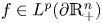 such that $f\geq 0,$
 $\|f\|_{L^{p}(\partial \mathbb {R}^{n}_+)}=1,$
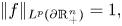 and $\|Tf\|_{L^{q}( \mathbb {R}^{n}_+)}=C_{n,\alpha,\beta,p}$
 . Moreover, all extremal functions are radially symmetric and strictly decreasing about some point $y_0\in \partial \mathbb {R}^{n}_+$
 .
We now turn our attention to study the regularity of the extremal functions for inequality (1.5), the Euler–Lagrange equation for extremal functions, up to a constant multiplier, is given by

We prove
Theorem 1.5 Let $n\geq 2,$ $\beta \geq 0,$
 $\alpha +\beta > 1$
 and $1 < p< \frac {n-1}{\alpha +\beta -1}$
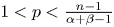 . Suppose that $f\in L_{loc}^{p}(\partial \mathbb {R}^{n}_+)$
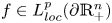 is nonnegative solution to (1.8) with $\frac {1}{q}=\frac {n-1}{n}(\frac {1}{p}-\frac {\alpha +\beta -1}{n-1})$
 . Then $f\in C^{\infty }(\partial \mathbb {R}^{n}_+)$
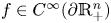 .
Assume that

Denote

Euler–Lagrange equation (1.8) can be rewritten as the following integral system

We use the Pohozaev identity to prove the following theorem.
Theorem 1.6 For $n\geq 2,$ $\beta \geq 0,$
 $\alpha +\beta > 1,$
 $\theta >0,$
 $\kappa >0,$
 assume that $(u,\,v)\in L^{\theta +1}(\partial \mathbb {R}^{n}_+)\times L^{\kappa +1}(\mathbb {R}^{n}_+)$
 is a pair of nonnegative nontrivial $C^{1}$
 solutions of (1.9), then a necessary condition for $\theta$
 and $\kappa$
 is

Obviously, extremals $(f,\,g)$ of inequality (1.4) satisfies the integral system (1.9). In light of theorems Reference Chen, Lu and Tao3.1, Reference Chen4.1 and Reference Christ, Liu and Zhang5.1, we obtain the sufficient and necessary condition for existence of positive solutions to the integral system (1.9).
Theorem 1.7 For $\theta >0,$ $\kappa >0,$
 let $n,$
 $\alpha,$
 $\beta,$
 $p,$
 $q$
 satisfy all the hypotheses of theorems Reference Chen, Lu and Tao3.1, Reference Chen4.1 and Reference Christ, Liu and Zhang5.1, then the sufficient and necessary condition for the existence of a pair of nonnegative nontrivial solutions $(u,\,v)\in L^{\theta +1}(\partial \mathbb {R}^{n}_+)\times L^{\kappa +1}(\mathbb {R}^{n}_+)$
 to system (1.9) is

The following Liouville type theorem was proved by Gluck.
Theorem 1.8 (see [Reference Gluck30])
Let $n\geq 2$ and suppose $\alpha,$
 $\beta$
 satisfy $\beta \geq 0,$
 $0<\alpha +\beta < n-\beta$
 and (1.3). If $u\in L^{\theta +1}(\partial \mathbb {R}^{n}_+)$
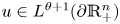 and $v\in L^{\kappa +1}(\mathbb {R}^{n}_+)$
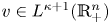 are positive solutions of (1.9) with $\theta =\frac {n+\alpha -2}{n-\alpha }$
 and $\kappa =\frac {n+\alpha +2\beta }{n-\alpha -2\beta }$
 . Then there exists $c_1>0,$
 $d>0$
 and $y_0\in \partial \mathbb {R}^{n}_+$
 such that

With the help of theorem 1.7, we use weaker assumption (1.10) to obtain theorem 1.9 instead of the conformal invariant case.
Theorem 1.9 Let $n\geq 2$ and suppose $\alpha,$
 $\beta$
 satisfy $\beta \geq 0,$
 $0<\alpha +\beta < n-\beta$
 . If $u\in L^{\theta +1}(\partial \mathbb {R}^{n}_+)$
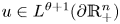 and $v\in L^{\kappa +1}(\mathbb {R}^{n}_+)$
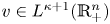 are nonnegative nontrivial solutions of (1.9) with

Then

Moreover, there exists $c_1>0$ , $d>0$
 and $y_0\in \partial \mathbb {R}^{n}_+$
 such that

From theorem 1.7, we must have $\theta =\frac {n+\alpha -2}{n-\alpha }$ and $\kappa =\frac {n+\alpha +2\beta }{n-\alpha -2\beta }$
 . Then, the proof is completely similar to the proof by Gluck in [Reference Gluck30], so we omit the details.
This paper is organized as follows. In § 2, we prove the Hardy–Littlewood–Sobolev inequality with the extended kernel. In § 3, by the rearrangement inequality, we obtain the existence of extremals of the inequality. Section 4 is devoted to the regularity estimate of the extremal functions of the Hardy–Littlewood–Sobolev inequality with the extended kernel. In § 5, using the Pohozaev identity in integral forms, we give sufficient and necessary conditions for the existence of nonnegative nontrivial solutions.
2. The proof of theorem 2.1
In this section, we use the Marcinkiewicz interpolation theorem and weak type estimate to establish the Hardy–Littlewood–Sobolev inequality with the extended kernel.
Theorem 2.1 Let $n\geq 2,$ $1< p,\, q'<\infty,$
 $\beta \geq 0,$
 $\alpha +\beta >1$
 and suppose that $\alpha,$
 $\beta,$
 $p,$
 $q'$
 satisfy

Then there is a constant $C_{n,\alpha,\beta,p}>0$ such that for any nonnegative functions $f\in L^{p}(\partial \mathbb {R}_+^{n})$
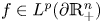 , $g\in L^{q'}(\mathbb {R}_+^{n}),$


Proof. For $t>0$ and $x'\in \mathbb {R}^{n-1}$
 , define

Then, for $x=(x',\,x_n)\in \mathbb {R}^{n}_+$ , $y\in \partial \mathbb {R}^{n}_+$
 , we have

We are ready to prove theorem 2.1 via proving inequality (1.5). For $p\in (1,\,\frac {n-1}{\alpha +\beta -1})$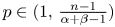 and $q$
 given by $\frac {1}{q}=\frac {n-1}{n}(\frac {1}{p}-\frac {\alpha +\beta -1}{n-1})$
 . By the Marcinkiewicz interpolation theorem (see [Reference Stein and Weiss52]), we only need to prove the following weak-type estimate:

That is, we need to show that there is a constant $C_{n,\alpha,\beta,p}>0$ such that

Without the loss of generality, we may assume that $\|f\|_{L^{p}(\partial \mathbb {R}^{n}_+)}=1$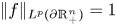 . Assume that $r,\,s$
 satisfy

It follows from the Young equality that

One can deduce from (2.3) that

Then, we have

In view of the Hölder inequality and the integration of the extended kernel, we can see that

Since $p\in (1,\,\frac {n-1}{\alpha +\beta -1})$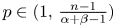 , we know that $\frac {n-1}{p'}+(\alpha +\beta -n)<0$
 . Then, we derive that

which implies that

Note that inequality (2.4) implies, via the Marcinkiewicz interpolation [Reference Stein and Weiss52], that

or even slight stronger inequality

where Lorentz norm $\|\cdot \|_{L^{p,q}}$ is defined by

3. The proof of theorem 3.1
In the following, we will employ rearrangement inequality to investigate the existence of maximizers for the maximizing problem

We prove
Theorem 3.1 Let $n\geq 2,$ $1< p,\, q<\infty,$
 $\beta \geq 0,$
 $\alpha +\beta >1$
 and suppose that $\alpha,$
 $\beta,$
 $p,$
 $q$
 satisfy

Then there exists some function $f\in L^{p}(\partial \mathbb {R}^{n}_+)$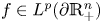 such that $f\geq 0,$
 $\|f\|_{L^{p}(\partial \mathbb {R}^{n}_+)}=1,$
 and $\|Tf\|_{L^{q}( \mathbb {R}^{n}_+)}=C_{n,\alpha,\beta,p}$
 . Moreover, all extremal functions are radially symmetric and strictly decreasing about some point $y_0\in \partial \mathbb {R}^{n}_+$
 .
Proof. Using symmetrization argument, we first show that the supremum of (3.1) is attained by radially symmetric functions. Now, we recall the important Riesz rearrangement inequality. Let $u$ be a measurable function on $\mathbb {R}^{n}$
 , the symmetric rearrangement of $u$
 is the nonnegative lower semi-continuous radial decreasing function $u^{*}$
 that has the same distribution as $u$
 . Then, we have

Using the fact $\|w\|_{L^{p}(\mathbb {R}^{n})}=\|w^{*}\|_{L^{p}(\mathbb {R}^{n})}$ for $p>0$
 and the standard duality argument, we see, for $1\leq p\leq \infty$
 ,

Moreover, if $u$ is nonnegative radially symmetric and strictly decreasing in the radial direction, $v$
 is nonnegative, $1< p<\infty$
 and

then from Brascamp et al. [Reference Brascamp, Lieb and Luttinger4], we have,

for some $x_0\in \mathbb {R}^{n}$ .
Now, assume $f_i$ is a maximizing sequence in (3.1). Since

and

We know that $f_i^{*}$ is also a maximizing sequence. Hence, we may assume $f_i$
 is a nonnegative radial decreasing function.
For any $f\in L^{p}(\partial \mathbb {R}^{n}_+)$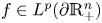 and any $\lambda >0$
 , we let $f^{\lambda }(y)=\lambda ^{-({(n-1)}/{p})}f(\frac {y}{\lambda })$
 , then it is easy to check that

For convenience, denote $e_1^{'}=(1,\,0,\,\ldots,\,0)\in \mathbb {R}^{n-1}$ and

It follows that

and hence

Thus, by (2.5), we have

which implies $a_i\geq c(n,\,\alpha,\,\beta,\, p)>0$ . We may choose $\lambda _i>0$
 such that $f_i^{\lambda _i}(e_1^{'})\geq c(n,\,\alpha,\,\beta,\, p)>0$
 . Replacing $f_i$
 by $f_i^{\lambda _i}$
 , we may assume $f_i(e_1^{'})\geq c(n,\,\alpha,\,\beta,\, p)>0$
 . On the other hand, since $f_i$
 is nonnegative radially decreasing and $f_i\in L^{p}(\partial \mathbb {R}^{n}_+)=1$
 , it is obvious that

Hence after passing to a subsequence, we may find a nonnegative radially decreasing function $f$ such that $f_i\rightarrow f$
 a.e. It follows that $f(y)\geq c(n,\,\alpha,\,\beta,\, p) > 0$
 for $|y|\leq 1$
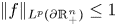
 , and $\|f\|_{ L^{p}(\partial \mathbb {R}^{n}_+)}\leq 1$
 . From Brezis and Lieb's Lemma [Reference Brezis and Lieb6], we see

It follows that

On the other hand, since $Tf_i(x)\rightarrow Tf(x)$ for $x\in \mathbb {R}^{n}_+$
 and $\|Tf_i\|_{L^{q}(\mathbb {R}^{n}_+)}\leq C_{n,\alpha,\beta,p}$
 , we see

Hence,

By (3.3) and (3.4) and letting $i\rightarrow \infty$ , we derive

Since $q>p$ and $f\neq 0$
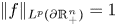
 , we deduce that $\|f\|_{ L^{p}(\partial \mathbb {R}^{n}_+)}=1$
 . Hence, $f_i\rightarrow f$
 in $L^{p}(\partial \mathbb {R}^{n}_+)$
 and $f$
 is a maximizer. This implies the existence of an extremal function.
Assume $f\in L^{p}(\partial \mathbb {R}^{n}_+)$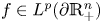 is a maximizer, then so is $|f|$
 . Hence $\|Tf\|_{L^{q}(\mathbb {R}^{n}_+)}=\|T|f|\|_{L^{q}(\mathbb {R}^{n}_+)}$
 , which implies either $f\geq 0$
 or $f\leq 0$
 . Without loss of generality, we only consider the case of $f\geq 0$
 , then the Euler–Lagrange equation after scaling by a positive constant is given by equation (3.1)

On the other hand, for $x_n>0$ ,

By (3.2), we deduce that

for some $y_0\in \partial \mathbb {R}^{n}_+$ . It follows from the Euler–Lagrange equation (3.5) and lemma 2.2 of Lieb [Reference Lieb39] that $f$
 must be strictly decreasing along the radial direction.
4. The proof of theorem 4.1
In this section, we establish the regularity properties of solutions to the following Euler–Lagrange equation:

We prove
Theorem 4.1 Let $n\geq 2,$ $\beta \geq 0,$
 $\alpha +\beta > 1$
 and $1 < p< \frac {n-1}{\alpha +\beta -1}$
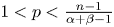 . Suppose that $f\in L_{loc}^{p}(\partial \mathbb {R}^{n}_+)$
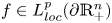 is nonnegative solution to (4.1) with $\frac {1}{q}=\frac {n-1}{n}(\frac {1}{p}-\frac {\alpha +\beta -1}{n-1})$
 . Then $f\in C^{\infty }(\partial \mathbb {R}^{n}_+)$
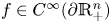 .
Let $u(y)=f^{p-1}(y)$ , $v(x)=Tf(x)$
 , $\theta =\frac {1}{p-1}$
 and $\kappa =q-1$
 . Then Euler–Lagrange equation (4.1) can be rewritten as the following integral system

with $\frac {1}{\kappa +1}=\frac {n-1}{n}(\frac {n-\alpha -\beta }{n-1}-\frac {1}{\theta +1})$ . If $f\in L_{loc}^{p}(\partial \mathbb {R}^{n}_+)$
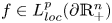 , then $u\in L_{loc}^{\theta +1}(\partial \mathbb {R}^{n}_+)$
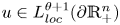 . Therefore, to prove theorem 4.1, it is sufficient to prove the following lemma.
Lemma 4.2 Assume that $\beta \geq 0,$ $\alpha +\beta > 1$
 and $\frac {\alpha +\beta -1}{n-1}< \theta < \infty,$
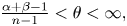 and $0<\kappa <\infty$
 given by

Suppose that $(u,\,v)$ is a pair of nonnegative solutions of (4.2) with $u\in L_{loc}^{\theta +1}(\partial \mathbb {R}^{n}_+)$
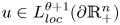 . Then $u\in C^{\infty }(\partial \mathbb {R}^{n}_+)$
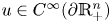 and $v\in C^{\infty }(\overline {\mathbb {R}^{n}_+})$
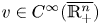 .
To prove lemma 4.2, we first establish two local regularity results, which are spirited by Brezis and Kato's lemma A.1 in [Reference Brezis and Kato5], Hang et al.'s propositions 5.2 and 5.3 in [Reference Hang, Wang and Yan33], Li's theorem 1.3 in [Reference Li Remark on some conformally invariant integral equations44], Dou and Zhu's propositions 4.3 and 4.4 in [Reference Dou and Zhu22].
For $R>0$ , define

For $x = 0$ , we write

Lemma 4.3 Assume that $\alpha +\beta >1,$ $1< a,\,b\leq \infty,$
 $1\leq r<\infty,$
 and $\frac {n}{n-\alpha -\beta }< p< q<\infty$
 satisfy

Suppose that $v,\,h\in L^{p}(B^{+}_R)$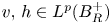 , $V\in L^{a}(B_R^{+})$
 , and $U\in L^{b}(B_R^{n-1})$
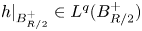
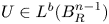 are all nonnegative functions with $h|_{B^{+}_{R/2}}\in L^{q}(B^{+}_{R/2})$
 , and

There is a $\epsilon =\epsilon (n,\,\alpha,\,\beta,\,p,\,q,\,r,\,a,\,b)>0$ , and $C=C(n,\,\alpha,\,\beta,\,p,\,q,\,r,\,a,\,b,\,\epsilon )>0$
 such that if

then,

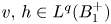
Proof. By scaling, we may assume $R = 1$ . Assume that $v,\, h\in L^{q}(B^{+}_1)$
 . For $y\in B_1^{n-1}$
 , denote

Let $p_1$ and $q_1$
 be the numbers defined by

Then, it follows from inequality (1.6) that


Given $0<\delta _1<\delta _2\leq \frac {1}{2}$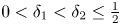 , for $x\in B^{+}_{\delta _2}$
 , we have

By (4.3) and (4.4), we deduce that

which combines with (1.5) and the Hölder inequality, it yields that

Since $p>\frac {n}{n-\alpha -\beta }$ , it follows from the Hölder inequality and (4.5) that

Then, we have

On the other hand, for $y\in B_{{(\delta _1+\delta _2)}/{2}}^{n-1}$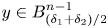 , we derive

Combining this and inequality (4.6), we obtain


if $\epsilon$ is small enough. One can employ the usual iteration procedure (see [Reference Han and Lin32]) to obtain

For $v,\, h\in L^{p}(B^{+}_1)$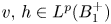 , we will show inequality (4.9) still holds. Let $0\leq \eta (x)\leq 1$
 be the measurable function such that

Define a map $T_1$ by

Choosing small enough $\epsilon (n,\,\alpha,\,\beta,\,p,\,q,\,r,\,a,\,b)$ , in view of the integral inequality (1.5), we have

Furthermore, one can utilize the Minkowski inequality to obtain that for $\varphi,\, \psi \in L^{p}(B^{+}_1)$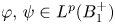 ,

which implies

Similarly, we also obtain

for any $\varphi,\, \psi \in L^{q}(B^{+}_1)$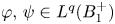 .
Set $h_j(x)=\min \{v(x),\, j\}$ , using the regular lifting theorem with contracting operators which can be seen in [Reference Chen and Li16, Reference Ma, Chen and Li46], we may find a unique $u_j\in L^{q}(B^{+}_1)$
 such that

Applying a priori estimate to $v_j$ , we obtain

Observing that

then we see that

Hence,

Taking a limit process in inequality (4.10), we conclude that

This completes the proof of lemma 4.3.
Similarly, we also can obtain the following local regularity lemma.
Lemma 4.4 Assume that $\alpha +\beta >1,$ $1< a,\,b\leq \infty,$
 $1\leq r<\infty,$
 and $\tfrac {n-1}{n-\alpha -\beta }< p< q<\infty$
 satisfy

Suppose that $u,\,g\in L^{p}(B^{n-1}_R),$ $V\in L^{b}(B_R^{+})$
 and $U\in L^{a}(B_R^{n-1})$
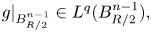
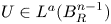 are all nonnegative functions with $g|_{B^{n-1}_{R/2}}\in L^{q}(B^{n-1}_{R/2}),$
 and

There is a $\epsilon =\epsilon (n,\,\alpha,\,\beta,\,p,\,q,\,r,\,a,\,b)>0$ , and $C=C(n,\,\alpha,\,\beta,\,p,\,q,\,r,\,a,\,b,\,\epsilon )>0$
 such that if

then,

Based on lemmas Reference Chen and Li4.3 and Reference Christ, Liu and Zhang4.4, we prove lemma 4.2. For $R>0$ , define

By (4.2), we have

We first verify that if $u\in L^{\theta +1}_{loc}(\partial \mathbb {R}^{n}_+)$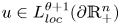 , then

Indeed, since $u\in L^{\theta +1}_{loc}(\partial \mathbb {R}^{n}_+)$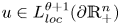 , we see $u<\infty$
 , a.e. on $\partial \mathbb {R}^{n}_+$
 . This implies $v<\infty$
 , a.e. on $\mathbb {R}^{n}_+$
 . Hence there exists an $x^{0}=(x_1^{0},\,x_2^{0},\,\ldots,\,x_n^{0})\in B_R^{+}$
 and $x_n^{0}>\frac {R}{4}$
 such that $v(x^{0})<\infty$
 . It follows that

For $0 <\delta < 1$ , $x \in B^{+}_{\delta R}$
 , it holds,

which implies that

Thanks to the integral inequality (1.5) with $\frac {1}{\kappa +1}=\frac {n-1}{n}(\frac {n-\alpha -\beta }{n-1}-\frac {1}{\theta +1})$ , we derive that

Hence,

Since $R$ is arbitrary, we deduce that

We now turn to verify that $u_R\in L^{\infty }_{loc}(B^{n-1}_R).$ Since $u\in L^{\theta +1}_{loc}(\partial \mathbb {R}^{n}_+)$
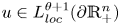 , there is a $y_0\in B^{n-1}_{{R}/{2}}$
 such that $u(y_0)<\infty$
 . Thus,

For $0 <\delta < 1$ , $x \in B^{n-1}_{\delta R}$
 , one can calculate that

which leads to $u_R\in L^{\infty }_{loc}(B^{n-1}_R).$
To prove the regularity of $u$ , we discuss two cases.
Case 1. $\frac {\alpha +\beta -1}{n-\alpha -\beta }<\theta <\frac {n+\alpha +\beta -2}{n-\alpha -\beta }$ .
Since $\frac {1}{\kappa +1}=\frac {n-1}{n}(\tfrac {n-\alpha -\beta }{n-1}-\frac {1}{\theta +1})$ and $\theta <\frac {n+\alpha +\beta -2}{n-\alpha -\beta }$
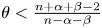 , we have $\kappa >\frac {n+\alpha +\beta }{n-\alpha -\beta }$
 . Then one can deduce that

Hence, we choose a fixed number $r$ such that

then it follows that

Then,

where

Since $u\in L^{\infty }_{loc}(\partial \mathbb {R}^{n}_+)$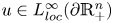 , for any $x\in B^{+}_R$
 , it holds,

It follows from inequality (1.5) and $u\in L^{\theta +1}_{loc}(\partial \mathbb {R}^{n}_+)$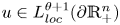 that

where $\frac {1}{q_0}=\frac {1}{\kappa +1}-\frac {n-1}{n}\frac {1}{r(\theta +1)}.$ For $\epsilon > 0$
 small enough, one can choose $\kappa -\frac {\alpha +\beta }{n}(\kappa +1)+\epsilon >1+\epsilon$
 such that

can be any large number when we choose $\epsilon$ small enough. Hence, it follows that $h_R\in L^{q}(B_R^{+}\cup B_R^{n-1})$
 for any $q<\infty$
 .
Let

which combines with $\frac {1}{\kappa +1}=\frac {n-1}{n}(\frac {n-\alpha -\beta }{n-1}-\frac {1}{\theta +1})$ , we obtain

Since $u\in L^{\theta +1}_{loc}(\partial \mathbb {R}^{n}_+)$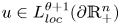 and $v\in L^{\kappa +1}_{loc}(\overline {\mathbb {R}^{n}_+})$
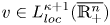 , one can choose $q$
 such that $q\in (\kappa +1,\,\tfrac {rn(\kappa +1)}{(\alpha +\beta )(\kappa +1)-n(k-r)})$
 , then it is easy to check that $\tfrac {r}{q}+\tfrac {1}{a}>\tfrac {\alpha +\beta }{n}$
 . It follows from lemma 4.3 that $v|_{B_{{R}/{4}}^{+}}\in L^{q}({B^{+}_{{R}/{4}}})$
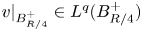 . Notice that $\frac {n\kappa }{\alpha +\beta }<\tfrac {rn(\kappa +1)}{(\alpha +\beta )(\kappa +1)-n(k-r)}$
 . For $q\in (\tfrac {n\kappa }{\alpha +\beta },\,\tfrac {rn(\kappa +1)}{(\alpha +\beta )(\kappa +1)-n(k-r)})$
 , we have

which implies that

Since every point may be viewed as a centre, we see $u\in L^{\infty }_{loc}(\partial \mathbb {R}^{n}_+)$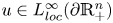 , and hence $v\in L^{\infty }_{loc}(\overline {\mathbb {R}^{n}_+})$
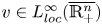 .
For any $R>0$ , one can apply

to obtain $v_R \in C^{\infty }(B^{+}_R\cup B_R^{n-1})$ and $u_R \in C^{\infty }(B_R^{n-1})$
 which yields that $u \in C^{\gamma }_{loc}(\partial \mathbb {R}^{n}_+)$
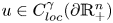 for $0 <\gamma < 1$
 . By the standard potential theory (see [Reference Gilbarg and Trudinger29], chap. 4) and bootstrap method, we see that $(u,\, v) \in C^{\infty }(\partial \mathbb {R}^{n}_+)\times C^{\infty }(\overline {\mathbb {R}^{n}_+})$
 .
Case 2. $\frac {n+\alpha +\beta -2}{n-\alpha -\beta }\leq \theta <\infty$ .
Since $\frac {1}{\kappa +1}=\frac {n-1}{n}(\tfrac {n-\alpha -\beta }{n-1}-\frac {1}{\theta +1})$ , it is easy to check that

Choosing a fixed number $r$ satisfying

then it follows that

Hence,

where

For any $y\in B^{n-1}_R$ , it holds,

It follows from inequality (1.6) that $g_R\in L^{q_1}(B_R^{n-1})$ with $q_1$
 given by

Let

which combines with $\frac {1}{\kappa +1}=\frac {n-1}{n}(\tfrac {n-\alpha -\beta }{n-1}-\frac {1}{\theta +1})$ , we obtain

Since $u\in L^{\theta +1}_{loc}(\partial \mathbb {R}^{n}_+)$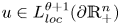 and $v\in L^{\kappa +1}_{loc}(\overline {\mathbb {R}^{n}_+})$
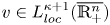 , one can choose $q$
 such that

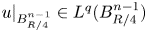
then it is easy to check that $\frac {r}{q}+\frac {1}{a}>\frac {\alpha +\beta -1}{n-1}$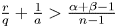 . It follows from lemma 4.4 that $u|_{B^{n-1}_{{R}/{4}}}\in L^{q}({B^{n-1}_{{R}/{4}}})$
 . Arguing this as we did in case 1, and by the standard bootstrap method, we conclude that $(u,\, v) \in C^{\infty }(\partial \mathbb {R}^{n}_+)\times C^{\infty }(\overline {\mathbb {R}^{n}_+})$
 .
5. The proof of theorem 1.7
In this section, we investigate the necessary and sufficient condition for the existence of nonnegative nontrivial solutions to the following integral system:

From theorems Reference Chen, Lu and Tao3.1 and Reference Chen4.1, to obtain the proof of theorem 1.7, it is sufficient to prove the following theorem.
Theorem 5.1 For $n\geq 2,$ $\beta \geq 0,$
 $\alpha +\beta > 1,$
 $\theta >0,$
 $\kappa >0,$
 assume that $(u,\,v)\in L^{\theta +1}(\partial \mathbb {R}^{n}_+)\times L^{\kappa +1}(\mathbb {R}^{n}_+)$
 is a pair of nonnegative nontrivial $C^{1}$
 solutions of (5.1), then a necessary condition for $\theta$
 and $\kappa$
 is

Proof. Assume that $(u,\,v)\in L^{\theta +1}(\partial \mathbb {R}^{n}_+)\times L^{\kappa +1}(\mathbb {R}^{n}_+)$ is a pair of nonnegative nontrivial solutions of the integral system (5.1). One can apply the integration by parts to obtain

Similarly, one can also derive that

It follows from $(u,\,v)\in L^{\theta +1}(\partial \mathbb {R}^{n}_+)\times L^{\kappa +1}(\mathbb {R}^{n}_+)$ that there exists $R=R_j\rightarrow +\infty$
 such that

Therefore, we get

On the other hand, one can calculate that

and

It follows from Fubini's theorem that

This together with (5.2) implies that $\frac {n-1}{\theta +1}+\frac {n}{\kappa +1}=n-\alpha -\beta$ .
Acknowledgements
The author is supported by the NNSF of China (No. 12261041), the Natural Foundation of Jiangxi Province (No. 20202BABL211001), the Educational Committee of Jiangxi Province (No. GJJ211101) and the Fundamental Research Funds for the Central Universities (No. 2020QNBJRC005).



