

The reception of Avicenna by medieval Jewish readers – philosophers, scientists, and physicians – presents an underappreciated enigma. Despite his philosophical and scientific stature, and the fact that Avicenna inaugurated a “golden age” of Arabic science and philosophy,Footnote 1 his philosophical writings were relatively little known in Jewish milieus, arabophone or other. The direct familiarity with Avicenna's works is strikingly less than that with Averroes, the Commentator par excellence. However, and perhaps paradoxically, despite the slight diffusion of Avicenna's philosophical oeuvre among Jews, some of his ideas were widely known and discussed in scholarly Jewish circles. In contrast with the philosophical treatises, Avicenna's medical writings had a broad distribution among Jews, especially in Hebrew, and remained influential until at least the seventeenth century. The present article presents a preliminary but comprehensive picture of Avicenna's reception by medieval Jewish cultures and tries to explain the Jews’ complex attitude to his work in a comparative perspective.Footnote 2
An important methodological point should be stated from the outset. When discussing the reception of a philosopher like Avicenna by later generations of scholars, three different things need to be clearly distinguished. The first is simple acquaintance with that philosopher's works: this acquaintance is attested to (in our case) by explicit references to Avicenna, by quotations from his works, or, more subtly, by the presence of distinctively Avicennian ideas. Here we refer only to the information on Avicenna's thought that Jewish philosophers had at their disposal, but without judging whether a given thinker also adhered to any Avicennian views. The second level of reception includes, in addition, a commitment to at least some of his ideas: the writer not only signals his familiarity with (in our case) Avicenna's ideas, but also accepts some of them as true and integrates them into his own thought. On a third level, his reading of Avicenna may have stimulated a thinker to ponder certain ideas or inquiries and to react to Avicenna's positions, without necessarily accepting any of them. In what follows, we will focus mainly on the historical questions of the dissemination of and acquaintance with Avicennian texts and ideas. To the extent possible, however, we will comment on whether a given author who evinces familiarity with Avicenna also accepted some of his ideas or drew on them in developing his own views. We will also distinguish between direct reception (reading Avicenna's own works), and indirect reception (becoming acquainted with Avicenna through another author's work; for example, via al-Ghazālī's Maqāṣid al-falāsifa [Intentions of the Philosophers], in its original Arabic version or in one of its three Hebrew translations). We will advisedly avoid using the popular term “influence”: in line with its origin in astrology, this term construes thinkers of the past as passive, their minds having been affected by “influences” emanating from other thinkers. We prefer to think of past philosophers as active agents, who thoughtfully and carefully decided to embrace certain of the ideas they encountered, rather than others.
As is well known, medieval Jews came into contact with Greco-Arabic science and philosophy in two phases: first in Arabic (beginning in the late ninth century), in both East and West; and later in Hebrew (starting towards the middle of the twelfth century), in southern Europe (Christian Spain, southern France, and Italy). We will therefore have to consider the attitude to and reception of Avicenna in these two distinct cultural spheres separately. We will include all of Avicenna's oeuvre in our purview – in philosophy and science and in medicine. We will also briefly mention treatises now known to be pseudonymous but which are part of the story of the reception of Avicenna because at least some medievals held them to be authentic.
PART A: AVICENNA AMONG ARABOPHONE JEWS
A.0. Introduction
Jews in Islamic lands read Arabic and also wrote in Arabic (usually in Hebrew characters). In principle, then, they had direct access to Avicenna's Arabic writings.Footnote 3 Although we would expect the works of arabophone Jewish scholars to evince a strong presence of Avicenna, one of the leading Arabic philosophers, and of post-Avicennian philosophies,Footnote 4 this expectation is not borne out. This will be shown by our review of the works of arabophone Jewish writers in East (A.1.1) and West (A.1.2), followed by a consideration of the literary evidence of Arabic manuscripts of Avicenna's works copied and used by Jews (A.2).
A.1.1. Avicenna among Arabophone Jews: The East
The reception of Avicenna in the East essentially boils down to that by four arabophone Jewish thinkers: (i) Hibat Allāh ʿAlī ibn Malka Abū al-Barakāt al-Baghdādī, (ii) Moses Maimonides, (iii) David II Maimonides, and (iv) ʿIzz al-Dawla Saʿd ibn Manṣūr Ibn al-Kammūna.
(i) As was shown by the late Shlomo Pines, Abū al-Barakāt al-Baghdādī (c. 1080–after 1165), a Jew who converted to Islam late in life, seriously engaged with Avicenna's al-Shifāʾ in his Kitāb al-Muʿtabar (“The book of what has been established by personal reflection”), although he may also have adopted ideas from the Isharāt wa-al-tanbihāt. Abū al-Barakāt's magnum opus is a purely philosophical work addressed to the philosophical community, in which the author's Jewish identity plays no role. This work includes large excerpts from the Shifāʾ, which it follows closely; Abū al-Barakāt's innovations resulted from a critical dialogue with that work.Footnote 5 Thus Abū al-Barakāt's psychology builds on Avicenna's, from which he borrows, in particular, the idea that an individual's self-awareness offers apodictic proof of the existence and activity of the soul. Unlike Avicenna, though, Abū al-Barakāt does not try to integrate this idea into Aristotelian psychology. In physics, Abū al-Barakāt begins from Avicenna's notion of “violent inclination” (mayl qasrī) to explain the continued motion of projectiles. On the other hand, rejecting Avicenna's notion that motion would continue indefinitely in the absence of an obstacle, Abū al-Barakāt holds that the “violent inclination” is “consumed” by the violent motion, which consequently terminates.Footnote 6
Abū al-Barakāt's second work is an Arabic translation of Ecclesiastes and commentary on that book. This work, composed in Judeo-Arabic and obviously addressed to a Jewish audience, has yet to be edited and has hardly been studied. Its contents seem to be quite unrelated to the doctrines presented in Kitāb al-Muʿtabar, and hence to Avicenna.Footnote 7 Abū al-Barakāt dictated this work to his student, Isaac Ibn Ezra, the son of the famous polymath Abraham Ibn Ezra; the amanuensis composed a panegyric on his master when the work was completed in 1143.Footnote 8
Despite his apostasy, there was no animosity to Abū al-Barakāt among Jews;Footnote 9 he played a role, albeit minor, in later Jewish thought. The Kitāb al-Muʿtabar was copied over in Hebrew characters and used by Samuel b. Eli, head of the Baghdad academy, in the controversy over Maimonides’ position on resurrection.Footnote 10 As noted by Y. Tzvi Langermann, “al-Baghdādī's works continued to be studied at the yeshivah of Baghdad, then the centre of Jewish conservatism, into the thirteenth century. Al-Baghdādī's commentary to the Book of Ecclesiastes continued to be copied at the same yeshivah, with full acknowledgement of its authorship.”Footnote 11 Abū al-Barakāt is thus a thinker who was a Jew not only by birth but also (until his conversion) by social identity and who engaged seriously with Avicenna. He left his marks on both the Muslim and Jewish intellectual worlds.
(ii) Maimonides (1138–1204) was, like Avicenna himself, both a philosopher and a physician. Accordingly we will consider Avicenna's presence in Maimonides’ philosophy and then in Maimonides’ medical works. We assign Maimonides to the “East,” where he wrote the great majority of his works; it should be kept in mind, however, that he was educated in Andalusia, whose intellectual climate reverberated in his thought throughout his life.Footnote 12
Whether or not Maimonides drew on Avicenna's philosophy is a question of great importance, given his momentous influence on Jewish philosophy throughout the ages. The topic has been repeatedly debated by scholars; what follows is a summary account of the “state of the art.”Footnote 13 To begin with, Maimonides himself informs us of his knowledge and appreciation of Avicenna. In a celebrated letter (dated 8 Tishrei 1511 Seleucid era [= AM 4960], i.e., September 30, 1199), addressed to Samuel Ibn Tibbon, the future Hebrew translator of the Guide, he commented on the relative merits of several Arabic philosophers. Avicenna is the last to be assessed. This passage of the letter is extant in two slightly different Hebrew translations (except for two short passages, the letter is not preserved in the Arabic original):Footnote 14

This short passage, in its two versions, has been diversely interpreted, but two conclusions seem to be warranted: first, Maimonides was acquainted with works he took to be by Avicenna; second, he had a fairly high opinion of Avicenna's philosophy and deemed it worth studying, although he did not esteem Avicenna as highly as al-Fārābī and (according to Version [2]) he may have believed that some matters were subject to reconsideration. With this in mind, let us consider the presence of Avicenna in Maimonides’ philosophical works.
We begin with Maimonides’ The Guide of the Perplexed, written in Fusṭāṭ and completed by 1191, in which Avicenna is never named. Nevertheless, medieval Jewish scholars, most notably the very erudite arabophone Shem-Ṭov Ibn Falaquera (c. 1280), followed by Moses Narboni (d. after 1362), identified distinctively Avicennian ideas in the Guide.Footnote 15 More recently, Pines showed that although Avicenna is never named in the Guide, a number of Avicennian doctrines are an integral part of its philosophy. Pines summarizes his thesis, which also accounts for Maimonides’ slightly reserved assessment of Avicenna, quoted above, as follows:
at a certain level of philosophic thought Avicenna had considerable influence upon Maimonides; this is indicated by the latter's adoption of negative theology, of the distinction between essence and existence, and of various particulars of Avicenna's prophetology and theory of the worship of God. This influence, however, […] did not essentially modify Maimonides’ fundamental position, which he inherited from al-Fārābī, and the Spanish Aristotelian school.Footnote 16
W. Z. Harvey has confirmed and deepened Pines’ suggestions in a number of studies,Footnote 17 as has H. A. Davidson.Footnote 18 Dov Schwartz has convincingly argued that Maimonides’ ideas about the afterlife, too, follow Avicenna.Footnote 19 Steven Harvey has suggested that Maimonides borrowed some of his ideas on the notions of ʿishq and prayer from Avicenna.Footnote 20 In sum, then, as Davidson put it, “despite Maimonides’ judging him [Avicenna] inferior to Alfarabi, he contributed considerably to the formation of Maimonides’ philosophic thinking: What Maimonides calls Aristotle's Metaphysics is, we saw, not Aristotelian but Avicennian, and Maimonides’ picture of the structure of the universe, while it draws from both Alfarabi and Avicenna, owes more to the latter than to the former, though Maimonides was unconscious of the debt.”Footnote 21 There thus is no question that the major philosophical work of the most influential Jewish philosopher of all time incorporated fundamental ideas going back to Avicenna (while maintaining more traditional Aristotelian positions on other matters). Maimonides also expounded some of these Avicennian ideas in the short metaphysical section of Sefer ha-Maddaʿ (The Book of Knowledge), the first part of his code of Jewish law (Mishneh Torah), written in Hebrew.
The ideas Maimonides borrowed from Avicenna are relatively independent of one another: Maimonides did not take over a systematical and coherent doctrine that would have compelled him to follow his predecessor's positions consistently. This is precisely why Maimonides could follow Avicenna on some issues but maintain more traditional Aristotelian positions on others. To describe this situation, which we will repeatedly encounter in what follows, we introduce the term “doctrinal item”: using it, we can say that Maimonides appropriated a number of Avicennian doctrinal items, i.e. discrete, unconnected, Avicennian ideas, which he integrated in his thought individually.
Maimonides’ works, both the Guide and even more so The Book of Knowledge, have been widely read by Jews in many cultural contexts over the generations. As a result, Avicenna's ideas (partly simplified) had a particularly wide dissemination: all students of Jewish philosophy from the early thirteenth century onward were familiar with them, although without the help of suitable commentaries they were unable to know that these ideas derived from Avicenna.Footnote 22
Another question is how Maimonides became acquainted with Avicenna's doctrines. Davidson has drawn attention to the fact that in the Guide, whenever Maimonides refers to “Aristotle's Metaphysics” he in fact has in mind Avicennian doctrines: “What he [Maimonides] calls Aristotle's Metaphysics is Avicenna's metaphysical philosophy, which he confused with Aristotle's or at best Aristotle's metaphysics as refracted through an Avicennian prism.”Footnote 23 But how did Maimonides become acquainted with these ideas? Davidson has forcefully argued that Maimonides did not know Avicenna first-hand: had he actually read a text by Avicenna he would have been aware of the difference between Aristotle's and Avicenna's doctrines and would not have ascribed Avicennian views to Aristotle. But if Maimonides did not learn Avicennian ideas from a work by their author, what was his source?
“Virtually everything of metaphysical character attributed by Maimonides to Aristotle but actually deriving from Avicenna can be found in Ghazālī's summary of Avicenna's philosophy, the Maqāṣid al-falāsifa,” Davidson states.Footnote 24 In a recent article, one of the present authors confirmed this thesis: a detailed examination of the evidence gathered by scholars in the past decades suggests that Maimonides was not directly acquainted with any of Avicenna's philosophical works and that he obtained his knowledge of Avicenna from al-Ghazālī's Maqāṣid.Footnote 25 Al-Ghazālī, who expounded philosophy allegedly in order to refute it,Footnote 26 thus emerges as a crucial conduit of Avicennian ideas to Maimonides and through him to Jewish thought – an apparent paradox that we will encounter again in what follows. (Note that Maimonides does not even mention al-Ghazālī in his letter to Ibn Tibbon.) Nonetheless, the possibility – maintained by some recent authors – that Maimonides read Avicenna's own al-Najāt (The Salvation) cannot be completely ruled out.Footnote 27 In fact, both al-Najāt and the Maqāṣid, which is based on Avicenna's Dānesh-Nāmeh,Footnote 28 summarize Avicenna's ideas and are accordingly similar: since Maimonides’ discussions are quite general and devoid of details, it may be impossible to decide the issue definitely. In any event, Maimonides does not seem to have known Avicenna's major philosophical work, al-Shifāʾ.
But why should Maimonides ascribe to Aristotle the doctrines he apparently appropriated from al-Ghazālī's Maqāṣid (or, for that matter, Avicenna's al-Najāt)? We conjecture that many readers of Ghazālī's Maqāṣid thought of it as a convenient summary of the “standard position,” as it were, of the worldview of the falāsifa: it was not taken to present a specific Avicennian doctrine, but the typical, “mean” stance shared by adherents of the philosophical school (see below, p. 248). Since in Andalusia – to whose intellectual preferences Maimonides largely subscribed – Aristotle continued to be viewed as the leader and fountainhead of the philosophical mode of thought,Footnote 29 Maimonides (and his milieu) may have associated the doctrines found in the Maqāṣid with Aristotle's emblematic name.Footnote 30 This may be why Maimonides attributed typically Avicennian positions to Aristotle. A last mystery remains: seeing that Maimonides was probably not acquainted with Avicenna's own works (especially not with Avicenna's major philosophical work), and, moreover, that he ascribed the Avicennian doctrines that he apparently knew from al-Ghazālī to “Aristotle,” what was the basis for his evaluation of Avicenna's philosophy in the letter to Samuel Ibn Tibbon? Our surmise is that Maimonides’ vague remark (it mentions no title) may have simply expressed one of the mashhurāt – generally accepted ideas – current and accepted in his basically Andalusian cultural milieu.Footnote 31
Let us now consider Avicenna's presence in other works by Maimonides. Maimonides’ only explicit reference to a work of Avicenna is found in his Treatise on Resurrection of the Dead (1191/2), in which he affirms that some ideas of his rival (Samuel ben ʿEli) “derive from Avicenna's al-Maʿād.”Footnote 32 It has proved impossible to trace the ideas in question in any of Avicenna's works whose title includes the word maʿād.Footnote 33 Remarkably, Maimonides’ favorite student, Joseph Ibn Shimʿon, in the treatise he composed in c. 1192 to defend his Master and “silence” Samuel ben ʿEli, drew on Avicenna, albeit silently. He incorporated quotations from Avicenna's Kitāb al-Nafs to the effect that the soul's persistence after death is eternal, rather than of limited duration.Footnote 34 It has recently been suggested that Maimonides’ erroneous statement that Samuel's treatise drew on Avicenna was intentional and was concealed criticism of his student's (silent) reliance on Avicenna.Footnote 35
We can tentatively conclude that although Maimonides derived essential building blocks of his philosophy from Avicenna, he apparently did not have direct access to this philosopher's works (except, perhaps, al-Najāt). For unknown reasons, he contented himself, as it seems, with the “digest” of Avicenna's doctrines offered by al-Ghazālī. The main point, however, is not how Maimonides came into contact with Avicenna's thought, but the fact that he embraced some Avicennian ideas. Maimonides’ appropriation of significant Avicennian doctrinal items, albeit not derived from Avicenna's own writings, is an example of a phenomenon that we dub Avicennian knowledge without Avicenna. We will repeatedly encounter it later.
The reception of Avicenna in Maimonides’ medical works presents another enigma. Although Avicenna was doubtless by far the most famous Arabic doctor in East and West throughout the Middle Ages, Maimonides nowhere refers to his magnum opus, al-Qānūn fī al-ṭibb (The Canon). Maimonides’ only explicit reference to a medical work by Avicenna seems to be in his On the Causes of Symptoms, where he quotes prescriptions that turn out to derive from Avicenna's al-Adwiya al-qalbiyya (The Cardiac Drugs).Footnote 36 Whether Maimonides silently borrowed from Avicenna's medical magnum opus requires further study.
Maimonides’ attitude towards Avicenna thus is a complex riddle. Although his philosophy certainly incorporates essential Avicennian ideas, Maimonides apparently did not read any work by him (or at least no major work). Maimonides rarely mentions Avicenna's name, except, paradoxically, to comment on the quality of his works in the letter to Samuel Ibn Tibbon. In medicine, too, where Avicenna had been the medical authority par excellence for more than a century, Maimonides almost totally ignored him. Why Maimonides did not read Avicenna himself, especially the Shifāʾ and the Canon, remains a mystery. The cause is probably more profound than the unavailability of manuscripts. Perhaps it was a consequence of the already noted Andalusian disdain for Avicenna. But, again, the uncertainties surrounding the reasons for Maimonides’ attitude to Avicenna should not lead us to lose sight of the historically important fact: via Maimonides’ Guide and Book of Knowledge, characteristically Avicennian ideas reached an immense Jewish readership over many centuries; Maimonides’ readers appropriated these ideas, even though they were rarely aware of their source.
The phenomenon of Avicennian knowledge without Avicenna had momentous historical repercussions. Because Maimonides in the Guide identified ideas that we know to be Avicennian (such as the Necessary Existent) as deriving from Aristotle, Jewish readers who encountered them in other writings by various authors (for example, in al-Ghazālī's Maqāṣid) were not liable to think of them as specifically Avicennian. In other words, through Maimonides’ Guide Jewish readers became acquainted with and embraced key ideas of Avicenna's, which they took to be Aristotle's. One result was to blur the opposition between Avicennism and orthodox Aristotelianism (as represented by Averroes) for many Jewish readers, especially those without access to Arabic literature. This may help explain the lack of any consolidated Avicennian movement in Jewish philosophy and the almost total absence of Hebrew translations of Avicenna's works (more on this below).
(iii) Maimonides’ descendents can hardly be described as continuing their ancestor's rationalist philosophy, but some of them nonetheless drew on Avicenna. Both his son Abraham (1186–1237) and especially his great-great-great-grandson, David II Maimonides (1335–c. 1415), were interested in the transmigration of souls (apparently an issue in their respective milieus) and wrote to refute metempsychosis. As Paul B. Fenton has shown, their rationalist arguments drew on a passage of Avicenna's Najāt.Footnote 37 A Hebrew translation of David Maimonides’ text was one of the sources used in a celebrated discussion of transmigration by two Jewish scholars, which took place in Candia in 1468.Footnote 38
(iv) Finally, Ibn Kammūna (d. 1284), too, needs to be considered here briefly. “Briefly” only, because while he was both Jewish and a philosopher, he wrote exclusively as a philosopher for philosophers, never as a Jew on Jewish philosophy (in this he differs from Abū al-Barakāt al-Baghdādī discussed above). Ibn Kammūna wrote in Arabic, not Judeo-Arabic, for the entire Arabic philosophical community of his time; hence he has no direct bearing on our overview.
Ibn Kammūna received a thorough Jewish education, as his knowledge of Hebrew and familiarity with rabbinic literature show.Footnote 39 Notwithstanding his commitment to philosophy, late in life he pursued his interest in Jewish subjects and composed a treatise on the differences between the Rabbanites and the Karaites.Footnote 40 In his celebrated Examination of the Inquiries into the Three Faiths (1280) he draws on two Judeo-Arabic writers (Judah Hallevi and Maimonides).Footnote 41 Ibn Kammūna's intellectual horizons thus included some writings on Jewish religious philosophy.
Avicenna looms large in Ibn Kammūna's thought. Pourjavaday and Schmidke observe: “As a philosopher, Ibn Kammūna was a follower of Ibn Sīnā. With some modifications, his cosmology is Avicennian. His distinction between the One as the Necessary Existent (wājib al-wujūd) and other existents as contingents (mumkināt) is also Avicennian, as is his notion of prophecy, explained in detail in the first chapter of his Tanqiḥ. […] The main sources of his psychology are again Ibn Sīnā's writings.”Footnote 42 Ibn Kammūna wrote a commentary on Avicenna's Ishārat wa-al-tanbihāt;Footnote 43 Langermann has pointed out the importance of Avicenna's concept of ḥads for Ibn Kammūna.Footnote 44 On the other hand, Ibn Kammūna parted company from Avicenna with regard to the eternity a parte ante of the human rational soul,Footnote 45 although his interest in soul itself “can be understood only in the context of the Avicennian legacy.”Footnote 46
Ibn Kammūna was read by only a few arabophone Jewish scholars in the East: he is cited by David Maimonides (just mentioned); a number of his writings were copied in Hebrew characters.Footnote 47 It seems unlikely that any of his writings were ever translated into Hebrew.
A.1.2. Avicenna Among Arabophone Jews: The West
The cultural language of the Jews in Muslim Spain, especially Andalusia, was Arabic. So they, too, had direct access to works in Arabic, which deeply informed their culture, including their works composed in Hebrew (notably poetry). Some arabophone Jews continued to write scientific and philosophical works in Arabic even after the rise of Hebrew-language Jewish philosophy in northern Spain and the Midi. Between the twelfth and fourteenth centuries we find no fewer than four arabophone Jewish authors who were familiar with and drew on Avicenna's works: (i) Judah Hallevi, (ii) Abraham Ibn Daʾud, (iii) Moses ha-Levi, and (iv) Joseph Ibn Waqār.Footnote 48 Their use of Avicenna in their Judeo-Arabic writings is important in its own right; so too is the fact that, via Hebrew translations, these works contributed to the transmission of Avicennian ideas to the Hebrew philosophical culture.
(i) As early as 1876, S. Landauer recognized that Judah Hallevi (c. 1080–1141) incorporated entire sections of Avicenna's Risāla fī al-Nafs (Compendium [lit. Epistle] on the Soul) into his magnum opus, the Kuzari (completed 1140).Footnote 49 Harry A. Wolfson and especially David H. Baneth confirmed this thesis through a detailed comparison of Hallevi's and Avicenna's texts.Footnote 50 Hallevi's dependence on Avicenna establishes that at least the Risāla fī al-Nafs was available in Andalusia before 1140.Footnote 51 In other parts of the Kuzari, too, Hallevi borrows various doctrinal items from Avicenna (and al-Fārābī);Footnote 52 but he never names his philosophical forebear.Footnote 53
(ii) In the case of Abraham Ibn Daʾud (1110–c. 1180), the acquaintance with and borrowing from Avicenna is no less clear. Ibn Daʾud wrote his The Exalted Faith in Toledo (then the capital of Castile) in 1160–1161. The Arabic original of the book (al-ʿAqīda al-rafīʿa) is lost, but two late-fourteenth-century Hebrew translations survive. Once again, Avicenna's name is not mentioned, but Ibn Daʾud's direct or indirect borrowings from Avicenna have been noted by scholars, notably J. Guttmann, R. Fontaine, and H. A. Davidson.Footnote 54 More recently, A. Eran has detailed Ibn Daʾud's direct dependence on Avicenna's Najāt.Footnote 55 For example, in Book 1, Chapter 6, Ibn Daʾud's discussion of the five “internal senses” follows al-Najāt, which on this topic deviates from the Risāla fī al-Nafs (excluding a dependence of Ibn Daʾud on Judah Hallevi).Footnote 56 Moreover, a general correspondence between the order of the discussions in the first part of The Exalted Faith – on logic, physics, and metaphysics – and the corresponding part of al-Shifāʾ has been pointed out.Footnote 57
More than half a century ago, M.-T. d'Alverny suggested that Abraham Ibn Daʾud is to be identified with the noted Jewish translator Avendauth, who, between 1154 and 1166, cooperated with the Christian philosopher and translator Domingo Gundisalvi in producing a complete Latin version of the section On the Soul of Avicenna's Shifāʾ.Footnote 58 Avendauth himself rendered the introduction and some chapters of the logical section of al-Shifāʾ into Latin. If (as it seems) d'Alverny was correct, then Ibn Daʾud alias Avendauth was indeed familiar with a large corpus of genuine Avicennian texts. We then face a remarkable and interesting situation, inasmuch as Avendauth the translator's attitude towards Avicenna is different from that of Abraham Ibn Daʾud the Jewish theologian: the former, far from being a mere translator, played an active role in initiating the Latin translations of Avicenna; the latter, by contrast, concealed his borrowings from Avicenna and never mentioned Avicenna by name. Unless Ibn Daʾud wrote The Exalted Faith before his translation activity made him familiar with additional texts by Avicenna, he censored the Avicennian materials on which he drew in his work addressed to Jewish readers. In any event, the Arabic-into-Latin translation activity of the Jew Avendauth (whether or not identical with Ibn Daʾud) had no impact on subsequent Jewish intellectual life.
(iii) In Andalusia, probably around the middle of the thirteenth century, Moses ben Joseph ha-Levi of Seville (Mūsā Ibn al-Lāwī al-Ishbīlī)Footnote 59 wrote a number of works drawing on Avicenna, of which the only survivor is the short Maqāla ilāhiyya (Metaphysical Treatise), preserved both in the original Arabic and in a Hebrew translation. Steinschneider, followed by Georges Vajda, showed that Moses ha-Levi defended Avicenna's metaphysical ideas about the difference between God and the First Mover against those of Averroes (who identified the two).Footnote 60 In particular, one passage in the Maqāla closely paraphrases Avicenna's doctrine of the nature of the Necessary Existent (i.e., God), as found in the metaphysical section of Avicenna's Najāt.Footnote 61 Here we have a first and rare use of Avicenna in a direct criticism of Averroes by a Jewish author, a circumstance that justifies viewing Moses ha-Levi as a committed Avicennian. It is also noteworthy – and no coincidence – that whereas Judah Hallevi and Abraham Ibn Daʾud never mention Avicenna by name (even in passages directly depending upon him), this committed Avicennian refers to “Abū ʿAlī Ibn Sīnā” several times.
(iv) Our fourth and last case is that of Joseph Ibn Waqār, who was active in Toledo around 1360. His main work, al-Maqāla al-jāmiʿa bayna al-falsafa wa-al-sharīʿa (Treatise Reconciling Philosophy and Religious Law), extant in the original Arabic and in a fragmentary Hebrew version, was studied by Vajda.Footnote 62 Ibn Waqār's goal is to “reconcile” philosophy and the superior science of Kabbalah. He devotes some space to a discussion of the relationship between God and the First Mover, incorporating the complete text of Moses ha-Levi's Avicennian treatise just considered.Footnote 63 Ibn Waqār's Avicennian sympathies are further confirmed by his explicit references (including quotations) to Avicenna himself and to two other philosophers with Avicennian tendencies – al-Ghazālī and Fakhr al-Dīn al-Rāzī (a follower of Abū al-Barakāt al-Baghdādī).Footnote 64 Ibn Waqār mentions Avicenna by name more than once, especially in connection with the metaphysical doctrines of the “giver of forms,” the nature of divine providence, and the difference between the First Cause and the First Mover. He also refers to the account of the activities of the five senses as found in al-Shifāʾ.Footnote 65 According to Vajda, Ibn Waqār, unlike other arabophone Spanish philosophers (notably Ibn Ṭufayl and Averroes), did not have first-hand knowledge of all of Avicenna's oeuvre. Although he was clearly familiar with many doctrines propounded by Avicenna and his followers, he had access only to some parts of al-Shifāʾ and al-Najāt; certain Avicennian doctrines he knew only through their summary presentations by other authors. His Avicennian leanings notwithstanding, Ibn Waqār does not follow Avicenna uncritically and distances himself from some of his ideas.
The study of other texts in Arabic composed by Jews is apt to discover additional authors who drew on works by Avicenna. For example, according to Steinschneider, Solomon Ibn Yaʿish, a physician in Seville (d. 1345), drew heavily on al-Shifāʾ in his as yet unstudied and mainly philosophical Arabic commentary on Avicenna's Canon.Footnote 66
A.2. Avicenna among Arabophone Jews: The Manuscript Evidence
Although arabophone Jewish scholars could read Arabic in Arabic script, when they copied texts for their own or their coreligionists’ use they usually preferred to employ the Hebrew alphabet. (Arabic transcribed in Hebrew letters is often designated “Judeo-Arabic”; we will use this somewhat imprecise term.Footnote 67) The existence or absence of Arabic texts in Hebrew characters is thus an excellent indicator of whether arabophone Jews were interested in a given work: a Judeo-Arabic exemplar testifies to real, direct knowledge of a work among arabophone Jews. In 1893, the great historian and bibliographer Moritz Steinschneider compiled a list of all Hebrew-alphabet manuscripts of non-Jewish works in Arabic known to him.Footnote 68 A century later, Y. Tzvi Langermann prepared a new list to complement Steinschneider's.Footnote 69 Drawing on both lists, supplemented by data from the online catalogue of the Institute for Microfilmed Hebrew Manuscripts (IMHM) at the National Library of Israel in Jerusalem, we offer some rough data on the existence of Avicenna's works in Judeo-Arabic manuscripts. (The information could not be checked first-hand and depends on that supplied by the IMHM catalogue.) The discussion here excludes evidence from the Geniza, which is presented in the Appendix, contributed by Renate Smithuis and Sagit Butbul (below, pp. 284–7). Our purpose is not to offer a comprehensive list of available manuscripts, but only to provide an idea of arabophone Jewish readers’ use of Avicenna. As we will see, his philosophical works and medical ones have very different histories.
A.2.1. Avicenna's Philosophical Works
We begin by noting a glaring absence. There is no trace of any complete or partial Judeo-Arabic copy of the key texts, al-Shifāʾ and al-Najāt. This seems consistent with the observations above that the philosophical works written by arabophone Jewish scholars, with the notable exceptions of Ibn Daʾūd and Judah Hallevi, show no evidence of familiarity with these Avicennian texts.
Manuscripts in Hebrew script of the following works are extant:
■ A section on geometry from Avicenna's Shifāʾ, a single fifteenth-century manuscript (Paris, Bibliothèque Nationale de France, héb. 1099, fols. 25v–26r).Footnote 70
■ The section on physics of Avicenna's encyclopedia, al-Ḥikma al-mashriqiyya (The Oriental Philosophy), a single thirteenth-century manuscript (Oxford, Bodleian Library, Pococke 181/4, fols. 63b–154a).Footnote 71
■ Risāla fī Aqsām al-ʿulūm (Epistle on the Divisions of the Sciences), in the same Oxford manuscript (Pococke 181/3, fols. 54a–61b).
■ Kitāb al-Ḥudūd (Book of Definitions), in a single seventeenth-century Yemenite manuscript, showing the work was still read and copied by Yemenite Jews at that period (London, British Library, Add. 27542).
■ Risāla fī Aḥwāl al-nafs (Epistle on the States of the Soul), in a single fifteenth-century manuscript (St. Petersburg, Russian National Library, Evr. Ar. II 2373).
■ A philosophic-theological work ascribed to Avicenna, Kalimat al-tawḥīd (Discourse on the Unity [of God]), St. Petersburg, Evr. Ar. II 1831 (a single folio).
We also take note of the following, apparently spurious work, which is, however, imbued with Avicennian thoughtFootnote 72:
■ Risāla fī Maʿrifa al-nafs al-nāṭiqa wa-aḥwālihā (Epistle on the Knowledge of the Rational Soul and its States), in a single fourteenth-century manuscript (St. Petersburg, Evr. Ar. I 3048).
A.2.2. Avicenna's Medical Works
First and foremost, as could be expected, is the Qanūn fī al-ṭibb (The Canon). Langermann lists no fewer than eighteen copies, though none of them is complete. His list can be supplemented by the following:
■ Munich, Bayerische Staatsbibliothek, ar. 816: the oldest extant Judeo-Arabic copy of the complete text of the Canon, dating to the fourteenth century.
■ Paris, Bibliothèque Nationale de France, héb. 1130: a sixteenth-century copy of the complete Arabic text of the Canon.
■ Oxford, Bodleian Library, Hunt. Don. 7: another sixteenth-century copy of the complete Arabic text of the Canon.
■ Cambridge University Library, Add. 551,1: sixteenth-century copy, Book II only.
The following Judeo-Arabic copies of three minor medical works by Avicenna can also be added to Langermann's list:
Three copies of the medical poem Urjūza (Cantics) are extant:
■ St. Petersburg, Evr. Ar. I 2245 (excerpt with commentary; fifteenth century).
■ Paris, Alliance Israélite Universelle, H 157 A: late Oriental manuscript, seventeenth-eighteenth centuries.
■ Berlin, Staatsbibliothek, OR Qu 751/6 (Karaite, dated 1666).
There is one copy of a commentary on the Mudkhal fī al-ṭibb (Introduction to Medicine):
■ St. Petersburg, Evr. Ar. I 4813: date unknown.
Finally, the Risāla fī Dafʿ al-mudār al kulliyya (Letter on the Protection against Damage in General)Footnote 73 was copied twice, in Oriental hands:
■ Moscow, Russian State Library, Guenzburg 724/15: sixteenth century.
■ Cambridge, University Library, Add. 1491: dated 1720.
What can be concluded from these manuscripts? A first observation is the striking absence of Avicenna's major philosophical works in the medieval Judeo-Arabic world. The contrast with Averroes (seven philosophical treatises and two medical works) is particularly striking.Footnote 74 Clearly, Avicenna's philosophy was low on the priority list of arabophone Jewish scholars. Data from the Cairo Geniza confirm this appreciation: there too, fragments of works by Avicenna are rare (see the Appendix). By the same token, philosophical works by Avicenna seldom appear in book lists found in the Geniza.Footnote 75
We saw above that Maimonides probably derived all or most of his knowledge of Avicenna's philosophy from al-Ghazālī's Maqāṣid. This raises the question: did also other medieval arabophone Jews use that work instead of works by Avicenna himself? Below we will see that this was precisely the case for Jews who were ignorant of Arabic. Insofar as arabophone Jewish scholars are concerned, however, the answer to our question is negative: only a single Judeo-Arabic copy of the Maqāṣid is extant (some additional fragments were found in the Geniza).Footnote 76
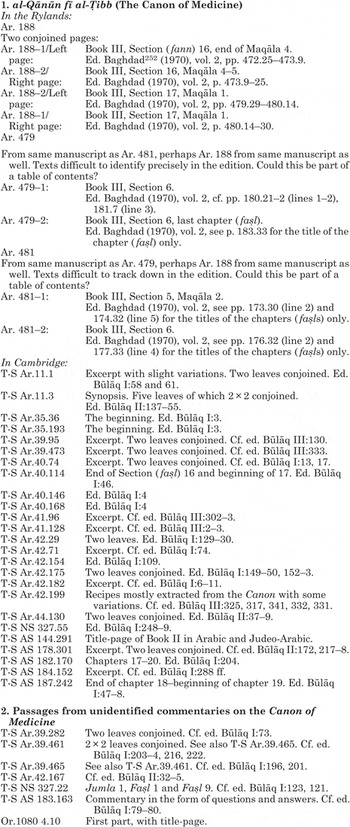
As against this shunning of Avicenna the philosopher, arabophone Jews were highly appreciative of Avicenna as a physician. Between c. 1300 and 1600, Avicenna's medical magnum opus was copied over, in whole or part, many times; even some minor medical works were disseminated among Judeo-Arabic physicians. “Clearly Ibn Sīnā's book was the most important text used by medieval Jewish doctors in medieval and Renaissance times,”Footnote 77 Langermann comments. He further observes that the marginal notes in the manuscripts provide valuable indications about how Jewish physicians read the work. By contrast, although most of the Avicenna material in the Cairo Geniza is medical, it amounts to very little (see again the Appendix). Nor do Avicenna's medical works appear frequently on booklists preserved in the Geniza.Footnote 78
The prominent role of Avicenna's medical works for arabophone Jewish physicians has been confirmed by P. Sj. van Koningsveld's exhaustive inspection of nearly all the extant medieval Arabic manuscripts (in Arabic script) produced in Christian Spain.Footnote 79 Of 104 such manuscripts, 24 could be identified as having circulated among Jews in those realms. Three of them contain works by Avicenna: al-Shifāʾ (one copy) and extracts from The Canon (in two manuscripts).Footnote 80 While this is obviously not much, it should be noted that the manuscripts that circulated among Muslims (as well as those that could not be ascribed to a particular religious milieu) contain no material by Avicenna at all.
A.2.3. Conclusion
Avicenna the philosopher was little read by arabophone Jews. Maimonides’ attitude towards him is enigmatic. Although he commented on the quality of Avicenna's philosophical works, he does not seem to have read them at first-hand, but to have extracted their content mainly through al-Ghazālī. Whatever the case, the historically significant fact here is that Maimonides used some Avicennian doctrinal items as important building blocks of his thought, thereby contributing to their diffusion (albeit as “Aristotle's”) among Jewish readers (both Arabic-speaking and Hebrew-speaking) in the following centuries. Maimonides’ descendants appropriated only Avicenna's refutation of metempsychosis. In the West, arabophone Jewish philosophers turned to Avicenna mostly for specific topics. The extant manuscripts, too, suggest that only a few minor works, bearing on specific themes, notably the nature of the soul, were read and copied. This state of affairs is consistent with our observations concerning the presence of Avicennian doctrinal items in Judeo-Arabic works on philosophy: two authors (Judah Hallevi and Joseph Ibn Waqār) drew on Avicenna for their discussions of the human soul. Moses ha-Levi is exceptional in his clear self-identification as an Avicennian. Avicenna the physician, by contrast, although all but ignored by Maimonides, was very popular among his arabophone Jewish confreres.
PART B: AVICENNA AMONG NON-ARABOPHONE JEWS
B.0. Introduction
Arabophone Jews usually wrote their theoretical works (linguistics, religious philosophy, biblical exegesis, etc.) in Arabic, while producing belles-lettres (mainly poetry, but occasionally prose) in Hebrew, especially in Spain. In the early twelfth century, a movement of Arabic-to-Hebrew cultural transmission (whose roots lay in the previous century) gathered momentum. The channels of transmission were twofold: (i) arabophone Jewish scholars wrote works in Hebrew that drew on knowledge they acquired from Arabic sources, thereby transmitting it to their coreligionists who had no Arabic; (ii) bilingual scholars produced Hebrew translations of works by Jews, Muslims, and pagans available to them in Arabic. This translation project, which spanned some four centuries (early twelfth–end of 15th century), laid the foundations for medieval Hebrew philosophy and science.Footnote 81 Philosophical tracts were translated into Hebrew from Latin, too.Footnote 82
We will now consider how, when, and to what extent Jewish scholars whose cultural tongue was Hebrew and who, as a rule, read only Hebrew, could become aware of Avicenna and Avicennian thought, whether identified as such or not. We begin with philosophy (B.1), looking at translations and adaptations of works by Avicenna as well as works written in Hebrew by arabophone Jewish scholars who drew on Avicenna. We will treat them by literary genre, more or less chronologically within each genre. The contribution of the Latin-to-Hebrew channel will also be addressed. A short concluding section will mention pseudo-Avicennian scientific works thought to be genuine by medieval scholars. Finally, we will turn to Avicenna's medical works (B.2).
B.1. Avicenna's Philosophy in Hebrew
B.1.1. Hebrew Translations and Adaptations of Philosophical Works by Avicenna
Remarkably little of Avicenna's philosophical oeuvre was translated into Hebrew.Footnote 83 This very significant datum of medieval Jewish cultural history calls for explanation, which we will attempt in the Conclusion. Specifically, almost nothing of Avicenna's great philosophical work, al-Shifāʾ, was translated; only his shorter encyclopedia al-Najāt (The Salvation) was translated into Hebrew, albeit partially and late. However, two so-called “visionary” texts by Avicenna were adapted in Hebrew.
(i) As noted, only a few short passages of al-Shifāʾ were translated into Hebrew:
■ One brief text on the division of the sciences (preserved in six manuscripts), includes the explicit notation that it derives from the Shifāʾ.Footnote 84 Steinschneider has plausibly suggested that the anonymous translator is either Samuel Ibn Tibbon (whose fondness for Avicenna will be discussed below) or his son Moses;Footnote 85 this would place the date of the translation in the second quarter of the thirteenth century.
■ The sections of al-Shifāʾ on arithmetic and on geometry were translated separately into Hebrew. Both of these circulated anonymously, so readers were unaware of their Avicennian origin. The place and time of these (unpublished) translations, preserved in only one and two manuscripts (respectively), are unknown.Footnote 86
■ Several passages from al-Shifāʾ, on logic and physics, were included in Ṭodros Ṭodrosi's Liqquṭim (“Philosophical Anthology”), which had a negligible circulation (see below, B.1.4 [iii]).
So Avicenna's most ambitious philosophical work, al-Shifāʾ, had hardly any presence in Hebrew. As a result, it did not even have a Hebrew title; Hebrew authors usually refer to it by its Arabic title, al-Shifāʾ, which they knew first- or secondhand.Footnote 87
(ii) In fact, the only philosophical work by Avicenna of which substantial parts were translated into Hebrew is al-Najāt; sections two and three (on physics and metaphysics) were translated by Ṭodros Ṭodrosi in Arles, c. 1334–1340, under the title Haṣṣalat ha-nefesh.Footnote 88 The section on logic was probably deliberately skipped by the translator rather than having been lost in the course of transmission. The reason for its omission may be that by 1337 Ṭodrosi had already translated (or was about to translate) Averroes’ commentary on the Rhetoric Footnote 89 and had given an account of logic in his “Philosophical Anthology.” In that work, however, the section on logic drew on additional sources (Themistius, al-Fārābī – including his lost Long Commentary on Book 8 of the Topics – and Averroes).Footnote 90Haṣṣalat ha-nefesh, which survives in only two manuscripts, did not play a notable role in the reception of Avicenna in Hebrew or in medieval Jewish thought in general.Footnote 91
Strikingly, the only works by Avicenna that were rendered into Hebrew in toto are two of the three compositions that Henry Corbin has described as “visionary.”Footnote 92 Also remarkable is that they were not translated, but rather freely adapted in the form of maqāma.
(iii) Avicenna's Ḥayy Ibn Yaqẓān was adapted into Hebrew by the great polymath Abraham Ibn Ezra (1089–1167). Ibn Ezra presumably composed this work after he began writing theoretical works in Hebrew, following his migration from Spain to Italy in 1140.Footnote 93 The fact that Ibn Ezra's Ḥay ben Meqiṣ is a Hebrew adaptation of Avicenna's Ḥayy Ibn Yaqẓān was noted by the medieval editor of Ibn Ezra's diwān; so some medieval readers of the maqāma were presumably aware of it.Footnote 94 A very creative thinker and poet, Ibn Ezra, who may have used Ibn Zayla's Arabic commentary on Avicenna's Ḥayy Ibn Yaqẓān, did not follow his model slavishly. The study of the differences between the two sheds interesting light on Ibn Ezra's own worldview and intentions.Footnote 95
At an unknown date, an otherwise unidentified “Moses” translated Avicenna's text into Hebrew, this time together with Ibn Zayla's commentary.Footnote 96
(iv) The second of Avicenna's “visionary” works to be adapted in Hebrew is the lesser-known Risālat al-Ṭayr (Treatise on Birds). Its Hebraicization, too, was written in the form of a maqāma – in fact, three different ones. Each of the adapters “transformed” Avicenna's prose work into a maqāma, producing an independent poetical work in a literary form conforming to the philosophical content. Although the Hebrew adaptations included the notation that they derived from an Arabic original, Avicenna's authorship was discovered only by modern scholarship.Footnote 97
None of Avicenna's great philosophical works was available in Hebrew, then: only a few passages (two unattributed) of al-Shifāʾ; al-Najāt was translated partially and late, and was very little disseminated; two “visionary” works were reworked into maqāmas, one of them without attribution. (The Risāla fī al-Nafs [Epistle on Soul] was also translated in part, albeit incorporated, unidentified, into two works that will be discussed below.Footnote 98 ) This was certainly an insufficient basis for Hebrew readers to become familiar with Avicenna's thought. Nonetheless, and this must be re-emphasized, despite the absence of translations, Avicenna was undoubtedly a household name among Hebrew-reading intellectuals. They derived information on Avicenna's ideas from a number of sources: Hebrew translations of works by Muslim scholars other than Avicenna, but containing accounts of his thought (B.1.2); Avicennian doctrinal items in Hebrew translations of works by arabophone Jewish authors (B.1.3); and Avicennian doctrinal items in works by arabophone Jewish scholars who wrote in Hebrew (B.1.4). Let us consider these three channels in turn.
B.1.2. Avicenna in Hebrew Translations of Philosophical Works by Other Muslim Authors
The Muslim authors whose works contained substantial material on Avicenna and whose works reached the Hebrew-reading public are mainly al-Ghazālī and Averroes; some additional information came via Fakhr al-Dīn al-Rāzī.
(i) Al-Ghazālī
As is now well known, al-Ghazālī's philosophical work Maqāṣid al-falāsifa (The Intentions of the Philosophers) is largely based on Avicenna's Dānesh-Nāmeh (Book of Knowledge).Footnote 99 In his introduction, al-Ghazālī states that his intention is to describe the philosophers’ ideas in order to refute them – a passage included in all Hebrew translations (but absent from most Latin manuscripts).Footnote 100 Nowhere in his work does al-Ghazālī mention Avicenna. Jewish scholars understood al-Ghazālī's stated goal in various ways: some (like Moses Narboni in the fourteenth century) believed that al-Ghazālī's real intention was to teach philosophy and that it was only the fear of his anti-philosophical contemporaries that led him to present his philosophical work as a criticism of philosophy.Footnote 101 Others (like Isaac Albalag and Judah ben Solomon Nathan, also in the fourteenth century) took al-Ghazālī at his word and either applauded his anti-philosophic intentions (Judah Nathan) or scolded him for them (Albalag).Footnote 102 Between roughly 1290 and 1330, the Maqāṣid was translated into Hebrew, perhaps even three times,Footnote 103 and was the object of quite a few commentaries in Hebrew. It was immensely popular for centuries, as indicated by the great number of extant manuscripts of all versions. The Intentions of the Philosophers in Hebrew garb (entitled Kawwanot [sometimes Deʿot] ha-pilosofim) brought the Avicennian ideas it presented to Hebrew-reading scholars. It is important to realize, however, that the text did not reveal its Avicennian pedigree; readers could know this only if they had access to external sources of information, notably in Arabic, as the translators did.Footnote 104
The first Hebrew version of the Maqāṣid was made in the late thirteenth century by the philosopher Isaac Albalag, who may have been from Narbonne.Footnote 105 He accompanied the translated text with a running commentary and named the entire work Sefer Tiqqun ha-deʿot (Rectification of the Opinions [or Ideas]).Footnote 106 Albalag explains what motivated him to translate the work. The Torah and philosophy express the same truth, albeit in different languages, adapted to the capacities of different groups of people. He himself belongs to the philosophers and would therefore translate strictly philosophical books, namely those of Aristotle. “Nonetheless, I saw fit to begin by translating this book by Abū Ḥāmid al-Ghazālī, because it narrates most of those [philosophical] ideas, treading a mean route that is common to philosophy and the vulgar belief. Its method is close to that of narration [sippur], so that it is easily comprehensible [even] to one who is not trained in philosophy.”Footnote 107 In his commentary, Albalag criticizes the opinions expressed in the text, siding with Averroes against Avicenna and al-Ghazālī; in this way, his readers became aware of the discrepancies between their views. Albalag had no qualms about voicing “radical” opinions openly; for this reason he was often deemed heretical by later orthodox scholars.Footnote 108 Nonetheless, to judge from the number of surviving manuscripts (at least thirteen), Albalag's book was widely read. A number of mainly critical supercommentaries on Albalag's commentary were also composed.Footnote 109
A second, anonymous version was produced in the first decades of the fourteenth century. It too is extant in a number of manuscripts (seven).Footnote 110 The section on logic has been published.Footnote 111
Finally, a third translation was executed by Judah ben Solomon Nathan (extant in a dozen manuscripts), a physician who translated a number of medical works as well.Footnote 112 We have some information on Judah Nathan's motives for undertaking the translation. In his long and informative introduction to the translation,Footnote 113 he says that al-Ghazālī presented the philosophers’ ideas in logic, natural science, and philosophy most exactly and comprehensively.Footnote 114 The composition therefore suited Judah Nathan's purpose, which was to allow a scholar who is engaged in Talmud study – which requires much time – to learn the sciences “in a short time, so as not to have to interrupt his [Talmud] study.” Everyone, Judah writes, desires to know the sciences “by nature,” an allusion to the opening sentence of Aristotle's Metaphysics that bespeaks the author's philosophical leanings. Any such student, Judah Nathan says, will “find what he seeks in this book which contains the totality of the intention[s] of the philosophers in the greatest brevity, without needing any further book.” Thus, by offering Jewish scholars a digest of all philosophical science in a single volume, Judah Nathan would allow them to avoid losing precious time with philosophy; they can and should put their time to better use by studying the Talmud. Judah Nathan was a conscientious and meticulous scholar: realizing that he did not always understand al-Ghazālī's text, and recognizing moreover that it expressed ideas deriving from Avicenna, he also consulted works by the latter: he writes that he “perused […] different books which follow this author [Avicenna]: a part of the book al-Shifāʾ, namely [the parts] on physics and metaphysics, by Avicenna; [and his] book al-Najāt, which covers all the seven sciences in brief.”Footnote 115 He notes that he added to his translation explanatory glosses from these works by Avicenna (and others); but these glosses are lost.Footnote 116 Still, Judah's introduction made it clear to users of his translation that al-Ghazālī's work was Avicennian in its tendencies.
Judah next makes an apologetic move. His intention is to counter the “philosophizing” individuals who “shriek and utter” and to refute their positions. Why then should he translate al-Ghazālī's précis of the philosophers’ views? Judah argues that al-Ghazālī's book in truth (and felicitously!) does not follow its declared goal. The name “philosopher” refers “to Aristotle and to the Greek philosophers, who have no religion, and to their counterparts of the Ishmaelite philosophers and even to some extent [be-sippuq] to individuals of our own faith.” In al-Ghazālī's summary, however, the philosophers’ views are mingled with those of Avicenna, who “deviates from Aristotle's way.” This book, Judah Nathan implies, is therefore not an account of the – dangerous – ideas of “the philosophers.” Kawwanot ha-pilosofim will rather allow its readers to defend “our holy Torah” against its critics, just as “was the intention of the author of this book [al-Ghazālī], namely to refute in a [further] dedicated work [namely, the Tahāfut al-falāsifa] everything that contradicts any of the cornerstones of religion.” Judah Nathan apologetically remarks that he is aware that the book he translated still “includes some matters that contradict the cornerstones of our religion, by which we live”; as a sort of penitence he therefore inserted Maimonides’ Thirteen Principles in the beginning of the book.
Judah seems to be ambivalent. He does not state that it is specifically the Avicennian bent of the book that makes it particularly useful for the defense of the Torah. What seems to have made the book commendable are rather two other features: first, al-Ghazālī's declared intention to refute the radical philosophical positions (those Judah identified with Aristotle's); second, the book's brevity, allowing its readers to learn the foundations of philosophy rapidly, so as to be in a position to engage in discussions with the holders of radical philosophical positions. The fact that Judah's annotations to the translation did not accompany the work implies that the readers of the translation presumably viewed the book as faithfully presenting a mild version of the views of “the philosophers.” We will return to Judah Nathan's role in diffusing Avicenna's thought in fourteenth-century Jewish philosophy in Hebrew.
As noted by Steinschneider, the three translations of the Maqāṣid are extant in a great number of copies, an indication of the popularity of al-Ghazālī's work. Many copies bear marginalia witnessing to intensive study.Footnote 117 The work also appears on numerous Jewish book lists in many cultural contexts,Footnote 118 including Karaite.Footnote 119 Moreover, al-Ghazālī's composition in Hebrew garb was the object of numerous commentaries: “few Hebrew works were commented as often as the Intentions,” Steinschneider observed.Footnote 120 The first of these commentaries, written by the noted Averroist scholar Moses Narboni in 1344–1349, is extant in more than 30 copies.Footnote 121 This Averroist commentary in turn was a source of inspiration for an encyclopedia entitled Ahavah be-taʿanugim (Love with Enjoyment), composed in 1354 by the Spanish philosopher Moses ben Judah Nogah.Footnote 122 Another supercommentary was composed in Italy by Moses Rieti (1389–after 1452).Footnote 123 All in all, no fewer than twenty commentaries, written in southwest Europe as well as in the East, are known (some of them not extant in full).Footnote 124 In 1367, the work was versified by the Abraham Avigdor b. Meshullam (then aged 17), in order to make the science laid out in al-Ghazālī's work as accessible as possible.Footnote 125
Al-Ghazālī's work was certainly a remarkable success. It became a major conduit of Avicennian ideas into Hebrew philosophical thought. It is doubtful, however, that the readers of the Hebrew versions of the Maqāṣid embraced specifically Avicennian modes of thought. No study dedicated to this question has been conducted, but the odds are that they did not. The Maqāṣid seems to have been perceived and used simply as a convenient short manual on science, not as an exposition of anti-Aristotelian (or anti-Averroist) science.Footnote 126 In this respect it is comparable, say, to Ruaḥ ḥen, Midrash ha-Ḥokhmah, and Shaʿar ha-shamayim, the popular thirteenth-century Hebrew encyclopedias or exposés of science that afforded readers a quick introduction to the basics of science, required for the perusal of works in religious philosophy. More often than not, authors “lifted” from al-Ghazālī's composition separate doctrinal items, disconnected from the global Avicennian outlook. Moreover, the Maqāṣid was often, perhaps mostly, studied with one of its commentaries, of which the most disseminated ones were Albalag's and Narboni's, both of which were Averroist in tendency. (The famous study program of Yoḥanan Alemano [1435–after 1504], for instance, includes the study of the Maqāṣid accompanied with these two commentaries.Footnote 127) Thus, at least until more detailed studies show otherwise, the Maqāṣid cannot be construed as a fountainhead of a “Hebrew Avicennism.” The first scholar to use the Maqāṣid to criticize science may have been Ḥasdai Crescas at the very end of the fourteenth century.Footnote 128
Al-Ghazālī's Tahāfut al-falāsifa (The Incoherence of the Philosophers), which also presents – and refutes – Avicennian doctrines in great detail, was translated into Hebrew, too. But this translation was late (first decade of the fifteenth century) and had little influence.Footnote 129 It seems to have played only a minor role in the reception of Avicenna in Hebrew (but a fuller examination of this question may be useful).
(ii) Averroes
The Spaniard Averroes was Avicenna's staunch critic and sought to reestablish the authority of “orthodox” Aristotelianism (as he understood it). In his earlier works, notably the epitomes of Aristotle's works, his positions on many subjects were not far removed from Avicenna's: readers of these works, most of which were translated into Hebrew, encountered in them positions fairly close to Avicenna's, though not labeled as such.Footnote 130 In his later works, by contrast, Averroes takes Avicenna to task, more often than not by name. These later works by Averroes were also very heavily translated into Hebrew – both the commentaries and the monographs.Footnote 131 Particularly important in this context is Averroes’ Tahāfut al-tahāfut (Incoherence of the Incoherence), the refutation of al-Ghazālī's critique of the philosophies of al-Fārābī, and, especially, Avicenna. This work, translated into Hebrew twice in the first half of the fourteenth century,Footnote 132 contained much information on Avicenna's ideas, albeit biased: Averroes reported only those of Avicenna's ideas he took to task; hence readers of this work could become aware only of these – Avicenna's more controversial views.
As a result of the substantial availability of Averroes’ compositions in Hebrew, Hebrew-reading scholars were aware of Avicenna's positions on a great number of issues, albeit through their refutations. To draw the “image of Avicenna” as it emerges from the works of Averroes available in Hebrew would possibly be a worthy contribution to the history of Jewish philosophy in Hebrew; but this cannot be attempted here.Footnote 133 We must content ourselves with drawing the reader's attention to Averroes’ translated writings as an important conduit for Hebrew Jewish cultures’ acquaintance with Avicenna.
(iii) Fakhr al-Dīn al-Rāzī
Although critical of him, some works by Fakhr al-Dīn al-Rāzī (1149–1209) were openly inspired by Avicenna. Traces of one of them are found in a fourteenth-century Hebrew translation of ʿUyūn al-masāʾil (The Fountains of Questions, or: The Principal Questions), ascribed to al-Fārābī,Footnote 134 by Ṭodros Ṭodrosi of Arles (active 1330–1340), whom we have already encountered as the translator of al-Najāt. In his translation of this work, Ṭodrosi incorporated two passages from al-Rāzī's al-Mabāḥith al-mashriqiyya (Oriental Researches).Footnote 135 These passages bear on the logical concept of “definition” (taʿrīf) and the Avicennian idea of the chain of emanations of the intellects.Footnote 136
It is quite likely that additional Arabic texts containing Avicennian materials were translated into Hebrew. They await identification by scholars.Footnote 137
B.1.3. Avicenna in Hebrew Translations of Judeo-Arabic Philosophical Works
The Arabic-to-Hebrew translation movement, whose beginnings go back to the eleventh century, gathered momentum after the Almohad takeover of Muslim Spain, which compelled Jews (as also Christians) to leave the country. Many reached the Midi, among them the Ibn Tibbons, who hailed from Granada. Judah Ibn Tibbon (c. 1120–1190) settled in Lunel around 1155 and initiated a systematic translation project under the patronage of Meshullam ben Jacob, a powerful and erudite local head of a yeshiva. This enterprise was to be continued by members of his family for at least three generations. The first works Judah Ibn Tibbon rendered into Hebrew were in religious philosophy. The translation of Judeo-Arabic works of this kind continued throughout the thirteenth and fourteenth centuries, in parallel to the translation of profane works by non-Jewish authors. The four Judeo-Arabic compositions discussed above that incorporated Avicennian doctrinal items indirectly introduced Avicennian ideas – not earmarked as such – into Jewish thought in Hebrew.
(i) The Kuzari (Book of the Khazar) by Judah Hallevi was one of the first books translated into Hebrew by Judah Ibn Tibbon (1167).Footnote 138 This work quickly became – and remains to this very day – a “must” in most Hebrew-reading intellectual milieus, both among those inclined towards philosophy and those more circumspect about “foreign” wisdom.Footnote 139 Correspondingly, it has also been the subject of multiple commentaries. Inasmuch as the Kuzari incorporated Avicenna's treatise on the soul, its Hebrew version acquainted a very wide audience with Avicenna's psychological doctrine, albeit without any reference to its author.Footnote 140
(ii) Abraham Ibn Daʾud's The Exalted Faith, no longer extant in the original Arabic, was twice translated into Hebrew in Spain: around 1370 by Salomon Ibn Labi, probably a member of the circle of Jewish scholars around Ḥasdai Crescas (1340–1412), and in 1391–1392 by Samuel Ibn Moṭoṭ, who apparently revised Ibn Labi's version.Footnote 141 While Ibn Moṭoṭ's version had no success (only one manuscript survives), Ibn Labi's circulated widely (eleven manuscripts extant). In this way, the Avicennian elements in The Exalted Faith reached a fairly wide readership, though again without attribution to Avicenna.
(iii) As noted above, Maimonides’ Guide of the Perplexed contains essential Avicennian building blocks. This foundational text of Jewish philosophy was translated into Hebrew twice, almost simultaneously: by Samuel Ibn Tibbon (first edition 1204), whose version became canonical, and by Judah al-Ḥarizi. Other texts by Maimonides, less relevant in the present context, were also translated into Hebrew during the thirteenth century. Needless to say, the Guide was the most widely read philosophical text in Hebrew, and its doctrines were known to a very large readership throughout the ages. However, as already explained, the numerous distinctively Avicennian doctrines in the Guide (and in other philosophical writings by Maimonides available in Hebrew) could not be recognized as such by the vast majority of the readers, except when enlightened by arabophone commentators (see below). (Maimonides’ Hebrew composition Sefer ha-Maddaʿ will be discussed in B.1.4.)
The Guide of the Perplexed, the Kuzari, and to a lesser degree The Exalted Faith all belong to the canon of medieval Jewish philosophy. They introduced Avicennian doctrines – concerning especially the notion of the Necessary Existent (Maimonides) and the theory of soul (Kuzari and Exalted Faith) – into the Jewish philosophical discourse. For the majority of their readers, we must remember, these works were authoritative works by respected Jewish masters, so adherence to their doctrines was almost de rigueur. It should be emphasized again that none of these works ever referred to Avicenna by name;Footnote 142 the Avicennian ideas introduced into Jewish philosophy through these works were not labeled as going back to Avicenna. Only learned arabophone readers who were acquainted with Avicenna through their readings in Arabic could identify the Avicennian doctrinal items encountered in these works. The Guide is to some extent a special case: in their erudite commentaries, Shem-Ṭov Ibn Falaquera and Moses Narboni did report the Avicennian origin of certain ideas.Footnote 143 Presumably, however, their observations did not essentially alter most readers’ perception that the doctrines in question were “Aristotle's,” as stated by Maimonides. So the translations of these influential Judeo-Arabic works introduced Avicennian ideas into Jewish philosophical thought, even as Avicenna himself remained mostly unknown.
Two further translations need to be mentioned, although they had a very small circulation and impact:
(iv) Moses ha-Levi's Metaphysical Treatise, which defends some key ideas of Avicenna's metaphysics (above, A.1.2 [iii]), was translated into Hebrew (probably in the late thirteenth century), but only a single manuscript survives.Footnote 144 It may have been translated into Hebrew another time, as part of Joseph Ibn Waqār's Treatise Reconciling Philosophy and Religious Law, to which we now turn.
(v) Joseph Ibn Waqār's Arabic Treatise Reconciling Philosophy and Religious Law (supra, A.1.2 [iv]) was apparently translated into Hebrew, although only a fragment of this translation survives.Footnote 145 If the translation was indeed complete, it must have included also Moses ha-Levi's Avicennian treatise. The same applies to two explicit quotations from Fakhr al-Dīn al-Rāzī that Joseph Ibn Waqār inserted in his work: from al-Rāzī's commentary on Avicenna's al-Ishārāt wa-al-tanbīhāt (Pointers and Reminders), and from the Lubāb al-Ishārāt (The Pith of [Avicenna's] Ishārāt).Footnote 146
Given the small circulation of the last two works, their contribution to the knowledge of Avicenna among Hebrew-reading students of philosophy was nil. Indeed, one can wonder whether the near disappearance of these two works was not related to the general lack of interest in Avicenna's thought in Jewish circles.
B.1.4. Avicenna in Philosophical Works by Arabophone Jewish Scholars Writing in Hebrew
The first major composition to expound philosophical matters in Hebrew was Sefer ha-Maddaʿ (Book of Knowledge), the opening part of Maimonides’ great code of Jewish Law, the Mishneh Torah. Maimonides composed this work in Hebrew in Egypt (concluded 1178–1180); it reached Europe in the last decade of the twelfth century. As already explained, the first chapters of Sefer ha-Maddaʿ present the basics of the Avicennian notion of the Necessary Existent and the contingent world in dogmatic fashion (meaning without argumentation). This was the first substantial exposition of these Avicennian ideas in Hebrew, although, again, they were not labeled as such. Inasmuch as Sefer ha-Maddaʿ is part of Maimonides’ authoritative legal code, written in Hebrew, his statement of fundamental Avicennian tenets made them (albeit in a very simplified form) obligatory articles of belief for numerous Jews throughout the ages. (Maimonides also incorporated basic Avicennian tenets in a succinct formulation in his Thirteen Principles of Faith.) The importance of this channel of transmission cannot be overemphasized: it was certainly the most significant conduit of Avicennian ideas to Jewish minds from the late twelfth century on. Indeed, these ideas became so well known as to appear trite, rather than as one way of construing the relationship between the deity and the world.
Even after most Jewish authors began writing on philosophy in Hebrew, many scholars (though by no means the majority) could still read Arabic: in some families, especially of physicians, Arabic was passed down from generation to generation. Some of these bilingual and bicultural intellectuals became Arabic-to-Hebrew translators; others wrote books in Hebrew that drew on knowledge available only in Arabic and not accessible to scholars who knew Hebrew only. Here we will examine information about Avicenna included in the Hebrew works of this small number of arabophone Jewish scholars.
(i) Abraham Ibn Ezra (1089–1167) has already been mentioned above as the adapter of Ḥayy ben Yaqẓan. But he also adhered to and expressed some Avicennian views. In his biblical commentary he shows, en passant, that he is aware of and accepts Avicenna's notion of God as the Necessary Existent.Footnote 147 More important, according to one of its possible interpretations, his obscure and elusive exegesis of the account of creation in Genesis follows Avicenna, much along the lines of the interpretation put forward by Samuel Ibn Tibbon a few decades later (see immediately below).Footnote 148 However, Ibn Ezra does not mention Avicenna; only commentators familiar with the latter's theory could identify it in Ibn Ezra's exegesis. We will come back to this shortly. It has been suggested in the past that Abraham Ibn Ezra referred to Avicenna (as “Abencine”) in his Liber de rationibus tabularum (preserved in Latin), but J. L. Mancha has recently argued persuasively that “Abencine” in fact refers to Ibrāhīm ibn Sinān ibn Thābit ibn Qurra (908–946).Footnote 149
(ii) Samuel Ibn Tibbon (c. 1160–1232), the well-known translator of Maimonides’ Guide, was an accomplished scholar and original thinker who introduced Avicenna into Hebrew thought in two of his works. The first, which does so in a minor way, is his meticulous Arabic-to-Hebrew version of Aristotle's Meteorology, finished in 1210. Here Ibn Tibbon complements and elucidates the difficult text with glosses based on information culled from various sources, among them Avicenna. (However, their brevity does not allow a precise identification of the works to which Ibn Tibbon had access then.)Footnote 150
More consequential is the use Ibn Tibbon made of Avicenna in his most important original composition, Maʾamar Yiqqawu ha-mayim (Treatise on “Let the Water Gather,” concluded c. 1231), which addresses the question of why the element water does not entirely cover the surface of the terrestrial globe (as it should according to the four-element theory). Ibn Tibbon recounts that he had been engaged with this problem for twenty years but failed to find a satisfactory solution. (He rejected notably Averroes’ account as not naturalistic.) The breakthrough came, he tells his readers, through Avicenna's “great book al-Shifāʾ,” in which he finally discovered a satisfactory naturalistic solution to the worrisome problem. Ibn Tibbon next inserts in his text his own Hebrew translation of a lengthy passage from the section on meteorology in al-Shifāʾ and proceeds to show that Avicenna's naturalistic theory – dry land repeatedly emerges from under the water and subsequently is covered by it again – accords with the biblical texts.Footnote 151 An essential premise of Avicenna's theory is that after each flooding of the land humans are generated again “not from man,” that is, through “spontaneous generation,” like any other animal species. This bold, indeed blasphemous statement is included in the passage quoted from Avicenna, and Ibn Tibbon was audacious enough to endorse it explicitly.Footnote 152 Ibn Tibbon incorporated in Yiqqawu ha-mayim another passage from al-Shifāʾ, from the section on “Generation and Corruption” (but without indicating its source): it gives a concise account of the theory of the mutual transformation of the four elements, albeit with an original and consequential twist that provides the basis for the theory of the infinite succession of sublunary worlds.Footnote 153 It would therefore seem that he had access to the entire work, or at least to large parts of it.
Maʾamar Yiqqawu ha-mayim is thus based on two distinctively Avicennian theses; this makes Ibn Tibbon one of the foremost Avicennian thinkers in medieval Hebrew culture. Indeed – and it is important to emphasize this point – unlike most other authors who integrated Avicennian ideas into their writings, Samuel Ibn Tibbon proclaims his indebtedness to al-Shifāʾ loudly and explicitly.
Ibn Tibbon's Maʾamar Yiqqawu ha-mayim was quite successful; at least fourteen manuscripts survive. But the passage translated from Avicenna, including the quotation about man's possible generation “not from man,” had an incomparably larger diffusion owing to its unaltered incorporation into Gershon ben Solomon's Shaʿar ha-Shamayim (The Gate of Heaven),Footnote 154 one of the most popular medieval Hebrew works of science; more than thirty manuscripts survive and it was printed several times. Through its inclusion in these two works, this account became one of those most commonly associated with Avicenna's name.Footnote 155 Some supercommentaries on Abraham Ibn Ezra's commentary on Genesis argued that his explanation is identical to Avicenna's theory, which they summarized with explicit attribution.Footnote 156 Whether they knew it from Samuel Ibn Tibbon or from other sources remains to be seen.
The fact that this Avicennian theory was publicized so early (1231) and was so widely disseminated may have played a role in the later phases of the reception of Avicenna in Hebrew. Ibn Tibbon had a reputation as a radical rationalist;Footnote 157 his endorsement of Avicenna may have backfired and deterred translators and potential patrons from any attempt to render works by Avicenna into Hebrew. It thus seems possible that, through the widely circulated Maʾamar Yiqqawu ha-mayim and Shaʿar ha-Shamayim, Avicenna became associated not only with the heterodox thesis of the eternity of the world (which was bad enough), but also with the provocative thesis that man can be “spontaneously” generated. Avicenna's identification with these blasphemous doctrines, we thus suggest, may have contributed to his being discredited for the Hebrew-reading public and thereby to the fact that his works were not selected for translation into Hebrew. We will return to the reasons for the paucity of Hebrew translations of Avicenna in the Conclusion.
(iii) Moses ben Samuel Ibn Tibbon (fl. 1244–1283) was far more conservative and less bold than his father. This is immediately evident from his commentaries, which constitute the great bulk of his own writing.Footnote 158 But he wrote also an original work on science, which consists of a series of responses to questions addressed to him by a young relative. This Answers to Queries on Physics is preserved in a single manuscript.Footnote 159 The questioner takes Samuel Ibn Tibbon's Maʾamar Yiqqawu ha-mayim as the point of departure of his queries. In his answers, Moses Ibn Tibbon distances himself from most of his father's positions. He is clearly acquainted with various parts of the section on physics in the Kitāb al-Shifāʾ, but more often than not rejects Avicenna's positions in favor of Averroes’. One important issue discussed is that of elemental transformations. Moses Ibn Tibbon dismisses Avicenna's notion of “intermediate transformation,” which was the very foundation of Avicenna's (and his father's) innovative theory of the eternity of the world, and instead accepts Averroes’ theory. Consequently, Moses Ibn Tibbon also rejects Avicenna's idea of a “dynamic stability” of the sublunar world, which was the core of his father's Maʾamar Yiqqawu ha-mayim. Similarly, he sides with Averroes against Avicenna on the causes of the elemental forms.
Moses Ibn Tibbon's Answers to Queries on Physics was little read. This is understandable, given that the confrontation between Avicenna and Averroes was passé soon after it was composed. Moses Ibn Tibbon indeed exemplifies Jewish philosophers’ almost wholesale adherence to Averroes from the middle of the thirteenth century onward. He is also one of its promoters: as the translator (between 1244 and 1258) of all of Averroes’ epitomes of Aristotle's works on physics and metaphysics and of one middle commentary (of De anima), he helped spread Averroes’ philosophy in Hebrew, to the exclusion of alternatives. Moses Ibn Tibbon, and specifically his rejection of his father's Avicennian ideas (and ideals), epitomizes the Averroist turn of Jewish philosophy in Hebrew.
(iv) As noted, Ṭodros Ṭodrosi of Arles translated Avicenna's al-Najāt (1334–1340). We should now take notice of another undertaking with an Avicennian component, namely his Hebrew “philosophical anthology” (Liqquṭim, i.e. collectanea, compilation), dated 1334, which includes a number of passages from Avicenna.Footnote 160 Ṭodrosi begins his work with logic: this section includes a translation of almost the full text of the first four chapters of this section of al-Shifāʾ (recapitulating Porphyry's Eisagoge) and some passages from the section on the Prior Analytics, including Avicenna's own classification of Aristotelian syllogisms. Ṭodrosi complements these long quotations with a few short passages taken from the logical section of Avicenna's Remarks and Admonitions and from al-Ghazālī's and Fakhr al-Dīn al-Rāzī's interpretations of Avicennian ideas about Aristotelian logic. The inclusion of quotations from authors with Avicennian tendencies suggests that when compiling his anthology Ṭodros was guided by an interest in Avicennian ideas running against the dominant Averroist consensus.Footnote 161 However, the anthology, now preserved in a single manuscript,Footnote 162 probably incomplete, clearly had a very limited circulation; it therefore bespeaks the interest of an individual rather than a widespread intellectual tendency.
In another work, his Arabic-to-Hebrew version of pseudo-Fārābī's ʿUyūn al-masāʾil (The Fountains of Questions, or: The Principal Questions), Ṭodros added in the margin of a certain passage two “Avicennian” quotations – one from Fakhr al-Dīn al-Rāzī and the other from the metaphysical section of Avicenna's al-Najāt.Footnote 163 Unless Ṭodros found these quotations already added to his Arabic manuscript of ʿUyūn al-masāʾil, he must have been well informed about Arabic-Islamic Avicennism and deemed it relevant to Jewish readers of his time.
Ṭodros Ṭodrosi undoubtedly marks an interest in Avicennian thought. Not only is he the only Hebrew translator of a scientific treatise by Avicenna; in his anthology he also gathered and translated other texts of the Avicennian tradition. Much the same holds of Ṭodros’ friend Judah Nathan,Footnote 164 who, we saw, translated al-Ghazālī's Maqāṣid into Hebrew, taking care to fill out unclear passages by drawing on works by Avicenna. The two scholars in fact acted in tandem. We know something of Judah Nathan's motives for appropriating Avicennian bodies of knowledge into Hebrew; perhaps he shared them with Ṭodros. As already noted, Judah Nathan says that al-Ghazālī's work, whose affinity with Avicenna he recognized, would allow one to rebuke the stance of “the philosophers” and thereby support that of the Torah. He observed that al-Ghazālī “deviates” from Aristotle, meaning from the Averroean philosophy that was the focus of the controversies over the legitimacy of the study of philosophy in the early fourteenth century. Judah's remark followed the intention to get the translated work of philosophy across to the adversaries of the contested “philosophy” identified with “Aristotle.” Put differently, Judah Nathan – and presumably Ṭodros Ṭodrosi – seem to have had a clear philosophical agenda, namely, to promote Avicenna and al-Ghazālī as a philosophical alternative to radical Averroism.
Does this make Ṭodros Ṭodrosi and Judah Nathan into major Avicennians, on a par with Samuel Ibn Tibbon or Moses ha-Levi? Probably not. Considering their choices of works for translation (and assuming that these choices reflect the personal preferences of the translators, not those of some patrons), both appear to be eclectic: Ṭodros translated not only a work by Avicenna, but also works by Averroes,Footnote 165 whereas Judah Nathan translated medical works, too.Footnote 166 Since neither author composed an original work that would have allowed us access to his own thought, it seems preferable not to describe them as Avicennians.Footnote 167
Instead, the two scholars can be described as champions of moderate philosophical study. The controversy over the legitimacy of the study of philosophy of 1305 revealed that the early split between arch-conservative anti-philosophical fundamentalists and radical Maimonidean philosophers had given way to a more stratified picture. After almost a century of controversies about the value of and danger to faith of the study of philosophy, most intellectuals of a conservative, anti-philosophical temper ended up persuaded that the study of philosophy was indispensable, even for themselves, and that a radical rejection of the study of philosophy was an untenable position.Footnote 168 These “moderate conservatives” thus shared some interests with the committed students of philosophy, although their objective in studying philosophy was not philosophy per se, but rather a philosophical defense of Torah study. The translation of the Maqāṣid was apparently intended for these circles of intellectuals who wished to tread a mean path between the radical philosophers and the staunch anti-philosophical conservatives and who needed adequate intellectual tools, notably works of science that presented an alternative to Aristotle.
(v) Ruaḥ ḥen is a small summary of the so-called Aristotelian sciences, composed in the Midi or southern Italy in the second third of the thirteenth century.Footnote 169 Its anonymous author produced an elegant synthesis of materials deriving from numerous unidentified sources, presumably in Arabic. As Ofer Elior has recently shown, the discussions in Ruaḥ ḥen include some distinctively Avicennian doctrinal items: for example, the notion that the qualities derive from the elements’ forms, rather than define them; the definitions of “priority”; the idea that the change of form of a substance occurs in no time; the definition of change in the category of position. Ruaḥ ḥen was read and studied throughout many centuries in different circles, but its numerous readers could not be aware of the Avicennian character of the doctrinal items presented in it.
(vi) Judah ben Solomon ha-Kohen Ibn Matqah composed his philosophical-scientific encyclopedia Midrash ha-ḥoḵmah (The Study of Science) in Arabic (now apparently lost) in Toledo around 1235 and translated it himself into Hebrew in 1247, in Sicily, under the patronage of Frederick II.Footnote 170 In his very dense and summary expositions of Aristotelian science, Judah as a rule follows Averroes, but occasionally complements his accounts with Avicenna's ideas (with or without explicit attribution); it has not yet been established whether he took them directly from Avicenna's works or indirectly from Averroes. For example, in the section on meteorology, Judah interpolates a remark to the effect that Avicenna (explicitly named) holds that the region of the equator is more moderate than the other climates, whereas Averroes holds the opposite view; the section on metaphysics contains a reference (again explicit) to Avicenna's theory of the necessary and contingent beings and its refutation by Averroes. There are as well borrowings from Avicenna not identified as such.Footnote 171 The mathematical section of the work also draws on al-Shifāʾ.Footnote 172
(vii) Shem Ṭov Ibn Falaquera (c. 1225–1295) was an erudite and extremely well-read author who lived in Provence or northern Spain and played a pivotal role in the Arabic-to-Hebrew cultural transfer, notably by composing in Hebrew works grounded in his deep knowledge of Arabic science and philosophy.Footnote 173 He read a substantial number of works by Avicenna, including al-Shifāʾ, al-Najāt, the Epistle on the Soul, and the Epistle on the Parts of Sciences, as well as at least one medical work (albeit with much philosophical content), The Cardiac Drugs.Footnote 174 Falaquera, who pursued the goal of acquainting the Hebrew reading public with Arabic philosophical lore, was certainly a most important agent of transmission of Avicennian ideas in Hebrew. Here we cannot survey the entire range of quotations from Avicenna found in Ibn Falaquera's voluminous writings and must content ourselves with a few representative examples.
In his Reʾshit Ḥoḵmah (The Beginning of Science, c. 1250), Ibn Falaquera devotes a section to the division of the sciences, in which he included a partial translation (unattributed) of Avicenna's Epistle on this subject.Footnote 175 We already noted that manuscripts of this Arabic text in Hebrew letters circulated among arabophone Jews, testifying to their interest in it. Ibn Falaquera's short popular treatise for laymen, Sefer ha-Mevaqqesh (The Book of the Seeker), includes an adaptation of a passage on logic derived from the beginning of al-Najāt.Footnote 176 In these synthetic works the Avicennian ideas (as well as those derived from other authors) are incorporated into the text without crediting their originators.
Ibn Falaquera's most wide-ranging work is Deʿot ha-pilosofim (The Opinions of the Philosophers; c. 1270), a comprehensive encyclopedia summarizing what “the philosophers” had to say about various problems. Avicenna is cited frequently, usually by name. For example, one of the main sources of Book 8, Section 1, on the nature of the human intellect, is Avicenna's Epistle on the Soul (which, we saw, was also incorporated into the Kuzari); similarly, his discussion of ḥads quotes from al-Shifāʾ.Footnote 177 Elsewhere, the work draws on some passages of the zoological section of al-Shifāʾ as well as of The Cardiac Drugs. Similarly, Falaquera's Sefer ha-Nefesh (Book on the Soul) is full of Avicennian doctrines, borrowed from al-Najāt and al-Shifāʾ.Footnote 178 While Deʿot ha-pilosofim impresses for its author's erudition and synthetic capacity, it was little read (only two incomplete manuscripts are extant). More important and influential was Ibn Falaquera's Moreh ha-Moreh (Guide to the Guide, 1280), an ambitious detailed commentary on Maimonides’ Guide that meticulously comments on Maimonides’ text from the stance of an expert in the history of philosophy. Avicenna (along with Aristotle and Averroes) is one of the most quoted authors. Ibn Falaquera was the first scholar to point out Maimonides’ dependence on Avicenna and to corroborate this statement with explicit quotations, notably from al-Shifāʾ and al-Najāt.Footnote 179
The knowledgeable and prolific Shem Ṭov Ibn Falaquera was certainly one of the most important conduits of knowledge of Avicenna into Hebrew culture. He was acquainted with Maimonides’ letter to Samuel Ibn Tibbon, but, like the addressee himself, was not negatively impressed by Maimonides’ evaluation of Avicenna; quite the contrary, he presumably understood Maimonides as recommending Avicenna (even if less than al-Fārābī).Footnote 180 Falaquera discussed Avicenna at great length and repeatedly pointed out that Maimonides himself was indebted to him. It is important to note that in his works for the intellectual elite (Deʿot ha-pilosofim and Moreh ha-Moreh) Falaquera refers to Avicenna explicitly. This is significant, inasmuch as Judeo-Arabic writers usually incorporated Avicennian ideas or quotations only implicitly. Consequently, Falaquera not only injected Avicennian ideas into Hebrew philosophical thought, but made his readers aware of their origin. In this way he deepened their acquaintance with Avicenna's thought despite the paucity of Hebrew translations of his works. Specifically, his Moreh ha-Moreh identified the Avicennian origins of many of the ideas expounded in the Guide. Undoubtedly Moreh ha-Moreh (preserved in more than ten manuscripts) and Falaquera's other numerous and informed writings were a major source of information about Avicenna's thought for Hebrew-reading scholars and were probably more important in this respect than any of the other works considered in this section.
(viii) Abner of Burgos (c. 1270–c. 1345) (known as Alfonso of Valladolid after his baptism [c. 1320]), refers to Avicenna a number of times. Specifically, his Teshuvot la-meḥaref (Replies to the Blasphemer), which is extant in both the original Hebrew and a fourteenth-century Castilian translation, as well as in three works extant only in medieval Castilian versions – namely, Offering of Zeal (Ofrenda de Zelos), Book of the Law (Libro de la Ley), and Teacher of Righteousness (Mostrador de Justicia) – include references to Avicenna's ideas. Especially intriguing are numerous citations attributed to Avicenna's so-called ‘Oriental Philosophy.’Footnote 181 It turns out, however, that they are nearly identical to passages in the Hebrew translation of Ibn Ṭufayl's Ḥayy Ibn Yaqẓān, which would thus seem to be Abner/Alfonso's source.Footnote 182
Abner/Alfonso's Hebrew philosophico-mathematical work Meyasher ʿaqov (Straightening the Crooked; after Is. 40:4) contains a number of explicit references to Avicenna,Footnote 183 but it seems dubious that they derive directly from Avicenna.
(ix) Ḥayyim Israeli (fl. 1320), a member of a well-known Toledan family that produced a number of distinguished scientists, wrote at least three scientific treatises, only one of which is extant.Footnote 184 In this treatise, which discusses the physical location of the Garden of Eden, Ḥayyim Israeli explicitly refers to and draws on Avicenna's Shifāʾ.Footnote 185 He says that the philosophers identify the deity with the ninth sphere and explains the proof from motion of God's existence. Some Muslim philosophers, however, “first and foremost among them the wonderful sage, Abū ʿAlī Ibn Sīnā,” hold that “the Creator, blessed be He, is the cause of the First Mover, not the First Mover itself.”Footnote 186 Referring to the meteorological section of al-Shifāʾ, he paraphrases Avicenna's account that the region of the equator is the most balanced clime,Footnote 187 so that the temperaments of its inhabitants are best balanced, and adds that Avicenna reiterated this view in “his medical work.” He observes that Avicenna mentions a composition proving this point that “has not reached us.”Footnote 188 (Consequently, Ḥayyim Israeli saw himself obliged to prove the point himself.) He notes that Averroes held the opposite view and comments:
Abū-l-Wālid Ibn Rushd is a great scientist in the eyes of the wise men of our generation, especially among the Christian philosophers. In his epitomes of Aristotle's books he wrote that he wished to take exception to Avicenna's view, [affirming] that the zone under the [celestial] equator is not balanced. I wish to probe into the claims of this scientist [Averroes] – who is wise in his own eyes – that are directed against Avicenna. […] I wish to show to truly wise men that the matter is not as Averroes holds. It is the same thing wherever Averroes diverges from Avicenna in other philosophical matters, where his claims are false [too].Footnote 189
Ḥayyim Israeli emphasizes that only scholars trained in both natural philosophy and astronomy are able to investigate this issue appropriately and that Averroes lacked Avicenna's astronomical competence and therefore failed to understand his position.
Ḥayyim Israeli also alludes to Avicenna's theory of the formation of dry land, which, as we saw, was enthusiastically embraced by Samuel Ibn Tibbon. He does not mention Ibn Tibbon's treatise on precisely this topic,Footnote 190 but believes that Abraham Ibn Ezra supported Avicenna's theory in his biblical commentary.Footnote 191 Ḥayyim Israeli audaciously affirms that Avicenna's naturalistic account of the formation of dry land is identical with the belief in creation (ḥiddush) as “affirmed by our perfect Torah”: regrettably he does not explain this thesis, to which Samuel Ibn Tibbon had devoted an entire volume. “It is extraordinary,” Ḥayyim Israeli comments, “that a man [Avicenna] would arrive through his own intellect at the foundations of the Torah as transmitted by Tradition.”Footnote 192 “I embraced the opinion of the sage Avicenna,” he adds, “because I found that his belief[s] on any philosophical subject, which he reached by the power of his intellect, are close to the belief of the tradition of our perfect Torah.”Footnote 193
Ḥayyim Israeli was neither prolific nor influential: two of his three treatises are lost, and the third is extant in only three manuscripts. He is interesting as an instance of a dedicated Avicennian who does not hesitate to go against what he knows to be the Averroist consensus of the day. (Noteworthy, too, is his awareness of the climate of opinion among Christian philosophers.) What brought him to this Avicennian commitment is unclear, but it may be mentioned that Ḥayyim Israeli translated Avicenna's Urjūza fī al-ṭibb into Hebrew (B.2 [ii]). Together with Samuel Ibn Tibbon and Moses ha-Levi, he is one of the few Jewish scholars who strongly and consistently side with Avicenna against Averroes.
(x) Judah Kohen, active in Provence around 1350, was apparently inspired by Avicenna's philosophic-mystical Risāla fī al-ʿIshq (Epistle on Love), which he seems to say he had in his hands while he was in “Melgueir” in Provence.Footnote 194
(xi) Moses Narboni (Provence, c. 1300–1360), the well-known commentator on Maimonides’ Guide and on Averroes, also commented on al-Ghazālī's Intentions of the Philosophers. The commentary is Averroist in its tendency, but often refers to al-Shifāʾ and al-Najāt, as pointed out by Steinschneider.Footnote 195 The same holds of Narboni's commentary on Maimonides’ Guide.
(xii) Simeon ben Ṣemaḥ Duran (Majorca, 1361 – Algiers, 1444) was a communal leader and prolific writer. In his philosophical work Magen ʾavot (Shield of the Forefathers) he often draws on Avicenna, whom he must have read in Arabic. Avicenna is particularly present in the chapter in which Duran criticizes the Qurʾan and Islamic theology. The sources of Duran's voluminous work have not yet been studied; we have to content ourselves with pointing out what Duran describes as a literal quotation from Avicenna:
In his Ḥayy ben Yaqẓān, Avicenna has left this question [of the world being newly created or eternal] open and controversial, but his view is that of the philosophers [who uphold] the eternity of the world. When questioned about what is said in the Book of their religion [= the Qurʾan], viz. that the world has come to be after not having been and that it will be corrupted after having come to be, he gave the following answer: “There is a demonstrative proof, which cannot be dismissed, that the spheres are eternal and are not susceptible to corruption. Concerning what is said in the Book, namely that they are newly [created] and have come to be after not having been, this means that they are not the cause of their own existence; rather, the cause of their existence preceded them, viz. their separate intellects which precede them temporally. The Book's reference to temporal priority is a hint for those who are learned and who understand.
The Book refers to the Throne of Glory as having existed prior to all existents. This means: it is their material cause and more honorable than they are. And what the Book says concerning the heaven's destructibility, this concerns … [the last five words are unintelligible].” So far his words.Footnote 196
Magen ʾavot repeatedly refers to Avicenna and many other thinkers; the study of its sources may well be rewarding.
(xiii) Aaron ben Elijah the Younger (1328 or 1329–1369), active mainly in Constantinople, is the only Karaite author included in this survey. The absence of Karaites is understandable, inasmuch as they remained faithful to the atomism of their Muʿtazilite forebears until very late and thus were not interested in philosophical systems in Aristotelian vein.Footnote 197 In his great theological-philosophical work, ʿEṣ Ḥayyim (Tree of Life, 1346),Footnote 198 intended as a Karaite counterpart to Maimonides’ Guide, Aaron ben Elijah refers to Avicenna, whom he read in Arabic, in his discussion of creation. He reports the controversy between Avicenna and Averroes concerning whether the existence of the heavens is necessary or contingent and seems to side with the latter.Footnote 199
(xiv) Judah Nathan, we recall, translated al-Ghazālī's Maqāṣid and realized that the work was related to Avicenna. He composed a Hebrew work consisting of glosses that constituted a running commentary on his translation. Unfortunately this works is lost (above, B.1.2 [i]).
These thinkers read some of Avicenna's works in Arabic and incorporated Avicennian doctrinal items into their works composed in Hebrew. The list has no pretensions to be exhaustive; texts that have been little studied may add new and valuable information.
B.1.5. Avicenna in Hebrew Translations of Latin Philosophical Works
Latin-to-Hebrew translations were far less numerous than those from Arabic. Still, here and there (especially in Italy), Latin-to Hebrew translations were produced. As it happens, one of them is of immediate interest to us: the Hebrew translation of the Tractatus de anima by Dominicus Gundissalinus (c. 1110–c. 1190), which offers a systematic presentation of Avicenna's psychology as found in the De anima, the Latin version of Avicenna's Kitāb al-Nafs.Footnote 200 The anonymous translator, possibly in Catalonia around the middle of the thirteenth century, called his work Sefer ha-Nefesh. This work did not circulate widely (extant in only a unique late and incomplete manuscriptFootnote 201); but a long excerpt (from its eighth chapter) was included in the widely disseminated Shaʿar ha-Shamayim by Gershon ben Solomon, albeit ascribing it to Aristotle.Footnote 202 While the discussion leads up to the conclusion that the soul subsists after the death of the body as a separate substance, the aim of the inclusion of the passage from Sefer ha-Nefesh was to show how the discussion can be grounded in medical or biological theory.Footnote 203
B.1.6. Avicenna's Philosophy in Hebrew Works by Latin-Reading Jewish Scholars
Contrary to the situation in the Midi, a number of Jewish scholars in Italy were in close contact with the Latin majority culture and wrote treatises drawing on Latin works, effecting a Latin-to-Hebrew transfer of knowledge. For example, in his Sefer Tagmulei ha-nefesh (Book of the Rewards of the Soul, c. 1290), Hillel ben Samuel of Verona (c. 1220–1295) incorporated long passages translated from Latin sources. As Joseph Sermoneta, the editor of Hillel's work, has pointed out, this includes “several fragments of the Latin version of Avicenna's book on the soul, Liber sextus naturalium [i.e., the treatise on the soul from al-Shifāʾ], to which are added expanded sections from the Liber de Anima written by the Christian scholar and translator, Dominicus Gundissalvi.”Footnote 204 Hillel drew on a work by Avicenna available to him in Latin translation and on the very same Avicennian text in Latin that had been translated into Hebrew about half a century earlier (a translation with which he was unacquainted).Footnote 205 His view of soul follows Avicenna on several points,Footnote 206 but with Averroist ideas mixed in.
B.1.7. Latin-to-Hebrew Translations of Pseudo-Avicennian Philosophical Texts
The medieval European philosophical and scientific tradition falsely ascribed to Avicenna two works that circulated in Latin and were translated into Hebrew. Neither has any connection with Avicenna's authentic thought. Nonetheless, inasmuch as some medieval scholars took them to be genuine, it seems appropriate to consider them here, albeit only briefly.
(i) Liber de celi et mundi (On the Heaven and the World) was ascribed to Avicenna in the Latin tradition and printed in the 1508 edition of Avicenna's works in Latin. Alonso showed that this text is not by Avicenna, a conclusion that was subsequently substantiated by Ruth Glasner.Footnote 207 Alonso considered it to be a paraphrase of Themistius’ commentary on De caelo; but according to Oliver Gutman, its modern editor, it is a translation from Arabic of a paraphrase (perhaps by Ḥunayn Ibn Isḥāq) of Aristotle's De caelo, translated into Latin in Spain in the late twelfth century.Footnote 208 It was then rendered into Hebrew by Solomon ben Moses Melguiri (c. 1225–1306) in the third quarter of the thirteenth century.Footnote 209 The Hebrew text (unpublished) was much studied in the Middle Ages (preserved in eighteen manuscripts). On several issues (such as the concept of the ray), the views expressed in this text not only differ from, but outright contradict those of Avicenna, a circumstance that may have confused some readers.Footnote 210
(ii) Another treatise needs to be mentioned here, although it was ascribed to Avicenna by only some Hebrew writers. This is Aristotle on Sleep and Wakefulness: it was translated into Hebrew, again by Solomon Melguiri, certainly from Latin, although the Latin Vorlage has yet to be discovered. Melguiri himself thought the text was by Aristotle and most of the readers, too, accepted Aristotle's authorship. But Gershon ben Solomon, in Shaʿar ha-shamayim, ascribed the text to Avicenna. Hagar Kahana-Smilansky has compellingly shown that the core of the text (whose Latin version probably goes back to an unknown Arabic original) consists of Aristotle's three treatises on sleep, dreams, and dream-divination, but “updated” (by Melguiri, possibly also by the Arabic and/or the Latin redactors) in the light of later theories, especially Galen's.Footnote 211 This Hebrew text, too was very popular (sixteen manuscripts).
B.2. Avicenna's Medical Thought in Hebrew
Contrary to Avicenna's philosophical works, which, as we have seen, were hardly translated into Hebrew, Avicenna's medical works, especially The Canon, were the object of enthusiastic reception, reflected in a multitude of translations and extant manuscripts and an early printing history.
(i) The Canon, Avicenna's major medical work, was translated into Hebrew, partially or totally, at least seven times.Footnote 212 Its translation history begins in Italy, and this is no mere chance. As the late Ḥayyim Rabin explained, most Jewish physicians in the Midi knew Arabic and could read The Canon in the original. In Italy, by contrast, very few Jews knew Arabic, or even Latin. When in the thirteenth century Christian medicine in Italy came to rely increasingly on Avicenna, Jewish physicians were in desperate need of a Hebrew version of the work in order not to fall behind their confreres.Footnote 213 Two versions of The Canon originated in Italy almost simultaneously.
A first translation was produced in Rome in 1279 by Nathan Hameʾati, who had acquired his mastery of Arabic during his tribulations in many countries.Footnote 214 This translation is now preserved in at least 77 manuscripts and thus seems to be the most widely disseminated version.
A second, incomplete, version was made around 1280 by the Catalan Jewish scholar Zeraḥiah ben Isaac Ḥen after he had migrated to Rome. It covers only the first two books of the work: Steinschneider thought that Zeraḥiah suspended the project when he became aware that a complete Arabic-to-Hebrew version already existed,Footnote 215 but Rabin convincingly demonstrated that Zeraḥiah merely revised Nathan's translation, limiting his work to the first two books, which are theoretical and were therefore more difficult to translate.Footnote 216 Zeraḥiah's version survives in ten manuscripts.Footnote 217
A third version, produced by the Spaniard Joseph b. Joshua ha-Lorqi before 1402, includes only Book 1 and the first chapter of Book 2. It was executed either in Spain or the Midi, where the knowledge of Arabic had meanwhile declined. Like Zeraḥiah, ha-Lorqi did not translate from scratch, but revised the first part of Nathan Hameʾati's translation.Footnote 218 Inasmuch as this version is incomplete, it is not surprising that in some manuscripts it is transmitted together with Nathan Hameʾati's translation, while in others it is transmitted independently (this version is extant in 23 manuscripts).
There are, in addition, no fewer than four more versions (full or partial) of The Canon, all anonymous, transmitted in 32 manuscripts.
All in all, there are more than 150 manuscripts with partial or complete versions of The Canon, making this work into the most widely disseminated medieval Hebrew work of science. In addition, about thirty commentaries were written.Footnote 219
The Canon in Hebrew was printed very early, in Naples in November 1491. It is the largest Hebrew incunabulum volume and was printed in a great number of copies, testifying to the work's importance for its users. Scholars have debated the question of which translation served as the basis for the print edition.Footnote 220 The most thorough examination of the question, by Ḥayyim Rabin, concluded that the print text was eclectic. The printers took Hameʾati's version as their copy text, but sometimes preferred Zeraḥiah's or ha-Lorqi's, though their criteria for doing so are not obvious. The printers seem to have occasionally corrected the Hebrew text on the basis of a comparison with the Arabic. The print edition is thus a third revision of Nathan Hameʾati's translation.Footnote 221 (It is possible, however, that the decisions were not made the printers, but that they employed a manuscript with a contaminated version of the text and with marginalia.)
(ii) The Urjūza fī al-ṭibb (Cantics), Avicenna's medical poem, was translated into Hebrew four times, always accompanied by Averroes’ commentary:Footnote 222 by Moses Ibn Tibbon in 1260; by Solomon b. Joseph Ibn Ayyub in 1261; by Ḥayyim Israeli, whom we have already encountered above (B.1.4 [ix]), in the 1330s;Footnote 223 and in an anonymous version. Together, the four versions are preserved in ten manuscripts.
(iii) Al-Adwiya al-qalbiyya (The Cardiac Drugs), a work that, as we observed, attracted the attention of a number of authors, because of its medical and philosophical content,Footnote 224 was translated into Hebrew twice by two anonymous translators: once from Arabic, and once from one of the Latin versions (probably that by Arnaldus of Villanova).Footnote 225
This work was little read in Hebrew: only five manuscripts are extant. Nonetheless, inasmuch as it contains some interesting psychological ideas, mainly about the relationship of soul to body, it attracted some attention, notably in the fifteenth century. Thus David Ibn Shoshan (straddling the fifteenth and sixteenth centuries) drew on it for his interpretation of Ecclesiastes 3:21.Footnote 226 At roughly the same time it was also deemed important enough to be the object of two commentaries:Footnote 227 one by Baruch Ibn Yaʿish, a “Jewish Schoolman” imbued in Latin culture, who migrated from Spain to Italy, where he wrote his partly philosophical commentary around 1485;Footnote 228 and by an anonymous translator. These commentaries did not circulate widely; each is extant in a unique manuscript.
(iv) The Short Canon (al-Qānūn al-ṣaghīr) is included here inasmuch as it circulated under Avicenna's name, although it is pseudepigraphical.Footnote 229 It was rendered into Hebrew twice: by Moses Ibn Tibbon in 1272 (extant in a single manuscript) and later by an anonymous translator (more than ten manuscripts are extant).Footnote 230
Doubtless, Avicenna was a major figure in Hebrew medicine. Even before the heyday of Avicennian medicine, Shem-Ṭov Ibn Falaquera, in a sort of roadmap for the lay amateurs of philosophy, recommends the medical books of Hippocrates, Galen, al-Rāzī, and Isaac Israeli. He continues: “The books of Avicenna are very meticulous (meduqdaqim) and enlighten [even] the unsophisticated, [but] they can be [truly] understood only by the experts in this science who are proficient in the science of logic.”Footnote 231
CONCLUSION: AVICENNA AMONG THE JEWS
We begin with the reception of Avicenna's medical writings by Jewish physicians, a topic that can be dealt with in a few sentences. The picture is clear and unequivocal: whether they read it in Arabic or in Hebrew, Jewish physicians used Avicenna's Canon extensively, just like their Muslim and Christian confreres. Maimonides is a single, baffling, exception to this rule. Other medical writings by Avicenna also found wide reception. Occasionally, the Canon, especially the theoretical Treatise One, was taken into account by philosophers in discussions of natural philosophy.
The question of the reception of Avicenna's philosophical writings is much more complex. In Andalusia, several arabophone Jewish authors drew on Avicenna (some of them even inserted extracts from his works in their writings), albeit silently.Footnote 232 Maimonides, an heir to the Andalusian tradition, continued this tradition, but strangely ascribed many Avicennian doctrinal items to Aristotle. In the East, the interest in Avicenna among Jewish scholars was nearly nil. Avicenna was thus absent from the overt, public agenda of Arabophone Jewish intellectuals in both East and West. Indeed, as noticed, Jews rarely copied Arabic works by Avicenna in Hebrew letters. This absence is prolonged in Hebrew-writing cultures, where works by Avicenna were rarely translated (only the Najāt was partly translated, but hardly circulated). As an author associated with a definite corpus of writings, Avicenna hardly existed in Jewish philosophy in Hebrew.Footnote 233 In this respect, the reception of Avicenna by Hebrew-reading Jewish philosophers stands in stark contrast with that of the other two major Arabic philosophers – al-Fārābī and Averroes.
As we saw, this absence of a clear textual presence by no means implies that Avicenna did not leave his imprint on Jewish philosophical thought. On the contrary: Avicenna is definitively present, both in Arabic and in Hebrew. This was made possible by works containing accounts of Avicenna's thought. We will now attend to this theme and then raise the key question: why so little Avicenna in Hebrew?
I. Avicenna's Presence in Hebrew Philosophical Texts
We have distinguished two types of thinkers in their relationship to Avicenna: (i) The first category are the committed Avicennians, who saw Avicenna's writings as a source of philosophical truth and accepted the essentials of Avicenna's thought, or who explicitly sided with Avicenna against other philosophers (notably al-Ghazālī and Averroes). These committed Avicennians explicitly ascribe to Avicenna certain doctrinal items, which they also embrace. Inasmuch as Avicenna was hardly available in Hebrew, committed Avicennians had to be scholars who read his works in Arabic. (ii) The second category are the eclectic Avicennians, that is, thinkers who chose to appropriate one or more Avicennian doctrinal items, that is, isolated views on some subject, which they integrated in their works. These thinkers characteristically did not have direct access to Avicenna's works and did not adhere to an overall Avicennian scheme or defend Avicenna's positions. In most cases they avoided explicit references to Avicenna as their source. Occasionally some thinkers made “an ‘ideological’ use of Avicenna,” notably by drawing on him “as a polemical tool against Averroes.”Footnote 234
There were few committed Avicennians in the history of Jewish thought. In fact, only three seem to qualify as such: Samuel Ibn Tibbon, Moses ha-Levi, and Ḥayyim Israeli. All of them overtly endorsed Avicenna against Averroes. (To be sure, it remains possible that additional committed Avicennians will be identified in the future.) By contrast, eclectic Avicennians are legion. In the Judeo-Arabic culture, we saw that Abraham Ibn Daʾud's Exalted Faith, Judah Hallevi's Kuzari, and Maimonides’ Guide all contain significant Avicennian elements. But none of these authors can be said to be an Avicennian. Instead, they borrowed distinct doctrinal items from Avicenna, such as the distinction between essence and existence, ideas regarding the soul, theory of prophecy, the doctrine of the “giver of forms,” accounts of divine providence and divine knowledge, etc. In this sense, Avicennism can be said to be “present” in these Judeo-Arabic works, but their authors are not committed to Avicenna's philosophy and their works themselves are not globally Avicennian. Usually the Avicennian doctrinal items were not identified as such. While it can be assumed that those who read these works in the Judeo-Arabic originals were sufficiently immersed in Arabic culture to recognize doctrinal items as Avicennian, this does not usually hold for readers of the Hebrew translations.
The bulk of medieval Jewish philosophy was written in Hebrew. We should now consider Avicenna's presence in it. Through their translations into Hebrew, the Judeo-Arabic works incorporating Avicennian doctrinal items introduced them – again without being marked as Avicennian – into the bloodstream of Hebrew philosophy. In the thirteenth century, however, works became available that allowed Hebrew-reading scholars to identify Avicennian doctrinal items when they came across them. These works fall into at least three categories. First are the commentaries on Maimonides’ Guide, written in Hebrew by arabophone scholars who identified many ideas as Avicennian: this is notably the case of Shem-Ṭov Ibn Falaquera and Moses Narboni. Second come treatises in Hebrew by arabophone scholars discussing Avicennian theories, with full acknowledgement of their authorship. Naturally, these are mostly works of the committed Avicennians discussed above (Samuel Ibn Tibbon, Ḥayyim Israeli, and the Hebrew translation of Moses ha-Levi's treatise). Their explicit references to Avicenna are not due to ethical considerations concerning intellectual property (in the rabbinic tradition, the principle that “whoever repeats a statement in the name of the one who said it brings redemption to the world” [M Avot 6:6]) but to their endorsement of Avicenna. Moses Ibn Tibbon is the rare instance of an arabophone scholar writing in Hebrew who went to the trouble of writing against Avicenna. Third, we have Hebrew translations of writings by Muslim authors: al-Ghazālī gave a general account of Avicennian ideas without referring to Avicenna, but Averroes explicitly referred to Avicenna and discussed some of his ideas, notably those he disagreed with, at great length. Thanks to these texts, Hebrew-reading scholars of subsequent generations could recognize at least some Avicennian doctrinal items when they saw them. Taken together, all these writings conveyed a considerable amount of information about Avicenna to readers of Hebrew philosophical literature, although how deeply they understood it needs to be investigated. (The apocryphal writings ascribed to Avicenna may have blurred the picture somewhat.) This is how Avicenna became a household name in Hebrew-language Jewish philosophy, even though almost none of his philosophical work was available in Hebrew, and how Jewish philosophers writing in Hebrew often integrated Avicennian doctrinal items into their works. This is the phenomenon that we dub Avicennian knowledge without Avicenna.
In order to gain a more comprehensive view of “Avicenna among Medieval Jews” beyond the mere enumeration of Avicennian texts available to Jewish scholars, two further kinds of research now seem to be necessary: First, the presence of Avicennian doctrinal items in Hebrew works needs to be “mapped.” Second, we should identify the thinkers who appropriated any combination of these doctrinal items. This task is far beyond what we can endeavor to do here at present.Footnote 235
II. Why so Little of Avicenna in Hebrew?
We finally come to the intriguing question, already asked above: why were none of Avicenna's major philosophical writings translated into Hebrew, with the (late) exception of part of al-Najāt? In particular: why was no significant part of al-Shifāʾ translated into Hebrew (with the exception of isolated short passages)? This problem is heightened by two considerations: First, other Avicennian works were translated into Hebrew (the Najāt, the Canon, and the two “visionary” compositions). One would expect their existence, together with the general awareness of Avicenna and his philosophy, to have stimulated curiosity and generated a demand for a Hebrew translation of Avicenna's magnum opus, of whose existence Jewish scholars were well aware. Second, the Latin philosophical culture in Andalusia evinced an early and intense interest in Avicenna. As early as 1150–1175, substantial portions of the Shifāʾ were translated into Latin in Toledo (with the likely participation of Abraham Ibn Daʾud); these are extant in a large number of manuscripts.Footnote 236 What motives stimulated the Latins’ interest but were absent among the Jews?
It has been suggested that Avicenna was little translated into Hebrew as a consequence of Maimonides’ evaluation of him in his letter to Samuel Ibn Tibbon (above, p. 222). Although the remark (in both versions) is in fact appreciative – Maimonides explicitly recommends the study of Avicenna's works, the only reservation being that they are somewhat inferior to al-Fārābī's – it has been presented as reserved or even negative. Based on this (mis-)reading, it has been claimed that the agenda of the Arabic-to-Hebrew translation movement was influenced or even “determined” by Maimonides’ letter to Samuel Ibn Tibbon. Maimonides’ allegedly unfavorable remark was taken to be the reason why translators shunned Avicenna's writings.Footnote 237 Inasmuch as this account offers a simple and straightforward explanation for a major cultural phenomenon of medieval Jewish letters, it has been accepted by some writers.
We beg to differ. Only rarely can a simple explanation come to grips with a complicated historical reality. Consider the following. Each of the more than 500 Hebrew translations listed in Steinschneider's Die Hebraeischen Übersetzungen resulted from a separate decision by a translator, perhaps negotiated with a patron. Between 150 and 200 translators spanning more than three centuries were involved.Footnote 238 It seems quite unreasonable to suppose that a single sentence in a letter, even by the Eagle of the Synagogue, none of whose Hebrew versions is completely preserved today, could possibly have played a significant role in (let alone “determined”) the decisions taken by so many individuals in so many locations over such a long period of time. Maimonides’ Epistle on [or rather: against] Astrology, a long, strongly worded and unambiguous admonition to reject astrology as idolatrous futility (preserved in over twenty manuscripts), did not keep generations of Jews, laymen and scholars, from engaging in this art. All the more so, a few ambivalent words in a poorly diffused letter can hardly have had a notable impact on the direction of a highly decentralized intellectual movement.
Another strong indication that this explanation does not hold water has already been noted: Samuel Ibn Tibbon himself, the addressee of the letter (who also translated it into Hebrew), openly turned to al-Shifāʾ for the foundations of his cosmology and cosmogony. Moreover, he emphatically proclaimed his indebtedness to Avicenna. In all likelihood he understood that Maimonides recommended Avicenna; in any event, he did not consider Maimonides’ opinions as binding on him. Thus, in the same letter, Maimonides characterized the translations of the Yaḥyā Ibn al-Biṭrīq as “doubtful” (mesuppeqet) and “very corrupt” (meshubeshet);Footnote 239 Ibn al-Biṭrīq's own works he qualified as “lost books” (sefarim avudim; probably meaning useless books), adding that “whoever occupies himself with them loses his time.”Footnote 240 Yet one of Samuel Ibn Tibbon's earliest substantial translations (1210) was of a translation by Ibn al-Biṭrīq, namely his version of Aristotle's Meteorology. Although this was a work by Aristotle, not by Ibn al-Biṭrīq, it is clear that Maimonides’ appraisal of Ibn al-Biṭrīq, with which Ibn Tibbon fully concurred,Footnote 241 did not deter him from turning to the latter's writings when he deemed them useful. Ibn Tibbon had an independent mind and did not rely on Maimonides for his literary agenda.Footnote 242
Nor did Maimonides’ letter keep Shem-Ṭov Ibn Falaquera (who was acquainted with the letter) from studying Avicenna: he, too, chose his reading list for himself, and, moreover, probably also understood Maimonides as recommending Avicenna.Footnote 243 Moreover, Falaquera amply and explicitly draws on Avicenna's writings and meticulously points out where Maimonides himself had borrowed his ideas. In addition, contrary to the proposed explanation, the great interest in al-Fārābī among the Jewish scholars of Provence and the translation of his works into Hebrew had begun around 1150–1160: this phenomenon thus predates Maimonides’ letter to Ibn Tibbon and cannot be attributed to it.Footnote 244
In sum, there is no evidence whatsoever that Maimonides’ letter to Samuel Ibn Tibbon played any role in determining the intellectual agenda of medieval Jewish scholars and in shaping the corpus of medieval Arabic-to-Hebrew translations; least of all did it keep scholars from translating Avicenna's works. In our view, this letter should be regarded as expressing the cultural preferences of its author, one document among others supplying evidence about the preferences of the Andalusian cultural milieu, with its Aristotelian tendencies, in which Maimonides was educated. It reflects preferences, but it did not create them.
Why, then, was Avicenna so little translated into Hebrew? The question is paradoxically underscored by the fact that Avicenna was so present in the minds of Hebrew authors. Avicenna was, as we put it, “a household name” among medieval Hebrew-writing Jewish scholars, many of whom integrated Avicennian doctrinal items into their works. Why, we wonder, did this presence of Avicenna not stimulate curiosity to know more about him? Why did no arabophone scholar take the initiative to translate al-Shifāʾ, a title that was well known to Hebrew scholars, as was the name of its author?
The following facts seem to us germane for an answer.Footnote 245 (1) In mid- to late 12th-century, two philosophical programs were running in parallel in Andalusia. One – in tune with the tendencies in the East – treaded notably in the footsteps of Avicenna (and al-Ghazālī): it was followed by most scholars, notably the Judeo-Arabic philosophers, who are in fact the earliest witnesses of the reception of Avicenna in the Iberian Peninsula (Ibn Daʾud, Judah Hallevi, etc.). The other, specifically Andalusian tradition consisted in a literal, philologically-grounded reception of Aristotle and his commentators and it culminated in AverroesFootnote 246; these Andalusian anti-Avicennian and pro-Aristotelian tendencies can be viewed as a component of a wider “attempt […] of the Andalusians to construct an alternative to the syntheses which were produced in the East.”Footnote 247 The two parallel and partly competing traditions gave rise to the two translation programs in Toledo as described by Charles Burnett: Dominicus Gundissalinus favored Avicenna's philosophy, whereas Gerard of Cremona preferred “the authentic works of the Greeks and their Arabic commentators.”Footnote 248 (2) The reception of Avicenna was quite problematic even among arabophone Jewish scholars: almost no manuscripts in Hebrew letters of his philosophical works exist and his works do not appear in Jewish book lists. By the same token, when Judeo-Arabic works of religious philosophy drew on Avicenna – and some of the more important ones did so quite substantially – they did not mention Avicenna's name; even quotations or paraphrases remained unattributed. (Maimonides is a baffling special case, inasmuch as he presents Avicennian ideas that he apparently drew from the Maqāṣid al-falāsifa but ascribes them to Aristotle.) Only the few committed Avicennians (Samuel Ibn Tibbon, Ḥayyim Israeli, Moses ha-Levi) discuss Avicenna's ideas with full attribution, as do arabophone commentators on Maimonides (Ibn Falaquera, Narboni). (3) Beginning in the third decade of the thirteenth century, Averroes’ commentaries on Aristotle began to be systematically translated into Hebrew, a trend that started with Jacob Anatoli and became a torrent with Moses Ibn Tibbon. This Averroean trend culminated in the work of Gersonides (1288–1344), who greatly furthered it by writing supercommentaries on most of Averroes’ commentaries and by teaching them to his students.Footnote 249 (4) Some of Avicenna's views were rather controversial: in addition to the tenet of the eternity of the world (shared by all philosophers) also the particularly audacious thesis that the surface of the earth is repeatedly flooded and that humans are (“spontaneously”) generated without a human parent. These are precisely the ideas embraced by two of the committed Avicennians (Samuel Ibn Tibbon and Ḥayyim Israeli), who emphatically ascribed them to Avicenna.
If we bring these threads together, the following account may be submitted. Of the two parallel trends active in late 12th-century Andalusia – the Avicennian and the more “purist” Aristotelian one – the early Andalusian Jewish scholars followed the first, heavily borrowing from Avicenna. But they did so without attribution (Judah Hallevi, Abraham Ibn Daʾud, Maimonides) and thus did not contribute to Avicenna becoming an “authority” for Jewish intellectuals. Now the intellectual climate in Provence, the region where the first Arabic-into-Hebrew translations were written, naturally depended to a considerable extent on that in Andalusia, from where the first translators originated. The “father of the translators,” Judah Ibn Tibbon, did not translate any work by a non-Jewish author. His son, Samuel, the translator of the Guide, was the first to translate such works, but only one or two and only in the beginning of his career; although he embraced Avicenna's cosmology, he did not translate any of Avicenna's works, probably because he was more interested in his own research program and also because he discovered them only late in life. With Samuel Ibn Tibbon's death in 1231 or 1232, it seems, the last chance to have a Hebrew translation of parts of the Shifāʾ vanished. For Samuel's son, Moses Ibn Tibbon, turned away from his father's Avicennian commitments to become a leader of Jewish Averroism – he dramatically epitomizes the Averroean landslide among Jewish thinkers in the Midi. In fact, as of the 1230s all Arabic-to-Hebrew cultural transmitters already followed the Averroean agenda: this is exemplified notably by the translation activity of Jacob Anatoli, and by Judah ben Solomon Ibn Matqah's Midrash ha-Ḥoḵmah, a précis of Averroes’ philosophy composed in Arabic and subsequently (1247) translated by the author himself into Hebrew (see p. 260).
Thus, whereas the early Judeo-Arabic scholars in Andalusia silently followed the Avicennian tradition, their Hebrew-writing successors in 13th-century Provence switched allegiance to the competing philosophical program. This shift seems to owe much to chronology. By the early 13th century, Avicenna already appeared to be outdated and was superseded by Averroes. The Cordovan had refuted Avicenna's positions systematically in many of his treatises, which were translated into Hebrew en masse. Potential Arabic-to-Hebrew translators and patrons had good reason to think that Averroes made Avicenna's philosophy obsolete and replaced it. Here it should not be forgotten that Maimonides identified his main philosophical authority in the Guide as “Aristotle”: Maimonides’ followers in Provence could plausibly believe that Averroes’ writings, which exposed Aristotle's philosophy so minutely, gave them the key to interpreting the Master's writings. Thus, whereas Latin scholars (aided by Jewish ones) had translated the Shifāʾ in the second half of the twelfth century with the intention “to provide Western scholars with a commentary on Aristotle's works,”Footnote 250 the Shifāʾ could no longer fulfill this function in the post-Averroean Hebrew philosophical culture a century later. Moreover, as Averroes’ star rose, manuscripts of Avicenna's works must have become increasingly difficult to obtain, especially since (as it seems) Avicenna's works had never been copied in Hebrew letters. In addition, contacts with Islamic culture loosened in the fourteenth century, making access to manuscripts held by Muslim scholars more difficult.
We thus suggest the hypothesis that the Arabic-into-Hebrew translation activity got momentum at a time when it was too late to translate Avicenna. From the second third of the 13th century onward, Jewish scholars generally believed that Averroes’ thought represented the true philosophy, namely that developed by Aristotle: the study of philosophy became largely coextensive with the study of the works of the Philosopher par excellence, namely Aristotle as presented by Averroes. Accordingly, Hebrew-reading Jewish scholars assumed that Avicenna's thought had been replaced by the Averroean system. This conviction, we suggest, curbed any potential motivation of translators and patrons to produce Hebrew versions of works by Avicenna.
Finally, one may surmise that the reception of Avicenna in Hebrew was also hampered by his image, which to some extent was associated with the controversial naturalistic theories mentioned above: the theory of the repeated flooding of the surface of the earth (itself part of the doctrine of the eternity of the world) and the theory that a human can be generated “not from a human.” Avicenna came to be associated with both theses, which were acceptable only to radical philosophers. We have an eloquent statement about this by the noted Hebrew poet Immanuel of Rome. Writing in Italy in the third decade of the fourteenth century, he suggested that Avicenna's philosophical positions had earned him eternal damnation. Following in Dante's footsteps, Immanuel describes his voyage through Hades and reports having sighted there, among others, Aristotle, Galen, al-Fārābī, Plato, and Hippocrates; Avicenna is the last on this list of illustrious freethinkers:Footnote 251
שָׁם אִבְּן סִינָא, הָיָה לְלַעַג וּשְׂחוֹק
יַעַן אֲשֶׁר אָמַר כִּי הִוָּלֵד אָדָם לֹא מֵאָדָם אֶפְשָׁר לִזְמַן רָחוֹק
,וְאָמַר כִּי לֵדַת הָהָרִים הָיָה דֶרֶךּ טִבְעִי
מִי יִתֵּן וְנֶאֱלָם
.נִמְשָׁךּ אַחַר אֱמוּנַת קַדְמוּת הָעוֹלָם
What translator would volunteer to be the mouthpiece of a thinker condemned to hell?
Acknowledgements
A shorter version of this study is appearing under the title “The Reception of Avicenna in Jewish Cultures, East and West,” in Peter Adamson (ed.), Interpreting Avicenna: Critical Essays (Cambridge, forthcoming in 2012). We are grateful to the respective editors for welcoming this parallel appearance of a short and a long version of our study, addressed to different audiences. For their kind reading of an early version of this paper and their helpful suggestions, we are very grateful to Peter Adamson, Ofer Elior, Ruth Glasner, Jules Janssens, Hagar Kahana-Smilansky, Y. Tzvi Langermann, Lukas Mühlethaler, Dov Schwartz, Yossef Schwartz, Alexander Treiger and David Wirmer. To Lenn Schramm we are yet again indebted for his close reading of the text and for his helpful suggestions.
APPENDIX – AVICENNA IN THE CAIRO GENIZA
RENATE SMITHUIS
University of Manchester, Department of Religions and Theology, Oxford Road, Manchester, M13 9PL, United Kingdom Email: renate.smithuis@manchester.ac.uk
SAGIT BUTBUL
Bar-Ilan University, Department of Arabic, Ramat Gan, 52900, Israel Email: sagitbutbul@yahoo.com
What follows is a preliminary list of Avicenna fragments identified to date in the Taylor-Schechter collection in Cambridge and the Genizah collection of The John Rylands University Library of Manchester. The Rylands fragments were identified by Dr Sagit Butbul during her five months in Manchester in 2010; the catalogues of the fourteen-volume Cambridge University Library Genizah Series provided the information about the Taylor-Schechter fragments. All fragments were included, including those in Arabic script, because their location in the Genizah indicates that they were used by Jews and are thus germane to the subject of this article.
Arabic Fragments in Hebrew Script
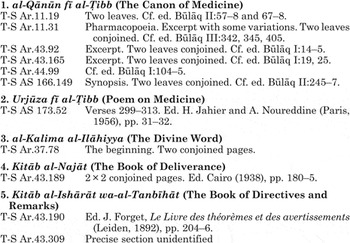
Hebrew Fragments
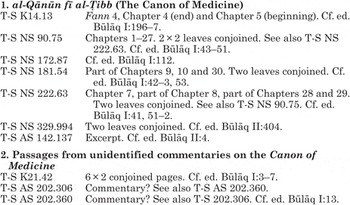
Fragments in Arabic Script