INTRODUCTION
The history of Bombay, or Mumbai as it has been called since 1995, often commences with a curious tale. The tale maintains that before being a bustling colonial city of the British Raj in Western India, it was a mere fishing village inhabited by the Koli, a caste purported to be Mumbai's aboriginal inhabitants.Footnote 1 A Lonely Planet guidebook for India from 2003, for example, claims, “The islands that now form Mumbai were first home to the Koli fisher folk as far back as the second century BC; Koli shanties occupy parts of the city shoreline today.”Footnote 2 The DK Eyewitness Travel Guide from 2002 even deploys the Koli tale to justify the city's renaming in 1995: “The city has now reverted to its local name, Mumbai, from Mumba Devi, the eight armed goddess worshipped by the Koli fishermen who were the islands’ original inhabitants.”Footnote 3 Such travel guides paint the Koli as engaged in traditional livelihoods and native arts and crafts. The Koli and their koliwadas (Koli habitations) thus become evidence of the strange and multiple temporalities persisting in urban India.
Both accounts, each of which occurs on the first page of the guidebooks’ sections on Mumbai, make the Koli ahistorical and timeless containers of Mumbai's premodern past rather than “emergent and shaped by social and historical contingency.”Footnote 4 The Lonely Planet’s narrative glosses “shanties” as indicative of primitivity and thus proof that an uninterrupted social landscape has existed from the second century BC to the present. The DK guidebook goes one step further and postulates that the city's renaming from Bombay to Mumbai was not due to contemporary politics—even though it was the pro-Marathi and Hindu nationalist Shiv Sena in Maharashtra who championed the renaming in 1995Footnote 5—but was a reversion to an original condition and thus honorific of local and religious sentiment. The changing of “Bombay” to “Mumbai” is thus artfully neutralized into a mere historical reclamation.
This paper analyzes such representations of the Koli as aboriginal that circulated in colonial Bombay. It asks to what ends the Koli tale was narrated in the nineteenth and early twentieth centuries and underscores the ways such representations were used to manage dispossession, enact claim-making practices, and build urban realities. It shows that only once the Koli became marked as aboriginal and treated as privileged petitioners by the early twentieth century did they garner protections with regards to the allocation of urban space that nominally exempted them from market-based redevelopment projects in the neighborhoods of Bombay. The Koli case thus serves as an illustrative example through which to understand the particular co-emergence of the power of caste and capital, although there were certainly other collective identities and groups who were similarly deployed.
The resourcefulness of Koli aboriginality in Bombay exceeded Koli and state agency. Various communities used the Koli tale as a narrative resource to establish their own position; each new telling of the Koli tale served particular agendas. Religious, regional, linguistic, caste, or class groups such as Hindus, Muslims, Christians, Parsis, Maharashtrians, property holders, financiers, and bureaucrats deployed the Koli either as genealogical ancestors in need of custodianship and liberation or as traditional obstacles to progress. The Koli story thus served as a means of negotiating access to land and resources amidst the rising dominance of capitalist land markets: it pluralized tenure possibilities, proliferated relations of clientelism with the state, and cemented relations of bondage to moneyed and empowered patrons. Together, these increased the viability of identity-based negotiations in acquiring space in the city. As they would continue to do in postcolonial and neoliberal India, “chains of capital thrived on stories of difference.”Footnote 6
Through the Koli story, this article revisits important questions about the relationship between aboriginal or indigenous peoples, capitalism, and governance. It unravels the relationship between the historical deployment of the concept of aboriginality and its mediating role in the power of capital and state-making practices in a colonial urban context. For this, I borrow from Tania Li's insights about the similar category of indigeneity: “[I]ndigeneity was not conjured unilaterally by ‘global capitalism’ with its functional requirements any more than it was conjured from the top down by technologies for indirect rule. It has been woven from diverse threads that emerge from above and below in entanglements with capitalism.… [I]ndigeneity does not stand opposed to capitalism as a prior state on a linear, evolutionary trajectory or as a marker of ineffable otherness. Rather, it stands opposed to capitalism because it coemerged with it.”Footnote 7 Pursuing such entanglements from above and below, I show that the Koli story served as both a new idiom for claim-making by competing actors in the city and as a tactic of governance by the colonial regime to contain, manage, regulate, distribute, and reorganize entitlements in the city at a time when the commoditization of land, labor, and shelter made colonial Bombay increasingly unlivable. In short, Koli aboriginality helped various actors manage capitalism in the city; it did not precede it.
CUSTOM AND CAPITAL IN THE COLONIAL CITY
In colonial India, the Koli tale brought Bombay's history into accord with the conceits of modern and colonial historiography wherein a sharp rupture is posited between the modern and the premodern, between capitalist organization and precapitalist organization, and between an India after Europe and an India before Europe. Mitchell Dean calls such a mode of history-telling a “profoundly discontinuist schema” in which “moral economy, paternalism, and the right to subsistence, are displaced by political economy, the contract, and the laws of market society.”Footnote 8 The Koli become positioned as the absolute Other to the novelty of what succeeded them, obscuring the dynamism of their so-called “traditional” habitation and reproductive practices. Foucault's warning against the concept of tradition in historical narratives is apt: “[T]radition enables us to isolate the new against a background of permanence.…”Footnote 9 While rendering the Koli aboriginal did nominally protect them from the displacements and dispossessions of the contract or the laws of the market, such renderings also cast the entire history of precolonial life as a static fiction wherein the Koli lived in harmony within nature, only to be subsequently oppressed by a shifting cast of “invaders,” the identity of whom depended on who was telling the story and who wanted to do the protecting.
Indeed, as Bombay's “aboriginals,” the Koli served as an alibi for the market-based dispossession of the remainder of the population and as a pretext for claim-making by competing collective identities who used the Koli tale as a narrative resource to argue for their own “nativity.” Following scholars who have warned of the limitations of concessions to tradition or caste by the colonial regime, the exemption of the Koli was a case of “hollowing out” customary norms and claims.Footnote 10 The Koli gained a privileged legal status within an urban regime that staged its concessions to custom by enshrining koliwadas throughout Bombay. However, it was only as if the Koli were exempt from market forces since, of course, market dynamics pervaded Koli experiences as well: they were often placed on land less desirable to urban developers and other residents; their ability to gain livelihood from fishing rose and fell with the vicissitudes of the market in fish and other provisions like wheat, rice, and materials for boat-making; their ability to gain by selling land was deeply constrained as laws emerged to prevent forfeiture by protected illiberal subjects; and the possibility of selling their labor for supplemental income was reduced by the over-determined nature of their caste status.Footnote 11 The koliwadas were not walled enclaves within which the circulation of capital stopped, even if that circulation was partially mitigated or mediated. The Koli were customary alibis for growing capitalist markets of land, labor, and shelter.Footnote 12
It is important to attend to the imbrications of custom, caste, and “the primitive” in colonial capitalism and see that the governance of the city as a space for capital was made possible through the Koli and the customary or traditional formations they indexed. We therefore must confront the specificity of the power of capital in colonial Bombay. Yet, studies of aboriginality are rarely undertaken for the colonial city; scholars are prone to debate whether and how colonial cities deviated from the North Atlantic urban form since capitalist modernity was allegedly thwarted by the colonial encounter.Footnote 13 We must move past views that cast Bombay as “a mosaic” where distinct social worlds live side by sideFootnote 14 and avoid repeating the paradigms of some nineteenth-century observers who called southern Bombay “Modern Town” (Upper and Lower Colaba, Fort North and South, and Esplanade) and opposed it to “Native Town” or “the winding narrow streets of Hindu, Muslim, and Jewish districts.”Footnote 15 While order characterized the former and neglect or repression characterized the “spontaneous settlements” of the latter,Footnote 16 an early critic warned that Bombay “was shaped increasingly and in important ways by its place within the internal economy and not simply by the ‘modernizing’ forces of the West.”Footnote 17 Such perspectives reflect wider conceptions of colonial modernity, in which liberal and illiberal, modern and traditional, or rational and customary are juxtaposed as separate, extending notions of “dual societies” into the colonial urban form.Footnote 18 Scholars have recently shown that dualism was an important imperial vision, a set of operating representations about “black town” and “white town,” but that the “critical aspect of colonial cities resided not in the clarity of this duality, but in the tension of blurred boundaries between the two.”Footnote 19 Recent scholarship on urbanism in South Asia has challenged the “colonial city” paradigm that treats port cities like Bombay, Madras, Calcutta, and Karachi as exogenous European impositions on traditional Indian terrain.Footnote 20
Critiques of the colonial or “dual” city paradigm can be assimilated into the Foucauldian insight that liberalism is not a political doctrine and state of affairs but rather an end toward which governmental actions and aspirations are undertaken and articulated.Footnote 21 Such a re-conception demands that we “attend to the relations of the ethos of liberalism and its techne.”Footnote 22 Doing so enables us to position questions of continuity and change in colonial India in an “international or global field of action” where “the rule of freedom” motivated urban reform projects worldwide.Footnote 23 The “freedom” of liberalism should thus be understood not as a given of urban modernity but rather an end towards which reform projects were motivated. Through such an understanding, we see that liberal and illiberal spaces were and are juxtaposed to justify governmental interventions.
Phenomena that appear “traditional” in colonial cities—like the koliwadas, customary land rights, and tenurial arrangements that do not follow a script of status to contract—are not signs of the persistence of the past but rather are produced as an element of colonial change, not because colonial Bombay was or still is illiberal but precisely because of the way in which new goals of liberal governance were vocalized. As in the case of the Koli tale, institutions of urban governance, variations on land tenure, and appeals to caste and custom proliferated in response to the dominance of capitalist land markets.
The remainder of this article begins by showing how the city emerged from within a regional commercialization of agriculture, a spatial and temporal dynamic into which East India Company officials inserted themselves. The Koli were initially not exempt and only later protected from Company dispossessions to reorder Bombay's space. The paper's second part follows the circulation of representations of the Koli as the aboriginals of Bombay by nineteenth-century Indian and colonial historians of the city. With the rise of novel calculative and classificatory techniques such as censuses, ethnographies, ethnolinguistic surveys and histories, anthropometric techniques, housing enumerations, and maps, the Koli became bearers of Bombay's premodern past who could be used to make claims over land and city space. A final section shows how the Koli tale was deployed to secure koliwadas in the early twentieth century under the City of Bombay Improvement Trust's urban renewal projects that served capitalist development. Seeing these together is necessary to understanding both Koli experiences and the specific history of capitalism in colonial Bombay.
THE “RURBAN” NEXUS IN COLONIAL BOMBAY
Bombay's emergence as the commercial capital of the British Raj was a product of contingent and contested processes that included the subcontinent's own precolonial trajectories toward capitalism. This section explores this specific history of the emergence of the power of capital from within these longer trajectories. My purpose is to counteract the notion that Bombay was a “colonial city” grafted onto traditional Indian terrain by administrative fiat. While the seven islands that made Bombay were acquired in the seventeenth century, it was not until, first 1774, and then again until 1803, that the Company acquired but then lost Salsette, the island to the north, and then regained it after wars with the Marathas.
Putting Bombay and its environs to use for Company purposes required settling the seven islands and Salsette by the early 1800s to maximize revenue, reordering spatial functions toward Company aims, and engaging in projects of “improvement”—all processes that necessitated dispossessions. Company officials used incentives and disincentives to manage land use. To reorder space, the Company compensated dispossessions of land—voluntary, involuntary, coerced, and opportunistic alienations—while it rationalized and regularized revenue collections. But locals repeatedly renegotiated these compensations. Amongst them were the Koli, who were one of several petitioners subjected to Company tactics of spatial reordering in what would eventually become the city. At first Koli were indistinguishable from other claimants who impeded or redirected the Company's aims. Only later did their status as customary claimants emerge, a status that lent credibility to a European-led and merchant-based theory of capitalism's origins.
The Kolis of Bombay were initially treated by the same rationale as were other inhabitants such as the bhandaris (a caste of toddy dealers and cultivators), cunbees (cultivators), and other merchants and landholders. A 1773 petition from the Koli to the Company contested their land and housing, but they were not exceptional claimants in this period. The “public diary” reported: “At a Consultation of the 16th March 1773, the Board read a petition from the caste of people called coolies, requesting as their houses contiguous to the works are ordered to be down that the ground formerly marked for rebuilding the same may now be appropriated to that use.”Footnote 24 Later accounts would change “coolies” to “Kolis.” The Company wanted to secure Dongri Hill, the highest point on the island, for its defense, which brought them into negotiations with the Kolis there. On 13 April 1774, officials responded to the petition. The land paymaster presented an estimate of the full value of the Koli houses there in comparison with the value of the land they had been allotted to rebuild their houses on. He determined that the Koli houses could remain since the Company's treasury was too low to compensate them. Kolis in other parts of the island, however, were displaced for cash, basically no differently than other inhabitants and dispossessed claimants. The Kolis were also subject to equivalent forms of taxation by the Company. A land survey of Bombay from the 1820s showed a village of Colwady having 116 houses, from which not all of the potential tax revenue was being collected, a situation the government sought to correct.Footnote 25
The Company had inserted itself into an already dynamic “rurban nexus,” a term the historian Frank Perlin used to describe translocal spaces of early modern Eurasia where gradual shifts in population density formed a social continuum between urban and rural functions. Functions typically of an urban type, like local mints, were nodes of connection across trade routes that transected country villages and small rural towns. “Manufacturing and cash cropping for distant markets” characterized parts of Western India in a “rurban-type economy.”Footnote 26 Perlin replaced the teleological notion of “proto-industrialization” with what he called an early modern arena of “commercial manufactures,” since not every such place eventually industrialized. Cultivators could be engaged in moneylending and moneylenders could become landlords, indicating dynamic and intensifying uses of capital and labor before the arrival of the East India Company.Footnote 27 This methodologically comparative strategy of analysis assumed that precolonial South Asia was a dynamic interregional and historical space, not a static or cyclical society awaiting European instigation. Perlin said that “rural industrialization in Prussia, Bohemia and Bengal were best treated as aspects of a single set of both comparative and historical problems” so that scholars did not render “‘colonialism’ … endowed with the status of a deus ex machina, the source of a radical break with this static or reversible past.”Footnote 28
How, then, could one explain the eventual dominance of the English colonial system over India? Like Perlin, numerous scholars argued that the Company ultimately succeeded by being politically centralized, militarized, and connected to sister companies that could utilize resources from the colonization of the new world. But up to the eighteenth century, outcomes were much more regionally inflected and contingent.Footnote 29 Thus, commercial capitalism did not originate in Europe in the sixteenth century and then incorporate India, as world systems theory offered, but rather had diverse local contexts of origin that articulated with each other. It was precisely the dynamism of “rurban” networks across space that lent power to colonialism. The theory of colonial change was effectively moved out of a colonial and nationalist framework, in which even de-industrialization under colonial rule in India was “simply one example among a large number, some cases being located in the industrial heartlands of northwest Europe, even in England.”Footnote 30
In colonial Bombay, commerce and agriculture not only complimented each other, but depended on the capital and labor of the same people, who could shift functions. This flexible pool of labor and local “portfolio capitalists” were central to the course of Bombay's colonial history.Footnote 31 A report to the Government in Calcutta from 1774 noted the potential for agrarian revenue on the island of Salsette if laborers and settlers could be enticed there.Footnote 32 Land surveys in the 1820s gave Company officials information that allowed them to point to the full monetary potential of land to justify incentivizing forfeitures.Footnote 33 Revenue policy sought to maximize monetary gains through agrarian, commercial, or industrial sources whenever possible. Later colonial historians observed that in the eighteenth and nineteenth centuries the Company's “chief policy” in Bombay seemed to have been the “extension of cultivation.”Footnote 34
Regularizing and increasing revenues was difficult due to the variety of land tenures, difficulties in procuring deeds of transfer and sale, a tendency toward encroachments of “alarming proportions,” and inhabitants who considered themselves “entitled to sell, transfer and mortgage the land held by them.” Revenue shortfalls were chronic and unauthorized land sales or “fraudulent alienations” constant.Footnote 35 Since the cultivating classes were unable to make capital investments in land, Company officials sought the capital of Parsees from Surat and other landholders. In a letter to Bombay in 1807 presumably from the Government at Calcutta, officials were told: “We direct that you hold out such encouragements as may induce persons from Bombay and the adjacent County to settle at Salsette, by which means and under the Government of mild and equal laws, the settlers enjoying the benefit of protection of person and property, both the agriculture and commerce of the Island may be promoted.”Footnote 36
By encouraging settlers such as cunbees (cultivators), merchants, and landholders, fallow lands were brought into cultivation.Footnote 37 The Company issued public notices offering rent and lease incentives to overcome cultivators’ worries over flooding, rising tides, and swampy conditions. The Company even paid to transport people in from the interiors, transferring on one occasion fifty families and their cattle. Eventually, the Maratha Government at Poona took objection to this and the Company had to stop offering cultivators relocation assistance.Footnote 38 All duties on the trade in fish were also abolished so as to remove a source of oppression from those engaged in fishing.Footnote 39 White batty, coconut groves, other forms of rice cultivation, and occasionally sugar, tobacco, and indigo, were cultivated on the northern islands, including in “Dharavee,” the area that brought the second-highest cash revenues in 1777, surpassed only by Mallar.Footnote 40 The policy of letting out land in perpetuity was discouraged so as to avoid lands becoming “an incitement to needy adventurers,” which would “thereby place the tenants on the footing of Zamindars.”Footnote 41 In 1779, the Company granted itself the right “to reserve in our hands all lands or villages whose leases might fall either by insolvency of the Farmers or other casualties in order to allot them upon easy terms to new settlers.”Footnote 42 The Company also occasionally relieved debt since insolvency destabilized revenues.
Garnering control over the money supply in South Asia was crucial for general colonial control as well as for the specific practices of what Kaushik Ghosh calls “exclusive” and then “incorporative” governance that characterized the way colonial officials organized relations between “primitives” and caste Hindus, or tribal peoples and settled agriculturalists.Footnote 43 Company officials became embroiled in questions of custom and disputes over value that could determine both compensation and taxation. They regularly adjudicated disputes amongst inhabitants as well as contests over rightful use of government lands and “encroachments.” They provided compensations to seize private lands to serve colonial and “public” purposes like making roadways, assuring spatial order, or placing military outposts for security. According to Company rhetoric and self-imagination, their policies served to “liberate inhabitants” from previous social systems of extraction that had only perpetuated poverty. Portuguese forms of land tenure had left properties residing in the hands of Jesuits that were “annulled, and extinguished by conquest” of the Marathas. If the Company could obtain said lands “by force or treaty,” then its revenues could be used to offset expenditures for defense, or so they argued.Footnote 44
Petitions from wealthy landholders, collections of poorer residents, Muslims, and merchants contested the Company's terms of displacements and dispossessions. Let me illustrate with a few examples. Landholders protested when oarts (coconut groves) were cleared of their trees and asked to be compensated with trees rather than their full value in cash. Some estate holders protested being stopped from repairing their houses, such as Raghunath Purvoe, whose home was near Church Street. The Company eventually persisted, saying in 1772, “As there is great want of ground within the town walls for Europeans to build … the present proprietors [should] be positively prohibited [from] repairing their houses. This we hope will be a means of inducing them to sell to Europeans on reasonable terms.”Footnote 45 Another case is that of the Shamshett brothers, who held land on Old Woman's Island, which was next to Colaba and eventually connected to it. It was also adjacent to artillery barracks that the Company wanted for military defense. When the brothers were unable to produce the sale deed, they were only offered compensation for the value of their trees that were forcibly cut down in 1805. Numerous petitions from the Shamshetts were to no avail and eventually oral testimony by another native, who claimed they had never paid the full value for their initial purchase, precluded their receiving fair compensation, although they may have gotten land in Salsette years later.Footnote 46 Some householders had built their homes on the provision that they would forfeit it whenever necessary, so they were warranted no compensation: “I observe the names of Govindji Coppersmith and Ranoji Barber.… To these no valuation should be paid as they are of the number who agreed to rebuild on condition that, whenever it might be deemed necessary to pull down their houses, it should be done without their being entitled to any compensation.”Footnote 47 But it was not just wealthy landholders who were managed. In 1771 it was stated, “[T]he small houses at present occupied by hamals and other indigent people between the Church and Bazar Gates should be removed” and the land “allotted to the proprietors of the larger houses which from being too near the ramparts are under orders to be pulled down.”Footnote 48
By the mid-nineteenth century, the commercial character of Bombay and its vicinity served the interests of more than just the Company. Even wealthy landholders saw the “public” benefits in managing space. The Company considered registering all titles and deeds to solve disputes, the need for infrastructures demanded more spatial reordering, and rent revenues were always short of what officials thought they should be. The historian Mariam Dossal says Act XVIII of 1839 was “essentially the act that accorded legal status to the existence of private property in Bombay.” It regularized terms for compensation when land was taken for public purposes, provided building regulations whose violations garnered penalties, and adjudicated land transfers and procedures for appeals. The Act also permitted laying railways and other infrastructures. Eventually contests over dispossessions enlisted wealthy native merchants like Juggonath Sunkersett, Dadabhoy Pestonjee, and Bomanjee Hormusjee, who worked to create a compromise in 1843 “owing to the selfish opposition of a few individuals … we trust, [they] will not be allowed to thwart Government in a measure of great public advantage.”Footnote 49
Space may have been neatly divided into towns and countries in the imperial censuses of colonial India, initiated in the 1860s, but in practice these spaces were physically and socially amorphous. Historians of Bombay ought to place the colonial city in terms of its regional, temporal, and spatial dynamics. Through negotiations with competing and neighboring governments, the Company deployed capital acquired from an early modern Indian Ocean economy that had made Parsis and other Gujarati merchants wealthy. It enticed large estates to displace smaller householders through successful appeals to the public value of commerce. Circular migrants continued to switch functions between agriculture, industry, and commerce as needs arose well into the twentieth century, and capitalists, too, traveled between country and city. This “fluctuating element of the population” frustrated census takers since it undermined efforts to classify and quantify people. Labor organizers and historians, too, wondered whether the circular migrations made organization against capital harder to sustain.Footnote 50 By the turn of the twentieth century, Bombay's population and growth was a distant second behind London, but its density had already become “fearfully more intense” in the 1880s.Footnote 51 Ultimately, the making of Bombay as a dense space with an urban logic was a process of subordinating agrarian interests within the city's boundaries whenever it was profitable to do so. It also entailed removing agriculture from the story of the city.
REPRESENTING THE KOLI PEOPLES
Representations of the Kolis as aboriginal were part of a widespread process of city-making, one that entailed demarcating, subordinating, and dissociating commercial functions from agricultural ones. Mid-nineteenth century Bombay was a place of mixed-use lands that included cultivation and commerce. Some neighborhoods still have names betraying their agrarian past such as Khetwady (“khet” means cultivated field; the suffix “-wady” denotes locality or neighborhood, the same suffix at the end of koliwada), Fanaswady (“fanas” means jackfruit), and Kakadwady (“kakad” means cucumber). Subordinating agrarian interests to urban ones was a fraught process.
This section traces the emerging representations of the Koli as the aboriginals of Bombay through Indian and colonial accounts of the city.Footnote 52 These representations were simultaneous with the rise of novel calculative and classificatory techniques such as demographic enumerations, ethnolinguistic surveys that informed linguistic histories, anthropometry, housing enumerations, and maps, all of which sought to manage the intensification of land use patterns, density, and crises of social reproduction in colonial Bombay. The American Civil War generated a speculative cotton boom and bust in the 1860s, and during the 1870s famines swept through Western India. Migrants fled to Bombay and some were denied entry to the city in order to manage the population. The plague of 1896–1897 foregrounded overcrowding within the dense entrails of neighborhoods such as Nagpada, Kamathipura, and Kumbharwada and pushed population pressures northward. Disputes increased around increasingly scarce resources in the city like land, labor, and shelter.
Amidst these changes, native and colonial historians of the city positioned their own collective identities inside genealogies deriving, to varying extents, from the Koli. The Koli provided legitimacy for being in the city, forming a prehistory for different “insiders” and “outsiders” depending on who told the story. The circulation of the Koli story served to authorize the colonial city paradigm, indigenizing a clearly distinguished portion of the “foreign” colonial city as “native” and using that boundary to separate migrants from descendants of the Koli. The story was mobilized for claim-making purposes and struggles over nativity became struggles over Bombay itself. Intense urban redevelopment in the colonial and postcolonial periods, discussed in the next section, made the Koli an object of governance and a medium through which governance in the city was produced.
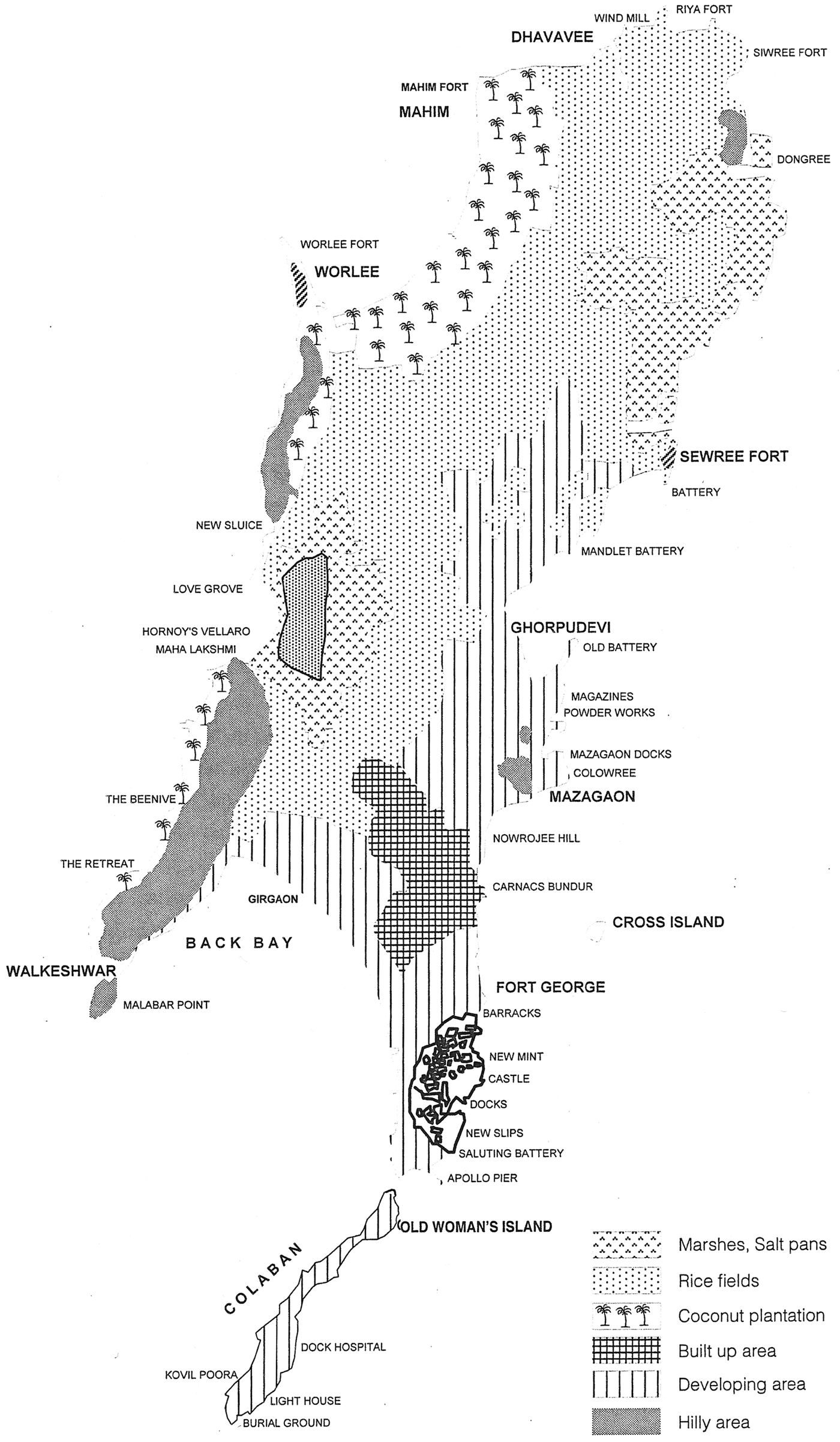
Mixed agrarian and urban land use in early Bombay. Courtesy/Source: Thomas Dickinson's map of Bombay Island, redrawn from The Gazetteer of Bombay City and Island, from Miriam Dossal, Theatre of Conflict, City of Hope (New Delhi: Oxford University Press, 2010).

At some point the English were aware of the diversity of the Koli peoples, but by the early twentieth century conceptions of Koli identity had shifted from flexible to fixed. Rather than being known as those who provided a variety of labor and services for early modern and regional states, and occasionally even raided emergent sovereigns to gain recognition or contest their authority, they were now conceived as a singular collective identity over-determined by a caste status that prescribed an occupation. The East India Company had employed Koli peoples as palanquin carriers, traded them as slaves, and suppressed “Koli outrages” in the hills of Western India in the 1830s and 1840s when hill peoples calling themselves Koli raided villages and forts. The Ratnagiri Gazetteer reported, “The warlike Kolis were a terrible menace to British Rule.”Footnote 53 The English suppressed Koli revolts in 1839 and 1844 and tried to socially reform the Koli by settling them alongside other tribal communities into an agrarian order on the Konkan coast.Footnote 54 Some “Kolis” were catalogued as an agricultural caste in the Madras census of 1881.Footnote 55 Moreover, the word “Koli” and “coolie” were still being conflated as late as the early 1900s. One 1844 source actually spelled “Koli” as “Colee,” and a later sources turned “coolie” into “Koli.”Footnote 56
New methods were applied to understand the Kolis’ history, culture, and geography. Knowledge production on colonial subjects used historical linguistics and anthropometric techniques to divide South Asian history into periods characterized by religion—namely “Hindu,” “Muslim,” and “British/Christian.” Peoples were classified on a spectrum between primitive and modern or amongst a hierarchy of races. The Koli came to be seen as non-modern fishing peoples willfully confined to coastal locations because of their nature-based and primordial identity. They needed to be protected by granting them access to the sea.Footnote 57
This section focuses on two pairs of narrative histories of the city of Bombay that each deploys the Koli differently. Rather than participating in a debate about whether the Koli were the first inhabitants or not, I will focus on the effects that various narrations of the Koli as “aboriginals” enabled. The word “aboriginal”—sometimes “autochthonous” in the sources—connotes an isolated, non-migratory, biological, race-like category. By the early twentieth century, the attribution of “aboriginal” status to the Koli fixed their once-shifting identity in a state of nature.
The first pair of histories includes one from 1863 billed as the “first Marathi biography of the city” by Govind Narayan, which depended on an 1838 English account written by R. X. Murphy and published by the Bombay Geographical Society. Narayan was a migrant to Bombay who wrote fourteen books in Marathi. He positioned himself as a reformer of Indian customs and castes and advocated for greater hygiene and thrift with regards to the use of family wealth. He aspired to what he perceived were English habits of philanthropy and citizenship, while holding the Marathi language in high esteem. Narayan's account borrowed heavily from Murphy's 1838 account in the Transactions of the Bombay Geographical Society, suggesting that what scholars privileged as native sources were produced in conversation with British knowledge-making practices. To determine Bombay's history, Murphy drew on English accounts, theories about the history of language as mapping onto the histories of people, and his own personal interviews.Footnote 58
While Narayan used a word that is often translated as “aboriginal,” it is important that we disambiguate the terms “original” and “aboriginal.” The word “aboriginal” in the 2008 English translation of Narayan's text was “muulasthayik”Footnote 59 in Marathi, which was itself Narayan's translation of Murphy's word “original” from 1838. Murphy used the term “original races” to discuss the groups he thought were the earliest. According to several Sanskrit, Marathi, and Hindi dictionaries, “muula” means rooted, long-standing, a source, or primary, chief, or dominant, and “sthayik” means resident, inhabitant, in place. Together, the words suggest one rooted in place as distinguished from members of a mobile community or migrants. Why Narayan chose to translate “original” into “muulasthayik” may have to do with the rise of histories that sought origins in fixed spatial containers. The Indic word “adivasi,” or “first inhabitant,” according to Kaushik Ghosh, “was a neologism produced by Jharkhand's tribal leaders in the 1930s, signaling the arrival of a new imaginary of a unified tribal identity.”Footnote 60 Ghosh demonstrates that in a setting of increasing contests over land, rights, and representation, the word itself masked the hierarchies among the peoples it sought to represent, obscuring the middle-class status of leaders who used it in self-representations to colonial, postcolonial, and transnational authorities. Thus, such forms of representation both reveal and mask contests over identity.
Murphy and Narayan both claimed that Hindu and Marathi-speaking peoples were the descendants of the earliest settlers of Mumbai by deducing the historical status of their spoken languages in relation to that of the Koli. They claimed that the Christians of Bombay were originally Marathi-speaking Kolis and so were originally Hindu. They found that of the several types of Marathi spoken in Bombay, the Christians’ Marathi was unique and they must have spoken that type of Marathi even before they were converted to Christianity, since there were no Portuguese loan words in their language. They inferred that this language must have been the lingua franca on the island before the Portuguese arrived. Other Christians were also seen as originally Koli because they spoke a language similar to the Koli dialect. All their spoken languages and dialects were analyzed as aspects of what together was a historically reconstructed “Marathi language” related to the “Koli dialect,” treated as an inert entity receiving change from the outside.Footnote 61 Narayan called it “Colee Bhasha.” He inferred that Marathi-speaking Hindus were descendants of the longest-resident community in Bombay, the Koli, an assertion made possible by the Orientalist periodization of India's history into three sequential religions.Footnote 62
Narayan determined that the Kolis had inhabited Bombay before 1295, after which four other castes arrived and intermixed with them, making their languages similar. Further borrowing from Murphy, Narayan claimed the Koli were incorporated into upper-caste Hinduism because of their need for protection from other religions, rendering an inert “Hinduism” as a unitary entity preceding Islam in India: “The Walkeshwar Mahatmaya, a Sanskrit Purana describing the temple of Walkeshwar says that prior to the building of the Walkeshwar Temple, the Hindus were very much terrorized by the religious intolerance of Mubarak Badshah. This led to the arrival of Hindus of a very high caste in Mumbai. If the population had consisted only of Kolis, they would neither have striven to build the Temple nor would they have been able to recognize the threat to their religion.”Footnote 63 Thus, the Koli were turned into victims of Islamic intolerance, from which only their descendants, high-caste Hindus, could protect them.
The second pair of sources includes one by a colonial official, Stephen Meredyth Edwardes, who in turn depended upon an account by J. Gerson Da Cunha, who was a Goan Catholic physician, Orientalist, and colonial anthropologist. Cunha served as president of the Bombay chapter of the Royal Asiatic Society and Anthropological Society and was an advocate of anthropometry. He called the Koli an “aboriginal tribe” based on his own measurements of them, and determined that they were of Dravidian origin, not Aryan, a claim not made in the earlier texts: “His nasal index, which is the best test of race distinction … gives the average 82.0, while that of the Brahman is 70.4.”Footnote 64 He used quantitative measurements to overcome the limitations of qualitative ethnolinguistic surveys.Footnote 65 Such measurements “confirmed” the view of an Aryan invasion theory—the notion that the first set of “invaders” into the Indian subcontinent were Aryans who conquered “aboriginal” or Dravidian subjects, imposing Aryan languages such as Sanskrit and its derivatives. Such a view depended on the reconstructed language “Proto-Aryan” or “Proto-Indo-European” that, like the case cited above, slipped easily from being a linguistic family to a “race.”Footnote 66 Romila Thapar and Thomas Trautmann have both critiqued this “racial theory of Indian civilization” that posited that “the constitutive event for Indian civilization, the Big Bang through which it came into being, was the clash between invading, fair-skinned, civilized Sanskrit speaking Aryans and dark-skinned, barbarous aborigines.”Footnote 67 In this second set of sources, unlike the first, quantitative measurements of the Koli confirmed an encounter between two “races” in Ancient India. The Koli were cast as Dravidian and pre-Aryan, and thus the most native of all.
Included in the censuses of Bombay city in the early 1900s were Edwardes’ histories that used Cunha as a source. Stephen Meredyth Edwardes wrote several histories of Bombay in the early 1900s that conformed to tropes of using aboriginals to legitimate the spatial inventions of colonial historians.Footnote 68 Whereas Cunha said, “the true history of India begins with the Portuguese,” Edwardes centralized English agency. Alluding to the foreign and merchant theory of capitalism's origins, he claimed that Company merchants were emancipators who harnessed idle natural resources to put them into use. He rendered the Koli as a part of Bombay's natural bounty, and thought the English alone recognized both the economic potential of the islands and the Kolis. They had emancipating the Kolis from the tyranny of oppressors which they had survived “because of their natural sturdiness.” Edwardes later cited the further authority of anthropometric techniques to “confirm” that the Kolis were of a Dravidian type and pre-Brahmanical, Brahmanism having “hid the truth of his lowly origin in a specious tale of descent from a Lunar Monarch.”Footnote 69 Edwardes criticized the Portuguese treatment of the Koli:
Of minor arrangements for the benefit of the people, one may remark in particular the emancipation of the Kolis, and the refusal to grant a five years’ monopoly to the sellers of betel-leaf. “As we understand,” wrote the Directors in 1791, “that an old arbitrary power, which was established when the island belonged to the Portuguese, has been exercised in later times … against that most useful set of people, the fishermen, a certain number of them being obliged to sell fish in the Breach water, and to act as palanquin-bearers to some of the gentlemen in office, for the first of which duties they either receive no pay or scarce any and for the latter not near the wages customary, and that they experience other grievances which must not only subject their industry to imposition,… they be on receipt of this letter entirely abolished and the fishermen released from all such servitude and left as free as the other inhabitants of the island.”Footnote 70
Liberating the Koli to their original, natural, and exalted status was central to the construction of English legitimacy; they were liberated and harnessed for English-led world commerce.
In a subsequent history meant to account for the rise in the population of Bombay and read before the “Indian Section of the Royal Anthropological Institute” in 1925, Edwardes provided the most fully developed of the above views. He divided the history of the “City and Island of Bombay” into five periods and noted that during the first four periods there were seven islands, and only in the last, “Their eventual union to form the modern Island of Bombay was effected during the final or British period.” This unification and reclamation of land were “potent factors in the growth of the occupied area and in the change from rural to urban.” To garner the authority of prehistory, the Koli needed to be located on each of the seven islands:
While the precise origin of the Bombay Kolis must remain conjectural, two facts concerning their contribution to the history of Bombay may be accepted as practically certain. The first is that in each of the seven islands, they formed rude settlements which still exist today. Those settlements are often mentioned in the letters and documents of the early period of British rule under the name of ‘Koliwadas’ or ‘Koli quarters,’ and were located close to the seashore, as it existed before the reclamations of the eighteenth and nineteenth centuries. Such a situation was obviously necessary for people whose primary occupation was, as it still is, sea-fishing … and although the general progress of the city and the acquisition of wealth by the Kolis themselves have combined to rob these settlements of their former primitive appearance and characteristic, there can be little doubt that they represent the original location of the Koli hamlets in the seven islands.Footnote 71
By establishing that the Koli were on each of the seven islands, the entirety of the “modern Island of Bombay” that had absorbed those prior seven islands was granted historical legitimacy.
Accounting for Bombay's growth with precision would have required a story of multiple beginnings, of connections between country and city, and of agrarian and commercial capitalism developing together. Neither the colonial state nor particularly Maharashtrian Brahmanical or any other community would be able to lay exclusive claim on it. The Koli tale managed this messiness. For the Marathi biography, the Koli story served to wrest authority from the colonial state and identify Hinduism as Bombay's earliest religion. For colonial officials, the Koli story identified the city's origins in an ahistorical and timeless, deep past protected only in the English present, through an English-led modernity borne of historical rupture. In identifying the Koli, colonial officials identified a local noble savage; Kolis were primitive, surely, but also superior in their authenticity, so English efforts could be seen as historically restorative.
In later histories of the city of Bombay, Cunha and Edwardes are repeatedly cited as sources for the claim that the Koli are the “indigenous” inhabitants of the islands of Bombay.Footnote 72 Each subsequent telling proliferates sources that successively “corroborate,” through inter-referentiality, the story of Koli timelessness. But besides being used by other groups to make claims on the space of the city, the Koli also acted as their own claimants. I will now turn to how the Kolis deployed their own status as the “aboriginal” inhabitants of Bombay to become privileged petitioners after the plague of 1898 disrupted commercial life and warranted urban renewal in colonial Bombay.
ENSHRINING KOLIWADAS AND CONTAINING ENTITLEMENTS
The ways in which capitalist land markets were mediated by, contested, or accommodated through appeals to caste and custom made Bombay's capitalist land markets historically specific. Once recognized as the aboriginals of Bombay the Koli became protected petitioners against official acquisitions of their land and property. The over-determination of Koli caste identity even extended to “fishermen” more broadly, “a trend of primitivizing the coast … where the caste nature of fishers … [arises] from their labor and the very landscape they inhabit.”Footnote 73 Like other claimants who had negotiated dispossessions since the eighteenth century, the Kolis continued to appeal to officials when faced with the risk of being displaced. Only now, they could appeal to their exclusive occupation so that living by the sea was compulsory and a customary demand that a colonial state keen to obscure its illegitimacy would have to honor.
This section discusses the emergence of the Koli as modern petitioners amidst the proliferation of institutions of governance in the city of Bombay. The critiques and limitations of the Municipal Corporation produced the City of Bombay Improvement Trust, which in turn produced the Bombay Development Department. Two particular events during this period display the emergence of the Kolis as modern petitioners as the politics of caste and capital were conjoined. The first was in 1904, when the City of Bombay Improvement Trust had designs on their neighborhood as part of the “Mandvi-Koliwada Scheme.” The second was in 1919, when a plan was drafted to develop an upper-class neighborhood in Colaba, which even Edwardes had cited as an early Koli village.
In the history of the government of colonial India, municipal offices were one of the first elected and partly representative bodies. While the Municipal Commissioner was appointed, members were elected. Demands for self-representative and liberal governance arose in Bombay as early as the 1860s in response to unfair trade conditions and debates over currency, tariffs, and exchange rates.Footnote 74 For decades these demands found outlets in officially sanctioned and voluntary institutions such as the Municipal Corporation, Port Trust, reform societies, and journalistic organizations that issued circulars, pamphlets, and newspapers to voice their concerns. By the 1890s, Bombay had a colonial public sphere filled with vibrant dialogue and debate voicing competing aspirations for the future of the city and of colonial India.
Municipal governance had been transformed in the 1880s by the liberal viceroy Ripon in the spirit of bureaucratic decentralization of the British Raj. These reforms gave municipal corporations legal autonomy by authorizing elected seats over appointed ones and more control over still very limited budgets. The reforms extended the franchise to salaried and propertied inhabitants three- to four-fold between the 1880s and World War I, according to some estimates.Footnote 75 Yet they paled in comparison to reforms in other cities like Glasgow or London. This discrepancy was a constant source of agitation voiced in leading newspapers in the interwar period.Footnote 76
Scholars have debated whether establishing municipal autonomy bolstered anti-colonial nationalism or whether the devolution of colonial power nullified anti-colonialism's effects. The latter argument is based on the reality that “autonomy” meant that mostly English-educated elites and propertied men were given the power to “represent” their communities within the structures of imperial governance, which provided the opportunity to amend imperial management but not the power to dismantle colonial rule.Footnote 77 In practice, municipal autonomy meant lower imperial expenditures for city improvement and therefore enormous municipal expenditures. Municipal councils and corporations were given the responsibility of sanitation, lighting, and town infrastructure, which they were to pay for through the establishment of a tax base. The strategy of accommodation and limitation was argued for plainly by Ripon himself when he claimed that the devolution of power instructed natives in self-rule, thereby furthering one of the aims of the colonial civilizing mission. This would do more to secure imperial control than would excluding natives, which was advocated by the Gladstone administration and exemplified in the very exclusive India Council in London.Footnote 78 Critics at the time argued, as have subsequent scholars, that although municipal corporations were partly elected bodies, this masked the ways in which the so called self-governance of the city actually enhanced the colonial state's power.
But there is more to consider here than questions of whether “autonomy” was a guise of imperial control, or municipal autonomy was too severely restricted to be effective. The emergence of the City of Bombay Improvement Trust in 1898 provides us an opportunity to reconsider the productivity and proliferation of governance in Bombay. Rather than mourn the limitations and incompleteness of offers of self-rule, or their ineffectiveness in practice, we can instead consider what was actually produced by the deployment of the discourse of self-rule, by a variety of actors across the colonial divide. This approach goes beyond highlighting gaps between the doctrine of liberalism and its practice in colonial spaces and explores liberalism as a patterned set of critiques of state-practice that produced effects in governance.
The City of Bombay Improvement Trust was created in 1898 in response to the global plague that caused capital and migrants to flee the city. Alarmed by the decline in businesses and provoked to restore urban order, new authorities like the Trust were created to clean up the city and restore what was called its “sanitary credit,” most especially in the city's dense central neighborhoods. The Trust cemented the constellations of networks that would keep credit and commerce moving by enlisting private capital for ostensibly “public” aims. As such, it concealed its linkage with state-financial networks that created new mechanisms for financial investments, land acquisitions, and rearrangements of the social order to secure revenues.
By partly masking its statist imbrications, such an institution could serve to legitimate state agendas ostensibly by extending the practices of “self-governance” that had begun with the Municipal Commissioner's office. A key mission of the Trust became to counter conceptions of the state as a site of repressive and negative power. The Trust rearranged the links between finance capital, banks, bankers, land, housing, space, occupants, law and regulations, and elected bodies. In 1920, just as critiques of the lack of representation in municipal affairs were mounting and gaining success—a major textile strike and several others had occurred in 1919, the government was being pressured to extend the franchise beyond property owners to renters paying Rs. 5/month, and universal franchise was being championed in the city—the colonial authorities allied with vested propertied interests to form yet another institution, the Bombay Development Department (BDD). These shifts in authority, from the Municipal Corporation to the City of Bombay Improvement Trust in 1898 and then outward to the Bombay Development Department in 1920, sidestepped previous limitations on the power of capital.
In 1904, a plan was proposed to redevelop Mandvi-Koliwada in central Bombay, the redevelopment project Edwardes’ had referenced in his 1925 speech. Doing so required that the Trust acquire some of the Kolis’ land. The Kolis organized in response and submitted a petition to the Trust that asserted that they had to live, “within easy reach of the sea as our people have for generations past lived and worked in Koliwada.” If they were not allowed to live by the sea, they claimed, their community would be broken up and they would be forced to live elsewhere, which would be difficult because “our industry already languishing, must collapse, and a population numbering over a thousand souls, go to ruin.” They were not opposed to moving provided they could be allotted new land “by which we may be kept together in New Koliwada, after the improvements are completed and space re-allotted for building purposes … [or] be still kept together in a fresh colony along the seaside and more or less near the scene of our present labours.”Footnote 79 We see here how the Koli used the notion of their customary and caste identity as workers on the sea to negotiate their displacement. Interestingly, their petition also commented on the way markets were impinging on their “languishing industry,” showing that the Koli were all-too-aware that protection mitigated but did not prevent erasure. They were assured that their request would be honored, but Trust officials later rescinded that promise and decided that in this case the Koli had no right to claim land in Mandvi-Koliwada since it was no longer near the sea.Footnote 80 Being a part of an eco-environment near the sea determined the outcome of their request—fixing Koli identity had fixed the Koli in place.
In 1919, an ambitious plan was proposed to redevelop Colaba (previously spelled “Kolaba”) from what was called a “slum” into an upper- and middle-class neighborhood. The plan is shown in a report by Mirams, the Consulting Surveyor to the Government of Bombay, and although we do not know if it ever materialized, it does indicate the rationales through which displacements were understood. The displacement of numerous inhabitants was described as “automatic,” indicating people followed their jobs and would occupy residences they could afford in the rental markets. “Fishermen,” however, were singled out as warranting specially allocated lands for their fishing village. Colaba was initially divided into Upper, Middle, and Lower Colaba in 1872, before which it had been two islands lying between the waters of the harbor and Back Bay. Reclamations united the two into Colaba in the southern part of Bombay near Fort, where businesses associated with overseas commerce housed local and foreign merchants. In 1872, Colaba's total population was 16,601 and it suffered the highest cholera death rate in the entire city. It had no system of drainage or sewage and was entirely dependent on the manual labor of the manual scavengers, halalkhors,Footnote 81 to clean the area. Upper Colaba was occupied by military and naval personnel, Middle Colaba was mostly private dwellings, and Lower Colaba, built from the reclamations on the island's eastern and western edges, contained “the thickly crowded and very insanitary village of Hamalwady.”Footnote 82 Hamalwady (or “porter's colony”) was called a “dirty village” and officials had attempted to move those inhabitants to make way for a railway and to protect the health of the European troops, but they had failed. By 1919, though, the majority had to leave. While the “slum” of Colaba was to be cleaned up by the Bombay Improvement Trust, customary occupations were exempted from the forces of the market.Footnote 83
Numerous other peoples classified as “poor” were displaced without compensation. In their proposal for the some 1,200 acres of land being reclaimed in Colaba, officials recognized that the working, middle, and upper classes were struggling to find adequate housing near their work. Officials thought Colaba should be a middle- and upper-class neighborhood, since working-class people would want to stay near industries moving northward. In a report about the redevelopment the surveyor, Mirams wrote: “In the same way the absence of the cotton green, will render the cotton go-downs as such no longer necessary. The boat basins will not be required and a great deal of the insanitary Colaba village will be automatically evacuated by the people who now find employment in industry in Colaba.”Footnote 84 He noted that much of Colaba had been a “festering sore” awaiting officials to address its problems. According to the census, 8,736 people would be directly affected by the development scheme and of those 6,570 would have no interest in remaining in Colaba. The Port Trust was charged with providing accommodation to the laborers who would be “automatically” moved to Sewri, the site of the new Cotton Green.
But of the fishermen of Colaba, the report stated: “The only people for whom housing accommodation must be provided within the area of the scheme is the fishermen, and a suitable area of land has been set aside towards the south for a Fishing Village of approved design with an area sufficient for 100 tenements. There are only 89 families of fishermen, numbering 400 persons. Ample provision has been made for the drying of nets, open spaces, etc. The intention is to make it a miniature model village and there need be no fear of its becoming a nuisance.”Footnote 85 “Ample space” was provided for “fishermen” to carry out their caste occupation within a “miniature model village” that would be instructive for others. The claim that they had lived by the sea “for generations past” showed such groups were effective in using their collective identity to convince officials to give them land.
Two maps in the report detail the model village to be constructed, just adjacent to middle- and upper-class housing blocks. In total, 294.6 acres were going to be developed with 360 building plots varying in size from roughly 1,000 to 3,000 square yards. Mirams intended to use the land to its most efficient end through an “economic development” of the space. Wide roads, a waterfront garden, tennis courts, a concert hall with a café, a swimming bath, market, chauffeur's quarters, motor garages, stables, and servants’ quarters all indicated that Colaba was to become a place of leisure and recreation. Mirams was especially proud of the innovative design of servants’ quarters: “To the west of the stables and immediately adjoining them, a site is provided for servants’ quarters. This is a new departure in Indian development, but it is hoped that owners of houses would be pleased to be free from the nuisance inevitably created by servants being located in close proximity to the main residences.”Footnote 86 Clearly, proximity to the servants was thought to be more of a “nuisance” to upper-class residents than was a reconstructed fishermen's colony. Colaba was to become an exclusive neighborhood with planned segregation. The fishermen were the exception to this vision, being the only non-upper-class community permitted there.
The report's final section provides the financial cost and estimated profits. Mirams projected that the scheme would cost Rs. 4,07,37,000. Sales of the building sites would recover an average of Rs. 50–75/square yard, totaling some Rs. 5,30,30,400. It was expected the net profit of 1 Crore and 23 Lakhs (Rs. 1,22,93,400) would be realized, with no credit required to purchase materials.Footnote 87 Not only developers, but the Municipality and Improvement Trust as well, would benefit from turning Colaba into an exclusive neighborhood. Upper-class residential neighborhoods with carefully controlled and planned segregation, and with Koli colonies visible for good measure, could make urbanism a profitable and worthy project at last. But the main purpose of the project was ostensibly to manage the population. In his concluding remarks Mirams touted three main goals accomplished by the scheme:
(1) Return a net profit of well over a crore of rupees;
(2) Provide for a population of 15,000 persons including of course servants and tradesmen; and
(3) Make of what is now a slum, a first class residential district and seaside resort, second to none in India.
These goals indicated the rationales that guided governance in colonial Bombay: First, any governmental intervention had to be profitable. Second, it had to provide for and manage the needs of various sectors of the population, all of which had for decades been classified, studied, distinguished, and documented in numerous censuses of the city and throughout colonial India. Finally, it had to secure the colonial port city of Bombay as capable of maximizing economic ends. Once the plague arrived, sanitizing the “slums” was pursued throughout the city to restore its “sanitary credit.” Intervening in Colaba's settlements helped to manage a crucial segment of colonial Bombay's population: the native bourgeoisie and propertied residents.
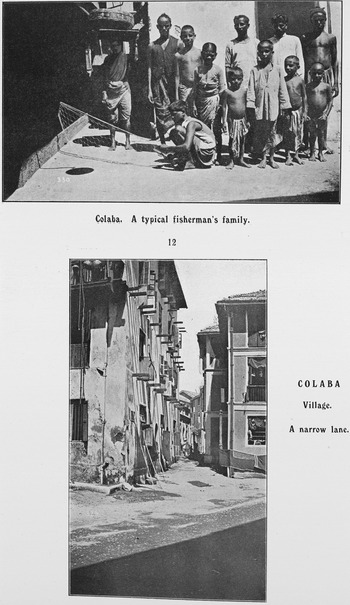
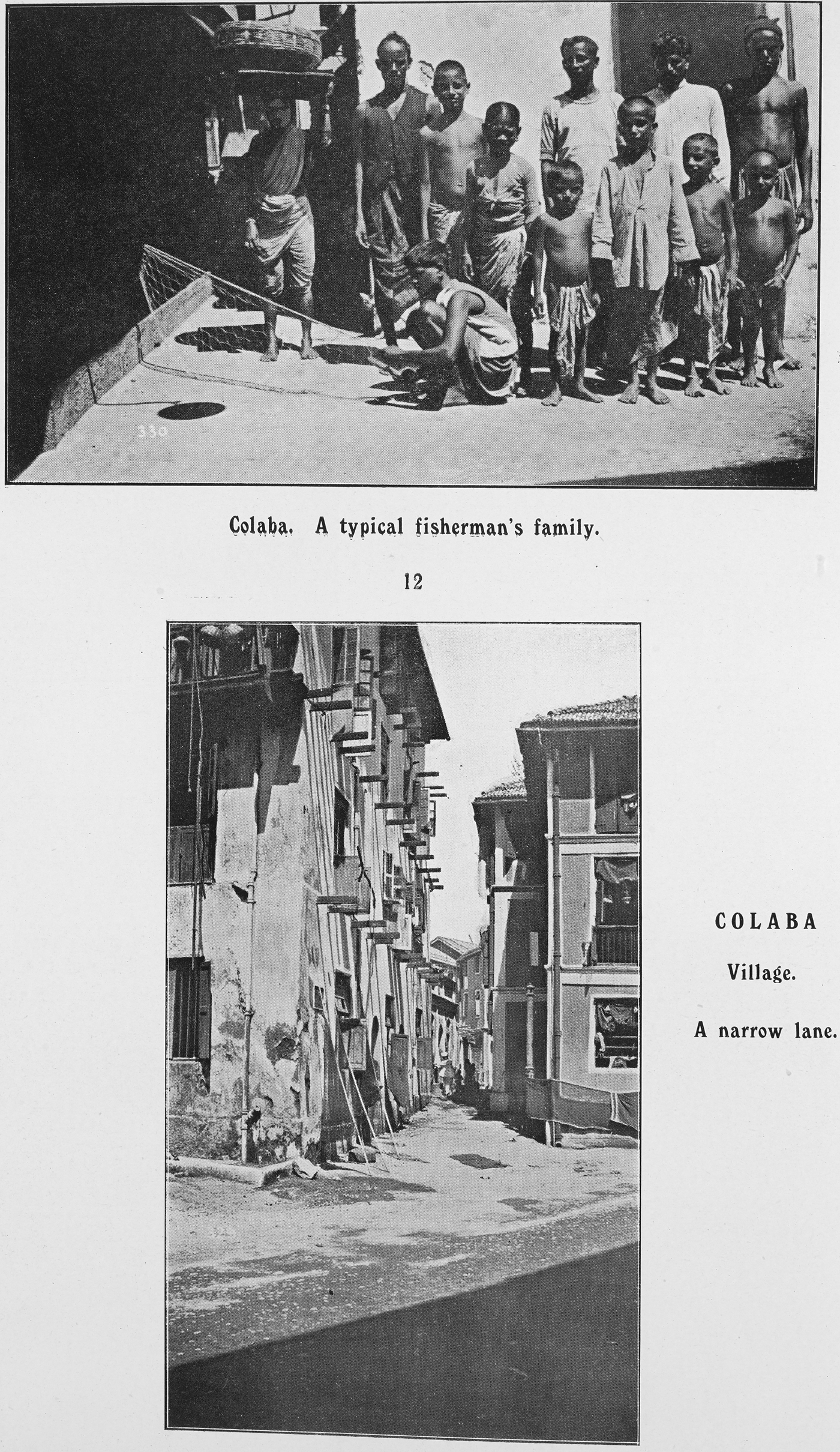
Once the aboriginal Koli story had installed them in their pastness upon the landscape of the present, practices of governance deployed it to modernize and “economize” housing practices within the city, leaving most inhabitants to “automatically” follow the vicissitudes of the markets. But by conceding Koli claims, contemporary officials established a link between their own actions and their custodianship of Bombay's deep “past” by demonstrating that select native customs were being honored. The photographs and captions in figure 2 were included with the documents of the Colaba Redevelopment Scheme, positioning the Koli as ethnographic subjects through an assumption of their alterity.
Pictures of the Koli peoples and Colaba. Courtesy/Source: “Colaba Development (Eastern Section) Preliminary Report,” by Mirams in Poona, ORW 1996 B6, 1916, British Library, London.
By the twentieth century, markets in land and housing were major determining forces in most Bombay residents’ lives, albeit mediated through affinities of religious, caste, and customary identity. The Koli, especially, but also other caste groups such as the Kumbhars, made themselves legible as political actors by locating themselves nominally outside of the market and with a special relation to the state. We will see that this special relation opened up opportunities for future contestation. Mostly prominent landlords and industrialists ran institutions of governance in the city; for them, honoring the Kolis’ customary claims served to grant governing bodies the legitimacy to transfer resources in the city to private interests in the name of the public good.
POSTCOLONIAL URBAN DEVELOPMENT
Rather than debate whether or not capitalism characterized colonial Bombay, we have seen here that the governance of the city as a space for capital was made possible through utilization of the Koli story. Capitalist land markets were layered onto, conjoined with, incorporated, and even produced a variety of customary entitlements and tenurial relations in response to new pressures. Koli identity became a narrative resource with which to make customary claims in the city and to contest and negotiate urban redevelopment projects.
By the twentieth century, and bolstered by the nationalist imagination, the Koli story lent credibility to the notion that capitalism arrived on the subcontinent from the outside, produced ex nihilo, as a foreign imposition that either needed to be removed or reoriented in native hands for local and national development. For nationalists, the city's landscape, where displaced and dispossessed villagers overcrowded the city, mirrored colonialism itself. Colonial urban modernity was a story of commercial ambition that incentivized an entire cadre of supporting actors to migrate to the city. However, through a brutal form of high imperialism, capitalist potential was thwarted by colonialism, which left underdevelopment, massive poverty, unbuilt urban environments, and unharnessed productive potential in its wake. Postcolonial development sought to reclaim the colonial city to set it on its modernizing path while avoiding the excesses of colonial extraction. It aimed to complete the task that had been left undone due to the racial exclusions and greed of colonizing adventurers. From the colonialist through the nationalist periods, the city, like modernity itself, was a sign of the new and the novel, a spatial container that could occasion a historical break with India's traditional past.Footnote 88 By deploying the Koli, colonialists and nationalists garnered the legitimacy of tradition.
It was long assumed that European colonizing adventurers imposed capitalism on Asia. As Sherry Ortner noted when discussing how many political economists’ view history: “History is often treated as something that arrives, like a ship, from outside the society in question…. The political economists, moreover, tend to situate themselves more on the ship of (capitalist) history than on the shore.”Footnote 89 Poignant interventions by scholars such as Perlin and Ludden located colonialism and capitalism in India as products of a dynamic peasant society before 1800, such that commercial towns and agrarian social landscapes across Eurasia produced capitalist imperialism in a “global, cross-cultural process of invention.”Footnote 90 Similarly decentering with regards to urbanism, this article has avoided the use of arbitrary demographic criteria to define a “degree of urbanization,” which has long been used to characterize India as primarily rural. Instead, I have shown how urbanization was a historical process that encompassed both the rural and urban and have explored “their structuration by some of the same political-economic processes.”Footnote 91
The growing power of the East India Company on the islands is best considered as a part and parcel of an already-existing “rurban” nexus, where Company tradesmen and officials, native merchants, cultivators, Koli peoples, and a circular migratory population used the city in agricultural, industrial, and commercial ventures. The city of Bombay was not grafted by European fiat and colonial vision onto a spatially empty premodern terrain, but was rather a contingent outcome of multiple factors whose beginnings extended into the subcontinent's interiors and hinterlands through deeper, temporal dynamics.
Multiple kinds of labor and land regimes articulated and flowed through networks that far exceeded the Europe-India encounter, and yet transformations rendered Bombay a node within nineteenth-century imperial commodity regimes. The Koli origin story was deployed in the early twentieth century to manage dispossession and lend credibility to a European-led merchant theory of capitalism's origins on Bombay's city-islands. “Maintaining” Koli habitation practices authorized the colonial regime to pursue the myth of a rational market, a culture-free and unmediated distribution of housing, land, and property in the remainder of the city. But Bombay's koliwadas and the Kolis' position as the aboriginals of the city were formed inside of colonial capitalist modernity, not outside of it.
While koliwadas may have become shrines to custom or tradition, they also contained Koli demands. Beyond serving as a metonym for the colonial history of Bombay, the Koli tale authorized a single register through which resistance to the recommodification of land, labor, and shelter could be enacted.Footnote 92 Kaushik Ghosh describes well how “tradition” can be mobilized against postcolonial development: “What began as an act of exclusive governmentality—the recognition of the negative and separate nature of tribal/adivasi identity—became an aporia in the project of incorporative governmentality. To incorporate the subjects of alterity, to make them continuous with the time of the modern, the state now has to include this alterity as a conceptual basis of its actions.”Footnote 93 Between 2006 and 2009, officials attempted to relocate the residents of Dharavi, notoriously cited by the United Nations as Asia's second-largest slum behind only Orangi Township in Karachi.Footnote 94 The Koli community of Dharavi was positioned as a particularly salient obstacle to the ambitions of developer Mukesh Mehta, who earned his property development credentials in the United States and had managed to mobilize an international alliance of capital. Activists and residents rallied behind the Koli and stalled Mehta's and the city's plans, even though Mehta had already made close to US$3 million in payouts.Footnote 95 The Koli argued they had lived there for at least 450 years and claimed to possess British documents to prove it. The redevelopment scheme required the consent of the Koli and the Kumbhar to proceed, the latter being potters by caste who also lived in Dharavi. Of the Koli, Mehta said, “They are the most important and government recognizes it, because they are the original ‘sons of the soil.’”Footnote 96 Dharvai's Koli community frequently supports Shiv Sena candidates and they suggest that the concepts of “aboriginal” or “indigenous,” being so close to “native,” are all too easily coopted by Hindu nationalism.Footnote 97
Whoever represents the Koli depends on “preserving the alterity” of Koli livelihoods and reproducing the illiberal spaces and modes of distribution and allocation that are a hallmark of colonial governance. But rather than merely ask why such spaces of exception or the “savage slot” were created under colonialism on the grounds that certain subjects were seen as not ready for liberalism, we ought to ask how these spaces of exception put into play practices and provocations that made liberalism a horizon or project of governance itself.Footnote 98 Some of those practices certainly include indictments against colonial exclusions, but they also include reform projects undertaken by emergent and aspiring imperial and national citizens or civic associations who seek to sedentarize and liberalize illiberal subjects through development projects, demands for self-governance, and inclusions in finance and development. For instance, increasing allotted FSIs (floor space indexes, a ratio between built area and plot size) to Koli land has made some Koli into landlords of non-Koli tenants in koliwadas, with the benefits accruing mainly to dominant Kolis and middlemen. In Dharavi, for example, some of the nicest houses belong to Koli.Footnote 99 Postcolonial dispossessions continue to build the city in the service of capital. Researchers and activists alike have warned, “Though the very aboriginals of Mumbai City—the Kolis are visible in the panorama of cultural flux in everyday life of the city, they are slowly being transitioned to social extinction.”Footnote 100