Introduction
Historians of South Asian Islam have long recognized the overlapping domains of religious and political power in Punjab.Footnote 1 Sufi shrines—and the powerful spiritual lineages and networks around them—provide a critical window into analysing the interplay between ideology and structure. As trusted intermediaries between the state and its subjects, the leading shrines of Punjab have historically acted as important nodes of rural power structure. Allies of the Moguls, tolerated by Sikh rule, and appeased by the British, the shrine families of Punjab have never remained out of favour. In the run-up to Pakistan's creation, they played an important role in the organization of Muslim politics in Punjab. This article develops a contemporary reading of this historically embedded relationship between shrines and politics, emphasizing patterns of both continuity and change.
Through a first ever comprehensive mapping of the number and influence of shrines across Pakistani Punjab, we furnish new evidence on the persistence of shrine-related families in politics after independence. The analysis in this article consists of three key components. First, we shed new light on long-run continuities in the political influence of shrines. We argue that the historically configured relationship between religion, land, and politics that was fostered in the pre-partition era has largely survived after independence. Second, we propose some underlying mechanisms for this political persistence. Using a detailed evaluation of the primary and secondary material on shrine-related political dynasties, we identify several potential explanations, including the nature and evolution of political alliances, marital networks, macro political structures, and patrimonial exchange. Third, some preliminary evidence is offered on key features of spatial and temporal heterogeneity with regard to the political influence of shrines.
Our analysis complements prior work on the subject, including the seminal contributions by David Gilmartin on PunjabFootnote 2 and Sarah AnsariFootnote 3 on Sind.Footnote 4 While largely historical in orientation and devoted to studying the interaction of Sufi saints and state power under colonial rule, both studies have tremendous contemporary relevance. The interplay between shrines and state power in Pakistan's formative phase points towards the role of initial conditions in shaping long-run continuities. Few studies have, however, attempted to link the past with the present by tracing the political influence of shrines over time. The three partial attempts in this regard conducted by Riaz Hasan, Saifur Rahman Sherani, and Khurshid Kamal Aziz, respectively,Footnote 5 are both dated and discursive, and have a weak evidentiary basis. While past research has developed some relevant contemporary insights, a systematic analysis of the relationship between pīrs and politics is still awaited. This article makes a humble contribution in this regard.
Apart from the literature on religion, state, and politics in South Asia, this article connects with wider debates on institutions and development. Exploring the interplay between shrines and politics provides a useful prism to analyse the conditions for democratic politics in Muslim societies. It is also central to understanding the long-term causes of weak political institutions. Given the centrality of path dependence to the study of politics,Footnote 6 understanding the historically embedded power of shrines, and its persistence over time, is both relevant and important. Institutional development is also ultimately tied to the genesis and persistence of elitesFootnote 7 and to dynastic politics.Footnote 8 Any such intellectual endeavour in Pakistan's context requires an understanding of religious authority, its intersection with material structures, and continuity over time.Footnote 9
The remainder of this article is organized as follows. In the second section, we lay out the conceptual and empirical framework, describe key features of our database on political shrines, and present selective evidence on political persistence. The third section offers potential mechanisms for persistence, the fourth section comments on patterns of variability across time and space, and the final section concludes.
Shrines and political power
Before mapping the political influence of shrines, we begin by setting out some conceptual preliminaries on the nexus between shrines and power. The exercise of power involves many elements that are central to the religious authority of shrines, including such factors as obedience, compliance, and reciprocity. In sociological terms, power is not simply expressed through force, domination, or manipulation; it also seeks legitimacy. Obedience is crucial for analyses of power relations. As Hans Gerth and C. W. Mills argue:
. . . the crux of the problem of power rests in understanding the origin, constitution, and maintenance of voluntary obedience . . .. An adequate understanding of power relations thus involves a knowledge of the grounds on which a power holder claims obedience, and the terms in which the obedient feels an obligation to obey.Footnote 10
Shrines are an integral component of this legitimating framework of power. In fact, when shrine guardians throw their weight behind any power proposition, the very legitimacy of their spiritual lineage and shrine brotherhood is effectively being invoked. Deference to well-established norms (adab) is a fundamental component of the religious eco-system of shrines.Footnote 11 Believers place high value on the extraordinary. The more superstitious can even be led to believe that a violation of norms will invite evils or activate supernatural forces.Footnote 12
In the wider social milieu, the pīrs’ political influence is a small part of their control of social structure. Where rural constituents are seized by deep structural inequalities, voting is reduced to a mundane compulsion. From the perspective of the poor believer, casting a vote to the pīr or to a candidate who enjoys his support is a relatively minor issue. This is connected with the politics of helplessness (majboori), which Mohmand and JavidFootnote 13 discuss in their analysis of voting behaviour and clientelistic political exchange in rural Punjab. The authors argue that ‘clientelism is not simply a negotiated relationship between two groups of unequal power, but one that is based on obligations and embedded exchanges that voters have come to interpret as helplessness’. This goes a step further in constituencies with politically influential shrines, since here helplessness is usually combined with voluntary obedience. Devotees seek the pīrs’ divine intercession in more consequential matters, such as decisions regarding property, jobs, marriages, ill-health, and disputes. It is in this context that voting becomes a minor affair; clearly, the political persistence it helps to generate is not a minor issue.
Connected with obedience is reciprocity in power relations. The dominance of religious elites is not a one-sided affair. It involves some ‘exchange of influences’.Footnote 14 Reciprocal interaction is the hallmark of all power relationships, including those formed around shrines. The relationship between sajjada nasheen and devotees (mureeds) is based on a stable exchange that involves both spiritual and material domains. Apart from offering religious intercession, the pīr provides a wide range of services: food for the poor, healing touch for the ill, talismans for the superstitious, and dispute resolution for conflicting parties. Where religious and landed power has blended, the mureeds remain economically dependent on the pīr. Their very sustenance is derived from the pīr’s control of economic resources.
The pīr’s privileged access to state elites and bureaucratic structures strengthens his intermediation capacity, resulting in the kind of patrimonial exchange that defines the political market place in poor democracies. Prominent shrine figures and their constituents are routinely engaged in clientelistic exchange, where the core religious influence of shrines is supplemented with patronage for followers. Given the structural dependence of rural constituents on traditional intermediaries, the pīr is usually both a religious and a political figure. While the religious authority stems from reverence for the original saint with whom the shrine is associated, the locus of shrine power is in its ‘informal organization’ and the implicit extra-associational norms situated in the community. However, shrine power is institutionalized through its intersection with the material domain. Politics plays a crucial role in institutionalizing shrine power.
If power is understood to be a social phenomenon stemming from numbers, resources, and organization, then many of Punjab's leading shrines possess these quintessential features. With their devotees running into hundreds of thousands and their influence spreading across various territories, shrine guardians usually command a large network of devotees. Electoral politics is often a means of converting this network into numbers. Shrine elites also control economic resources. The pīrs are a rich propertied class with historic claims to large tracts of agricultural land. Their control over land, which is a vital political asset, remains uncontested in the absence of any serious land reform. Control of the shrine economy, including public offerings on annual festivals (Urs), provide additional sources of wealth. Supplementing these resources is their symbolic capital, which Bierstedt describes as ‘supernatural resources’ of religious communities that ‘as agencies of a celestial government, apply supernatural sanctions as instruments of control’.Footnote 15 Finally, the pīrs operate as a well-organized class who can mobilize other landed and religious elites as well as their constituents to preserve their privileged position. Several illustrations of this superior social organization of pīrs will be offered in the following pages
It is useful to wind up this discussion on a quote from Paul L. Heck that underscores the deep connection between Sufism and politics:
Sufism has been involved in all that we think of as politics: conception of authority and power, legitimacy and contestation of rule, formation of socio-moral order of a community or nation, competition for patronage, prestige and control of a society's wealth, the mobilization of people and resources in support or against the status-quo, and so on.Footnote 16
Mapping political shrines across Punjab
The analysis in this article is based on one of the first comprehensive mappings of shrines across the length and breadth of Pakistani Punjab conducted by Malik and Mirza.Footnote 17 The effort entailed nearly two years of intensive data collection, drawing upon a variety of published and unpublished sources. In this section, we briefly describe the principal modes of data collection and summary features of this database.Footnote 18
Briefly, the compilation exercise consisted of a three-step procedure to merge historical and contemporary data on shrines. Our starting point was the detailed list of shrines on the register of Auqaf Department, Government of Punjab. Information on names and addresses of shrines was available for each circle, which typically consists of regions with overlapping district boundaries. A first challenge was to slot each shrine into the relevant contemporary administration division (tehsil) in which it is located. In the second step, we added supplementary historical information on prominent shrines from the different British District Gazetteers of Punjab. The Gazetteers typically provided information on influential shrines and their associated families under a separate section on ‘Religious Fairs and Festivals’. For supplementary information, web resources were also consulted, including Government of Punjab websites and Wikipedia pages on individual tehsils and districts.
Finally, we mapped all shrine-related families that directly participated in national and provincial elections using 15 waves of election results since 1937.Footnote 19 Relevant electoral information was obtained from a multitude of sources, including: Gazette notifications, FAFEN (2010), websites of Election Commission of Pakistan (ECP) and Punjab Assembly, and published resources in Urdu.Footnote 20 After having exhausted these sources, we verified the data with district resource persons and conducted supplementary unstructured interviews with leading shrine figures. These three complimentary elements (Auqaf, historical, and political lists) allowed us to create a consolidated database of 598 shrines across Punjab. This mapping reveals some interesting patterns. On a per-capita basis, there is no significant difference in shrine density between the north-central and south-western regions of Punjab.Footnote 21
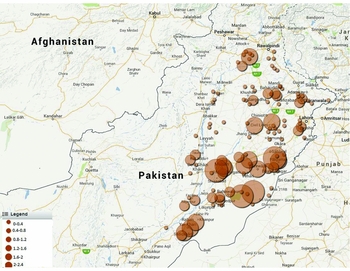
There is considerable heterogeneity in shrines by size and significance. A key differentiating characteristic is entry into electoral politics. Our qualitative mapping identified 64 shrines with a direct political connection. Out of a sample of 115 tehsils of Punjab, 42 tehsils had at least one politically influential shrine. Multan had the highest number of shrine families in politics, followed by Khairpur Tamewali, Chishtian, and Okara. Figure 1 provides a spatial representation of politically influential shrines. While south Punjab clearly dominates the distribution, around 39 per cent of politically influential shrines are situated in central Punjab. Many parts of central Punjab, including such districts as Sargodha, Jhang, Pakpattan, Sahiwal, Vehari, Mandi Bahauddin, and Okara, have shrines whose families directly participate in elections.Footnote 22
Numbers of politically influential shrines. Source: Malik and Mirza, Religion, Land and Politics.

Another important distinction in the shrine space is proximity to the river. Some of the oldest and most influential shrines are to be found in close proximity to the river. Access to the river has historically afforded better conditions for settled agriculture, especially prior to the construction of perennial canals. Rivers also acted as natural trade routes. At a time when Punjab's rivers were more navigable, proximity to the river facilitated greater mobility of people, sustaining the spiritual network revived periodically through attendance in religious fairs and festivals. The greater influence of riverine shrines also translated into privileged access to some of the most productive land along the river. With their control of land and water, these shrines had a natural advantage in the political arena. Today the politically influential shrines are overwhelmingly situated in close vicinity to the river (ten kilometres less). Guardians of these shrines are thus part of Punjab's influential landed gentry known as pīr-zamindars. It is this confluence of religion, land, and politics that sets apart the political economy of riverine shrines.
Entry and persistence
The power of leading shrine families is historically embedded. The pīrs have been courted by every ruler in Punjab. This is particularly true for Punjab's peripheral regions where, given the weak control of the centre, rulers have typically relied on indirect rule through traditional intermediaries. When the British rulers began consolidating their control over Punjab in the nineteenth century, they turned towards shrine notables for support. Support of shrine families was critical in crushing the 1857 uprising against the East India Company's army. Many shrine guardians issued fatawas (independent non-binding legal opinions of religious scholars) that dissuaded believers from rising against the British. Others provided men and materials to quell the uprising.
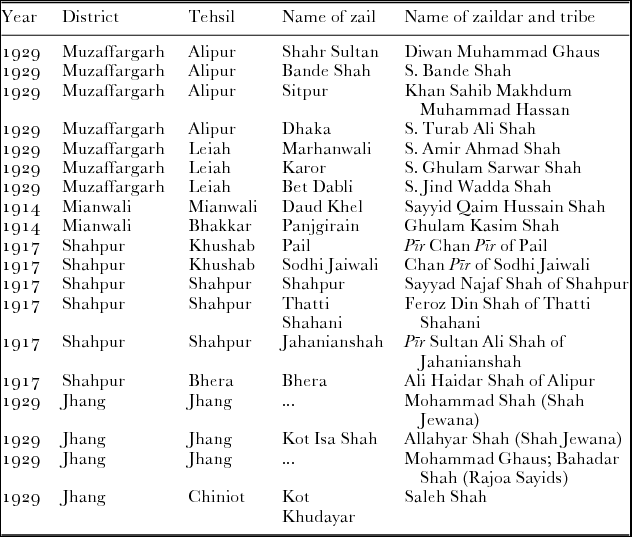
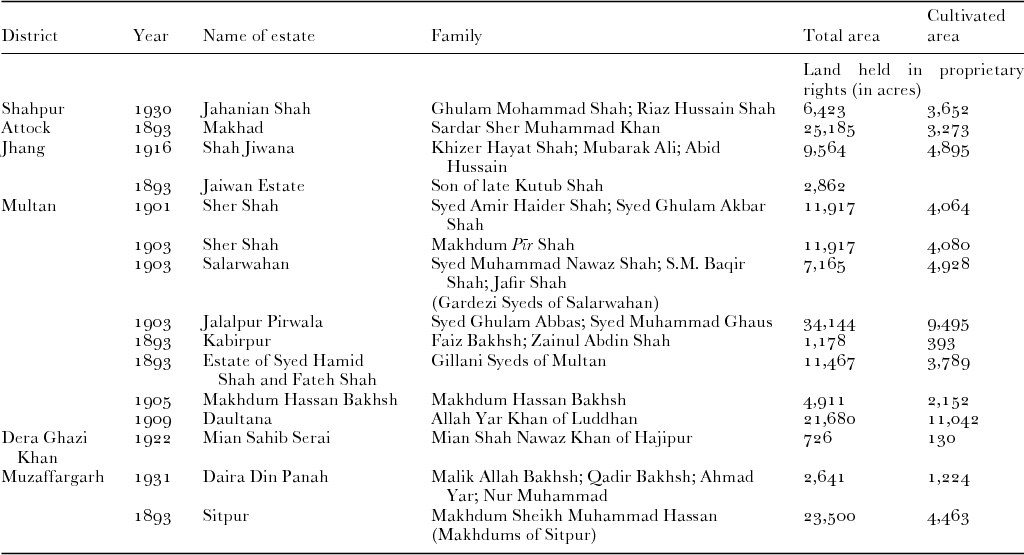
British rule brought some radical transformations that further entrenched their power. The rewards and privileges extended to shrine guardians were systematized by the British, which incorporated them firmly into the formal power structure.Footnote 23 The loyalty of pīrs was rewarded through land grants, honours, titles, and official positions. Many went on to become revenue collectors (zaildars), honorary magistrates, and presidents of municipal boards. Although plentiful evidence exists on this account, Table 1 presents the names of selected shrine families who were appointed as zaildars under British rule. Leading shrine families also benefited from the Court of Wards—an explicit instrument to prevent elite fragmentation after the family head dies or acquires excessive debt. In either of those two instances, the landed estates were temporarily taken over by the colonial state and children of the family looked after. Several prominent shrine families, including the Gilani Syeds of Multan, the Bukhari Syeds of Jhang, the Pīr of Makhad, and the Makhdums of Sitpur, benefited from the Court of Wards (see Table 2). Perhaps the most significant legal intervention that protected the landed interests of shrine families was the introduction of the 1900 Land Alienation Act that forbade the sale of land to non-agrarian castes. Through an exceptional categorization of religious families as agrarian castes, the sajjada nasheens of Punjab became beneficiaries of superior proprietary rights and eligible for landed gentry grants.
Zaildars from shrine families, selected districts and years

Source: Only a sample: many in Multan, Montgommery, and so on. Source: Punjab District Gazetteers (various issues).
Estates of leading shrine families under Court of Wards

Source: Punjab Government Record Office, Report of Estates Under Charge of the Court of Wards (various years).
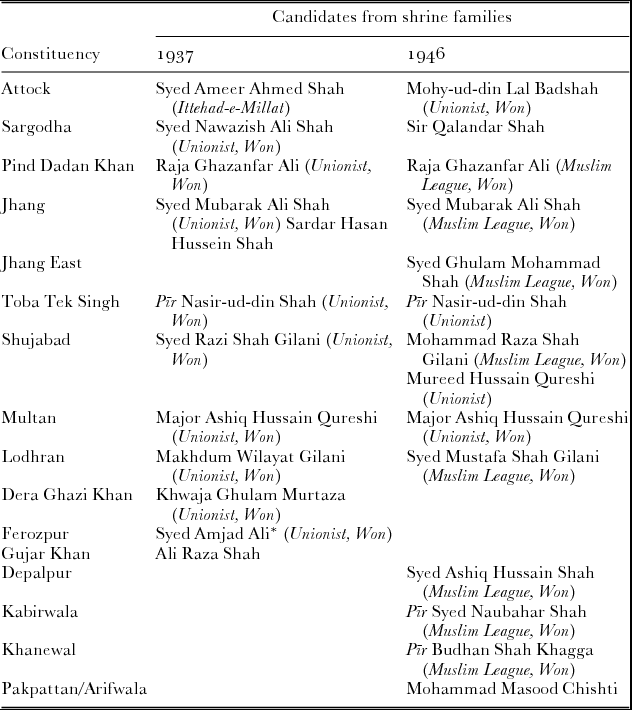
A critical juncture in Punjab's history, the Land Alienation Act firmly embedded the nexus between religious and landed power in Punjab, which continues to persist to this day. Establishment of property rights converted the hereditary succession of shrines into a powerful economic proposition, facilitating the rise of political dynasties that allowed religious families to spread their power across several generations. When the British permitted restricted enfranchisement in the 1920s, the shrine guardians, who had already emerged as leading beneficiaries of colonial patronage, were well positioned to enter the political arena. Punjab's prominent pīrs became elected on rural Muhammedan and landed gentry seats. Their subsequent participation in 1937 and 1946 elections made them a formidable political reality. Table 3 presents notable pīrs as candidates for elections held by the colonial administration. Besides their traditional strongholds in south-western Punjab, several shrine families ran elections from central Punjab. Prominent amongst these were Pīr Nasir-ud-din Shah of Kamalia, Makhdum Syed Ali Raza Shah of Sindhlianwali, Makhdum Nasir Hussain Shah, and Pīr Mohy-ud-din Lal Badshah of Makhad Sharif (Attock). With an early foothold in politics, pīrs became natural contenders for political power.
Participation of shrine families in elections in pre-partition Punjab

Source: Anjum, 2013; Punjab Assembly website. *related to the caretakers of Daud Bandagi in Shergarh.
In the early twentieth century, Punjab's prominent shrine families firmly aligned themselves with the Unionist Party, a secular alliance of Punjab's landed aristocracy. When the demand for Pakistan gained momentum, they joined the Muslim League; some of them became front-runners of the Pakistan movement.Footnote 24 After independence, the pīrs retained a permanent presence in politics, well represented in both military and civilian dispensations. They were part of all experiments in political engineering introduced by military rulers. From Ayub Khan's idea of Basic Democracy (BD) to Zia-ul-Haq's Majlis-e-Shura, the pīrs had little difficulty adjusting to political flavours of the time. They were absorbed both in Zia-ul-Haq's narrow vision of Islamization and General Pervez Musharraf's regime of enlightened moderation.
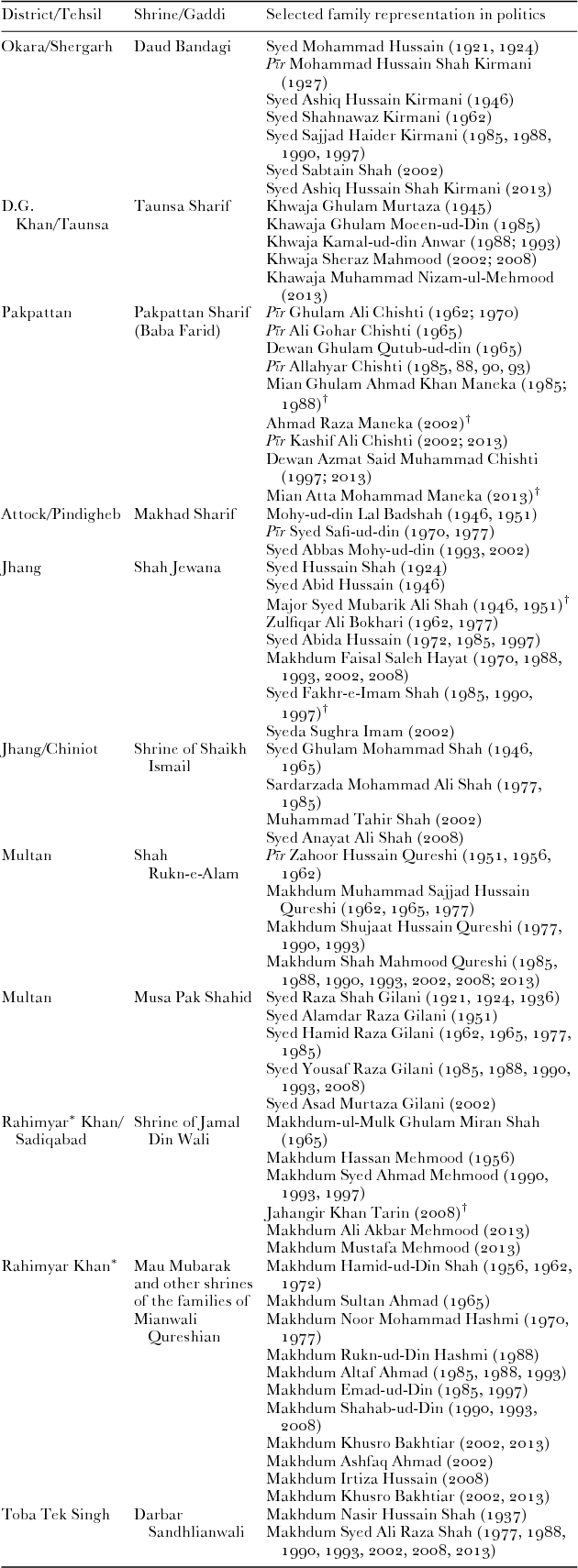
In short, the pīrs have remained a pervasive political reality in post-1947 Punjab. As Table 4 shows, many leading shrine families were repeatedly elected as members of provincial and national assemblies.Footnote 25 Interestingly, while 19 per cent of total rural Muslim constituencies in the 1920 and 1946 provincial elections were occupied by shrine families,Footnote 26 the corresponding ratio still stands at 16 per cent for the National Assembly formed after 2013 elections. Clearly, the pīrs constitute a resilient political class whose electoral presence has only moderately reduced despite the growth of education, addition of new constituencies, and rapid urbanization.
Persistence of leading shrine families in politics

† Related to the shrine family. *Previous political and administrative appointments with the Bahawalpur state not mentioned (Rahimyar Khan was part of the former Bahawalpur state). Year in parentheses represents the year elected to the National or Provincial Assembly. Information in this table is purely illustrative; the list of individuals and their respective election years is not comprehensive. Source: Adapted from Malik and Mirza, Religion, Land and Politics.
The initial political economy configuration, represented by the confluence of religion, land, and politics, has effectively endured in post-independence Punjab. Historically influential shrines, particularly those recognized and rewarded under British rule, were more likely to select into politics after 1947. The shrine-related political dynasties mentioned in Table 4 were both part of the pre-partition nobility and members of landed gentry. The combination of landed and religious power is a most potent political weapon.Footnote 27
Mechanisms of persistence
The strong patterns of political persistence established in the previous section call for a better understanding of the mechanisms that reproduce shrine influence in the political domain. Limited research has been carried out on this subject. This section takes a first stab at this by offering some plausible explanations for this persistence.Footnote 28
Shifting political loyalties
Pīrs are men of all political seasons. Demonstrating a remarkable capacity to reinvent and adapt themselves to changing political realities, the pīrs have remained part of every winning coalition. The pīrs were well represented in the Unionist Party and, later, in the Muslim League. Barring a few exceptions, this pattern of shifting allegiances has continued after independence. When the Muslim League broke away into several factions after independence, the pīrs became part of all dispensations, including the Republican Party, which was formed in 1955, and attracted members of landed gentry. When General Ayub Khan imposed Martial Law, Punjab's leading sajjada nasheens were quick to declare their support. Many joined the ranks of Convention Muslim League, the king's party that had the general's blessings. When Ayub Khan's grip on power weakened, they joined the breakaway faction known as the Council Muslim League and, later, the Muslim League, Qayyum Group. Perhaps, the first major political challenge to shrine families was posed by the rise of Zulfiqar Ali Bhutto's People's Party (PPP) when prominent pīrs were wiped out from Punjab's electoral map in 1970.Footnote 29
This political challenge was short-lived, however. The PPP soon opened its ranks for pīrs who were fully rehabilitated by 1977 when they ran elections on PPP's platform. Unsurprisingly, the same families did not wait long to desert Bhutto's party after Zia-ul-Haq imposed Martial Law in 1979.Footnote 30 Running with the backing of military machine, pīrs contested the non-party-based elections and joined the Majlis-e-Shura.Footnote 31 After Zia's exit in 1988, shrine families were well represented in the flanks of two major political parties that subsequently vied for power: the PPP and PML-N. A decade later, in 1999, Pervez Musharraf's coup generated another opportunity for political realignment. With a few notable exceptions, many pīrs crossed over to join the PML (Q)—a loose coalition of brokers supporting Musharraf's rule. As the above analysis indicates, Punjab's notable shrine families lack a stable political affiliation, and are ready to jump the ship when needed.
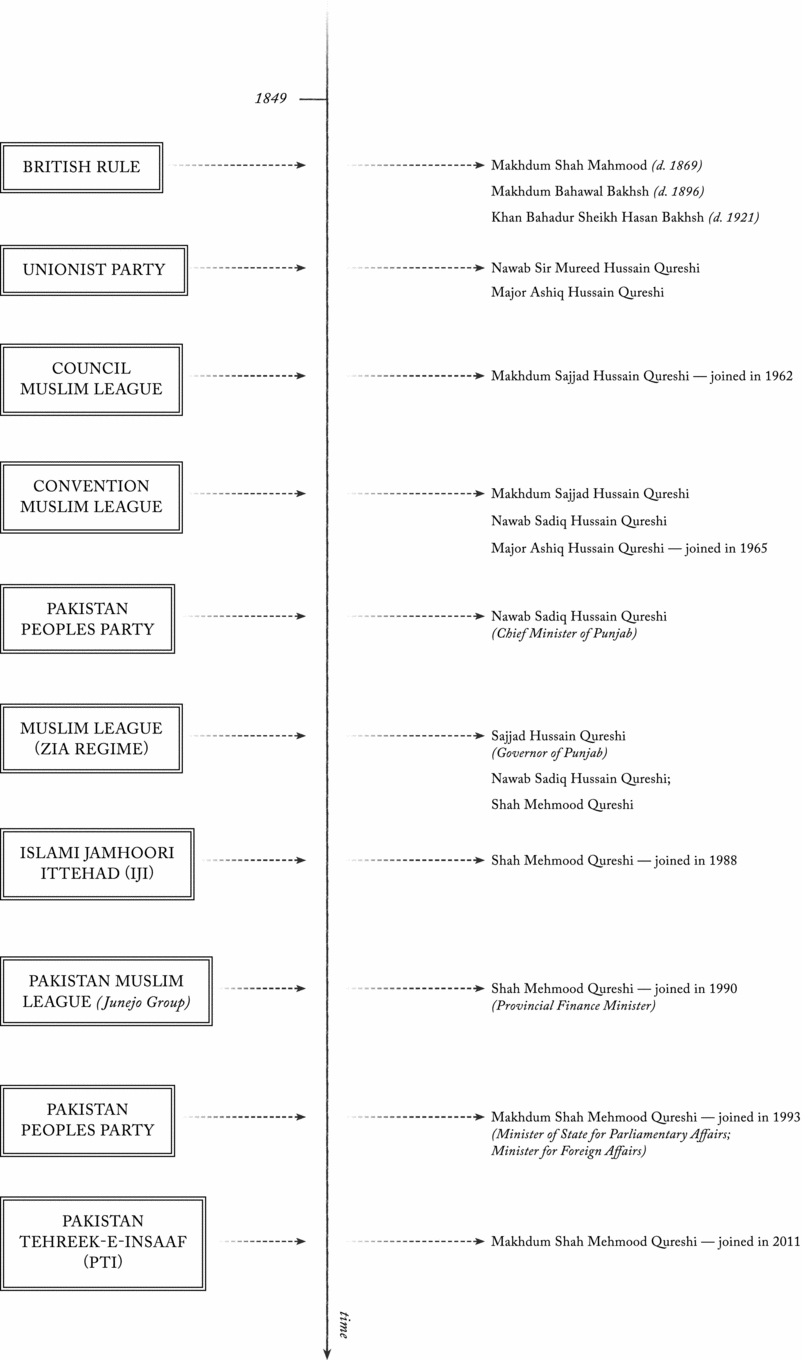
A vivid example is offered by the Qureshis of Multan who have sided with nearly every political dispensation since the Moguls. Although the family's status was recognized by Maharaja Ranjeet Singh, it provided covert support to the British in late Sikh period. In the 1857 uprising, the family, under the leadership of Makhdum Shah Mahmood, openly supported the British in crushing the rebellion. Since then, the descendants of Qureshi family have been affiliated with around ten political parties, supporting the military regimes of Ayub Khan and Zia-ul-Haq along the way. Charting this ever-changing political trajectory, Figure 2 provides a powerful illustration of the family's permanent allegiance to power.
Shifting in the political loyalties of the Qureshis of Shah Rukn-e-Alam. Sources: Anjum, Siasat Key Firaun; Anjum, Siasat Danaun Kee Kalabaziyan; Jaffrey, Pakistan Key Siasi Waderey; Ismail, ‘Elections 1985’.

The Chishtis of Pakpattan Sharif have followed a similarly volatile path. Dewan Qutbuddin, the elder sajjada nasheen, was the chief divisional organizer of Republican Party and a member of Ayub Khan's Convention League. Although initially opposed to Zulfiqar Ali Bhutto's PPP, he later joined the party in the 1970s, only to desert it after the imposition of Martial Law in 1979. In Rahimyar Khan, the Makhdums of Mianwali Qureshian have been associated with virtually every major political dispensation. Their family members have remained part of the Muslim League, Republican Party, Conventional League, and Council Muslim League. Makhdum Hameed-ud-din ran elections on the People's Party ticket in 1977 but left the party after General Zia-ul-Haq's Martial Law. Thereafter, the family has won elections on different party platforms. While space constraints preclude us from presenting an exhaustive list, these cases affirm a common pattern.Footnote 32
What explains these shifting political alliances? For many pīrs, a permanent foothold in the corridors of power is an essential means for survival. With hereditary succession as the predominant norm among religious shrines, intra-family conflicts are commonplace. When there are multiple claimants to the spiritual lineage, establishing a genuine claim on the gaddi can be tricky. In the colonial era, such succession battles were often adjudicated in the legal domain but, today, they are effectively resolved through politics. It is the family member with superior political connections—and therefore preferred access to state resourcesFootnote 33 —who is recognized as the de facto heir to the spiritual throne. It is usually at his invitation that the Deputy Commissioner or a politician pays an official visit to the shrine and presents the holy shawl (chaddar). Such official recognition confers a seal of legitimacy, establishing the intermediary position of the concerned family member. In some instances, shrines are treated as a family enterprise with a careful division of labour between family members who oversee the affairs of the gaddi as sajjada nasheen and others who solely direct political matters. Such arrangements prevent the direct mixing of piri-mureedi with politics, insulating the shrine from the polluting effects of competitive electoral battles. For shrine families, politics can be part of an existential struggle.
Retaining a foothold in politics is also important for countering challenges to shrine authority posed by urbanization and intensified political competition. Even well-established shrine families feel the need to combine the prestige of their spiritual lineage with patronage for the local electorate. Stability of the religious network depends both on spiritual intercession and exchange of political goods—a routine feature of patronage politics in South Asia. Voters need constant mediation in accessing public services through the local state apparatus represented by the police (thana) and courts (kutchery). Local political brokers, with the ability to mobilize electorates in their wards, use their links with shrine notables to stake a claim for public sector jobs and construction contracts. As members of national or provincial assembly, pīr families control the allocation and disbursement of development funds. Prolonged absence from the parliament can deny resources that are regularly ploughed back to refurbish the political and spiritual hold of the gaddi. Thus, continued political presence trumps the value of any fixed political affiliation. Not only do prominent shrine families repeatedly switch parties, but also members of the same family, at any one point in time, are often associated with different political outfits. Such simultaneous representation in different parties provides resilience against possible political shocks, and a means for political diversification. It ensures that the pīr is never out of power. In this context, change is simply another facet of continuity. Punjab's religious elites follow the famous principle for elite reproduction, espoused in Giuseppe Tomasi's epic, The Leopard: in order for things to stay the same, everything must change.Footnote 34
This helps to explain the shifting political allegiances of the Qureshis of Shah Rukn-e-Alam, whose latest political affiliation, Imran Khan's Tehreek-e-Insaaf (PTI), can be interpreted as a pre-emptive strategy to regulate the political inroads of a growingly popular and urbanized middle-class constituency. Since his entry into PTI, Shah Mahmood Qureshi has quickly rose to prominence as the party's senior vice president, with the ability to influence major party decisions relating, for example, to the nomination of party candidates in elections, political alignments, and party manifestos. As the party's lead organizer from south Punjab, he attracted key members of landed gentry, and helped to build a coalition of like-minded pīr-zamindars in Sind. Through such strategic and pre-emptive affiliations with rising parties, traditional elites preserve their hold as political gatekeepers, without whose support parties are systematically constrained in extending their reach to rural areas. From the perspective of shrine elites, such monopoly of access must be guarded at all costs, including the costs associated with changing political loyalties.
Military interventions
Repeated military interventions have strengthened the de facto power of historically entrenched elites, bolstering their local standing and intermediation capacity. A key political inheritance of Pakistan is the legacy of indirect rule. Much like the colonial state, successive governments after the country's independence have preferred to govern through powerful local intermediaries.Footnote 35 Such indirect rule is particularly favoured by military rulers, who, like their British and Moghul predecessors, need legitimate power brokers at the local level. The landlord and the pīr ‘formed important links in the system of indirect rule under the British’.Footnote 36 Their significance has been recognized by military rulers, for whom shrine guardians, with their powerful spiritual and material networks, are perfect allies. The bargain is mutually advantageous. For military leaders, support from shrine aristocracy buys peace in the countryside and support in the parliament, where the pīrs’ support helps to comb together coalitions of disparate groups. For shrine guardians, in return, this partnership ensures continued presence in power corridors and access to state resources.
Soon after settling into power, dictators are confronted with a legitimacy gap, which they seek to fill through support from traditional elites. The manner in which Pakistan's first military ruler, Ayub Khan, deployed the religious network of shrines in aid of his rule is well known. When the general pitched himself as a presidential candidate against his rival, Fatima Jinnah, major shrine gaddis sided with the military ruler. The Pīr of Dewal Sharif is well recognized for his role in garnering support for the general, for which he was amply rewarded.Footnote 37 With the release of controlled political space under military rule, electoral competition is often converted into elite selection. Since many pīr families are part of a historically embedded elite with superior property rights, they had a natural affinity with Punjab's landed gentry. When the Nawab of Kalabagh was tasked to put together a coalition of supporters, his natural choice remained the traditional chief families with a proven track record of loyalty to imperial rule. He cobbled together a group of powerful local intermediaries from each district, which, unsurprisingly, included many shrine notables that possessed both spiritual and feudal power. Many such families ran elections with official support and joined legislative assemblies; some went on to become cabinet members.
Apart from strengthening well-entrenched intermediaries, military rulers typically release political space for new entrants, many of which are pīrs who had hitherto played only an indirect role in it. As a result, shrine families with a marginal presence in the pre-partition period rose to prominence under Ayub Khan's local government system, known as Basic Democracy (BD). An example is ManekasFootnote 38 of Pakpattan, who commanded nominal influence under the British but consolidated their power under Ayub Khan. Many shrine gaddis with local standing nominated family members as counsellors in local governments. One example of such late entry into politics is the gaddi of Sharaqpur Sharif in Gujranwala.
The political ascendancy of pīrs under military rule is partly attributable to the demise of party-based politics. Elections organized by military dispensations are typically held on a non-party basis, where candidates are barred from openly associating with mainstream political parties. By seeking to bypass multi-party politics, dictators from Ayub to Musharraf have sought to centralize their power by directly relying on support from local notables. This enhances the role of natural formations prior to national politics, such as basic alliances around kinship, community, caste, ethnicity, and religious networks. With a weak insertion of party politics, factors such as wealth, landed power, and clan loyalty become the prime determinants of electoral success. While democratic governments have been reluctant to devolve power to the local level, such devolution has been politically more palatable for military rulers who have used it to bypass party politics, centralize political power, and build a loyalist clientele at the local level.Footnote 39 But, just like the general elections under military regimes, local bodies’ elections are held on a non-party basis, which intensifies factional competition based on wealth, kinship, caste, and clan loyalty (biraderi).
Elite capture of local politics is a common feature of military-supervised elections. A recent evaluation of the local government elections in 2002, for example, suggested that, in most rural constituencies, land ownership conferred a definite advantage on winning candidates.Footnote 40 In constituencies where shrines played an important role, the interplay between landed and shrine power is a decisive factor in electoral success.
The pīr is set to benefit from non-party elections where electoral success is largely built on ability to forge efficient alliances. Although many pīrs presented themselves as candidates for BD electionsFootnote 41 under Ayub Khan, their role became more prominent under General Zia-ul-Haq in the 1980s, when many of them contested for local body elections and, later, graduated into provincial and national assemblies. The Zia period was an important watershed in this regard, since it catapulted many pīrs into power in constituencies where they had hitherto played only an indirect role.Footnote 42 Since the 1980s, many of these emergent shrine centres have consolidated their electoral strength and persisted in politics. An example is the Gilanis of Hujra Shah Muqeem in Deepalpur, who entered late into politics but have never lost an election since 1985.
Besides managing electoral competition, military regimes introduced new modes of patronage and control to win the favour of religious classes. Ayub Khan tried to take over shrines through promulgation of the West Pakistan Waqf Properties Ordinance 1959. Although this takeover has largely been interpreted as an attempt to reform Sufi Islam,Footnote 43 the underlying power logic cannot be ignored, as it was partly geared towards political control of pīrs. Ayub Khan maintained a close relationship with caretakers of many influential shrines. He organized conferences for religious clerics and pīrs (Ulama-o-Mashaikh) that afforded networking opportunities for the country's top religious elite with the president and state functionaries. These conferences were organized with a particular zeal in the 1980s by General Zia-ul-Haq, who also created a separate wing for Ulama and Mashaikh in the legislative assembly (Majlis-e-Shura).Footnote 44
Several forms of appeasement were instituted to win the loyalty of pīrs. These included such patrimonial instruments as land grants, contracts, and jobs for kith and kin. To appease loyal religious clienteles, the Auqaf and Religious Affairs Department was used for rent distribution. The department received expanded powers to make direct inroads into shrine management by taking over control of the charity box associated with several gaddis. Apart from managing the waqf lands under its control, the department manages its rental properties and ploughs money back into social welfare activities. As a largely self-funded department, it also allocates funds for the repair, upkeep, and maintenance of shrine properties. Another patrimonial device, which became growingly popular under General Zia, was the appointment of shrine deputies (khalifas) in the Auqaf Department. Controlling the waqf machinery, which is the lifeline of the shrine community, has therefore become an important priority for the religious elite.Footnote 45 That auqaf matters are largely governed at the provincial level in Lahore is one reason behind the shrine families’ growing participation in provincial elections since the 1980s. Prominent pīrs have also proceeded to become ministers of religious affairs, allowing direct control over religious endowments.Footnote 46
Marital ties
While shrine guardians enjoy strong group solidarity based on shared material interests and a common spiritual ground, their interests are often consummated through nuptial bonds. Many of Punjab's noted shrine families are related through a complex web of marital ties that supersedes their political affiliation and local interests. Such marital ties have a larger political significance, since they allow the involved parties to tap into complementary networks of power and help to expand both families’ reach and influence. Importantly, it permits shrine families to play a larger national role in politics, since support from powerful regional brokers brings a decisive advantage on the political canvas.
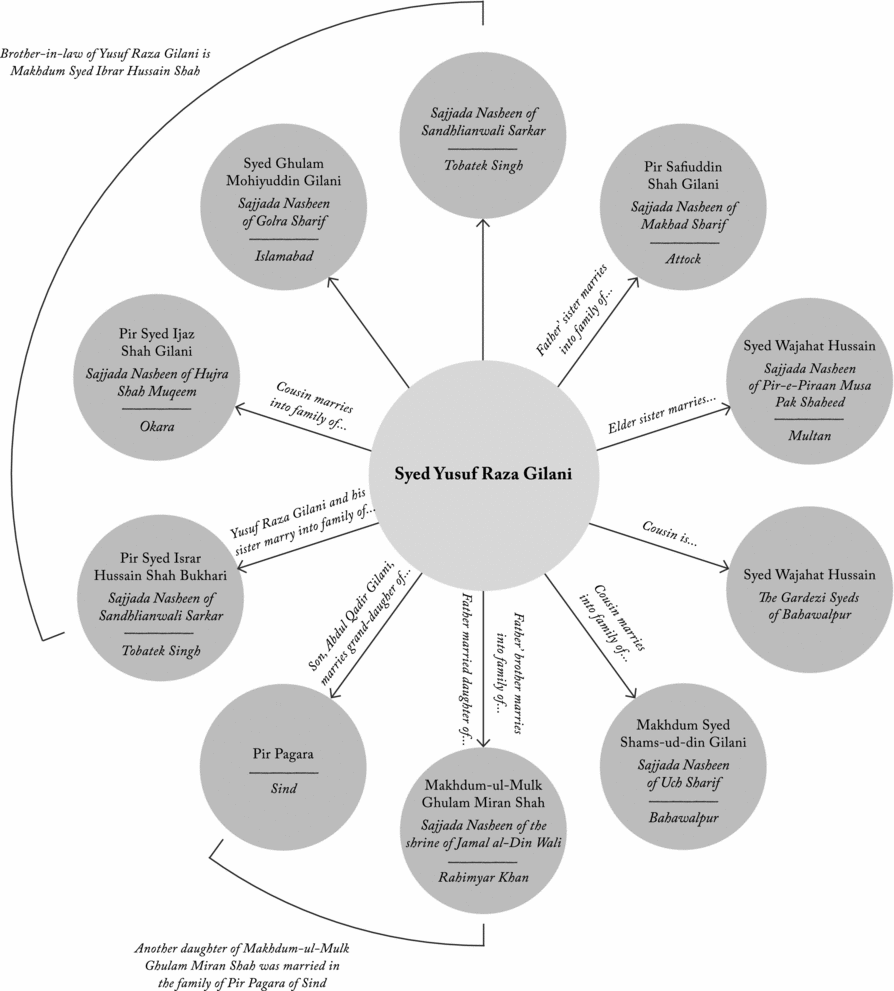
Although examples of inter-marriages among notable shrine families are too numerous to exhaust in these pages, a few illustrations will support the larger argument. The family of the Gilani Syeds of Multan is well known for its diverse and extended marriage relationships, which connect one of Multan's most revered spiritual seats with other major shrines of Punjab, extending even into neighbouring provinces. The Gilani Syeds are related by marriage with at least eight other shrine families belonging to the prominent gaddis of Punjab and Sind. Mapping these marital ties across shrine families, Figure 3 shows that the Gilani Syeds of Multan enjoy nuptial bonds with families belonging to the shrines of Jamal Din Wali (Rahimyar Khan), Hujra Shah Muqeem (Okara), Makhad Sharif (Attock), Golra Sharif (Islamabad), Pīr Qatal (Jalalpur Pirwala), Sandhlianwali (Peer Mahal), and Khairpur Tamewali (Gardezi Syeds). The Gilanis are also related by marriage with Pakistan's most influential shrine figure, the Pīr Pagara of Sind.Footnote 47
Marital ties of the Gilani Syeds of Multan. Sources: Y. R. Gilani, Chah-E-Yusuf Sey Sada, Nigarshat Publishers, Lahore, 2006; personal interviews by authors.

Such dense familial networks are a common feature of the larger brotherhood of shrine guardians. The Chishtis of Shaikh Fazil in Vehari, for example, are related by marriage to the Chishti family of Pakpattan Sharif in Arifwala and the prominent shrine families of Chishtian in Bahawalnagar. Similarly, the Qureshi Makhdums of Shah Rukn-e-Alam in Multan are related to other prominent shrine families in Punjab. Daughters of Makhdum Sajjad Hussain Qureshi, the former governor of Punjab, are married to Pīr Shujaat Hasnain Qureshi of Khanewal and Senator Iftikhar Ali Bukhari of Rajoa Sadaat (related to caretakers of Shah Jewana, Jhang). Like any traditional nobility, Punjab's shrine families use marriage as a strategic instrument to expand their material and political stakes.
Marital connections are also strategically forged to consolidate relationship with landed elites. The family of Taunsa Sharif in D. G. Khan, for example, is related by marriage with the family of former governor of Punjab, Ghulam Mustafa Khar, a major landowner of Muzaffargarh. Another elder of Taunsa Sharif, Khawaja Hameed, was married into the family of one of Punjab's biggest landowners, Nawab Iftikhar Mamdot.Footnote 48 Amongst the many marriage connections of the Qureshis of Multan, one was with the family of Sir Sikander Hayat Khan, the chief minister of united Punjab.Footnote 49 Similarly, the Dewans of Pakpattan are married into the politically influential Maneka family; the latter typically participate in elections with the spiritual blessings of the gaddi of Pakpattan Sharif.
The breadth of these marital ties goes beyond shrine and landed families, and include relationships with businessmen and members of the civil service. Probably the best example of the fusion of landed pīr aristocrats and industrialists is provided by the marriage connections between the Bokhari Makhdums of Jhang and Sir Syed Maratab Ali Shah, founder of one of Pakistan's largest business empires that controls such brands as Packages, Nestle, and Mitchells.Footnote 50 Syed Maratab Ali's son, Syed Babar Ali, is also the founder of Lahore University of Management Sciences (LUMS), Pakistan's foremost private educational institution. The family is also related to the Kirmani Syeds of Daud Bandagi in Shergarh.Footnote 51 Similar connections of shrine families exist with civil bureaucracy. The Sultan Bahu family of Garh Maharaja, Jhang, has several hands in the power corridors, with representation both in politics and civil service. Sahibzada Nazeer Sultan, was a former federal minister. His brother, Sahibzada Hameed Sultan, was a federal secretary.Footnote 52 Thanks to this vast connective capital, Punjab's shrine elites remain permanent insiders of the system who are always in power regardless of whether they are in or outside the parliament.
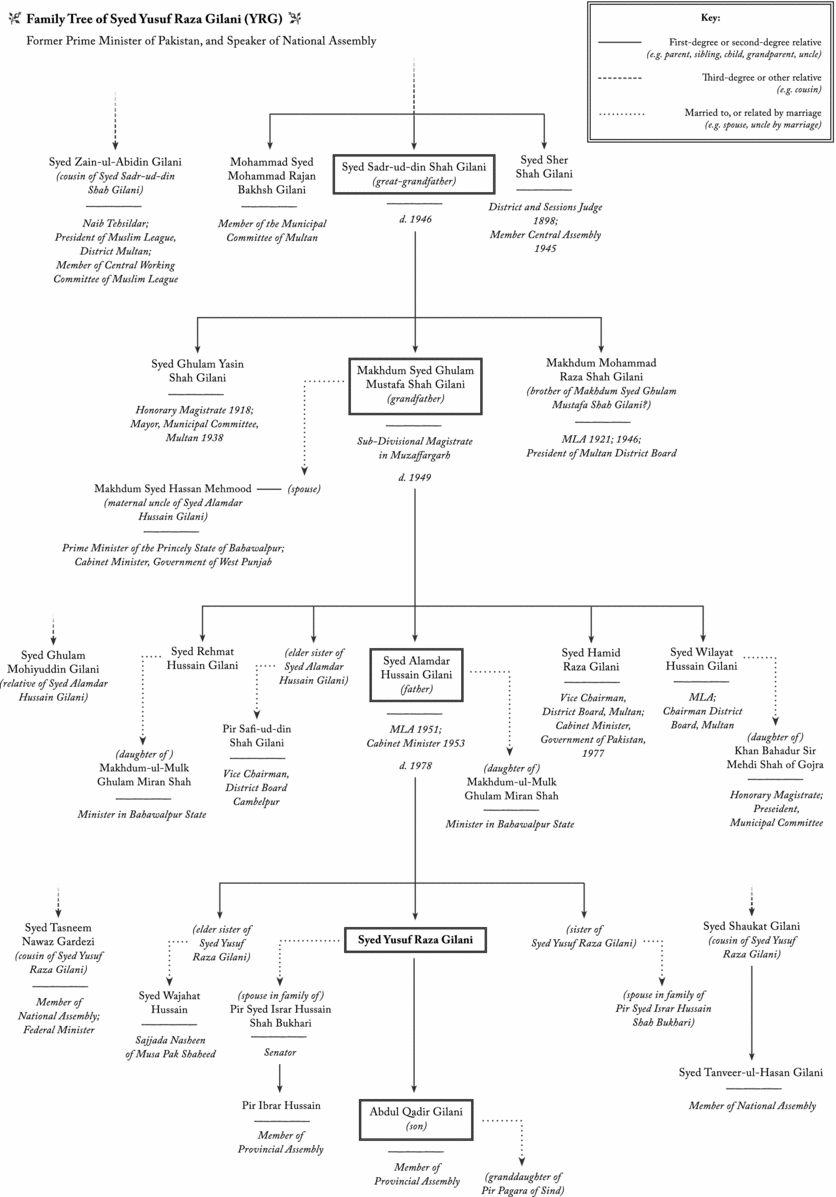
The Aristotelian logic that ‘the whole is greater than the sum of its parts’ applies well to these elites. The relationships consummated through marriage are a vital asset on the national political stage. The true impact of these alliances is revealed by piecing together these relationships in family genealogies. Figure 4 provides one such illustration by drawing a family genealogy chart covering the extended family relationships of Syed Yusuf Raza Gilani, former prime minister of Pakistan and a leading shrine aristocrat from Multan. Unfolding the consolidated powerbase of Gilanis, Figure 4 establishes the family as much more than a spiritual dynasty. It is also part of the power elite that has retained its influence through the vicissitudes of Pakistani politics. Like most shrine notables, the power of Gilanis is historically rooted. Recognizing the influence of Gilani Syeds, the British rewarded them with official visits, titles, administrative positions, and other material rewards.Footnote 53 Subsequently, several family members became chairmen of district boards and municipal committees, and MLAs in pre-partition Punjab. After independence, many rose to become cabinet ministers and political advisers.
Pathways to power: the Gilani Syeds of Multan. Sources: Anjum, Siasat Key Firaun; Anjum, Siasat Danaun Kee Kalabaziyan; Jaffrey, Pakistan Key Siasi Waderey; Ismail, ‘Elections 1985’.

Family connections are so extensive that they are difficult to capture in one chart. Gilanis’ relationship with the family of Makhdum-ul-Mulk of Rahimyar Khan, Gardezi Syeds of Bahawalpur, and Pīr Pagara of Sind inject them into an ever-expanding network of influence. Members of the Makhdums of Rahimyar Khan have previously served as chief minister of Bahawalpur state (Makhdum Hasan Mehmood) and governor of Punjab (Makhdum Ahmed Mehmood). Similarly, Syed Tasneem Nawaz Gardezi's great-grandfather, S. M. Nawaz Gardezi, was the chief minister of Bahwalpur state and his uncle was a federal minister. Several other relatives were members of parliament. While not fully represented in Figure 4, these extended connections show the tremendous political reach of the Gilani Syeds, and their durability in electoral politics.
Political brokerage
The pīrs’ power of political brokerage is an essential factor contributing to their persistence in politics. Pīrs protect their political foothold by attempting to capture both the electoral space and political parties, which results in reduced competition in the political market place. Three inter-related strategies are worth mentioning in this regard: (a) preserving the power of intermediation, (b) mobilizing shrine networks in the service of factional politics, and (c) erecting entry barriers to reduce political competition. As mentioned before, the spiritual network of shrines is a vital political asset, especially in regions that suffer from continued underdevelopment, ingrained culture of superstition, and unequal land distribution. Shrines deploy this historically embedded powerbase to bolster their bargaining position vis-à-vis mainstream political parties.
We are principally interested here in the pīr’s ability to intercede between political parties and the constituency. In several parts of rural Punjab, the pīrs’ hold is so strong that, without their local brokerage, political parties may find the electoral space impenetrable.Footnote 54 Here, pīrs act as political gatekeepers for and within political parties. Parties are obliged to delegate crucial political decisions regarding the local constituency to pīrs, who have a decisive voice in whom to award party tickets, which factions to support, what local party officers to appoint, and the like. The degree to which parties are dependent on such brokerage varies across regions, with such dependence being particularly high in districts of south-western Punjab.
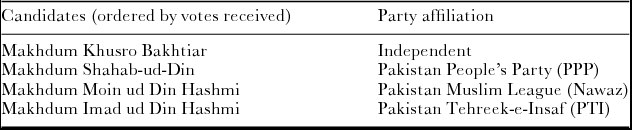
The reach of political parties remains limited in these closely guarded political spaces, where they are sometimes entirely dependent on shrine intermediaries for fielding party candidates. Party affiliation merely provides a top-up to this captive vote bank. In several rural constituencies of south Punjab, the Makhdums enjoy such loyal clientele that they often manage to win without an explicit party affiliation. Winning elections as independent candidates, they only adopt a party platform after joining the parliament. Revisiting results for the 2013 general elections in NA-124, a constituency in district Rahimyar Khan, illuminates this by showing that all top four candidates in this constituency hailed from prominent shrine families (see Table 5). The winner, Makhdum Khusro Bakhtiar, ran as an independent candidate. From the pīrs’ standpoint, such independent political power is emblematic of a sovereign and undiluted space where political parties have little choice but to work through established shrine brokers. Even Imran Khan's PTI, which raised the slogan for change in the 2013 elections, had to field a Makhdum from an established religious family as its candidate for this constituency.
Monopoly of representation: pīrs as candidates for NA-194, Rahimyar Khan III

Source: Election Commission of Pakistan, Gazette Notification, 2013.
Such influence usually elevates the status of shrine gentry within political parties. Important decisions pertaining to the local constituency—and sometimes even neighbouring districts and regions—are delegated to important pīrs. Prominent shrine families have traditionally exercised a decisive influence in awarding party tickets for elections to their favourite candidates. In the 1951 elections, for example, Syed Yusuf Raza Gilani's father nominated many members for Muslim League tickets. Since then, prominent shrine families have continued to engage in such political brokerage on behalf of military rulers and political parties.
Apart from their role in political selection, it is also common for parties to engage in a bilateral political exchange of sorts, where candidates running for the provincial assembly seats are requested to support candidates for the same party running for a National Assembly seat. Similar exchange is common in local government elections where candidates are typically fielded as part of a panel, where a pīr can be nominated for a slot in exchange for his support to other candidates in the panel. Such transactional bargaining is particularly prevalent in central and western parts of Punjab where a growing number of shrine families are awarded tickets for provincial assembly in exchange for their support for party candidates in related constituencies. The award of tickets, then, becomes a strategic decision where parties carefully weigh the influence of different factions and try to field a winning combination that best optimizes the strength of local candidates. With their well-established networks, shrine elites figure prominently in this calculation and enjoy a natural advantage in such electoral bargaining. This has contributed to the ascendance of pīrs in the provincial politics of Punjab since the 1980s.Footnote 55
The connective capital of shrine gentry serves as a vital political asset whose importance transcends beyond elections. Beyond conferring electoral advantage, political parties derive other benefits from inducting pīrs in their ranks. With their extended marital ties and relationships with other landed families, ability to tap into the larger fraternity of pīrs, and a support base that can cross the party and regional divides, pīrs provide an important instrument for elite mobilization. They are valued by political parties for their role in building coalitions and alliances in and outside the parliament. The power of important shrine brokers is invoked every time a party needs the right numbers for senate and presidential elections. The major shrine centres of Punjab are turned into hotbeds of political activity during such periods.
Given their important role in coalitional politics, pīrs are afforded greater vertical mobility within party hierarchy. When the People's Party began its search for a suitable prime-ministerial candidate in the wake of Benazir Bhutto's murder, it selected Yusuf Raza Gilani for the coveted slot. This was a predictable choice. Makhdum Gilani brought with him a rich network of spiritual and landed families, as outlined in Figure 4. Later into his tenure, when Prime Minister Gilani was disqualified by the Supreme Court, the party proposed another sajjada nasheen, Makhdum Shahab-ud-din, as his successor.Footnote 56 Similarly, closer to the 2013 elections, the PPP appointed another leading shrine personality from south Punjab, Makhdum Ahmad Mahmood, as the governor of Punjab and, later, as its provincial party chief.
Clearly, the pīrs’ mobility within parties depends on their power of brokerage. The more established the family and the greater their capacity for brokerage, the higher are pīrs’ prospects for political mobility. A well-known instance is the rise of Muhammad Khan Junejo in 1980s when he became the prime minister of Pakistan as a nominee of Pakistan's foremost shrine aristocrat, the Pīr Pagara of Sind. In her recently published memoirs, Syeda Abida Hussain, a descendant of a leading shrine family herself, narrates how, on the day of voting, Pīr Pagara and his devotee, Mr Junejo, were escorted into the parliament by General Zia-ul-Haq. Announcing Pīr Pagara's support for Muhammad Khan Junejo, General Zia requested the parliament to support Junejo as his prime-ministerial candidate.Footnote 57
The pīrs have a direct interest in protecting this power of political intermediation. Sometimes, this entails controlling the space for contestation. In many regions, members of the same shrine family are often pitted against each other on the electoral stage. A noted example is the family contest between Syeda Abida Hussain and Makhdum Faisal Saleh Hayat, both descendants of the shrine of Shah Jewana in Jhang. The family rivalries of the Mianwali Qureshian clan in Rahimyar Khan are also regularly played out in the political domain. Similar political struggles exist outside the family when competing shrine centres jostle to gain electoral influence. Political competition among rival families belonging to different shrines is not a rare sight on Punjab's political landscape. Electoral competition between the Gilanis and Qureshis has been a traditional feature of Multan's politics through the ages. Even when such competition is not a product of grand design, having shrine families represented on both sides of the electoral divide allows an almost complete domination of the political space and an assured protection of their shared interests.Footnote 58 While intra-family political rivalries have sometimes opened space for new challengers, such competition is also part of a larger effort to consolidate the influence of the gaddi.Footnote 59 By reducing electoral struggles to intra-family competition for political office, such family rivalries can pre-empt genuine competition from emerging, effectively erecting entry barriers for new challengers. In such tightly contested spaces, political parties have few options but to work through existing political brokers from within the same family. Even if opponents on the electoral stage, shrine elites sit on the same table to protect their common class interests.Footnote 60 They are an important resource for political parties, since the pīrs bring with them not just the support of their devotees, but also a wider class consciousness that greases the wheels of political brokerage.
Recognizing heterogeneity
While mapping shrine influence, our analysis has so far suppressed the significant patterns of variation across space and time. In this section, we introduce four major sources of heterogeneity that are pertinent to our discussion: (a) regional and temporal differences, (b) competing influence of different religious traditions, (c) differences between shrine- and non-shrine-landed elites, and (d) nature of shrine influence (that is, whether direct or indirect). Each of these constitutes a separate area of enquiry deserving rigorous field research. Without offering any definitive claims, we offer below plausible hypotheses to be assessed by future research.
Spatial and temporal heterogeneity
There are important spatial patterns of variation in the sacred geography of Punjab. The political hold of shrines is admittedly stronger in south and western parts of Punjab. While we have identified several politically influential shrines in north and central Punjab, few of them are capable of securing electoral success entirely on their own strength. Some are dependent on the strength of factional alliances and party votes. While we have argued that prominent shrine gaddis and political parties are intertwined in a mutually dependent relationship, the degree of dependence changes as we move from north to south Punjab. If political parties are more dependent on pīrs in south Punjab, the opposite is often true in constituencies of central Punjab, where, saving a few gaddis,Footnote 61 most shrine families have to bargain, concede, and form alliances to retain their political influence.
There is also variation within regions, which advises against a crude geographic characterization. Whether in central or south Punjab, the political authority of pīrs is stronger in rural constituencies and regions where religious and landed power coalesces. Electoral success can often depend on the complex overlay of party, clan, land ownership, and religious network. Having an advantage in only one attribute may not guarantee success. This compels pīrs to engage in constant acts of negotiation with other relevant brokers. Regardless, the relative importance of these factors varies from one constituency to the next.
Shrine influence is also subjected to change over time. Such temporal shifts are a natural corollary of Punjab's evolving political economy. A pertinent example is provided by the shifting fortunes of the family of Sir Mehdi Shah of Gojra (Faisalabad) who was a leading shrine aristocrat in the British era but his successors have subsequently found it difficult to break the electoral barrier, managing, at best, small-time victories in district-level elections.Footnote 62 The shrines of Mianwali district, which the British-era district gazetteers recognized as being influential, are no longer able to decisively shape electoral outcomes. With Mianwali acting as an important base for military recruitment and a logistic node for domestic trade, its residents have benefited from opportunities for upward mobility. This raises an important question: what leads a particular shrine family to lose power over time? As the above examples suggest, the political influence of shrines is receding in regions penetrated by growing urbanization. It is not without reason that various pīrs of Jhang have avoided running elections from the district's urban constituencies. In Multan, the 2013 elections provided a tough challenge to established shrine families who have long dominated the political landscape.
Three other forces—connectivity, education, and migration—also play a complementary role in challenging traditional structures of authority. The fast-expanding road networks across Punjab have afforded greater connectivity. Today, Multan is better connected with the rest of Punjab than it was two decades ago. As evidence suggests, such connectivity tends to moderate the impact of political clientelism.Footnote 63 Punjab has similarly witnessed a growing demand for private schooling and an unprecedented expansion of higher-education institutions during the Musharraf era (1999–2008). Concomitantly, migration has emerged as a prime vehicle for economic mobility. Admittedly, the impact of these modernizing influences is not uniform across regions: south-western regions of Punjab, home to some of the leading political shrines, are relatively weakly penetrated by such forces.
In the face of these changes, distinguished spiritual lineage is not a sole guarantor of electoral success. Another factor is the ability to adapt to changing circumstances through intelligent political moves. In regions with a growing middle-class presence, such as the towns and villages straddling along the Grand Trunk road, the choice of a party platform has become a crucial decision.Footnote 64 Despite their vast network of devotees, the Gilanis of Multan paid dearly for their association with PPP's corruption-tainted image by losing the 2013 elections. Political survival is leading shrine families to join political parties with a more robust urban vote base.Footnote 65 Pīrs in these regions are usually required to supplement the fixed support base of the gaddi with the vote bank of political parties. Indeed, the 2013 elections brought several pīrs from central Punjab into the parliament on PML (N) platform.
Thus, in regions where pīrs are not in a uniquely advantaged position, they are actively engaged in acts of negotiation and concessions with political parties. This constantly evolving dialectic between pīrs and political parties deserves a closer analysis. As a classic electoral act the pīr needs to form alliances with other kinship groups. When it comes to intra-family competition in politics, the candidate who is more approachable and has a better record of service delivery has improved chances of survival. Without further empirical research, it is difficult to pin down factors that are more decisive in shaping these dynamics. The strength of these explanations is also likely to vary across different contexts. However, we can argue with a degree of confidence that, in constituencies exposed to rapid economic change and its associated modernizing influences, the pīrs can no longer take their power for granted.
Rival religious influences
Rival religious influences pose another challenge to the political authority of shrine families. In the 1980s, Jamaat-e-Islami carved a competing political domain for itself in many towns and peri-urban constituencies. More recently, the Tablighi Jamaat has made greater inroads into previously under-served rural areas. Although expressly apolitical, the Tabligh network promotes symbolic capital that undercuts the power of traditional religious intermediaries. As travellers in faith with significant connective mobility, which takes them from town to town, the Tabligh network, unlike the shrine or Madrassah, is not a captive constituency with a fixed location. Importantly, it defies hierarchy and emphasizes individual piety—both attributes that challenge the regime of voluntary submission typically associated with shrines.
An interesting dynamic is emerging, for example, in tehsil Tulamba of Mian Channu, Khanewal district, the hometown of a leading public figure of Tablighi Jamaat, Maulana Tariq Jameel.Footnote 66 While, historically, the region was under the spiritual influence of the shrine of Sheikh Fazil, the Tableegh network is gradually emerging as a silent challenger. An interesting dimension of this challenge is the sensitive interplay between caste and religion. Maulana Tariq Jameel, the public face of Tabligh, belongs himself to the same Sahoo caste that is the die-hard constituency of the sajjada nasheen of Sheikh Fazil, Khawaja Noor Muhammad Sahoo. This is, by no means, an isolated case of this emergent challenge.Footnote 67
Such challenges are not new. A broad range of religious traditions, including the one from Deoband, had shaped strong reformist currents earlier that challenged mediatory religion in the name of more personal, individual religion. It is a critical question as to why, despite such ideological challenges, Punjab's shrine networks have continued to survive. Answering this question requires that we differentiate such influences across the rural–urban grid. One explanation might lie in the greater appeal of such movements in townships and cities. In parts of rural Punjab where the ordinary villager is still shackled in a patron–client relationship, the pīr’s power is largely intact. Here, the choice is not simply between different religious traditions, but also between different patronage structures. Instances where the pīr and the religious cleric (maulvi) operate in a mutually accommodative religious space are not completely unheard of.
Some scholars see the rise of militant Islamic groups in south Punjab as a challenge to the religious authority of shrines.Footnote 68 According to Siddiqa, the growing support and material resources commanded by these militant groups are diluting the traditional powerbase of feudal elites. While an interesting proposition, there is little empirical basis to suggest that the inroads made by such Islamic groups have yet translated into a formidable political challenge. Apart from the well-known case of Jhang, where Shi'a pīrs are pitted against Sunni extremists, and Dera Ghazi Khan, where former cleric, Hafiz Abdul Kareem, defeated the powerful Leghari clan in the 2013 elections, there are few other pockets of influence that could point to a generalized pattern.
Abstracting from the sectarian dimension for a moment, these emergent challenges can also be described as an alternative politics in the making where new money is trying to replace the old influence. Hafiz Kareem's electoral success, for example, was built at the back of tremendous riches he acquired over the years and his control of local administration through proximity to the Punjab Chief Minister Shahbaz Sharif. Viewed in this perspective, both traditional elites and new challengers are embedded in similar patronage structures that perpetuate exclusion of subordinate classes. In other words, the new inclusions are premised on existing exclusions. The persistent failure of both the state and south Punjab's feudal elites in delivering the poor from their economic misery has created a governance gap that, in the absence of structural economic change, is likely to be filled by other forces. Commenting on the contested religious space in Jhang, Kamran notesFootnote 69 how ‘the reaction against feudalism came in the garb of Sunni/Deobandi condemnation of Shiaism and its followers’.
Shrine- versus non-shrine-landed elites
Another aspect of heterogeneity relates to the distinction between shrine- and non-shrine-landed elites. An important question is whether the political engagement of the ‘religious’ side of landed shrine families is different from that of other (non-shrine) landed elites. Importantly, to what extent is the phenomenon that we have described so far simply a reflection of the survival of landed power more generally, or is it a distinctive phenomenon rooted in the intersection of landholding and a very distinctive exercise of religious authority? Our initial examination of constituency-level election results after independence reveals a definite political advantage of shrine elites over their landed counterparts. A few examples serve to illustrate this. Historically, the Makhdums of Jhang have outperformed the Sials in the electoral domain. Similarly, Chishtis of Pakpattan have a significant political edge over competing landed biraderis, such as Rajas and Raos, and the Khwajas of Taunsa Sharif have successfully routed out Khosas in most elections in which they have directly participated. There are numerous other examples where pīrs have politically outperformed, including the electoral competition between the Makhdums of Jhang and rival candidates from Bharwana and Sial clans, and Makhdums of Rahimyar Khan against Chaudhries (Iqbal and Munir).Footnote 70
The difference between shrine- and non-shrine-landed elites is partly rooted in how these elites are defined and their relationship with underlying resources. Apart from being major landowners themselves, shrine guardians effectively control large swathes of state-owned waqf land, amounting, by one estimate, to 70,000 acres in Punjab.Footnote 71 However, distinguished spiritual lineage affords both landed power and control over symbolic and organizational resources. Shrine elites may thus be viewed as landed gentry-plus. The combination of landed power with perceived capacity for divine intercession provides a particularly lethal combination in the electoral domain. As members of the landed gentry, pīrs derive the well-known political benefits associated with land ownership but, additionally, they can also translate their religious following into political following.
While pīrs deploy the typical instruments for political control—for example, the control over coercive and administrative apparatuses of the state and access to public goods provision—they have the benefit of supplementing coercion and co-option with compliance. This is the domain of voluntary obedience that undergirds any stable power structure (see the second section). In fact, in many cases, local feudal elites are themselves religious followers of the sajjada nasheens, seeking divine blessings and an affirmation of their connection with the pīr from time to time. This shows that landed elites are often themselves dependent on the religious legitimacy of the pīr.
The religious network around the piri-mureedi relationship is another crucial distinguishing marker. Three inter-related aspects of this network—composition, access, and transportability—demonstrate its significance as a political asset. The solidarity built around shrines is usually inclusive and cuts across the kinship (biraderi), class, and regional divides. Services provided by the shrine sustain its pure use value in the everyday life of devotees. These range from naming of the newly born and preparing amulets for the ill to funeral and marriage services. The open kitchen (langar) runs around the clock and makes food available to all and sundry. Importantly, in many regions, shrines act as local conflict management institutions where pīrs help to resolve feuds among opposing tribes or parties, buying themselves local legitimacy in the process. These examples point towards a more open access regime where, compared to their landed counterparts, pīrs remain generally more accessible to common folk.Footnote 72 Finally, the staying power of the pīr is bolstered by the stability of this network, which is sometimes transportable across political parties. When pīrs in south Punjab switch political parties, they usually join them with hundreds of devotees and local brokers tied with the gaddi.
In comparison with landed elites, the staying power of shrine guardians may also be tied with the stabilizing association that shrine, as a fixed institution, offers to pīrs. Conceptualizing shrine-based gaddis as semi-permanent ‘family seats’ might explain why shrine families are usually spared from some of the most destructive forms of factionalism. While internal strife, especially emanating from succession battles for the gaddi, is not entirely uncommon, it is subdued by the role of a shrine as the classic centripetal force that could generate incentives for cooperation among family members.
With shrine families establishing well-defined codes for succession, intra-family conflicts over succession have become growingly rare. In line with the law of primogeniture, the eldest son is typically nominated as heir to the gaddi. Just like kingship, conflicts over succession constitute a major challenge to family cohesion. However, once uncertainties around succession are resolved, the gaddi, as a family seat of power, provides a more stable structure for cooperation among family members. From the perspective of the pīr’s family, the shrine thus acts as a common-interest institution that facilitates internal power sharing, which becomes necessary for laying claim to the economic and political spoils linked with the shrine. This stabilizing influence of the gaddi might also reduce the severity of property disputes among shrine elites—a key concern for landed families facing inheritance-related fragmentation of land. While the instruments of elite consolidation (for example, the Court of Wards) under British rule applied equally to landed and shrine gentries, it is possible that the latter were more advantaged in this respect after partition as their gaddis might have provided a safeguard against dilution of landed power. This is worthy of future enquiry.
While it is true that shrine elites use the traditional instruments for elite persistence, such as strategic marriage alliances, switching party affiliations, and political clientelism, there are some subtle differences in the way they exercise their powers in national politics. Punjab's leading shrines offer a ready-made network, bringing forth not only the unflinching support of their devotees, but also the wider network of shrine brotherhood (pīr-bhai) spread across neighbouring regions. This strengthens their brokerage capacity inside political parties, which, in turn, derive significant political externalities by enlisting the pīrs’ support. Thus, pīrs have a natural advantage in factional politics where the ability to forge grand alliances is treated as a crucial political asset. Compared to the landed class, the pīrs seem to possess a stronger sense of class consciousness, allowing them to protect their group solidarity more cohesively in and outside the parliament.
Indirect political influence
Our analysis understates the true impact of shrines, since it takes into account only the direct political influence of shrines as captured through their formal participation into electoral politics. Many pīrs influence local politics indirectly by extending their blessings to election candidates who deem their support critical for electoral survival. For brevity, two examples are sufficient to underscore this point. In the Khushab district, where few, if any, shrine guardians have taken part in elections, the pīrs of Pail-Piran have indirectly influenced local politics. Another relevant example is Burewala in central Punjab, where Haji Baba Shah Dewan remains an indirect political force. When evaluating shrines by their indirect political influence, it is important to appreciate the considerable variation that underlays their power.
While several shrines enjoy only a moderate, largely localized impact, others are capable of playing the kingmaker role. Commanding the support of numerous smaller shrines whose sajjada nasheens have submitted in allegiance (bay'ah), the kingmaker shrines can mobilize the support of several overlapping shrine networks at the same time.Footnote 73 The shrine of Sheikh Fazil in Sahiwal is a lead political broker of the region. Its influence spans a vast area from central to bordering districts of southern Punjab. Although not a direct political contender, the caretaker of Sheikh Fazil, Khawaja Noor Muhammad Sahoo, was recently made an adviser to the chief minister in lieu of his immense political influence. The gaddi of Golra Sharif remains a similarly important seat for the Potohar region, where rarely any political leader has set foot without the blessings of the Golra pīrs.Footnote 74 Although the shrine does not enjoy the kind of influence that its peers have in south-western Punjab, the devotees of Golra Sharif are spread around the rural surroundings of Islamabad and Jhelum.Footnote 75 Many election candidates have sought the political intercession of Golra pīrs, who, in exchange for their blessings, have amassed considerable material advantage over time. The gaddi remains one of the largest landowners of Islamabad and controls a variety of rent streams from small informal businesses that operate with the pīrs’ support.Footnote 76 , Footnote 77
Conclusion
This article provides one of the first systematic mappings of politically influential shrines across Pakistani Punjab. Taking into account multiple rounds of electoral data, we find strong evidence of political persistence. The political power of shrines is anchored in Punjab's colonial history that placed pīrs in a favourable position, allowing them to combine their religious authority with landed power. Supported by systematic colonial patronage, shrine elites made an early entry into the politics of pre-partition Punjab and survive in the parliament to this day. In fact, the pīr-zamindars remain an important component of dynastic politics.
Our analysis suggests possible mechanisms for this persistence, highlighting four inter-related explanations for the survival of religious dynasties in politics. These pertain to the role of shifting political loyalties, use of marriage as a strategic political instrument, frequent military interventions, and the pīrs’ control of political brokerage. In doing so, we draw on several previously un-consulted sources and furnish rich information on relevant actors and their strategies, alliances, and control of economic resources. Punjab's leading shrines offer a ready-made network for politics, bringing forth not only the unflinching support of their devotees, but also the wider network of shrine brotherhood (pīr-bhai) spread in neighbouring regions. The pīrs have a strong sense of class consciousness and protect their group solidarity. In the political domain, however, they are often engaged in acts of both cooperation as well as competition. Valued for their role in elite brokerage, political parties derive significant political externalities by enlisting their support.
In broader terms, the evidence marshalled in this article corroborates David Gilmartin's astute observation that the religious and political authority is co-constituted in Punjab. Enshrining the combined influence of religion, land, and politics, riverine shrines are an important component of de facto political power. This analysis underscores the need for a deeper understanding of the mutual intertwining of religion and politics for any holistic mapping of Punjab's political economy. Although our analysis is limited to Punjab, it has important parallels in other Muslim societies. In North Africa, where shrine personalities had figured less prominently in the political calculus, Sufi orders have reasserted their power in the political domain and are providing a new lease of legitimacy to authoritarian regimes.Footnote 78
While casting fresh light on an important and under-studied subject, we identify several potential lines of enquiry for future researchers. Analysis based on aggregate data masks the considerable variation in the political influence of shrines. The constantly evolving dialectic between pīrs and political parties deserves a closer analysis. Depending on where they are located and the strength of their network, the pīrs can have a differential bargaining power vis-à-vis political parties. In regions where pīrs are not in a uniquely advantaged position, they are actively engaged in acts of negotiation and concessions. Another source of variation is purely temporal. Despite strong patterns of persistence, the pīr’s political authority is subjected to new sources of contestation, such as the rise of media, education, urbanization, and migration. A more refined understanding of both the emerging patterns of heterogeneity and their underlying drivers deserves close scrutiny. Admittedly, our analysis does not fully encapsulate the political impact of shrines, since it takes into account only the direct role of shrines in electoral politics. Many pīrs abstain from the electoral race but play an important kingmaker role from behind the scenes. In such instances, real power tends to reside in unelected brokers outside the parliament. Given its significance, supplementary work is needed to map such indirect political role of shrines.