INTRODUCTION
As the Chinese saying goes, “A good doctor has the heart of a parent.” This has been, for centuries, a guiding principle for East Asian physicians; so deeply rooted that it is inscribed into the gates of a cancer hospital in Hanoi. The paternalistic ethical framework is built upon compassion, care, and responsibility, intricately linked to cultural influences of Confucianism and the traditional philosophy of the region. However, although more established than the emergent emphasis on patient autonomy, such an approach to healthcare has often been portrayed as negative, and even consciously avoided. As Southeast Asian society becomes increasingly culturally diversified, how has the role of the physician changed in the decision-making process of the patient at the end of life?
The heavy influence of culture on medical decision making has resulted in a wide spectrum of physician–patient relationships (Rodriguez-Osorio & Dominguez-Cherit, Reference Rodriguez-Osorio and Dominguez-Cherit2008). For example, Japanese patients preferred increased roles of family and physician in decision making compared with their United States counterparts, and even among United States patients, stark differences were seen among different races (Blackhall et al., Reference Blackhall, Murphy and Frank1995; Ruhnke et al., Reference Ruhnke, Wilson and Akamatsu2000). This trend was likewise seen in Thai terminal patients, of whom 57.2% of placed the physician as the point of authority in their treatment (Sittisombut & Inthong, Reference Sittisombut and Inthong2009).
The communication of information to aid decision making is also difficult territory to tread. One review showed that most patients did want to be informed through the course of their illness, although the degree of their participation in decisions thereafter varied as much as 22–81% across cultures (Benbassat et al., Reference Benbassat, Pilpel and Tidhar1998). Older patients also preferred paternalistic doctoring (Cassileth et al., Reference Cassileth, Zupkis and Sutton-Smith1980). In another study reflective of the heterogeneity of disclosure, 18% of South American physicians thought that their patients wanted to know of their terminal cancer, compared with 93% in Canada (Bruera et al., Reference Bruera, Neumann and Mazzocato2000).
Here, in Singapore, a study among local doctors revealed that only 43.6% of physicians would inform patients alone of the diagnosis, whereas 90.4% would tell the family (90.4%) (Tan et al., Reference Tan, Teo and Wong1993). However, in a later study, 83.7% of Singaporean elderly Chinese indicated that they would have preferred to have been told of their terminal illness. Therefore, there seems to be a disconnect between the behavior of physicians and the preferences of patients (Low et al., Reference Low, Ng and Yap2000).
In general, the heavy involvement of doctors is the result of the consensus that they have increased understanding and are in a better position to make decisions. It is the additional East Asian cultural blend that is unique here; for example, patients expect superior morality and character from physicians, granting respect and a willingness for paternalistic doctoring in return (Guo, Reference Guo1995). This explains the high regard patients place on having good relations with physicians and consultations with doctors in making important decisions. Balancing this, however, is the increasing desire of patients to actively participate in their own decision making (Blank, Reference Blank2011).
This article represents a foray into understanding palliative cancer patients' decision making process in Singapore, in the current era. In particular, we attempt to get a glimpse into the state of the physician–patient relationship.
OBJECTIVES OF STUDY
This is part of a larger pilot study that aims to explore the way decisions are made in this subset of patients. Here, we focus on the physician–patient dynamic in three areas: (1) the influence of physicians on decisions made, (2) the influence of symptom control and quality of life on decision making, and (3) the relationship between physicians and patients and the communication of information.
METHOD
An interviewer-administered questionnaire was designed. This consisted of 11 questions on demographics, an EuroQol Visual Analogue Scale (EQ-VAS)Footnote i scale as a rough gauge of quality of life, and 38 questions on factors that influence treatment decision making, of which 18 dealt with physician–patient related influences, including 6 on information communication and 3 on symptom control. Most questions followed a three-point scale of “Agree,” “Neutral,” and “Disagree.” In addition, any other comments by the participants were also noted. As a pilot, the study was conducted over a period of 2 weeks.
Singapore Centralized Institutional Review Board approval was obtained prior to the start of the study. Before administration of the questionnaire, an information sheet was provided to participants. Its contents were explained by the interviewer and informed consent was then taken. Participants could, at any time, decline answering questions or stop the process altogether. In total, the whole process took 20–30 minutes to complete. To ensure consistency, all questionnaires were conducted by one co-investigator.
The inclusion criteria were as follows: (1) Singaporean or permanent residents, (2) ≥21 and years of age, (3) under the care of the Department of Palliative Medicine, National Cancer Centre, either as inpatients or outpatients, (4) able to understand and provide informed consent, and (5) able to complete the questionnaire in English or Mandarin. Patients who could only converse in other dialect and languages were excluded from this pilot.
RESULTS AND ANALYSIS
Response
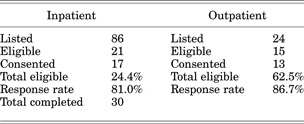
A total of 30 questionnaires were administered (Table 1). Eligible patients consisted of 24.4% of inpatients and 62.5% of outpatients of all patients in the palliative care service. The overall response rate of eligible patients was 83.3%. There was a higher rate of response in the outpatient setting than in the wards (86.7% vs. 81.0%). Some patients declined participation because of fatigue and anhedonia, but most patients did not offer any particular reason in for declining.
Respondents

A general overview of the questions and responses of patients are presented in Tables 2 and 3.
Information acquisition

aAn open-ended option was present for other sources of information, to which there were no responses.
The physician-patient relationship in decision making

aWhen asked which doctor this referred to, 21 chose oncologists, 5 palliative physicians, 2 “all doctors,” and 1 declined response.
Demographics
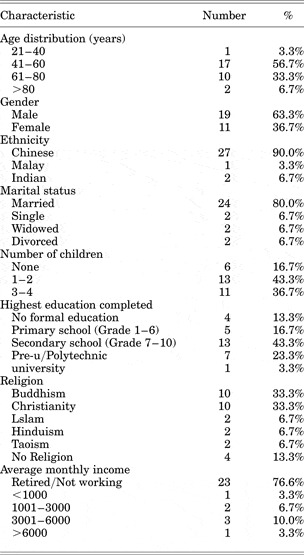
The majority of the respondents were Chinese (90%), with more male than female patients (63.3% vs. 36.7%) (Table 4). Those between 41 and 60 years of age formed the largest group surveyed. The majority of patients had received secondary school education (43.3%) and were either not working or retired (76.6%). An equal number of Christian and Buddhist patients were surveyed, at 33.3% each. When it came to family, 80.0% of patients were married, most had at least one child, and 93.3% lived with at least one family member. All patients surveyed had been diagnosed with some form of cancer.
Characteristics of study population (n=30)

For comparative purposes, 74.1% of Singaporeans are Chinese, with Malays and Indians making up 13.1% and 9.2% respectively. In religion, 33.3% of Singaporeans follow Buddhism and 18.3% are Christians. Islam, Taoism, and Hinduism represent 14.7%, 10.9%, and 5.1% of the population, respectively. In education, 32.4% of Singaporeans have less than a secondary education, and 18.9% have secondary school education. More than half (61.9%) of Singaporeans are married and the average number of children born to females ever married stands at 2.02 (Singapore Department of Statistics, 2010a, b).
People of Influence
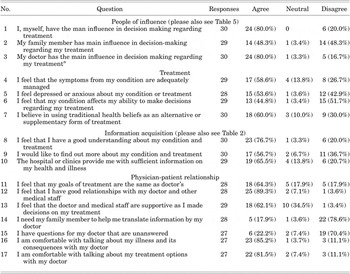
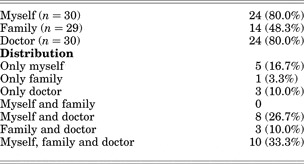
When asked if three groups, namely Self, Family, and Doctor, had major influence in decision making, 70.0% of respondents felt that multiple parties were involved (Table 3 Questions 1–3, Table 5). Whereas family influence was interestingly split both ways, at 48.3% each for the presence and absence of involvement, self and doctors featured more strongly, at 80% apiece.
Main influences (people)

Neutral responses indicate “not of influence in the decision making process”
Questions are represented in Table 3, Questions 1–3
Although all patients were followed by the palliative care service, 73.3% of patients picked their primary oncologist as the main doctor of influence, 16.7% chose palliative care physicians, and 10.0% of patients grouped all of their doctors together as a body of influence.
Symptom Control and Quality of Life
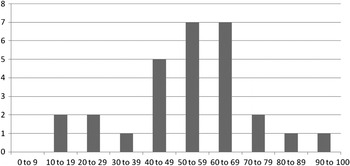
The median quality of life, measured by the EQ-VAS scale stood within the 50–59 point range (Figure 1, Table 3 Questions 4–7). A substantial number of patients (26.7%) felt that their symptoms were not well controlled, and 42.9% of patients identified experiencing low mood or anxiety. Interestingly, these were not the same group of patients, because only 10.0% of patients perceived having both poor symptom control and mood difficulties. Indeed, 66.7% of patients were found to be struggling with one or the other of these issues.
Median of EQ-VAS is within the 50 to 59 point range.

When asked if their condition affected decision-making ability, slightly more patients felt that there was no effect than that there was one (51.7% vs. 44.8%). Nevertheless, 75.0% of the latter group still claimed themselves as a main influence on the decision-making role in treatment.
Physician–Patient Relationship and Communication of Information
A large majority of those felt that they had a good relationship with their physicians and medical staff (89.3%), likewise 85.2% felt comfortable having conversations regarding their illness, and 81.5% felt comfortable with conversations on treatment (Table 3 Questions 11–17). There seemed to be less agreement over treatment goals between patients and doctors, and a poorer impression of the support patients felt they were receiving in the decisions they made (64.3% and 62.1% respectively). We also found a small group of patients who still had questions for their physicians that were still left unanswered (22.2%).
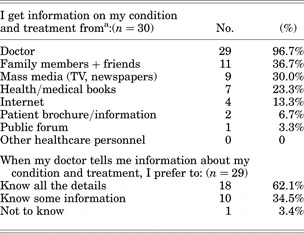
In general, 76.7% of our patients felt that they had good understanding of their condition and treatment. A large majority of patients received some information from doctors (96.7%), with 36.7% receiving information from family members, followed by 30.0% from the mass media (Table 2, Table 3 Questions 8–10). In this light, 20.7% of patients were still dissatisfied with the amount of information provided by the hospital regarding their illness, with many patients desiring more information on their condition and treatment (56.7%).
Most Singaporean patients also preferred knowing at least some details of their condition and treatment (96.6%), with 62.1% preferring full disclosure (Table 2). Only one patient preferred not to know any information at all.
Study Limitations
This was a pilot study, and the small sample size limits generalization of findings. Moreover, as the questionnaire was only in two languages (English and Mandarin), Malay, Tamil, and all other Chinese dialect speaking patients were underrepresented. Likewise, a smaller number of followers of Islam and Hinduism were represented when compared with national demographics. In addition, a large number of patients were too ill to take part in the questionnaire, resulting in the low numbers of eligible patients, especially in the inpatient setting.
Some patients may have also interpreted the questions differently. We attempted to reduce bias through the use of a single interviewer. Acknowledging that the narrow structure of “agree/disagree” questions may not capture the full essence of the responses, we also took note of spontaneous answers.
During the course of the questionnaire, some patients chose not to answer certain questions (differentiated from neutral responses), which may mask underlying opinions and render some findings less accurate.
DISCUSSION
In keeping with East Asian studies done previously, 80% of our patients felt that physicians had a strong influence on the decision making process, albeit in partnership with themselves and family members. Only 10% of patients felt that physicians played this role alone.
Patients rely on doctors for some information regarding their condition and treatment, although the extent of their reliance on physicians is unclear. Nearly 90% of patients felt that they had good relationships with doctors and >80% felt comfortable with talking to their doctors about their illness and treatment options. However, only 64.3% felt that their goals of treatment were the same as their doctors', and only 62.1% felt that the doctor and medical staff were supportive of their decisions. More than 22% had questions they felt their doctor had not answered and 56.7% wanted to find out more about their condition and treatment. Therefore, support and the provision of information may be the areas wherein the decision-making process can be further improved.
Of importance is that 96.6% patients wanted some details of their condition, with 62.1% preferring full disclosure. This corresponds to literature on disclosure and decision making. In the wide spectrum of patient involvement worldwide (22–81%), our patients' involvement in decision making stands at 76.7%. (Benbassat et al. Reference Benbassat, Pilpel and Tidhar1998) (Table 5).
Finally, the degree of symptom control was felt to have effect on 44.8% of patients' ability to make decisions. The presence of poorly controlled symptoms and/or low mood and anxiety we found among patients surveyed might be a reflection of the challenges and difficulties of care at the end of life, and it is not clear how the dynamic of the decision-making process changes with such hurdles.
CONCLUSION
Some authors advocate the removal of models of decision making in light of the wide variations in this day and age (Clarke et al., Reference Clarke, Hall and Rosencrance2004). Although it is true that each patient with whom the doctor comes into contact with may not fit into the generalized findings of our study, it is the hope that such information will provide physicians a flavor of the clinical and cultural context of this day and age. Such awareness may in turn be beneficial in managing ideas, concerns, and expectations in practice.
Our patients appear to uphold both their own autonomy and the role of the physician of equal influence in the decision-making process at the end of life. Therefore, the role of the doctor in providing good symptom control, building good rapport, and providing adequate communication of information should not be underestimated. The traditionalist preference for paternalism is not all together lost; however, the effects of Westernization and the promotion of autonomy are already clearly present. Current society seems locked in this delicate balance, a flux that makes clinical practice all the more challenging today.
This pilot study leaves many questions to be answered, namely, (1) What is the information and support patients feel that they are lacking?, (2) How do patients respond when they feel their symptoms compromise their decision-making abilities, (3) To what extent do patients rely on doctors for information? and (4) How is decision making different in the underrepresented groups?
Many difficulties were identified as well, including the need for a standardized translation and questioning technique across multiple languages and dialects, for proper representation of the palliative care population. The agree/neutral/disagree format might also be too restrictive, as many patients qualified their answers. Finally, many patients were too ill to initiate the questionnaire, and therefore were ineligible for participation. In addition, many patients were unwilling to go through a long questionnaire process, especially those who were more ill, which is reflected in the higher response rate in the outpatient setting than in the inpatient setting.
It is hoped that the findings of this pilot will spur further research, giving more definitive answers in the areas covered by the questionnaire, and further improve the physician's knowledge of patient's decision making at the end of life.
ACKNOWLEDGMENTS
We thank all doctors and nurses of the Department of Palliative Care at the National Cancer Centre, Singapore and Singapore General Hospital, for their contributions.
This research received no specific grant from any funding agency in the public, commercial, or not-for-profit sectors.