Our understanding of the origins of public opinion has expanded from elite messaging, socialization, and group membership to include the possibility that attitudes toward group life may have some basis in our biology. That is, the social signals humans have generated and interpreted throughout the history of our species may continue to influence complex social behaviors like politics. In this article, we explore whether the detection of the hormone androstenone is predictive of political attitudes. We selected androstenone because of the variation in detection and preference for this odor in adult populations. If sensitivity to disgust (Balzer & Jacobs, Reference Balzer and Jacobs2011; Inbar et al., Reference Inbar, Pizarro and Bloom2009; Smith et al., Reference Smith, Oxley, Hibbing, Alford and Hibbing2011a ), interpretation of facial expressions (Vigil, Reference Vigil2010), and responses to startling noises (Oxley at al., Reference Oxley, Smith, Alford, Hibbing, Miller, Scalora and Hibbing2008) are associated with social protective policies, then it stands to reason that the ancient and powerful sensory detection system of olfaction also may continue to provide social cues today.
Olfaction is the most chemically direct component of the sensory system, with its signals registering in the emotional centers of the brain without elaborate filters or mechanisms (Gloor & Gubeman, Reference Gloor and Gubeman1997). Biologically, olfaction’s origins are based on little more than a protein serving as a receptor—a simple and direct sensory system that allowed primitive organisms to move toward or away from chemicals detected in the environment. Neurophysiologist John Allman argues that the evolutionary foundation of all behavior builds on this simple avoid-approach system, which in its most basic form can be thought of as a “lust-disgust” signal that attracts (or repels) organisms to particular environmental stimuli (e.g., Woodward & Allman, Reference Woodward and Allman2007). In more complex organisms, this primitive and powerful regulation mechanism evolved to allow olfaction to detect and transmit information about the social as well as the physical environment.
This is reflected in olfaction’s unusually direct link to the central nervous system, as regions of the human brain tasked with olfaction and socioemotional processes overlap (Zhou & Chen, Reference Zhou and Chen2009). Odors register directly in the olfactory bulb, which is proximate to brain areas at the heart of emotion, memory, and sociality, including the amygdala, hypothalamus, and orbitofrontal cortex (Neville & Haberly, Reference Neville, Haberly and Shepherd2003). As a result, odors exert a strong influence on behavior. For example, subjects presented with a strawberry while smelling the odor of an orange spread their grips as if they were reaching for the larger fruit. Conversely, participants spread their grip too narrowly in grasping an orange when the prevailing odor was of strawberry (Castiello, Reference Castiello2006). Retail outlets manipulate ambient smells because research suggests that consumer behavior is situationally affected by odors (Fiore, Yah, & Yoh, Reference Fiore, Yah and Yoh2000; Morrin & Ratneshwar, Reference Morrin and Ratneshwar2000), even when the scent is not strong enough to register in conscious thought (Lundström & Olsson, Reference Lundström and Olsson2005).
Individual-level variation in the physiological constitution of nervous systems is known to correlate with differences in behavior (Insel & Young, Reference Insel and Young2001), which has been suggested to be least partly attributable to individual differences in the number of olfactory receptor genes (Keller, Reference Keller2011). Partly as a result of physiological variations in the way stimuli are sensed, some organisms experience the world differently than others, and, as Vigil (Reference Vigil2008) notes, the way individuals process social stimuli differently may partly explain differences in political orientations. For example, individuals who see emotionally neutral faces as threatening (Vigil, Reference Vigil2008) or who startle when they hear a loud and unexpected noise (Oxley et al., Reference Oxley, Smith, Alford, Hibbing, Miller, Scalora and Hibbing2008) show an increased likelihood of harboring certain politically conservative orientations. Given that a large proportion of sensory input does not pass through consciousness (Sherwood, Reference Sherwood2010), it is important to note that the effects of sensory variations do not require the individual to be aware that something has been sensed for the sensory variations to manifest in behavior. We suggest that olfaction is a helpful next step in efforts to understand how and when political attitudes and orientations are biologically substantiated.
The odor of politics?
Given the central role that olfaction plays in disgust detection and disgust’s link to politics (Aarøe, Petersen, & Arceneaux, Reference Aarøe, Petersen and Arceneaux2017; Balzer & Jacobs, Reference Balzer and Jacobs2011; Inbar et al., Reference Inbar, Pizarro and Bloom2009; Smith et al., Reference Smith, Oxley, Hibbing, Alford and Hibbing2011a ), we have borrowed its theoretical organizational scheme to think about how olfaction may also connect to political opinions. Recent research has identified three primary functions of disgust: pathogen avoidance, mate choice, and social interaction—sometimes labeled microbes, mating, and morality (Neuberg et al., Reference Neuberg, Kenrick and Schaller2011; Tybur et al., Reference Tybur, Lieberman and Griskevicius2009; Tybur et al., Reference Tybur, Merriman, Hooper, McDonald and Navarrete2010). As mentioned, the precursor to olfaction originated as a mechanism for identifying substances that single-celled organisms should approach or avoid. When more complex organisms began acquiring nutrients through ingestion rather than absorption, olfaction became a crucial indicator of what to ingest and, more importantly, what not to ingest. Thus, the first of three primary uses of the olfactory system is pathogen avoidance.
The second function of olfaction is mating. When certain animals began reproducing sexually rather than asexually, olfaction became an integral part of the process and continued to play that role even in humans (Jacob et al., Reference Jacob, Garcia, Hayreh and McClintock2002; Lundström & Olsson, Reference Lundström and Olsson2005; Pause, Reference Pause2004; Saxton et al., Reference Saxton, Lyndon, Little and Roberts2008), heightening the attractiveness of some prospective sexual partners while greatly reducing the attractiveness of others. Recent research in political science also supports the notion that olfaction may mediate the connection between political agreement and mate choice (McDermott et al., Reference McDermott, Tingley and Hatemi2014).
The third fundamental role of olfaction pertains to morality or the following of social norms—the focus of this research. From the beginning of social life, olfaction has been employed to identify offspring, close kin, and out-group members. Within a group, it is also valuable in identifying dominance hierarchies, conspecifics to avoid or befriend, and one’s own place within the group (Hummer & McClintock, Reference Hummer and McClintock2009; Kline et al., Reference Kline, Schwartz and Dikman2007; Tobin et al., Reference Tobin, Hashimoto, Wacker, Tankayanagi, Langnaese, Caquineau, Noack, Landgraf, Onaka, Leng, Meddle, Engelmann and Ludwig2010; Zhou & Chen, Reference Zhou and Chen2009). In short, the chemosignals crucial to olfaction serve as a means of social communication, especially as it relates to reproduction, territoriality, and both intergroup and intragroup behavior (Stockhorst & Pietrowsky, Reference Stockhorst and Pietrowsky2004). When new challenges arise, existing systems typically modify, so when social life began, the uses of olfaction broadened to include identifying offspring and to provide other socially valuable information. With the growing complexity of social life, individuals expanded the use of olfaction from its role in small-scale dominance hierarchies and later, we test, to mass-scale social life—that is, to politics.
Support for this conception is found in the physiology of olfaction. In mammals, olfaction depends on approximately 1,000 different receptors, each designed to detect the presence of a specific ambient, odor-causing chemical (Mombaerts, Reference Mombaerts1999). Any given receptor is capable of identifying only a single chemical, though many odors contain more than one chemical and so activate a portfolio of olfactory receptors. The variety of receptor combinations allows organisms to identify a multitude of distinct odors, estimated to be 10,000 for Homo sapiens (Sherwood, Reference Sherwood2010). As might be expected, many olfactory receptors correspond to the chemicals emitted by foodstuffs; however, numerous other receptors are targeted toward odors associated with reproduction and sociality. For example, the peptides oxytocin and vasopressin, long known to have marked social implications (Insel & Young, Reference Insel and Young2001; Kosfeld et al., Reference Kosfeld, Heinrichs, Zak, Fischbacher and Fehr2005; Tobin et al., Reference Tobin, Hashimoto, Wacker, Tankayanagi, Langnaese, Caquineau, Noack, Landgraf, Onaka, Leng, Meddle, Engelmann and Ludwig2010), are detected by receptors in the olfactory system, and blocking these receptors in rats has been demonstrated to impair social recognition abilities and associated behaviors (Tobin et al., Reference Tobin, Hashimoto, Wacker, Tankayanagi, Langnaese, Caquineau, Noack, Landgraf, Onaka, Leng, Meddle, Engelmann and Ludwig2010). This fits with Damasio and Damasio’s (Reference Damasio, Damasio, Koch and Davis1994) somatic marker hypothesis that emotion and its physiological correlates are key to decision-making.
Even so, olfaction traditionally has not been taken seriously as a correlate of political orientations and behavior (Hatemi & McDermott, Reference Hatemi and McDermott2012; cf. McDermott et al., Reference McDermott, Tingley and Hatemi2014), perhaps because of the erroneous assumption that political judgments arise solely from conscious sensory input—a notion that recent research is beginning to correct (Lodge & Taber, Reference Lodge and Taber2005; Oxley et al., Reference Oxley, Smith, Alford, Hibbing, Miller, Scalora and Hibbing2008). To date, the impetus for analyzing olfaction has come largely from the aforementioned broader interest in the connection of disgust to political views. Haidt and Graham (Reference Haidt and Graham2007) find judgments of political conservatives to be influenced more by “purity” concerns than those of liberals, and work by Inbar, Pizarro, and Bloom (Reference Inbar, Pizarro and Bloom2009) shows a correlation between self-reported disgust sensitivity and political stances, particularly those pertaining to sexual attitudes such as gay marriage. The connection between political stances and disgust makes sense when one considers research demonstrating the impact of disgust on social interactions, particularly with regard to violations of deep-seated norms such as marriages or emotional partnerships (e.g., Hatemi & McDermott, Reference Hatemi and McDermott2012). Moreover, Smith et al. (Reference Smith, Oxley, Hibbing, Alford and Hibbing2011a ) find that physiological responses to disgusting images, independently from self-reports, correlate with political attitudes toward same-sex marriage, though these effects seem to be moderated by gender (Balzer & Jacobs, Reference Balzer and Jacobs2011). As certain odors strongly evoke disgust, it is not surprising to find olfactory parallels to the correlation between disgust and certain social judgments.
Though previous research is suggestive that the primitive “pathogen-avoidant” role of olfaction trickles over into moral and political judgments, our interest is in whether the aspect of olfaction that evolved specifically for social and political life is related to political orientations. In some respects, this is the more obvious approach, but it may be less obvious because socially relevant odors tend to be much less likely than purity or disgust odors to enter conscious awareness. Many pathogen-relevant disgusting smells are immediately and unavoidably detectable, and responses to them visible (a contorted expression, gagging, or vomiting), but at most realistic levels, the odors of socially relevant chemicals do not enter conscious awareness. This subtle nature of reactions to odors may have discouraged scholars from correlating political orientations and social odors. In any event, despite variations in how attitudes toward authority predict political differences (Adorno et al., Reference Adorno, Frenkel-Brunswik , Levinson and Nevitt1950; Graham et al., Reference Graham, Haidt and Nosek2009) and how olfaction relates to mate choice by political attitudes (McDermott et al., Reference McDermott, Tingley and Hatemi2014), we can locate no previous research that has tested for a link between olfaction and attitudes toward authority and security.
Androstenone
The particular social chemical analyzed in this study is androstenone, a nonandrogenic steroid found in the sweat and saliva of many mammals, including humans (Hummer & McClintock, Reference Hummer and McClintock2009). Androstenone is a generic term typically applied to any of 16 chemical substances in the same family (Havlicek et al., Reference Havlicek, Murray, Saxton and Roberts2010). Its centrality to humans is indicated by event-related potentials studies showing that androstenone elicits faster cortical responses than a broad range of “control” odorants (Lundström et al., Reference Lundström, Olsson, Schaal and Hummel2006). Androstenone, androstadienone, and androstanol are all part of this family of hormones, and which compound or substance researchers select for experiments seems more related to availability or popularity “than a logical and rational process of falsification” (Havlicek et al., Reference Havlicek, Murray, Saxton and Roberts2010 , p. 69).
Scholarly interest in odor detection is due to its dramatic variation from person to person (Bremner, Reference Bremner2003; Keller, Reference Keller2011). Menashe et al. (Reference Menashe, Man, Lancet and Gilad2003) call olfaction receptors “one of the most pronounced cases of functional population diversity in the human genome” (p. 143). With regard to androstenone, though all humans produce it—with adult men producing higher levels than adult women—studies have consistently reported wide variation in both the intensity and the valence with which androstenone is detected within the population. Even at concentrated dosages, some people do not smell androstenone at all. They are often referred to as androstenone anosmics and constitute somewhere between 10% and 40% of the population (Havlicek et al., Reference Havlicek, Murray, Saxton and Roberts2010; Pause et al., Reference Pause, Ferstl and Fehm-Wolfsdorf 1998). Others report the odor of androstenone to be overwhelming, while still others are somewhere in the middle, thereby making the distribution reasonably continuous. Among osmics, there are pronounced differences in whether androstenone is detected favorably or unfavorably. Some find the odor pleasing and compare it to sandalwood, incense, or vanilla; others dislike the odor and believe it to be similar to ammonia, sweat, or urine (Havlicek et al., Reference Havlicek, Murray, Saxton and Roberts2010; Jacob et al., Reference Jacob, Garcia, Hayreh and McClintock2005; Knaapila et al., Reference Knaapila, Tuorila, Silventoinen, Wright, Kyvik, Cherkas, Keskitalo, Hansen, Martin, Spector, Kaprio and Perola2008).
One reason for the marked variation in androstenone detection appears to be genetic differences. Heritability studies suggest a strong genetic role (Knaapila et al., Reference Knaapila, Tuorila, Silventoinen, Wright, Kyvik, Cherkas, Keskitalo, Hansen, Martin, Spector, Kaprio and Perola2008; Wysocki & Beauchamp, Reference Wysocki and Beauchamp1984). A gene labeled OR7D4 may be related to the detection of androstenone (and the closely related androstadienone) but not to any other known odors (Keller et al., Reference Keller, Zhuang, Chi, Vosshall and Matsunami2007), and this has paved the way to examine the direct connections between specific genes and associated behaviors (Keller, Reference Keller2011). Though androstenone detection is undoubtedly affected by environmental factors (Wang et al., Reference Wang, Chen and Jacob2004), including the frequency of exposure to the substance—perhaps in the same way that taste sensitivity moderates visceral disgust sensitivity (Herz, Reference Herz2014)—it is also partially based in genetics, and “differences in the OR7D4 gene may have behavioral consequences beyond the psychophysical tests in a smell laboratory” (Keller, Reference Keller2011, p. 13).
Androstenone is also clearly important to human social life, and it seems especially relevant to social perception and cognition (Kline et al., Reference Kline, Schwartz and Dikman2007). A number of studies have confirmed that the odor of androstenone alters social judgments, especially how females judge males. For example, after being exposed to androstenol (the alcohol version of androstenone), females usually evaluate males more favorably, while males tend to be unaffected (Cowley et al., Reference Cowley, Johnson and Brooksbank1997). One study even finds that females are more likely to sit in a chair that has been treated with androstenone than one that has not (Kirk-Smith et al., Reference Kirk-Smith , Booth and Van Der Starre1980; see also Gustavson et al., Reference Gustavson, Dawson and Bonett1987).
Yet few studies have addressed androstenone’s potential relevance to the broader (nonmating) aspects of social life. Filsinger et al. (Reference Filsinger, Braun, Monte and Linder1984) find that exposure to androstenone leads men to rate other men as more passive. Kline et al. (Reference Kline, Schwartz and Dikman2007) report that individuals more sensitive to the odor of androstenone tend to be less likely to give evidence of the personality trait known as defensiveness, in which negative traits (such as anger) are assigned to others but not assigned to oneself. Hummer and McClintock (Reference Hummer and McClintock2009) document that androstadienone (closely related to androstenone) heightens sensitivity and attention to emotions. For example, participants who received androstadienone (instead of a control substance) on their lip exhibited reduced response times in a dot probe task if the dots appeared on the same side as an emotional (rather than a neutral) face. So, on one hand, androstenone detection is linked to a type of sociopathology (defensiveness) but, on the other, to the ability to use emotional cues to make decisions (akin to Damasio and Damasio’s [Reference Damasio, Damasio, Koch and Davis1994] somatic marker theory). As interesting as these studies may be, given the complete absence of any previous research on the effects of androstenone detection on politically rather than sexually relevant variables, Footnote 1 at this stage, a priori theoretical expectations must be viewed as provisional. Despite androstenone’s acknowledged “relevance to social life,” we simply have little empirical or theoretical work on which to build.
Given androstenone’s role in providing information about mating strategy and possibly social hierarchy related to mate selection, it might be possible that heightened olfactory sensitivity to androstenone could be positively related to authoritarianism or conservatism, or at least to that subset of conservative positions most pertinent to an established and secure social order. Vigil (Reference Vigil2010) finds that conservatives are more likely than liberals to attribute certain emotions (such as anger) to faces presented on a computer screen, and Oxley et al. (Reference Oxley, Smith, Alford, Hibbing, Miller, Scalora and Hibbing2008) find that individuals who are conservative on selected “social order” issues are more likely than liberals to display an elevated startle reflex subsequent to an unexpected loud noise. Sensitivity to the emotional content of other people’s odors, as well as to the emotional content of their faces, may be conducive to certain right-of-center political orientations.
A related line of reasoning is that, given its close relationship with testosterone (Gower & Ruparelia, Reference Gower and Ruparelia1993), a substance often associated with aggression, competition, and risk taking (Booth et al., Reference Booth, Granger, Mazur and Kivlighan2006; McDermott et al., Reference McDermott, Johnson, Cowden and Rosen2007), those who readily detect androstenone in those around them may be more likely to seek comfort and protection in the arms of the secure, traditional social order that conservatives often hold out as the end goal of their policy preferences. Thus, heightened sensitivity to odors such as androstenone may be consistent with favorable attitudes toward decisive leaders, protection from both in-group rule breakers and out-group invasions, and a desire to promote traditional rather than avant-garde lifestyles. This is not to say that conservatives possess higher levels of androstenone or testosterone than liberals, but that they may be better able to detect hormones related to aggression. In sum, previous research provides a basis for exploring a positive relationship between the intensity with which people report detecting a standardized concentration of androstenone and political beliefs designed to promote a stable, secure social order with a clear authority structure (Altemeyer, Reference Altemeyer1996; Feldman & Stenner, Reference Feldman and Stenner1997; Hetherington & Weiler, Reference Hetherington and Weiler2009; Stenner, Reference Stenner2005).
Methods
The data used in this analysis were collected as part of a larger study conducted in the summer of 2010. A professional survey organization sent informational letters (to promote response rate) to a random sample of adults in the area surrounding a medium-sized midwestern city, then followed up by phone, recruiting a sample of 340 individuals to come to a lab on a nearby college campus in exchange for $50.
Though the sample was drawn randomly, we make no claims that those eventually participating constitute a random sample. The restriction to a small part of the country and the requirement that participants travel to the lab undoubtedly introduced biases, but a national random sample is not necessary to explore the possible connection between political orientations and variations in androstenone detection. Still, we are pleased to note that the group that eventually participated was not a student sample and matched nicely with demographic figures for the overall adult population in the United States, though these individuals were more educated and predominantly white. The mean participant was 45 years old, had some college education, and earned $60,000 annually. The sample was 55% female and 95% white. Also reflecting the population from which it was drawn, marginally more participants self-identified as conservatives than as liberals, with many others identifying as moderates, but the important consideration is that substantial variation in political orientations was present.
Participants first completed a computer-based survey about their political beliefs, personal tastes and preferences, personality traits, and demographic characteristics. After completing a separate experimental task in an adjacent lab, they were escorted to a well-ventilated room where they began a second computer-based survey protocol. Participants answered the set of olfactory screening items used by Keller et al. (Reference Keller, Zhuang, Chi, Vosshall and Matsunami2007) that catalog characteristics or experiences that may interfere with the ability to detect odors overall (general osmia), for example, seasonal allergies, current respiratory infection, chronic alcoholism, endoscopic surgery, and current use of hormonal birth control. These questions were used as a strict filter. Individuals who indicated that one or more of these conditions applied to them were excluded from subsequent analyses, resulting in an eventual sample of 136. These filters for factors known to degrade the ability to measure general osmia at the time of the study substantially reduced the number of available cases, with seasonal allergies being the main culprit. Individuals removed from the analysis may be able to detect androstenone when their impediments to normal olfactory function (such as seasonal allergies) are absent, but they need to be removed from the analysis because their current condition prevents accurate assessment of their detection abilities (Keller et al., Reference Keller, Zhuang, Chi, Vosshall and Matsunami2007).
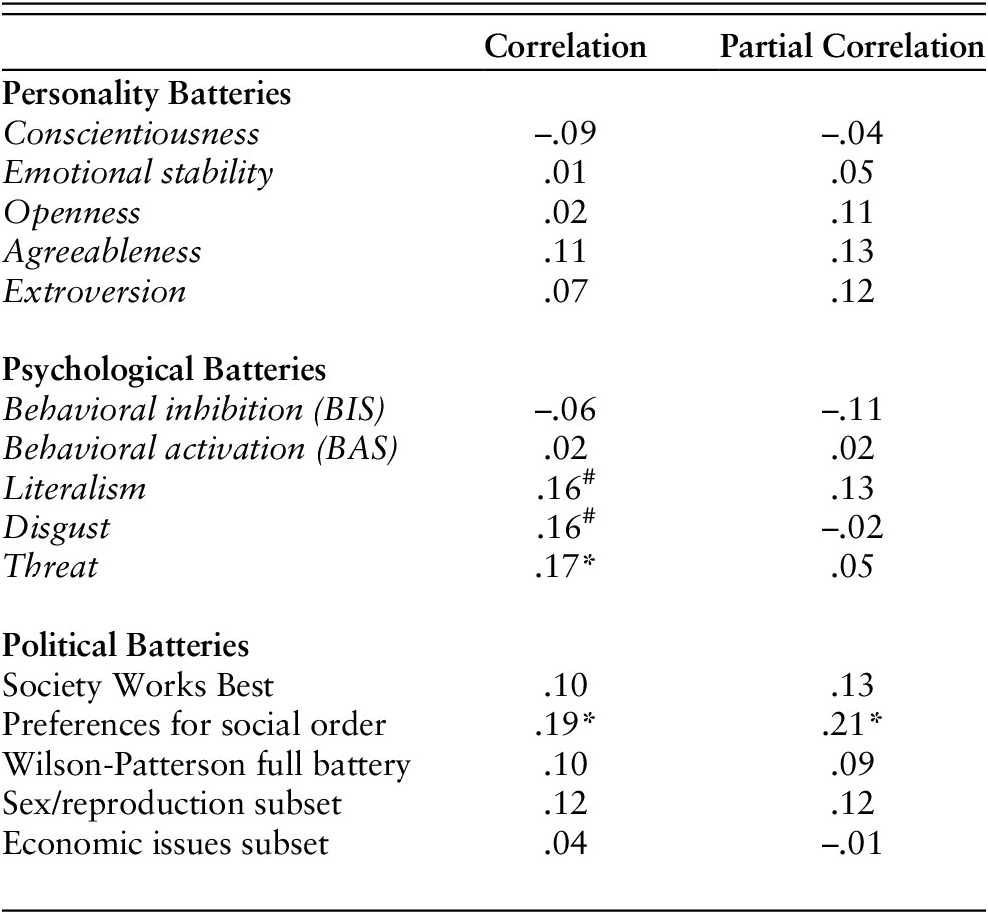
The characteristics of the individuals in the reduced sample were quite similar to those of the complete sample: 51.4% male, some college, annual income of just under $60,000, 91.2% white, and mostly conservative (39.4%) and moderate (34.3%). Similarly, differences between the full and reduced sample on our variables of interest ( Table 1) were modest. For most of these variables, mean differences were not statistically significant and were substantively trivial.
Androstenone detection correlated with personality, psychological, and political batteries.

Notes: Coefficients in the first column are simple correlations. Coefficients in the second column are partial correlations controlling for age, gender, income, and education.
Two-tailed significance tests: # p < .10; * p < .05.
After completing the screening questions, all participants—including those we later excluded because of possible osmic interference—engaged in an olfactory test. Amber-colored 40 ml bottles, labeled only with a number, were set up on the table next to the computer in the room. Directions on the computer screen instructed the participants to pick up each bottle, beginning with one labeled “#1,” unscrew the cap, place the bottle under their nose, and inhale gently. After recapping the bottle, they were asked to rate the strength or intensity of the odor (with 1 being “smelled no odor” and 10 being “smelled a strong odor”) and then the favorability or valence of the odor (with 1 being “unpleasant odor” and 10 being “pleasant odor”). This same process was then repeated for the remaining bottles.
The bottles were presented in the same order for all participants. Bottle #1 contained 5 ml of a solution of androstenone (5α-androst-16-en-3-one) with solvent propylene glycol at a dilution of 1:1000. Though androstenone has 16 distinct derivatives, scholarly studies of androstenone typically employ one of two: ∆4, 16-androstadien-3-one (also known as androstadienone) or 5α-androst-16-en-3-one. They are closely related, and we employ the latter here to keep our work consistent with that of Keller et al. (Reference Keller, Zhuang, Chi, Vosshall and Matsunami2007) and Knaapila et al. (Reference Knaapila, Tuorila, Silventoinen, Wright, Kyvik, Cherkas, Keskitalo, Hansen, Martin, Spector, Kaprio and Perola2008).
Bottle #2 contained only propylene glycol (5 ml) as a check to ensure that the solvent did not have a detectable odor, following a practice advised by Keller et al. (Reference Keller, Zhuang, Chi, Vosshall and Matsunami2007). Bottle #3 contained our control odor: 5 ml of a solution of citronella oil (Chinese 85/35%) diluted at 1:10,000 in paraffin oil. Citronella was used because it is an odor that is easy to detect and has no known specific anosmia (Knaapila et al., Reference Knaapila, Tuorila, Silventoinen, Wright, Kyvik, Cherkas, Keskitalo, Hansen, Martin, Spector, Kaprio and Perola2008). The central variable of interest in this analysis is the intensity with which each respondent reported detecting androstenone (Bottle #1).
To ensure that we are not merely uncovering general odor detection with sociopolitical attitudes, we correlated respondents’ self-reported perception of androstenone intensity with the control solvents. Detection of propylene glycol had a positive correlation with androstenone intensity (r = .17, p < .05), though not with self-reported pleasantness of the solvent (r = .007, p = .96). Likewise, citronella detection was positively correlated with androstenone intensity (r = .39, p < .001), though citronella’s perceived pleasantness was not (r = .03, p = .74). As a further check, we correlated detection and perceived pleasantness of propylene glycol and citronella with the sociopolitical batteries in question and found no significant correlations between the control solvents and constructs of interest.
Variations in people’s political orientations are measured in several different ways. One is an exclusively political version of the Wilson-Patterson Index (Wilson & Patterson, Reference Wilson and Patterson1968), which asks participants how strongly they agree or disagree (on a five-point scale) with a set of 28 individual political items, including same-sex marriage, protecting gun rights, and increasing military spending (full listing in the Appendix). Responses to each item were coded such that higher scores correspond to a conservative position, and then they were summed to obtain an overall measure of issue-based political conservatism. Using a schema developed by Smith et al. (Reference Smith, Oxley, Hibbing, Alford and Hibbing2011b), we measure broader social preferences using 15 items gauging the extent to which participants agreed or disagreed with statements such as “Society works best when our leaders are obeyed.” Responses were coded such that higher scores indicate more conservative preferences, with scores summed to obtain an additive “Society Works Best” (SWB) scale. For more information on Society Works Best, see Hibbing et al. (Reference Hibbing, Smith and Alford2013) as well as Friesen and Ksiazkiewicz (Reference Friesen and Ksiazkiewicz2015).
Finally, a distinct battery of five items asked respondents about their preferences for social order, for example, whether they prefer leaders to be firm and decisive, rule breakers to be harshly punished, and public policies to stress protection. Responses were coded such that higher scores indicate a stronger desire for clear social order, and individual scores were summed to obtain an additive index (see the Appendix for details). These three batteries are highly correlated (r for SWB-WP = .75; r for SWB-Social Order = .65; r for WP-Social Order = .66) suggesting that, though they pick up unique features, they tap into a similar general construct. Age, gender, income, and education were also recorded in the surveys taken by the participants and are included as control variables.
Results
We first investigate androstenone detection and political orientations using the aforementioned personality, psychological, and political batteries. In addition to the three measures of political ideology, the survey also tapped cognitive and personality patterns, including the Big Five personality inventory (conscientiousness, emotional stability, openness, agreeableness, and extroversion), the BIS/BAS (behavioral inhibition and activation, respectively) scales, preference for literalism, and tendencies to be both disgust and threat sensitive. We have no strong expectations for the nature of the relationship between androstenone detection and these concepts, but we do expect positive relationships for all three of our political batteries and particularly for the “preferences for social order” battery, a finding that would indicate that those with politically conservative and “authority-attuned” positions tend to be more sensitive to androstenone.
The results for all of these batteries are presented in Table 1. The first column of numbers reports Pearson correlations between self-reported odor intensity and the corresponding variable. With regard to the Big Five personality battery, we find no relationship between androstenone intensity and conscientiousness (r = –.09, p > .10), emotional stability (r = .01, p > .10), openness (r = .02, p > .10), agreeableness (r = .11, p > .10), or extroversion (r = .07, p > .10). Moreover, there was no significant bivariate correlation between behavioral inhibition (r = –.06, p > .10) or behavioral activation (r = .02, p > .10). Preferences for literalism were positively correlated with androstenone intensity, albeit at a relaxed level of significance (r = .16, p < .10), with higher preferences for literalism associated with higher self-reports of androstenone intensity. The same trend is found for disgust sensitivity and androstenone intensity (r = .16, p < .10), with higher levels of disgust sensitivity associated with more intense self-reports of androstenone detection. Threat sensitivity was also positively correlated with androstenone intensity (r = .17, p < .05).
Turning to the political batteries, androstenone intensity was positively correlated with the preferences for social order battery (r = .19, p < .05), with subjects reporting higher preferences for social order also typically reporting higher androstenone intensity. Intensity, however, was not associated with the SWB scale (r = .10, p > .10) or the full Wilson-Patterson battery (r = .10, p > .10), nor was it associated with either the sex/reproduction (r = .12, p > .10) or economic issues (r = .04, p > .10) subsets of the Wilson-Patterson battery.
The second column of Table 1 reports partial correlations after accounting for the effects of age, gender, income, and education. The best indicator of the presence of an independent relationship is provided when standard control variables are partialed out (Column 2). We find no relationships between androstenone and either personality (p > .10 in all cases) or psychological (p > .10) batteries. There was no significant partial correlation between the SWB scale and androstenone intensity (r = .13, p > .10), though we do find that androstenone intensity continued to exhibit a significant positive relationship with preferences for social order (r = .21, p < .05) even after accounting for the effect of our control variables. Neither the full Wilson-Patterson battery (r = .09, p > .10) nor the sex/reproduction subset (r = .12, p > .10) and economic issues subset (r = –.01, p > .10) was related to self-reported androstenone intensity.
With low effect sizes and nonsignificance, the strength of the connection between variations in androstenone detection and political views does not seem to be related specifically to economic or sexual morality items. The lack of relationship with sex attitudes is somewhat surprising, given androstenone’s connection to gender signals in the extant literature, but this might indicate that androstenone affects interpersonal interactions, perceptions, and judgments but not necessarily preferences for sexual policies that would affect communities and society.
Though these results are somewhat promising, the simplicity of the models shown here—particularly those models showing systematic relationships between androstenone intensity and political batteries—demand more scrutiny. We are particularly interested in subjecting the relationship between respondents’ preferences for social order and androstenone detection, given that it is both of central interest in this research and the only sociopolitical battery to show a relationship with olfaction. Recall that in our correlational analyses, the scales were constructed through summation of their constituent parts, which, while parsimonious, risks confounding meaningful variance with error variance due to the fact that simple summation does not partition out the variability in individual items that are not related to the construct as a whole.
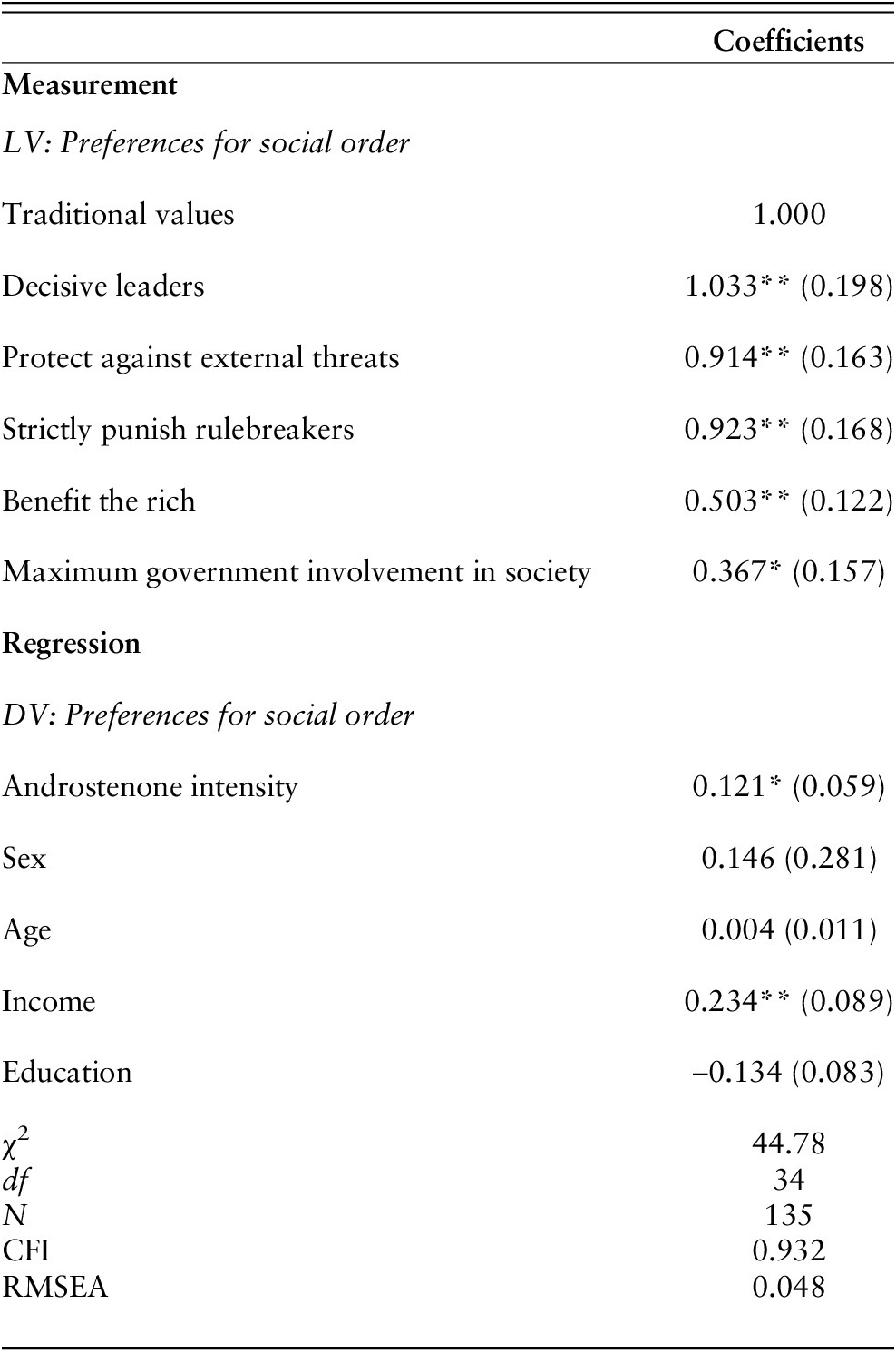
To further examine the relationship between preferences for social order in a more rigorous way, we constructed a structural equation model simultaneously specifying a factor model of the preferences for social order battery and then regressing the resulting latent factor for social order on androstenone intensity, sex, age, income, and education. The results of this analysis are shown in Table 2.
Structural equation models predicting preferences for social order.
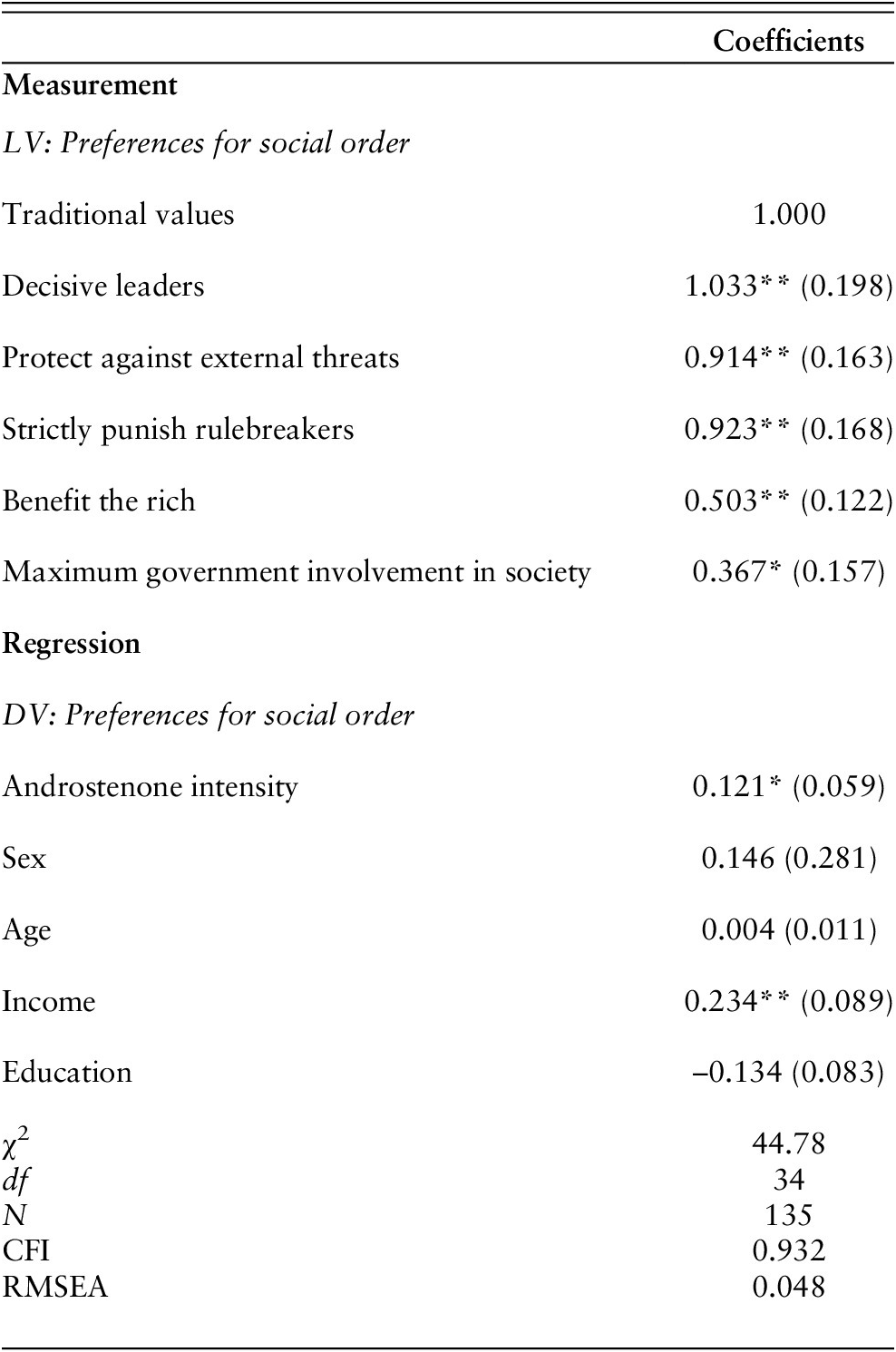
Notes: Standard errors in parentheses. The structural equation model was estimated using the Lavaan package in R.
Two-tailed significance tests: * p < .05; ** p < .01.
The factor model for individuals’ preferences for social order, when regressed on androstenone intensity and our control variables, continued to show a positive and significant relationship with androstenone intensity (b = .121, p < .05). As in the partial correlation for this survey battery, participants who reported higher intensities of androstenone detection were also typically more prone to having heightened preferences for social order. That this relationship persists when the data were subjected to increasingly rigorous methodological tests suggests that it is a connection between biology and preferences necessitating further investigation. Importantly, though there are known gender differences in and rostenone detection and production (e.g., Cowley et al., Reference Cowley, Johnson and Brooksbank1997), there is no relationship between sex and preferences for social order—so it might be possible that reported biological sex is not a moderator between androstenone intensity and preferences for social order. We also ran a structural model specifying a preference for social order regressed on a sex * androstenone intensity interaction; this interaction was not found to be significantly related to preferences for social order. These results, combined with the relationship between androstenone detection and our battery tapping preferences for organizing society, are consistent with our earlier theoretical speculation that androstenone detection would be most apparent on issues pertaining to securing the social order.
Discussion
In our sample, variations in androstenone detection appear to be relevant to variations in political orientations—specifically, preferences for order—but not psychological orientations. Economic and sexual morality issues appear to be unconnected to sensitivity to androstenone. As we noted earlier, the absence of a relationship with sex items is particularly interesting given that other research has demonstrated that sensitivity to pathogen-relevant disgust is indeed related to issue stances on sexual matters. Sensitivity to the human odorant androstenone appears to manifest itself politically in quite a different fashion than sensitivity to pathogen-indicating odors (e.g., human excrement, vomit, or spoiled food). Certain individuals are sensitive to the odor of androstenone, and they also tend to be the people who are attuned to and eager to squelch threats to the social order.
We also recognize the limitations of our study. The sample is quite small, given the effect sizes of these relationships, and though we use an adult (rather than student) population, it is geographically constrained and racially homogenous. Because of these limitations, we have tried to be careful in drawing any broad conclusions or extending our findings to other populations other than the one from which we sampled. We hope that this effort at connecting these domains provides a foundation for future research, particularly for a priori power analysis, research design, and replication and extension.
Variation in androstenone detection has been related to small-scale social and emotional responses, such as reactions to facial images. In this study, we examined whether variation in androstenone detection is also related to mass-scale political orientations. Given the nature of androstenone as it relates to hormones like testosterone, we reasoned that, if there is a relationship with politics, it is likely to center on issues concerning dominance, authority, hierarchy, competition, leadership, and security—in short, social order. Preliminary tests support the connection of androstenone detection to general political orientations, with further indication that preferences for social order are more affected than preferences for policies related to the economy, sex, and reproduction. This relationship of androstenone to social order and hierarchy supports the hormone’s connection to testosterone—that is, those sensitive to testosterone-related behaviors like aggression may desire strong leadership and tight in-group coalitions to mitigate what they see as social disruption.
Setting aside the need to replicate this research at a larger scale, the evidence we present of a connection between olfactory sensitivity and political orientations is novel, intriguing, and supports previous work on individual responses to various pheromones. The suggestive relationship between political orientations and olfactory sensitivity to the odor of androstenone should encourage additional work in olfaction and politics—not just that portion of olfaction related to disgusting odors. Though people are not consciously aware of their sensitivities to odors such as androstenone, it would appear that subthreshold detection is enough to exert a modest effect on some political orientations. Much like work conducted on nonconscious physiological responses to stimuli and associated political attitudes (Friesen et al., Reference Friesen, Smith and Hibbing2017; Gonzalez et al., Reference Gonzalez, Smith, Hibbing and Berinsky2015; Wagner et al., Reference Wagner, Deppe, Jacobs, Friesen, Smith and Hibbing2015), subthreshold detection of environmental signals may help us bypass many of the problems with survey self-reporting and lead to a fuller understanding of individual variation in preferences for group life. It would be particularly useful to test larger samples that could be split or moderated by sex to detect differences in how male and female responses to the hormone may alter its relationship with social preferences. Measuring gender in addition to binary sex also might reveal nuance differences in gender orientation, gender identity strength, and attitudes toward strong leaders, social order, and hierarchy (Bittner & Goodyear-Grant, Reference Bittner and Goodyear-Grant 2017).
Psychologists, biologists, and geneticists have demonstrated human variation in every sensory system just as social scientists have been examining differences in social and political orientations and attitudes. Our work seeks to bridge these worlds in the hope of contributing to the understanding of the nature and origins of human political behavior and, broadly, public opinion. Few, if any, disciplines treat biological and behavioral variation as completely unrelated, yet much of the political science research does just that. This is a matter of empiricism. Just as parents, schools, peers, culture, and time periods may influence sociopolitical attitudes and behavior, we posit that the manner in which individuals process these environmental inputs may be just as important as the inputs themselves (Gonzalez et al., Reference Gonzalez, Smith, Hibbing and Berinsky2015). Combined with the growing body of work connecting politics to behavioral genetics and physiology, we demonstrate olfaction should not be ignored in the examination of political attitudes and orientations.
An earlier version of this article was presented at the Annual Meeting of the Midwest Political Science Association, Chicago, Illinois, April 2011. Financial support was provided by the National Science Foundation (BCS-0826828).