President Franklin Delano Roosevelt shaped the role of the modern president in part with his relentless pursuit of grand policies and his ability to marshal historic legislation through Congress. In this article, I focus on one legislative tactic FDR employed that has received little attention—the detailing of Executive Branch staff to select Senate committees during his third term. This tactic, effectively a blending of legislative powers between two branches of government, was used to implement FDR’s ambitious postwar domestic agenda as detailed in his Second Bill of Rights. My specific research questions are (1) How effective was the tactic? (2) How did the blending of legislative powers relate to FDR’s direct bargaining with Congress? and (3) How did Congress react to the tactic?
The research I conducted to answer these questions is organized in three sections. The first section addresses the effectiveness of the tactic. This section starts with a brief review of the existing literature on the modern presidency and FDR’s tactics to influence Congress and build a responsive organization under his direction. I follow this with a full discussion of FDR’s efforts to blend legislative powers. This portion of the article provides new details, drawn from contemporary sources, on FDR’s efforts to shape legislation through detailing Executive Branch personnel to Senate policymaking committees. The second section addresses how the blending of legislative powers related to FDR’s direct bargaining with Congress. This section provides original quantitative research on the number of contacts FDR had with Congress during each year of his presidency. This data is used to interpret how the timing of FDR’s efforts to blend legislative powers substituted for, or overlapped with, his direct bargaining with members of Congress. The third section addresses how Congress reacted to the tactic of legislative blending. It also contains a qualitative analysis of public testimony on the Legislative Reform Act of 1946 (LRA) to determine if FDR’s efforts to blend legislative powers influenced the legislation. Following these three sections, I present my conclusions on how FDR’s blending of legislative powers adds to the interpretation of his place in shaping the modern presidency and the modern Congress.
FDR’s Presidency and Blending Legislative Powers
Historians and political scientists have posited various criteria to define the transition to the modern presidency. Most consider the breadth and scope of the organization controlled by the president and the power they exercise over Congress. Clinton Rossiter suggested five specific measures to define a modern president: a substantive legislative agenda, active public relations, service as protector of the peace (at home and abroad), championing civil liberties and rights, and inspiring a positive outlook for democracy. Applying these criteria, Rossiter views FDR as creating the modern presidency, Truman as defending it, and Eisenhower as making it accepted.Footnote 1 David Nichols credits George Washington as the first modern president, for giving life to the office by exercising powers granted to the office in the Constitution (i.e., the legislative veto).Footnote 2 Still others look to Woodrow Wilson as a starting point for modernizing the presidency. Wilson applied pressure on Congress to follow his agenda through aggressive campaigning and harnessing new forms of media to rally the populous.Footnote 3 One common thread in the debate over defining the modern presidency is the supposition that there is a zero-sum tug-of-war between the President and Congress for power.Footnote 4
FDR exercised power over Congress during his first year in office by meeting individually or with small groups of Senators and Representatives. With a few personal staff and no chief of staff in place to manage his agenda,Footnote 5 FDR parlayed these meetings into several monumental legislative victories early in his first term. FDR promoted this interbranch collaboration as an efficient tactic to advance policies and programs. After nearly a year of progress on his New Deal agenda, he told Congress during his annual message on January 3, 1934, “I know that each of you will appreciate that I am speaking no mere politeness when I assure you how much I value the fine relationship that we have shared during these months of hard and incessant work. Out of these friendly contacts we are, fortunately, building a strong and permanent tie between the legislative and executive branches of the government. The letter of the Constitution wisely declares a separation, but the impulse of common purpose declares a union.”Footnote 6
In FDR’s second term, after finding resistance to expanding his domestic agenda beyond the New Deal, he sought more staff resources to combat congressional resistance. At the time, his only support staff was the Bureau of the Budget—a department with just thirty-five employees, stowed away in the Treasury Department, led by an administrator grounded in scientific management principles, and hired by a Republican.Footnote 7 FDR wanted an organization under his control with responsive competence—a quality Terry Moe defined as “an institutional system responsive to his needs as a political leader.”Footnote 8 He advanced toward this objective when he formed The President’s Committee on Administrative Management. The committee, formed on March 20, 1936, was comprised of just three members; Louis Brownlow, a former city manager and consultant to several members of FDR’s cabinet, Charles E. Merriam, a professor at the University of Chicago and an appointee to FDR’s National Resource Committee, and Luther Gulick, the director of the Institute of Public Administration in FDR’s home state of New York. FDR kept the numbers small and held several meetings with the members to ensure that the committee shared his vision.Footnote 9
Congress opposed the reach of FDR’s second-term administrative reforms at every turn, using a variety of arguments to whittle down his grand plan. Chief among these was the contention that FDR was creating the infrastructure to transform the presidency into a dictatorship. It didn’t help FDR that Adolph Hitler was reshaping Germany’s government at the same time to increase executive power.Footnote 10 Another major concern was FDR’s proposal to assume, in the Executive Branch, the policymaking and regulatory functions of independent commissions. Powerful members of these commissions, most notably Joseph Eastman of the Interstate Commerce Commission, warned Congress about the perils of permitting the Executive Branch to assume their functions.Footnote 11 Without a constituency to support his plan, and a Congress unwilling to strengthen the Executive Branch, FDR settled for legislation that gave him a few staff assistants, moved the Bureau of the Budget from Treasury to the White House, and renewed the President’s opportunity to submit reorganization proposals to Congress. The legislation granting these nominal changes, the Reorganization Act of 1939, was signed into law on April 3, 1939. Neither Brownlow, Merriam, nor Gulick was consulted on its language.Footnote 12
In FDR’s third term, still lacking significant staff resources under his direct control, he turned to blending legislative powers to advance an increasingly aggressive domestic agenda. FDR made the move quietly, with no public announcement. He did not invoke the framers of the Constitution in this move, but if he had, he would have found plenty of supporting material in their writings and actions. The Constitution provides a few explicit provisions that blend powers between branches.Footnote 13 Examples of blending include the Vice President’s vote in the Senate to break ties on legislative measures and the Senate’s approval of Executive Branch appointments to cabinet-level positions. While instances of blending are few, there are no prohibitions to expand on these blending of powers.
The flexibility of the Constitution to permit blending reflects a desire by the framers to balance the separation of powers with the opportunity for efficiencies gained through interbranch cooperation. Early writings by Alexander Hamilton advocated for overlapping or moderation of powers between branches. Efficiencies through cooperation were valued over clear and simplistic boundaries.Footnote 14 However, as time drew closer to adoption of the final version of the Constitution, Hamilton dropped this more complex relationship from his writings for a clear separation of powers. Some attribute this change as a necessity to round up votes for the ratification of the Constitution.Footnote 15 The change in rhetoric was not, however, reflected in the final version of the Constitution or the Bill of Rights. James Madison attempted to add stronger language on the separation of powers but was rejected.Footnote 16 The final product is an incomplete contract between branches that permits flexibility for future presidents and Congresses to define.Footnote 17
Hamilton, the first Secretary of the Treasury, wasted no time testing the new Constitution’s limits on blending legislative powers. Prior to Hamilton’s appointment by President George Washington, The House of Representatives established the first Ways and Means Committee to review the federal government’s revenues and expenditures. The committee was established in July 1789. Hamilton, appointed to the treasury post two months later, convinced the Federalist-controlled House to dissolve the new committee and rely solely on his support for guiding members on the financial future of the nation.Footnote 18 Hamilton proceeded in this role to issue reports, recommend legislation, lobby members, and guide his bills to approval by the House and Senate.Footnote 19 Hamilton continued in this role until the Federalists lost control of Congress in 1794. Republicans, upon taking over control, reestablished the Ways and Means Committee, bringing an end to the first experiment in blending legislative powers.Footnote 20
FDR’s first overt exercise in blending legislative powers occurred in his first term when he assigned Benjamin Cohen from his staff to serve as an adviser to Senator Burton Wheeler during contentious committee debates on the Public Utility Holding Company Act of 1935. The Act was FDR’s top legislative priority at the time, and Cohen, who teamed another Executive Office staffer, Thomas Corcoran, to draft the legislation, sat by Wheeler’s side during committee meetings, offering advice on potential compromises necessary to secure the bill’s passage.Footnote 21 With Cohen’s advice to Wheeler inside the committee room and Corcoran’s intense lobbying in the hallways outside, FDR achieved a signature legislative victory. FDR’s blending of legislative powers in his third term would be on a much grander scale.
The literature on FDR’s use of detailed staff in his third term to blend legislative powers is sparse. Alexander Bolton and Sharece Thrower (2016) recently identified the reliance of Congress on detailed staff from FDR’s Executive Branch as an indicator of low capacity for Congress to limit presidential power.Footnote 22 Prior to Bolton and Thrower’s article, the practice is mentioned briefly in studies of full-employment legislation from the 1940s. The legislative battle over full-employment legislation started with the proposed Full Employment Act of 1945 and ended with the adopted Employment Act of 1946. Lessons from this legislative battle were taught in political science and public administration courses throughout the country in the 1950s and 60s. Stephen Bailey’s Congress Makes a Law mentions in passing the use of detailed staff to develop and push full-employment legislation inspired by FDR’s Second Bill of Rights. Bailey writes about the bill’s original sponsor, Senator James E. Murray (D-MT): “Murray was aided and abetted by large committee staffs which he had built up during the war to assist him with his legislative program. Off and on during 1944–45 he had approximately seventy-five staff assistants and secretaries working for him and his committees. Most of these assistants had been borrowed on a temporary basis from executive agencies and departments. The detailed staff came from the White House and various federal agencies.”Footnote 23 Senator Murray’s biographer, Donald Spritzer, expanded on Bailey’s observation, claiming, “At a time when most Senators and Congressmen had only a handful of people working for them, Murray pioneered the concept of a large Senatorial staff of professionals.”Footnote 24
Full-employment legislation was not, however, the extent of FDR’s reach into the Senate policymaking structure. FDR deployed Executive Branch staff into several Senate committees drafting legislation aligned with his postwar domestic agenda. As the war progressed through the early 1940s, it became clear to FDR that a new round of public programs was necessary to smooth the transition from the wartime economy. This reconversion had to address the potential sudden unemployment of four to five million citizens and a surplus of $15 billion in military supplies associated with the downsizing of military personnel and industrial production.Footnote 25 FDR’s plan to address this pending shock to the economy centered on a “Second Bill of Rights,” which he presented to a disinterested, half-filled chamber during his 1944 State of the Union address.Footnote 26 The plan included eight points:
1. The right to a useful and remunerative job in the industries or shops or farms or mines of the nation;
2. The right to earn enough to provide adequate food and clothing and recreation;
3. The right of every farmer to raise and sell his products at a return which will give him and his family a decent living;
4. The right of every businessman, large and small, to trade in an atmosphere of freedom from unfair competition and domination by monopolies at home or abroad;
5. The right of every family to a decent home;
6. The right to adequate medical care and the opportunity to achieve and enjoy good health;
7. The right to adequate protection from the economic fears of old age, sickness, accident, and unemployment;
8. The right to a good education.Footnote 27
Going beyond his postwar domestic agenda, FDR detailed a significant contingent of Executive Branch staff to progressive Senators James E. Murray (D-MT), Claude Pepper (D-FL), and Harley Kilgore (D-WV). During the period when records were kept on the detailing of Executive Branch’s personnel (August 1944–February 1946), the committees of these three senators operated with nearly 80 percent of the staff lent to committees by FDR’s Executive Branch agencies.
Senator Murray held the largest contingent of detailed staff. The junior senator from Montana previously demonstrated his commitment to FDR by standing behind both the president’s court-packing and reorganization plans. In doing so, Murray bucked Senate protocol by refusing to cast his votes in line with Montana’s senior Senator, Burton K. Wheeler.Footnote 28 Murray, a lawyer trained at New York University, with strong connections to FDR confidants Al Young and Senator Robert Wagner,Footnote 29 was both the wealthiest member of Congress and among its most progressive.Footnote 30 Dubbed “Millionaire Moses” by the Saturday Evening Post, his personal wealth, and, being a native of Canada, his ineligibility for higher office, ensured that he would not compromise the president’s agenda for personal financial gain or political advancement. Murray’s enlistment was likely a topic of conversation between the pair when they met six times in 1942. Only one senator, Majority Leader Alben W. Barkley, met more with FDR that year.Footnote 31
Senate records indicate Murray’s committees were assigned about 40 percent of the detailed staff, thirty employees and consultants in all. This was during a time when some committees did not have any staff to support their work.Footnote 32 Murray placed his team of staff and consultants under the direction of two New Deal advocates: Bertram Gross and Isadore Falk. The effort to pass full-employment legislation was assigned to Gross, who came highly endorsed by Leon Keyserling, a senior aid on Senator Wagner’s staff.Footnote 33 Falk, a senior official in the Social Security Administration and a confidant of Harry Hopkins, coordinated the drafting of universal health-care legislation.Footnote 34 By the mid-1940s, Murray’s committee staff had evolved into a satellite braintrust for FDR. Most were paid for by the executive agencies from which they were detailed. Bertram Gross, for example, remained on the payroll of the Navy Department throughout his tenure with Murray.Footnote 35 While Murray took on key elements of the Second Bill of Rights (i.e., economic security and universal health care), Pepper and Kilgore’s detailed staff worked on complementary issues focused on military activities.Footnote 36
Full Employment Legislation
FDR’s primary means to provide economic security was to establish a right, for all Americans, to a useful and remunerative job. The legislation to implement this key element of his Second Bill of Rights was the Full Employment Act of 1945, drafted by Gross and introduced by Murray. It was a bold plan to create a failsafe when private enterprise and state and local government could not produce employment opportunities for every willing able-bodied person. The bill called for a national economic budget to appropriate enough funds for public-service employment to provide work for anyone unemployed. After a year of debate on the measure, the final product was an entirely new bill, the Employment Act of 1946. The full employment mandate was switched to a goal in the final legislation, and there was no trigger for a public employment element. Instead, the bill created the Council of Economic Advisors (CEA) to conduct a critical analysis of the economy and make policy recommendations to the president to address any projected unemployment. Although it did not meet the goal set by FDR’s Second Bill of Rights, it nevertheless was viewed as a victory for labor.
The AF of L, CIO, and the National Farmers Union held hope that the goal of full employment, and a CEA, would “mark the beginning of an American crusade for economic security, stability, and justice.”Footnote 37 Gross served as the executive secretary for the first five years of the Council, and the economic reports he prepared for FDR’s successor, Harry S. Truman, took on many of the qualities outlined in the original Full Employment Act of 1945. The first report proposed an economic budget and focused almost entirely on full employment. Successive CEA staff and presidents continued the focus on full employment through the Johnson administration, leading Kenneth Galbraith in 1966 to call out the Employment Act of 1946 as the most important single piece of economic legislation of the postwar years.Footnote 38 The focus on employment was dropped, however, in President Richard Nixon’s first year in office,Footnote 39 and today the work of the CEA and its reports shift focus between health care, climate control, energy production, and any number of policy areas depending on the priorities of the president.
Universal Health-Care Legislation
Health security was another critical element of FDR’s Second Bill of Rights. FDR initially supported national health care as an element of the Social Security Act of 1935 but encouraged its sponsors to shed the program to salvage the income-support component of the Act. Senator Wagner, who carried the Social Security legislation, reintroduced national health care in 1939, but that bill also failed due to political pressure from the medical lobby. The effort regained momentum in 1941, when reports surfaced that 40 percent of the one million men called up for the draft failed their physicals.Footnote 40 Wagner joined with Murray and Representative John Dingell (D-MI) in 1943, using language drafted by Isadore Falk, to introduce a variety of programs, including national health insurance. FDR followed the introduction of the legislation by including the measure in his proposed Second Bill of Rights. FDR again felt the heat from health insurers, but he gave tacit approval to the trio to continue their push for the legislation.
Murray took a pragmatic approach to the legislation, knowing the medical lobby could not oppose every part of their bill. The first element to make it to the president’s desk was a component to give veterans Social Security credit for time spent in service to their country. In language lifted directly from the 1943 bill,Footnote 41 the Servicemen’s Readjustment Act of 1944 (commonly referred to as the GI Bill) passed Congress and was signed into law by FDR with this element. The GI Bill broke new ground in the area of health care, providing a national health-care system for the segment of society that served in the military.Footnote 42 Following this victory, and FDR’s passing, Murray secured Truman’s endorsement of national health insurance and proceeded to break the Wagner–Murray–Dingell bill into pieces. This permitted him to bring the health-insurance component under his Education and Labor Committee and push less controversial components forward through other channels. When the dust settled, hospital construction bills passed in 1945 and 1949, as did the National Dental Research Act of 1948 and the National Heart Act of 1948. These latter two bills spawned the formation of the National Institutes of Health.Footnote 43 The national health insurance component did not fare so well. It took almost twenty years for a limited version of the measure to find acceptance during the Johnson administration. At the signing ceremony to establish Medicare in 1965, President Johnson remarked that it ended a battle that began in 1943, and thanked Wagner, Murray, and Dingell, among others, for their perseverance.Footnote 44
On matters of economic and health security, FDR’s use of detailed staff was particularly effective because Murray’s committees were able to gain control of every important piece of legislation in these policy arenas. Murray accomplished this feat through a complex series of internal maneuvers involving the joining and separating of bills and by wielding his seniority over other competitors. Bailey described the machinations by Murray as a seven-part play, with the explicit purpose of introducing more liberal language than could be expected from other committees.Footnote 45 With the enormity of Murray’s staff, his control of key legislation, and his alignment with FDR, it was not long before several members of Congress realized that FDR’s blending of legislative powers represented, in Gross’s words, “a powerful force in the campaign for liberal reconversion legislation.”Footnote 46
Direct Contact vs. Blending: The Data
In this section, I’m interested in determining whether FDR’s detailing of staff to Senate committees overlapped with or replaced his direct bargaining with Congress. Historians have used select data on the number of meetings between FDR and congressional leaders to construct a bargaining-centric model of presidential power.Footnote 47 However, the meeting data used in these analyses is neither comprehensive, nor is it compared with the presidents that served before and after FDR. For the analysis that follows, a comprehensive data set of congressional meetings was constructed from calendar records for Presidents Herbert Hoover, Franklin D. Roosevelt, and Harry S. Truman. The methodology used to construct this data set is provided in the appendices.
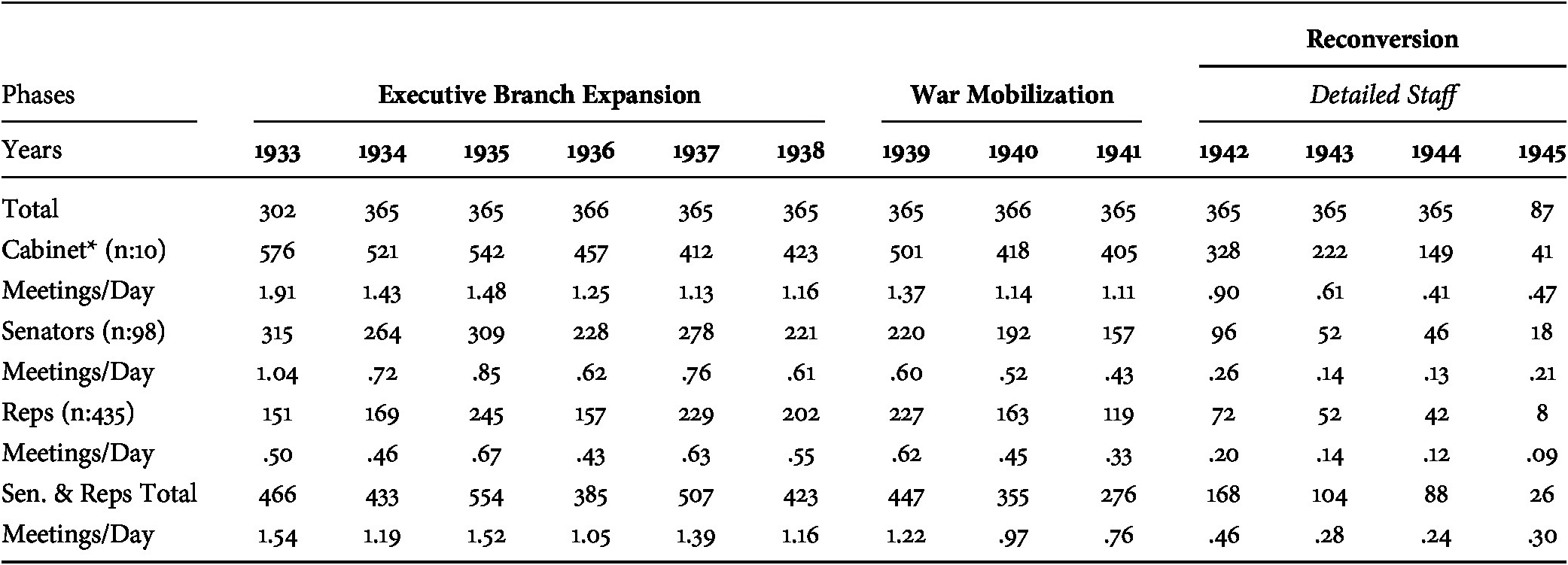
The number and type of FDR’s contacts with Congress are recorded in a database of meetings assembled from original meeting logs by the Pare Lorentz Center at the Franklin D. Roosevelt Presidential Library. Table 1 provides the total number of meetings conducted by FDR each year involving the cabinet, Senators, and Members of the House of Representatives. The number of meetings conducted per day for each group is also presented as a means of comparing years where the president did not serve the entire calendar year.
FDR’s Annual Distribution of Meetings.

* Cabinet meetings included
Source: Franklin D. Roosevelt Day by Day 2011, Pare Lorentz Center at the Franklin D. Roosevelt Presidential Library.
During the twelve full years of FDR’s presidency, his engagement with his cabinet and Congress follows a pattern that is roughly divided into three phases: (1) Executive Branch Expansion (1933–38), (2) War Mobilization (1939–41), and (3) Reconversion (1942–45). The first phase (1933–38) shows steady contact between FDR and his cabinet and Congress. During the second phase (1939–41), contact levels are maintained with his cabinet but decrease with Congress. In the third and final phase (1942–45), contact levels with both cabinet and elected officials decline. It is in this last phase where FDR inserted key ideologues and Executive Branch staff into the committee structure of the Senate (last two columns).
During the Executive Branch Expansion (1933–38), FDR participated in between 1.54 (1933) and 1.05 (1936) daily activities with members of Congress at the White House or his estate in Hyde Park, New York. He met with Senators with more frequency than members of the House of Representatives. During the mobilization for World War II, from 1939 until 1941, which included the bombing of Pearl Harbor, FDR’s contact with Congress began to decline, while his contact with cabinet members remained steady. During the start of this War Mobilization phase (1939), he engaged with Congress 1.22 times per day. By the end of this phase in 1941, his contact with Congress dropped to just .76 daily activities. His activity level with his cabinet members did not suffer a similar drop-off during this period. Post–Pearl Harbor, until the last full year of his presidency in 1944, the decline in contact with Congress accelerated. During this Reconversion phase, between 1942 and 1944 his daily contact with members of Congress dropped from .46 to just .30 daily activities. His daily contact with Congress in his final full year in office (1944) was approximately 16 percent of the level of his first year in office.
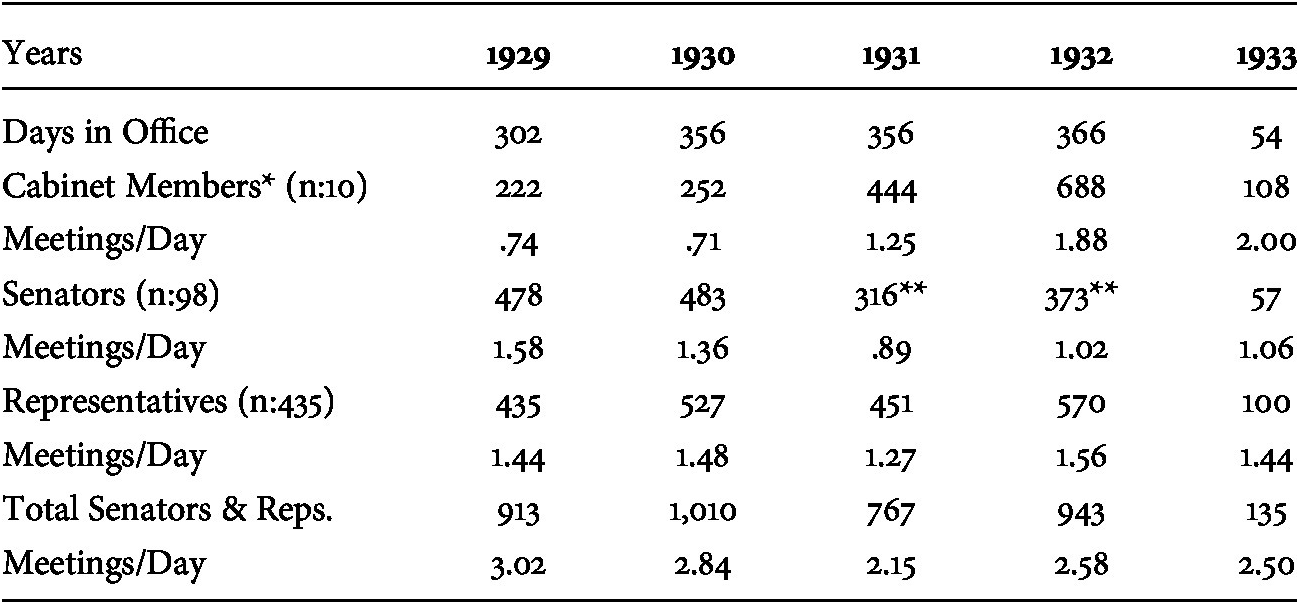
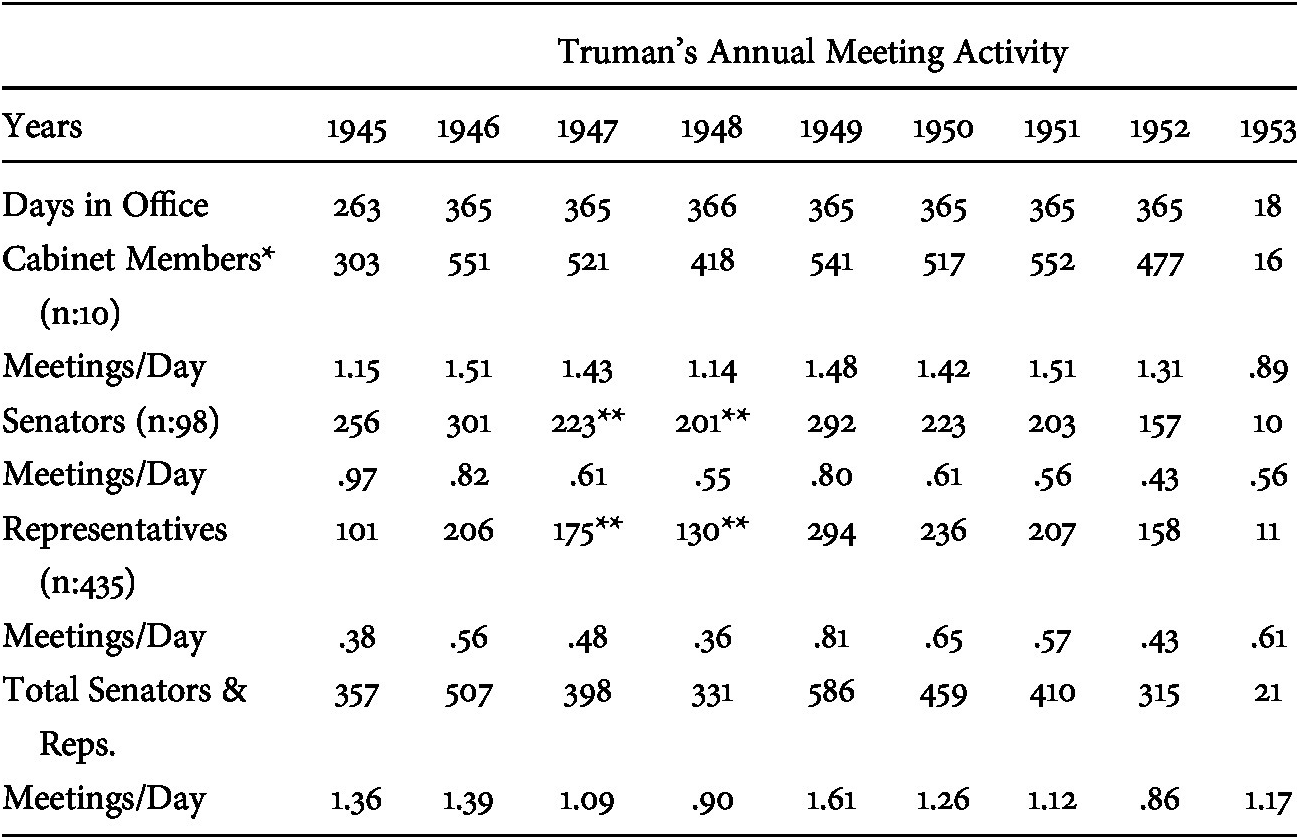
To determine if FDR’s pattern of declining contact with Congress was unique, and therefore evidence in supporting a shift in legislative strategies (direct bargaining versus blending), I reviewed and compared the calendars of his predecessor and successors. President Herbert Hoover’s contact with Congress significantly exceeded that of FDR’s. Hoover met with Congress 3.2 times per day during his first year in office (1929), and then dropped to 2.5 contacts per day in his final calendar year in the position (1933). Hoover’s meeting activity with cabinet members started at relatively low .74 meetings per day in his first year and climbed to 2.0 meetings per day in his final year (Table 2). Hoover’s contact with Congress nearly doubled that of FDR, and his meeting activity increased during his term, while FDR’s decreased. President Harry S. Truman’s contact with Congress was remarkably similar to FDR’s, both in starting intensity and consistency over the first two terms (Table 3). Truman started with 1.36 average daily contacts with Congress in 1945 and ended with .86 daily contacts in his final full calendar year in office (1952). As for cabinet meetings, Truman’s cabinet-level meetings were fairly consistent during his term. He started his presidency meeting with cabinet members 1.15 times per day in his first year, and at the end of his presidency met with his cabinet 1.3 times per day.
Hoover’s Annual Distribution of Meetings.

* Group Cabinet meetings not included
** Opposition party in control of chamber
Source: Herbert Hoover Presidential Library-Museum.
Truman’s Annual Distribution of Meetings.

* Group Cabinet meetings not included
** Opposition party in control
Source: Harry S. Truman Presidential Library and Museum.
The data indicate there was a long decline in FDR’s contact with Congress and his cabinet members before he turned to using detailed staff to pursue his legislative agenda. Therefore, it is apparent that there is no distinct overlap of blending with direct bargaining, or a clean transition from one tactic to the other. FDR’s long steady decline in meetings with Congress is similar to Truman’s meeting data. One explanation for the similarity is that after an initial burst of congressional contacts early in their administration to establish relationships, the maintenance of those relationships required less effort as time passed. Another explanation for FDR’s decline in contact with Congress is that the war effort did not require bargaining with Congress in the same way that it was necessary to pass domestic legislation. The notion that domestic agendas required more congressional contacts is supported by Hoover’s calendar. Hoover was consumed for all four years with domestic issues, in part arising from the start of the Great Depression. He maintained a high level of contact (relative to FDR and Truman) with Congress during his entire term. However, if pushing a domestic agenda required more contact with Congress, it would be expected that FDR would increase his number of contacts with members of Congress when he proposed his Second Bill of Rights. That did not happen. It may not have happened because FDR relied on established relationships that did not require intense contacts. Another explanation is that he was not capable of replicating the previous intensity of his interaction with Congress due to declining health. The steep decline in meetings with cabinet members, a sustained trend only seen in FDR’s meeting patterns, suggest that health may have been a factor. Without the energy to maintain his contacts with Congress and his cabinet, perhaps the blending of legislative powers allowed key staff and Senators to serve as his proxy in advancing his legislative agenda.
Congress Reacts to Blending Legislative Powers: The Testimony
Before and during FDR’s presidency, Congress did not have the capacity to maintain control of the legislative process. Presidents with strong personalities and party support, like Jefferson, Jackson, and Wilson, were able to control the legislative functions of Congress. During times with weak presidents, Congress regained control of the legislative function.Footnote 48 As with the Executive Office of the President, Congress struggled to address this lack of institutional power with several self-sponsored organizational studies.Footnote 49 The first efforts to bolster support for Congress came in 1915, when the first appropriation was made for the Legislative Reference Service. Shortly thereafter, in 1918, the Office of Legislative Counsel was established. Finally, in 1924 a limited number of staff was funded to provide direct support for committees.Footnote 50
Representative Clarence Cannon (D-MO) attributed the inaction of Congress to initiate substantial organizational reforms to the fear of “unleashing a monster.” Cannon explained the lack of action this way: “The delay in reaching some earlier solution of the matter has been largely occasioned by two major difficulties, the difficulty of building up an organization which through its intimate association with the members of the committee would slowly but surely increase its salaries, its personnel, and its jurisdiction until it became in effect a Frankenstein which could not be controlled or dislodged, and, second, the establishment of an organization amenable to political manipulation that could be used for partisan purposes.”Footnote 51 Nevertheless, FDR’s increasing power advantage on matters relating to foreign affairs, and the increasing responsibilities of Congress on the domestic front, renewed interest in the long-studied topic.
The American Political Science Association (APSA) took a lead role in the wartime review of Congress. Much of the responsibility fell to, or was seized by, George Holloway. He served as the primary author of APSA’s review of Congress between 1941 and 1943, and then took the lead staff role for a Joint Committee of Congress studying the issue.Footnote 52 The Joint Committee launched its effort with ominous hyperbole, likely written by Galloway, suggesting the committee’s work would address “wide-spread congressional and public belief that a grave constitutional crisis exists in which the fate of representative government itself is at stake.”Footnote 53 Others saw the charge in more basic terms. With an eye on FDR’s increasing power and resources, manifested in part by the blending of Executive Branch personnel into the policymaking machinery of the Senate, Congress needed to level the playing field with the White House and Executive Branch by securing approval to hire staff that could provide all committee members with unbiased, impartial, and apolitical research and analysis.Footnote 54
The Joint Committee, formally titled the Joint Committee on the Organization of Congress, conducted hearings between March 13 and June 29, 1945, a period of just over fifteen weeks in which the nation celebrated VJ day in Europe, mourned the death of FDR, and witnessed the swearing-in ceremony of President Harry S. Truman. The Committee was co-chaired by Senator Robert La Follette Jr. (P-WI) and Representative Mike Monroney (D-OK). Oral testimony before the committee was recorded for thirteen senators and twenty-nine representatives. The committee also took extensive testimony from committee staff, agency employees, and representatives of various think tanks.
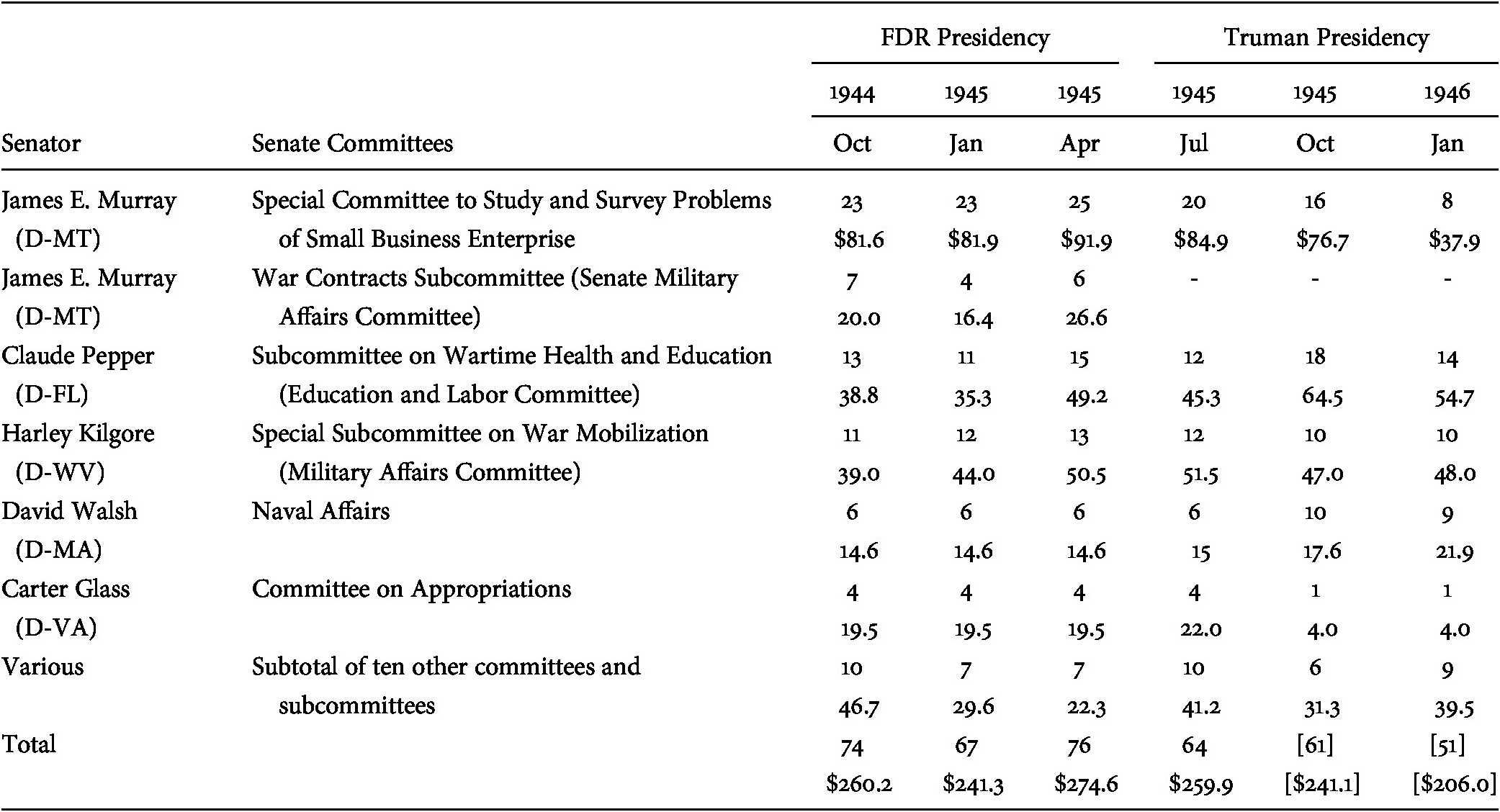
Senator Kenneth S. Wherry (R-NE), a minority member of Murray’s Select Committee on Small Business, was the only elected official to provide data to the Joint Committee. Wherry, who had been tracking the number and influence of detailed staff for some time, presented data he collected on the number of Executive Branch employees detailed to Senate committees. Wherry expressed his opinion that the practice resulted in divided loyalties among borrowed staff between Congress and the president.Footnote 55 He referred the Joint Committee to his remarks on the Senate floor earlier that year (January 29) on the matter. In that floor discussion, the issue of divided loyalties was debated due to borrowed staff’s dependence on the Executive Branch for pay and job security. Executive Branch appropriations were used for their salaries and Executive Branch managers decided whether or not to accept the employee back into their agency once their assignment to a Senate committee was terminated.Footnote 56 Divided loyalties was of particular concern as it related to congressional oversight activities involving a staff member’s home agency. However, no examples of borrowed staff providing oversight support were provided by members.Footnote 57 Wherry’s concern with detailed staffing did not end with his Joint Committee testimony. Later that year he introduced a resolution on the Senate floor that required a monthly report of each committee on the names and salaries of any staff detailed from the Executive Branch. Footnote 58 The data collected from that report is presented in Table 4.
FDR’s Detailed Staff to Senate Committees.

Source: Proceedings and Debates of the 79th Cong., 2nd sess., April 1946, 2868–69.Footnote 72
Senators Sheridan Downey (D-CA) and Ralph Brewster (R-ME) also provided testimony to the Joint Committee on issues with committee staffing. Downey lamented that “most important legislation originates in the executive department, while Congress can only investigate and veto.” He recommended that Congress be “fortified in order to offset the expansion of executive power.”Footnote 59 Senator Brewster described committee staff arrangements as “utterly inadequate, archaic, and grotesque.” He provided an example of one committee, after spending eighteen months wrestling with aviation problems, having no one on staff to draft potential solutions.Footnote 60 Senator Glen Taylor (D-ID), a stage-performer-turned-politician, provided some levity to the proceedings, suggesting congressional activities were under the spotlight, and that it was turning in a disappointing performance, while FDR, a “consummate actor,” was being allowed to “run away with the show.” Murray’s collaboration with FDR was spared any direct assault, thanks in large part to Senate Rule Nineteen, which prohibits members from “directly or indirectly, by any form of words impute to another Senator or to other Senators any conduct or motive unworthy or unbecoming a Senator.”Footnote 61
Senator Murray did not testify before the Joint Committee, but he previously offered his opinions on the topic during the January 29 floor discussion involving Senator Wherry. At that time, Murray promoted the use of Executive Branch staff, citing their “vast experience in the problems which confronted (his) committee” and the difficulty he would have trying to find similar support on the open market.Footnote 62 Murray’s executive secretary for his small-business committee, Dr. Dewey Anderson, appeared before the Joint Committee and expressed similar sentiments. Anderson defended the use of detailed staff from the Executive Branch, claiming it provided for intensive study and allowed Senators ready access to subject-matter experts.Footnote 63
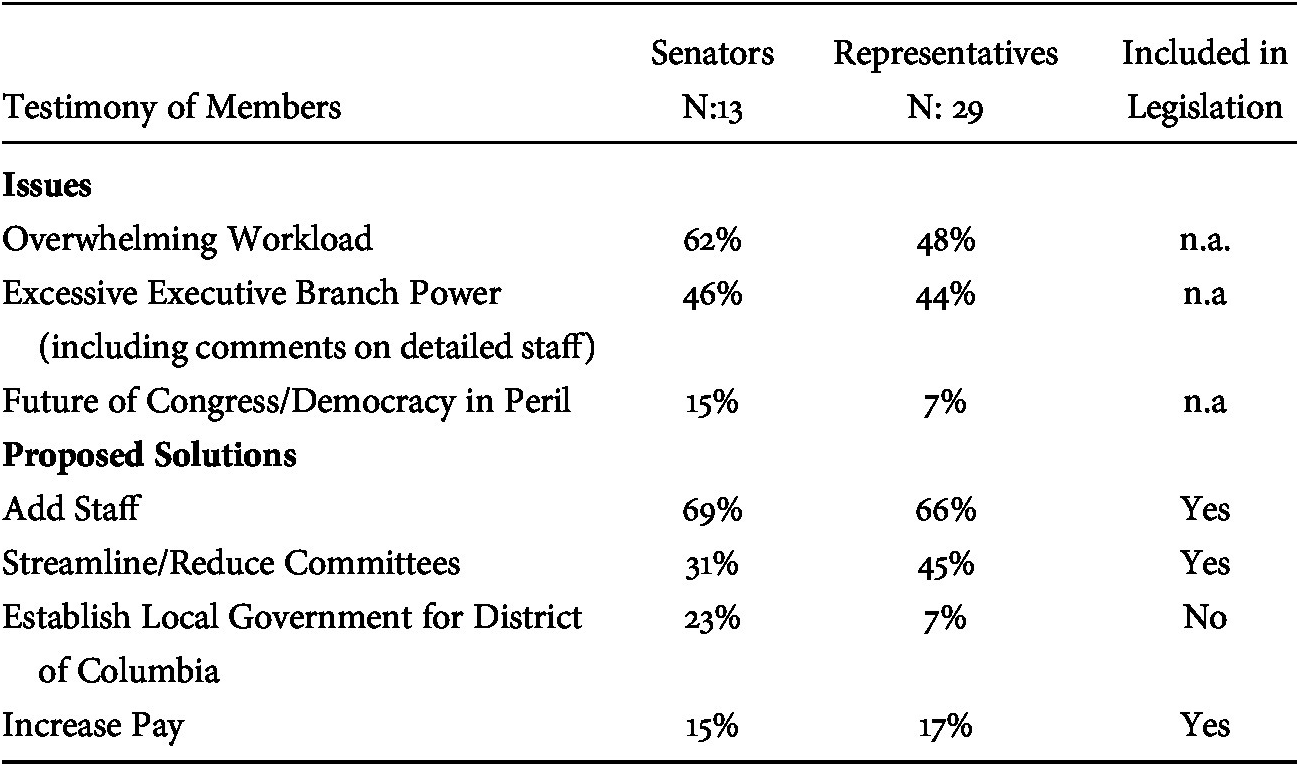
At the completion of testimony before the Joint Committee, the synopsis of comments on issues and solutions was remarkably consistent. Table 5 provides the results of a content analysis from the committee hearings; problems raised and solutions suggested by thirteen Senators and twenty-nine Representatives who appeared before the joint committee. The methodology for the analysis is in the appendix. The primary issues raised by the elected officials were, (1) an overwhelming workload, (2) excessive Executive Branch power (including the presence of detailed staff on Senate committees), and (3) the sustainability of Congress under current rules. The leading recommendation from elected officials to address these issues was to add more congressional staff for members and committees. Other suggestions included reducing the number of committees and unloading the administrative burden of managing the day-to-day affairs of the District of Columbia.
Testimony Before the Joint Committee.

Source: Galloway, Summary of Hearings before the Joint Committee on the Organization of Congress.
After the Joint Committee completed its testimony, and before the LRA was introduced, several events dramatically reshaped Senator Murray’s opinion on the use of detailed staff. First, he completed introducing all major legislation that he developed under FDR’s Second Bill of Rights; universal health care with Senator Wagner and Rep. John Dingell Sr. (D-MI) and the Full Employment Act of 1945 with several co-sponsors. Second, FDR passed away, releasing the Senator from any obligations to align himself with the Executive Office of the President. And third, as his legislation was winding its way through Congress, Murray found it in the best interest of his legislation to join the congressional movement to gain more power. He started casting his full employment legislation as meeting that end.
Murray, writing in favor of his full-employment legislation in the December 1945 edition of American Political Science Review, reversed course from previous testimony and cited a disastrous decline of congressional authority and chided his fellow members for delegating their policymaking powers to the presidency. He claimed that his bill, which formed a new standing joint committee to coordinate full-employment policies, would finally wake Congress from its Rip Van Winkle slumber and finally “live up to the expectations of our founding fathers.”Footnote 64 The article, likely written by Bertram Gross, appeared with a companion piece about the technical requirements for pursuing full employment.Footnote 65 This second piece was written by Gross’s close friend, Gerhard Colm, the second in command in FDR and Truman’s Bureau of the Budget.Footnote 66 The coordination of the articles is additional evidence that a close tie remained between Murray and Executive Office of the President to implement the first element of FDR’s Second Bill of Rights, an element President Truman openly endorsed shortly after he was sworn into office.Footnote 67
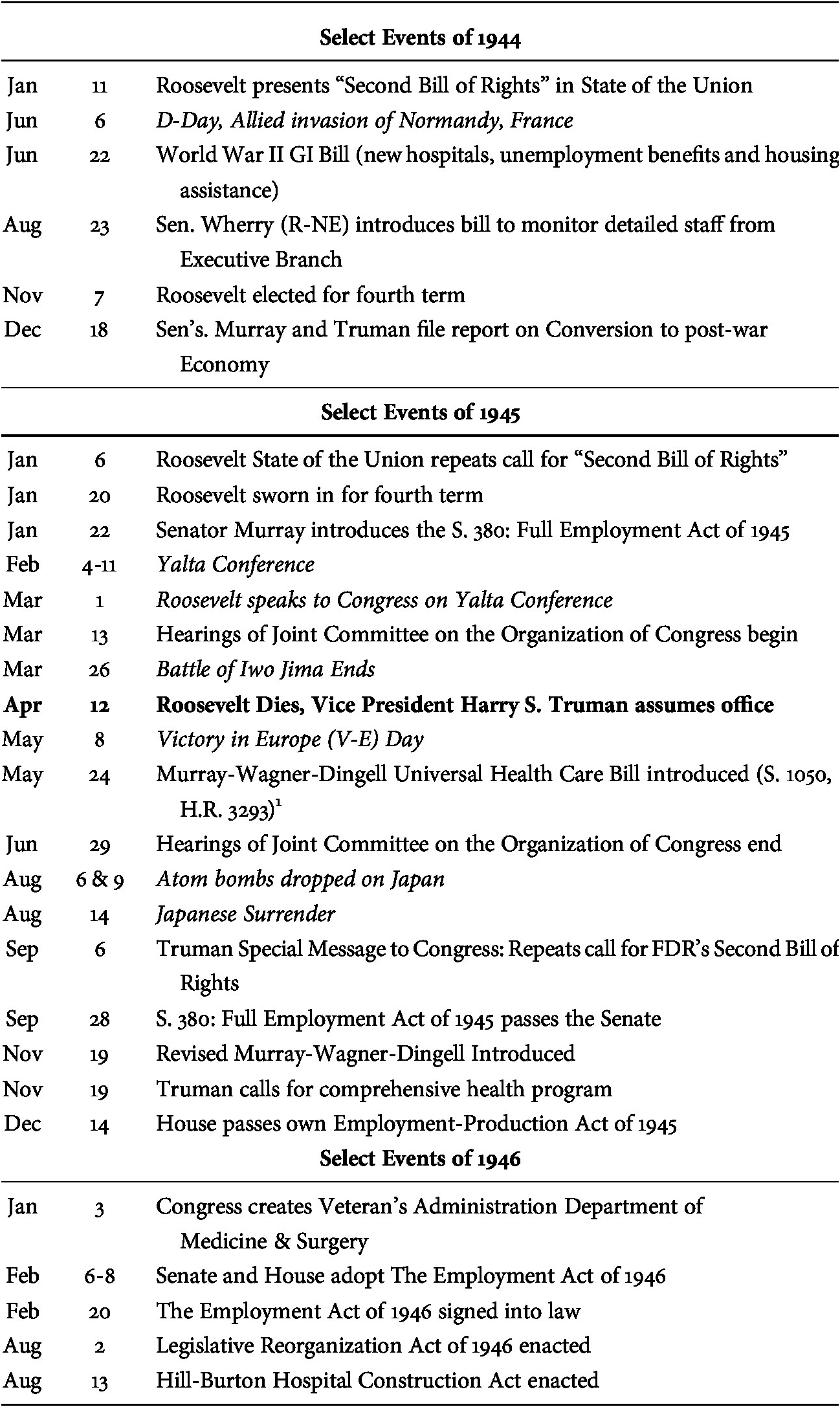
The LRA, which followed the conclusion and publication of the findings of the Joint Committee, provided a clear response to FDR’s use of detailed staff to blend legislative powers. The LRA prohibited the use of detailed staff from the Executive Branch for committee work and authorized hiring dedicated congressional staff as replacements. Each committee was granted four staff members and six clerks. Additional provisions included a reduction in standing committees from 81 to 34. Congress deferred on creating a separate governing structure for the District of Columbia (that would wait until 1973). Congressional pay was increased, and restrictions on lobbying were instituted.Footnote 68 In congressional scholar Charles Beard’s view, the changes enacted would lead to committee meetings that were “regular, open, and dignified, instead of irregular, subterranean, and often undignified, vulgar, and capricious.”Footnote 69 It also was seen as increasing the authority and role of Congress itself, creating a body that could compete for policy leadership with future presidents like FDR, a man with “extraordinary gifts as a political leader.”Footnote 70 The act became law on August 2, 1946. Table 5 includes a column that indicates which proposals from the Joint Committee were included in the final language of the adopted LRA. Table 6 provides a timeline of events involving war efforts and FDR’s domestic agenda leading up to the passage of the LRA.
Time Line of President Roosevelt’s Domestic Agenda and World War II

(1) First version of bill was introduced on June 3, 1943.
Conclusions
FDR encroached on the policymaking process of Congress to advance his ambitious postwar domestic agenda outlined in the Second Bill of Rights by detailing key ideologues and Executive Branch staff to select Senate Committees. FDR’s placement of detailed staff from the Executive Branch into Senate policy committees exposed a crack in the Madisonian model of government—a fissure that emerged after a premodern Congress was overwhelmed by the expansion of federal programs under New Deal legislation. In this article, I addressed three questions about this unique ad-hoc effort: (1) how effective was the tactic, (2) how did the blending of legislative powers relate to FDR’s direct bargaining with Congress, and (3) how did Congress react to the tactic?
First, I found the tactic of legislative blending was moderately effective in moving FDR’s legislative agenda through Congress, but it did not replicate the rousing success he achieved in his first term with his direct contact with members of Congress. Adopted legislation included the Employment Act of 1946, health-care provisions of the GI Bill, various hospital construction bills, and creation of the National Institutes of Health. The universal health-care bills introduced by FDR’s committee staff, but not passed, were later recognized by President Lyndon B. Johnson as foundational for Medicare’s passage in 1965.
Second, I was not able to find a clear association between FDR’s use of direct contact with Congress and the blending tactic he introduced in his third term. There was no clear shift from one tactic to the other, or evidence that the two tactics overlapped. However, based on the significant drop in FDR’s contact with Congress and cabinet members late in his third term, I suggest one possible explanation for the shift in tactics is that, lacking the energy of his first and second terms, FDR turned to blending as a last resort to generate the necessary momentum to move his aggressive postwar domestic agenda. In this respect, FDR used blending as a proxy for his direct contact with members of Congress.
Finally, I found that there was a significant negative reaction by Congress to FDR’s blending of legislative powers. This reaction was manifested in the adoption of the LRA, which prohibited the future use of detailed staff from the Executive Branch and transformed Congress into the modern institution we know today.
Beyond these specific findings, I draw a few conclusions from this research. First, Hamilton and FDR’s team of progressive Senators both squandered opportunities to promote the efficiency of blending legislative powers. Instead, both used blending as a tactic for the Executive Branch to exercise power over Congress and advance purely partisan agendas. If Hamilton and FDR had taken a more strategic approach, collaborating more and steamrolling less, the blending that Hamilton and other framers of the Constitution once championed, may not have been forced into hibernation by the LRA. Today, with a modern presidency, a modern Congress, and two very strong political parties, the prospect of reviving the efficient blending of legislative powers is rather dim.
Second, the meeting patterns of Hoover, FDR, and Truman with members of Congress reveal more than the waning presidential energy of FDR in his third term. They provide evidence that FDR may have taken a cue on legislative contacts from Hoover, or that Congress pushed FDR for regular meetings based on precedents set by Hoover. In either case, it is Hoover’s personal contact with Congress, and not FDR’s, that were exceptional among the calendars presented here. Combining this distinguishing feature of Hoover’s presidency with his late-term success in gaining congressional approval to propose changes to the organization of White House staff adds to Hoover’s role in advancing the modernity of the presidency.
And finally, although it was not his intent, FDR’s ad-hoc use of legislative blending generated a backlash from Congress that contributed to the adoption of the LRA and, in turn, the establishment of the modern Congress. In this respect, FDR’s use of detailed staff represents the last clash of a premodern presidency and a premodern Congress. Truman and Eisenhower advanced the modernity of the presidency by building organizations to develop and present legislation to Congress. Fortified by the LRA, congressional committees were organized with dedicated professional staff to evaluate the president’s proposals or develop policies on their own. As a result, FDR can be viewed not just as a transitionary figure for the presidency but equally as a transitionary figure in pushing the Congress into modernity.
Appendix
The raw data that captures the meeting activity of Presidents Roosevelt, Hoover, and Truman is available in Excel spreadsheets from the various presidential libraries. The format of the spreadsheets varies widely, so I used various techniques to determine the counts of meetings with Senators, Representatives, and cabinet members. Each of these techniques is described below. There are likely other approaches that would produce the same results.
Methodology for Counting FDR’s Meetings with Cabinet Members, Senators, and Representatives
The data used to calculate the number of meetings held by President Franklin Delano Roosevelt involving congressional members (Senators and Representatives) and the leadership within the Executive Branch (Secretaries, undersecretaries, and assistant secretaries) (Table 1) is derived from a database of meetings assembled by Pare Lorentz Center at the Franklin D. Roosevelt Presidential Library in cooperation with the National Archives and Records Administration (NARA). The meeting database, known as “Franklin D. Roosevelt Day by Day,” is searchable through the Library’s website (http://www.fdrlibrary.marist.edu/daybyday/), but for this article I requested and received, from staff at NARA, direct access to the complete database file of calendar entries. NARA staff indicated that the file “represents the most comprehensive set of transcribed appointment details” but cautioned that “there are many known errors in the transcriptions, which were created mostly by volunteers over the course of several years, drawing from handwritten original archival sources.” Direct access allowed me to review the entries for potential errors and to clean the data prior to analysis.
Data Cleaning
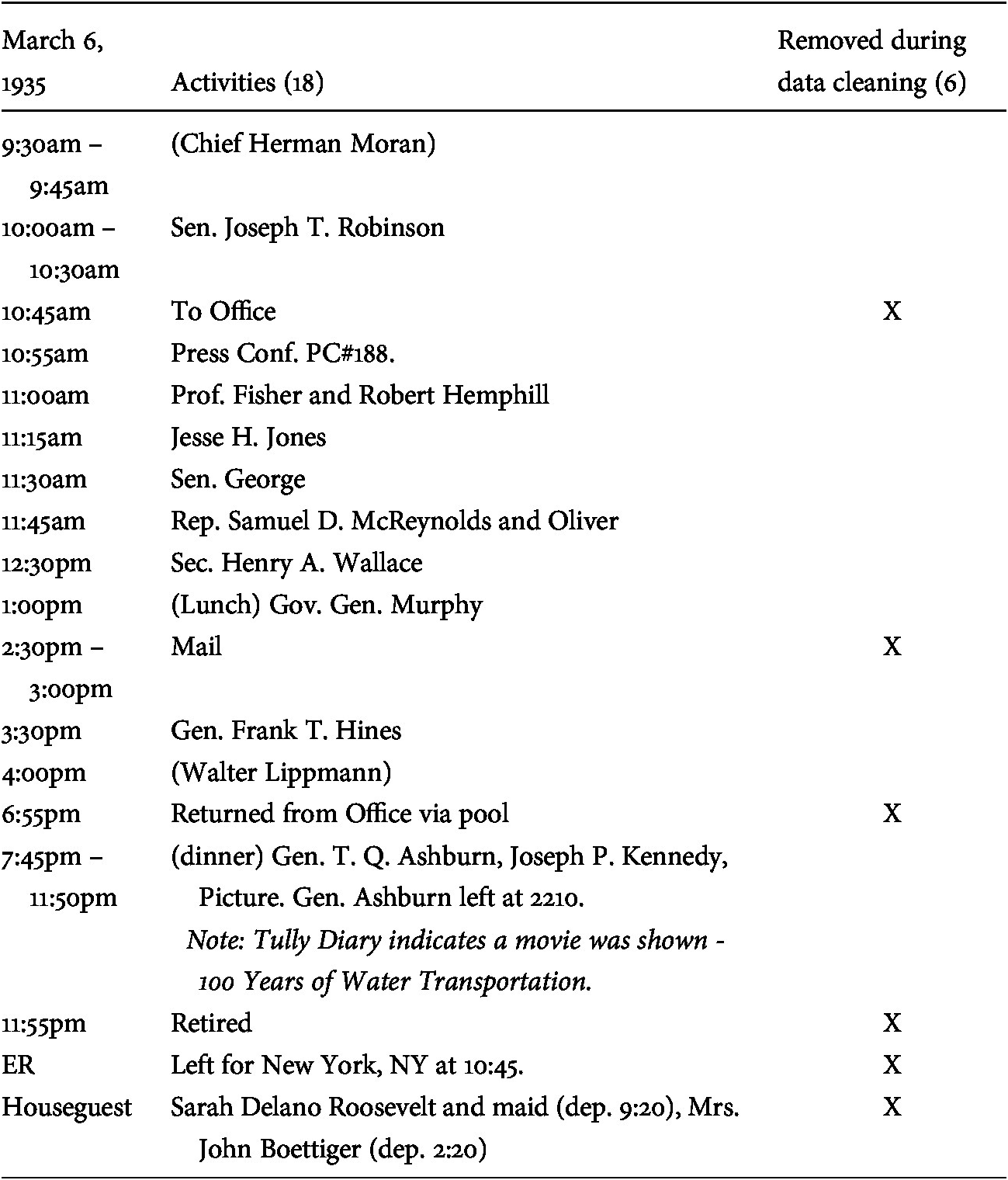
The primary database, USHERLOG, contained 45,762 entries. For context, FDR was in office for approximately 4,400 days. Therefore, these entries represent just over ten activities per day. After cleaning the data, there were 26,192 entries remaining, which I used in my analysis (on average, six activities per day). Table A-1 is an example of the information stored for each day.
Example of FDR Daily Calendar Information

To clean the data, I exported the USHERLOG Access file into Excel. There were 45,762 rows of data capturing discrete activities (i.e., meals, meetings, travel, swimming, etc.). The columns that captured the detail of each activity included; Date, Year, Start time, ID, End time, Subject, Subject Footnote, Location, Description, World Event, Footnote, Source (four columns). The “Description” column captured the meeting attendees. This is the data I searched to count the number of activities involving cabinet secretaries and their subordinates, Senators, and Representatives.
I eliminated all nonbusiness activities from the data by sorting and deleting rows using a variety of criteria. The following steps (deletions in bulk) account for 75 percent of the removals:
1) Eliminated approximately 2,200 activities between midnight and 8:00 AM and those that were not associated with a time. Entries in these rows were, in general, placeholders for travel, meeting requests, or personal activities. Formal breakfast meetings with guests started at 8:00 AM.
2) Eliminated 3,359 entries associated with Eleanor Roosevelt, most of which were tied to travel status (en route, location, departure)
3) Eliminated 2,727 rows associated with houseguests arriving or staying with the president.
4) Eliminated all rows, using the “location” column, that were not associated with the White House, FDR’s Office, or Hyde Park. These locations, 2,730 in all, were typically identified as En Route, no location, or traveling.
5) Eliminated all entries with the following descriptions: retired, dinner alone, dinner household, lunch (if no guests were mentioned), mail, motoring, movies, returned (if no attendees are mentioned), swimming, to apartments, to doctor’s office, to dentist. This eliminated another 3,773 rows.
The remaining deletions followed the same criteria, but were made individually or in small groupings.
The second aspect of data cleaning relates to the identification of individuals within the meeting “description” column. To count the number of activities FDR conducted with members of his cabinet, I needed to have titles associated with names. For example, Frances W. Perkins, FDR’s Labor Secretary, was not always referred to as Secretary Perkins. Several other longtime associates of FDR who took cabinet positions were referred to without title. I searched the names of all twenty-one individuals that served in the ten cabinet posts during FDR’s presidency and added titles, if they were missing, for the time they served on the cabinet. For the Attorney Generals and Postmaster Generals (both cabinet members), I changed their titles to secretary to ensure I did not double-count a meeting where they attended with other cabinet members. I also went through each entry for “cabinet meetings” and deleted any additional reference to individual secretaries. This allowed me to add the cabinet-meeting totals with individual-meeting totals with secretaries and avoid double-counting.
Data Analysis
My primary objective with the clean data set was to count and compare the number of meetings FDR had with cabinet members, Senators, and Representatives. First, I established ranges for each year of “description” column in the data set. Then, for cabinet members I searched the “description” column, counted, and added together occurrences of Sec. and cabinet for each year. For congressional members, after visually screening portions of the data set, I searched the “description” column for Sen., Sen’s., Rep., and Rep’s. I used the “Countif” function in Excel, using the predefined ranges, and the above terms, to arrive at the count for each group by year. For context, I also counted the total number of activities in each year, to compute a percentage of meetings with my target groups. I checked the accuracy of the individual ranges by checking the sum of individual years against a search of a defined range that captured all years. Since some meetings included Senators and Representatives, and I wanted to have a total of all meetings with members of Congress, I calculated the duplicative meetings by setting up individual columns to indicate attendance by Senators and Representatives (1=Attendance, 0=No Attendance) and a third column to total duplications (1=Duplication, 0=No Duplication).
Methodology for Counting Hoover’s Meetings with Cabinet Members, Senators, and Representatives
The data for Hoover’s meetings is available in Excel worksheets by year. Data for each meeting is contained in a single row. The first column in each row contains the name of the attendee, the second column includes the title of the attendee (first occurrence only), and the third column contains the date of the meeting. The titles for individuals were not repeated in most cases. So, if a person met twice with the president, there was no title in the second column for subsequent meetings in all subsequent years.
Without a consistent use of titles, the names of Senators, Representatives, and cabinet members were used to develop a count.
The counting process was as follows:
1. The data for 1929 (first year in office) and 1933 (last year in office) were sorted by date, and all entries outside the date of presidential service were deleted.
2. For 1931, the meeting dates were split by the different sessions of Congress (71st and 72nd).
3. For each year, all entries that included the term “Mrs.” were deleted. This was necessary to avoid overcounting because spouses were identified by the member or cabinet officer’s name preceded by “Mrs.”
The figure below provides an example of how the data appears in the 1929 Excel workbook with the addition of the column to identify entries with “Mrs” (Formula: COUNTIF (A2, “*Mrs*”)).

4. After the entries with “Mrs.” Were deleted, a range name was assigned to column A that included all rows with meeting dates.
5. Separate sheets were created for Senators, Representatives, and cabinet members in each of the workbooks (1929, 1930, 1931, 1932, and 1933). For 1931, a sheet was created for each group for each session of Congress in that year (71st and 72nd).
6. In each of the sheets for Senators and Representatives, the names of all individuals that served in the appropriate session of Congress were added to Column A. For 1929–30, the names from the 71st Congress were added. For 1932–33, the names of the 72nd Congress were added. For 1931, a separate sheet was created for both the 71st and 72nd sessions of Congress and the meetings associated with each session were combined for a 1931 total.


The names of members for each session of Congress were obtained from the Clerk of the House’s Office of Art and Archives.Footnote 71
Methodology for Counting Truman’s Meetings with Cabinet Members, Senators, and Representatives
The Truman meetings are contained on one single Excel spreadsheet with 25,182 rows (each row is a meeting, activity, or note) and three columns. The first column contains the date, the second column includes the time, and the third column includes the meeting attendees, or an activity, or a note. The first step in preparing this data step was to eliminate nonmeetings. This was undertaken by sorting all entries (Column 3) alphabetically. Groups of nonmeetings were then deleted from the spreadsheet. Notations that were deleted include:
“At home”
“Holiday”
“No Visitors”
“On Ship”
“Arrived”
“Leave”
“Lunch-No Guest”
“Eye Doctor”
“Dentist”
“Public Papers” (Letters, Special Messages, etc.)
This reduced the number or records (rows) to 19,788.
The second step was to create a range for each year (Year45, Year46, Year47, Year48, Year49, Year50, Year51, Year52, Year53).
Third, on a new sheet, a table was created to look up the titles associated with Senators, Representatives, and cabinet Member. In the meeting records Senators were referenced as “Sen.” or “Senator.” Representatives were referenced “Cong.” or “Congressman.” And cabinet members were referenced as “Sec.” or “Secretary.” Other cabinet-level positions were identified as “Attorney General,” or “Postmaster General.”
The Excel formula to count the number of occurrences of each title by year was =COUNTIF (YearXX, “*”&Title&“*”). The “Title” in this formula was the cell where the title was entered. The table used to count the appearances is constructed as follows:

Methodology for Content Analysis of Testimony before the Joint Committee on the Organization of Congress
My objective in reviewing the subject testimony was to identify the issues and proposed solutions, which were raised by members of Congress. I reviewed the synopsis of testimony provided by committee staff to receive the benefit of their distillation of the remarks. In my view, this allowed me to focus on data that had already been cleaned for analysis. The summary testimony is 59 pages in length and covers 102 participants. My subjects, the elected members of Congress, account for 42 of this total.
Each synopsis was approximately one-half page. I read each synopsis and entered descriptive phrases for issues and solutions into an Excel spreadsheet. After completing my analysis, I revisited the phrases and looked for instances where I could consolidate phraseology under one term. For example, one person identified the need to check “bureaucratic power,” while another person stated the need to “keep pace with a greatly expanded executive machine.” I consolidate these types of comments under “excessive executive branch power.” I identified three primary issues and five primary solutions, which appear in Table 5. I then tallied the number of times each appeared in individual testimony. The result of this analysis serves as most of the data for Table 5. To complete the table, I reviewed the final language of the Legislative Organization Act of 1946 to see if the proposed solutions were enacted. A separate column in the table indicates my findings on this point.