Following the Fukushima Daiichi nuclear disaster, maintenance of the medical system was vital due to the lack of supplies and increasing number of patients affected by the disaster. Reference Jan and Lurie1 In addition to being a short-term issue, the disaster also had long-term effects on the affected area. Reference Raker, Zacher and Lowe2 Thus, from a public health viewpoint, it became very important to consider a wide-range maintenance of the medical system following the disaster, not only in the short term (that is, ‘for weeks’), but also in the long term (that is, ‘for several months or years’), 3 in order to treat the affected inhabitants of the disaster-stricken area.
In this context, the provision of appropriate medical care to ‘severe patients’ was 1 of the important purposes of the medical system. ‘Severe patients’ refer to patients who require urgent transportation and early medical intervention for their critical medical conditions. While it is important to take care of severe patients immediately after a disaster, the long-term provision of care for these patients is an additional concern that needs to be acknowledged. However, trends pertaining to severe patients in a disaster-stricken area, as well as the nature of demands for their long-term critical care following such a disaster remain to be fully uncovered.
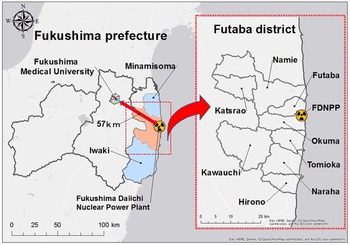
The present study focused on one such natural disaster, the Great East Japan Earthquake. The earthquake occurred on March 11, 2011 and was followed by the Fukushima Daiichi nuclear disaster. An evacuation directive was issued for the area within 20 km of the affected power plant. The Futaba district is located within this range and was severely affected by the resultant radioactive contamination (Figure 1). Radioactive pollution impeded re-establishment of the living environment of the community’s inhabitants. Furthermore, the maintenance of the local long-term medical care system was problematic. Reference Kumagai and Tanigawa4
Areas of the Futaba district and Fukushima Daiichi Nuclear Power Plant in the Fukushima Prefecture.

Fukushima is in the southern part of the Tohoku region, and it is the third-largest prefecture in Japan, after the Hokkaido and Iwate Prefectures, covering an area of 13782.75 km2. The Futaba district is located on the coast of the Fukushima prefecture and covers an area of 865.71 km2 with a population of approximately 72000 people. After the Fukushima Daiichi Nuclear Power Station accident, the residents were forced to evacuate the area. Although the initial number of emergency requests in the Futaba district was 2715 in 2010, it decreased to 908 in 2011 owing to evacuation of the residents. Graded release of the evacuation directive began in September 2011, and Kawauchi (village), Hirono (town), and Naraha (town) in Futaba secured the earliest release.
Providentially, the Fukushima Prefecture operates the Fukushima doctor helicopter service primarily for severe patients in the prefecture. As data of the doctor helicopter service represents local severe patients, Reference Hannay, Wyrzykowski, Ball, Laupland and Feliciano5 they would be an effective source for investigating the contents of the doctor helicopter requests so as to analyze the trends and characteristics of severe patients in the disaster-stricken area following the Great East Japan Earthquake.
The current study used the doctor helicopter dispatch data for the Futaba area which was severely affected before and after the Great East Japan Earthquake to examine the characteristics of severe patients in the disaster-stricken area in the short-and long-term.
Methods
Hospitals responsible for emergency medical care in Japan are generally classified into 3 categories: primary, secondary, and tertiary care facilities. The tertiary care facility is a hospital for critically ill patients who are presumed to require intensive care. However, the Futaba district does not have a tertiary care facility. Although the district initially contained 6 secondary care facilities, it was only left with 1 facility after the earthquake which had continued to take care of emergency patients after the Great East Japan Earthquake. Reference Shimada, Nomura and Ozaki6 The hospitals in cities like Minamisoma and Iwaki, which are located in the northern and southern areas of the Futaba district respectively, helped in the provision of care for emergently-ill patients who decided to transfer to Fukushima Medical University Hospital, a critical care center in the northern prefecture (Figure 1).
The doctor helicopter in Fukushima
The Fukushima Medical University Hospital manages the Fukushima doctor helicopter service, which is the only emergency medical service in the prefecture. Patients who need the service are ‘severe patients’ who require early medical intervention. Specifically, ‘severe patients’ denote:
-
(1) Patients who are faced with or are suspected to be faced with a life-threatening condition.
-
(2) Patients who are seriously ill patient and are expected to take long durations to be transported.
-
(3) Patients who have special emergency conditions (for example, severe burns, poly-trauma, amputation of fingers or limbs, etc.) and need to be immediately transported.
-
(4) Patients who require a doctor for emergency diagnostic treatment at the emergency site.
The helicopter is called for dispatch by the emergency service staff that was present at the site or the fire department that received the request. The doctor-requested helicopter communication order room in the Fukushima Medical University Hospital receives a request from the emergency service. After landing, a flight staff member contacts the ambulance carrying the patient(s) and commences treatment. Depending on the patient’s medical condition, a flight doctor coordinates with the hospital for the further treatment.
Approximately 360 cases (on an average) were dispatched every year in Fukushima prefecture from 2008 (when the service began) till 2019.
Data collection
Cases dispatched in the Futaba district from March 11, 2008, to March 10, 2014, were extracted using the dispatch database of the doctor helicopter and flight-nurse records. Cases that were cancelled or could not be dispatched were excluded from analysis. The extracted data included patient demographics, emergency request site, and time from emergency request till the end of transfer.
Statistical analysis
To evaluate the characteristics of patients that requested the doctor helicopter service in the Futaba district after the earthquake, the period before March 11, 2011 was defined as ‘pre-earthquake’ and the period after March 11, 2011 as ‘post-earthquake.’ The cases were compared on the basis of patients’ age, sex, disease type, residential address, request site, and time from emergency request to the end of transfer. t-tests were conducted to determine the statistical significance of differences between the means of continuous variables, and the Chi-square test was conducted for categorical variables. Statistical significance of the calculated coefficients was determined at P <0.05.
Ethical considerations
This study was approved by the ethics committees of Fukushima Medical University (Authorization No.: 29107). Informed consent was obtained from the patients for their participation using the opt-out method.
Results
A total of 128 patients from the Futaba district were treated by the doctor helicopter service during the study period (Table 1). Treatment was provided to 78 patients (Mage = 61.4 years, SD = 17.6 years), out of which 42 patients (53.8%) were aged between 20 and 65 years during the pre-earthquake period; and 50 patients (Mage = 53.2 years, SD = 16.0 years), including 41 patients (82.0%) aged between 20 and 65 years in the post-earthquake period. There was a statistically significant difference between the patients’ age in the 2 periods (P = 0.001); patients in the post-earthquake period were significantly younger than patients in the pre-earthquake period. Furthermore, the proportion of men in the post-earthquake period (90.0%) was significantly higher than that in the pre-earthquake period (65.4%; P = 0.002).
Baseline characteristics of patients who were treated by the doctor helicopter from the Futaba district in Fukushima

Note:
a Person living outside the Futaba district;
b Number of patients treated from Kawauchi (village), Hirono (town), and Naraha (town) in Futaba;
ACS: Acute Coronary Syndrome; T1: Time from emergency request time to doctor helicopter request; T2: Time from doctor helicopter request time to doctor helicopter landing time; T3: Time from doctor helicopter landing time to start of treatment time; T4: Time from the start to treatment time to the start of transfer time; T5: Time from the start of transfer time to the end of transfer time; SD: Standard Deviation
*p < 0.05, **p < 0.01.
The number of patients residing outside of the Futaba area for whom the helicopter doctor service had been requested was higher during the post-earthquake period as compared to pre-earthquake period (P < 0.001). The ratio of requests from Kawauchi (village), Naraha (town), and Hirono (town), which had been released from evacuation at an early stage following the earthquake, increased from 25 cases (32.0%) during the pre-earthquake period to 39 cases (78.0%) during the post-earthquake period (P < 0.001).
The illnesses were categorized as physical trauma, heart diseases, cerebrovascular diseases, intrinsic diseases, and poisoning. The number of patients with physical trauma was the highest during both the pre- and post-earthquake periods. The number of requests received over 6 years (3 years per period) and the details pertaining to illness and injury among patients have been presented in Table 1. It was noticed that the number of requests decreased during the post-earthquake period. The number of patients with physical trauma requiring doctor-requested helicopter dispatch during the post-earthquake period was 4 patients (33.3%) in 2011, 7 patients (43.7%) in 2012, and 13 patients (59.1%) in 2013; indicating an increasing trend. However, the increase in the number of requests was not statistically significant (P = 0.33). All 4 incidents of physical trauma in 2011, and the 3 out of 7 incidents in 2012, occurred at the power plants. Furthermore, 4 incidents occurred at decontamination worksites in 2013.
The response time required by doctor helicopter was significantly longer during the post-earthquake period (P < 0.001), in particular, the durations from T2 to T4 were significantly longer during the post-earthquake period as compared to the pre-earthquake period.
Discussion
This study highlighted that severely ill patients were physically traumatized, both in the short- and long-term, during reconstruction of the disaster-stricken area as the rate of physical trauma was seen to have increased over 3 years during the post-earthquake period. According to past reports on the Great Hanshin-Awaji Earthquake in 1995, 40% of the patients who needed hospitalization were injured within 15 days following the earthquake. Reference Tanaka, Oda and Iwai7 Furthermore, 34% of the active doctor helicopter cases during the 2016 Kumamoto earthquake were trauma-related cases. Reference Motomura, Hirabayashi and Matsumoto8 Similarly, the current study found that the number of severe patients with physical trauma was high in the long-term following the disaster. Thus, it was of primary importance for hospitals in charge of the emergency medical care in these disaster-stricken areas to build a sustainable system for patients with physical trauma, with the aim to provide needed care during the short- and long-term.
Severe physical traumatization of patients in the affected areas was observed to occur simultaneously with the influx of people due to reconstruction; the emergency requests in Kawauchi, Naraha, and Hirono had increased from 32.1% in the pre-earthquake period to 78.0% in the post-earthquake period. Furthermore, all 4 cases of physical trauma in 2011, and 3 out of 7 incidents in 2012, occurred at the power plant. However, there were no cases of physical trauma at the power plant in 2013; 4 out of the 13 incidents occurred at decontamination worksites. Therefore, the occupational workers involved in reconstruction of the disaster-stricken region tended to simultaneously suffer physical trauma. Research has found that there is a high risk of occupational danger. Reference Muennig, Sohler and Mahato9 Furthermore, decontamination workers have recorded cases of untreated hypertension, dyslipidemia, impaired glucose tolerance, and have also been found to be at high risk of infection. Reference Sawano, Tsubokura and Ozaki10 Therefore, adaptive responses are necessary to cope with incidents of physical trauma and other circumstances, during and after the disasters.
Medical institutions surrounding disaster-stricken areas should also address the injuries and illnesses of workers outside of the disaster-stricken area; 13.9% of the included patients during the pre-earthquake period and 62.0% patients during the post-earthquake period were out-of-region patients. This could be attributed to the influx of migrants from outside the prefecture owing to the reconstruction of the area. However, a proportion of the migrant workers were socio-economically vulnerable, and information on their past medical history remains unknown. Thus, the increase in influx of migrant workers (from outside the prefecture) and proportion of socio-economically vulnerable people involved in the reconstruction work might imply that the proportion of endogenous and extrinsic diseases in the area would significantly change over time. Therefore, it is necessary to develop social measures to address this possibility, including collaboration and cooperation with hospitals outside of the prefecture, as well as the provision of necessary social security interventions.
Limitations
There are several limitations to this study which need to be considered. First, this study included limited numbers of cases. Second, the specifications of the injury or diagnosis after transportation and the severity of the patients’ condition thereafter could not be tracked. Therefore, not all diseases might be severe, and the records could have overestimated the severity of the patients’ illnesses.
Third, only helicopter requests were considered for analysis, and serious cases of ambulance transportation were not included in this study. As a result of this, it is possible that the number of seriously ill patients across the region could have been underestimated.
Finally, it is possible that cases of patients with mild illnesses were included as transport cases as helicopters tend to be requested for transportation owing to limited medical access in the area.
As the request criteria for the doctor helicopter service and helicopter operation methods might differ across regions, 1 must be cautious while applying the results of this study to various regions. Furthermore, 1 must also be cautious while generalizing the findings to areas affected by natural disasters as this research focused on a special situation against the background of reconstruction involving evacuation and decontamination work owing to the nuclear power plant accident following the Great East Japan Earthquake.
Conclusion
After a large-scale disaster like the Fukushima Daiichi nuclear disaster, severely injured patients were physically traumatized, not only in the short-term, but also for the long-term. The occupational workers involved in the reconstruction of the disaster-stricken region simultaneously suffered physical trauma. However, the characteristics of each phase might vary across disasters, and adaptive responses are necessary to cope with the circumstances during and after the disasters.
Author contributions
Kotaro Sorimachi drafted the manuscript under supervision by Ken Iseki. Kazuya Muto, Kazuki Sugaya and Santoshi Ueno acquired the data. Makoto Onodera, Tetsuya Ohira, and Masaharu Tsubokura provided advice for data analysis. All authors made critical revision of the manuscript for important intellectual content and gave final approval for the manuscript. The opinions, results, and conclusions reported in this paper are those of the authors and are independent from the funding bodies.
Conflict of interest
The authors declare no conflict of interest.