1. Introduction
Defamation law has attracted significant public attention in Israel. Both academia and the press have dealt extensively with the need to find the optimal balance between protection of reputation and freedom of speech suitable for Israel's culturally and socially complex society. The debate focuses on the need to cope with technological phenomena that pose new threats to reputation as well as with broader issues, mainly the role of the media as the watchdog of democracy and public mores and the tools by which the media's checks and balances should be maintained.
During the last few years, a significant number of members of the Knesset, Israel's legislature, have joined the debate by presenting a flow of (mostly private) bills proposing amendments to the Defamation (Prohibition) Law.Footnote 1 Some of these bills advocate the promotion of freedom of speech and freedom of the press while some call for increased protection of reputation. The latter are the subject of this article.
The battle over the Defamation Bill in particular and protection of reputation in general was triggered by the growing tension between the press and Israel's political and financial leadership. A documentary entitled The Shakshuka Method Footnote 2 is probably the best-known example of investigative reporting linking one of Israel's leading financial tycoons with a prestigious media figure. A series of unflattering television and newspaper stories accusing public figures of unethical and even criminal deedsFootnote 3 are also good examples. Since then, a persistent flow of new billsFootnote 4 introducing revisions, amendments and alterations to the Israeli Defamation (Prohibition) Law have piled up before the 18th Knesset's Constitution, Law and Justice Committee, thus keeping alive the sometimes very heated public debate on reputation protection by Israeli private law.Footnote 5
Most of these bills, like those dealing with group defamation and SLAPP,Footnote 6 have almost no impact on the delicate hierarchy of norms represented by the Defamation (Prohibition) Law. These bills do not threaten to introduce a meaningful change in either the original balance between reputation and freedom of speech established by the Defamation (Prohibition) Law or the much broader issue of protection of human dignity and reputation under Israeli private law in general.Footnote 7 Some of these proposed amendments – such as the bill regarding anonymity on the internetFootnote 8 and liability of web services providersFootnote 9 – are clearly motivated by technological changes. Other amendments are meant to override jurisprudence on various provisions of the Law. For instance, the bill relating to group defamationFootnote 10 is obviously a direct response to the Supreme Court's controversial decision that denied a film producer's liability towards a group of Israeli soldiers portrayed as cold-blooded murderers because – according to the Supreme Court's interpretation – the Law limits civil liability to individual rather than group defamation.Footnote 11
Each of these bills, notwithstanding their specific triggers, signifies a slight shift in the delicate balance achieved by the current Defamation (Prohibition) Law and by relevant case law. Each introduces a small change into the complicated puzzle; and each represents a fraction of the overall norm-creating regime by adding or detracting a bit to or from the normative setting, reflecting the value preferences of Israeli society with respect to the optimal balance between freedom of expression and reputation protection. Yet none of these bills threaten the status quo of Israeli defamation law, which has been compiled by both the legislator and the judiciary over the past 48 years.
However, Amendment No 10 to the Defamation (Prohibition) Law – a bill introducing higher caps to compensation without proof of damageFootnote 12 – is different. It bears an overall impact on the existing Israeli defamation law. It constitutes a huge threat to the achieved balance because it pertains to some of the basic value choices that Israeli law has struggled to adopt during the last few centuries.
The new perspective on evaluative and normative hierarchies introduced by the bill may be acceptable and even hailed when one can trace a reason – cultural, political, economic or social – calling for a shift in the accepted legal regime. I contend that there is no such reason for any change in Israel's current defamation law. The empirical data I present in the second part of this article will show that the annual average sum of compensation for reputation damages does not reach the current NIS 50,000Footnote 13 statutory cap. The data also shows that the statutory cap does not really form a ‘cap’ at all because the courts apply their long-established power to award (unlimited) ‘general damages’ whenever they want to make awards rising above the cap. There is practically no difference in the underlying logic, the amount of proof, or the evidence required that differentiates between these two processes for awarding damages.
Hence, if the main reason for the proposed bills lies in the shift in values towards protection of reputation, expressed in increased deterrence and punishment, such a shift must follow a comprehensive analysis of current legal culture and practice in general. It demands a reconsideration of theoretical as well as practical aspects of the balance set by the Defamation (Prohibition) Law and by recent case law, as well as issues regarding additional sources of personality interest protection as found within current Israeli private law. It needs to take into account liability rules, not just remedial considerations. And it needs to adopt a holistic rather than a limited, casuistic approach.Footnote 14
Defamation law reform in the UK may serve as a good example of the above argument. London's plaintiff-friendly defamation regime, adopted by both the legislator and case law, has become a globally targeted forum for defamation claims (the ‘Mecca’ of libel tourism) and has been constantly condemned for the courts' one-sided decisions by public opinion in and outside the UK as well as American courts and legislators.Footnote 15 In response to the criticism, the British legislator initiated the long-awaited ‘libel reform’: Lord Lester's Defamation Bill and the UK government's 2012 Defamation Bill.Footnote 16 The government also appointed the Leveson Committee,Footnote 17 whose mandate required it to examine media culture, practices and ethics. The process was transparent and open to public debate. So is the four-volume Leveson Report which has recently been published.Footnote 18 All grounds were covered and most arguments – for and against the proposed reform – received a response.
The British experience can thus provide an excellent model for both a public debate, before and throughout the course of change, and a comprehensive legislative process. It demonstrates the proper method and fashion in which changes should be decided and applied.
Israeli lawmakers and other proponents of change in current defamation law could have adopted a similar process. Supporters of increased protection of reputation in Israel could have initiated a public debate on the issue of change, using academic and social forums; they could have introduced facts showing that a change is called for; they could have used comparative law – contrasting English defamation law with American freedom of expression values; they could have used all the relevant defamation bills as an opportunity to conduct a thorough and comprehensive deliberation on the broad issue of the relationship between protection of reputation and freedom of expression in Israeli private law.
Yet the promoters of the Israeli defamation bill are doing exactly the opposite. Parliamentarians advocating the bill are intent on revising the current balance between reputation and freedom of speech in defamation law through a supposedly ‘minor’ adjustment of the existing mechanism for awarding compensation without proof of damage, by increasing the statutory caps. I argue that, contrary to the claimed minimalism of the adjustment, its impact on defamation law may be meaningful. This is why the rationale, procedure and context of the bill require close and critical study. This article aims to make a small contribution to that examination.
The article is structured as follows. Section 2 outlines the protection of reputation under Israeli private law. Section 3 details the suggested changes to the Defamation (Prohibition) Law, focusing on the 2011 bill on statutory damages. I then argue that, although some of the latest amendments might appear reasonable in light of modern technological and other time-induced changes, at least two issues should be examined extensively before such an amendment is adopted. The first relates to the basic, practical need for any amendment to the current statutory caps. The second, emanating from the first, refers to whether the specific proposed changes are indeed appropriate in manner and context. I shall argue that attacking free speech by introducing higher compensation caps without proof of damage – general or special – is a mistake.
2. Protection of Reputation under Private Israeli Law
2.1 The Statutory Framework – Plaintiff-friendly Legislation
Reputation has always been highly appreciated in the Jewish tradition. The notion of ‘a good name is better than fine perfume’Footnote 19 is deeply rooted in biblical culture as well as in modern Israeli society and legal discourse.Footnote 20 The right to reputation is in itself a segment of the right to human respect and dignityFootnote 21 within the framework of Basic Law: Human Dignity and Freedom,Footnote 22 which provides the formal legal foundation of human rights protection under Israeli law. Reputation is also protected by the Defamation (Prohibition) Law, which imposes civil and criminal liability for publication of defamatory content,Footnote 23 as well as by the old-fashioned tort of injurious falsehood,Footnote 24 which deals primarily with economic and commercial reputation.Footnote 25 And, because protection of reputation is sometimes linked with protection of privacy,Footnote 26 the Protection of Privacy LawFootnote 27 provides an additional important cause of action in some instances. The moral rights of authors are protected by the Copyright Law,Footnote 28 and unfair competition practices linked with libellous activities also incur tort liability according to the Commercial Torts Law.Footnote 29 The last and perhaps most powerful element in this evolving law protecting reputation is the ever-expanding tort of negligence.
Taken together, this legislation provides an impressive arsenal of legal measures. I shall concentrate on the Defamation (Prohibition) Law and Basic Law: Human Dignity and Freedom and then evaluate the protective umbrella they provide in light of the protection of freedom of expression in Israeli law.
2.1.1 The Defamation (Prohibition) Law – A General Survey
The origins of protection of reputation in Israeli private law are rooted in the Civil Wrongs Ordinance of 1947Footnote 30 which, for the most part, replicated contemporary English common law. Israel's Defamation (Prohibition) Law, enacted in 1965, incorporated all the relevant rules regarding defamation in one comprehensive statute: civil and criminal liability components;Footnote 31 definitions; special limitations on specific problematic situations (for example, posthumous defamation and group defamation); a closed list of defences; onus of proof; remedies and other miscellaneous factors.Footnote 32
The basic principles of Israeli civil liability for defamation are thus quite similar to those under the English model. Liability for defamation requires proof that publication is likely to provoke a derogatory impact: to lower a person's position in society; expose a person to ridicule, hatred or contempt; degrade or harm a person's business, vocation or professionFootnote 33 and so forth, all in accordance with an objective standard (‘right-thinking member of the society’) as applied by the court.Footnote 34 Liability is strict (no fault need be established)Footnote 35 and no proof of injury is required.Footnote 36 The law protects both individuals and corporations,Footnote 37 although the protection against group defamation where the individuals comprising the group are not personally defamed is more limited.Footnote 38
The Law is quite stingy regarding defences against a defamation claim and affords only three avenues of defence:
1. Permitted publications. These are primarily fair reports of official information usually made in public or by public officers. The onus of proof lies on the defendant to establish that publication indeed occurred in the circumstances listed in section 13. Yet, once established, the public interest reflected in the listed circumstances supplies an absolute defence.Footnote 39
2. True statement made in the public interest. Interestingly, truth in itself does not suffice as a defence, not even in a criminal action for defamation. Public interest must also be proved. The level of proof necessaryFootnote 40 to establish the defence that the publication was indeed true depends on the severity of the defamation.Footnote 41
3. Good faith. This defence is somewhat narrow in Israel as compared to other common law systems. It applies only when publication was made in good faith in one of the situations listed in the Law.Footnote 42 The most important privileged situation relates to publication of comments and opinions.
As for remedies, aside from temporary or permanent injunctions (which are quite rare), courts usually award the successful plaintiff damages according to standard civil criteria.Footnote 43 As in most tort cases, the primary aim of compensatory damages is to eliminate the consequences of the wrongdoing and to shift the loss suffered by the plaintiff onto the defendant.Footnote 44 Although punitive damages are not unknown to Israeli law, the Defamation (Prohibition) Law makes no reference to such compensation and contains no special rules in this regard.
In 1998, a significant addition to the common tort/defamation compensation rules was introduced by the Defamation (Prohibition) Law:Footnote 45 the newFootnote 46 provision allowed the courts to award damages up to NIS 50,000 (NIS 100,000 in cases of intentional injury) without the plaintiff having to prove damage – neither general nor special. It is important to stress that notwithstanding this rule's substantial importance and despite the fact that it became the refuge of most plaintiffs, the ‘compensation without proof of damage’ format did not eliminate or alter the original common evidential rule of compensation that places the onus of proof regarding the nature and amount of loss on defamation plaintiffs. Thus when the plaintiff chooses the capped ‘compensation without proof of damage’ route then no damage has to be proven yet the awarded damages are capped. When, on the other hand, the plaintiff can satisfy the court that the publication indeed caused damage – special or general – and that the damage is higher than the statutory cap, the court is free to award any level of damages proven.Footnote 47
In 2011, statutory damages became the subject of two new private bills. Both bills aimed to increase the statutory NIS 50,000Footnote 48 caps to NIS 300,000 and NIS 500,000Footnote 49 respectively. The two bills were eventually amalgamated into one bill following the first formal round of debates in the Knesset Constitution, Law and Justice Committee.Footnote 50 (This bill is discussed in detail in Section 3 of the article.)
2.1.2 The Constitutional Arena – Basic Law: Human Dignity and Freedom
Israel does not have a formal constitution. Instead, the early legislators enacted a series of basic laws that would eventually comprise the equivalent of a constitution.Footnote 51 The most important is Basic Law: Human Dignity and Freedom, which came into force in 1992.
The first sections of the Basic Law declare its purpose of preserving human dignity and freedom: ‘Every human being is entitled to protection of life, body and dignity’.Footnote 52 In view of the Basic Law's explicit reference to human dignity, it is now accepted that reputation is constitutionally protected by Israeli private law.Footnote 53
Regarding the effect of Basic Law: Human Dignity and Freedom on Israeli private law, case law has supplied two principled insights. First, the Basic Law provides no direct private cause of action – not even through use of the tort of breach of statutory duty;Footnote 54 second, it nonetheless has an indirect impact on private law in general and tort law in particular. Following this line of interpretation, ‘dignity’, including reputation,Footnote 55 has become a constitutional right with regard to all relevant balancing processes with contrasting rights. Nevertheless, this change in status has had only limited influence on the delicate balance between reputation and freedom of speech. The reason for this is that although the latter is not explicitly mentioned in the Basic Law, case law has construed ‘human dignity’ as accommodating freedom of speech as well.Footnote 56 Hence, the rights to both reputation and freedom of expression are now usually regarded as equal in force and origin, and equal in status under existing case law.Footnote 57
2.1.3 Freedom of Expression
As noted above, Israeli statutory law does not explicitly refer to freedom of expression. Unlike the profound commitment of American society to freedom of expression, Israeli society and its legal system, devoid of legislation corresponding to the First Amendment, has developed its own balancing regime as prompted by the Supreme Court's activist leadership.Footnote 58
Israeli case law has set the American model, which ascribes absolute supremacy to freedom of expression, as its guide in jurisprudence, yet with an independent Israeli interpretation.Footnote 59 This practice stems from the need to adapt foreign values to the very different Israeli society as well as a reconstruction of the original meaning of freedom of speech and its implementation.Footnote 60 On the whole, the Israeli Supreme Court clearly demonstrates true dedication to freedom of expression (especially regarding political content),Footnote 61 and the legal acrobatics – in its rhetorical and normative settings – that the Court has had to perform in order to overcome the legislative void makes protection of this important value quite impressive.Footnote 62
Freedom of the press and freedom of information comprise two aspects of freedom of expression. Freedom of the press is protected through the Basic Law as part of freedom of expression, while freedom of information is explicitly protected by the Freedom of Information Law.Footnote 63 Both have high standing in the Israeli discourse on personal rights.Footnote 64
Israeli law has not yet adopted a SLAPP and anti-SLAPP Footnote 65 procedure to further protect freedom of speech. SLAPP – Strategic Lawsuits against Public ParticipationFootnote 66 – are lawsuits targeted at organisations, public officials, and even private persons who initiate public debates on an issue of public interest. These lawsuits (which are mainly defamation actions but also include privacy, injurious falsehood and negligence actions) pose a threat to the free flow of information and freedom of expression by forcing an expensive legal process as a means of silencing criticism and opposition.Footnote 67 Many legal systems fight SLAPP suits with anti-SLAPP rules, usually within a civil procedure code, which allow the courts to decide at the outset whether the claim has any probability of success. If the court holds the case to be non-viable, the claim is dismissed and the defendant is awarded legal defence costs. Although gaining force not only in the US,Footnote 68 Israeli free speech proponents have only recently discovered the potential of such SLAPP and anti-SLAPP. In consequence, legal discourses have only just emerged, obliging the courts to form an educated opinion on the budding legal issues of the SLAPP phenomenon and the means for combating it.Footnote 69 They also induced some Knesset members to introduce two private bills,Footnote 70 supported primarily by Israeli labour organisations and the Association for Civil Rights in Israel. These legal developments, as well as a public scandal involving one of the wealthiest families in Israel (settled without legal proceedings),Footnote 71 are likely to evoke heated public debate in the future.
2.2 Balancing Reputation and Freedom of Expression – Israeli Case Law
Israel's Defamation (Prohibition) Law reflects the original statutory balance between reputation and other competing interests and provides the first module of protection of reputation in Israeli defamation law as a whole. It is commonly accepted that the Law adopted a pro-plaintiff attitude.Footnote 72 The second module is case law. It is no less important, and certainly much more complex and unstable. While statutory law creates the framework, case law in fact forms the heart of defamation law, mirroring the passage of time together with changing values and beliefs. Case law is the instrument that helps to constantly reshape protection of reputation, keeping it relevant and able to preserve human dignity on the one hand, while ensuring that freedom of expression – reputation's perpetual rival – maintains its status as protector of the general public interest as well as individuals, on the other.
Israeli case law currently exhibits a very delicate balance between protection of reputation and freedom of expression, sometimes slightly favouring reputationFootnote 73 but usually giving preference to freedom of speech.Footnote 74 It is in fact quite clear that recent Supreme Court case law reflects at least some opposition to the Defamation (Prohibition) Law's original plaintiff-friendly attitude as well as strong opposition to recent plaintiff-friendly bills.Footnote 75 The latest illustration of the Supreme Court's inclination towards free speech is the 2012 decision in the Dayan case, discussed below. This decision has openly and explicitly challenged the current equilibrium.Footnote 76 The legislature, quickly reacting to this decision, produced a new bill aimed at introducing into the Law the new ‘responsible journalism’ defence adopted by the Supreme Court in the Dayan case.Footnote 77 Indeed, such ‘exchanges’ between the legislature and the Supreme Court, common in Israeli law in generalFootnote 78 and in defamation law in particular,Footnote 79 clearly underline the salience of case law in this field.
Usually, the impact of case law on the balance between reputation and freedom of speech relates to the following issues: (i) the definition of ‘defamation’; (ii) the scope of the main defences; and (iii) the choice of remedies – injunctions or compensation. The specific problems posed by advanced technologies forms a separate cluster of case law. I relate shortly to the relevant case law on each of these issues.
2.2.1 Cause of Action – What is a ‘Defamatory’ Context?
As previously stated, the Defamation (Prohibition) Law's cause of action is based primarily on proof that a publication contains potentially injurious content. In order to decide whether a publication is injurious or not Israeli case law applies an objective test, looking at each allegedly defamatory publication through the lens of the reasonable addressee, while asking whether the publication may lower or degrade the plaintiff's standing in her group or society. This test sometimes demands delicate moral and cultural choices.
The case law scale is continually tilting in one direction or another as it reflects the difficult struggle between reputation and freedom of speech. Although the Supreme Court has clearly stated in a series of important cases that both rights – the right to a good name and the right to freedom of expression – basically enjoy the same status, it is clear that the weighing scale is in a constant sway, reflecting a changing perception of the optimal scope of ‘injurious’ publication. The different rhetoric and the different approaches to social and cultural values within the Supreme Court mirror a true debate on moral choices of normative hierarchy. On the one side of the scale we find the expansive approach to ‘injurious publication’, allowing more instances of defamatory meaning into section 1 of the Law. Two famous examples which were both answered positively and incurred liability are (i) a story which ascribed homosexual tendencies to the plaintiff,Footnote 80 and (ii) a picture of an identifiable overweight woman linked to a promotion for a television series on the phenomenon of obesity;Footnote 81 these serve as good instances of the dominance of the right to society's esteem in two very complex circumstances. The legal choices reflected here are not free from moral criticism.Footnote 82 The same expansive interpretation of the common objective, right-thinking member of Israeli society test of defamatory content was adopted when the Court decided to apply subjective criteria in cases where the plaintiff belongs to a community whose normative standards and morals are different from those held by Israeli society in general. The introduction of subjective elements into the commonly used objective test not only introduces uncertainty, it also broadens the scope of liability for defamation.Footnote 83
On the other side of the scale, liability has been denied in a series of cases which also reflect not merely a different fortuitous assortment of media victory but a cluster of instances that all reveal explicit dedication to freedom of expression and freedom of the press. The famous case of Ben Natan,Footnote 84 which triggered emotional public responses, is a good example. The true meaning of the publication and its reference to the plaintiffs – either personally to each one of them or to the group as a whole – could easily be interpreted differently. It was clear that the decision was motivated by the dominance of freedom of expression.Footnote 85 In Hertzikovitch the Supreme Court not only denied liability for an extremely vulgar publication, but Justice Rivlin also used the opportunity to explain that zealous publications should usually be exempted from liability because the reasonable reader would not attach any serious meaning to such outrageous content as the test for ‘injurious publication’ does not provide a positive reply within the meaning of section 1 of the Law.Footnote 86 The cases in which the plaintiffs were called ‘Nazis’ and the courts were hesitant with regard to the ‘injurious’ meaning of the publication provide additional examples of the expansion of freedom of speech.Footnote 87
2.2.2 Defences
All three statutory defences – permitted publication (section 13), truth (section 14) and good faith (section 15) – have been extensively discussed by the Supreme Court and no doubt provide the most appropriate reflection of the ongoing struggle between opposing policy considerations and conflicting interests. Until recently, the leading case law did not provide a clear answer as to which of the two interests – reputation or freedom of expression – prevails. However, in 2012, in Dayan, the Supreme Court issued a decision that is likely to impact deeply on legislation and future defamation case law. The plaintiff was a Captain in the Israeli Defence Forces (IDF) whom the District Court deemed to be a victim of libellous television reportage; the defendant was one of Israel's most esteemed media figures. Both the District Court decision imposing liabilityFootnote 88 and the Supreme Court decision allowing the appealFootnote 89 elicited heated public debate. The following is a concise summary of the leading precedents over recent years on the defences to a defamation claim in Israeli defamation law, and include the main innovations of the Dayan case.
Interpretation of section 13
The absolute defences in section 13 – which relates to special public interest, public situations, public officers and specific public formal associations (usually governmental and administrative entities) – are usually construed in favour of freedom of speech. Thus, for example, the Supreme Court decided that courtroom freedom of speech is absolute even when the defamatory speech is totally irrelevant to the subject of the legal proceedings.Footnote 90
Rejection of over-protection in public defendants' cases
Although all three defences granted by the Defamation (Prohibition) Law relate to defendants who are public officials or public figures and to public interest publications, Israeli defamation law does not a priori provide special rules for public as opposed to private plaintiffs. Israeli law has never accepted the philosophy behind the New York Times v Sullivan rule that established the actual malice standard in public figure defamation actions.Footnote 91 The fact that a plaintiff is a public figure, public official or engaged in public activity is just one of the many relevant circumstances that the courts consider in order to determine liability.Footnote 92
Expanding defence in cases of public interest
The definition and application of ‘public interest’ as an element in all three defences is constantly expanding.Footnote 93 Public interest, which reflects the moral justification of all three defences, played an important role in the statements of all three justices in the Dayan case.
Expanding the meaning of ‘truth’ as a defence
The meaning of ‘truth’ for section 14 purposes has been expanded by the Supreme Court to include the following:
1. Truth at the time of publication. Facts would be regarded as ‘true’ if they were true at the time of publication, even if later they were revealed to be incorrect.Footnote 94 This ‘truth at the time of publication’ defence had already been established by the Supreme Court some 15 years ago.Footnote 95 Yet, in Dayan it was stressed and further clarified, with the circumstances of the case giving the Court the perfect opportunity to reassess the meaning of this defence. In this specific case, the defendant, an officer in the Israeli Defence Forces, was reported to have ordered his soldiers to shoot and ‘confirm the killing’ of a Palestinian girl who was approaching a restricted military zone. At the time of the broadcast, the Military Tribunal had only just begun its proceedings. Later, the Tribunal acquitted the officer. The Supreme Court decided that, as the facts broadcast were true when aired, the truth defence should be allowed.Footnote 96
2. Journalistic truth. This new category of truth, according to the Supreme Court, is not an objective, or legal, truth. It is a portrait of the facts as established by a journalist following a reasonably professional investigative process.Footnote 97 A fact established as ‘true’ by responsible journalistic practice is regarded as true according to section 14 even if it turns out to be untrue in reality.Footnote 98
Expanding the defence of good faith
The defence of ‘responsible journalism’ was imported into Israeli defamation law by the Court in the Dayan case as part of the defence allowed by section 15, the ‘good faith’ defence.Footnote 99 The origin of the responsible journalism defence is the famous Jameel case, argued in the UK.Footnote 100 The Supreme Court also stressed that in certain public matters the press owes a moral and/or social duty to publish. This duty to publish, when it is accomplished in a ‘responsible journalistic way’ and according to ‘responsible journalistic’ standards, provides a ‘good faith’ defence under section 15 of the Defamation (Prohibition) Law. This is perhaps the most important innovation emanating from the Dayan decision.Footnote 101
2.2.3 Remedies
In accordance with the priority that the Supreme Court attaches to freedom of speech – and contrary to the preferences adopted by the legislator in the Defamation (Prohibition) Law – Israeli courts are very cautious in issuing prior restraint orders and injunctions (temporary or permanent), and allowing closed-doors proceedings and other means by which defamation may be avoided or minimised.Footnote 102 The Israeli courts' attitude towards temporary injunctions is of particular interest, especially in light of the ‘injunction festival’ displayed by British courts during the summer of 2011.Footnote 103 The initial position of Israeli law regarding prior restraint of defamatory publications was formed two decades ago, when an extremely unflattering book about a famous candidate for a Knesset seat was scheduled for publication a few days before elections. This incident provided the Supreme Court with a perfect opportunity to define a clear and comprehensive rule regarding the optimal balance between public and private interests together with a plaintiff's prospects for obtaining a prior restraint order in such circumstances. The Court refused to issue the injunction.Footnote 104 This priority of freedom of speech over a plaintiff's reputation with respect to prior restraint of publication was reaffirmed a few years ago. Again, the circumstances indicated that the damage that the defendant's television reportage could cause the plaintiff – a well-known gynaecologist – would be severe. Nevertheless, the injunction was refused.Footnote 105 In both cases, the Court stressed that the plaintiffs were free to claim damages following publication.
The frugality with which the Israeli legal system approaches prior restraint is backed by the effect of technological changes and the accelerating instance of defamation appearing on the internet. Thus, case law on this issue does not indicate any prospects for change.Footnote 106
Damages are still the usual remedy in defamation cases. Their amount is meant to reflect the gravity of the injury and the chances for rehabilitation.Footnote 107 Yet, as both these factors are difficult to prove – just like injury to privacy or autonomy – the Israeli legislator decided to ease the evidentiary burden placed on the plaintiff and introduced into the Defamation (Prohibition) Law the capped statutory compensation without proof of damage procedure. Accordingly, courts may today award a successful plaintiff up to NIS 50,000 without proof of damage.Footnote 108 They may, of course, award higher compensation when the plaintiff is able to prove some general and/or special damage caused by the publication.
The proposed new bill raising statutory compensation caps will be discussed in detail in the next part.
3. Damages under the Defamation (Prohibition) Law
One of the leading goals of tort law in general and defamation in particular is to restore the plaintiff's position to its pre-injury status and to shift the burden of the loss suffered by the plaintiff onto the defendant.Footnote 109 The onus of proof lies on the plaintiff to convince the court also of the nature of the damage – special damage that can be backed by factual data and/or general damages that are awarded according to general impression and general circumstances – as well as the amount of the damages. These damages are ‘compensatory damages’.Footnote 110
Yet liability in defamation sometimes involves other types of compensation. Although all are common in other areas of tort, they are more frequently applied in defamation cases. Through these types of compensation the courts try to achieve additional goals: vindicating the plaintiff's reputation and providing deterrence and punishment, especially in cases of media defendants, are some of the most important of these goals. A value declaration and a moral statement on the balance between reputation and free speech are also of particular importance. Therefore, in addition to compensatory damages, Israeli courts sometimes award aggregated damages, punitive damages and at times even contemptuous damages.Footnote 111 Still, compensatory damages are the rule in tort law cases in general and in defamation cases in particular.
Compensatory damages reflect the injury that was caused by the defamatory publication and are based on the evidence supplied by the plaintiff. However, because of the problematic nature of reputational harm, it is often difficult for plaintiffs to present convincing proof to support their claims for specific and general damages.Footnote 112 This evidential problem is not limited to defamation cases: similar problems arise in cases of invasion of privacy, sexual harassment and negligence (when harm to autonomy is asserted), and indeed in many other tort cases where pain and suffering, and similar non-physical harm, is claimed.
In order to ease the burden of proof of reputational harm, a unique legal tool – rather revolutionary at the time – was introduced into the law of defamation in 1998, in the form of section 7A of the Defamation (Prohibition) Law: ‘compensation without proof of damage’.Footnote 113 The provision empowered the courts to award up to NIS 50,000Footnote 114 without proof of damage when the defendant had not acted maliciously, or up to NIS 100,000Footnote 115 in the case of a maliciously defamatory publication. The true meaning of section 7A was initially debated by both the courts and academia;Footnote 116 this debate was later settled by the Supreme Court by explaining that if the plaintiff can convince the court that damage indeed was incurred, then the court may award any sum of compensation it sees fit without reference to the statutory damages cap. The statutory cap thus aims to help successful plaintiffs who find it hard to show the scope of their loss.Footnote 117
A 2002 study by Karniel and Barkat of 108 magistrate courts' cases decided between 1996 and 1999 showed that prior to the introduction of section 7A the sums awarded by the courts were increasing rapidly. The average compensation per case in those years was approximately NIS 43,000.Footnote 118 At the time of the study's publication, the interpretation of section 7A was still under discussion, so it was impossible for the authors to predict its impact on the amount of compensation to be awarded by the courts in future. Nevertheless, the authors recommended abolishing the then-new legislation. They emphasised the potential harm that the plaintiff-friendly rule might cause to the balance between freedom of speech and the right to reputation, and concluded that the threat to freedom of speech in general and to freedom of the press in particular was substantial and undesirable.Footnote 119
Now, ten years later, the Israeli legislature not only openly rejects the authors' critical position, but even takes the section 7A innovation a good deal further by suggesting a much higher statutory cap. Moreover, over the years, statutory damages have been introduced into more than 30 other Israeli laws (with minor changes dictated by the subject matter).Footnote 120 Their attractiveness to the legislator and to the plaintiff is obvious.Footnote 121
Consequently, we witness an interesting phenomenon in Israeli tort law: an ongoing expanding category of plaintiffs who enjoy special evidential rules when it comes to proving their damages. Plaintiffs claiming privacy rights, protection from sexual harassment, discrimination, consumer protection, economic rights and other diverse interestsFootnote 122 are all entitled to compensation without proof of damage. The possible reciprocal relationship between the bill increasing the reputational caps and the other caps in the diversified list of laws that also allow for compensation without proof of damage will be discussed later.
Supporters of the new billFootnote 123 argue that the Defamation (Prohibition) Law does not supply adequate protection to reputation; that the original balanced protection of reputation by the Law has been lost in the constant war between reputation and free speech in recent case law; that the damages awarded by the courts are too low and that the protection that the Law grants to public figures does not meet the democratic and political needs of modern society.Footnote 124 They contend that the media in general and the press in particular have abandoned most of their original commitment to high-standard professional ethics and that the law should intervene in order to protect against further abuse of personal reputation (mainly for public figures). The recent Supreme Court decision in Dayan, which has already been referred to in some new defamation cases,Footnote 125 is likely to strengthen the position of the bill's proponents in this public debate.
Opponents of the bill – mainly the media, the Association for Civil Rights in Israel and The Israeli Institute for DemocracyFootnote 126 – maintain that the bill is harmful and unnecessary. They are of the opinion that the bill lacks factual justification as no empirical data supports a need for a change in balances and preferences in the Defamation (Prohibition) Law that the bill promotes. The extreme protection of reputation is thus unconstitutional in their view.
These arguments call for a comprehensive discussion. I shall relate to some of them in Section 3.2. Yet both proponents and opponents of the new bill could benefit from the empirical data collected from defamation case law over the eight-year period from 2004 to 2011 with regard to compensation awarded by Israeli courts to successful defamation plaintiffs, which I shall now present. This empirical data can also shed light on the above-mentioned normative debate and provide a common basis for an educated debate on the pros and cons of the change in compensation awards through increased statutory damages.Footnote 127
3.1 Compensation Awards: 2004–11
This section provides data from 563 successful defamation cases that were decided by Israeli courts between 2004 and 2011, awarding damages to the winning plaintiffs. The working assumption of the research teamFootnote 128 was that the current debate on the various defamation bills can benefit from case law data on the following issues:
• How is reputation valued by Israeli courts?
• What are the awards granted by the courts in certain types of defamation?
• How expensive is the deterrence created by reputation awards and what was the impact, if at all, of section 7A on subsequent rulings?
Both proponents and opponents of the bill would be better equipped to weigh the need for change in the status quo of Israeli defamation law if they are fully informed as to the current trends in defamation awards.
Following up on the Karniel and Barkat findings of data before the enactment of section 7A, and based on their prediction of the potential impact of the section, we assumed that the compensation awards would have increased following the adoption of section 7A by the courts. Furthermore, the reasonable assumption was that most plaintiffs would still avoid the statutory caps and try to prove that ‘general damage’Footnote 129 actually occurred rather than settle for the statutory capped awards.
As case law, as well as academic writings, prior to 2004 still reflects the debate upon the precise meaning of section 7A, the starting point of the research is 2004. This allows for a few years until the courts had become sufficiently familiar with the amendment and had learned to apply it routinely and confidently.Footnote 130
The data collected does not show the overall number of defamation claims filed in Israeli courts between 2004 and 2011. No formal data regarding the number of defamation files opened each year could be located. There is also no formal data regarding the number of cases referred to mediation or arbitration, or the number of cases that were settled between the parties. Thus there is also no data regarding the ratio between the number of defamation cases filed each year and the number of successful cases. The data shows only the number of successful defamation plaintiffs and the compensation awarded.
It is also important to stress that the data relates to all successful defamation cases and to all types of award: general damages in which the courts were satisfied that some damage was indeed caused to the plaintiff, and compensation without proof of damage in which the plaintiff does not present evidence of any loss claimed. The latter is capped. The former is uncapped and the courts may grant any award they see fit.Footnote 131 Indeed, the original aim of the research was to relate to the two formats of compensation award separately. Yet, unfortunately and unexpectedly, there was no reliable method by which two separate groups of defamation cases could be formed. The courts usually use the two formats without reference to which of the two was adopted. Therefore, the following figures reflect all the cases and all types of compensation. Nevertheless, it is important to stress an interesting conclusion regarding the use of the two compensation formats concurrently and alternatively: when the award is low, the reference to section 7A is usually explicit. When the award is high, the court tries to establishFootnote 132 that damage was in fact proven. In all other circumstances, when the awards are lower than the cap, it is difficult to know how the court treated the case at hand.
This finding is nonetheless meaningful and will later support the argument that the bill proposing to increase the cap on compensation without proof of damage is incorrect.
The data certainly presents interesting findings:
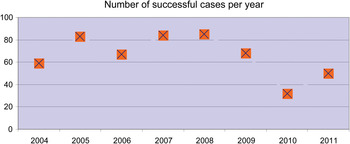
1. The number of defamation claims in which compensation was awarded is not increasing.
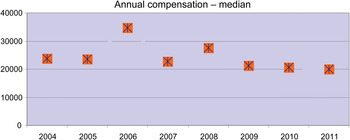
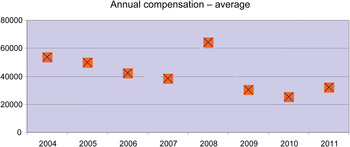
2. There was no increase in the amounts of damages awarded by the courts. As previously explained, the data recounts all successful defamation claims, under both section 7A and otherwise.
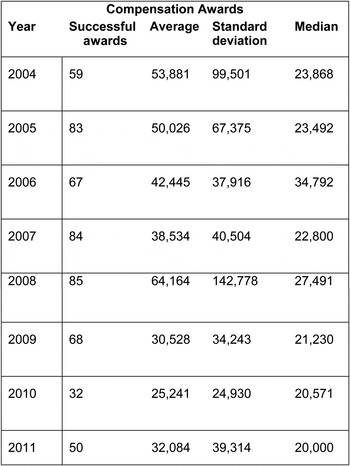
Figures 1 to 4 reflect per year the number of successful defamation cases through the duration of the research and the awards granted.
3. The overall number of claims against the media – old and new – is also quite steady: in 2011, only eight defamation defendants were media institutions or journalists.Footnote 133
4. Although it was impossible to neatly divide compensation awards into two separate categories as explained above, it is still clear from the reasoning and the rhetoric of the courts that in most of the cases compensation was indeed awarded according to section 7A. In most non-7A cases, it is unclear what the evidence was on which the court relied in deciding on the (high) awards.Footnote 134
5. In most of the section 7A cases, the amount of compensation awarded did not reach the statutory cap.
6. Even in cases where the plaintiff claimed and proved that damage was indeed sustained, the awards usually remained below the statutory caps.
Summary of compensation awards – 2004 to 2011

Figure 2

Figure 3

Figure 4

The empirical data is not surprising from a comparative perspective. It corresponds with data collected in other jurisdictions, although most of that data relates to both the number of cases and to the compensation awards, whereas our research does not relate to the number of defamation claims filed in courts. Data from the US and England also shows that during the last few years there was no increase in the overall number of defamation cases nor in the average amount of compensation – neither generally nor specifically against the media, old and new.Footnote 135
3.2 Increased Caps on Compensation without Proof of Damage: An Uncalled for and Risky Bill
The recent bill proposing to amend the Defamation (Prohibition) Law by increasing the statutory caps on compensation without proof of damage poses two main issues. The first questions the theoretical and practical need for the proposed change in the statutory caps. The second relates to the potential impact of the bill's form and style on the initial value choices made by the law and on the current balance achieved by Israeli defamation law between reputation protection and freedom of speech. These issues, as well as additional issues inherent in the increased statutory caps, are discussed below.
3.2.1 ‘If It Ain't Broke – Don't Fix It’
It is generally accepted that Israeli courts are authorised to award general damages in tort cases.Footnote 136 The awards are practically unlimited. The courts have had the power to award such damages long before the introduction of the new format for compensation without proof of damage into the Defamation (Prohibition) Law.Footnote 137 Thus, section 7A, when enacted in 1998, had almost no practical effect on the power of the courts to award damages in defamation cases apart from the declarative effect of the ‘new’ explicit power and the specific financial guidance set by the legislator. In practice, the difference between the nature and scope of proof in section 7A cases (where the scope of damage need not be proved yet the plaintiff has to convince the court that some damage in fact occurred) and most non-section 7A ‘general damages’ cases (where some ‘general damage’ must be proved) is trivial.Footnote 138 Thus, in the case of Natan Sharansky – the Knesset member and former Prisoner of Zion in Russia who was severely defamed in a libellous book written by a fellow Russian immigrant – the District Court awarded compensation of NIS 900,000Footnote 139 (which the Supreme Court later reduced to NIS 500,000Footnote 140) even though the plaintiff did not really present hard evidence to support either claim. In the Dayan case, the District Court awarded NIS 300,000,Footnote 141 again without any precise evidence to sustain this relatively high level of compensation.Footnote 142 The same is true with regard to the case of Dan Tichon, the former Knesset speaker, whom the District Court awarded NIS 450,000Footnote 143 (reduced through settlement in the appeals process to NIS 300,000Footnote 144), as well as other cases in which the courts – without any solid (specific or general) proof – were content to form a professional, educated and independent opinion on the appropriate amount of compensation without any effort to relate their decision to the evidence presented to them.Footnote 145 Thus, apart from the moral statement and the formal prompting to increase awards, section 7A had nothing to add to the judicial power of the courts with regard to compensating for defamation. The fact that the legislator abandoned the plan to amend the Civil Wrongs Ordinance and to introduce compensation without proof of damage in all tort casesFootnote 146 may be the best proof for the argument that section 7A was unnecessary and, as I shall shortly show, even harmful. The fact that the leading proponent of the 2011 bill, Member of the Knesset (MK) Meir Shitreet, had already stated openly – responding to a heated debate and a series of arguments from the opposition – that he was ready to reconsider the concept of the 2011 bill and strike out all references to specific caps, is yet additional proof for this argument.Footnote 147
Moreover, for all practical purposes, the compensation caps introduced by section 7A have never really produced a ‘capping effect’ at all on damages for defamation. Even after the enactment of section 7A and the introduction of the NIS 50,000 cap, courts could still grant – whenever they saw fit – unlimited ‘general compensation’ in the same manner in which they award uncapped compensation for a negligent breach of autonomy, for example, even though the Civil Wrongs Ordinance lacks any explicit reference to compensation without proof of damage and is likely to remain devoid of such a remedial procedure at least in the near future.Footnote 148
Yet, unnecessary as section 7A may have originally been, it is still important to see if the new formula did, in fact, have any influence on compensation for defamation.
The first possible impact that the then new plaintiff-friendly amendment to the Law could have had was an increase in compensation awards. In fact, this was indeed the motivation behind the section 7A innovation.Footnote 149 Yet the data shown above, collected from case law covering the eight year period 2004–2011, clearly shows that the average annual defamation award in 2011 was no higher than the annual average compensation awarded in the period 2004 to 2010.
The stagnation in compensation awards after 1998, especially in light of the legislator's explicit efforts to increase awards, can be explained in a number of ways. First, it is possible that the amount of compensation awarded in recent years actually reflects the true value of reputation according to the best judgment of the courts. If this is the case, then neither the statutory caps nor the higher ‘general damages’ option plays a major part in the process of translating the injured reputation into compensation awards. The data shows that in most cases the NIS 50,000 cap is not exhausted. Assuming that this relatively low level of compensation represents the actual evaluation of the abused interest, then the proposed new increased cap of NIS 300,000 is also unlikely to produce a change and is thus absolutely redundant.
If, on the other hand, the statutory NIS 50,000 cap had indeed played a role in the process of setting compensation awards, then this role should be traced back and explained prior to any further change in caps or otherwise. I maintain that, since the statutory cap merely provides a maximum limit to compensation without proof of damage – offering guidance rather than binding to a certain award – and since the courts still have very wide discretion regarding compensation awards, then the role played by the statutory defamation caps is minor, doubtful and not sustained by relevant data. In light of the availability of the ‘general damages’ option, this role is all the more negligible.
The main potential impact of the increased statutory damages caps on the courts is obvious. They are supposed to set a higher price for the plaintiff's injured interest. We have already seen that this is not the case here. Yet statutory caps, as indeed other special forms of compensation such as punitive damages, have an additional potential effect, known as the ‘anchoring effect’.Footnote 150 Research shows that information to which a decision-maker is exposed prior to making the decision is reflected in the decision, sometimes without the decision-maker even being aware of the psychological process. Thus, the NIS 50,000 cap may serve as an anchor for the court, causing it either to avoid the statutory top awards and ‘reserve’ them for extreme circumstances only, or to settle between the edges of the awards' spectrum and adopt the average (NIS 0–NIS 50,000) as the optimal fall-back. Each of the two courses of action provides a reasonable explanation for the low average/median in compensation awards during the years 2004–11. If indeed the statutory caps serve as an anchor then defamation awards are low not because the courts really believe that an injured reputation is worth less than NIS 50,000 but because their judgments are swayed by the Law's anchoring effect which, in turn, serves as a potential argument sustaining the effectiveness of statutory caps and even explaining the proposal to increase them.
The data presented above responds to this argument. It confirms that although courts usually do refer to the NIS 50,000 as a guideline,Footnote 151 they nevertheless freely and consistently turn to the ‘general damages’ format as an alternative whenever they feel that the awards should be higher than the statutory caps. They do not regard the NIS 50,000 cap as real. This practice eliminates – or at least minimises – the popular anchoring argument: where there is no real anchor it is reasonable to believe that the courts' discretion is much less affected than the anchoring phenomena may suggest.Footnote 152
All of the above, backed by case law data from 2004–11, forms a firm argument against the proposed increases in defamation compensation awards according to all practical aspects. The 1998 initiative to increase defamation compensation awards was rejected by case law – both section 7A case law and ‘general damages’ cases – that persist in making awards which do not come close to the statutory caps. This level of the awards reflects the real price of defamation unaffected by undercurrent factors.
3.2.2 A Casuistic Disproportionate Attack on the Current Hierarchy of Values Reflected in Defamation Law
Israeli defamation law reflects a constant wrestling between the legislator and the judiciary.Footnote 153 The Israeli Defamation (Prohibition) Law reflects the original value choices of Israeli society as to the proper balance between reputation and freedom of expression. These choices are mostly plaintiff friendly. Israeli case law, on the other hand, has taken a different course. Some of the most important decisions of the Supreme Court openly challenge the said pro-plaintiff agenda.Footnote 154
As defamation law is a mirror of ideological, cultural and social norms of Israeli society, both the legislator and the judiciary are very actively reacting to each other's attempts to change the status quo of current defamation law and promote new ideas. Thus we have witnessed in recent years many bills (mostly private) proposing amendments to the Defamation (Prohibition) Law, along with some important Supreme Court cases responding to the legislator's winds of change as well as to changing times and new circumstances.
The following are the most important pending bills of the last three years:
Exposure of anonymous publications.Footnote 155 Following the controversial decision of the Supreme Court that centred on the insufficient procedural means by which anonymity on the internet might be curbed, this bill proposes a practical way to avoid defamation on the one hand, yet on the other hand to preserve anonymity – an aspect of privacy and freedom of speech – as much as is reasonably possible.Footnote 156
The duty to update.Footnote 157 The duty to update a publication of a criminal investigation was originally inserted in the Defamation (Prohibition) LawFootnote 158 following a two-round decision of the Supreme Court in which liability was denied even though the newspaper failed to update its readers that no criminal proceedings followed the investigation.Footnote 159 This bill proposes to impose the said duty in additional circumstances.
Group defamation. This bill is a response to the Supreme Court's decision on the much debated Ben Natan caseFootnote 160 in which the liability of a well known Arab-Israeli film producer with regard to a movie in which a group of Israeli soldiers were accused of inhumanities against the Arab population was denied. The Court had no choice but to abide by the explicit language of the LawFootnote 161 and decided that, as the film related to the plaintiffs as a group (of soldiers in the Israeli Defence Forces), no individual plaintiff could constitute a cause of action. The bill proposes the introduction of a group action mechanism.Footnote 162
Defamation of the state. Footnote 163 Building on the previous notion of the group action mechanism, this bill proposes that defaming the State of Israel is to be regarded in the same way as defamation of any other legal entity. The State Attorney will bring and run the claim for such an action.
Preserving the public right to know.Footnote 164 This bill voices the Parliamentary opposition in the Knesset, and proposes to form a public national fund to help defendants in cases of public interest.
Truth at the time of publication defence.Footnote 165 Following Dayan,Footnote 166 proponents of freedom of the press hurried to try and turn the important ruling into explicit law by introducing a bill which defines ‘truth at the time of publication’ as ‘Truth’ for section 14 purposes.
Liability of internet service providers.Footnote 167 The issue of liability of internet service providers is settled in the Electronics Signature Law,Footnote 168 which also addresses other forms of tort committed on the internet.Footnote 169 This private bill proposes a means to decide upon liability when defamatory publication appears online. The liability of internet service providers in tort is at present vague.
SLAPP and anti-SLAPP.Footnote 170 The procedure of striking out defamation claims that are aimed only at silencing public debate on public issuesFootnote 171 is still to date unknown to the Israeli legal system. The proposed anti-SLAPP procedure, heavily supported by the Association for Civil Rights in Israel,Footnote 172 aims to combat the use of legal proceedings to silence criticism and debate on important public matters (SLAPP) by offering a detailed method, imported from the US, to strike out such unjustified claims.
This list of amendments to the Defamation (Prohibition) Law portrays a mixture of issues and interests, and even an interesting fusion of right and left political affiliations, liberalism and pragmatism. Each of the amendments targets a specific perceived flaw in the existing defamation law. Each was triggered by a certain need or want, by technological progress and even by explicit request from the Supreme Court.Footnote 173 Yet none of these bills aims to achieve an overall change or a general normative innovation. They are all targeted at a specific issue and, if and when adopted, will have only limited impact on the present balance between reputation and freedom of expression. They do not pose a threat to the current status quo of defamation law at large.
The bill advocating increased caps on compensation without proof of damage in defamation is clearly different. It deals with a central issue of basic rights; it is aimed to alter a very delicate balance between reputation and freedom of speech. It is expected to achieve change across the board. This is why it is both deceptive and hazardous.
The change in the cap on compensation without proof of damage is deceptive because it appears to be dealing with only one component of the struggle between reputation and freedom of speech, namely the price of defamation, while actually it threatens to affect the whole normative balance and hierarchy of values of reputation, on the one hand, and freedom of speech on the other. It fails to look at the issue of reputation protection as a whole. It overlooks the complicated liability elements as well as the defences provided by the Law. It merely addresses caps on statutory damages, disregarding important implications such as prior deterrence, over-deterrence, press silencing and other undemocratic side effects.Footnote 174
The bill is not only unwarranted; it is also hazardous. It endangers the balance achieved through centuries of deliberations by both legislator and the judiciary. It threatens to shake the delicately stable scale by brutally addressing an isolated issue of defamation liability alone – raising the current cap six-fold – and totally neglecting to weigh the potential change on the overall legal regime governing reputation protection in Israel.
Such casuistic legislation might be understandable when changing circumstances call for the shift in rules, norms or values addressed by the proposed amendment. But this is not the case with the defamation bill. The incremental development of protection of reputation in Israel has thus far reflected a dialogue between the Knesset and the judiciary. Mostly it has reacted to certain needs and objective cultural social and moral developments. The increase in compensation caps has no justification whatsoever in current Israeli society. The courts are reluctant to increase defamation awards. Forcing them to do so without an objective good reason will only end up with unwanted battles in which each tries to subjugate the other.Footnote 175 The Dayan case may well have been the first response of the judiciary to the legislator's ongoing effort to curb freedom of the pressFootnote 176 and, based on past experience, it is not going to be the last.
The new UK Defamation BillFootnote 177 provides an example for an alternative legislative process. This bill, which was announced by the British government in 2012, followed a long public debate on the flaws of defamation law and very extensive preliminary work by some leading members of Parliament,Footnote 178 a report on the Draft Defamation Bill by a joint Committee of the House of Lords and House of Commons,Footnote 179 and a lively discussion by some leading blogs,Footnote 180 the Coordinating Committee for Media Reform,Footnote 181 academic research centres,Footnote 182 and other professionals from the British media and renowned law firms.Footnote 183
Although the bill is still under deliberation and commentators are uncertain as to its potential impact on the ‘volume or nature of libel litigation’,Footnote 184 it is certainly a product of a holistic approach, reflecting the intricacy of the issues involved and reviewing all the components of defamation liability: definition, defences and remedies, together with specific clauses on website operators,Footnote 185 limitation period,Footnote 186 jurisdiction,Footnote 187 and publication of a summary of the judgment by a losing defendant.Footnote 188
Israeli defamation law, on the other hand, is in no dire need of such an overall reform. The original Law – amended, refined and adjusted for modern circumstances – together with the leading precedents of the Supreme Court safeguarding freedom of speech, produce a suitable toolkit by which defamation law can be further developed to accommodate change.
3.2.3 Silencing the Investigative Press and Public Criticism
The data, experience and current statutory changes in other countries serve as warning of the danger created by the ‘chilling effect’Footnote 189 of over-deterrence and the over-silencing of open public debates. This negative impact of over-friendly defamation laws is reflected in a decrease in investigative journalism and academic researchFootnote 190 and an increase in settlements of lawsuits for fear of legal costs. It can also cause intimidation of media, stifled public opinion and criticism, and obstruction of the free exchange of ideas and information.Footnote 191 It is only logical to assume that the greater the danger of liability and large compensation awards, the greater the precautions the press will adopt before publishing a story or airing a television reportage. Media decision-makers will check, then double-check, then re-check their assessment, and in some cases they will ultimately decide that the risk of publishing is too great. Hence there are stories, some carrying genuine public interest, that will be abandoned.
Although at first glance, one may doubt if such outcomes should really arouse cultural, moral or even legal concerns, as a more cautious press could certainly be an improvement that society should strive for, and more meticulous professional ethics are to be cherished. Yet the real issue does not concern the media's ethics or the self restraint of the press alone. The key challenge here lies in determining the reasonable deterrence level. Whereas achieving ‘responsible journalism’ through a careful combination of many public interest considerations is certainly a positive goal,Footnote 192 the road to over-deterrenceFootnote 193 is quite short.Footnote 194 The British experience in the fight against ‘libel tourism’ and international criticism shows how imminent this danger is.Footnote 195
Moreover, rather than investigating, promoting positive criticism and contributing to the fight against corruption, the press might become too eager to satisfy the rich and powerful.Footnote 196 It might tend to adopt compromising practices, both regarding its original task as the watchdog of a free, western democratic society and as a placating mechanism vis-à-vis the wealthy and powerful plaintiffs it offends.Footnote 197
3.2.4 Legalising Punitive Damages
The initial goal of the changes promoted by the new bill is to increase protection of reputation. Monetary deterrence is an effective method. In responding to irresponsible media, it is certainly a meaningful tool.Footnote 198 Yet NIS 300,000 compensation caps are problematic, at least in light of the far more modest current average reputation compensation awards that Israeli courts usually grant. Indeed, the proposed caps reflect punitive purposes far more than compensational purposes.Footnote 199 The new high caps thus pose a theoretical problem that goes to the roots of compensation awards in tort law. Compensational damages are supposed to correspond to the claimant's loss. Yet a cap of NIS 300,000 can hardly be regarded as a reasonable sum by Israeli standards.Footnote 200 The NIS 1,500,000 cap on compensation for breach of the duty of prior notification and response publication is also exaggerated. Indeed, recent awards hardly ever reach the present cap of NIS 50,000. Very few cases result in an award that even approaches the increased suggested caps. Hence the new caps are undoubtedly more punitive then compensatory.
According to most theories on tort law and tort compensation, punitive damages – contrary to the well known tortious principle of restitution in integrum – are problematic.Footnote 201 Most legal systems try to limit them.Footnote 202 In Israel, punitive damages (in contrast to aggravated damages, which are an augmentation of general damages to compensate for aggravated injury, yet are still compensatory in natureFootnote 203) are awarded only in limited situations, mostly in defamation cases.Footnote 204
As the average amount of compensation awards in Israeli case law is much less than the proposed new caps, one might mistakenly infer that in practice the new bill legitimises punitive damages as a routine practice in defamation cases. Yet Israeli legislation refers to punitive damages, when allowed, in very few laws and under strict limitations, which are totally different from the sweeping potential impact the new bill will introduce, if adopted. To allow ‘punitive damages’ without an explicit reference or reasonable justification through the back door of ‘caps’ on statutory damages in defamation cases stands in contrast with the very limited use of punitive damages in the budding Israeli private law codification.Footnote 205
3.2.5 Problematic Relations with Other Acts Providing for Caps on Compensation without Proof of Damage
Section 7A of the Defamation (Prohibition) Law was followed by many similar amendments in Israeli legislation. Compensation without proof of damage is now awarded not only in cases of constitutionally protected personal interests, but also in diverse contexts that involve diverse interests.Footnote 206 The main common denominator of all these laws is the unique nature of the protected interests and the harm caused: hurt feelings, pride, reputation, autonomy (social, economic or other), discrimination, insult, dignity, privacy and many additional interests of this non-physical type. Harm to these interests is always difficult to prove and quantify.
The troubling aspect of this proliferation of statutory damages is the difference in the caps of the various Acts. Whereas some similarities exist between the defamation/privacy/sexual harassment Acts, different and diversified caps have been set in other laws, ranging from NIS 20,000Footnote 207 to NIS 200,000.Footnote 208 Any change in the Defamation (Prohibition) Law caps must involve careful examination of the caps under the Privacy (Protection) Law as well as the Prohibition of Sexual Harassment Law, for example. This is especially important because many defamation cases also give rise to causes of actions under other Acts. Needless to say, any change in the Defamation (Prohibition) Law caps is likely to prompt a similar legislative move in statutory caps under various other Acts. The signs of this process were already evident at the first hearing of the proposed bill in the Knesset Committee on Constitution, Law and Justice. Knesset Member Meir Shitreet – one of the initiators of the new bill and the driving force behind the concept of statutory compensation in defamation claims – when faced with the issue of parallel caps was prepared to introduce the same increased caps into the Privacy (Prohibition) Law. Moreover, when asked, he admitted that there is no reason to believe that this trend would halt and that the Defamation (Prohibition) Law would be the last to undergo such a change.Footnote 209
As explained above yet still important to stress, a potential across-the-board drift in such a direction could present a significant hazard. An increase in compensation caps causes a meaningful change in liability. Such a change should be backed by suitable theoretical reasoning accounting for its overall impact on the specific Laws in question as well as Israeli private law in general. The current (mostly) political sense that defamation awards should be higher hardly constitutes a sufficient basis for an overall increase in the statutory caps. The potential danger of a slippery slope is self-evident.Footnote 210
3.2.6 Problematic Relations with Other Liability Sources
Liability for reputational harm is gradually movingFootnote 211 from the particular torts of defamation, privacy and injurious falsehood into the ever-expanding tort of negligence.Footnote 212 The theoretical justification for this shift – if any exists – is beyond the scope of this article.
Since liability in negligence (as opposed to defamation)Footnote 213 is based on proof of damage, the proposed increased caps under the Defamation (Prohibition) Law may affect the growing popularity of the ‘negligent-defamation’ cause of action. A plaintiff claiming under the Defamation Law may claim compensation up to NIS 50,000 (NIS 300,000 according to the bill) without proof of damage, whereas a plaintiff claiming negligence has to convince the court that the publication had indeed caused some damage. Nevertheless the ‘general damages’ formula that courts apply so eagerly in Defamation (Prohibition) Law cases, as the data shows, can provide a suitable alternative in negligence cases as well.Footnote 214 The Defamation Bill's proponents might also reconsider the long-forgotten 2004 bill that proposed to insert compensation without proof of damage in the Civil Wrongs OrdinanceFootnote 215 in order to achieve equal effect in all avenues of reputation protection.Footnote 216
4. Conclusion
Israeli tort law is solidly rooted in English law. It is therefore only natural to examine the English ‘libel reform’ process of the last few years and the current UK Defamation Bill – which reflect the twists and turns taken by defamation law in England during the past few years – as an illustration to back not only those who support the argument that reputation in Israel needs increased protection but also those who believe that freedom of speech should be carefully guarded against unreasonable curbs, in their effort to improve the balance between the two rights.
The recently introduced Defamation Bill (2012) in the UKFootnote 217 is a product of intensive legal research of theoretical/normative and practical/implemental issues.Footnote 218 It mirrors the results of a long and heated public debate on the need for a modification in the over plaintiff-friendly defamation law, which turned London into the ‘Mecca of libel tourism’Footnote 219 and the target of fierce criticism, especially from the US, where special laws were enacted to fight the unbalanced decisions of the UK courts.Footnote 220 In the midst of the legislative process the phone hacking scandal of summer 2011 erupted. Unethical and even criminal practices – phone hacking, police bribery and improper influence on politicians – of some very popular newspapers were exposed causing the closure of The News of the World and the resignation of Rupert Murdoch, chairman and chief executive of News International. These regrettable events – which also led to the establishment of the Leveson CommitteeFootnote 221 to examine the culture, practices and ethics of the press and its relationship with the public, police and politicians – served as an additional catalyst for the intensive legal and administrative groundwork accompanying the legislative procedure. It involved long public and Parliamentary debates, including a House of Lords private defamation bill (‘Lord Lester's Bill’),Footnote 222 a government proposal and consultation papers,Footnote 223 a Scrutiny Committee ReportFootnote 224 followed by government response,Footnote 225 and intense private and public campaigns in magazines and websites,Footnote 226 all reflecting comprehensive endeavours to improve English defamation law and enhance UK media ethics. The method, pace and management of the whole process illustrates how a legal ‘reform’ can be achieved.
Across the sea, in the US, we have witnessed a persistently growing trend towards the adoption and implementation of SLAPP and anti-SLAPP legislation.Footnote 227 The Australian government has recently announced an inquiry into media practices and media regulations,Footnote 228 while in Canada, the Supreme Court has initiated a look into important issues of journalistic responsibility, libel tourism, defamation on the internet and freedom of speech.Footnote 229 Most of these legislative initiatives focus on the need to update and improve the balance between protection of reputation and freedom of speech. Thus, the English Defamation Bill reflects a less plaintiff-friendly approachFootnote 230 than the current English defamation law, whereas in the US we witness a growing number of proponents of the protection of reputation.Footnote 231
What can Israel learn from this global experience? Over the years, the Israeli legislature has introduced some quite important changes into the Israeli Defamation (Prohibition) Law of 1965. Basic Law: Human Dignity and Freedom has also affected the balance between freedom of expression and reputation. Parallel developments in privacy and in negligence law have also had their impact.
Ultimately, the present Israeli defamation law – both the Defamation (Prohibition) Law and case law – reflect a relatively well established moral hierarchy of norms and values, which can be said to portray Israeli society. And, unlike English law, Israeli defamation law does not seem to invite major revision. Thus, while it would be wise for the Israeli legislature to address technological changes and other special issues that call for precisely targeted solutions through piecemeal legislation, it would definitely be ill-advised to introduce major changes that might endanger the fragile status quo.
The proposed bill to increase compensation caps should be abandoned. First, case law data from 2004 to 2011 demonstrates practically no need for such increases. Second, the proposed changes in the caps carry meaningful declarative cultural and social value choices regarding the hierarchy of reputation and freedom of speech in Israeli society. Third, there is no evidence to justify the legal earthquake that the proposed bill will trigger, if adopted, or the negative impact that it is likely to have on the important role of the media.