Introduction
Social isolation refers to ‘the absence of relationships with other people’ (de Jong Gierveld, van Tilburg and Dykstra Reference de Jong Gierveld, van Tilburg, Dykstra, Vangelisti and Perlman2006: 486), including limited engagement with others and restricted social networks. On the flip-side, social integration refers to the extent to which people have social relationships and social contact. There is much research evidence to support that being socially integrated and avoiding social isolation are not merely luxuries of life, but are fundamental for experiencing optimal physical and mental health (Krause Reference Krause, Binstock and George2006; Nicholson Reference Nicholson2012). A recent meta-analysis, for example, reported that being socially isolated increased the odds of natural death mortality by 29 per cent (Holt-Lunstad, Smith and Layton Reference Holt-Lunstad, Smith and Layton2015).
Although prior studies have found that most community-dwelling older adults are not socially isolated (DiNapoli, Wu and Scogin Reference DiNapoli, Wu and Scogin2014; Nicholson Reference Nicholson2012), older adults can be considered at risk because of age-associated life events, including retirement, widowhood and declining mobility (although for a discussion of how some life events can enhance older adults’ social networks through compensatory processes, see Cornwell, Laumann and Schumm Reference Cornwell, Laumann and Schumm2008). An emerging body of evidence indicates the public health importance of helping older adults maintain robust social networks. Research has found that mixed-composition social networks in later life – consisting of relationships with family and non-family alike – are associated with more positive outcomes including better cognitive functioning (Ellwardt, van Tilburg and Aartsen Reference Ellwardt, van Tilburg and Aartsen2015), lower levels of depressive symptomatology (Fiori, Antonucci and Cortina Reference Fiori, Antonucci and Cortina2006; Litwin Reference Litwin2011), better outcomes in serious physical illnesses (Cohen and Janicki-Deverts Reference Cohen and Janicki-Deverts2009), and reduced likelihood of loneliness and anxiety and increased likelihood of happiness (Litwin and Shiovitz-Ezra Reference Litwin and Shiovitz-Ezra2011).
Our study aimed to advance research on how formal organisations potentially influence older adults’ social integration by exploring participation in community activities in the context of Naturally Occurring Retirement Community Supportive Service Programs (NORC Programs). NORC Programs constitute an ageing services model in the United States of America (USA) that seeks to promote the health and wellbeing of older adults ageing in place in their own homes and communities (Altman Reference Altman2006). Although enhancing older adults’ social networks and reducing social isolation has been identified as a core goal of the NORC Program model (Bedney, Goldberg and Josephson Reference Bedney, Goldberg and Josephson2010; Vladeck Reference Vladeck2004), there has been little systematic exploration regarding how NORC Programs work towards this outcome in practice, especially from the perspectives of older adults themselves. Our study aimed to advance research on the causes and consequences of participation in community activities offered by NORC Programs to better understand the processes through which community-based organisations can potentially enhance older adults’ social integration.
Societal responses to promote social integration in later life
Internationally, there is growing attention to the role of community-based organisations in promoting the social integration of older adults (Cattan et al. Reference Cattan, White, Bond and Learmouth2005). The USA formalised the role of such organisations in the 1970s, at which time national legislation was passed to provide federal public support for senior centres as designated places for older adults to socialise and receive other services and supports (Gelfand Reference Gelfand2006). As another and more recent example, local governments and not-for-profit organisations in Japan have become increasingly interested in programmes to prevent social isolation among older adults, particularly in light of demographic changes, such as growing proportions of people who are not married (Saito, Kai and Takizawa Reference Saito, Kai and Takizawa2012). Moreover, a growing number of age-friendly community initiatives, guided by the World Health Organization framework, also address community inclusion and participation as core features of age-friendly places (Fitzgerald and Caro Reference Fitzgerald and Caro2014).
Despite enthusiasm for the efforts of formal organisations to influence older adults’ social integration, there has been scant research on the processes and ways in which organisations potentially exert such influence. Much of the research on what facilitates or constrains older adults’ community participation has been based on large multi-national survey data and has focused on individual as well as neighbourhood predictors of participation (e.g. Bøen et al. Reference Bøen, Dalgard, Johansen and Nord2010; Pardasani Reference Pardasani2010; Seong Ho and Chul Soo Reference Seong Ho and Chul Soo2005; Vaughan et al. Reference Vaughan, LaValley, AlHeresh and Keysor2015). Prior studies on formal group activities largely have addressed specific types of socialisation activities, such as educational programmes or discussion groups; have examined pre-defined and specific social-relational outcomes, such as social isolation or loneliness; and/or have focused on programmes that are targeted specifically to older adults with known risk factors for social isolation, such as widows (e.g. Cattan et al. Reference Cattan, White, Bond and Learmouth2005; Constantino Reference Constantino1988; Dickens et al. Reference Dickens, Richards, Greaves and Campbell2011; Findlay Reference Findlay2003; Martina and Stevens Reference Martina and Stevens2006; Saito, Kai and Takizawa Reference Saito, Kai and Takizawa2012; Stewart et al. Reference Stewart, Craig, MacPherson and Alexander2001). In contrast, NORC Programs constitute an ageing services model that seeks to support all older adults within a locality through a range of offerings with multiple intended outcomes (Vladeck Reference Vladeck2004). Therefore, NORC Programs provide an opportune context to further advance research on the processes through which community-based organisations engage older adults in formal group activities and the meaning of such participation for older adults’ social integration.
NORC Programs and social integration
One of the primary ways in which NORC Programs seek to influence older adults’ social relationships is through facilitating group, or community, activities. Descriptions of the NORC Program model have identified a variety of types of community activities, including social-recreational (e.g. yoga classes, luncheons and trips), educational (e.g. discussion groups and informational sessions) and civic (e.g. advisory council meetings, meetings with local government officials and intergenerational volunteering) (Vladeck Reference Vladeck2004). Congruent with these descriptions of the programme model, a national survey of 62 NORC Programs in 2012 – with approximately half located in New York City and the other half located across the USA – found that 98 per cent of the programmes offered social-recreational activities (Greenfield et al. Reference Greenfield, Scharlach, Lehning, Davitt and Graham2013), and approximately 90 per cent noted strengthening older adults’ social relationships and reducing social isolation as among their programmes’ top goals (Greenfield et al. Reference Greenfield, Scharlach, Graham, Davitt and Lehning2012a , Reference Greenfield, Scharlach, Graham, Davitt and Lehning2012b ).
Research on NORC Programs and older adults’ peer relationships has focused largely on whether older adults and service providers perceive social-relational benefits, either in terms of pre-defined outcomes or in a general sense. For example, an evaluation of a NORC Program in Cleveland, Ohio, found that increased interactions with neighbours and making new friends were among the most widely cited reasons that participants liked the programme (Anetzberger Reference Anetzberger2010). Moreover, a national survey of NORC Program participants indicated that more than 80 per cent stated that the NORC Program led them to attend more community events and to know more people (Bedney, Goldberg and Josephson Reference Bedney, Goldberg and Josephson2010). A case study of NORC Program development at two sites in Los Angeles concluded that the activities ‘helped create a sense of community for residents … and fostered social interaction and contributed to the formation of new friendships among seniors’ (Enguidanos et al. Reference Enguidanos, Pynoos, Denton, Alexman and Diepenbrock2010: 297). Similarly, a statewide study with professional staff of NORC Programs in New Jersey demonstrated the perception that NORC Program activities provide a way for older adults to meet new people and to deepen their existing social relationships (Greenfield Reference Greenfield2013).
While this prior research provides beginning insights into how NORC Programs influence older adults’ social-relational wellbeing, there have been no multi-site studies to explore in depth how older adults themselves describe their experiences of participation in community activities through NORC Programs. Advancing research based on older adults’ own perspectives is especially important in light of calls for ageing services research to be more client-centred by eliciting the voices of consumers (Carpenter et al. Reference Carpenter, Edwards, Pickard, Palmer, Stark, Neufeld, Morrow-Howell, Perkinson, Morris and McCallion2012). It also addresses growing attention to individuals’ subjective experiences of services as an important aspect of service quality (Berwick, Nolan and Whittington Reference Berwick, Nolan and Whittington2008).
Guiding theoretical principles
Our inquiry in this area was guided by insights from ecological systems theory. Ecological systems theory broadly orients attention to embedded levels of environments that shape individuals’ experiences, behaviours and human development (Bronfenbrenner Reference Bronfenbrenner1979). Each level of the environment is distinguished by its proximity to the focal individual, with those occurring more proximally (e.g. older adults speaking with each other at a luncheon) being influenced by those that occur farther from the individual (e.g. NORC Program committee meetings that plan the luncheon). This insight led us to explore how potentially multiple levels of people's social ecologies influence their experiences of participation in formal group activities offered by NORC Programs.
An additional insight from the ecological systems perspective is that individuals influence the very environments that influence them. This idea recognises that people have some degree of choice over which environments they select and the features of their environments to which they attune (Bronfenbrenner and Morris Reference Bronfenbrenner, Morris and Lerner2006). Extending this insight to the focus of our study, our analysis was sensitive to the idea that people engaging in the same social behaviour (e.g. attending a NORC Program activity) potentially experience different subjective meanings of that behaviour. It also sensitised us to the ways in which individuals potentially have agency in whether they participate in group activities offered through NORC Programs. Accordingly, we conceptualised NORC Programs as a community-level context that creates environments for socialisation, while also orienting to the potential for individuals to differ in their experiences and degree of engagement with these environments.
Research questions
Guided by these theoretical insights, our study explored the following research questions:
-
• Research question 1: What individual and environmental circumstances do older adults identify as influencing their participation in community activities offered by NORC Programs?
-
• Research question 2: How do older adults describe the meaning of their contact with others at community activities offered by NORC Programs?
Method
Research design
We used data from an in-depth interview study with older adults living in catchment areas for NORC Programs in New York City. The original parent study aimed to understand how NORC Programs influence older adults’ contributions to their communities through formal volunteerism and informal helping. As part of this focus, all participants were asked to describe their involvement with the NORC Program and their participation or non-participation in the community activities offered by the programme. However, because the current study's focus on older adults’ participation in formal community activities was not the explicit and primary aim of the original study, our study could be considered secondary qualitative analysis (Heaton Reference Heaton2004).
Sample
Data were from 41 residents across seven NORC Program sites in the greater New York metropolitan area. Purposive sampling was done at both the individual and site levels to include participants from varying neighbourhood environments with different socio-demographic characteristics. Two of the sites were in mixed-age, publicly subsidised housing complexes (with multiple apartment buildings managed by a single property management group at each complex), one was in a neighbourhood of mostly detached homes within a less densely populated area of New York City, one was in a neighbourhood of mostly detached homes within a suburb of New York City and the remaining were in areas with mostly independently owned co-operative complexes across multiple city blocks. Three of the sites were located in Manhattan, two in Queens, one in Brooklyn and one in Long Island.
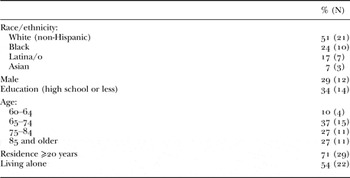
As part of the parent study's theoretical sampling design, NORC Program staff at each site were asked to recruit individuals across three levels of overall programme participation, with the aim of recruiting two people at each level: (a) minimal to no participation (e.g. resident has provided contact information to staff, but has not participated in any NORC Program activities or services), (b) moderate participation (e.g. resident who occasionally attends a group activity through the NORC Program), and (c) high participation (e.g. resident who regularly attends group activities). Staff also assisted with identifying participants who differed by their socio-demographic characteristics, with a particular emphasis on age, gender and race/ethnicity. Table 1 displays the sample demographics, indicating that the participants were majority females (71%), long-time residents of the neighbourhoods (71%), had more than a high school education (66%), were age 75 or older (54%) and lived alone (54%). Slightly over half of the participants were White (51%), almost a quarter were Black (24%), 17 per cent were Latino/a, and 7 per cent were Asian.
Sample description

Note: Data are from a sample of 41 older adults residing in catchment areas for seven Naturally Occurring Retirement Community Supportive Service Programs in the New York City metropolitan area. Percentages are rounded to the nearest unit.
Data collection
Participants were interviewed for approximately one hour in their homes or within a private location of a community centre. A semi-structured interview technique was used, which ensured that similar questions were asked across the interviews, while allowing the researchers to explore in greater depth themes particular to each participant. Sample questions included: ‘What is the purpose of the NORC Program from your perspective?’ and ‘Have you been involved in the NORC Program, and how?’ Through open-ended questions such as these, participants provided accounts of their participation and non-participation in NORC Program activities. As necessary, the researcher asked probing questions to elicit greater depth in participants’ narratives on the group activities. For example, when participants simply listed the NORC Program activities that they attend, the interviewer asked follow-up questions concerning why they became involved in those specific activities, as well as the meaning of those activities in light of their other potential social involvements.
The initial wave of data collection took place with 36 participants across six sites from September 2012 to February 2013. From January to June 2014, 32 of the original participants were re-interviewed, and five participants at a seventh site were added to the study to better understand the perspective of residents within a more suburban setting (for additional information, see Greenfield Reference Greenfield2015). For participants interviewed twice, the second interview served largely as a member check for the parent study and provided opportunities to explore in greater depth the themes that were emerging from the analysis at that time. Transcripts from both waves of data collection were included in the current analysis, as both waves contained potentially theoretically relevant data.
Data analysis
Our analysis was broadly guided by grounded theory principles – a research method that is optimally suited for developing theory to understand a given phenomenon in a way that is rigorously grounded in empirical observations (Corbin and Strauss Reference Corbin and Strauss2008). We began our multi-phased analysis with open coding of the transcripts by both authors using QSR International's NVivo 10 Software. Consistent with the methods described by Strauss and Corbin (Reference Strauss and Corbin1990), the coding was informed by sensitising concepts from the literature (e.g. an orientation to individual circumstances as well as programmatic factors, as suggested by ecological systems theory); however, the coding was open in the sense that all data were considered candidates for further analysis (LaRossa Reference LaRossa2005). As recommended by Lincoln and Guba (Reference Lincoln and Guba1985), team discussions were used to achieve convergence in the creation and application of codes, as well as to resolve discrepancies. Throughout the analysis, we sought to maximise the credibility of our analysis by maintaining detailed coding records, as well as referring to interviewer notes and writing and reviewing coding memos. After initial open coding, axial coding was conducted (Strauss and Corbin Reference Strauss and Corbin1990). At this stage, we further refined our initial codes – focusing on a higher level of abstraction and more clearly specifying how the codes indicated themes most closely related to our study's specific research questions. We also explicitly employed a constant comparative method at this stage – orienting to the emergence and non-emergence of themes across interviews (Glaser and Strauss Reference Glaser and Strauss1967) – to more fully explore the meanings and inter-connections of higher-order codes. Subsequent to axial coding, we used theoretical coding to explore how the primary themes related to each other and to integrate them into an overarching, empirically based narrative. At this stage of the analysis, we created, refined and re-created diagrams – continuously checking these diagrams against our coded data, as well as using team meetings to ensure that both authors viewed the interrelationships as grounded in the data.
Results
Research question 1: Influences on participation in community activities
As described below, five themes emerged within participants’ accounts on what they perceived as influencing their participation in NORC Program activities. Guided by ecological systems theory, we present these themes according to the level of person–environment systems that they address, including individual circumstances (personal desire for social activity and health status), programmatic factors (relationships with staff and appeal of the activities) and community contexts (appeal of the other attendees).
Individual circumstances
Personal need for additional social activity: Respondents described how their need for additional social engagement – in the context of their own private network of friends and other voluntary group participation – influenced their participation in community activities offered through the NORC Programs. Some respondents attributed their lesser participation to their social needs already being met through other channels, such as through their churches. In contrast, respondents without such outlets described the importance of the NORC Program in facilitating social interactions. This theme was especially prominent among people whose social networks were in flux because of major life changes, such as retirement and widowhood. For example, one woman – who was regularly attending weekly coffee socials offered through her NORC Program at the time of the interview – described how she had her group of friends when her husband was alive; however, after he died, ‘I decided that I have to make friends in the community more than I had. So I reached out to people through the activities of NORC’. Another woman recalled how after her retirement, she continued her long-standing social commitments that took place in a neighbouring borough. However, as she experienced health problems, she became unable to travel and gradually became more involved with the local activities offered through the NORC Program. At the time of the interview, she was attending several NORC Program activities on a regular basis. She reflected, ‘So [the NORC activities have] really been very beneficial for me because I cannot go into the city anymore. I'm feeling good about NORC’.
In addition to their existing social networks, respondents also described how their dispositional tendencies influenced their feelings of need to participate. For example, some respondents described how they had always enjoyed the company of other people or viewed themselves as gregarious, which led them to seek out opportunities to be with other people, including through the community activities offered by the NORC Program. On the flipside, a handful of respondents described themselves as more solitary in their dispositions, thereby limiting their participation in the activities.
Health status: A commonly perceived reason for limited participation in NORC Program activities was people's self-ascribed capacity to participate. This capacity was described largely in terms of their health status and mobility. This theme was especially common at sites where residences were more spread out, and people lived farther away from central gathering places. For example, at a more suburban site, activities were located primarily at a local community centre. A man who was no longer able to drive described how he would like to attend more activities if he were not dependent on others to drive him there, and a woman at risk for falls mentioned how an incline from the parking lot to the building made her more selective about which activities she attended. A handful of participants with more severe disabilities had health aides, acknowledging that, in theory, they could use this source of assistance to attend more activities. However, they cited logistical barriers around doing so, including a limited number of hours that the aides were available, as well as the aides’ hours not being compatible with the times at which the programmes of interest were offered.
Participants further described how health problems limited their discretionary time and energy to participate in community activities. They noted the need to be more selective about where they expended their energies – prioritising self-care activities (such as bathing, getting dressed, cooking) over attending NORC Program activities. For example, one frail participant explained that even the act of going to the pharmacy to pick up medicine demanded a considerable amount of time and energy, concluding, ‘I have such a limited amount of time that when I go, I just don't waste it. I'd love to be out, but I can't, you know?’ As a result, her involvement with the NORC Program was limited to receiving direct services and not participating in community activities. Moreover, a small number of respondents in the sample were spousal care-givers, who lived with a partner necessitating daily care. Similar to respondents with their own health problems, these respondents cited care-related demands on their time as a limit to their participation in NORC Program activities.
Programmatic contexts
Relationships with staff: Another theme addressed how relationships with NORC Program staff influenced older adults’ participation in community activities. Some respondents described that because the NORC Program staff were so helpful to them, they wanted to help the programme by attending community activities, especially when staff personally invited them to participate. As one man, a self-described ‘homebody’ who nonetheless regularly attended advisory council meetings, explained:
[The NORC Program social worker] really goes overboard doing for people and really helping them. That's why I don't mind going the extra yard. If she asks me to do something … I can't tell her no.
In contrast, a woman at a different site explained in her initial interview how her negative perceptions of the staff limited her participation in the programme's activities, stating: ‘The staff [is not] that talented to work with seniors. It keeps everything tense. So people tend to go places where they feel more welcomed’. At the follow-up interview, she described how new staff, for whom she expressed high regard, had joined. As a result, she reported becoming more involved in the community activities.
Appeal of the activities: Many respondents explained their participation or non-participation in terms of whether they found value in the specific activities offered through the NORC Program. For example, while some participants elaborated on how much they appreciated and enjoyed exercise classes offered through the NORC Program, other participants described their lack of interest in this type of activity and their resulting non-participation. Older adults’ lack of interest in the programme offerings was especially prevalent at a site where residents described themselves and their community as increasingly frail and where there was some concern over the long-term viability of the NORC Program itself. While the participants acknowledged that the NORC Program offered opportunities to socialise – such as trips and educational classes – they expressed interest in other types of social activities, such as health education workshops and more intimate gatherings with friends.
Community context
Appeal of the other attendees: Similar to whether participants were attracted to the specific types of activities offered by the NORC Program, older adults further described how their perceptions of the other attendees influenced their participation. Many people described other participants in terms of whether or not they fit their preferences for social activity partners in general. For example, one man – who had minimal social involvements outside the NORC Program – described how he had always been most comfortable with older women, finding them to be ‘nicer people’ than others. Although he generally did not seek the company of others, the older women who attended the NORC Program's weekly social hour motivated his regular participation there. In contrast, a woman who explicitly expressed her loneliness described how she no longer participated in NORC Program activities because she did not feel comfortable with the people: ‘I don't like the people that go there. When I used to go a lot, it was a lot of older people, and the only Spanish one was me’. She further described her wish that the people there would be ‘more friendly’ to her. In addition to these social barriers, she also experienced mobility limitations, which limited her ability to get to some of the community activities taking place farther from her residence.
Research question 2: Meaning of social contact through community activities
Participants reported experiencing a spectrum of social effects from involvement in NORC Program activities. Five themes captured the meanings that older adults attributed to their contact with peers at NORC Program activities, both in limited and profound ways. An additional theme identified participants’ perceptions of other attendees as a context that influenced these varied experiences.
Limited changes
Experiencing a social environment: For some participants, the significance of the other attendees at NORC Program activities did not extend beyond the provision of additional social contact or exposure. For example, one man described the community centre at which NORC Program activities took place as a ‘public family living room [with] social activity’. Although he partook in some of the community activities there, such as lectures provided by the NORC Program, he explicitly described that, for the most part, he would not talk with others when attending. Similarly, another woman at a different site who regularly attended NORC Program activities observed that at weekly coffee hours, there are ‘some that just sit there like a lump on a log and never seem to talk to anybody, and you feel this must be a blessing for them’.
Replicating existing contacts: Some participants described how the NORC Program did not lead to new relationships because they already knew the people attending the community activities. Rather than meeting new people or making new friends, the NORC Program provided another platform for them to socialise with people whom they would see and socialise with regardless of the NORC Program. This theme was especially prevalent at a site where NORC Program activities were offered in a formal community centre, where many older adults tended to participate in activities outside the NORC Program, such as for congregate meals.
Profound changes
Sense of community: In contrast to the themes above, some participants described how the NORC Program activities helped them to expand their sense of community. Many mentioned how the NORC Program connected them to people whom they had not met before – including people from more distant areas of their communities, as well as people living quite close to them whom they simply did not have an opportunity to meet before. While some participants described that although they would not regard such people as friends, they were still meaningful in terms of enhancing their sense of connection to their community more broadly. For example, a focal event for a NORC Program at one site was a community-wide barbeque. Respondents described the meaning of this event in terms of bringing together people from all over the community – including people of diverse ages, races and ethnicities, and religions. Another participant, who attended NORC Program meetings on a monthly basis as well as occasional luncheons, described how NORC Program luncheons engendered:
a feeling of belonging. You know, you're sitting at a table with people that I might not ordinarily be with, but they're people that I've seen. We're all together. We're all part of the same group.
Activity-based friendships: Some participants freely stated that the NORC Program helped them to develop new friendships. However, in many cases, participants described how the people they met at NORC Program activities were ‘NORC friends’ – meaning friendships that took place in the context of the NORC Program activities, but that did not extend into independent friendships outside these settings. Reflecting this theme, one participant who regularly attended activities and served on the NORC Program advisory council said:
I've gotten to know people I never knew before. So yes, they're not my personal friends. We're not doing things other than [the NORC Program activity], but we sometimes linger after the group and talk a little … Even if you don't socialise elsewhere, the friendship feels good there.
Participants described the personal significance of interacting with people at NORC Program activities – especially when those activities were explicitly designed for people to get to know each other better. For example, a woman who recently began to participate regularly in NORC Program activities reflected on her experiences in a life history writing group that was organised through the NORC Program:
You get to know more about what people go through, what they've gone through, what's important in their life when they were growing up, and it keeps you closer because you get to know just like a little more, a little more piece of information about that person which makes you want to learn more about them.
Participants also described the significance of reconnecting at the NORC Program activities with people whom they once knew. As one woman, who occasionally attended NORC Program activities with her husband, stated:
we meet people we haven't seen because either they're incapacitated or we're incapacitated. And our kids grew up together, and you get to talk to them, ‘how is this one, how is that one?’ And it's great. Without NORC, we never would have that.
Independent friendships: Some participants noted the potential for relationships with other NORC Program attendees to evolve over time into friendships beyond the activities, and a few respondents actually described how independent friendships grew from the new connections made at NORC Program activities. In these cases, the connections that developed at NORC Program activities evolved into interactions outside the NORC Program setting, with people being in regular contact and making plans to see each other independent of the NORC Program activities. As one participant, who would regularly attend group activities and volunteer with administrative tasks for the NORC Program, reminisced:
I made some very, very good friends at NORC, and I'm 87 years old, and you figure when you're in your eighties and you make new friends that become like sisters to you, I mean, it's remarkable because you lose friends. You don't expect to make friends. [I feel] very, very fortunate with the people I have met through NORC.
Perceptions of programme attendees: Perceptions of other attendees were found to help explain why some participants experienced more profound social changes from their participation in NORC Program activities than others. For example, demonstrating the importance of the perceived friendliness and openness of others, one woman with limited participation in NORC Program activities described her experiences at NORC Program parties, noting that people would save tables for their own personal friends, and as a result,
Unless you're a little bit more open to pushing your way in, sometimes you have to sit with a group that you don't know, and that establishes something, but it never continues beyond that afternoon.
Many people described how their perceptions of others as being similar or dissimilar to themselves influenced their experiences of social contact at community activities. Dimensions of similarity included age, health status, personal interests, personality and cultural background. For example, one man described his lack of meaningful engagement with others through NORC Program activities because of a mismatch in interests with other attendees:
I am too philosophical to talk to people. Usually [the people] start ‘oh, nice day today, right?’ ‘Yah, in the morning it was so-so and some wind’. And I don't care about that’.
For this participant, the meaning of his social contact with others was limited to a social environment only. As another example, a young-old participant, who was regularly attending educational lectures provided by the NORC Program, explained that she had not become independent friends with the other attendees outside the program because of their age differences. She explained:
Most are quite a bit older than I am. I am quite a bit more active. I like to do yoga and things like that. So I can't say that once in a while, maybe [we get together for] a little lunch, but not really. I do telephone some yes, but not really go out.
Discussion
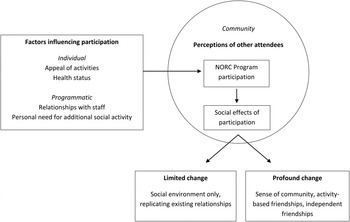
Guided by ecological systems theory, this study used in-depth interview data from older adults in NORC Program sites in the greater New York City area to explore systematically how the NORC Programs’ community activities potentially influence older adults’ social integration. Figure 1 organises the primary themes from the analysis into an integrated theoretical model. This model addresses the study's research questions regarding what older adults perceive as influencing their participation in NORC Programs’ community activities, as well as the meanings of the social contact afforded by this participation. The model identifies five factors influencing older adults’ participation in activities: personal need for additional socialisation, health status, relationships with staff, appeal of the activities and perceptions of other attendees. Perceptions of other attendees also emerged as a theme relating to the effects of programme participation, which ranged from limited meaning of contact (social environment only and replicating existing relationships) to more profound changes (greater sense of community, activity-based friendships and independent friendships). We further interpret this model according to ecological systems theory and discuss its implications for organisational practice and research in ageing.
An empirically grounded theoretical account of how Naturally Occurring Retirement Community (NORC) Supportive Service Program activities influence older adults’ social integration.

A primary finding, which is depicted in the model, is that individual factors (additional need for social activities and health status), programmatic factors (appeal of the activities and relationships with staff) and the broader community context (perception of other attendees) all influence participation in NORC Program activities. This finding is consistent with prior research on community activities (Ashida and Heaney Reference Ashida and Heaney2008; Cattan et al. Reference Cattan, Newell, Bond and White2003; Hemingway and Jack Reference Hemingway and Jack2013) and other types of services (e.g. Reid and Chappell Reference Reid and Chappell2015), which have similarly indicated the confluence of multiple factors in influencing older adults’ utilisation of community-wide supports.
Our findings go beyond simply listing these factors by suggesting ways in which they interact and cumulatively influence people's experiences of NORC Program activities. A key insight of ecological systems theory is that behaviour and development are ‘a joint function’ of both individual and environmental conditions (Bronfenbrenner Reference Bronfenbrenner, Friedman and Wachs1999). In the context of our findings, for example, health status alone – a characteristic of individuals –was found to influence NORC Program participation especially in sites where residences were more geographically diffused, as well as in cases where people experienced poor ‘fit’ between the other attendees and their preferences for social activity partners.
Another key insight from the model is the identification of diverse social effects of participation in community activities, according to older adults themselves. In each of the seven NORC Program sites, participants experienced the meaning of their contact with others in vastly different ways. Participants’ accounts of their experiences in NORC Program activities ranged from simply experiencing a social environment to creating independent and long-lasting friendships. Moreover, for some people, simply increasing social contact was a meaningful outcome from participating in NORC Program activities. This insight is congruent with prior qualitative studies, which have found increased social connection alone – regardless of other social-relational outcomes, such as new friendships – as a cited benefit of participating in formally organised community activities (Cattan et al. Reference Cattan, Newell, Bond and White2003; Hemingway and Jack Reference Hemingway and Jack2013). This finding also emphasises a key proposition of ecological systems theory: people can experience similar environments in potentially very different ways depending on their unique constellation of both person and environment factors (Bronfenbrenner Reference Bronfenbrenner1979). It also supports growing attention within social gerontology that ‘social connectedness does not mean the same thing to everyone’ (Abramson Reference Abramson2015: 14).
The model also highlights the centrality of participants’ perceptions of other programme attendees as influencing both the causes and effects of participation in group activities. Older adults who perceived programme attendees as warm, friendly and similar to themselves were especially likely to report participating in NORC Program activities, as well as deriving more profound social effects from such participation. It is beyond the scope of this analysis of in-depth interview data to assess the extent to which a resident's own perceptions of other attendees are consistent with those of others, such as staff and other residents. Nevertheless, this finding is congruent with theorising from the ecological systems perspective, which posits, ‘What matters for behavior and development is the environment as it is perceived rather than as it may exist in “objective” reality’ (Bronfenbrenner Reference Bronfenbrenner1979: 4). It also responds to calls for understanding better how people's psychological sense of community, defined as ‘an individual's sense of membership, influence, fulfillment of needs, and shared emotional connection’ (Bronfenbrenner Reference Bronfenbrenner1979: 2), influences and is influenced by community development processes more generally (Powell Reference Powell2015).
Implications for organisational practice
Our study's findings have implications for community-based organisations that offer group activities to enhance older adults’ social integration. First, the findings suggest several influences on older adults’ participation that are potentially amenable to organisational practice. For example, while limited resources might constrain an organisation's ability to offer appealing activities for all older adults, results of this study reinforce the importance of deeply understanding the needs and preferences of the local community to prioritise programme offerings. Previous studies have demonstrated the variety of ways in which NORC Programs gather data about their communities, including surveys, focus groups and key stakeholder interviews, especially at the beginning phases of programme development (Enguidanos et al. Reference Enguidanos, Pynoos, Denton, Alexman and Diepenbrock2010; Vladeck Reference Vladeck2004). More broadly, adopting continuous evaluation and monitoring reflects a larger trend within ageing and community-based service provision to use assessment data as part of a population health approach to service delivery (Vladeck et al. Reference Vladeck, Segel, Oberlink, Gursen and Rudin2010).
Moreover, the finding regarding how relationships with staff influenced older adults’ participation indicates the importance of hiring, training and supporting staff who are skilled at both delivering particular types of services (e.g. case management, wellness checks) as well as engaging older adults in the NORC Program more broadly. Retaining staff with competence in both domains is especially important in light of relatively limited budgets for NORC Programs (Greenfield et al. Reference Greenfield, Scharlach, Graham, Davitt and Lehning2012a , Reference Greenfield, Scharlach, Graham, Davitt and Lehning2012b ) and similarly sized community-based organisations.
The findings further suggest the importance of practitioners in helping individual older adults overcome environmental barriers to participation. For example, while limited budgets can preclude programmes from providing transportation to community activities (Colello Reference Colello2007), staff can consider specialised engagement strategies for older adults with limited health, helping them to activate informal networks of support to access activities (Greenfield Reference Greenfield2015). As part of one-on-one work with older adults, NORC Programs – and similar organisations – could also encourage older adults in high need to see community activities as health-promoting, similar in significance to going to the physician, akin to the idea of social prescribing (South et al. Reference South, Higgins, Woodall and White2008). At the same time, findings suggest the importance of staff's recognition of their own limitations in influencing older adults’ social relationships and honouring older adults’ choice in participation (i.e. attendance) and engagement (i.e. what they do when they attend).
Findings further suggest two specific areas for assessment to optimise the potential social-relational benefits of group activities. First, results indicate the importance of assessing a range of potential outcomes from participation in group activities, as well as older adults’ satisfaction with these outcomes. For example, some older adults might be content with merely being in the presence of others, while others might wish for relationships more intimate than they are achieving from their participation in programme activities. This approach is likely to yield a more nuanced and potentially appropriate understanding than asking about pre-determined outcomes, such as ‘friendships’ more generically. It further allows staff to honour the value of social contact as an end in itself while also engaging in practices to deepen benefits from participation in community activities.
Second, the findings indicate the importance of assessing participants’ perceptions of other programme attendees. Staff can adapt questions from existing and validated measures, such as the Psychological Sense of Community Scale, which has been designed specifically to assess people's social-psychological connection to others through specific organisations in which they participate (e.g. Jason, Stevens and Ram Reference Jason, Stevens and Ram2015). Information from such assessments can be used within tailored approaches to help individual older adults to maximise benefits from formally organised group activities. It also can be used to monitor the development of programmes and organisations at the community level – assessing a key community context that is likely to have implications for both the utilisation of group activities and the effects of such utilisation.
Implications for future research
Results from this qualitative study yield insights for future research on how community-based organisations influence older adults’ social integration. First, our empirically derived model encourages research to hypothesise and test sub-group differences in organisational effects, especially in terms of interactions across individual, programmatic and community contexts. For example, future research could specify particular statistical interactions between individual and community factors, such as having a mobility limitation (at the individual level) and being in a more geographically spread-out setting (at the community level). Future studies are also necessary to test cumulative effects across multiple barriers and facilitators to participation, based on the interpretation of our results that individual, programmatic and community contexts have interlocking effects on group activities (for additional discussion of the concept of cumulative effects, see Flouri Reference Flouri2008).
Findings further highlight the importance of assessing a range of social-relational effects from participation in group activities, which might not reflect programme effectiveness, but could instead indicate a desirable range of possibilities for programme participants. Benefits from group activities might be appropriately more modest for some older adults than for others depending on their personal goals for their social relationships (for further discussion, see Machielse Reference Machielse2015). Accordingly, it is important for studies regarding the effects of participation in group activities to consider a spectrum of potentially valued outcomes, including enhancements to one's sense of community, meeting new people at activities and re-connecting with former acquaintances.
Findings regarding the importance of perceptions of other attendees further highlight the need for future research to examine more fully the dynamic processes of social inclusion and exclusion within NORC Programs and among similar models. Consistent with our findings, a large body of research suggests that people are most likely to create friendships with people whom they perceive as similar to themselves (for a review, see McPherson, Smith-Lovin and Cook Reference McPherson, Smith-Lovin and Cook2001). Accordingly, do community activities yield more profound effects on older adults’ social-relational wellbeing in settings where residents are more homogeneous? What strategies can community-based organisations use to encourage older adults who perceive themselves as dissimilar from each other to forge meaningful relationships? Research has begun to address this latter question, specifically in the context of schools, highlighting the importance of creating low-cost environments – in which minimal levels of initiative and energy are needed for contact with dissimilar others – to help foster friendships among diverse individuals (Leszczensky and Pink Reference Leszczensky and Pink2015). Gerontologists also have identified the value of specific types of activities, such as community-based arts programmes (Moody and Phinney Reference Moody and Phinney2012) and environmental volunteering (Pillemer Reference Pillemer2009), as vehicles for strengthening connections among diverse community members – which NORC Programs and other community-based entities could strategically adopt and evaluate as part of their programme offerings.
Study limitations
Despite this study's empirically grounded model and its implications for organisational practice and research, this study has several key limitations that merit consideration when interpreting the results. First, this study was conducted in the greater New York City area – an urban setting in the north-eastern USA. The findings might not be transferable to NORC Programs and community-based organisations that offer similar programmes in different geographic contexts. For example, in our own sample, issues of access were discussed somewhat at sites where community activities were more geographically spread out; this theme would likely be more prominent with even more suburban or rural samples. As another example, the appeal of activities and personal need for additional socialisation might have emerged as especially salient within our sample given that the New York metropolitan area has relatively dense concentrations of other formal organisations that offer community programmes. Moreover, NORC Programs are largely grant-funded, typically do not charge participation fees, and are open to residents based on age and geographic residence (Vladeck Reference Vladeck2004). Therefore, costs and waiting lists might be more of a factor influencing people's participation in other programme models with different funding structures (Cattan et al. Reference Cattan, Newell, Bond and White2003; Hemingway and Jack Reference Hemingway and Jack2013).
An additional sample-related limitation is that NORC Program staff identified the participants to interview. Although efforts were made to invite a diverse group of study participants, it is likely that NORC Program staff had less access to the most socially isolated individuals or those completely uninvolved with the NORC Program (e.g. older adults with limited time to participate because of full-time employment). The results, therefore, might not adequately capture the voices of those on either end of the spectrum from social isolation to social integration and might fail to reflect an understanding of factors that influence a total lack of participation in NORC Program activities.
Furthermore, because the data collection had ended when we began this analysis, the data were limited to transcripts from the parent study. As a result, we could not pursue further data collection based upon our emerging analysis, which could have yielded more depth and nuance with respect to our study's focal themes. Similarly, our findings are based on older adults’ perspectives alone; it is important to further triangulate the findings with other sources of information, such as staff's observations. For example, older adults might be hesitant to disclose that clinical depression prevents them from socialising with others at community activities, but a staff member might have readily offered this perspective. Also, because of the study's small and purposive sampling design, we were unable to draw inferences regarding the prevalence of themes across particular sub-groups of older adults, such as by gender, race or ethnicity.
Finally, out of concern for depth over breadth alone, we substantively limited our analyses, focusing specifically on social integration with other older adults. Additional research is necessary to address the other types of relationships that NORC Programs potentially influence (e.g. intergenerational or staff relationships), as well as other aspects of peer relationships (for an example, see Greenfield Reference Greenfield2015).
Conclusion
In summary, this qualitative study supports the idea that formal organisations can influence social integration in later life; however, it indicates several sources of complexity in these processes of influence. First, findings indicate how pathways to participation are multi-determined beyond programme characteristics alone, and second, results demonstrate how social-relational outcomes from participation range from limited to profound changes. Taken as a whole, these results suggest the importance of considering diverse contexts when planning, implementing and evaluating activities-based approaches to promote social integration in later life, as well as exploring a broad continuum of meanings that can be derived from participating in such activities. More broadly, our study demonstrates the value of drawing on key insights from ecological systems theory to conceptualise, design and measure the effectiveness of group activities offered through community-based organisations, and thereby strengthen the promise of societal responses to support robust social networks throughout the entirety of lives.
Acknowledgements
This study was supported by a grant from the Hartford Faculty Scholars in Geriatric Social Work Program and a fellowship from the Zúñiga y Rivero Foundation. This research was approved by the Institutional Review Boards at Rutgers, The State University of New Jersey, and at the University of Houston.