1 Introduction
Accounting for the emergence and the historical stability of words such as gold, bind, mount, fault, ounce or false, this article addresses the general problem of how and why individual languages adopt and retain phonological structures that (a) appear to be generally rare and (b) appear to be so for intuitively plausible reasons involving, for example, phonetic difficulty. The words mentioned above represent the problem in that their rhymes consist of long vowels or diphthongs followed by sonorant–obstruent clusters, which represent a subset of VVCC rhymes. VVCC rhymes occur only in a minority of the world's languages, and it is widely assumed that their rarity is due to perceptual difficulties. Nevertheless, English has them, and this calls for a special explanation.
This study focuses on words with VV–sonorant–obstruent rhymesFootnote 2 attested in present-day English Received Pronunciation (RP),Footnote 3 and approaches the question of why they exist from a diachronic perspective. Our approach reflects an understanding of languages as inherently historical – or evolutionary – systems of mentally instantiated constituents (in our case specific rhyme patterns), which ‘exist in a language’ when they are shared by a minimal number of speakers. Since being shared implies having been transmitted, the existence of linguistic constituents depends on their being expressed faithfully and frequently enough in linguistic discourse to be successfully recognised and acquired. In that sense, we regard constraints on articulation and perception, as well as constraints on learnability and cognitive processing as amounting, in their combination, to constraints on the transmission of linguistic constituents.
Distinguishing between rhyme patterns as mental constituents of phonological knowledge on the one hand, and their phonetic expressions in discourse on the other, naturally implies a multilayered architecture of phonology, and within such a multilayered system we take the words we deal with, i.e. words such as gold, bind, mount, fault, ounce or false, to be represented with VVCC rhymes at the deepest lexical level, i.e. at a level that would be taken to host underlying representations in Lexical Phonology (Kiparsky Reference Kiparsky1982a, Reference Kiparsky and Lee1982b) or lexical inputs in Optimality Theory (see Prince & Smolensky Reference Prince and Smolensky2002). Thus, the questions that our article addresses are the questions of when, how and why VVCC rhymes emerged in the mental lexica of speakers of English, and how and why they have been successfully transmitted since.
Our own theoretical roots are in Natural Phonology (see e.g. Stampe Reference Stampe1979; Dressler Reference Dressler1985, Reference Dressler, Hurch and Rhodes1996; Dziubalska-Kołaczyk Reference Dziubalska-Kołaczyk2009) on the one hand, and in Evolutionary Phonology (see e.g. Blevins Reference Blevins2004; Ritt Reference Ritt2004) on the other. That is to say, we think of phonological knowledge, or competence, as reflecting ‘grammar-external’ constraints on speaker physiology and psychology, just as Natural Phonologists do, but at the same time we regard the historicity of language as its most fundamental property and therefore think of external constraints on phonological constituents ultimately as constraints on their transmission, or replication. Nevertheless, we shall make repeated reference in this article to concepts and arguments developed in other schools of phonological thought, such as Optimality Theory or CV Phonology, to the extent they are relevant to the questions we address.
In the following sections of this article, we first identify and discuss the reasons why VVCC rhymes are typologically rare. Next we turn our attention to words attested in Present-day English Received Pronunciation with VV–sonorant–obstruent rhymes, and sketch the historical sequence in which they emerged. We do this (a) on the basis of their first attestations in the Oxford English Dictionary and (b) by taking the historical development of their segmental constituents into account.
We then discuss the hypothesis that VVCC rhymes have come to be established in lexical phonotactics because morphological processes created word forms of the same structure. This started to be the case when, after Middle English schwa loss, past tense and participle forms like [mɔ:nd] moan+ed or [faɪld] fail+ed, and present tense forms and noun plurals like [saɪlz] sail+s or [bɔ:nz] bone+s emerged.
Although we show that lexical VV/(n|l)d/ rhymes (as in [tʃi:ld] child or [hu:nd] hound) may indeed have been stabilised by the frequent occurrence of morphologically produced counterparts, we argue against the more general hypothesis that segment sequences will get licensed in lexical phonotactics when they are frequently produced morphologically. Instead, we follow a proposal by Dressler & Dziubalska-Kołaczyk (Reference Dressler and Dziubalska-Kołaczyk2006), elaborated in Dressler, Dziubalska-Kołaczyk & Pestal (Reference Dressler, Dziubalska-Kołaczyk and Pestal2010), who point out that languages normally tend to avoid homophonies between phonological structures that occur within simple morphemes and phonological structures that are produced through morphological operations such as concatenation (We henceforth refer to the former as ‘lexical’ and to the latter as ‘morphotactic’.)
Therefore, we suggest that the rising frequency of morphotactically motivated VVC+/(z|d)/ words first merely increased the expectability of the relevant rhyme structures, and made them both easier to recognise and indicative of morphological complexity. Unavoidably, however, this also facilitated the perception of homophonous sequences that were not morphological in origin but reflected different processes. In English, this applied to the outputs of vowel lengthening before homorganic clusters like [nd] or [ld] (as in bind or child). Being successfully perceived and phonologically parsed as VV/(n|l)d/ rhymes while being unamenable to morphological analysis, these were then interpreted as lexically underlying. Although the resulting homophony between lexical and morphotactic VV/(n|l)d/ rhymes was semiotically suboptimal, competing variants that would have done better in that respect were not (and, as we argue below, could not be) produced by morphological or phonological changes. Thus, the establishment of VV/(n|l)d/ rhymes in English phonotactics became the frozen result of very specific historical circumstances.
We also suggest that a distinction needs to be made between VV/(n|l)d/ rhymes on the one hand, and all other extant VV[sonorant][coronal] rhymes on the other. It was only after the former were established in lexical phonotactics, that an ‘accidental gap’ in the phonotactic system was created, which subsequently came to be filled by words with rhymes like VV/nt/ (as in mount), VV/lt/ (as in halt), or even VV/ns/ (as in ounce) and VV/ls/ (as in false). VV/(n|l)d/ rhymes being already established, the new structures could be accommodated in lexical phonotactics because they were (a) perceptually less problematic and (b) morphotactically unambiguous.
2 Outlining our hypotheses
2.1 What it is that makes VVCC rhymes unlikely
Why exactly are lexical VVCC rhymes unexpected? First, the number of languages whose lexical phonotactics allow them is indeed small: according to the World Atlas of Language Structures (WALS; Maddieson Reference Maddieson, Dryer and Haspelmath2013), 61 of 484 (i.e. 13%) documented languages do not admit consonantal codas at all, while in 274 (57%) languages codas with at most a single consonant may occur. Only 151 (31%) languages allow complex syllables, whose codas may contain more than one consonant. However, WALS counts also those syllable structures that are brought about through morphological operations, as in English ‘strengths, when pronounced /stɹɛŋkθs/’ (Maddieson Reference Maddieson, Dryer and Haspelmath2013). Since morpheme-internal phonotactics are more restrictive than the phonotactics of wider phonological domains, this means that the proportion of languages that admit complex codas in lexical morphemes must be considerably lower than the 30 per cent mentioned in WALS. Thus, their rarity can count as safely established (see also Jakobson Reference Jakobson1962: 526; Clements & Keyser Reference Clements and Keyser1983: 29, 133). However, it is not only the case that complex codas are rare as such, they are even rarer after long vowels or diphthongs, which are in turn rarer than short vowels.Footnote 4 This implies that languages like English, which allow lexical entries like gold or false, are few and far between. Why is this so?
In theories such as CV phonology (Clements & Keyser Reference Clements and Keyser1983), Government Phonology (Kaye, Lowenstamm & Vergnaud Reference Kaye, Lowenstamm and Vergnaud1990), or Strict CV Phonology (e.g. Scheer Reference Scheer2004), the unexpectedness of any sequence other than CV follows from assumptions about the organisation of phonological competence. While this is not the place for reviewing the proposals in any detail, it seems that their models, in many of which any patterns attested in the surface structures of word forms are invariably derived from underlying CV sequences, express adequate and powerful generalisations about sound patterns attested in natural languages, and this might suggest that a preference for such structures is entrenched in the human language faculty. Similarly, Optimality Theory (Prince & Smolensky Reference Prince and Smolensky2002) quite explicitly assumes innate constraints that in their combination select against any other sequence than CV. Examples are *NOCODA (selecting against CVC sequences), *NOLONGVOWELS (selecting against VV sequences), *NOCOMPLEXCODA (selecting against CC codas), or *SUPERHEAVY (selecting against rhymes containing more than two elements).
However, while it can certainly not be ruled out that the human mind has evolved a bias against complex rhyme sequences, and that models of phonological competence should therefore incorporate it, it is also possible to explain their rarity without making such a strong and specific assumption. It is sufficient, in our view, to take into account that, like any phonological constituent, also rhyme structures need to be transmitted in order to become firmly established in a language.
In order to be transmitted, phonotactic structures need to be articulated, produce acoustic signals and then be inferred from the auditory cues that those signals contain. As is widely known, the acoustic expressions of consonants are perceived most easily against a vocalic background (see e.g. Wright Reference Wright, Hayes, Kirchner and Steriade2004: 43–6). Furthermore, the specific acoustic cues from which the specific types of articulatory constriction involved in the expression of consonantal segments can be inferred are perceived most strongly in the signals that are created when consonantal constriction is released (ibid.), so that prevocalic consonants are recognised more easily while ‘word final and preconsonantal consonants are . . . poorer vis-à-vis the cues for auditory perception’ (49). Taken together, this means (a) that sequences in which vowels and consonants alternate strictly will be transmitted more reliably than other sequences, and (b) that sequences in which consonants precede vowels will be transmitted more reliably than sequences in which they follow them. In their combination these constraints represent a strong selection bias against sequences that end in consonantal clusters (see also Vennemann Reference Vennemann1988).
As far as the rarity of long vowels is concerned, it seems to be established that not all languages make a phonological distinction on the basis of length contrasts, and where there is no such distinction there cannot be a class of phonologically long vowels either – although this does not necessarily imply anything about the duration of their phonetic expressions, of course. So, what actually needs to be explained is the rarity of phonological long–short distinctions, and this is fairly easy to understand: the transmission of distinctive length contrasts requires their expression in terms of durational differences. Since duration is a scalar property and usually also influenced by factors such as speech tempo, rhythm and context, categorical distinctions based on phonological length are difficult to recover from durational cues in the speech signal, and this explains why length-based distinctions between vowels cannot be found in all languages.
More important for our purposes, however, is the fact that even in languages which do distinguish between short and long (or diphthongal) vowels, long vowels and diphthongs rarely occur before complex codas. Plausible reasons for this are again based on both articulation and perception. Thus, the effort involved in the production of two consonants may reduce the energy available for the articulation of the preceding vowel gesture, and vice versa: it is well documented that the duration of syllabic sequences does not rise in proportion to the number of segments it contains, but that the more segments there are, the smaller will the amount of time allocated to the pronunciation of each single one of them be (see e.g. Fowler Reference Fowler, Heuer and Keele1996: 542; Lyberg et al. Reference Lyberg, Holmgren and Lindblom1981). At the same time, the duration of a vocalic signal may also be perceived as relatively short in the immediate context of a relatively long consonantal stretch, and vice versa. Context-induced contrast effects on perceived size and/or intensity have been known since the days of John Locke (Reference Lock1690). Together, these factors may explain why consonant clusters are transmitted less well after long vowels or diphthongs than after short vowels, and, conversely, why long vowels are transmitted better when they are followed by just a single, short consonant.
In short, there are good articulatory and perceptual reasons why monomorphemic words whose lexical representations end in VVCC are comparably difficult to transmit among speakers and are therefore rare in the world's languages. Whether, like Blevins (Reference Blevins2004), one is satisfied with historical (or cultural-evolutionary) explanations like the ones just given, or whether one prefers to assume that human genomes have internalised, in the evolution of the species, corresponding cognitive biases (as held in generative theories, such as Optimality Theory, strict CV Phonology, etc.), is very much a matter of speculation, given how little we actually know about the human brain and its genetic basis. What matters, however, is that for ultimately physiological and physical reasons, words ending in VVCC are difficult to transmit and have, therefore, established themselves in very few actual languages. Thus, the existence of words such as gold, halt, blind, mount or false is indeed remarkable, and implies that the constraints otherwise selecting against them must be outweighed by other factors.
2.2 Morphology as a source of phonologically unexpected patterns: a good idea and a caveat
Apart from the remarkable fact that they exist at all, another striking fact about the lexical VVCC rhymes in Present-day English is that they all end in coronal obstruents. As has been long and widely known (for a good survey see Paradis & Prunet Reference Paradis and Prunet1991, and the references therein), coronals seem to be special among consonants in a number of respects. For instance, they appear to be more frequent than other consonants, in any series their existence in a language is implied by the existence of non-coronal counterparts (e.g. /k/ or /p/ imply /t/, /m/ or /ŋ/ imply /n/, /f/ or /x/ imply /s/, etc.), and their phonotactic distribution within languages is typically less constrained than that of other consonants. In theories that employ such terms, coronals are regarded as ‘unmarked’, or comparably little ‘dispreferred’.Footnote 5 Against this background, it may therefore not be surprising that the only consonants attested in English lexical VVCC rhymes are indeed coronal ones.
However, although VVCC rhymes ending in coronal clusters may be less surprising than VVCC rhymes ending in other clusters, the fact that the rhymes attested in English do happen to end in coronals does not in itself explain their existence. VVCC rhymes are still difficult to transmit, and the fact that the selection bias against coronal clusters seems to be comparably weak does not turn it into a positive bias, merely into a less negative one.
Trying to account for their existence, we therefore turn to another conspicuous quality of the rhymes in question, namely to the fact that they are not merely coronal but share that property with rhymes that get produced through regular morphological operations, namely in (a) verbal past tense forms such as fail+ed, reel+ed, cool+ed, moan+ed, sign+ed or feign+ed, (b) verbal third-person present forms such as fail+s, reel+s, cool+s, moan+s, sign+s or feign+s and (c) noun plurals such as sail+s, fool+s, wheel+s, loan+s, mine+s or crown+s.
This correlation has often been noticed (e.g. Hall Reference Hall2000) and has inspired hypotheses about a causal connection. Thus, Hogg & McCully (Reference Hogg and McCully1987: 47) speculate:
One interesting question . . . is why only [+coronal] obstruents are permitted to appear in the R4 [Footnote 6 ] position. In earlier stages of English the final obstruents in words such as climb were indeed pronounced and their loss is to be dated round about the time of Chaucer. Examples such as Scottish chiel ‘lad’ perhaps suggest that dentals could be lost as well as labials and velars.[Footnote 7 ] Consider in this respect, therefore, inflected forms in Modern English such as weaned. One of the oddities of English since around the time of Chaucer is that inflectional endings, if they do not contain a single syllable, as in the case of -ing, always contain (underlyingly) a single [+coronal] obstruent. It may be, therefore, that the type of syllable structure found in a word such as wind /waind/ has been protected through analogy with inflected forms such as weaned.
While Hogg & McCully's suggestion fits the example they give, they wisely refrain from proposing the generalised rule their discussion implies. And indeed, a proposition such as ‘Lexical VVCC rhymes will (or even only: can) be historically stable if there exist morphologically produced analogues’ does not seem to hold. First of all, the set of VVCC rhymes produced morphologically is not fully identical to the set of lexical ones. Thus, VV/nz/ (as in moan+s) and VV/lz/ (as in sail+s) are produced morphologically but never occur morpheme finally, while VV/nt/ (as in mount), VV/ns/ (as in ounce), VV/lt/ (as in fault) and VV/ls/ (as in false) are possible at the end of lexical morphemes, but are never produced by regular morphological operations.Footnote 8
Furthermore, there are many VVCC rhymes that are produced morphologically but nevertheless fail to occur within simple word forms. In the domain of {/z/}Footnote 9 and {/d/} suffixation they represent a clear majority. In fact, the rules produce only seven types of VVCC rhymes with lexical counterparts, namely
-
(1) VVf(+)t craft – laugh+ed
VVk(+)s coax – peak+s
VVl(+)d bold – bail+ed
VVn(+)d wind – sign+ed
VVp(+)s corpse – rope+s
VVr(+)d beard – fear+ed
VVs(+)t moist – race+d
and nineteen without (practically) any, namely
-
(2) VVb+d robe+d
VVb+z robe+s
VVd+z seed+s Footnote 10
VVð+d mouthe+d
VVð+z loathe+s
VVf+s laugh+s
VVg+d intrigue+d
VVg+z league+s
VVk+t peek+ed Footnote 11
VVl+z goal+s
VVm+d seem+ed
VVm+z stream+s
VVn+z bone+s
VVp+t seep+ed
VVt+s goat+s Footnote 12
VVθ+s bath+s
VVv+d bereave+ed
VVv+z leave+s
Therefore, the prediction that phonotactic sequences produced through morphological operations will come to be licensed in lexical phonotactics is not borne out.
In fact, the existence of phonotactic sequences arising in speech through morphological processes can even be expected to disfavour, rather than support, the establishment of corresponding lexical structures. This hypothesis represents the core of the ‘morphonotactic’ research programme proposed by Dressler & Dziubalska-Kołaczyk (Reference Dressler and Dziubalska-Kołaczyk2006) and elaborated in Dressler et al. (Reference Dressler, Dziubalska-Kołaczyk and Pestal2010) or (Zydorowicz Reference Zydorowicz2007). They assume that the relationship between the phoneme sequences that a language allows lexically, and the ones that it produces through morphological operations is systematic and functional, and governed by domain-specific dynamics.
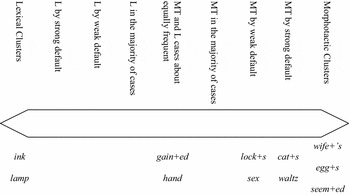
Focusing on consonant clusters, Dressler & Dziubalska-Kołaczyk (Reference Dressler and Dziubalska-Kołaczyk2006) observe that some of them occur exclusively in lexical roots, others occur exclusively across morpheme boundaries, and still others occur in both contexts. Clusters of the third type, which occur both within roots and across morpheme boundaries can be ordered on a scale according to the relative frequency of their lexical and morphotactic occurrences. Some clusters are lexical by strong default, others morphotactic by weak default, still others frequent both morpheme finally and across boundaries, and so on. Figure 1 illustrates the idea with final two-consonant clusters from Present-day English.Footnote 13
The morph(on)otactic cluster scale

As Dressler & Dziubalska-Kołaczyk argue, some predictions can be derived a priori about the distribution of clusters on the scale in figure 1. Thus, physiologically grounded biases against the transmission of specific phonotactic sequences should affect monomorphemic configurations more strongly than morphotactic ones. Compare, for example, the lexical cluster /nd/ in land to its morphotactic homophone in gain+ed: whenever land gets produced, its final [d] is invariably preceded by the homorganic nasal [n]. Since the contrast between [n] and [d] is small each of the two segments makes the other relatively difficult to perceive.Footnote 14 Therefore, morpheme-final clusters can be predicted to be relatively unstable, and the historical fate of /mb/ in climb, or /ng/ in sing appears to reflect this. In the past tense form gain+ed, on the other hand, the situation is different: here, the /n/ and the /d/ that make up the final /nd/ cluster do not occur exclusively in each other's company. Instead, uses of gain will see the final /n/ in a variety of different contexts, and many of them will be more favourable to its clear perception. Also the /d/ in the past tense morph will often occur after segments with which it contrasts much better than with the /n/ of gain. Thus, the /n/ will remain stably represented in lexical gain and the /d/ will remain stably associated with the past tense morpheme. Being transmitted independently of each other, and being each associated with their own content, the constituents of morphotactic clusters should be less strongly affected by articulatory and perceptual constraints than their lexical counterparts. Therefore, the inventory of morphotactically produced clusters can be expected to include some that do not occur lexically.
At least for languages where the inventory of inflectional and derivational affixes is highly restricted, another prediction can be made (see Jakobson Reference Jakobson1962). In such languages, lexical cluster types can be expected to be more numerous and more diverse than morphotactic ones. In English, for example, the inventory of purely consonantal inflectional and derivational suffixes includes only {[s], [z]}, {[d], [t]} and {θ}.Footnote 15 Thus, no morphological operations produce clusters ending in [p] [b], [m], [k], [g], [ŋ], [tʃ], [dʒ], etc., while such clusters occur quite frequently at the end of simple morphemes, as in limp, bulb, elm, sink, ring, finch or singe, for example. This means that such languages, if they admit clusters at all, are likely to include some that are exclusively phonotactic.
Together the two predictions imply a tendency for lexical and morphotactic consonant clusters to distribute complementarily, and Dressler & Dziubalska-Kołaczyk point out that this tendency lends itself to being utilised for semiotic purposes. According to them, ‘prototypical morphonotactic clusters . . . have the function of co-signalling the existence of a morphological rule’ (Reference Dressler and Dziubalska-Kołaczyk2006: 83). They conclude that the ability of morphotactic clusters to invite morphological decomposition may be an additional motivation for their stability, and hypothesise that the natural likelihood of phonotactic and morphotactic clusters to distribute complementarily is likely to be further enhanced.
Morphotactic clusters with frequent phonotactic homophones, however, ‘are hardly apt to co-signal the application of morphological rules (MRs) and . . . may be liable to lose their internal morpheme boundaries in diachronic development’ (Reference Dressler and Dziubalska-Kołaczyk2006: 72. Furthermore, clusters which are produced morphologically cause listeners to analyse them as compositional even when they are in fact lexical. This has been demonstrated in experiments by Post et al. (Reference Post, Marslen-Wilson, Randall and Tyler2008), which confirmed that
any incoming string that shows the critical diagnostic properties of an inflected form – a final coronal consonant (/t/, /d/, /s/, /z/) that agrees in voicing with the preceding segment as in filled, mild, or nilled [Footnote 16 ] – will automatically trigger an attempt at segmentation, [and showed that] any stimulus that can be interpreted as ending in a regular inflection . . . is responded to more slowly than an unambiguously monomorphemic stimulus. (Post et al. Reference Post, Marslen-Wilson, Randall and Tyler2008: 1)
In other words, there are good functional reasons for keeping morphotactic and lexical clusters apart, and they are in clear conflict with Hogg & McCully's hypothesis that the frequency of morphotactic VV/(n|l)[+coronal]/ clusters supported the emergence of lexical homophones in English. Rather than mutually stabilising each other, Dressler & Dziubalska-Kołaczyk would seem to argue, the lexical rhymes and their morphotactic counterparts would have made it difficult for each other to be inferred from speech data, and should not stably coexist in grammars.
2.3 A slightly more complex proposal
As we shall show, there is a way in which both Hogg & McCully's intuition and Dressler & Dziubalska-Kołaczyk's observations are helpful for understanding the way by which VVC[+coronal] rhymes in the lexical phonotactics of English came about. However, the mechanics by which morphologically produced VVC[+coronal] rhymes came to facilitate the establishment of corresponding forms in the lexicon were less than straightforward and can certainly not be simply understood as the ‘lexicalisation’ of structures that were frequent on the surface.
Instead, the frequency of morphotactic VVC[+coronal] rhymes first merely made such sequences more ‘expectable’ in the surface realisations of phonological words, and this helped their constituent segments to be perceived and recognised more readily. Crucially, however, the establishment of morphologically created VVC[+coronal] rhymes in phonological words would have increased the perceptibility of all word final VVC[+coronal] sequences – even when they did not, actually, involve inflectional suffixes. In English, such non-inflectional [VVC][+coronal] sequences happened to be produced (a) in the nouns ME freend ‘friend’ (< OE freond) and ME feend ‘fiend’ (< OE feond), which in Old English were still relatableFootnote 17 to the verbs freogan, ‘to love’ and feogan ‘to hate’ and (b) through the lengthening of short vowels before homorganic clusters such as /nd/ or /ld/ (as in [huːnd] from lexical /hund/ ‘hound’, [tʃiːld] from lexical /tʃild/ ‘child’).Footnote 18 Being easily perceived and phonologically parsed as ending in VVC[coronal] rhymes while not being analysable as inflected word forms, such word forms were then interpreted as faithful reflections of lexically underlying structures.
While the morphotactic ambiguity that was thereby created among surface word forms would unavoidably have posed processing difficulties of the type detected by Post et al., none of the potential variants of the new VV/(n|l)d/ words that phonological or morphological changes could plausibly have produced would have done much better in this regard (see section 4.2 for a more detailed discussion). Therefore, the transmission of VV/nd/ words could not easily be avoided.
Thus, we show that Hogg & McCully's proposal is ultimately plausible, and that the stability of lexical VV/(n|l)d/ rhymes was indeed due to the existence of morphotactic patterns of the same shape, even though the resulting ambiguity may indeed have been communicatively suboptimal, as Dressler & Dziubalska-Kołaczyk argue with equal justification. However, it was only in combination with other factors and in specific historical circumstances that the establishment of {/d/} and {/z/} as regular inflectional suffixes came to support and stabilise the existence of [VVC][coronal] rhymes in the English lexicon.
Apart from explaining the establishment of VVC[coronal] rhymes in the English lexicon, we also show that it proceeded in distinct phases involving different subtypes. The first lexically attested VVCC rhymes were VV/nd/ and VV/ld/,Footnote 19 and it was their emergence that came about in the way just sketched. In a second phase, i.e. after VV/nd/ and VV/ld/ rhymes were lexically established, words came to be integrated in the lexical phonotactic system which ended in VV/nt/, VV/ns/, VV/lt/, and VV/ls/. We suggest that this was likely to happen, because the existence of VV/nd/ and VV/ld/ words had prepared the phonotactic system for accommodating them. Compared to VV/ld/ and VV/nd/, they were perceptually easier and morphotactically less ambiguous. Thus, when VVCC rhymes that ended in sonorants followed by voiced coronal obstruents had established themselves in the lexicon, the absence of counterparts with voiceless final obstruents came to represent an ‘accidental’ gap in the lexical phonotactics of English (see Hayes & White Reference Hayes and White2013), but no longer reflected a conventionalised, categorical constraint against them. When the occasion arose, the accidental gap was filled, and words such as constraint, default, announce, or false became current, and finally also words established themselves in which long vowels or diphthongs were followed by [sononant]/(t)ʃ/ or [sonorant]/(d)ʒ/ clusters, such as range, strange, staunch or launch.
Indicatively, and very much in line with Dressler & Dziubalska-Kołaczyk's predictions, these later arrivals were not only phonologically more preferred than the VV/nd/ and VV/ld/ types that had paved their way, but they were also morphotactically unambiguous: no productive morphological rule produced VV/n+t/, VV/n+s/, VV/l+s/, VV/n+ʃ/, or VV/n+ʒ/. At the same time, VV/nz/ and VV/lz/ rhymes – which were of course frequently produced morphologically – failed to establish themselves in the lexicon.
3 Reconstructing the emergence of VVCC rhymes in the English lexicon
3.1 Collection and classification
In terms of data, our article rests on a relatively coarse-grained survey of the periods in which Modern English words ending in bimoraic vocalic nuclei (VV) followed by sonorant–obstruent clusters were first attested.Footnote 20 We excluded clusters containing /r/ as a sonorant, because (a) we took Present-day English Received Pronunciation as our starting point, where /r/ has been fully vocalised or lost before obstruents, and because (b) in the varieties where pre-consonantal /r/ still exists it is realised as a highly vocalic allophone and additionally has a length neutralising effect on preceding nuclei (Labov, Ash & Boberg Reference Labov, Ash and Boberg2006: 14–15), so that the rhymes involving it do not unambiguously constitute VVCC rhymes anymore. As far as final obstruents are concerned we focussed on /t/-/d/ and /s/-/z/, because clusters built with the voiced members of the pairs (i.e. /n+d/, /n+z/, /l+d/ and /l+z/) are also produced by suffixation, while clusters ending in voiceless /t/ and /s/ (i.e. /nt/, /ns/, /lt/ and /ls/) are not. Of these eight clusters /nz/ and /lz/ are lexically unattested,Footnote 21 and as we shall see (section 4.3) this is indicative. We were therefore left with six rhyme types, namely VV/nd/, VV/nt/, VV/ld/, VV/lt/, VV/ns/ and VV/ls/.Footnote 22 The sample of actual words was derived from the latest Longman Pronunciation Dictionary (Wells Reference Wells2008), because it comes, conveniently, with a phonetically searchable CD.
We found a total of 621 items, which included both rather common words (such as ground, wound, kind, command, plant, aunt, faint, pint, mild, hold, field, bald, salt, malt or false) and a substantial number of more peripheral items, such as hind ‘female deer’, purblind, wont ‘be likely to do something’, catamount ‘panther’, cuckold, mangold, cobalt and waltz.Footnote 23
In a next step, we attempted to determine when the words emerged in the English lexicon. For that, we relied on the first-attestation dates given in the online OED. We were of course perfectly aware that this would give us only a terminus post-quem, and no more than a rough estimate, but there simply is no way of estimating the age of an English word that provides a better balance of accuracy and efficiency.
One issue that we did have to deal with, however, was that the OED does not commit itself on the phonological shapes which words had at specific dates, although it is of course explicit about attested spelling variants. In our case, the problem was particularly relevant for words ending in /nd/ and /ld/, because although many of them are of common Germanic origin, they acquired their VVCC rhymes only through a sound change known as Homorganic Lengthening. Examples are bind, ground, cold, field, but also comb and others. The sound change lengthened short vowels before clusters of sonorants and voiced obstruents with identical or at least very similar places of articulation. Homorganic Lengthening represents one of the least well understood sound changes in the history of English, and its dating is insecure. Although the changes have been known since the early days of historical English phonology (see e.g. Luick Reference Luick1914–21) and repeatedly investigated (e.g. Minkova & Stockwell Reference Minkova, Stockwell, Rissanen, Ihalainen, Nevalainen and Taavitsainen1992; Ritt Reference Ritt1994; Fulk Reference Fulk, Carr, Harbert and Zhang1998; Weɫna Reference Weɫna, Fisiak and Krygier1998, Reference Weɫna, Taavitsainen, Nevalainen, Pahta and Rissanen2000; Minkova Reference Minkova2014), all that can count as safely established is that they were never implemented as categorical Neogrammarian sound changes. Instead, they seem to have led to sporadic, item-based replacements of underlying vowels (thus the verb wind came to have a lexically long vowel, while the noun wind kept its short one). The earliest unambiguous evidence of Homorganic Lengthening is from the Ormulum (twelfth century) (Anderson & Britton Reference Anderson, Britton and Fisiak1997 and Reference Anderson and Britton1999), but it is hard to say which stage in the change it reflects.Footnote 24 Having to make an assumption for the period during which lengthened vowels were established in the lexical representations of the words that eventually kept them, we settled for the thirteenth century.
Another sound change by which words came to assume VVCC structures although they had not had them earlier reflected a breaking process. The change diphthongised back vowels before word-final or pre-consonantal /l/ in words such as hall > haul, fals > fauls, bolt > b[ou]lt or folk > f[ou]lk.Footnote 25 Although the diphthongs did not always remain stable, the bimoraic nature of the nuclei did (and before coronals, the /l/ remained stable as well). Compared to Homorganic Lengthening, the sound change is dated fairly uncontroversially in the fifteenth century (Jones Reference Jones1989; Brunner Reference Brunner1960; Luick Reference Luick1914–21; Flasdieck Reference Flasdieck1954), and that is when we shall take words such as salt, false or bolt to have assumed VVCC structures.
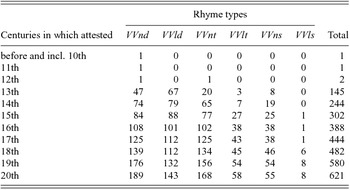
On the basis of these decisions we adjusted the first-attestation dates given in the OED. Table 1 below lists the result of our survey. As each of the columns is read downwards, the number of words with the relevant rhyme types increases, because words first attested in each century are added to the previously existing ones.
Emergence of lexical VV/(n|l)d/, VV/(n|l)t/, and VV/(n|l)s/ rhymes: lexical types per century

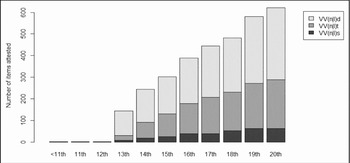
Table 1 shows that words with VVCC rhymes did not emerge in significant numbers before the thirteenth century, but have become continually more frequent since. It also suggests that words ending in the voiced obstruent /d/ emerged earlier and have remained more numerous than words ending in /t/ or /s/. This comes across more clearly in figure 2.
Emergence of lexical VV/(n|l)d/, VV/(n|l)t/, and VV/(n|l)s/ rhymes: bar chart
The respective trajectories of frequencies show a highly significant increase (Pearson's product–moment correlation, pd = 9.81 · 10− 8, pt = 4.89 · 10− 8 and ps = 6.19 · 10− 8). In each of the three cases the effect is large with R = 0.98.

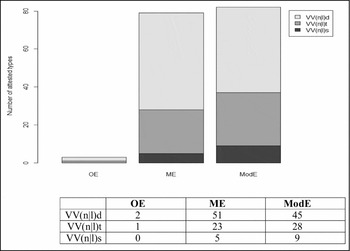
Suggestive as these numbers appear at first sight, however, their significance needs to be ascertained for two reasons. First, when one starts with a complete set of words attested in a language at a particular stage and moves into the past in incremental steps to check how many of them were already there at each prior stage, it is to be expected that one will find fewer and fewer of them the further into the past one moves. This follows from the default assumptions that (a) no word has been around forever, and that (b) the range of word ages represented in any sample can be large. Thus, in order to make sure that the picture in figure 2 reflects a set-specific increase in the number of VVCC words rather than the expected base-line pattern, we carried out a search of the corresponding forms in three subsections of the Helsinki Corpus of English Texts, namely sections O4 (1050–1150), M4 (1420–1500) and E3 (1640–1710). Figure 3 shows the results for attested types.
Type frequencies of VV/(n|l)d/, VV/(n|l)t/, and VV/(n|l)s/ rhymes in Helsinki Corpus periods O4, M4 and E3
The number of attested types in the ME period is significantly larger than the type frequency in OE at a 5% significance level in each of the three cases (chi-squared goodness-of-fit for equal distribution, χ2 s = 5, χ2 t = 20.17, χ2 d = 45.3; ps = 0.02, pt = 7.10 · 10− 6, pd = 1.69 · 10− 11). The respective effects are large (Cohen's w, ws = 1, wt = wd = 0.92). Note that in the case of VV/(n|l)s/ rhymes the sample size is small.

The picture derived from the corpus data corresponds very well indeed to the impression gained on the basis of the dictionary data: apart from showing a sudden and significant increase during the Middle English period, the corpus data indicate that VV/nd/ words seem to have established themselves sooner and more firmly than VV/nt/ and VV/ns/ items respectively.
Of course, the corpus data may include items that have not survived into present-day varieties of English, and it deserves to be acknowledged at this point that the perspective we take in this article makes us blind to such items. At the same time, we do not think that this is problematic, since the question we address is when, how and why specific types of rhymes came to be established in the lexical phonotactics of English. For this purpose it is sufficient that the corpus data yield the same general pattern as the backward-looking search for first attestations, because it tells us that the increase in the number of VVCC items that we ‘see’ when ‘looking backwards’ reflects a real increase rather than the continuous replacement of old VVCC items by new ones.
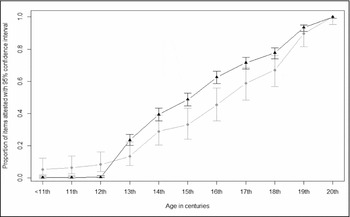
Even though the corpus data replicated the pattern derived from the backward-looking search, however, we performed another check on it. In particular, we wanted to make sure that the noticeable sharp increase in the frequency of VVCC types in the Middle English period does not simply reflect the well-known fact that the whole vocabulary of English was significantly expanded by the influx of Romance loan words in the wake of the Norman Conquest. Therefore, we performed an age check like the one performed on Present-day English VVCC rhymes on a random control sample of 100 words,Footnote 26 and compared the resulting pattern to the age profile of the former. Once again, we took the results, which are reproduced in figure 4, to be reassuring.
Age profiles of VVCC items (black triangles) and a random set of PDE words (grey circles) together with 95 per cent confidence intervals for the estimated proportions
In pairwise comparisons, non-overlapping confidence intervals imply a significant difference between the two proportions (based on a chi-squared test for independence).

As figure 4 shows quite clearly, the increase in the frequency of VVCC items during the thirteenth century was markedly sharper than the increase in the control sample. Also, their practical non-existence in Old English seems to mark VVCC items as special. Thus, both the corpus-derived figures and the control sample suggest that the age profile of VVCC words attested in Present-day English represents a solid basis for further interpretation.
4 Interpretation: phases in the evolution of lexical VVCC rhymes
4.1 Phase 1: Old English
In the Old English lexicon words ending in VVCC were almost non-existent. There were, however, notable exceptions, namely the Old English ancestors of ModE fiend and friend, i.e. fēond ‘enemy’ and frēond, respectively.Footnote 27 Although not really representative of our sample, they are highly interesting, since they illustrate one plausible mechanism by which morphological processes may come to expand the range of lexically admissible phonotactic structures, namely lexicalisation. Originally, OE fēond and frēond were transparently related to the verbs fēogean ‘to hate’ and frēogean, ‘to love’. Whether they represented nominalised participles as suggested in the OED (see s.v. friend and fiend) or whether the two -nd- stem nouns had another source is an open question but does not affect the fact that in Old English the nouns and the verbs would still have been relatable to each other both semantically and phonotactically. Nevertheless, both because of their frequency and their increasing semantic autonomy the nouns would probably have been memorised as lexical chunks, and as they gradually lost the last traces of their compositionality, they would have contributed to establishing the VVCC patterns in the English lexicon.
Of course, only fiend has stably maintained the relevant structure over the centuries, while friend, which has come to be much more frequent,Footnote 28 has been replaced by a variant with a short vowel. Spelling evidence (such as ME fend, fent, find or fynt; see OED, s.v. fiend) might be taken to suggest (albeit with some appropriate reservation) that also fiend has been facing similar competition. This shows that in the absence of specific factors supporting their inferability, constraints on their pronounceability and their perceptibility make final VVCC sequences comparably hard to transmit. In the case of frēond and fēond, however, their relation to the verbs fēogean and frēogean did represent such a supporting factor and helps to explain why they got a foothold in the English lexicon.Footnote 29
4.2 Phase 2: (Early) Middle English
The Middle English period saw the first substantial increase in the number of lexical VVCC items. Practically all of them resulted from the lengthening of vowels before sequences of homorganic sonorants and voiced obstruents, as in child, find, climb or long (with a lengthened vowel preserved only in Northern and Scottish forms such as laing). We are of course primarily interested in the words ending in /nd/ and /ld/, because they are the only ones to have preserved their VVCC structure.
Clearly, the period of their emergence supports Hogg & McCully's hypothesis that their stability may have been due to the fact that rhymes of the same structure were produced morphologically, because it was in the same period that English inflection came to produce word forms ending, phonetically, in [VVCC]. This came about, essentially, through the loss of schwa in unstressed final syllables. The change (for which see particularly Minkova Reference Minkova1991 and Reference Minkova2009, but also Lass Reference Lass and Blake1992), was well developed by c. 1250 and practically completed (at least for open final syllables, and except in the south of England) by the middle of the fourteenth century. Supressing the phonetic expression of schwas first in absolutely final position and then in checked final syllables, schwa loss caused word forms such as del+ed ‘dealt’, howl+ed, nayl+ed ‘nailed’, stayn+ed ‘stained’, ston+ed, sayl+es, hol+es, bon+es, stain+es to surface with rhymes such as [eːld], [uːld], [aild], [aind], [ɔːnd], [ailz], [ɔːlz], [ɔːnz] and [ainz] respectively. Although it is likely to have taken some time until schwas disappeared from lexically underlying representations, [VVCd] and [VVCz] rhymes are likely to have emerged phonetically in the course of the thirteenth century.Footnote 30 This means that schwa loss occurred early enough to qualify as a factor in explaining the emergence of lexical VVCC rhymes.
When schwa loss began to spread, even if only as an optional post-lexical phonetic process, past tense forms and past participles ending in [VVCC] would have been common. A search of M4 of the Helsinki Corpus returns about 90 types such as arreigned, assigned, complayned, constreyned, conteyned, crowned, feyned, fyned, oppynd, ordayned, stained, woned ‘wont’, appeled, begiled, begyled, deled, fayled, feled ‘felt’, heled ‘healed’, kneled, sailed, sealed and many others.
Now consider what is known – or can at least be assumed with some confidence – about Homorganic Lengthening. Like most sound changes, it is likely to have originated in the phonetics of speech. The factors that motivated it were probably threefold. First, the triggering clusters were high in sonority for consonants. In this respect, then, the boundary between them and the preceding vowel, itself highly sonorous, was perceptually blurred. At the same time, homorganic sonorant-stop sequences are known to allow a fairly rapid pronunciation, so that they surface as hardly longer – in terms of their actual duration – than single segments (Herbert Reference Herbert1986). Finally, there are reasons to assume that – just as in Present-day English – the duration of Middle English syllables would have been frequently adjusted to increase rhythmical isochrony between sequences of stress peaks. Thus, when word forms like bind or child were pronounced in utterances where they were closely followed by a rhythmic lift, as for instance in The ˈchild ˈfelt the ˈcoldness of ˈmen, they would have seen the pronunciation of their vowels phonetically lengthened. When that happened, their rhymes would have been phonetically indistinguishable from the rhymes in forms like fyn+ed or begil+ed.
As argued above, in the rhymes of such complex word forms the successful recognition of all elements would have been facilitated because (a) they also occurred independently in other word forms where they were easier to pronounce and/or to perceive, and because (b) the final /d/s were morphologically significant, so that their intended presence could be inferred from the semantic context, even when the speech signal itself contained less than optimal cues. Furthermore, the frequency of regular past tense and participle forms would have made final /d/s, statistically speaking, expectable, so that fewer acoustic cues were actually necessary for recognising them. Crucially, however, the expectablility of final /d/s would have also helped them to be recognised in the phonetic expressions of simple lexical items, because, taken together, past tenses and past participles could occur in practically all the syntactic contexts (i.e. both typically verbal and typically nominal ones) in which simple lexical items could also occur. This meant that when listeners heard an expression of lexical cild in which the vowel was durationally lengthened, they were likely to identify it as [tʃiːld], because (a) they would recognise the final /d/ easily, and because (b) they would find nothing odd about the fact that it was preceded by a long [iː] and an [l], as such sequences were frequent. Next, they would pursue the hypothesis that the perceived sequence represented, in fact, a morphologically complex word form: as Post et al. (Reference Post, Marslen-Wilson, Randall and Tyler2008) have demonstrated, this is what speakers invariably do when they process a word form whose shape suggests that it may be compositional. Now, in the processing of phonetically lengthened forms such as [tʃiːld] from underlying /tʃild/, or [biːnd] from /bind/, this hypothesis would of course have turned out wrong, but at that point the vowels would already have been interpreted as phonologically long. When [tʃiːld] and [biːnd] proved not to represent /tʃiːl/+/d/ and /biːn/+/d/, however, the next best inference would have been that they reflected lexical /tʃiːld/ and /biːnd/. Since the lexicon did at that stage already contain forms like the inherited /freːnd/ ‘friend’ and /feːnd/ ‘fiend’, there was no hard and fast phonotactic restriction that would have ruled out /tʃiːld/ and /biːnd/. In that way, then, the emergence of /d/ as a regular past tense marker and the phonetic lengthening of vowels before homorganic clusters ‘conspired’ to establish phonological VV/(n|l)d/ forms in the English lexicon.Footnote 31
Clearly, no similar support was available for rhymes in which vowels were reinterpreted as lexically long before clusters such as [ŋg] or [mb], even though such reinterpretations have sporadically occurred. Just as in the cases of [nd] and [ld], the high sonority and the reduced duration of [mb] and [ng] must have led to lengthened articulations of preceding vowels in favourable prosodic contexts, and these have also occasionally been interpreted as reflecting long lexical underliers. In the absence of morphotactic homonyms, however, VV[mb] and VV[ng] forms would have remained rare, and ‘unexpected’. Since this made their phonetic expressions difficult to recognise, lexical VV/mb/ or VV/ng/ rhymes soon came to be ousted again by more easily transmittable variants such as VV/m/ or V/ŋ(g)/ (cf. PDE /klaɪm/ ‘climb’ and /lɒŋ/ ‘long’).
While the scenario just proposed is clearly compatible with Hogg & McCully's idea that the stability of lexical VV/nd/ and VV/ld/ rhymes is due to the existence of morphotactic counterparts, it is not quite clear what it means for Dressler & Dziubalska-Kołaczyk's theory of morphonactics. At first sight it appears to contradict it, because they seem to suggest that structural similarities between purely lexical and morphotactic sequences should be dispreferred because of the ambiguities they create. However, in evolutionary systems, the mere fact that a specific combination of constituents is ‘suboptimal’ or ‘dispreferred’ does not necessarily imply that it should also be unstable. Rather, it may remain stable enough as long as competing variants that are more easily transmitted together fail to emerge, and in the present case this was arguably unlikely.
There were, in principle, two ways in which the structural ambiguity of VV/(l|n)d/ forms might have been removed: either the past and participle forms, or the monomorphemic lexical ones could have been systematically replaced by unambiguous competitors. As far as past forms were concerned, however, this clearly would have come at the cost of creating irregularity unless the whole system of past formation had been changed as well. At the same time, the number of regularly derived past forms ending in VVC+/t|d/ that signalled compositionality correctly and unambiguously (such as VV/b+d/, VV/ð+d/, VV/m+d/, VV/v+d/, VV/f+t/, or VV/k+t/) was clearly higher than the number of forms that did not, which were essentially only VV/l+d/,VV/n+d/ and VVs+t/. Thus, on the whole, the system that was establishing itself produced a sufficiently large number of morphotactically unambiguous rhymes so that the ambiguity of VV/(l|n)d forms represented an unavoidable imperfection, and the costs incurred by its removal would have outweighed the benefits by far. As such imperfections are typical (even diagnostic) of evolutionary systems in general (see e.g. Dawkins Reference Dawkins1982: 30–55), it is unsurprising that one should find them in languages as well.
Next consider the option of disambiguating VV/nd/ and VV/ld/ items by changing the phonological structure of lexical instantiations. The following options are theoretically available: (a) vowel shortening, e.g. /biːnd/
 /bind/; (b) nasal/liquid deletion e.g. /biːnd/
/biːd/; (c) final devoicing, e.g. /biːnd/
/biːnt/; (d) final coronal deletion, e.g. /biːnd/
/biːn/. Obviously, however, (a) and (b) would not have removed the morphotactic ambiguity, because VV/d/ and V(l|n)/d/ were also attested in past tense and particle forms such as sinned /sin+d/, filled /fil+d/, or died /diː+d/.
This leaves (c) final devoicing, and (d) final coronal deletion. Clearly, their outputs – i.e. forms ending in VV/(n|l)t/ or VV/(n|l)/ – would not have been created by past tense formation and would therefore have been unambiguously monomorphemic. Particularly final coronal deletion might look like a very plausible ‘remedy’, since studies in variationist phonology have repeatedly demonstrated (e.g. Labov Reference Labov1989; Guy Reference Guy and Labov1980; Guy & Boyd Reference Guy and Boyd1990; Tagliamonte & Temple Reference Tagliamonte and Temple2005) that stops are more likely to be reduced in simple items than in past tense or past participle forms (e.g. more often in mist than in miss+ed, or and more often in find than in fin+ed). It might therefore seem a small step from reducing final /d/s more often in simple items such as find than in complex items such as signed, to categorically deleting them in the former while retaining them in the latter.
However, there are good theoretical reasons why the pattern that is so readily observable in synchronic variation, is unlikely to lead to a sound change of the expected type, and why final stop deletion (nor final devoicing for that matter) could not have selectively and categorically targeted lexical VV/(n|l)d/ rhymes without applying to morphotactic VV/(n|l)d/ rhymes as well. As Bermúdez-Otero (Reference Bermúdez-Otero, Honeybone and Salmons2014) demonstrates, phonological processes that become sound changes go through a diachronic life cycle, in which they usually start as post-lexically phonetic, and reach the stem level only after having been phonologised first on the phrase level and next on the word level. This means that processes such as:
-
(3)
-
(a) d
 Ø /(n|l) __ +
-
(b) d
t /(n|l) __ +
-
imply prior
-
(4)
-
(a) d
Ø /(n|l) __ # -
(b) d
t /(n|l) __ #
-
Therefore, no stages in the life cycle of final devoicing or final coronal deletion are easily conceivable, where they could have exclusively applied to word forms like [find] w without having applied to word forms like [[sign] s ed] w as well, and thus, neither of the two processes would have been capable of removing the morphotactic ambiguity of VV/(n|l)d/ forms through being implemented as a sound change.Footnote 32
In other words, suboptimal as it may have been, the morphotactic ambiguity of word-final VV/nd/ and VV/ld/ failed to inhibit their successful transmission, because variants which would have done better in that respect could not arise immediately. Thus, the interaction between past tense formation and Homorganic Lengthening resulted in a frozen evolutionary accident: it helped to establish phonotactic sequences in the lexicon that would not have emerged otherwise, that produced ambiguities in the speech signal, and that were, communicatively speaking, ‘suboptimal’, but once they had emerged, there was no way to get rid of them. As already pointed out, such ‘imperfections’ are perfect examples of the ‘bricolage’ that characterises evolutionary systems in general (see Lass Reference Lass1997), and therefore support the idea that languages do indeed represent such systems.
4.3 Phase 3: Late Middle and Early Modern English
As the data in our survey suggest, the inventory of lexical items ending in VVCC came to include words whose rhymes did not have morphotactic counterparts practically as soon as VV/nd/ and VV/ld/, which did have such counterparts, were already established.Footnote 33 New arrivals among lexical VVCC items include words in VV/nt/, such as grant, plant Footnote 34 , point, quaint, faint, count or constraint, in VV/lt/, such as salt, malt, halt, bolt, fault or assault, in VV/ns/, such as dance, ounce, trance, chance, circumstance, or pronounce, and very few in VV/ls/, namely false, waltz, ringhals ‘spitting cobra’ or valse.
As far as their origin is concerned, many of them reflect loans. In cases such as grant, dance, their long vowels reflect /au/ diphthongs, which in turn, reflected the way in which the nasalised originals were resolved, while faint, or point reflect diphthongal pronunciations in the source language (see Bliss Reference Bliss1952/53; Flasdieck Reference Flasdieck1954; Jones Reference Jones1989; Lass Reference Lass and Blake1992). Items ending in /lt/ or /ls/, on the other hand, include not only Romance loans, but also a number of Old English words which underwent /l/-breaking in the fifteenth century, yielding first /au/ diphthongs, and eventually long /ɔː/ monophthongs (see Flasdieck Reference Flasdieck1954; Jones Reference Jones1989).
What the rhymes in these words have in common is (a) that the constituents of their final consonant clusters contrast better with one another than the consonants in the clusters /nd/ and /ld/ (Dziubalska-Kołaczyk Reference Dziubalska-Kołaczyk2009), (b) that the voiceless obstruents in which they end are easier to pronounce in final position than their voiced counterparts, and (c) that they are not involved in morphotactic ambiguities. This means that they fare better both with regard to physiologically grounded constraints on the transmission of long vowels and coda clusters, and with regard to the processing difficulties arising from homophony with morphotactic counterparts. Since they form a natural class with VV/nd/ and VV/ld/ rhymes, there is no plausible way in which speakers might have learnt that the former should be lexically admissible in their language, while the latter shouldn’t. Having learnt to expect coronal consonants even after VV/n/ or VV/l/ sequences, listeners must have recognised them even more easily when they were easier to perceive than the ones they actually expected. Thus, also words like grant, dance, fault,Footnote 35 or false profited indirectly from the originally morphologically motivated skill in recognising voiced coronals at the end of the same sequences.
At the same time, their recognition would not have required the processing efforts involved in testing the recognised forms for potential morphological compositionality. Thus, when VV/nd/ and VV/ld/ sequences had become phonotactically permissible in the English lexicon, the absence of VV/nt/, VV/lt/, VV/ns/ and VV/ls/ constituted what Hayes & White (Reference Hayes and White2013) refer to as a historically motivated ‘accidental’ gap in the system, which subsequently came to be filled when the occasion arose. In English that occasion arose in the form of French loans whose surface shapes suggested their interpretation in terms of the relevant lexical structures, and in the form of /l/-breakings in complex codas.Footnote 36
In this connection, what may be even more telling than the occasional emergence of forms like false, is the complete absence of lexical VV/lz/ items. That VV/l+z/ has remained exclusively morphotactic, while VV/ls/ is only lexical, demonstrates the validity of Dressler & Dziubalska-Kołaczyk's proposal that languages generally shun homophony between lexical and morphotactic structures. It also goes to show that the mutually supportive interaction between lexical and morphotactic VV/nd/ and VV/ld/ clusters depended on a very specific historical coincidence.
5 Summary and conclusion
As we hope to have shown, the establishment of cross-linguistically rare VVCC in the lexical phonotactics of English represents the outcome of a number of independent developments, which happened to occur at the right time and in the right sequence. Only in their combination do they explain why words such as gold, bind, mount, fault, ounce or false came to emerge in the English lexicon, and how they managed to be transmitted stably and faithfully afterwards. These factors involved:
-
(a) The partial lexicalisation of the original participles fēond and frēond, whose transparent relation to the verbs frēogean and fēogean, helped them to retain their long vowels in spite of lexical constraints against lexical VVCC.
-
(b) The coincidence of Homorganic Lengthening in words like child or bind with the effects of schwa loss on the phonetic outputs of highly productive morphological operations. The co-occurrence of these events made word-final [VVnd] and [VVld] sequences frequent on the phonetic surface. Homorganic Lengthening achieved this through the phonetic lengthening of lexically short vowels (as in child or bind), while schwa loss caused the past tense and past participle forms of verbs ending, lexically, in VV/n/ and VV/l/ to surface in the very same sequences. The morphological significance of frequently produced [VVnd] and [VVld] sequences facilitated not only their own recognition, but also that of morphologically non-compositional forms, which then came to be interpreted as expressing lexical underliers.
-
(c) The creation of a systemic gap in lexical phonotactics through the establishment of the comparably difficult rhyme types VV/nd/ and VV/ld/ before that of their more easily expressible, recognisable and transmittable counterparts VV/nt/, VV/ns/, VV/lt/ and VV/ls/. Predictably, the gap came to be filled as soon as an occasion arose.
Generalisable lessons that we think can be drawn from our account include the following. Phonologically dispreferred, or marked, sequences may arise in the lexicon when they are frequently produced in surface word forms through morphological operations, even without straightforward lexicalisation processes being involved. Instead, the frequency of morphologically produced phonotactic sequences first merely facilitates their recognisability. This can have lexical effects when similar sequences come to be produced through independent processes as well, particularly when these processes are variable. In such cases, their outputs – easily recognised without being interpretable in morphological terms – may come to be analysed as faithful reflexes of lexical underliers.
Secondly, we have seen that predictions about the likelihood of linguistic patterns, derived from physiologically grounded constraints on their expressibility or their recognisability, or from semiotic considerations, play an important role in attempts to account for the properties of specific languages. They represent universally present selection pressures, and in our case they have served to explain why, after the establishment of VV/nd/ and VV/ld/ in the English lexicon, their phonetically more easily transmittable and semiotically less problematic variants VV/nt/, VV/lt/, VV/ns/ and VV/ls/ followed suit practically immediately.
Finally, we have shown that history can create specific circumstances in which the interactions of constituents from different levels of linguistic organisation have surprising effects and come to stabilise sound patterns which strike one as decidedly odd if one considers their phonetic transmittability or their semiotic functionality in general and ahistorical terms. Of course, these interactions always take place against the background of universal, or natural, constraints on the possible design space of linguistic structures. However, whether they are conceived of as grounded in a specific cognitive module or in more general properties of cognition or physiology, all constraints on possible properties of human languages will unfold their full explanatory potential only if one takes into account that the transmission of linguistic patterns is an essentially historical process always occurring under specific circumstances.