On September 3, 1918, Woodrow Wilson released a letter praising seven civilian organizations that had been working with the War Department to provide recreation and other services for soldiers. Most he named were religious, including the Young Men's and Young Women's Christian Associations (YMCA and YWCA), the National Catholic War Council (NCWC), the Jewish Welfare Board (JWB), and the Salvation Army. Through the work of these agencies, Wilson declared, “the moral and spiritual resources of the nation have been mobilized.” He then made a request. The groups were in the process of setting up separate fundraising drives, and Wilson asked that they instead have single drive during the week of November 11, 1918. He hoped they would “act in as complete cooperation and fellowship as possible” for this “united war work campaign.”Footnote 1 While seven groups ultimately participated in the campaign, this essay focuses on the three that worked directly with the War Department to set up training camprecreational centers, known as “huts,”:: the YMCA, the Knights of Columbus (who were represented by the NCWC during the campaign), and the JWB.
The story of the United War Work Campaign fits into a larger narrative of the inclusion of Catholics and Jews into a Protestant-dominated nation, leading to what historian Kevin Schultz has called “tri-faith America.”Footnote 2 Schultz and others see the emergence of a tri-faith nation during the years leading up to World War II with the rise of interfaith organizations such as the National Council for Christians and Jews. They also show how calls for religious toleration and unity intensified during and after World War II.Footnote 3 Recent scholarship has made a case for the importance of World War I in the shifting religious character of the nation.Footnote 4 The conditions of wartime mobilization pushed Americans to come to terms with the growing religious diversity in their nation and find ways to make sense of it, and the War Department became the government agency that confronted this in the most direct way. As historians Ronit Stahl, Jessica Cooperman, and David Mislin have shown, War Department officials realized that to achieve military readiness, they needed to accommodate the changing religious landscape, so they expanded the chaplaincy to allow more space for Catholic and Jewish chaplains alongside Protestants.Footnote 5 At the same time, they worked to set boundaries on legitimate religious expression and, in Stahl's words, to “streamline its diverse and ethnically fragmented citizenry into more manageable groups,” that is, Protestants, Catholics, and Jews.Footnote 6 Wilson's government also blurred the distinction between religious and political obligations as they sought to mobilize denominations and civilian religious groups in support of the war effort. This led to heavy-handed tactics, especially toward pacifist denominations, but it also provided opportunities for minority religious groups to use their war work to solidify their place in the nation.Footnote 7
Wilson's call for a cooperative fundraising effort compelled religious organizations to go further. He proposed that Protestants, Catholics, and Jews should overcome doctrinal differences and past animosity to unite in a common effort to serve the United States government. In his letter, he asked for “patriotic cooperation” among religious groups which, he argued, could be “expressed without distinction of race or religious opinion” and would “not imply the surrender on the part of any of their distinctive character and autonomy.”Footnote 8 Through these words, Wilson linked the United War Work Campaign to a form of pluralism described by Horace Kallen in 1915: the belief that those with diverse faith perspectives could participate in the public sphere on an equal basis while without forfeiting their religious commitments.Footnote 9 The public success of the campaign—which raised over two hundred million dollars—seemed to confirm Wilson's vision. The behind-the-scenes memos, letters, and meeting notes of those involved, however, reveal that Protestants, Catholics, Jews, and government officials did not agree on what it meant to mobilize the nation's spiritual resources or how patriotic cooperation would work on the ground.
The United War Work Campaign provides a window into understanding the challenges of church-state collaboration and the compromises that were needed for the emergence of a tri-faith nation. When they began their war work, the YMCA, the Knights, and JWB relished the prestige that came from government recognition but then grew frustrated by the strictures that recognition required. War Department officials sought to harness the energy and expertise of the religious groups, but this meant dealing with theologies, religious practices, and worldviews they did not fully understand. The advent of a combined fundraising effort forced all involved to navigate new relationships with each other. The YMCA leadership fought to have a separate campaign, but they were forced into accommodating the changing religious dynamics of the nation. The Catholic and Jewish groups confronted Protestant establishment assumptions prevalent in both the YMCA and War Department as they offered their own takes on how to appeal to a diverse American public. All the religious groups found themselves in situations where they had to downplay their faith commitments to ensure the campaign's success, and this led to tensions within the organizations and struggles with their co-religionists. War Department officials, for their part, pushed for a single campaign as a demonstration of American unity during wartime, but they came to resent the time spent managing antipathies and misunderstandings. Overall, the United War Work reveals how a more pluralistic United States emerged through a process that involved competition and sacrifice as well as cooperation.
I. Mobilizing Protestants, Catholics, and Jews
The groundwork for the United War Work Campaign was laid in a series of hasty actions by War Department officials soon after the United States declared war on Germany in April of 1917. Secretary of War Newton Baker knew the military was not prepared for the influx of millions of men, and he directed the War Department officials to partner with civilian agencies to provide supplemental aid at training camps.Footnote 10 Baker had an Episcopalian background, but he was more shaped by the progressive mindset he developed as an activist mayor of Cleveland, and he believed in using government power to provide a wholesome environment that would keep American soldiers on a straight path and free of venereal disease.Footnote 11 The most recent engagement by the Army—the unsuccessful attempt to capture Poncho Villa in northern Mexico—exposed the unready state of US forces as stories emerged of American soldiers drinking, gambling, and visiting prostitutes.Footnote 12 As the Army prepared to mobilize millions of soldiers to fight in Europe, Baker created the Commission for Training Camp Activities (CTCA) to oversee the atmosphere in and around training camps and placed Raymond Fosdick at the head.
Fosdick shared Baker's progressive worldview. He grew up in a Baptist household and was the brother of prominent liberal pastor Emerson Fosdick.Footnote 13 After working at the Henry Street Settlement House in New York City, he rose to prominence fighting police corruption as Commissioner of Accounts in New York City. He became a key member of the Rockefeller Foundation–funded Bureau of Social Hygiene and had studied the vice conditions in the military camps along the Mexican border.Footnote 14 When Fosdick took the reins of the CTCA, he argued that they needed to take both a negative approach, cracking town on prostitution, gambling and other vice, and a positive approach by providing wholesome activities to substitute for temptation.Footnote 15 However, the army had no resources or experience for creating recreational programs on a wide scale, so Fosdick turned to civilian expertise. He included on the CTCA representatives from secular organizations like the Bureau of Social Hygiene, the American Library Association, and the Playground Association of America (which used the name War Camp Community Service during the war).
Fosdick also made a decision that seemed like common sense: he requested that the evangelical Protestant YMCA take on recreation work at military camps, and asked its general secretary, John Mott, to serve on the Commission. The YMCA had a long history of providing recreational activities to young men and had provided wartime aid to United States military since the Civil War; Mott himself had an extensive background of working with young men through organizing the YMCA international student movement.Footnote 16 He had taken the lead in setting up YMCA recreation huts along the Mexican border, which garnered the admiration of Fosdick.Footnote 17 On April 27, 1917, Wilson issued an Executive Order granting the YMCA permission to direct recreational work at army camps.Footnote 18 At the CTCA's first meeting, the YMCA was given control over all the huts at military camps, where YMCA workers, known as secretaries, would oversee reading, games, moving pictures, dramatics, and singing activities. In May, the CTCA turned to another evangelical Christian organization, the YWCA, to create a series of Hostess Houses outside of the camps to house visiting families of soldiers.Footnote 19
War Department officials would soon realize the complications of partnering with an evangelical Protestant group. While Mott and others in the YCMA leadership had a strong desire to serve their nation, they also saw this war work as an opportunity renew evangelical Protestantism as a moral force. Like others in the Protestant world, the YMCA had been confronted by tensions within American Protestantism that had been building for decades, including the growth of the fundamentalist movement, the challenge of new scientific discoveries to biblical interpretations, and increasing religious diversity in the nation.Footnote 20 John Mott was a life-long Methodist but he wanted the YMCA to transcend denominational divisions and unite all Protestants under the YMCA's umbrella in order to strengthen their voice in the public sphere.Footnote 21 Mott assured the War Department that the YMCA could serve men of every faith and no faith, but internal meeting notes reveal he and other leaders set up a policy of evangelization, including hymn singing, Bible classes, and public prayer, and they only hired members of evangelical Protestant churches to staff their huts.Footnote 22 Coming from more liberal Protestant backgrounds, Fosdick and Baker had not fully understood the YMCA leadership's evangelical commitments. Years later in his autobiography, Fosdick described the invitation to the YMCA as a “miscalculation.” He and Baker had believed that the YMCA leadership and staff represented a full range of Christianity, including Catholics, but learned “with dismay” that this was not the case.Footnote 23
Soon the War Department faced a torrent of criticism, particularly from Catholics but also from other minority faiths, including Jews. Catholics were about 15 percent and Jews 3 percent of the total United States population, but they made up around 35 percent and 5 percent, respectively, of men in the military.Footnote 24 Protestants still dominated American institutions, but the Catholic and Jewish population had become increasingly prominent in urban areas, and members of both religions saw the war as an opportunity to make their presence and importance to the nation known. Catholic and Jewish organizations did not trust the YMCA to service their co-religionists and demanded their own representatives at training camps.
The first protest came from the Knights of Columbus, the United States's largest Catholic fraternal organization. Like many American Catholics, the Knights found themselves in a precarious political position during World War I. Nativists question Catholic loyalty, particularly since prominent Irish and German American Catholics spoke out against the growing American alliance with England before the United States declared war.Footnote 25 In May of 1917, the Knights’ leadership diverted funds from their Religious Prejudice Bureau to war work in an effort to prove Catholic loyalty. Father John Wynne, an advisor to the Knights, saw full support of the war as the best approach to fighting anti-Catholicism and declared that this plan “contains a solution of the religious prejudice problem now and for fifty years.”Footnote 26 The Supreme Secretary William McGinley wrote to President Wilson to request an executive order allowing the Knights to work at military camps.Footnote 27 The president never responded, but Fosdick met Supreme Knight James Flaherty in June of 1917. Flaherty made the case that the Knights could provide benefits the YMCA could not. When Fosdick complained he was having trouble with the YMCA's refusal to allow for Sunday baseball games, Flaherty assured him that the Knights would have no trouble offering this.Footnote 28 At their June meeting, the CTCA gave the organization permission to build huts at camps.Footnote 29 While the Knights were pleased to have official status, they did not feel like equal members of the war effort. Fosdick did not invite Flaherty to serve on the CTCA, like he had with Mott, and at the same meeting that the CTCA recognized the Knights, The CTCA passed a motion to keep religious and recreational activities separate, an action they had not taken when the YMCA had joined.Footnote 30 Through the summer, other religious groups asked for recognition, but Fosdick and Baker sought to hold the line.Footnote 31
They would make one more exception. In April 1917, the Young Men's Hebrew Association pulled together representatives of other Jewish organizations to form the JWB in order to provide spiritual support for Jewish soldiers.Footnote 32 Much like the Knights, the JWB saw their work as a way to counter discrimination by demonstrating Jewish loyalty to the nation, but the member groups struggled to figure out a balance between protecting Jewish traditions and demonstrating support of the war effort.Footnote 33 Initial meetings of the JWB descended into infighting between Orthodox, Conservative, and Reformed Jews over issues like the language in prayer books for Jewish soldiers.Footnote 34 The organization gained a leader who could navigate these tensions when they appointed Colonel Harry Cutler as their chair in July of 1917. Having emigrated from Russia as a child, Cutler became a successful jeweler in Rhode Island who chaired the state branches of the American Jewish Relief Committee and the Jewish War Relief Commission. He had also served as a colonel in the National Guard and as an aide to General Pershing along the Mexican border.Footnote 35 Cutler refocused the JWB into an advocacy group for Jewish soldiers and pushed for the military to respect Jewish dietary law, provide furloughs for the High Holy Days, and hire Jewish chaplains.Footnote 36 In August of 1917, he approached Baker and Fosdick and requested that the JWB have access to Jewish soldiers at military training camps. At first, Baker refused. He categorized the JWB with other “minority bodies,” like the Christian Scientists and the Salvation Army, which had already been denied official status.Footnote 37 The newly formed JWB successfully made the case that Jews were not simply like another Protestant denomination, and Jewish soldiers needed distinctive religious support.Footnote 38 In September of 1917, Baker relented, but while the JWB received recognition, their secretaries had to work under YMCA administration in YMCA huts.
On September 22, Baker declared that the “task of ministering to the social needs of the soldiers within the camps has been met fully” and the War Department would recognize no other religious organizations.Footnote 39 Overall, the YMCA dominated recreation and service work with soldiers. By October of 1918, they had constructed 663 service buildings in the United States staffed by four thousand secretaries. When American troops went to France, the YMCA not only established hundreds of huts but also, at the request of General Pershing, took up the canteen service for the American Expeditionary Force. They would eventually send over five thousand secretaries to Europe. The Knights established 187 structures in the United States with 475 workers, and they built an additional 76 structures in France. The 193 JWB secretaries did most of their work out of the YMCA huts.Footnote 40
Each group infused their work with their own distinct mentality. The YMCA exuded the authority of those with access to the center of power. John Mott had a strong ties with Woodrow Wilson, a lifelong Presbyterian, and they shared a providential worldview that emphasized God's guiding hand in the fate of the nation.Footnote 41 Wilson even asked Mott to be part of Elihu Root's June 1917 diplomatic mission to Russia, where Mott made connections with the Orthodox and Jewish communities.Footnote 42 Fosdick and Mott were connected through the Rockefeller Foundation, which had been a key funder of the YMCA.Footnote 43 Backed with assurance that the YMCA's program had full government support, the YMCA War Council incorporated their religious mission into their work. At the first meeting organizing their war work, they made plans for a “War Roll,” in which soldiers signed a vow to serve not only their country, “but God and Christ as well.” In subsequent weeks, they outlined a policy to “relate all who come under the Association's influence to the principals and aims of the Kingdom of God.”Footnote 44
The attitudes of the Knights and the JWB were shaped by their positions as religious minorities. The Knight brought to their work a working-class sensibility characterized by both defensiveness and pugnaciousness. While they were frustrated by the YMCA's dominance in war work, they also saw themselves as more in touch with the common soldier and promoted what they saw as a more welcoming program based on recreation rather than religion. In private the Knights derided the YMCA as both sanctimonious and money-grubbing. One member, Thomas Lawler, advised McGinley: “Leave the organized praying and hymn-singing and profit-making to our brothers of the ‘holy hotels’” and let the Knights’ more practical program stand as “a silent comparison in each soldier's mind with the activities of the YMCA.”Footnote 45 In general, the JWB sought to adopt an accommodating stance. For instance, when presented with cases of what they termed “racial discrimination” the Board decided to take no official action but instead relate the problems to the American Jewish Committee.Footnote 46 Cutler did protest when he felt the CTCA treated the JWB as second class. For instance, after a series of incidents where the JWB was left off CTCA publicity, Cutler declared that the commission did “not seem to give this board proper recognition and standing.”Footnote 47
Even when the groups worked at the same military camps, they rarely collaborated. In public, they expressed sentiments of support and offers of cooperation.Footnote 48 But underlying tensions simmered. The JWB fielded complaints about perceived YMCA proselytization. For instance, one soldier, Aaron Robisen, expressed his frustration that a YMCA event ended with a chaplain giving a sermon. Then the chaplain asked, “‘Who will stand up and pledge allegiance to this flag and Jesus Christ?’ Can you see his trick in trying to get us to stand up for Jesus Christ?”Footnote 49 Since they were dependent on the YMCA for space, the JWB kept these kinds of complaints to themselves, but Cutler continued to work for independent huts, particularly at camps that had a high concentration of Jewish soldiers, like Camp Upton on Long Island.Footnote 50 The Knights leadership also complained about the YMCA being on a stealth campaign to undermine Catholicism. When the YMCA proposed a plan to distribute bibles to Catholic soldiers, the Knights’ director of war work, P. H. Callahan, dismissed it as “nice and clever,” but argued that the work belonged to the Knights, in part to “offset the ridiculous charge that Catholics are not allowed to read the Bible.”Footnote 51
The Knights and the JWB, for their part, had a cordial but distant relationship. When the JWB received recognition from the War Department, P. H. Callahan wrote Cutler a congratulatory note. He said he heard that the JWB was to “do for the Hebrew soldiers what we are doing for the Catholics in the different army training camps” and said he would love to meet with Cutler to find ways to bring the “very best efficiency and cooperation.” James Marous, a JWB worker at Camp Wheeler in New Jersey, thanked the Knights for the use of their hut for Friday Services and declared, “Truly, the war has given us a better concept of the noble principles that each separate race is striving after, and has tended to bring us nearer each other to better understanding and appreciation.”Footnote 52 At times the two organizations seemed to have a kind of camaraderie built on a shared identity as religious outsiders. In one instance, when a soldier complained that YMCA secretaries had given out Yiddish translations of the New Testament, he also pointed out that the Knights secretaries had collected them and turned them over to a JWB secretary.Footnote 53
The YMCA leadership tried to stay above the fray, but they had their own struggles, especially with the Knights. For their part, the YMCA national leadership worked to avoid direct confrontation, even as they fielded complaints. Robert Wilder, a member of the YMCA's National War Work Council, criticized a priest who denounced YMCA Bible classes in their shared hut. He called it “a very serious breach of courtesy,” saying, “it does not seem right to announce Catholic mass in our buildings when they abuse the privilege and show no appreciation of our hospitality.”Footnote 54 The YMCA's greatest frustration, however, came from the Knights’ distinctive slogan, “Everyone Welcome, Everything Free.” The YMCA's canteen work in France had become an albatross; because the army did not allow the YMCA shipping privileges, it had to pay more to get supplies over to Europe, which in turn forced them to charge more for supplies than the Army canteens. Soldiers complained about the prices, and the organization faced severe criticism for gouging the “boys.”Footnote 55 The Knights sought to promote themselves at the expense of the YMCA. They gave away cheaper supplies, like chocolates and cigarettes, and promoted their slogan at their huts, on stationary, and in song. The YMCA complained bitterly about this, and the Knights blithely ignored them.Footnote 56
For their part, War Department officials became exasperated by the groups’ promotion of their own interests over military needs. Fosdick dealt with this issue regularly. He was furious when a JWB secretary convinced a colonel at Camp Upton to allow the JWB to set up a kosher restaurant in the camp even though Secretary Baker had forbidden kosher food.Footnote 57 Meanwhile, the Knights were, in Fosdick's words, “playing a rather selfish game” by giving away supplies and having boxing matches but falling behind in setting up huts in Europe. He complained that the Knights were “centering their work where the limelight strikes and . . . not accepting responsibility for the needs of the army wherever the needs may be.”Footnote 58 However, the YMCA provoked the greatest frustration for the War Department, particularly when secretaries tried to convert soldiers. Fosdick heard about this issue from Cranston Brenton, an American YMCA leader stationed in England who had grown critical of the YMCA war work. In the summer of 1918, he complained about a YMCA entertainment secretary in France who showed a moving picture to soldiers and then started an impromptu prayer “before they could get away.” Brenton also shared a card this secretary distributed that listed, in an attempt at sarcastic humor, “Ten Good Reasons for Profanity,” which included comments such as “your mother would so enjoy hearing you swear” and “it makes you so much surer of heaven.” Brenton then added, “The card will probably suggest to you an eleventh reason for swearing.” He concluded his letter by advising the War Department to take more control and ensure that the YMCA did not “mix up religious observance and instruction with their welfare work among the troops.”Footnote 59
As they kept putting out fires, Fosdick and others in the War Department were coming around to Brenton's view. While they appreciated the work the religious organizations did, the time and energy spent managing conflicts took a toll. The War Department's attempt to organize the United War Work Campaign would add further layers of complication when Fosdick tried to get the YMCA to work directly with the Catholic and Jewish organizations.
II. The Struggle for a United Campaign
By the spring of 1918, the YMCA, the Knights, and the JWB all faced financial crises. Each group had been expected to fund their own work, and they had all held their own fundraising drives in the previous year. However, they struggled when the War Department sent troops to France faster than expected. Those three organizations, along with the YWCA, the American Library Association, and the War Camp Community Service, proposed their own funding drives for the fall of 1918. Fosdick, with the backing of the Wilson administration, called for a single drive. He saw this as practical—the government was preparing for a Fourth Liberty Loan campaign and Chambers of Commerce and other local groups complained of campaign fatigue.Footnote 60 He also believed that a combined drive would demonstrate American unity in wartime. However, Fosdick, Baker, and even President Wilson found themselves mired in a months-long struggle as they found themselves in the position of reluctant referee to the Catholic and Jewish challenge to Protestant hegemony. At the February 1918 meeting of the CTCA, Fosdick made his first request for a combined campaign and asked Mott to organize a meeting to plan it.Footnote 61 In April, Fosdick went to Europe believing that a single campaign would happen.
He had not, however, contended with the competing pressures Mott and the YMCA faced by the prospect of a united campaign. Since the beginning of their work, the YMCA War Council struggled to resolve tensions between funders, local YMCA branches, Protestant religious denominations, and other national Protestant organizations. Those who were more liberal saw a benefit to the YMCA being more open to connections beyond the Protestant sphere. For instance, John D. Rockefeller Jr., the head of the Rockefeller Foundation, which funded YMCA war work, approvingly quoted a pastor who argued that the “Christian” in YMCA should be “interpreted in terms of the spirit” of the essential elements of Christianity, which he saw as the two great commandments of Mark 12:28–31. He said that “any Jew” and “any Romanist” could accept these, and therefore men from those religions should be welcome in the YMCA.Footnote 62
Yet Mott and the YMCA War Work Councils received greater pressure from denominations, organizations, and individuals who worried that the YMCA was losing touch with its evangelical mission. The Federal Council of Churches, through its General Wartime Commission of Churches, sent numerous complaints to the YMCA War Work Council, many having to do with their view that the YMCA did not allow ministers from specific denominations to participate in their work in camps, but they did include pamphlets and newsletters from Christian Scientists and the JWB.Footnote 63 Mott replied to one of these letters by saying that while the YMCA “represents the Church” it also has to act as a “government agency” that must to be open to all. He argued that to have “any real influence in the army, the Association has to act not ecclesiastically nor denominationally, but as representing the total Christian spirit of the nation,” meaning the Protestant Christian spirit.Footnote 64 Despite this, Mott was sensitive to the fact that cooperation with non-Protestant entities, particularly the Knights, would rile many against the YMCA. Indeed, as word trickled out about the possibility of a combined campaign, letters came in denouncing the idea, such as one from D. E. Luther, a YMCA General Secretary in Louisiana, who said a merged campaign with Jews and Catholics “would be looked upon among the Protestants of this city as a farce.”Footnote 65
Mott himself saw a campaign partnership with the Knights and the JWB as untenable and worked to derail it. Sometime in the spring of 1918, he met privately with President Wilson and advocated for a separate YMCA campaign, and Wilson acquiesced. With Fosdick out of the country, Mott announced at a June meeting with the different organizations that the YMCA would proceed with their own separate campaign.Footnote 66 He explained that the YMCA had a sixty-year-old constitution that called for the Association to ensure that funds were not expended on any religious program but their own.
This change of plan surprised the other organizations’ representatives. They had come to the meeting expecting to plan for a combined campaign and became frustrated when Mott shut down the possibility. P. H. Callahan, who ran the Knights’ war work, objected to Mott's reasoning, saying that a common drive would “build up a morale of citizenship, a wider understanding, and a better appreciation of one another.” He then remarked that the Catholic Church “has been in operation, you know, for much longer than sixty years,” and yet the hierarchy had gladly agreed to a common drive.Footnote 67 After the war, Callahan reflected that Mott had had “a true type of Protestant conscience, with a kindly regard for all religions but feels in his soul that the YMCA is the instrument that will save America from agnosticism.”Footnote 68 Joseph Lee, head of the War Camp Community Service, had a less charitable view. In a letter to his wife, he complained that Mott implied that the other organizations “were all bunk.” After describing Mott's secretive tactics, Lee asked, “Is Church religion compatible with ordinary human honesty? Lee experience with Mott: One seldom finds it.”Footnote 69
Mott held firm, and even though it went against the will of the War Department and the other groups, the YMCA proceeded with their individual campaign. By July of 1918, however, he partially relented and agreed to work with the YWCA, which set up Hostess Houses outside the camps for relatives visiting soldiers.Footnote 70 They announced that the official week of their joint campaign between the two groups would be November 11–18, so as not to compete with the Fourth Liberty Loan drive, which was scheduled for October.Footnote 71 When Fosdick returned in late July, he implored YMCA to also include the two groups most in need of money—the War Camp Community Service and the American Library Association. Mott reluctantly agreed but also declared that the YMCA would not cooperate with any other groups.Footnote 72 The JWB and Knights, meanwhile, had not realized that that the other groups had combined, and they continued to plan individual campaigns during two separate weeks in late January 1919.
Fosdick still wanted to consolidate as much as possible, but he faced two major problems. First, ever since they had recognized the Knights, the CTCA had faced criticism from other fraternal organizations, particularly the Masons. Fosdick worried that allowing the Knights into a government-sanctioned campaign would arouse further bitterness.Footnote 73 To solve this dilemma, he reached out to a new Catholic organization that formed during the war—the NCWC. The NCWC was the brainchild of Father John Burke, a Paulist priest who had been editor of The Catholic World, a New York–based newspaper that had supported US entry into the war. Burke convinced prominent bishops that they needed to coordinate a unified Catholic response to the war effort. In the fall of 1917, they formed the NCWC, chaired by Bishop Peter Muldoon of Rockford, Illinois, and directed by Burke.Footnote 74 Early in 1918, Burke joined a committee to consult with the War Department on the training of chaplains, and through this work, he developed cordial relationships with Fosdick, Mott, and Cutler.Footnote 75 In late July, Fosdick suggested that the NCWC become the official Catholic group in the fundraising campaign with the stipulation that the NCWC could designate another group, in this case the Knights, to receive the funds. In early August, the NCWC, eagerly, and the Knights, reluctantly, agreed to this arrangement.Footnote 76
Fosdick then had to confront a second problem: the Catholic and Jewish groups were relegated to a later, and seemingly inferior, campaign. Fosdick found a solution when he invited another Protestant organization—the Salvation Army—to take part in the second campaign. The Salvationists had received positive publicity for their service at the trenches, particularly their women workers, affectionately known as “Doughnut Girls” because of the signature treat they made.Footnote 77 However, they did not have official status with the War Department, even though they had sought it. Fosdick, realizing the group's popularity, thought that their inclusion could demonstrate that another Protestant organization was involved with the Catholics and Jews. On July 29, he approached Evangeline Booth, the General of the United States Salvation Army, to see if she would be willing to participate in the campaign with the Knights and JWB, and she agreed.Footnote 78
In mid-August, Fosdick settled on two CTCA-sponsored campaigns—the YMCA-led drive in November and the NCWC, JWB, and Salvation Army drive in January. However, Fosdick still had not informed the three groups that all the other CTCA organizations had joined the YMCA's earlier campaign. They found out when, on August 16, the New York Times published an article announcing there would be two funding drives.Footnote 79 Protests began immediately. In a letter to Newton Baker, Booth made it clear that she understood that the Salvation Army was included as a way of “neutralizing” claims that the government was segregating Catholics and Jews. She argued the two-campaign solution would undermine “unification” and would lead to “something bordering on sectarianism.” She concluded, “Such a possibility would be entirely removed in the making of one appeal.”Footnote 80
The most public outcry came from the Knights. At their annual convention, which began the day after the Times article came out, they passed a resolution protesting the decision.Footnote 81 Supreme Knight James Flaherty sent a telegram to Secretary Baker saying that having two campaigns “would be drawing a religious line in time of war that cannot fail to cause great criticism and disturbance throughout the country.” The telegram became the basis of a New York Times article that also quoted Flaherty, who said, “It seems to me that this is drawing a line between Protestants on one side, and Catholics, Jews and the Salvation Army on the other, a line which we have seeking to have wiped out in war activities.”Footnote 82
Burke and Cutler were also dismayed by their exclusion but took a more behind-the-scenes approach through letters and phone calls to Fosdick. Fosdick expressed sympathy but also used the reasoning the YMCA presented, arguing that “conservative elements” in the South and Midwest would not support a combined campaign.Footnote 83 Indeed, even when there was a rumor of one campaign, Fosdick and President Wilson received letters from places like Joplin, Missouri, and Greenville, South Carolina, saying they would protest any campaign that involved Catholics and Jews.Footnote 84 Fosdick seemed to accept the argument that a combined campaign would undermine the fundraising effort.
However, members of the NCWC and JWB, who were rooted in more urban, religiously diverse environments, encouraged Fosdick to see a different dynamic. They had been involved in successful fundraising drives in urban areas that had incorporated people of all faiths. For instance, Burke had helped lead a New York funding drive for the Knights in the winter of 1918. It was widely advertised in the non-Catholic press, and even sections of the city known for anti-Catholicism gave generously.Footnote 85 In a letter to Fosdick on August 21, Cutler pointed out the successes of other multifaith War Chest drives in cities like Philadelphia, Cleveland, and Detroit, which all made more money than expected, and declared that it was “perfectly possible to unite all elements.” He also warned about “rumblings” of complaint that could become “loud thunder bursts” of protest against separate campaigns.Footnote 86 Cutler also recruited Louis Marshall, a civil rights lawyer and founder of the American Jewish Committee, to lobby for a combined campaign.Footnote 87 Marshall wrote to Fosdick and laid out the practical problems of two campaigns, saying the first groups “would have the cream” and the other groups would have to be satisfied with what was left. But Marshall saw a larger problem: two campaigns meant “the moral virtue of cooperation would be minimized.” He continued: “[T]o place in one class Protestant Christians and in another the Catholics, the Jews and members of the Salvation Army, cannot fail to stimulate class prejudice and arouse jealousy.”Footnote 88
The major turning point for a single campaign came when bishops who were part of the NCWC met with Secretary Baker on August 28.Footnote 89 The bishops reiterated Marshall's arguments, pointing out that the later groups faced disadvantages since “the second milking of the cow is never as good as the first.” Bishop Peter Muldoon also argued that a united drive would lead to a “united Americanism” and a divided drive “drew a line that was fraught with a fatal distinction and was separating Americans into classes when all should be one.” Catholics, he said, “did not relish being considered a certain kind of American.” By this point, Baker had been convinced, and he told the bishops, “Six drives are better than seven, and two better than three, but one is best of all.”Footnote 90 Fosdick later told Burke that this meeting “really won the case.”Footnote 91
Fosdick's correspondence reveals that he had come to realize that it was in the War Department's interests to treat the Catholics and Jews as co-equals with Protestants. In a mid-August memo to Baker, he argued that a combined drive would “do more to break down sectarian distinctions and pull the country together behind a common cause than anything else that could be imagined,” and could “wipe out once and for all any suspicion of religious prejudice or denominational self-seeking in connection with this work for the Army and Navy.”Footnote 92 In a letter to Wilson on August 31, Fosdick acknowledged that there would be objections, “particularly from the communities where anti-Catholicism runs high.” Yet he believed a joint drive would be the better course because it put the administration in the “logical position where we can only be attacked from the angle of sectarian prejudice,” and Fosdick maintained that this was preferable to the alternative of separating Catholics and Jews from the first campaign.Footnote 93
When Baker agreed to a combined campaign, Fosdick contacted members of the YMCA's financial committee to convince them to acquiesce. He also called George Vincent, the president of the Rockefeller Foundation, which was a major funder of the YMCA. Fosdick appears to have been told in that call that Mott would support a single campaign if the President wrote a letter explicitly requesting it. Fosdick leapt at this chance and got Baker to write to Mott to say that the president would make a public statement.Footnote 94 But Mott had not changed his mind. In the margins of Baker's letter, where Baker had written that he heard Mott could “fall in with the joint drive idea,” Mott handwrote, “this is absolutely without foundation and completely contrary to my views.”Footnote 95 He realized, however, that he had been outmaneuvered and agreed to a single campaign. Fosdick then ghostwrote Wilson's September 3 letter praising the organizations for mobilizing the “spiritual resources of the nation.”Footnote 96 The next day, the United War Work Campaign became official.
III. Unity and Division
In September of 1918, representatives of the seven groups formed the Committee of Eleven, which oversaw the campaign's finances. John Mott chaired, and they met regularly that fall to hammer out the specifics of the campaign. The official goal was to raise $170,000,000, with the YMCA receiving 56 percent ($100,000,000), the NCWC 17.6 percent ($30,000,000), and the JWB about 2 percent ($3,500,000), with the rest split between the other groups. As they began their work, the committee faced several logistical problems. The greatest setback came as the influenza pandemic intensified in the fall of 1918, and mass rallies had to be cancelled. Moreover, the posters, buttons, and other campaign literature produced by the YMCA had to be discarded once the campaign expanded to include all seven groups. On top of this, a printers’ strike further delayed poster distribution.Footnote 97
Even with these problems, the leadership of the YMCA, NCWC, and JWB succeeded in finding ways to cooperate and learned to appreciate the contribution each group could make. Harry Cutler poured himself into the campaign and engaged in an extensive speaking tour throughout the Northeast. Mott sent a letter of praise to the JWB, for “their wholehearted and highly efficient cooperation.”Footnote 98 At an Executive Committee meeting of the NCWC, Father John Burke praised John Mott for the generous offer of the YMCA to share office space with the NCWC in Washington, DC, and thanked him for the “friendliest cooperation” as they worked together on the campaign.Footnote 99 In reports to the NCWC from parish and diocesan representatives, local leaders reported warm cooperation. In Scranton, Pennsylvania, for instance, a campaign worker declared that the local YMCA leaders of the campaign “were appreciative of cooperation from the National Catholic Headquarters” and a Catholic campaign leader in Albany, New York, said that local Protestant businessmen “assured me that they would not know what to do without the Catholics.”Footnote 100
The promotional material highlighted that all the groups were acting as one entity. One pamphlet about local organization emphasized the importance of including all the groups:
These seven organizations represent all the differences of thought that exist among patriotic citizens. They also represent the unity of purpose that inspires the nation to its utmost effort in winning the war for liberty and the preservation of democratic institutions. . . . It is an unparalleled opportunity to promote the spirit of brotherhood and to show the value of cooperation in a great cause.Footnote 101
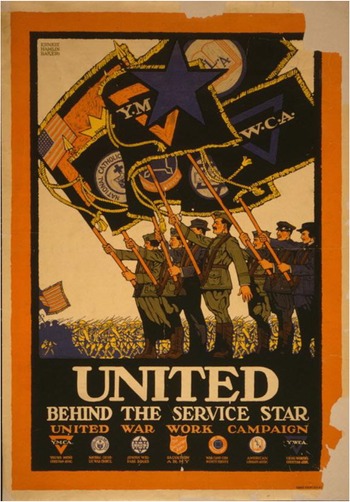
Posters also emphasized the unity of mission. One, notably, had representatives of all the groups wearing uniforms and holding flags of their respective organization (Figure 1). They all faced the same way, showing a common direction and purpose, and in the background, soldiers marched in the same direction behind the American flag.
This United War Work Campaign poster incorporates all the seven organizations, with their emblems represented on the different flags. The Service Star represented the blue star emblem families of service members would hang in their homes. Poster by Ernest Hamlin Baker. Courtesy Library of Congress Prints and Photographs Division.

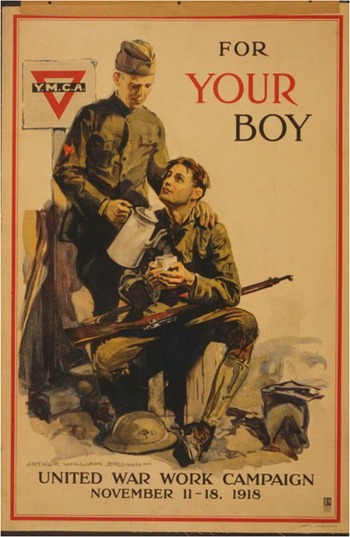
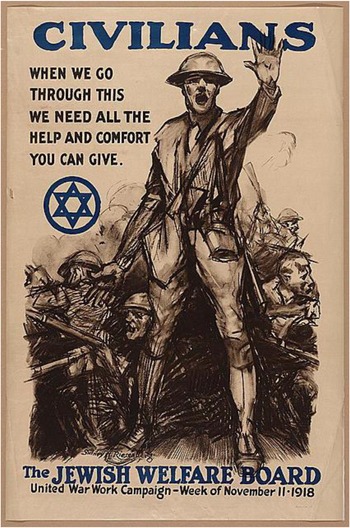
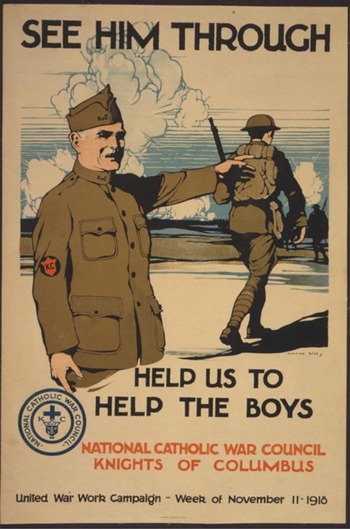
Yet the groups also promoted their own distinctive visions through individual posters the organizations created. The YMCA posters tended to feature warm colors and wholesome scenes emphasizing the home comforts the YMCA provided. The soldiers that appeared in their posters had a young and innocent look, and the YMCA secretaries exuded a calming presence (Figure 2). Since the NCWC and the JWB did not have time to prepare extensive publicity, they produced fewer posters, but the ones they did produce presented starker images. One JWB poster depicted an abstract sketch of a group of soldiers in a firefight, with one beckoning the viewer for aid and saying, “when we go through this, we need all the help and comfort you can give” (Figure 3.) The main NCWC poster featured an older, resolute-looking man in a Knights uniform facing the viewer and directing soldiers to the active battle in the background (Figure 4). Both of these posters conveyed that Catholics and Jews faced the horrors of war with courage and resolve.
This was a United War Work Campaign poster produced for the YMCA Each organization produced their own individual posters to publicize the campaign. This poster emphasizes the role of YMCA secretaries and the comfort and aid they provided soldiers. Poster by Arthur William Brown. Courtesy Library of Congress Prints and Photographs Division.

This United War Work Campaign poster was produced for the Jewish Welfare Board. Its stark imagery depicted the horrors of the trenches and the bravery of Jewish soldiers. Poster by Sidney H. Riesenberg. Courtesy Library of Congress Prints and Photographs Division.

The National Catholic War Council produced this poster for the United War Work Campaign. By featuring a Knights of Columbus secretary, the poster makes it clear that the NCWC was acting as a surrogate for the Knights. Poster by Burton Rice. Courtesy Library of Congress Prints and Photographs Division.

Tensions did emerge as the YMCA tried to integrate the other groups into the extensive bureaucratic apparatus they had created for their original campaign. Burke and the NCWC organized Catholics in the way that made the most sense to them, which meant coordinating groups first through the fourteen metropolitans, then through dioceses and parishes. So, for instance, they organized the “Victory Boy” and “Victory Girl” aspect of the campaign by having each soldier from a parish be represented by a girl or boy who would raise money on their behalf.Footnote 102 The YMCA leadership had organized on what they saw as the logical basis of state, county, and city committees and were initially confused by the Catholic method.Footnote 103 Further struggles occurred at the local level as the YMCA state and local leaders, who had been part of the planning longer, tended to ignore Catholic workers or not include them in local committees.Footnote 104
Catholic and Jewish campaign workers complained about their status in the campaign and complained about religious prejudice. Several reports to the NCWC bemoaned the lack of publicity Catholic efforts received. In the words of one correspondent from Fredericksburg, Virginia, “the Jews and the ‘Y’ saw to it that their needs were provided for, but the story of the Catholics was left untold.”Footnote 105 Members of the Knights particularly distrusted the YMCA-dominated leadership apparatus of the United War Work Campaign. One wrote from Missouri about having to be subordinate to a YMCA worker. He quoted a community member saying: “that damned YMCA bunch . . . want to run the whole show and won't give recognition to anybody else.”Footnote 106 Harry Cutler objected to an anti-Semitic joke that appeared in a September 1918 issue of the YMCA's magazine for the troops, Trench and Camp, as well as about YMCA entertainments that caricatured “the Jewish people especially with vehemence and prejudice.”Footnote 107
For the YMCA, the Knights slogan of “Everyone Welcome, Everything Free” continued to be a point of contention. The YMCA kept losing money on their canteens, and John Mott got the Committee of Eleven to discourage using campaign funds for free distribution of goods.Footnote 108 The Knights resisted this order, arguing that the American people gave money to support their sons overseas, and so the young men should not be charged for the goods bought with those donations. Joseph Pelletier, the Supreme Counselor of the Knights, advised the leadership to ignore the ruling.Footnote 109 Raymond Fosdick struggled to manage this problem, and tried to get the NCWC to intervene, but the Knights continued to obfuscate. One leader wrote, “F. [Fosdick] is probably having a fit. I guess he will let us alone, even if some of our friends of the NCWC would let him destroy us!”Footnote 110
The final clause reveals another struggle that the organizations faced as they participated in the United War Work Campaign: tensions rose within the religious groups as they tried to balance fulfilling their own missions and working with the War Department. The campaign would expose fissures in all three organizations and their leaders had to figure out ways to manage internal dissension as they sought to cooperate with other faith groups and the government.
As the official Protestant representative of the campaign, the YMCA faced criticism from multiple sides. Mott's fears about backlash materialized as leadership received hundreds of protests about their cooperation with Catholics and Jews. Petitions and letters expressed particular horror that they would work with the Knights, “agents of the Pope,” and Mott received a report that two thousand men in Canton, Ohio, refused to donate to the campaign because of Catholic involvement.Footnote 111 Baptist publications in particular linked their criticism of the campaign to other spiritual lapses, such as criticizing YMCA secretaries for allowing dancing and being lax on observing the sabbath.Footnote 112 Dr. James Burton Gramble, the president of the Southern Baptist Convention, decried the campaign and accused Mott of trying to subsume all denominations under the banner of the YMCA.Footnote 113 The YMCA's policies, he said, led to “putting a soft pedal on the great distinctive principles of the New Testament for which we stand.”Footnote 114
At the same time, liberal leaders continued to complain about the YMCA's limited view of Protestantism. For instance, Charles Eliot, former president of Harvard, criticized the YMCA for their policy of hiring only “men of genuine Christian character” and rejecting otherwise-qualified Unitarian candidates.Footnote 115 For the YMCA, true Protestant Christianity required a Trinitarian belief system, but people like Eliot wanted a broader understanding of who fell under the Protestant banner. Raymond Fosdick exhorted the YMCA to develop more inclusive hiring policies, particularly in response to complaints that they had excluded Christian Scientists and Mormons, religious groups the YMCA did not view as Christian, much less evangelical Protestant.Footnote 116
Catholic internal conflicts focused less on theology and more on power. Some of the tensions echoed the struggles occurring as bishops sought to extend control over the laity.Footnote 117 The leadership of the Knights resented the financial control the NCWC had and expressed great concern that the NCWC would turn over the campaign funds in a timely manner.Footnote 118 There was also an underlying class animosity between the Knights and the NCCW, and the Knights distrusted the NCWC representatives who served on the Committee of Eleven, laymen James Phelan and John Agar, referring to them as “Wall Street Catholics.” The leadership became particularly incensed when Phelan and Agar did not defend the Knight's “Everything Free” policy to the Knights’ satisfaction.Footnote 119 The NCWC, on the other hand, saw the Knights as a detriment to the reputation of American Catholics. In April of 1918, Burke had written a scathing memo, complaining, “Our men secretaries are few and far below the average YMCA secretary in fitness and training.” Because of the Knights’ lack of organization and professionalism, “the Catholic body [has] lost one of the greatest opportunities ever presented to it.” Burke concluded that war work should be organized through the hierarchy and not a lay group.Footnote 120
The JWB leadership had to navigate divides between Reformed, Conservative, and Orthodox Judaism as conflicts arose over how secretaries would uphold Jewish observances and practices. As the JWB was negotiating to be part of the campaign, Cutler received a letter from Harry G. Fromberg, president of the Young Israel Synagogue, who decried the ignorance and lax attitude of JWB secretaries. “In some cases,” Fromberg complained, “your representatives do not know the first thing about Judaism, or Jewish customs.” He accused JWB secretaries of violating the Sabbath by smoking and ridiculing devout Jews, and related a story of a soldier who asked a secretary to gather a minyan to say Kaddish for his dead father, and was met with the response, “What's a minyan?” Fromberg threatened to have his synagogue do welfare work outside of the control of the JWB. Cutler, knowing that Fosdick would frown on this, sought to quash Fromberg's proposal. He replied sharply that the JWB served a wide variety of Jews, from “the man who on one hand would have nothing to do with anything Jewish” to “the other extreme—the man who would have nothing to do with anything the least Goyish.” He said Jews needed to work together to avoid “a manifestation of disunion in Israel.”Footnote 121
Supporters of the JWB also had internal disagreements about the relationship between Jewish identity and American patriotism. Cutler argued that JWB secretaries needed to minimize overt Jewish rituals to demonstrate loyalty. In one speech during the campaign, he declared that during wartime, the nation's religious differences needed to be “not merely theoretically but practically set aside.” Louis Marshall, however, rejected that reasoning, insisting that Jews needed to defend their right to their own beliefs and practices. He argued, “You will not find a Catholic or a Protestant to be so ready to cast their convictions into the scrapheap as we are apt to be in our desire to coin convenient phrases.” Marshall framed the United War Work Campaign in a way that emphasized both united service and religious distinction: “Religious observances are not set aside either theoretically or practically. What has been accomplished is that, in spite of all differences of opinion and all religious observances, men of every faith have found it not only possible but desirable to unite in a practical application of religion for the maintenance of the morale of our boys abroad and the promotion of their spiritual welfare.”Footnote 122 Marshall's vision presented a pluralistic ideal: faith-based organizations could stay true to their religious foundations while still serving the interests of the US military and the broader federal government.
Many aspects of the campaign lived up to this ideal. One of the main pieces of campaign literature was an article written by John D. Rockefeller, Jr., who described the distinctive work of all seven organizations, and then praised the way they united for the campaign. “Working side by side and seeing eye to eye,” he declared, “there will grow up a spirit of greater tolerance, of better understanding and of more genuine sympathy between the various groups.”Footnote 123 A campaign rally at Madison Square Garden included representation from Protestants, Catholics, and Jews: prayers by Anglican Bishop David H. Greer and Union Theological Seminary professor Hugh Black, songs by the Paulist Choristers and a benediction by James Cardinal Gibbons, and a psalm reading by Rabbi Stephen Wise and an address by Louis Marshall.Footnote 124
The financial success of the campaign became an even greater sign of cooperation. Even though the war ended on the exact day that the official campaign was supposed to begin, November 11, 1918, Americans still pledged over two hundred million dollars. At the December CTCA meeting, John Mott admitted that he had been wrong to resist a united campaign. Through it, he declared, Protestants, Catholics, and Jews gained “larger and truer understanding of each other.” “I sometimes think,” he mused, “time will show that this by-product of the campaign was far more important than the direct object we had before us.” Mott's speech then took a turn, and he expressed fear that the good work could all fall apart due to “lack of forethought.”Footnote 125 He was referring to the fraying relationship between the War Department and the religious agencies of the CTCA.
IV. The Aftermath of the United War Work Campaign
Raymond Fosdick was not at the meeting where Mott gave his speech. He had gone to France in late December, but before he left, he made it known that he wanted to disband the CTCA and leave the administration of the United War Work funds to the Committee of Eleven. Mott argued that in the past “that relationship to the government proved to be an invaluable steadying guiding influence,” and “I am persuaded that it would continue to be.”Footnote 126 The “relationship” Mott spoke of had evolved during the war and the process of organizing the campaign. The experience of working with the religious groups led Fosdick and others in the War Department to become convinced that private religious organizations had no place in the military.
Throughout the fall of 1918, Fosdick had spent considerable energy defending the interfaith aspect of the campaign. He answered hundreds of letter writers who pledged their support to the YMCA but said they could not support “sectarian” organizations like the Knights or JWB. In response, Fosdick and others at the CTCA pointed out that “[t]he YMCA and the YWCA are just as much religious societies as the NCWC or the JWB; that is, they sustain the same relationship to Protestantism than the NCWC sustains to Catholicism or the JWB sustains to Judaism.”Footnote 127 In September of 1918, Fosdick privately responded to a newspaper editor who had argued that the government, and not religious organizations, should do recreation work with soldiers. Fosdick agreed, saying, “it is entirely possible that before the war is over the government may be forced into just such a position as you indicate.”Footnote 128
During the period of demobilization, War Department officials made moves to disassociate from the religious organizations. In a June 1919 report, Fosdick complained that most of his time had been given to “straightening out the differences between these societies and correlating their work.” While he valued their specific accomplishments, he admitted that allowing sectarian groups to work at camps stimulated “rivalries and a jockeying for position that are disheartening to witness and discouraging to cope with.”Footnote 129 In August of 1919, the War Department decided to take over recreation work with soldiers and ordered organizations to turn over their huts, furniture, and equipment to the military.Footnote 130
Newton Baker made this decision, in part, because he felt that outside religious agencies muddied the chain of command. In a letter to a congressman, he declared, “I am persuaded that the true place for religious effort in the army is from the Chaplain down.”Footnote 131 The YMCA and Knights protested, declaring that soldiers respond better “to the services of civilians, to whom they owe no special duty of military deference and obedience.”Footnote 132 Baker, however, complained about the proselytizing conduct of the religious organizations, saying that their competition led to “a constant emphasis being placed upon religious differences among soldiers” and that the soldiers resented being “made the object of competitive effort.”Footnote 133
On November 1, 1919, the CTCA huts were disbanded. After that, the religious groups drifted apart and focused on their own internal issues. In the immediate aftermath of the war, the YMCA faced a military investigation based on criticism of how they ran their canteens.Footnote 134 The Knights had gained prestige and goodwill during the war but still maintained an acrimonious relationship with both the NCWC and the YMCA.Footnote 135 The NCWC remade itself into the National Catholic Welfare Conference after the war and sought to coordinate Catholic welfare service work in the nation, often in an effort to challenge the dominance of the YMCA and YWCA.Footnote 136 Tragically, Harry Cutler died in 1920 while traveling in England as an envoy of the War Memorial Board, a group seeking to consecrate the graves of American soldiers.Footnote 137 The JWB continued on, focusing its work on supporting their co-religionists in the military and building Jewish community centers.Footnote 138 Raymond Fosdick left government service and partnered with John D. Rockefeller Jr. and John Mott in the creation of the Interchurch World Movement, an organization founded on the principle of creating a pan-Protestant movement for social reform.Footnote 139
Baker continued to believe that the presence of religious organizations in the army hurt both the military and the cause of religion. The military, he maintained, needed to disassociate itself from religious ties that could interfere with recruitment, training, and fighting, and he advocated a secular ethos when dealing with soldier morale and morality. As for religion, Baker saw it as progressing in a more cooperative, pluralistic direction. He declared, “[T]he religious world itself is moving away from these lines of distinction and discrimination, so that it would seem unwise to introduce them into our new army along old and traditional lines.”Footnote 140
V. Conclusion: The Legacy of the United War Work Campaign
The postwar period did not play out this way. Religious and ethnic tensions rose in the 1920s, and Catholics and Jews felt under particular threat, as illustrated by legal attempts to shut down Catholic schools, the rise of the Ku Klux Klan, and the passage of the 1924 immigration restriction law which targeted immigrants from largely Catholic and Jewish nations.Footnote 141 The splits between liberal and conservative Protestants, who had maintained tenuous connections in the war years, grew as they took opposing stands on issues like evolution, changing sexual mores, and the inerrancy of scripture.Footnote 142 Meanwhile, academic and other secular elites became more vocal in their criticisms of institutional religion while theologians like Reinhold Niebuhr criticized Protestant denominations for adapting materialist values and drifting in a business-friendly direction.Footnote 143
Nevertheless, many individuals who had been involved in the interfaith war work participated in new movements to promote religious dialogue. Some Protestant leaders in the Federal Council of Churches of Christ in America reached out in the spirit of goodwill to Catholic and Jewish leaders, and they participated in a series of conversations and civic activities to build understanding.Footnote 144 This led to the 1927 creation of the National Conference of Jews and Christians, which gained more publicity and prestige in the 1930s (it changed its name to the National Council of Christians and Jews in 1938). Newton Baker, John Mott, and members of the JWB participated in these interfaith initiatives. Some prominent Catholics who had links to the NCWC, such as Columbia history professor Carlton J. H. Hayes, also became involved.Footnote 145 However, the leadership of the NCWC resisted involvement, particularly after the release of the papal encyclical Mortalium Animos, which prohibited Catholic participation in interfaith dialogue.Footnote 146
As Europe again descended into war, the religious groups that had been involved in the United War Work Campaign reunited. In November 1940, leaders of the YMCA, YWCA, JWB, Salvation Army, and the National Catholic Community Service (created in late 1940 by the National Catholic Welfare Conference) sent a letter to Franklin Roosevelt explaining that the agencies were cooperating “for the purpose of contributing to the spiritual and physical well-being of the men and women summoned to national defense training or to serve in industrial defense enterprises.” They offered their “extensive facilities and our professional experience in drafting a program of welfare services.”Footnote 147 In February of 1941, the agencies officially formed United Service Organizations for National Defense, Inc., more commonly known as the USO.Footnote 148
Early in the formation process, government officials sought to prevent what they saw as mistakes made during World War I. The Federal Security Administration (FSA), and not the War Department, became the government organization that coordinated the USO groups. The USO was banned from direct work in military camps, and instead coordinated services in communities where these camps were being built. FSA officials also set ground rules about the visibility of religion. They insisted that all signage on buildings use “United Service Organizations” and not the individual agencies’ names.Footnote 149 The agencies created clear guidelines about religion, such as a rule that symbols like the cross or Star of David could be displayed only in private offices.Footnote 150 In the fall of 1941, the USO board made an agreement with Camp Shows, Inc., to provide entertainment at venues near training camps, which would later expand to bases overseas.Footnote 151 Overall, the USO became a viable, long-term organization, and the religious organizations would continue overseeing the work through the Vietnam War. However, in the public mind, the USO became most known for its social clubs and entertainment, and not the religious mission of its founders.Footnote 152
Over twenty years before the founding of the USO, Protestants, Catholics, Jews, and government officials had seen the potential and problems that came with interfaith endeavors as they worked with the government on the United War Work Campaign. On one hand, the campaign allowed religious leaders to build personal connections and intellectual frameworks that would be key to the emergence of the vibrant ecumenical and interfaith movements of the World War II era and beyond. At the same time, the campaign exposed the tensions and difficulties that came from collaborations between the government and faith groups. The experiment of the United War Work Campaign set a template for the greater acceptance of religious diversity in the United States, but it also demonstrated the kinds of sacrifices involved when religious organizations worked with each other in the public arena.
Acknowledgments
I would like to express my gratitude to the many people who provided guidance and feedback on this project, particularly Christopher Capozolla, Meaghan Dwyer-Ryan, Natalie Dykstra, Anne Heath, Torrie Hester, Rachel Koopmans, Alan Kraut, Maria Mazzenga, Maddalena Marrinari, Catherine Osborne, Tom Rzeznik, and W. John Shepherd.