Introduction
Multiple sclerosis (MS) is a chronic inflammatory demyelinating disease of the central nervous system in which abnormal immune mechanisms cause myelin injury. In addition, evidence exists indicating that axonal damage is present even in early stages of the disease, causing MS patients to suffer a wide array of symptoms including sensory, motor, behavioral and cognitive impairment (Confavreux, Vukusic, Moreau, & Adeleine, Reference Confavreux, Vukusic, Moreau and Adeleine2000).
Evidence is accumulating to suggest that up to 70% of patients with MS show cognitive impairment at some point during the course of the disease (Chiaravalloti & Deluca, Reference Chiaravalloti and Deluca2008). Although some cognitive deficits can be present even in early stages (Schulz, Kopp, Kunkel, & Faiss, Reference Schulz, Kopp, Kunkel and Faiss2006), overall, cognitive dysfunction tends to correlate with clinical progression (Amato, Ponziani, Siracusa, & Sorbi, Reference Amato, Ponziani, Siracusa and Sorbi2001). The most frequently impaired cognitive domains in MS patients are memory (visual and verbal), processing speed, and complex attention (Benedict et al., Reference Benedict, Cookfair, Gavett, Gunther, Munschauer, Garg and Weinstock-Guttman2006; Chiaravalloti & Deluca, Reference Chiaravalloti and Deluca2008).
Attention is traditionally defined as the act of taking possession in the mind of one out of several simultaneous objects or trains of thought (James, Reference James1890). More recently, attention has been described as being composed of three independent networks, namely, Alerting, Orienting, and Executive Control (Fan & Posner, Reference Fan and Posner2004). Alerting is defined as the ability to achieve and maintain response readiness for an impending stimulus. Orienting is the selection of information from multiple sensory inputs. Executive Control represents the capacity to resolve a conflict when faced with competing responses (Fan, McCandliss, Sommer, Raz, & Posner, Reference Fan, McCandliss, Sommer, Raz and Posner2002; Raz & Buhle, Reference Raz and Buhle2006).
Each of these networks is linked to specific anatomical areas and is dependent on specific neuromodulators. The Alerting system has been associated with thalamic, frontal and parietal regions of the right hemisphere and is modulated by norepinephrine from the midbrain nucleus coeruleus. The Orienting system appears to activate parts of the superior parietal lobe, the temporoparietal junction and the frontal eye fields and is modulated by acetylcholine. The Executive Control network activates midline frontal areas (anterior cingulate cortex) and lateral prefrontal cortical regions and is modulated by dopamine (Fan et al., Reference Fan, McCandliss, Sommer, Raz and Posner2002; Fan & Posner, Reference Fan and Posner2004).
Attentional networks can be assessed using the Attentional Network Test (ANT), a computerized attention test designed to evaluate all three attentional networks simultaneously but independently. The ANT has been used with normal subjects (Fan et al., Reference Fan, McCandliss, Sommer, Raz and Posner2002) and a variety of patient populations (e.g., Attention-Deficit/Hyperactivity Disorder, Schizophrenia, Borderline Personality Disorder, and Post-Traumatic Stress Disorder), showing dissociations in performance for the different networks in each population (Breton et al., Reference Breton, Plante, Legauffre, Morel, Ades, Gorwood and Dubertret2010; Johnson et al., Reference Johnson, Robertson, Barry, Mulligan, Daibhis, Daly and Bellgrove2008; Leskin & White, Reference Leskin and White2007; Posner et al., Reference Posner, Rothbart, Vizueta, Levy, Evans, Thomas and Clarkin2002).
Recently, the ANT has also been used with MS patients. Specific dysfunction in the Alerting network was found, with preservation of the other networks (Urbanek et al., Reference Urbanek, Weinges-Evers, Bellmann-Strobl, Bock, Dorr, Hahn and Paul2010).
In light of the general aforementioned correlation of overall cognitive dysfunction with clinical progression over the course of disease, we set out to investigate whether, as others have found, we could detect specific aspects of cognitive dysfunction, in particular, attention network deficits, earlier in the disease process, and before significant physical and/or overall cognitive impairment are seen.
Methods
Patients
Patients were recruited from the outpatient MS clinic at the Raúl Carrea Institute for Neurological Research (FLENI) by attending neurologists. Twenty-seven relapsing-remitting MS patients fulfilling 2005 McDonald criteria (Polman et al., Reference Polman, Reingold, Edan, Filippi, Hartung, Kappos and Wolinsky2005), with less than 2 years disease duration, and scores<2 on the Expanded Disability Status Scale (EDSS) underwent complete neuropsychological evaluation. Patients were evaluated at the outpatient MS clinic every 3 months. No patients had significant upper limb impairment, visual acuity or field deficits, history of alcohol or drug abuse, head trauma, major psychiatric disorder, other neurological disorders or systemic illnesses. Patients with hearing loss, which is not considered in the EDSS score, were excluded because hearing loss would limit test performance. No testing was done before 90 days after recovery from the most recent relapse, or discontinuation of steroid treatment. Fifteen patients were receiving Interferon-β, 7 were taking glatiramer acetate, and 5 were not on medication. Twenty-seven subjects matched for age, gender, and educational level, recruited from a local volunteer group, served as controls. The local ethics committee approved the protocol and all subjects signed an informed consent form.
Tests
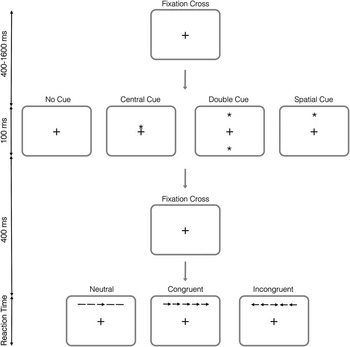
Attentional networks were examined with the ANT (Fan & Posner, Reference Fan and Posner2004), a computerized 30-min task designed to combine cued reaction time (RT) and a flanker task (Posner, Sheese, Odludas, & Tang, Reference Posner, Sheese, Odludas and Tang2006). Software was downloaded from the author's website (http://www.sacklerinstitute.org/users/jin.fan/) and run on a MacBook laptop computer. Subjects were required to decide whether a central arrow pointed left or right, and press a left key if the arrow was pointing left or a right key if it was pointing right. To test all 3 attentional networks, a series of spatial and alerting cues and flankers were presented as follows: Participants were instructed to focus on a central cross-shaped fixation point presented for 400 to 1600 ms (randomized), subsequently replaced for 100 ms by one of four warning cues providing information about the imminent target. The target, a central arrow, could appear above or below the fixation point and was surrounded by two flankers (arrows) on each side. Different evenly balanced cues and flankers appeared in pseudo-random order.
Subjects completed a 24 trial practice block with feedback provided after each trial. Subjects then completed 3 experimental blocks of 96 trials each without feedback, with up to 2 min rest between blocks. RT and accuracy were recorded.
The Alerting network was assessed using either a double cue (temporal cue) or a no-cue condition before target presentation. The double cue indicated imminent appearance of the target. Alerting efficiency was measured by subtracting the mean RT of the double cue condition from the mean RT of the no-cue condition.
Orienting efficiency was measured using a spatial orienting cue and a center cue. The target could appear above or below the fixation point. The spatial orienting cue warned where the target would appear. Orienting efficiency was then calculated by subtracting the mean RT of the spatial cue condition from the mean RT of the center cue condition.
To measure Executive Control, the central arrow was shown with left and right flanker arrows in some trials. The flankers could be congruent, that is, pointing in the same direction as the central arrow (in 1/3 of the trials), incongruent, that is, pointing in the direction opposite to the central arrow (in 1/3 of the trials), or neutral (no arrowhead). Executive control efficiency, reflected by time needed to process incongruent flankers, was calculated by subtracting the mean RT for the congruent condition from the mean RT for the incongruent condition (see Figure 1).
Attentional Network Test. Gray rectangles represent computer monitors faced by patients during the test. Four types of cues were presented to participants at variable time periods. Center and double cues provided no information on future target location, whereas spatial clue warned subjects target would appear on upper or lower screen sectors. After a 400 ms pause, target appeared with one of three different flankers at each side: neutral (no flanker), congruent (arrowhead pointing in the same direction as the target), and incongruent (arrowhead pointing in opposite direction). Time delays registered to press key indicating target arrow direction were defined as reaction time.

Additionally, all patients completed a Rao Brief Repeatable Battery (Rao, Reference Rao1990) and the FastScreen version of the Beck Depression Inventory (BDI-FS) (Benedict, Fishman, McClellan, Bakshi, & Weinstock-Guttman, Reference Benedict, Fishman, McClellan, Bakshi and Weinstock-Guttman2003).
Statistical Analysis
A linear regression model was used to calculate adjusted network scores, with Alerting, Orienting or Executive Control network test results used as the dependent variables and diagnosis as the independent variable. The mean-centered no-cue no-flanker RT (baseline RT) was used to obtain the “baseline-free” or adjusted values. The difference between groups in percentage of correct answers was assessed with the Mann-Whitney test. To evaluate the effect of fatigue on test performance, a hierarchical linear model was constructed, with baseline RT as the dependent variable, clustered by individuals (using subject ID as a random intercept) and a dichotomous variable, block 1 (the initial block of the experiment) or block 3 (the last block of the experiment), as an independent variable. Finally, diagnosis was added as an independent variable to assess whether MS and controls patients were differentially affected by fatigue. Correlation between overall RT and no-cue and double-cue RT was assessed using Pearson's correlation coefficient. Interaction between the Alerting and Executive Control networks was investigated using an analysis of covariance (ANCOVA) model. RT was the continuous dependent variable. Diagnosis, cue condition, and type of flanker were categorical independent variables. Finally, baseline RT was used to adjust for baseline subject capacities. The p values below .05 (two tailed) were considered significant. All statistical analyses were performed using Stata v11.1 (Statacorp LP, College Station, TX).
Results
Overall Cognitive Status of Recently Diagnosed MS Patients
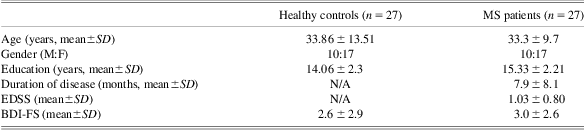
Clinical and demographic characteristics of study participants are presented in Table 1. For the purposes of this study, patients were considered cognitively impaired when 3 of Rao's Brief Repeatable Battery scores were at least 2 SD below those of controls. Twenty percent of the recently diagnosed MS patients were categorized as impaired, using this criterion.
Participant clinical characteristics and demographics
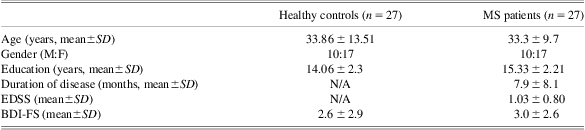
EDSS, Expanded Disability Status Scale; BDI-FS, FastScreen version of the Beck Depression Inventory.
Attention Network Test Results Indicate Specific Alerting Network Deficits in MS Patients
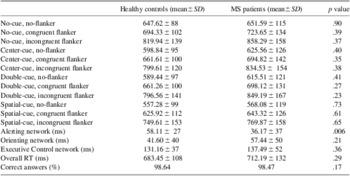
Results for all the conditions tested, the network effects, total RT and accuracy are presented in Table 2. There were no differences between groups with respect to overall mean RT (p = .29), percentage of correct answers (p = .17), or baseline RT-adjusted Orienting (p = .21) or Executive Control tests (p = .36). However, we did find significant differences in baseline RT-adjusted Alerting network scores between patients and controls (p = .006), with a 22.1 ms discrepancy favoring controls.
Attentional Network Test results

RT, reaction time.
Since the Alerting effect is calculated by subtracting the mean RT for the double cue condition from the mean RT for the no-cue condition, differences found in this study may have been due to a shorter response time in MS patients when cues were not given, or to reduced benefit from a non-spatial cue such as the double cue. To rule out the first possibility, we compared no-cue RTs between groups. No difference was found (p = .90). Nor did we detect a significant correlation between Alerting network scores and no-cue conditions (p = .34). However, we did find a correlation with the double-cue condition (p = .005), which suggests that this may have been responsible for the changes observed in Alerting scores. Therefore, specific Alerting deficits observed in MS patients appear to be due to decreased response to Alerting cues (double-cue).
Influence of Fatigue and Depression on Attentional Performance
A potential alternative explanation for differences observed in attention scores may be that the mental burden imposed by the test differentially affects MS patients, leading to more fatigue, and, furthermore, that the Alerting domain is more susceptible to this effect. To evaluate this possibility, test scores were compared in two repeated measures, one at the beginning of the test (block 1 of 3) and the other during the last test (block 3 of 3). Had fatigue influenced test results and affected MS patients more significantly, one would expect differences between blocks 1 and 3 to be particularly evident in the MS group. No significant differences in baseline RT results were detected between MS and control subjects (p = .42 and p = .16, respectively), with baseline RT decreasing only by 15.7 ms by block 3 (p = .10). The Alert score improved significantly in both patients and controls over the course of the test (p = .003), but there was no difference between controls and MS patients in this regard (p = .24).
Another potential factor influencing attentional performance is depression. However, depression, as assessed by the BDI-FS, was not significantly different in our patients and controls (p = .52). Nor was there a correlation between the BDI-FS and Alerting scores (p = .5).
Interaction Between Alerting and Executive Control networks in MS Patients
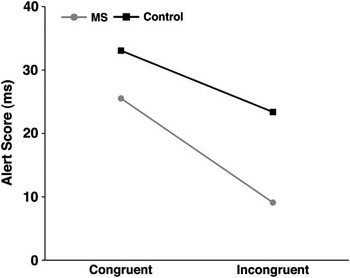
Interaction between Alerting and Executive Control networks has been found both in healthy controls (Fan et al., Reference Fan, McCandliss, Sommer, Raz and Posner2002) and MS patients (Urbanek et al., Reference Urbanek, Weinges-Evers, Bellmann-Strobl, Bock, Dorr, Hahn and Paul2010). For every cue condition, the presence of incongruent flankers increases RT. Interference produced by flankers was further enhanced when center- and double-cues (non-spatial) were presented. This suggests interaction between these networks. To determine whether this interaction was also present in our MS patients and whether they differed from controls in this regard, we performed an analysis of covariance (ANCOVA) with cue condition, flanker type, diagnosis, their interactions, and baseline RT as covariates. There was no significant interaction in controls (p = .11), but there was in the MS group (p = .007). This was indicated by steeper drops in Alert scores for this group when challenged with incongruent flankers (Figure 2). Thus, although MS patients did not differ from healthy controls with respect to Executive Control network scores, interference in this network generated by Alerting was further enhanced in these patients.
Mean Alert scores for healthy controls and multiple sclerosis (MS) patients with congruent and incongruent flankers.

Discussion
We studied attention in MS, and, in particular, in recently diagnosed MS, using the ANT. That instrument is based on a recent theoretical model in which attention is seen as being composed of three independent networks, namely, Alerting, Orienting, and Executive Control. Differences between patients and controls varied, depending on which of the three networks is involved. Patients had significantly worse Alerting network function than controls. However, no differences were found between patients and controls in the Orienting or Executive Control networks. The Alerting network deficit suggests patients do not benefit from temporal cue warnings as much as normal subjects. That is, they do not respond faster when temporal cues warn that a target is about to appear. Significant interactions were found between Alerting and Executive Control networks, but only in the patient group.
Our results are consistent with those from a previous study of attentional network performance in MS patients, also using the ANT (Urbanek et al., Reference Urbanek, Weinges-Evers, Bellmann-Strobl, Bock, Dorr, Hahn and Paul2010). In that study, Alerting network deficits were also found in the patients, as well as normal Orienting and Executive Control functioning in patients. Of note, the patients in that study had a longer disease history and higher EDSS scores than ours. Those authors also found, consistent with our results, an interaction between the Alerting and Executive Control networks in patients only.
Our study, then, indicates that attentional deficit, and, specifically, the network pattern found by Urbanek et al. is present at earlier stages of MS, before patients exhibit clinical, and, in particular, cognitive deficits. In addition, we specifically addressed the effect of fatigue on the ANT and we found no effect of fatigue on performance. Finally, we showed that RT in a simple task (baseline RT), equivalent to a two-choice RT test, was not different for patients and controls. This suggests that the Alerting network deficiency found is not due simply to overall decreased processing speed, which is a common cognitive deficit in MS patients. However, an alternative explanation of our results is that because the two-choice reaction task we used was embedded in a test that has trials involving various stimulus conditions, the complexity of the context may have erased any differences between patients and controls. The relationship of these Alerting network deficits to cognitive status over the course of disease needs clarification in future studies.
As just noted, among the cognitive deficits seen in MS patients is deficient information processing speed, shown, for instance, by slower execution of a variety of simple RT tests. Those deficits have been found to worsen as test complexity increases (Jennekens-Schinkel, Sanders, Lanser, & Van der Velde, Reference Jennekens-Schinkel, Sanders, Lanser and Van der Velde1988; Reicker, Tombaugh, Walker, & Freedman, Reference Reicker, Tombaugh, Walker and Freedman2007; Tombaugh, Berrigan, Walker, & Freedman, Reference Tombaugh, Berrigan, Walker and Freedman2010). Also, impairment, on various simple and choice RT tests, has been shown to be a function of disease subtype and severity (De Sonneville et al., Reference De Sonneville, Boringa, Reuling, Lazeron, Adèr and Polman2002); normal RTs have been reported in some MS patients who are relatively cognitively preserved (Kujala, Portin, Revonsuo, & Ruutiainen, Reference Kujala, Portin, Revonsuo and Ruutiainen1994). Thus, if discrepancies between studies are found, they might arise from several factors. Among these are the use of different tests and differences between study populations (e.g., disease duration, problems captured by the EDSS, or overall cognitive status).
Despite the presumed theoretical independence of the three networks (Alerting, Orienting, and Executive Control), some studies have found interactions in test performance. This was found both in healthy controls (Fan et al., Reference Fan, McCandliss, Sommer, Raz and Posner2002) and in MS patients (Urbanek et al., Reference Urbanek, Weinges-Evers, Bellmann-Strobl, Bock, Dorr, Hahn and Paul2010). We found interaction between Alerting and Executive Control networks in the MS group. This suggests that incongruence was more challenging to patients when alerting cues were presented. This effect may be due to the fact that the effort made to respond to an alerting cue had a negative impact on the RT needed to process incongruent flankers.
Although fatigue and depression are common symptoms of MS, and can interfere with neuropsychological test performance (Chiaravalloti & Deluca, Reference Chiaravalloti and Deluca2008), our findings do not appear to be explained by either factor.
An effect of fatigue might be expected in a test lasting 20 or more min, which poses a significant mental burden. If this effect were greater on patients than controls, that might account for the differences observed. However, we compared performance at the beginning to performance at the end of the test. There was no decrement over time in either group. Actually, to the contrary, improved performance was found in Alerting scores for both groups. This makes fatigue an unlikely explanation for differences in patients and controls.
Depression has been found in MS. Minden and Schiffer (Reference Minden and Schiffer1990) found that it was present in approximately 60% of MS patients. However, our patients did not differ from controls in depression, at least as measured by the BDI-FS, so this does not explain our results. Our patient group might be expected not to be especially depressed, because our inclusion criteria required patients to be relapse-free for at least 3 months, and also to have very low (or no) physical disability. In addition to the fact that we found no measurable differences in depression between our patients and controls, no correlation was observed between BDI-FS scores and Alerting network scores.
The Alerting system has been seen as associated with thalamic, frontal and parietal regions of the right hemisphere, and with the norepinephine system, arising in the locus coeruleus (Fan, McCandliss, Fossella, Flombaum, & Posner, Reference Fan, McCandliss, Fossella, Flombaum and Posner2005; Fan et al., Reference Fan, McCandliss, Sommer, Raz and Posner2002). However, there is not, yet, evidence of specific lesions correlated with decreased overall attentional performance. Future imaging studies should assess correlation of Alerting network performance with changes in specific neuroanatomical regions in early MS.
In conclusion, our results show that the Alerting network is affected in recently diagnosed MS patients. Early detection of cognitive dysfunction and the characterization of the contribution, in the overall burden on patients, from problems with processing speed and attention will improve our understanding of MS. Finally, as more is known on differential effects of MS treatments on cognitive performance, early detection may help to improve treatment choices in affected patients.
Acknowledgements
Dr. Correale is a board member of Merck-Serono Argentina, Biogen-Idec LATAM, and Merck-Serono LATAM. Dr. Correale has received reimbursement for developing educational presentations for Merck-Serono Argentina, Merck-Serono LATAM, Biogen-Idec Argentina, and TEVA-Tuteur Argentina as well as professional travel/accommodation stipends. The remaining authors have no disclosures in relation to this study. We thank Dr. James H. Waters and Dr. John Woodard for editing and English language correction of the manuscript. This study was supported by funding from the Raúl Carrea Institute for Neurological Research, FLENI