Acinetobacter baumannii is an important opportunistic pathogen causing hospital-acquired infections (HAIs), especially in debilitated patients. Most hospital-acquired strains are multidrug resistant, for which there are only limited antibiotic treatment options. A. baumannii infections are associated with increased mortality and hospital costs.Reference Perez, Hujer, Hujer, Decker, Rather and Bonomo1–Reference Casini, Selvi and Cristina5
Acinetobacter baumannii can survive and spread rapidly in the hospital environment.Reference Gong, Shen and Huang3, Reference Casini, Selvi and Cristina5 The bacterium can colonize surfaces for weeks under a wide range of environmental conditions.Reference Maragakis and Perl6 Patients can acquire A. baumannii through contact with contaminated surfaces or contact with healthcare workers who have touched such surfaces. Objects that have been shown to be contaminated with A. baumannii include curtains, patient hoists, door handles, and bed rails.Reference Rosa, Depascale, Cleary, Fajardo-Aquino, Kett and Munoz-Price2, Reference Maragakis and Perl6 Therefore, environmental cleaning and disinfection is a critical component of an infection control intervention to limit the spread of A. baumannii in healthcare facilities.Reference Perez, Hujer, Hujer, Decker, Rather and Bonomo1, Reference Casini, Selvi and Cristina5
Here, we describe environmental contamination by carbapenem-resistant A. baumannii (CRAB) in a hospital where CRAB is endemic. We aimed (1) to assess the baseline level of environmental contamination by CRAB in various room types; (2) to describe the effectiveness of cleaning in multipatient step-up rooms before and after refresher training of the cleaning staff; (3) to evaluate the performance of aerosolized hydrogen peroxide (aHP) for room disinfection after discharge of a known CRAB carrier; and (4) to examine the correlation between a method to evaluate cleaning (using the fluorescence gel marker) and a method to evaluate CRAB contamination (using sponge cultures).
Methods
Study setting and patient sample
This study was conducted from November 2015 to May 2016 at a 1,450-bed tertiary-care hospital in Tel Aviv, Israel. In 2015, CRAB was the most frequent multidrug-resistant organism causing HAIs. Incidence of clinical acquisitions was 5.15 per 10,000 hospital days. No routine screening for carriage of CRAB was performed. CRAB affected mostly critically ill patients who were mechanically ventilated and/or needed constant monitoring either in intensive care units (ICUs) or in step-up rooms in medical wards. Patients with CRAB were placed under contact isolation but were not necessarily hospitalized in private rooms due to the scarcity of such rooms. Closed suction systems were used in ventilated patients. To preliminarily evaluate environmental contamination to direct infection control interventions, we sampled the monitor devices in all 9 internal medicine wards for CRAB. Based on the preliminary results, we serially tested for environmental CRAB in multipatient rooms in medical wards, both regular rooms (2 or 3 patients per room) and step-up rooms (6 or 7 patients per room, some of them mechanically ventilated or in critical condition), and in single-patient rooms in the medical-surgical ICU.
Sampling method
Environmental samples were collected as described previously.Reference Nutman, Lerner, Schwartz and Carmeli4 In brief, we sampled environmental objects using sponges. High-touch objects were categorized into 4 groups based on the classification by the Centers for Disease Control and Prevention.7 We also tested the air vent cover, which we classified as a low-touch surface. After sampling, sponges were placed into sterile 50-mL containers and were transferred to the laboratory for processing within 30 minutes of collection.
Processing of samples
Samples were processed as described in detail by Nutman et al.Reference Nutman, Lerner, Schwartz and Carmeli4 In short, 2 processing methods were performed in parallel: (1) direct plating, in which specimens were inoculated directly onto ChromAgar MDR Acinetobacter plate (Hylabs, Israel), and the plates were incubated overnight at 37°C and (2) indirect plating (enrichment procedure), in which sponges were suspended in a tube containing 20 mL brain-heart infusion broth (BHI; Hylabs, Israel). The tubes were vortexed for 1 minute at maximum speed and transferred for incubation overnight at 37°C. The broth suspension was inoculated onto CHROMagar MDR Acinetobacter plates using a sterile loop and incubated overnight. From each plate with suspicious growth, 1 suspicious colony (red color) was isolated and identified using matrix-assisted laser desorption/ionization time-of-flight mass spectroscopy (MALDI-TOF MS; bioMérieux, Marcy-l’Étoile, France). If organisms other than CRAB were identified, the plates were considered negative for CRAB.
Evaluation of environmental contamination
Baseline evaluation of contamination was performed at 8 a.m., before morning cleaning of patients-units; each patient unit was evaluated once. Environmental contamination was determined for each patient unit and for each individual object. We used 2 scales. First, a patient-unit contamination scale was based on the percentage of sampled objects (or surfaces) that were positive for CRAB in each patient unit: clean (no positive sites), sparsely contaminated (<30% of the objects sampled positive), moderately contaminated (30%–70% positive), or heavily contaminated (>70% positive). Second, an object contamination scale was based on the density of colony counts: no growth (0), growth only after enrichment (1), direct growth of up to 10 CFU (2), direct growth of 10–100 CFU (3), and direct growth of >100 CFU (4).
Assessment of the effectiveness of cleaning and disinfection with sodium hypochlorite
We sampled patient units in the step-up rooms one day after intensive cleaning which was performed every other week by cleaning staff, who were trained at the start of employment and yearly thereafter. Step-up rooms were cleaned while the room was occupied and included changing curtains and cleaning surfaces of all objects with cloths soaked with 1,000 ppm sodium hypochlorite–based disinfectant. Objects that could not be cleaned with sodium hypochlorite according to the manufacturer’s instructions (eg, ventilator screens) were cleaned with alcohol wipes. We repeated sampling after refresher training of the cleaning staff, which focused on technique, changing personnel protective equipment (gown and gloves) between units, and replacing cloths and chlorine solution between units.
Measuring the effectiveness of terminal cleaning using aHP versus sodium hypochlorite
We sampled single-patient rooms after discharge of known CRAB carriers, before and immediately after terminal cleaning/disinfection. We evaluated cleaning and disinfection using 3 methods: (1) manual cleaning with sodium hypochlorite; (2) manual cleaning using sodium hypochlorite followed by aHP; and (3) aHP alone. Terminal cleaning was performed in unoccupied rooms from which curtains and linens had been removed. The GLOSAIRTM 400 (Johnson & Johnson, New Brunswick, NJ) was used for aHP.
Measuring cleaning using a fluorescent gel marker
Fluorescent gel (Glo Germ Gel, Glo Germ, Moab, UT) was used in 3 step-up rooms to evaluate cleaning effectiveness. The invisible transparent gel was applied over specific sites in the patient unit before intensive cleaning with sodium hypochlorite. After cleaning, each site was assessed with the Clinell UV Torch Kit (GAMA Healthcare, Hertfordshire, UK) to detect fluorescent gel. Only sites with complete removal of the gel were defined as “clean.” The results obtained with the Glo Germ Gel were compared to the results of the sponge culture for CRAB from the same areas.
Statistical analysis
Statistical analyses were performed using SAS version 9.4 software (SAS Institute, Cary, NC). The χ2 square or Fisher exact test was used, depending on the distribution of the data. The interobserver correlation (agreement between measures) was tested using the McNemar χ2. A P value <.05 was considered significant.
Ethics
The study was approved by the hospital’s institutional review board.
Results
Contamination of monitor devices
We evaluated the contamination of 71 monitor devices in 9 medical wards; 30 of these 71 devices (42%) were contaminated with CRAB. Contamination was much more prevalent among monitors in 6–7-bed step-up rooms (50%) than in regular 2–3-bed rooms (17.6%). Although all (7 of 7) monitors in use by a known CRAB carrier were contaminated, a high proportion of other monitors were also contaminated: 18 of 52 (35%) monitors used by patients without a positive CRAB culture and 5 of 12 (42%) monitors not in use.
Baseline environmental contamination
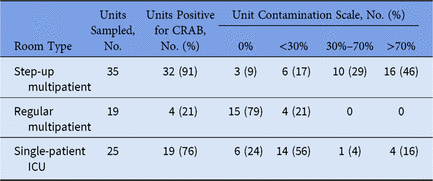
Unit contamination in multipatient rooms. Contamination was assessed in 54 patient units in multipatient rooms in medical wards: 35 in step-up rooms and 19 in regular rooms. Overall, 32 of 35 patient units in step-up rooms (91%) were contaminated with CRAB, and 50% of these were heavily contaminated. Furthermore, 3 of the patient units had been occupied by a patient with a positive CRAB culture in the previous month: 2 of these units were heavily contaminated and 1 unit was moderately contaminated. In the regular multipatient rooms, 4 of 19 patient units (21%) were contaminated, all of which were sparsely contaminated. None of these patient units had been occupied by a CRAB-positive patient.
Unit contamination in single-patient rooms. Contamination was assessed in 25 single-patient ICU rooms; 19 (76%) of the rooms were contaminated with CRAB, 14 of 19 (74%) were sparsely contaminated. Among the 19 contaminated rooms, all 4 that were occupied by a patient with a positive CRAB culture during the previous month were heavily contaminated. Table 1 presents the percentage of patient units that were positive for CRAB and the respective contamination levels.
Baseline Contamination of Patient Units by Carbapenem-Resistant Acinetobacter baumannii (CRAB) in Different Room Types

Note: ICU, intensive care unit.
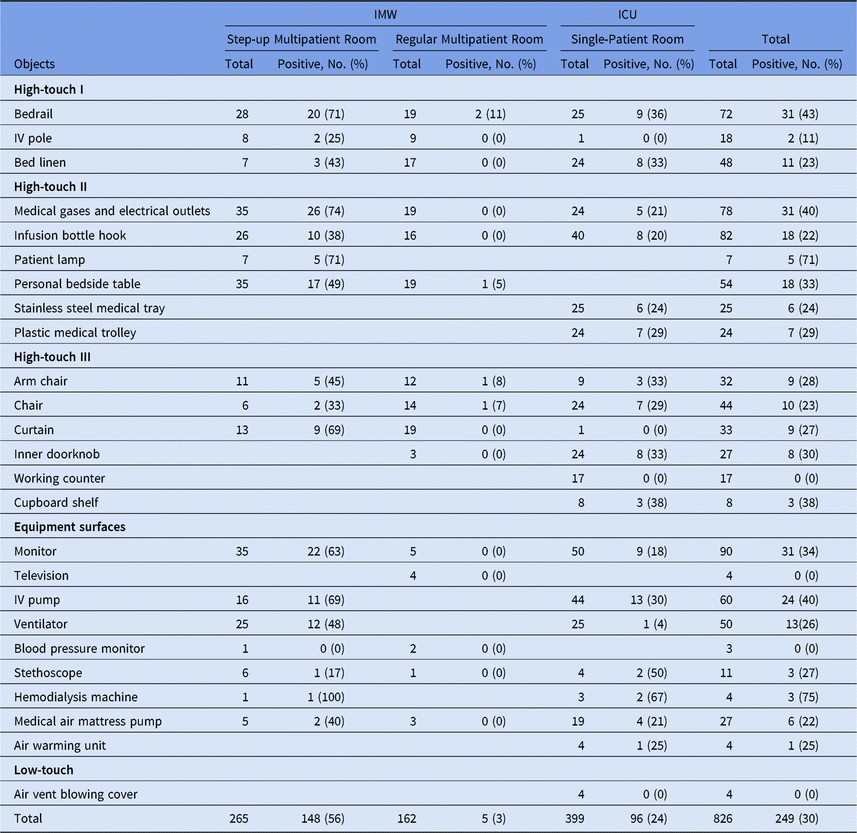
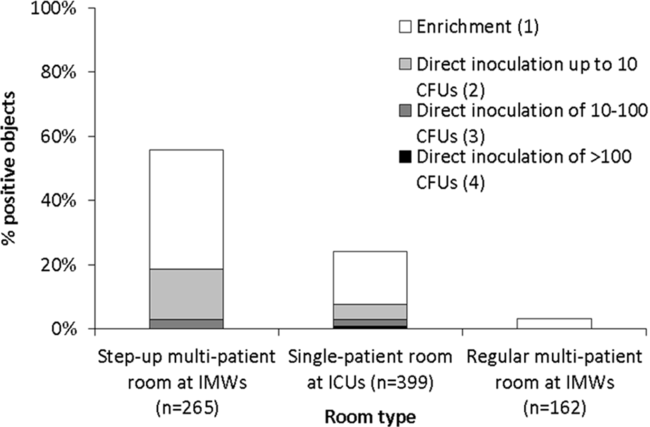
Object contamination in multipatient rooms. We sampled 265 objects in step-up rooms and 162 objects in regular rooms. In step-up rooms, 148 of 265 objects (56%) were contaminated with CRAB. Contamination was detected in 49 of 148 contaminated objects (33%) after direct plating and in 99 of 148 contaminated objects (67%) only after enrichment. The objects most frequently contaminated with CRAB were the medical gas and electrical outlets (26 of 35, 74%), patient lamps (5 of 7, 71%), and bedrails (20 of 28, 71%). In the regular multipatient rooms, only 5 of 162 objects (3%) were positive for CRAB; all of them were detected after enrichment. The contaminated objects included the bedrail, personal bedside table, chair and arm chair.
Object contamination in single-patient rooms. Overall, 399 objects were sampled in single-patient ICU rooms. Overall, 96 objects (24%) were contaminated with CRAB; 30 of these 96 (31%) were detected after direct growth, and 66 (69%) were detected only after enrichment. The objects most frequently contaminated were: stethoscope (50%), cupboard shelf (38%), and bedrail (36%).
Table 2 summarizes the results of objects tested for CRAB contamination in multipatient and single-patient rooms. Figure 1 shows the percentage of CRAB- contaminated objects and the level of contamination (based on a semiquantitative scale).
Baseline Contamination of High-Touch Objects and Environmental Surfaces by Carbapenem-Resistant Acinetobacter baumannii (CRAB), by Room Type

Note: IMW, internal medicine ward; ICU, intensive care unit.
Contamination level of CRAB-positive objects in multipatient rooms in internal medicine wards (IMWs) and single-patient rooms in intensive care units (ICUs) based on a semiquantitative scale: growth only after enrichment (1); direct growth of up to 10 CFU (2); direct growth of 10–100 CFU (3); and direct growth of >100 CFU (4). Note: n, number of objects tested.

Contamination after intensive cleaning in step-up multipatient rooms (before and after refresher training)
Object contamination after intensive cleaning. In total, 271 objects were tested for CRAB following intensive cleaning; 80 objects were sampled before refresher training and 191 after training. Before training, 62 of 80 objects sampled after cleaning (78%) were CRAB positive; 26 of 62 (42%) were CRAB-positive from direct plating. After refresher training, 75 of 191 objects sampled after cleaning (39%) were CRAB positive; 14 of these 75 objects (19%) were CRAB positive from direct plating. The difference between the percentage of positive objects before and after refresher training was statistically significant (P < .0001) (Details are provided in Table S1 online.)
Unit contamination after intensive cleaning. In total, 14 patient units (in 2 step-up rooms) were tested for CRAB contamination before and after intensive cleaning. Before cleaning, 12 units (86%) were contaminated with CRAB; 7 of 12 (58%) were heavily contaminated. After cleaning, all units were contaminated with CRAB, and 9 of 14 (64%) were heavily contaminated. After refresher training, 21 units (in 3 step-up rooms) were tested for CRAB contamination before and after cleaning. Before cleaning, 20 units (95%) were contaminated with CRAB, and 9 of 20 (45%) were heavily contaminated. After cleaning, 20 of 21 (95%) of the units were still contaminated with CRAB, but the percentage of heavily contaminated units decreased to 2 of 20 (10%).
Terminal cleaning by aHP versus manual cleaning with sodium hypochlorite
We tested 7 single-bed rooms of known CRAB carriers for CRAB contamination after patient discharge, before and after cleaning/disinfection with either sodium hypochlorite (3 rooms) or aHP technology (4 rooms). We could not evaluate the benefit of aHP after sodium hypochlorite terminal cleaning (tested in 2 rooms) because no contamination was detected in these rooms after the manual cleaning.
Overall, 59 objects were sampled before and 52 objects after manual cleaning with sodium hypochlorite; 24 of 59 of the objects (41%) were contaminated before cleaning, and 3 of 52 objects (6%) remained contaminated after cleaning (85% reduction). The contaminated objects after manual cleaning were the infusion bottle hook, patient lamp, and door handle.
In total, 74 objects were sampled before using the aHP system, and 68 objects were sampled after using the aHP system. Of the 74 objects sampled before using the aHP system, 59 (80%) were contaminated. Of the 68 objects sampled after using the aHP system, 12 (18%) were contaminated (78% reduction). The mattress (3 positive of 4 tested), arm chair (2 of 4), and bed rail (2 of 4) were most frequently contaminated after aHP.
Measures to monitor the effectiveness of cleaning
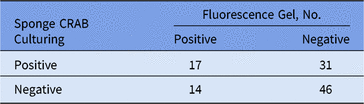
Overall, 108 objects in 3 step-up rooms were tested simultaneously after intensive cleaning by the Glo Germ gel technique and by sponge cultures for CRAB. Using the fluorescent marker, 72% of the objects were clean. Using sponge cultures, only 56% of the samples were CRAB negative. The concordance between the fluorescence marker and sponge cultures is presented in Table 3; the 2 methods differed significantly (P = .01).
The Concordance Between the Fluorescence Marker and Sponge Culturing for Measuring the Effectiveness of Cleaning

Note: CRAB, carbapenem-resistant Acinetobacter bamannii.
Discussion
Hospital room design (ie, single-patient versus multiple-bed rooms), especially in ICUs, can affect HAI acquisition and patient welfare.Reference Stiller, Salm, Bischoff and Gastmeier8 Hospital-acquired pathogens can be isolated from medical equipment, objects, and environmental surfaces in the ICUs, and this eventually can lead to serious infections.Reference Russotto, Cortegiani, Raineri and Giarratano9, Reference Boardman and Forbes10 Studies have found a reduction in infection incidence and mortality among patients hospitalized in a single-patient room compared to a multipatient room.Reference Ulrich, Quan, Zimring, Anjali and Choudhary11–Reference Brouqui14
In this study, we evaluated CRAB contamination in a CRAB-endemic hospital in different room types. We found CRAB to be widely distributed and in high concentrations in step-up multipatient rooms. In single-patient ICU rooms, CRAB was also common, but at lower levels of contamination. The characteristics of step-up rooms are important for understanding these results. First, step-up rooms host 6–7 critically ill patients who need continuous monitoring (some of them ventilated) in a big open-bay room, where patient units are separated by curtains. In addition, the nurse-to-patient ratio ranges between 1 and 2 nurses per 6–7 patients (compared to 1 nurse per 2 patients in the ICU). Also, there is one sink for hand washing (in addition to alcohol-based hand rub in each patient unit). Finally, the shared space may be overcrowded by equipment, personnel, and visitors.
We found high CRAB contamination of high-touch objects, such as the medical gases and electrical outlets, bedrails, patient lamp, IV pump, curtains and monitors, particularly in the step-up multipatient rooms. Special attention should be given to high-touch objects in the immediate vicinity of a patient because they are a potential source for nosocomial pathogens.Reference Huslage, Rutala, Sickbert-Bennett and Weber15–Reference Jinadatha, Villamaria and Coppin19 According to our hospital’s cleaning protocol, these objects, except for the patient lamp and curtains, are cleaned daily. Our results suggest that this frequency may be insufficient.
The unique characteristics of the step-up rooms pose a great challenge for the cleaning personnel because these rooms are never empty; thus, terminal cleaning is very limited. To overcome this limitation, our hospital implemented an intensive cleaning regimen for the entire step-up room on a regular basis (every other week). However, patients and medical equipment cannot be removed during cleaning. We evaluated the performance of this intensive cleaning and found no improvement in the CRAB contamination level of patient units after cleaning. We suspect that poor cleaning technique and the multiuse mops and cloths used by the cleaning personnel contributed to the mechanical spread of the bacteria from contaminated to clean areas.
Implementation of refresher training of the cleaning personnel led to a partial improvement in cleaning results. We detected a reduction in the number of contaminated objects after cleaning, but the percentage of contaminated patient units remained high. This implies that achieving totally clean patient units in the step-up rooms is practically impossible. The high-touch objects and surfaces that were CRAB positive after the refresher training were located farther away from the patient. Clifford et alReference Clifford, Sparks and Hosford20 reported that after refresher training for cleaning staff, cleaning thoroughness improved for some surfaces and decreased for others. We recommend educating cleaning personnel about the role of objects in disseminating pathogens to the environment and to patients. At the same time, since infectious doses differ between organisms, we should ask, “How clean is clean enough?”Reference Dancer21 Further studies are needed to determine whether even very low levels of CRAB contamination pose a risk to patients.
Several methods can be used to measure the effectiveness of cleaning, such as microbial counts, ATP bioluminescence, and fluorescent markers.Reference Boyce22, Reference Fattorini, Ceriale and Nante23 Assessment by fluorescent marker is easy to perform, and its immediate results make it a useful training tool for cleaning staff.Reference Fattorini, Ceriale and Nante23, Reference Boyce, Havill, Havill, Mangione, Dumigan and Moore24 We found discordance of 42% between the fluorescence marker and CRAB detection by culture. These results suggest that the fluorescence marker might be effective in assessing the thoroughness of cleaning, but it cannot determine whether pathogens were removed from an object. Goodman et alReference Goodman, Platt, Bass, Onderdonk, Yokoe and Huang25 also found that removal of a black light mark did not predict a positive MRSA or VRE surface. In our study, some surfaces were found to be not clean by the Glo Germ Gel were negative using the culturing method (probably because we used a specific medium targeting CRAB only). The ATP bioluminescence assay may be a good alternative for assessing environmental cleaning. In contrast to the fluorescent marker, this assay provides a quantitative measure of the organic material remaining on the surfaces after cleaning and, therefore, a quantitative measure of cleanliness.Reference Boyce, Havill, Havill, Mangione, Dumigan and Moore24, Reference Boyce, Havill, Dumigan, Golebiewski, Balogun and Rizvani26
‘No-touch’ cleaning methods such as UV light devices and hydrogen peroxide systems are new options for terminal room disinfection.Reference Weber, Kanamori and Rutala27 In this study, we evaluated the aHP system. Few studies have evaluated the effectiveness of these systems in room decontamination.Reference Fu, Gent and Kumar28, Reference Doll, Morgan, Anderson and Bearman29 We observed similar results of CRAB surface decontamination using chlorine-based manual cleaning (85% reduction) and the aHP system (78% reduction). Objects such as mattresses and bedrails, which are often cleaned manually, were still CRAB positive after aHP. Therefore, we suggest combining aHP and manual cleaning, especially in heavily contaminated rooms. Notably, aHP, which can be used only in unoccupied rooms, is not applicable for multibed step-up rooms, which are always occupied.
In summary, environmental contamination with CRAB in ICUs and gross environmental contamination in step-up rooms is common. Step-up rooms are not cleaned effectively. Refresher training of cleaning personnel reduces CRAB contamination of objects in step-up rooms, but patient units often remain contaminated after cleaning. The role of aHP is still unclear; however, it is not an option for multipatient step-up rooms. Given the limitations of cleaning to remove CRAB contamination, other methods to limit transmission, such as screening and cohorting, should be considered.
Supplementary material
To view supplementary material for this article, please visit https://doi.org/10.1017/ice.2019.307
Acknowledgments
We thank Noga Fallach, MSc, for helping with the statistical analysis; and Racheli Shvartz, MSc, for helping preparing the manuscript.
Financial support
No financial support was provided relevant to this article.
Conflicts of interest
All authors report no conflicts of interest relevant to this article.