Introduction
Glucose has been found to be the major source of functionally important metabolites and processes in the brain (Hoyer, Reference Hoyer1998). However, impairments in cerebral glucose utilization and energy metabolism occur very early, especially in the late onset form of the disease, and may precede or accompany the initial signs and symptoms of dementia in LOAD (Gasparini et al., Reference Gasparini, Netzer, Greengard and Xu2002). In different epidemiologic studies, hyperinsulinemia, hypertension and obesity have been shown to be potential risk factors for AD (Yaffe et al., Reference Yaffe2004). Higher fasting insulin levels and reduced cerebrospinal fluid-to-plasma insulin ratios, suggestive of insulin resistance, have been observed in patients with LOAD without apolipoprotein ɛ4 alleles (Watson and Craft, Reference Watson and Craft2003). Besides, LOAD or vascular dementia could be a part of a metabolic syndrome (Hoyer, Reference Hoyer1998; Pilcher, Reference Pilcher2006). The age-associated decline in the metabolic rate and utilization of glucose by the frontal cortex suggests that IR may produce executive dysfunctions in older people, not just global cognitive impairment (Taubes, Reference Taubes2003; Yaffe et al., Reference Yaffe2004). However, how IR affects the cognitive profile has still remained unclear.
According to the cholinergic hypothesis, the loss of cholinergic function in the central nervous system (CNS) contributes significantly to the cognitive decline associated with LOAD, which may be one of the underlying pathogenic mechanisms of LOAD (Terry and Buccafusco, Reference Terry and Buccafusco2003). Because cholinergic neurotransmission plays a pivotal role in the pathology of AD, cholinesterase inhibitors, which increase the amount of acetylcholine (ACh) at ACh receptors within the brain, are the primary medications used to treat LOAD (Samochocki et al., Reference Samochocki2000). Unlike other currently available cholinesterase inhibitors, galantamine has a postulated dual mechanism of action: in addition to inhibiting cholinesterase, galantamine allosterically modulates nicotinic cholinergic receptors by binding to the α-subunit (Wilkinson et al., Reference Wilkinson, Francis, Schwam and Payne-Parrish2004). Recently, Ezoulin et al. demonstrated that galantamine is also neuroprotective by lowering oxidative injury in the neuronal cell line (Ezoulin et al., Reference Ezoulin, Ombetta, Dutertre-Catella, Warnet and Massicot2008).
LOAD is not a single disorder in spite of a common clinical phenotype, and the desensitization of the neuronal insulin receptor in LOAD is different from that occurring in normal aging and early-onset familial Alzheimer disease. In LOAD, changes in the brain are similar to those caused by non-insulin-dependent diabetes mellitus (Hoyer, Reference Hoyer2004). In addition, the connection between cholinergic depletion, amyloidogenesis, and tau phosphorylation, which has not yet been fully elucidated, seems too complex (Mesulam, Reference Mesulam2004), and it was also suggested that levels of serum butyrylcholinesterase may be related to IR (Randel et al., Reference Randel, Mathews, Zhang, Seraj and Sun2005).Thus, this study was designed to determine whether inhibition of cholinesterase improved the IR in patients with LOAD, thereby reversing the cortical cholinergic deficit.
Methods
Ninety-five consecutive patients with and without dementia, aged 65 or older, without diabetes mellitus and morbid obesity were evaluated at our geriatric clinic. Forty of the patients were newly diagnosed LOAD and 55 had no dementia (control group). Each group was age, gender, waist, and body mass index matched.
Patients were excluded if they had severe dementia, mild cognitive impairment, hypersensitivity to galantamine, liver dysfunction, renal dysfunction, cardiac arrhythmia, recent acute myocardial infarction (within 3 months), heart failure (decompensate), dementia of other etiology, pseudodementia or a history of schizophrenic or affective psychoses and a body mass index ≥40 kg/m2.
Blood samples were collected in the morning after at least eight hours of fasting for biochemical analysis. Serum glucose levels were determined by using an enzymatic calorimetric assay and using a modified glucose oxidase-peroxidase method (Roche Diagnostics, Germany). Plasma insulin was determined using a commercial double antibody solid phase assay (Sorinbiomedika, Italy). In order to make the insulin measurement valuable and not to interfere with pancreas pathology, plasma C-peptide levels were also detected by the same method.
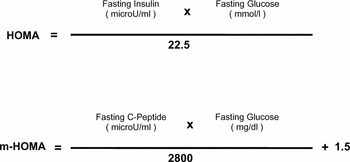
Peripheral IR was calculated both with the homeostasis model assessment (HOMA) formula (Gokcel et al., Reference Gokcel2003) and with the modified-HOMA formula, which is suitable for elderly subjects (Li et al., Reference Li, Zhou, Qi, Chen and Huang2004) (Figure 1).
Homeostasis model assessment (HOMA) and modified-HOMA formulae

All the patients were evaluated through comprehensive geriatric assessment methods (Isik et al., Reference Isik2007) including Mini-mental Status Examination (MMSE), Clock Drawing Test (CDT), Clinical Dementia Rating (CDR), and instrumental activities of daily living (IADL), and diagnosed based on NINCDS-ADRDA and DSM-IV criteria for Alzheimer dementia. In addition, each patient with dementia was evaluated with magnetic resonance imaging (MRI).
Serum samples and assessments were collected at baseline and at 6, 12 and 18 months or until death, entry into an institution, study withdrawal, or loss to follow-up. The patients with dementia were treated with a flexible four-weekly galantamine dose titration regimen up to 24 mg/day. Patients with intolerance to galantamine were excluded.
Statistical analyses were performed using SPSS software version 15.0 (Chicago IL, SPSS Inc). Demographics and baseline characteristics are reported as the number (n) and percentage (%) for nominal variables and as the mean ± SEM for continuous variables. Levene's test was used to evaluate the equality of variance. Differences between the groups were tested for significance by independent samples t test, paired t test, and χ2 test, as appropriate. The relationship between variables was analyzed by Pearson's correlation. Differences and correlations were considered significant at p < 0.05.
Results
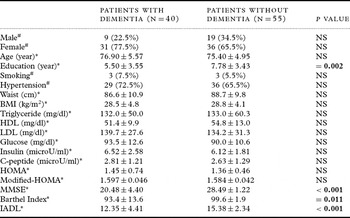
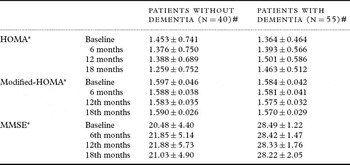
Demographics and baseline characteristics of the subjects are presented in Table 1. All the subjects were weight, waist and BMI stable during the study. MMSE scores and IR indexes of the two groups during the study are presented in Table 2.
Demographics and baseline characteristics of the patients (with and without dementia).

*= Mean ± SD; # = n (%).
BMI = Body Mass Index, HDL = High Density Lipoprotein; LDL = Low Density Lipoprotein; HOMA = Homeostasis model assessment; MMSE = Mini-mental State Examination; IADL = Instrumental Activities of Daily Living.
Changes in patients’ main characteristics during the follow-up period.

*= Mean ± SD.
# = At 18 months, n = 26 for patients with dementia and n = 41 for those without dementia.
HOMA = Homeostasis model assessment; MMSE = Mini-mental State Examination.
At the beginning of the study, all the subjects were euglycemic. Fasting plasma glucose levels in subjects with dementia and without were 93.5 ±12.6 mg/dl and 90.0 ± 10.6 mg/dl, respectively.
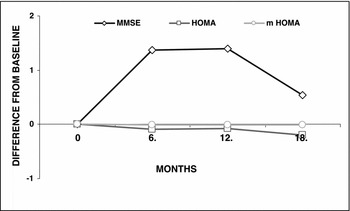
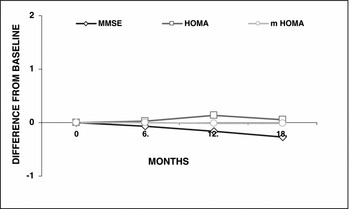
Changes in the mean values of MMSE, HOMA and modified-HOMA scores during the study are shown in Figures 2 and 3. Over three six-month galantamine treatment periods, compared to the baseline values, there was a significant increase at 6 and 12 months in the MMSE and at 6 months in the IADL scores (t = 3.25, p = 0.002 and t = 2.69, p = 0.011 for MMSE; t = 2.03, p = 0.049; for IADL, respectively).
The Mini-mental State Examination (MMSE) scores in patients treated with galantamine increased significantly at 6 and 12 months (p < 0.007 and p < 0.034, respectively), but not at 18 months (p>0.05). The HOMA and the modified-HOMA scores in the galantamine-treated patients did not change significantly during the treatment. There was no correlation between MMSE score and insulin resistance indexes.

The Mini-mental State Examination (MMSE) score among patients without dementia declined slightly during the follow up period but the decline was not significant. The HOMA and modified-HOMA scores in the these patients did not change significantly during follow up periods. There was no correlation between MMSE score and insulin resistance indexes.

In spite of the improvement of cognitive tests by galantamine, HOMA, modified-HOMA and the others parameters related to plasma glucose (fasting plasma glucose, C-peptide and insulin) did not change during the treatment period. No significant correlation was determined between changes in the mean values of MMSE and IR indexes.
As shown in Figure 3, the MMSE score and the IR indexes in the non-demented patients did not change significantly during follow up periods.
Discussion
Several epidemiological studies have suggested that IR is associated with a two- to threefold increased relative risk for AD, independent of the risk for vascular dementia (Leibson et al., Reference Leibson1997; Stolk et al., Reference Stolk1997); However, it was also demonstrated that there was no relation between IR and cognitive function in people categorized according to five forms of cognitive status (Isik et al., Reference Isik2007). In transgenic mouse models of AD, studies show that diet-induced IR promotes amyloidosis suggesting that IR may influence Aβ production in the brain (Gasparini et al., Reference Gasparini, Netzer, Greengard and Xu2002; Ho et al., Reference Ho2004).
Recent studies have shown that the plasma and tissue activities of cholinesterase, which may potentiate both amyloid deposition and the toxicity of amyloid deposits (Reyes et al., Reference Reyes2004), are elevated in patients with Alzheimer's disease and IR (Das, Reference Das2007). Both IR and impaired cortical cholinergic function, however, have accelerated the amyloid deposition in the brain with AD (Ho et al., Reference Ho2004; Reyes et al., Reference Reyes2004; Das, Reference Das2007). Literature reveals no information on the relation between acetylcholinesterase inhibition and IR in LOAD, while this study has demonstrated that acetylcholinesterase inhibition by galantamine does not improve IR but improves the cognition or cholinergic deficit in the patients with LOAD.
Craft et al. have hypothesized that peripheral IR can affect CNS insulin levels, cognition and Aβ levels (Craft et al., Reference Craft, Reger and Baker2006), and butyrylcholinesterase and acetylcholinesterase may be indirectly involved in the pathogenesis of IR in AD (Randel et al., Reference Randel, Mathews, Zhang, Seraj and Sun2005; Houstis et al., Reference Houstis, Rosen and Lander2006; Sharma et al., Reference Sharma2006). In contrast, Hoyer has indicated that in LOAD, damage to the insulin signal transduction cascade may be an early and dramatic event and associated with desensitization via the β-subunit of the insulin receptor in the neuronal insulin signal transduction cascade rather than peripheral IR (Hoyer, Reference Hoyer2004). We think that the latter may be named central insulin resistance.
In AD, brain glucose utilization as well as some key enzymes of glucose metabolism are reduced (Bigl et al., Reference Bigl, Beck, Bleyl, Bigl and Eschrich2000). As insulin, insulin-like growth factors and their receptors, molecules which are known to regulate glucose metabolism in brain, are also affected in AD, it has been hypothesized that insulin-dependent functions may be of pathogenetic relevance in sporadic forms of the disease (Hoyer, Reference Hoyer2004; Frölich et al., Reference Frölich1998, Bernstein et al., Reference Bernstein1999). A relationship between glucose metabolism and cholinergic transmission and β-amyloid has also been derived from animal experimental approaches suggesting functional links between cortical cholinergic activity and glucose metabolism in cholinoceptive target regions (Bigl et al., Reference Bigl, Apelt, Eschrich and Schliebs2003). In addition, Randell et al. suggested that levels of serum butyrylcholinesterase may be related to IR (Randel et al., Reference Randel, Mathews, Zhang, Seraj and Sun2005). For these reasons, an investigation of whether there is a relation between inhibition of cholinesterases and IR in the patients with LOAD is not a fishing expedition. It has been also thought that IR in the brain may be more important than peripheral IR in LOAD. Regarding this issue, it was demonstrated that peripheral IR indexes in patients with LOAD were similar to the IR indexes of the subjects in the control group, as shown in our previous study (Isik et al., Reference Isik2007). In addition, galantamine did not affect IR indexes over the 18-month period although it improved the cognitive function in the patients with LOAD compared to their baseline values. These results indicated that cholinergic deficit and IR may play a role in the pathogenesis of LOAD by different mechanisms. Perhaps inhibition of butyrylcholinesterase as well as acetylcholinesterase should also be evaluated in order to determine the interaction between cholinesterase inhibition and IR in LOAD. To evaluate this topic, currently, we have an ongoing clinical study investigating the effect of rivastigmine treatment on IR in LOAD.
The patients with AD have reduced cerebral production of choline acetyl transferase, which leads to a decrease in acetylcholine synthesis and impaired cortical cholinergic function. This led to the study of therapeutically augmenting cholinergic activity. With this purpose, cholinesterase inhibitors, which increase the amount and residence time of ACh at ACh receptors within the brain, are the primary medications used to treat AD (Wilkinson et al., Reference Wilkinson, Francis, Schwam and Payne-Parrish2004). In this study, beneficial effects of galantamine were demonstrated with MMSE and IADL. The changes from the baseline in MMSE and IADL scores were better at 6, 12 and 18 months as in our previous study (Isik et al., Reference Isik, Celik, Bozoglu and Doruk2009). However, the differences in IADL at 6 months and in MMSE at 6 and 12 months were statistically significant. In contrast to the literature (Cummings et al., Reference Cummings, Schneider, Tariot, Kershaw and Yuan2004), the improvements in the MMSE and IADL scores were still above the baseline levels at 18 months, which may be due to the fact that all the patients were highly selected and the patients with dementia had mild to moderate LOAD. This again demonstrates how important the initiation of the cholinesterase inhibitors is as early as possible. The MMSE and IADL scores at 6, 12 and 18 months were compared with baseline values of the same patients because treatment with placebo after the diagnosis of LOAD was considered unethical.
In this study, IR indexes were measured using two different mathematical methods in those without diabetes mellitus and morbid obesity, and all the patients of this study were normoglycemic; Ferrara and Goldberg, however, indicated that HOMA should not be used as an index of IR in older patients who may be at risk for impaired glucose tolerance (Ferrara and Goldberg, Reference Ferrara and Goldberg2001). The present IR indexes were lower than cut-off levels of Turkish adults compared to the previously reported results for Turkish population (Gokcel et al., Reference Gokcel2003). This may be because of the fact that our patients were highly selected. Measuring IR by hyperinsulinemic-euglycemic clamp might be preferable, but these indexes were found to be useful, practical and non-invasive methods for the geriatrician to diagnose IR in older patients without impaired glucose tolerance.
Although 40 people with late onset AD constitute a seemingly small sample group that may weaken the power of the study; it must be pointed out that this sample group comprised highly selected patients, and this was the first study to evaluate interaction between inhibition of acethylcholinesterase and insulin resistance in patients with LOAD.
In summary, galantamine was effective in elderly patients with LOAD without changing IR over 18 months. Due to the complexity of disease pathogenesis, it is too early to make general comments, and further longitudinal and long-term studies in the larger population on this issue are needed. Ameliorating cognitive performance, galantamine had no effect on the peripheral IR in the patients with LOAD, which was not clearly demonstrated in earlier studies. Unlike the findings of other studies, in LOAD, intracerebral IR may be more important than is peripheral IR, and neuronal IR and cholinergic deficit may play a role in the pathogenesis of the disease by different mechanisms.
Conflict of interest
None.
Description of authors' roles
Ahmet Turan Isik designed the study. Both authors collected the data, undertook the statistical design and analysis, and wrote the paper.