

1. Introduction.
Dutch, English, and German determiners differ with respect to the amount of information they carry. Out of these three languages, only German determiners are specified for case, and in addition, they are also specified for gender and number. “Specified for” is used here to indicate that there are certain form distinctions that can be related to a specific distinction in function. Dutch determiners are specified for gender and number, whereas English determiners are not. All three languages distinguish between so-called definite (the) and indefinite (a) determiners.
This realization of case, gender, number, and definiteness on the determiner relates to different levels of linguistic information. Simplifying somewhat, one could say that case is a syntactic notion, gender and number are lexical (or semantic) notions, while definiteness is related to information structure, or discourse. A more detailed discussion follows in section 2.1.
These linguistic levels (that is, syntax, lexicon, and discourse) are not equally impaired in aphasia, a language disorder caused by focal brain damage. There are different types of aphasia, with different symptoms. Speakers with agrammatic aphasia have been claimed to suffer from a specific syntactic disorder (see, among others, Avrutin 2006, Friedmann 2006, Grodzinsky 2000, and Ruigendijk 2002). For this reason, linguists have been interested in the language performance of these speakers, assuming that studying this performance can be used as a window into the healthy language system (see, for instance, Grodzinsky 1990).
Agrammatic aphasic speakers have problems with, among other things, determiners (see Ouhalla 1993, Saffran et al. 1989, Ruigendijk et al. 1999, Ruigendijk 2002, Ruigendijk & Friedmann 2008). We compare the use of determiners by agrammatic speakers of German, Dutch, and English taking into account the different properties (such as case, gender, and definiteness) of these elements in the three languages. This allows us to examine the influence of these different properties on the speakers’ performance. More specifically, one could ask: What is causing the vulnerability of this class of elements in agrammatism? Answering this question cannot only provide us with a better understanding of agrammatism; it may also shed some light on why German, Dutch, and English determiners developed the way they did. Agrammatic performance data may provide insight into what grammatical elements and what structures are particularly vulnerable in a language. Combining these data with data from language acquisition, as well as diachronic cross-linguistic data, may be a fruitful way of exploring language evolution phenomena (see Jackendoff 1999, Botha 2004a,b).
2. Overview: Determiners and Agrammatism.
2.1. Properties of DPs in German, Dutch, and English.
Noun phrases in Dutch, German, and English generally need a determiner, as is illustrated in 1. There are exceptions to this rule: mass nouns and plural count nouns do not require a determiner as shown in 2 and 3, respectively. Nevertheless, one could say that in general a determiner completes the noun phrase. Abney's (1987) DP-analysis goes even further, stating that the determiner heads the noun phrase, hence the abbreviation DP (Determiner Phrase).
(1) Singular count nouns
a.

b.
c.
(2) Mass nouns
a.
b.
c.
(3) Plural count nouns
a.
b.
c.

The advantage of the DP-analysis is that it can explain many similarities between determiners and pronouns, for instance the fact that both can carry gender, number, and case information. This study focuses on elements that can head a DP, namely determiners, and to a somewhat lesser extent also pronouns. Both types of elements, of course, consist of a few subcategories (see Haeseryn et al. 1997 for specific information in Dutch). As far as determiners are concerned, this study focuses on articles, and demonstrative and possessive pronouns. As far as pronouns are concerned the focus is on personal and demonstrative pronouns.Footnote 1 When the term DP or determiner is used below it is meant to refer to these subcategories.
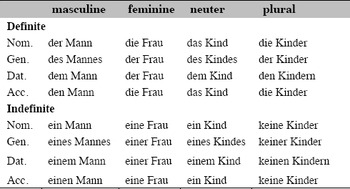
As mentioned in the introduction, the amount of functional information carried by determiners depends on the individual language. German determiners are specified for number, gender, case, and definiteness, Dutch determiners are specified for number, gender, and definiteness, while English only distinguishes between definite and indefinite determiners. The three languages differ with respect to the amount of information the determiner carries. English determiners have the least of information load, German—the most. German and Dutch mainly differ with respect to case information. For example, English only has the as the definite and a as the indefinite article. Dutch has two types of definite article, de and het, for common and neuter gender respectively, and only one indefinite article, een. German has three different definite articles for the nominative case: die, der, and das for feminine, masculine, and neuter, respectively. The same distinctions exist for the indefinite articles. See table 1 for the complete German paradigm for the nouns Mann ‘man’, Frau ‘woman’, Kind ‘child’, and Kinder ‘children’.
German article paradigm.

Determiners in German and Dutch, but not in English, carry gender information. Pronouns are specified for gender in all three languages. In German and Dutch, the gender on a determiner depends on the lexically specified gender of the noun it belongs to. Gender on pronouns is usually seen as a semantic property in Dutch and English. It mainly depends on the gender of the antecedent it refers to. The pronouns hij and he refer to masculine persons (and animals), whereas the pronouns zij or she are used for female persons. When referring to objects, the important factor is whether or not they are countable. Countable objects are referred to by means of hij or he, whereas neutral het or it are used for uncountable objects (see, among others, van Haeringen 1956). For German pronouns the situation is different. Here the gender of the pronoun depends on the lexically specified gender of the noun it refers to. Thus, to replace the DP das Mädchen ‘girl-DEF.NEUT.NOM’ the neutral pronoun es is used.
Two types of case can be distinguished: abstract (also: syntactic) case and morphological case. Of course, more distinctions can be made, that is between syntactic/structural case and inherent/lexical and/or semantic case, but a discussion of these would exceed the scope of this paper. Following Chomsky 1981, all languages have case. Complete noun phrases, (that is, DPs) must have case (this is the Case Filter); without case, there cannot be a complete noun phrase (see Chomsky 1981, 1986, Ouhalla 1993, Giusti 2006). This implies that complete noun phrases are dependent on case (in the abstract sense), and hence on the presence of a proper case assigner. Nominative case is assigned to the subject by the finite verb of the clause, as can be seen in 4. The finite verb, wird ‘will’, assigns nominative case to the subject of the sentence, der Mann ‘the man’. Objects receive the accusative case from the verb of the sentence: the verb retten ‘save’ assigns accusative case to the object, den Jungen ‘the boy’.Footnote 2
- (4)
a.
b.
Languages differ with respect to the morphological realization of this abstract case. In some languages, case is never realized morphologically, while in other languages, such as Dutch and English, case is only visible on the pronoun (see 4b). In many other languages, case is specified morphologically on the noun phrase, either as a suffix on the noun, as in Russian or Hungarian (which is referred to as “suffix” case), or via the determiner, as in German (which is referred to as “analytic” or “periphrastic” case), or both.
2.2. Agrammatism.
Agrammatism is often characterized by “the omission of grammatical morphemes, reduced phrase length, the omission or nominalisation of verbs, and difficulties with word order” (Caramazza & Berndt 1985:33). More specifically, agrammatic speech production is characterized by problems with the realization of verbs, finiteness, and prepositions (see, among many others, Saffran et al. 1989), as well as problems with the production of determiners, pronouns, and case morphology (Ouhalla 1993, Ruigendijk et al. 1999, Ruigendijk 2002). In other words, agrammatic speakers have problems with those categories that assign case, as well as with elements that require case.
How can the problems with determiners and pronouns be explained? There are, in principle, four possibilities with regard to the realization on these elements in agrammatism:Footnote 3
(i) The information load a determiner carries does not play a role. Problems with determiners arise because they head DPs and/or are dependent on case assignment. The expectation is that there are no differences between the three languages, and that determiners and pronouns, which can both be heads of DPs, show the same pattern.
(ii) The higher the information load, the more difficult it is to process a determiner. This would predict that most determiners are omitted in German, less in Dutch, and even less so in English agrammatism.
(iii) The information load renders a determiner less vulnerable (based on the idea that the more information it carries, the more salient it is, see, for example, Bates et al. 1991). This would predict the opposite pattern from b), namely, that most determiners are omitted in English, less in Dutch, and the least in German agrammatism.
(iv) There is one specific feature for which determiners are specified that is more problematic than the other features. If this feature is gender, then German and Dutch should pattern together, such that more determiners are omitted in these languages than in English. If this feature is case, then English and Dutch should pattern together, such that most determiners are omitted in German.
As mentioned before, agrammatism has often been claimed to be the result of an underlying syntactic disorder (see Grodzinsky 1990, Friedmann 2001, 2006). If this is correct, then no problems with case morphology as such are expected and no cross-linguistic differences with respect to abstract case should arise (that is, possibility a). For, if all languages have abstract case, all languages have the Case Filter, and hence in all languages complete noun phrases require case.
This hypothesis has been investigated in a series of studies. More specifically, it has been tested whether there is indeed a relationship between the realization of complete noun phrases (that is, determiners) and the realization of case assigners such as (finite) verbs (Ruigendijk et al. 1999, Ruigendijk & Bastiaanse 2002, Ruigendijk 2002, Ruigendijk & Friedmann 2008). The results of these studies showed that when the syntactic preconditions were met, that is, when the proper case assigner was realized, then determiners were more often produced than omitted, and this held for both Dutch and German. However, when syntactic preconditions were not met, that is, when there was no proper case assigner present, more determiners seemed to be omitted in German than in Dutch.
Consequently, the following question arises: is there a real difference between the German and Dutch data, or, is the difference that was found caused by methodological limitations? In these studies, not all data that were analyzed for these languages were elicited by the same task. Some studies used spontaneous speech, while others used elicited speech. More importantly, the severity of the language impairment of the participants was not controlled for in these studies, since they were not designed to compare the languages directly.
To investigate whether German agrammatic speakers omitted more determiners than Dutch agrammatic speakers, a new study was performed (Ruigendijk 2007). In this study, the spontaneous speech of two closely matched groups was compared with respect to the number of pronouns, determiners, and noun phrases that were realized. The results revealed very clearly that when the data set was highly comparable and the speakers were affected by agrammatic aphasia to the same degree, German agrammatic aphasics still omitted significantly more determiners than Dutch agrammatic aphasics. Moreover, hardly any gender, case, or definiteness substitution errors were found in the data, neither on determiners nor on pronouns, and that held for both groups. A possible explanation for the different determiner omission rates is that German determiners are morphologically specified for case, whereas Dutch determiners are not, and that this case morphology makes the processing of determiners somewhat more difficult. The fact that no difference in the number of pronouns is found (which are morphologically specified for case in both languages) suggests that this explanation (see possibility d) is on the right track.
These results suggest that structural case assignment as such remains unaffected, and that the omission of determiners and pronouns is due to a problem with case assigners, such as verbs, and the notion of finiteness (for instance, Ruigendijk 2002, Ruigendijk & Friedmann 2008). However, these results also suggest that morphological case may be problematic as well, as indicated by the higher omission rate in German. Results from elicited sentence production tasks also hint at problems with morphological case. Both German and Russian agrammatic aphasic speakers made case substitution (but hardly any omission) errors in elicitation tasks in which the case assigner was provided (Ruigendijk 2002).
In the present study, we add one language to the analysis, namely English, to test the hypothesis that case morphology makes the determiner more vulnerable in German. Since English determiners are not marked for case, English is expected to pattern with Dutch.
3. Methodology.
To test the hypothesis, spontaneous speech data of eight Dutch-speaking, seven German-speaking, and seven (American) English-speaking a-grammatic aphasics was analyzed.Footnote 4 For each subject, 300 words of spontaneous speech were transcribed. For those speakers for whom less than 300 words were available, the data were converted as follows: the score was divided by the actual number of words that were analyzed and then multiplied by 300 to estimate the speakers’ scores for 300 words to enable a comparison with the other samples.Footnote 5
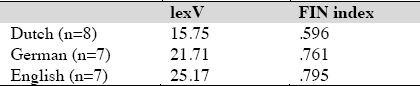
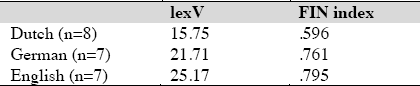
The three groups were matched on the number of lexical verbs and the finiteness index. This was done to ensure that the groups did not differ in severity of the language impairment. The finiteness index is calculated in the following way: count the number of utterances with a verb, then count the number of these utterances that have a finite verb.Footnote 6 Divide the last number by the first, which results in a number between 0 and 1, the finiteness index. A score closer to 1 means relatively few problems with finiteness, while a score closer to 0 suggests relatively more problems with finiteness.
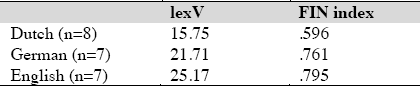
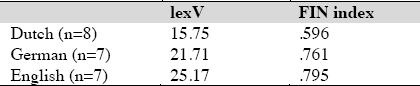
Furthermore, the Dutch and German participants were matched by severity on the basis of the Aachen Aphasia Battery (subtests: Token Test, repetition, and naming). Unfortunately, the data obtained by means of this diagnostic test were not available for the English group. The number of lexical verbs and the finiteness index reflect key characteristics of agrammatic aphasia cross-linguistically (see, among others, Bastiaanse et al. 2003, Friedmann 2001), namely problems with verbs and problems with finiteness. The group means on these two variables are shown in table 2. Mann-Whitney U tests revealed no significant differences between the three groups on either measure (p>0.05).
Mean scores on number of lexical verbs (lexV) and finiteness (FIN) index.
All data were then analyzed in the same way. The number of pronouns, nouns, nouns that require a determiner (NRD), number of NRD with and without determiner, and the determiner/noun ratio were examined for each speaker. The determiner/noun ratio was calculated by dividing the number of nouns (NRD) with a determiner by the number of nouns that require a determiner (NRD). This lead to a number between 0 and 1, where 0 reflects the complete absence of obligatory determiners and 1 reflects the presence of all obligatory determiners.
4. Results.
The results are presented in table 3. As can be seen, the number of pronouns, nouns, and nouns requiring a determiner did not differ among the three groups. This was confirmed by a Kruskall-Wallis test (pronouns: Chi-Square=2.203, p=.332; nouns: Chi-Square=2.803, p=.246; NRD: Chi-Square=3.936, p=.140; NRD without: Chi-Square=2.763, p=.251). This remained basically the same for pair-wise comparisons performed between two groups (Mann Whitney test, all but two p-values for these comparisons are >0.5). The two exceptions were that German speakers used more NRD without determiners than the Dutch speakers, Z=-1.918, p=.055, and that English speakers used more NRD than the Dutch speakers, Z=-1.865, p=.062. These results do not change the overall pattern in which German differs from Dutch and English with respect to determiner omission.
Mean number of pronouns, nouns, NRD, NRD with and without a determiner, and the determiner/noun ratio.
The det/noun ratio (see table 3), however, did show an effect (Kruskall-Wallis Test, Chi-Square=5.691, p=.053, Monte Carlo significance). Due to the small groups and hence small statistical effects, we choose to use conservative statistical tests, but in order not to overlook any possibly relevant effects, we choose not to ignore marginally significant effects (that is, p<0.10). Therefore, we performed posthoc Mann-Whitney U tests on this marginally significant value anyway. German agrammatic speakers omitted more obligatory determiners than the Dutch and Eng-lish agrammatic speakers (pair-wise comparisons with Mann-Whitney U tests, tested one-sided: German compared to Dutch Z=-2.317, p=.011; German compared to English Z=-1.727, p=.042). The latter two groups did not differ significantly from one another with respect to the det/noun ratio (Z=-.232, p=.867), suggesting similar problems with these elements in Dutch and English agrammatism.
A tendency was also found for NRD with determiner (Kruskall-Wallis Test, Chi-Square=5.326, p=.07), which was caused by a relatively higher number of NRD with a determiner in the English group than in the German group (pair-wise comparison with Mann Whitney U test: Z = -1.981, p< .05).Footnote 7
5. Discussion.
The data support the hypothesis that the relatively more severe problems that German-speaking agrammatic aphasics have with the realization of obligatory determiners are (at least partly) caused by the presence of case morphology on these elements. The examination of three groups of carefully matched agrammatic aphasic speakers shows that English- and Dutch-speaking agrammatic aphasiacs exhibit the same pattern, both groups revealing significantly less determiner omissions than the German group. Therefore, gender information on the determiner can be excluded as the cause of the problem with determiners. Since both Dutch and German, but not English determiners carry gender information, which is more specified in German than in Dutch, Dutch agrammatic speakers would have been expected to omit more determiners than the English speakers if gender were the problem. This can be dismissed on the basis of the data presented here.
It is also clear that the chance of omission is not smaller as a morpheme carries more information, as has been suggested by Bates et al. (1991). If that were the case, then English agrammatic speakers should omit most determiners, more than Dutch agrammatic speakers, who, in turn, are expected to omit more determiners than German agrammatic aphasics. Note, however, that the opposite does not hold either. The data cannot be explained in terms of the information load alone as a complicating factor. If information load were complicating the realization of determiners, then German should be more difficult than Dutch which, in turn, should be more difficult than English. This state of affairs is clearly not reflected in the data.
The comparison of German, Dutch, and English agrammatic language production data shows that determiners are vulnerable in all three languages, which can be explained by the fact that determiners, like pronouns, are the head of the DP, and hence their presence depends on case assignment (see section 2.1). Since the ability to produce case assigners (that is, verbs, finiteness, prepositions) is impaired in agrammatism, the ability to produce elements that depend on these case assigners is impaired as well (see Ruigendijk et al. 1999, Ruigendijk 2002, Ruigendijk & Friedmann 2008). However, apparently this cannot be the whole explanation, since that should result in similar determiner omission rates across languages. The fact that German determiners are omitted most often suggests that case morphology makes determiners even more vulnerable than they already are.
There is more evidence for this explanation. First, no significant difference is found with respect to the number of pronouns realized by the three groups. Since the kind of information for which pronouns are specified, namely case, person, gender, and number, is the same in all three languages, no difference is expected among these languages with regard to the production of pronouns.Footnote 8
The second piece of evidence comes from elicited sentence production tasks, in which it has been shown that when the case-assigning category is given, production of DPs is still not completely unproblematic in agrammatic aphasia. In elicited sentence production, hardly any omission errors are made, but in German and Russian agrammatism case substitution errors do occur (quite often accusative case is used instead of dative case, see Ruigendijk 2002). Crucially, agrammatic speakers of Russian, which has a suffix case system unlike German, hardly ever omit case morphology, neither in elicitation nor in spontaneous speech (Ruigendijk 2002).
Third, there is also evidence pointing at a specific difficulty of case on determiners, which is also called periphrastic case. It has been argued, for instance, that suffix case (for example, case marking via a suffix on the noun, as in Russian) is acquired somewhat earlier than periphrastic case (Eisenbeiss et al. 2008).
Returning to the idea that agrammatic production data may provide us with a window into the language system (see Botha 2004a,b), it is interesting to note that this periphrastic case system, that is, case marking on determiners, did exist in older variants of Dutch as well, but disappeared in the fifteenth century. The data used in the current study do not necessarily imply that the German case system might disappear eventually, as it has in Dutch and English. That would be an over-simplification, since there are definitely more factors that play a role in this. The results of the agrammatic speakers combined with the findings from language acquisition (Eisenbeiss et al. 2008) do suggest, however, that case morphology on determiners is—for some reason—difficult. It is apparently more difficult to acquire than suffix case, and it leads to more omissions in agrammatic speech production.