Introduction
Many of the most serious agricultural pests have very broad geographical distributions and encounter a great diversity of environmental conditions in different localities (Tauber et al., Reference Tauber, Tauber and Masaki1986). Therefore, genetic differences must exist as a result of adaptation to local conditions. To date, geographical variation in life-history traits has been reported in a large number of insect species. Populations along a latitudinal gradient often show biological gradients in larval development time, body size, and growth rate (Masaki, Reference Masaki1967; Roff, Reference Roff1980; Gotthard et al., Reference Gotthard, Nylin and Wiklund1994; Bidau and Martia, Reference Bidau and Martía2007; Chown and Gaston, Reference Chown and Gaston2010; Kivelä et al., Reference Kivelä, Välimä, Carrasco, Maenpaa and Oksanen2011; Barton et al., Reference Barton, Sunnucks, Norgate, Murray and Kearney2014; Parsons and Joern, Reference Parsons and Joern2014; Xiao et al., Reference Xiao, He, Huang, Geng, Fu and Xue2016; Tang et al., Reference Tang, He, Chen, Fu and Xue2017; Chen et al., Reference Chen, Yang, Xue and Xia2019). A geographical difference in life-history traits is also an inherited characteristic. Studies on intraspecific hybridization between separate geographic populations are often desirable to reveal how life-history traits are inherited and to help us understand the evolution and maintenance of these traits.
Colaphellus bowringi (Coleoptera: Chrysomelidae), the cabbage beetle is widely distributed in China and is considered one of the major pests of Cruciferae plants throughout its distribution range (Zhang and Zhao, Reference Zhang and Zhao1996). This beetle generally feeds on the developing leaves of crucifers and aestivates and hibernates in the soil in the adult stage (Xue et al., Reference Xue, Li, Zhu, Gui, Jiang and Liu2002a). The seasonal life cycle of the cabbage beetle is complex, and the beetle exhibits considerable diversity in life history, especially between its southern and northern populations. The environmental conditions experienced by parents can determine offspring phenotypes (He et al., Reference He, Xiao and Xue2018). The southern populations show a short-day response and enter diapause under long day lengths, whereas the northern populations lack a photoperiodic response, and diapause induction completely depends on temperature (Lai et al., Reference Lai, Yang, Wu, Zhu and Xue2008). The low-latitudinal southern populations have four generations per year with summer and winter diapause, one generation in spring, and three generations in autumn (Xue et al., Reference Xue, Li, Zhu, Gui, Jiang and Liu2002a, Reference Xue, Spieth, Li and Hua2002b), whereas the high-latitudinal northern populations usually have one generation and a winter diapause (Hu et al., Reference Hu, Yu, Sun and Xue2008). The southern populations lay significantly more eggs than the northern populations (Liu et al., Reference Liu, Tu, He, Chen and Xue2014); they have a shorter larval developmental time and greater body weight than the northern populations (Tang et al., Reference Tang, He, Chen, Fu and Xue2017). The inheritance of diapause in the cabbage beetle has been investigated by crossing a low-latitudinal population (entering diapause in response to a short photoperiod) with the high-latitudinal northern population (entering diapause regardless of photoperiod) (Lai et al., Reference Lai, Yang, Wu, Zhu and Xue2008; Chen et al., Reference Chen, Xiao, He, Xu and Xue2014). The hybrid population with southern mothers showed a short-day response, but the hybrid population with northern mothers had no photoperiodic response, indicating that the photoperiodic induction of diapause is influenced by maternal genotype. The incidence of diapause in hybrids was intermediate between those of their parents, with the female parent exerting a greater effect on diapause incidence than the male parent (Chen et al., Reference Chen, Xiao, He, Xu and Xue2014). These significant differences in phenotype between southern and northern populations of C. bowringi provide an excellent resource to study the inheritance of life-history traits in this species.
Development time, body size, growth rate and fecundity are closely related to life-history traits in insects. These traits typically reflect adaptation to the environment (Nylin and Gotthard, Reference Nylin and Gotthard1998). However, there are few data in relation to the inheritance of these traits (Ghosh and Joshi, Reference Ghosh and Joshi2012; Tsuchiya et al., Reference Tsuchiya, Takami, Okuzaki and Sota2012; He et al., Reference He, Tang, Huang, Gao and Xue2019). Most studies of intraspecific hybridization focus on mating compatibility between different geographical populations (Cayol et al., Reference Cayol, Coronado and Taher2002; Schug et al., Reference Schug, Baines, Killon-Atwood, Mohanty, Das, Grath, Smith, Zargham and Mcevey2008; Taret et al., Reference Taret, Sevilla, Wornoayporn, Islam, Ahmad, Caceres, Robinson and Vreysen2010; Jennings et al., Reference Jennings, Mazzi, Ritchie and Hoikkala2011; Liu et al., Reference Liu, Tu, He, Chen and Xue2014; Iranipour et al., Reference Iranipour, BenaMolaei, Asgari and Michaud2015).
In the present study, we conducted a reciprocal mating experiment between a southern Xiushui population (S population) and a northern Shenyang population (N population) of C. bowringi under a wide range of temperatures. The S population is a short-day species undergoing an imaginal summer and winter diapause. However, its photoperiodic response mainly depends on temperature. All individuals enter diapause at ≤20°C regardless of photoperiods. High temperatures strongly weaken the diapause-inducing effects of long daylengths (Xue et al., Reference Xue, Spieth, Li and Hua2002b). In the field, there are two distinct infestation peaks per year, one in spring between March and April with one generation and a second in autumn between late August and October with three generations (Xue et al., Reference Xue, Li, Zhu, Gui, Jiang and Liu2002a). The N population has an annual life history; one generation is produced in summer between May and June, and then newly emerged adults enter diapause after several days of feeding. Its diapause incidence is determined by temperature and is independent of photoperiod; almost all individuals enter diapause even at 28°C (Tang et al., Reference Tang, He, Chen, Fu and Xue2017). We investigated the larval development time, body weight, growth rate, sexual size dimorphism (SSD) and fecundity between the two separate pure populations and their two hybrid populations, and then used their life-history traits to analyze whether hybrids exhibit some advantages over individuals from pure parental populations.
Materials and methods
Populations of C. bowringi
The S and N populations were from Xiushui County (29°1′N, 114°4′E) in Jiangxi Province (China) and from Shenyang city (41°48′N, 123°23′E), Liaoning Province (China), respectively. The daily mean temperature experienced by the S population was below 20°C in spring and was between 28 and 17°C in autumn. The daily mean temperature experienced by the S population was below 20°C in May and above 20°C in June when the insect was active in the field.
Naturally diapausing C. bowringi adults of the two populations were collected from vegetable fields between late March and mid-May in 2018 and were reared on Chinese cabbage leaves (Brassica chinensis) under natural conditions for several days, and then they were transferred to glass bottles (diameter: 50 cm; height: 180 cm) containing soil in which they could burrow and become dormant. Those bottles were placed outdoors at Jiangxi Agricultural University, Nanchang, Jiangxi Province (28°46′N, 115°59′E). When the postdiapause adults emerged from the soil in spring 2019, we sexed them immediately and placed males and females separately in Petri dishes (height 2 cm; diameter 9 cm) lined with filter paper and fresh Chinese cabbage leaves so that we could ensure that the beetles used in experiments were virgins. Females were allowed to mate with males from either the same population or a different population. The Petri dishes were cleaned by replacing the filter paper and fresh Chinese cabbage leaves daily.
Crosses and measurement methods
Pure populations and reciprocal parental crosses were made as follows (females shown on the left, males on the right): S × S, N × N, S × N, and N × S. At least 30 pairs were used in each cross. The eggs produced by these pairs were collected for experiments. At the same time, we recorded the egg production of each pair that survived more than 20 days after the postdiapause adults emerged from the soil at 22°C. The numbers of pairs observed were 20 pairs for the S and N populations, 16 pairs for the S × N population, and 15 pairs for the N × S populations. The progenies of these crosses were fed mature leaves of Chinese cabbage in transparent plastic boxes (17.5 × 12.5 × 6.5 cm) under an LD photoperiod of 15:9 h at 19, 22, 25, and 28°C until pupation. The boxes were cleaned daily and supplied with new food as needed. The time of pupation was recorded and new pupae were placed individually in cell culture plates with 12 holes for adult eclosion (for each hole: diameter: 2.4 cm; height: 2 cm). Time of adult eclosion was recorded daily. Unless otherwise stated, each experimental unit was tested by rearing four to six replicates of at least 50 newly hatched larvae per replicate.
For all the individuals, we recorded the following traits: development time from hatching to pupation and from pupation to adult eclosion, pupal and adult weights, growth rate, proportional weight loss at metamorphosis, and SSD. Pupae were weighed on the day following pupation, and adults were weighed after the release of the meconium. We used an electric balance (AUY120, SHIMADZU Corporation, Japan).
Growth rate was calculated as ln pupal weight/larval development times (Gotthard et al., Reference Gotthard, Nylin and Wiklund1994). Weight loss between pupation and adult eclosion was calculated using the following formula: proportion weight lost = l-(adult weight/pupal weight). The SSD for both pupae and adults was estimated for each population and temperature using the Lovich and Gibbons (Reference Lovich and Gibbons1992) sexual dimorphism index, in which SSD = (size of the larger sex/size of the smaller sex)–1. Overall, 2858 offspring from four populations were raised to adulthood and weighed.
All experiments were performed in illuminated incubators (LRH-250-GS, Guangdong Medical Appliances Plant, Guangdong, China). The light intensity during photophase was approximately 1.97 W m−2, and the variation in temperature was ±1°C.
Statistical analysis
Statistical analyses were conducted using SPSS 17.0 statistical software package (IBM, www.ibm.com). For the analysis of life-history traits, a mixed linear model was used, in which temperature, population, and sex were treated as fixed main effects and rearing box was treated as a random effect. The full model with all possible interaction terms was performed at first; the non-significant three-way term (population × temperature × sex) was dropped from the final model in the analysis.
One-way analysis of variance (ANOVA) was used to test the effects of crossing types on fecundity (measured by counting the number of eggs per female) and to determine whether there were significant differences in life-history traits between different populations at each temperature. One-way ANOVA and Tukey's test were used to compare the differences in life-history traits between sexes in each population and at each temperature.
Results
Fecundity
The fecundity of C. bowringi was evaluated by the mean egg production per female in crosses involving beetles from the S (pure southern population), N (pure northern population), S × N, and N × S (hybrid populations) populations at 22°C. Mean egg production varied among the four cross types (F 3, 67 = 46.02, P < 0.001) (fig. 1). Fecundity was highest in the S population with an average of 852 eggs produced per female, followed by the S × N population with 740 eggs per female on average, the N × S population averaging 277 eggs per female, and the N population with a mean of 242 eggs per female. This indicates that fecundity in the hybrid populations was intermediate between those of their parents. There was no significant difference in fecundity between the S and S × N populations and between the N and N × S populations (P > 0.05), suggesting that fecundity is mainly influenced by the maternal genotype.
Fecundity of the pure populations (the southern SS population and the northern NN population) and their hybrid populations (the S♀ × N♂ and N♀ × S♂ populations) in Colaphellus bowringi. Error bars indicate SE.

Development time
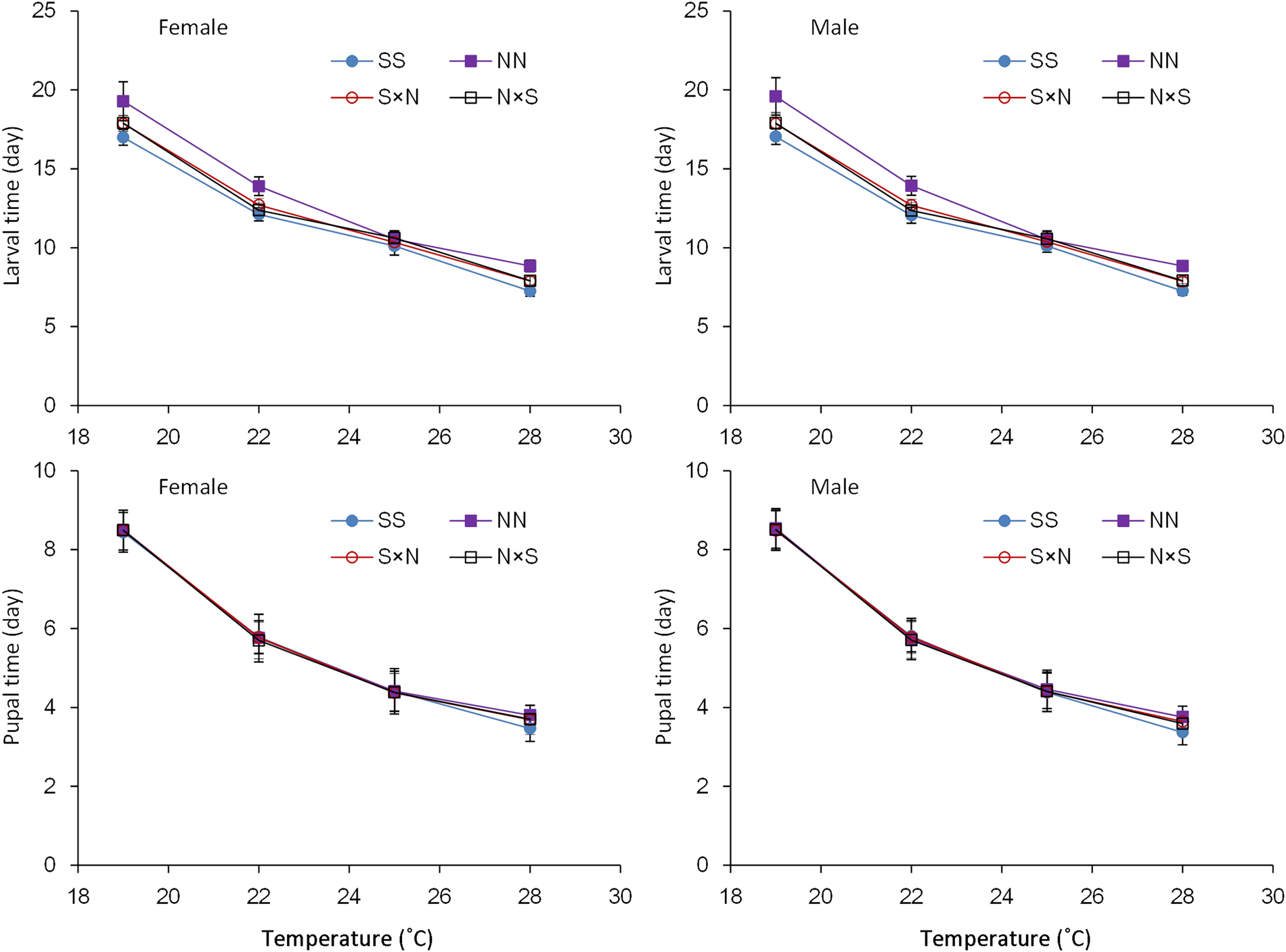
Larval development time was significantly affected by population, temperature, and their interactions (population × temperature) (table 1). Larval development time was not significantly different between the sexes (table 1, P > 0.05). In all populations, larval and pupal development times decreased significantly as rearing temperature increased (fig. 2, see also table S1). Larval development time for both sexes was shortest in the S population, followed by the S × N, N × S, and N populations at almost all temperatures, showing that larval development times in hybrid populations were intermediate between those of their parents (fig. 2, see also table S2). There were significant differences between the S population and the S × N, N × S, and N populations at almost all temperatures (see S2 table). There were no significant differences in pupal development time among the four populations at 19, 22, and 25°C (P > 0.05). However, pupal development time for both sexes was significantly shorter in the S population than in the S × N, N × S, and N populations at 28°C (P < 0.05) (fig. 2, see also S1 table).
Results from a linear mixed-model analysis of fixed effects on larval time, pupal time, pupal weight, and growth rate in Colaphellus bowringi in relation to temperature, population, and sex

Larval and pupal development time of the pure populations (the southern SS population and the northern NN population) and their hybrid populations (the S♀ × N♂ and N♀ × S♂ populations) in Colaphellus bowringi. Error bars indicate SD.

Pupal weight and growth rate
Population, temperature, sex, and their interaction (population × sex) significantly affected pupal weight (P < 0.001) (table 1). In all populations at each temperature, female pupae were significantly larger than male pupae (P < 0.05, see S1 table), showing a female-biased SSD. Pupal weight for both sexes in all populations gradually decreased as rearing temperature increased from 19 to 28°C (fig. 3a, see also S1 table). There were significant differences in pupal weight among populations at all temperatures (table 1, see also table S2). Pupal weight for both sexes was greatest in the S population, followed by the S × N, N × S, and N populations at all temperatures, showing that pupal weight in hybrid populations was intermediate between those of their parents (fig. 2a, see table S2). Pupal weight was significantly higher in the S population than in the N population at all temperatures (P < 0.05, see table S2). Pupal weight was significantly higher in the S × N population than in the N × S population at all temperatures (P < 0.05, see table S2), indicating that the female parent plays a greater role in determining pupal weight than the male parent.
Pupal weight and larval growth rate of the pure populations (the southern SS population and the northern NN population) and their hybrid populations (the S♀ × N♂ and N♀ × S♂ populations) in Colaphellus bowringi. Error bars indicate SD.

Population, temperature, and sex also had a significant impact on the growth rate of C. bowringi (P < 0.001), and there were significant interactions between population and temperature and between temperature and sex (P < 0.001) (table 1). The growth rate for both sexes in all populations increased significantly as rearing temperature increased (fig. 3b, see also table S1). There were significant differences in growth rate among populations (table 1, see also table S2). Growth rate for both sexes was highest in the S population, followed by the S × N, N × S, and N populations at all temperatures, showing that the growth rate in hybrid populations was intermediate between those of their parents (fig. 3b, see also table S2).
Adult weight and weight loss
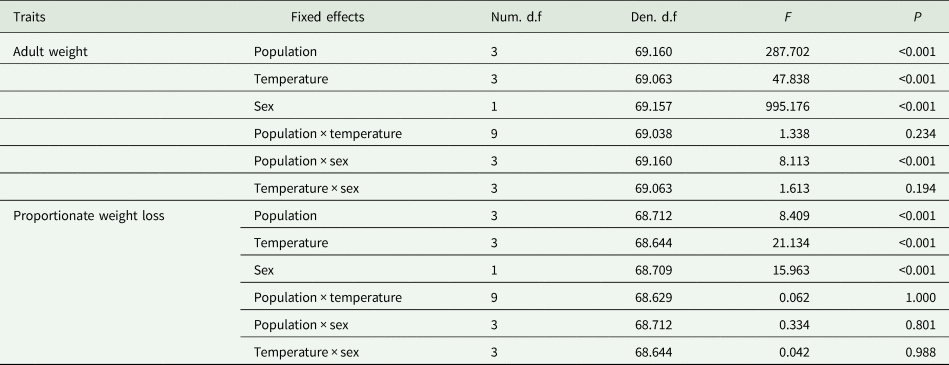
Population, temperature, and sex significantly affected the adult weight of C. bowringi, and there was a significant interaction between population and sex (P < 0.001) (table 2). Adult weight for both sexes gradually decreased as rearing temperature increased (fig. 4a, see also table S1). In all populations at each temperature, female adults were significantly larger than male adults (P < 0.05, see table S1), indicating female-biased SSD.
Results from a linear mixed-model analysis of fixed effects on adult weight and proportionate weight loss in Colaphellus bowringi in relation to temperature, population, and sex

Adult weight and proportional weight loss of the pure populations (the southern SS population and the northern NN population) and their hybrid populations (the S♀ × N♂ and N♀ × S♂ populations) in Colaphellus bowringi. Error bars indicate SD.

There were significant differences in adult weight among populations at all temperatures (table 2, see also table S2). Adult weight for both sexes was greatest in the S population, followed by the S × N, N × S, and N populations at all temperatures, showing that adult weight in hybrid populations was intermediate between those of their parents (fig. 4a, see table S2). Adult weight was significantly higher in the S × N population than in the N × S population at all temperatures (P < 0.05, see table S2), indicating that the female parent had significantly more influence on the determination of adult weight than did the male parent.
Proportional weight loss from pupa to adult was significantly affected by population, temperature, and sex (P < 0.001); there were no significant interactions (P > 0.05) (table 2). Weight loss for both sexes in all populations gradually increased with increasing rearing temperatures (fig. 4b). Weight loss for both sexes was highest in the S population, followed by the S × N, N × S, and N populations at almost all temperatures, suggesting that the larger pupae lost more weight during metamorphosis (fig. 4a, see table S2). Male pupae lost more weight at metamorphosis than did females in all populations at each temperature (fig. 4b, see also table S1).
Sexual size dimorphism
The trends of change in SSD for pupa and adults at various temperatures were similar between the S and S × N populations (a trend to increase from 19 to 25°C, then decline at 28°C) and between the N and N × S populations (a trend to increase from 19 to 28°C). However, no significant differences in SSD were found among temperatures (F 31, 68 = 1.091, P > 0.05) (fig. 5).
Sexual size dimorphism of the pure populations (the southern SS population and the northern NN population) and their hybrid populations (the S♀ × N♂ and N♀ × S♂ populations) in Colaphellus bowringi. Sexual dimorphism was estimated for each population at each temperature as (mean size of the larger sex (mg)/mean size of the smaller sex (mg)) ̶1, which is made positive when females are the larger sex and negative when males are the larger sex. Error bars indicate SE.

The SSD indexes of pupae and adults were greatest in the S population, followed by the S × N, N × S, and N populations at 19, 22, and 25°C, showing that the SSD index in hybrid populations was intermediate between those of their parents. At the temperature of 28°C, the S and S × N populations showed a decline in the SSD index, compared with that of the N and N × S populations. However, there were also no significant differences among populations at any temperatures (P > 0.05).
Figure 5 shows that the SSD index was greater in the adult stage (from 0.29 to 0.38) than at the beginning of the pupal phase (from 0.27 to 0.36) in all populations at each temperature. This is probably because male pupae lost more weight than female pupae at metamorphosis (fig. 5).
Discussion
The cabbage beetle, C. bowringi from the southern Xiushui (S) and northern Shenyang (N) populations was selected for hybridization studies because the two allopatric populations demonstrated geographic reproductive isolation and showed apparent differences in life-history traits. The present study is the first to compare the key life-history traits of the two pure populations and their two hybrid populations at four different temperatures.
To date, relatively few studies have examined the effects of crosses between populations on the fecundity of insects. Cross-experiments in the housefly Musca domestica, the yellow dung fly Scathophaga stercoraria, the red flour beetle Tribolium castaneum, and the parasitoid wasp Trichogramma chilonis showed that hybrid females had higher offspring production than non-hybrid females (Andres and Arnqvist, Reference Andres and Arnqvist2001; Hosken et al., Reference Hosken, Blanckenhorn and Garner2002; Attia and Tregenza, Reference Attia and Tregenza2004; Benvenuto et al., Reference Benvenuto, Cheyppe-Buchmann, Bermond, Ris and Fauvergue2012a). This hybrid vigor is thought to occur between heteropopulation males and has a fertilization advantage during sperm competition (Hosken et al., Reference Hosken, Blanckenhorn and Garner2002). A cross-experiment in the mountain pine beetle Dendroctonus ponderosae showed that whether hybrid females had higher or lower offspring production depending on the fecundity of females (Langor et al., Reference Langor, Spence and Pohl1990). In the parasitoid wasp Psyttalia lounsburyi (Benvenuto et al., Reference Benvenuto, Tabone, Vercken, Sorbier, Colombel, Warot, Fauvergue and Ris2012b), the seed beetle Callosobruchus maculatus, the fruit fly Drosophila melanogaster (Ghosh and Joshi, Reference Ghosh and Joshi2012), and the cabbage beetle C. bowringi (Liu et al., Reference Liu, Tu, He, Chen and Xue2014), the fecundity of hybrid females was intermediate between those of their parents. Our study supports the findings of Liu et al. (Reference Liu, Tu, He, Chen and Xue2014) and the results of a study of T. castaneum (Benvenuto et al., Reference Benvenuto, Cheyppe-Buchmann, Bermond, Ris and Fauvergue2012a, Reference Benvenuto, Tabone, Vercken, Sorbier, Colombel, Warot, Fauvergue and Ris2012b). We also found that the fecundity of hybrid populations more closely resembled that of their maternal population (fig. 1), indicating a maternal effect on fecundity. It is worth mentioning that fecundity was higher in the hybrid S × N population than in the hybrid N × S population (277 eggs per female vs. 244 eggs per female), suggesting that larger S males may contain more sperm or be able to stimulate ovulation and oviposition (Jennings et al., Reference Jennings, Mazzi, Ritchie and Hoikkala2011).
At all temperatures, the S population showed a significantly shorter development time, heavier pupal weight and adult weight, higher growth rate, and higher weight loss than the N population. These differences reflect that the two populations experience different selection pressures and will diverge, even though some gene exchange exists between them. Interestingly, these phenotypic traits of the hybrid populations (S × N and N × S) were all intermediate between those of their parents (SS and NN populations). An intermediate response of hybrids is generally considered characteristic of polygenic inheritance. An intermediate response of hybrids in development time or body weight has been reported in hybrid populations of the fruit fly D. melanogaster (Ghosh and Joshi, Reference Ghosh and Joshi2012), the ground beetle Carabus tosanus (Tsuchiya et al., Reference Tsuchiya, Takami, Okuzaki and Sota2012), and the egg parasitoid Trissolcus vassilievi (Iranipour et al., Reference Iranipour, BenaMolaei, Asgari and Michaud2015). However, in the seed beetle Callosobruchus maculates, hybrid populations had higher larval survival, a faster developmental rate, and a greater female dry weight (Bieri and Kawecki, Reference Bieri and Kawecki2003). In contrast, intraspecific hybridization in the Asian corn borer Ostrinia furnacalis reduced the fitness of hybrids in terms of larval development time, body weight, growth rate, and sex ratio (He et al., Reference He, Tang, Huang, Gao and Xue2019). Therefore, the influence of hybridization between divergent populations on life-history traits can be positive, intermediate, or negative (Barton, Reference Barton2001; Burke and Arnold, Reference Burke and Arnold2001).
We also found that the maternal effect was particularly apparent in terms of fecundity and body weight. The mean egg production per female of the hybrid S × N and N × S populations more closely resembled that of their maternal S population and N population, respectively. At all temperatures from 19 to 28°C, the mean female adult weights of the hybrid S × N and N × S populations also tended to be closer to that of their maternal S population and N population, respectively. Therefore, both fecundity and body weight in this beetle are mainly influenced by the maternal genotype, whereas paternal effects are relatively weak. This is the first time that maternal effects on life-history traits have been demonstrated in C. bowringi. Such a maternal effect has been reported in the egg parasitoid T. vassilievi (Iranipour et al., Reference Iranipour, BenaMolaei, Asgari and Michaud2015), in which female progeny of crosses more closely resembled the maternal population than the paternal population.
In all populations, male pupae lost significantly more weight at metamorphosis than females at all temperatures, suggesting that the female is more efficient in converting metabolites into reproductive needs. Similar results have been found in the copper butterfly Lycaena tityrus, the rice stem borer Chilo suppressalis, and the Asian corn borer O. furnacalis (Fischer and Fiedler, Reference Fischer and Fiedler2000; Fu et al., Reference Fu, He, Zou, Xiao and Xue2016; He et al., Reference He, Tang, Huang, Gao and Xue2019).
Pupal and adult weights for both sexes in all populations were lower at higher temperatures, following the general pattern observed in ectothermic animals (Atkinson, Reference Atkinson1994). However, the pupae and adults of female C. bowringi were significantly larger than the male pupae and adults at all temperatures in all populations (see table S1), indicating female-biased dimorphism. The body weights were largest in the S population, followed by the S × N, N × S, and N populations at all temperature. Additionally, the SSD index was highest in the S population, followed by the S × N, N × S, and N populations at 19, 22, and 25°C. With these results, we speculate that the difference in body size may result in the difference in SSD. It is worth noting that the changes in SSD with temperature were similar between the S and the S × N populations and between the N and the N × S populations, suggesting a maternal effect. SSD was lower in pupae than in adults for all populations at each temperature because the male pupae lost more weight at metamorphosis than did the female pupae (table 2; P < 0.05), which suggested that sex-specific weight loss was an important regulator of SSD, supporting the finding of Testa et al. (Reference Testa, Ghosh and Shingleton2013).
In conclusion, the S population had a significantly higher fecundity, shorter larval development time, greater body weight, higher growth rate, and higher weight loss during metamorphosis than the N population at all temperatures. The life-history traits in their hybrid populations were intermediate between those of the parents and were mainly dependent on the maternal population. Comparisons of life-history traits between the southern and northern populations revealed that adaptation to local climatic conditions in geographically isolated regions has led to divergence in the life-history traits of the insect; whereas our crossing experiments demonstrated a genetic basis for these differences. Our results may provide additional insight into the evolution of life-history traits.
Supplementary material
The supplementary material for this article can be found at https://doi.org/10.1017/S000748532100002X
Acknowledgements
The research was supported by a grant from the National Natural Science Foundation of the People's Republic of China (31560608).