Implications
The compost barn (CB) system provides a larger bed area per animal, and it can increase the comfort of cows if managed well. However, multiparous and primiparous cows show different behaviors when grouped in these systems, which might affect welfare during housing. By evaluating the behavior and characteristics of a herd, this study identified possible critical issues associated with behavioral changes of multiparous cows, which showed more probability of agonistic behaviors and higher hygiene scores than primiparous cows. These results might establish further changes in CB management based on number of lactations and behavior’s patterns in tropical and subtropical climates.
Introduction
A CB is a loose housing system for dairy cows that has gained prominence among producers around the world by providing increased comfort to animals. Compost barns differ from conventional free stall and tie stall systems because partitions are not present in the rest environment (Eckelkamp et al., Reference Eckelkamp, Taraba, Akers, Harmon and Bewley2016). To avoid the accumulation of moisture in this system, the bed is usually separated from the feeding line by a wall or an ~1.2-m elevation step (Shane et al., Reference Shane, Endres and Janni2010a). The spacing per animal varies from 6.1 to 9.4 m2, depending on the size and breed of the cows as well as the timing of bedding material replacement (Endres, Reference Endres2009).
The success of CBs depends on ideal bed management, which includes bedding stirring (between 25 cm) at least twice per day using a cultivator for aeration and waste incorporation (Barberg et al., Reference Barberg, Endres, Salfer and Reneau2007; Shane et al., Reference Shane, Endres, Johnson and Reneau2010b). Bed aeration promotes microbial activity that aids the compost process, and it helps maintain adequate moisture levels and a soft surface for the cows (Janni et al., Reference Janni, Endres, Reneau and Schoper2007).
The increased bed area per animal in CBs and the soft surface of the bed permit increased movement of cows, and these characteristics allow cows to lie down more comfortably (Endres and Barberg, Reference Endres and Barberg2007). Furthermore, CB systems allow cows to lie down in the following natural positions: head held high, head on the ground and head back while lying on a side. In addition, Endres and Barberg (Reference Endres and Barberg2007) found that the social behavior of cows in CBs did not differ relative to other reports of previously described systems. Thus, a well-managed CB provides conditions for cows that result in high animal welfare levels. Some studies have shown that the prevalence of lameness is low in the system (Lobeck et al., Reference Lobeck, Endres, Shane, Godden and Fetrow2011; Burgstaller et al., Reference Burgstaller, Raith, Kuchling, Mandl, Hund and Kofler2016), and the prevalence of mastitis and somatic cell counts were both lower than observed in conventional systems (Barberg et al., Reference Barberg, Endres, Salfer and Reneau2007; Endres and Barberg, Reference Endres and Barberg2007).
However, doubts about the behavioral aspects of cows in tropical and subtropical climates remain, because the CB system offers a larger bed area per animal at a lower stocking rate. We hypothesized that multiparous cows in the CB likely represent the highest hierarchical level as indicated by agonistic behaviors and relatively better hygiene than primiparous cows. The objective of this study was to investigate whether the behavior, hygiene and lameness of dairy cows in the CB system are influenced by different number of lactations under hot and humid conditions.
Material and methods
Location
The study was carried out on private property in the southwest region of the state of Paraná, Brazil, located at 25° 43' 34.20" S and 53°06' 35.19" W at 556 m above sea level. The climate of the region is humid subtropical (mesothermic or Cfa), with an average annual precipitation of 2200 to 2500 mm, average temperatures of −3°C to 18°C during cold months and temperatures above 22°C during hot months (Alvares et al., Reference Alvares, Stape, Sentelhas, Moraes and Sparovek2013).
Structure and management
The physical structure of the barn was composed of a rest area with a wood shaving bed (576 m2), a feeding line (36 m in length and 4 m in width, total 144 m2) and an attached milking room. The feeding line included feed fences for 40 cows and three drinking fountains. The barn had a 5-m ceiling, the roof had a skylight and the sides were open. The ventilation system was manually controlled, with seven DeLaval DF 1250 fans that had six blades each and an air flow capacity of 34 000 m3/h. The fans are fixed to the metal structure of the shed; three axial fans are spaced every 5 m with capacity to produce air movement of 3 m/s, oriented toward the compost bed area.
The average stocking rate for the bed area was 16.4 m2/animal. The bed had an average depth of 25 to 30 cm (depths of the beginning and end of the study, respectively), was stirred twice a day (between 0800 and 0900 h; 1700 and 1800 h) using a cultivator six-stem type. The cows were milked twice a day at 0630 and 1700 h, and food was provided ad libitum after milking at 0730 and 1800 h. The diet was composed of corn silage (53.5%), soybean meal (13.5%), commercial feed with 20% CP (31.3%), mineral salt (1.1%) and sodium bicarbonate (0.6%).
Animal management
Between September 2015 and February 2016, 24 days of behavior observation (four monthly behavioral assessments) and 12 hygiene and lameness assessments (two monthly assessments) were carried out, with time interval of 15 days between assessments.
The sample was composed of 12 Dutch and Jersey crossbred cows, which were within 30 to 90 days of lactation. The cows were divided into two treatment groups containing six animals each, and the groups were based on number of lactations as follows: (1) primiparous cows with a mean age of 2.7 years, an average weight of 430 kg and an average production of 32 kg of milk/day; and (2) multiparous cows with an average of four lactations, an average weight of 500 kg and an average milk yield of 34 kg of milk/day.
The animals examined in this study remained in the same environment as other cows (n=35) in the CB throughout the experimental period. The same 12 animals were used from the beginning to the end of the study, which were selected at the beginning according to their stage of lactation and birth order. For the identification of the cows selected for this research, collars with different colors were used for each individual and its associated treatment.
Behavior record
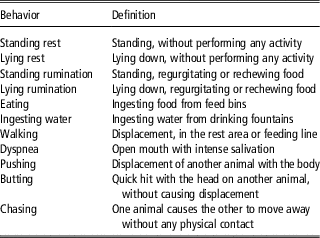
Daytime behavior was recorded between 0800 and 1700 h by two trained observers. The observations were performed using the focal method with 0/1 sampling, as described by Broom and Fraser (Reference Broom and Fraser2007). Each observation lasted 10 min, and there was a 30-min interval between observations. The behaviors were observed using an ethogram adapted from the method proposed by Endres and Barberg (Reference Endres and Barberg2007), as described in Table 1.
Behavioral ethogram and respective definitions for dairy cows

Hygiene and lameness
Two trained evaluators conducted the evaluations simultaneously. After milking, the animals were observed marching and standing on hard, flat ground. The hygiene evaluation was performed using a dirtiness score based on subjective scores from 1 to 4 (1=no dirt, 2=slightly dirty, 2% to 10%, 3=moderately dirty, 10% to 30%, 4=very dirty more than 30%) as proposed by Schreiner and Ruegg (Reference Schreiner and Ruegg2002). Lameness was evaluated using a subjective score that ranged from 1 to 5 (1=normal, 2=slightly limp, 3=moderately limp, 4=limp, 5=severely limp), which was based on the method of Sprecher et al. (Reference Sprecher, Hostetler and Kaneene1997).
Thermal environmental variables
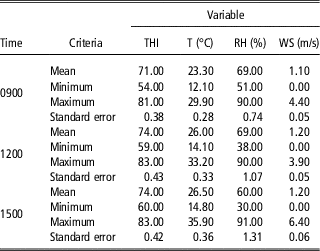
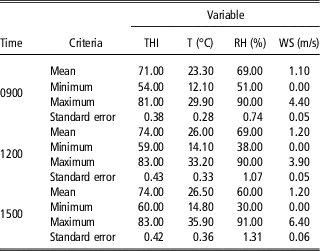
Table 2 shows the microclimatic data associated with the environment and the temperature humidity index (THI) values recorded during the experimental period. Air temperature (°C), relative air humidity (%)and wind speed (m/s) data were recorded at 3-h intervals (0900, 1200 and 1500 h). In order to record the variables associated with temperature and the relative humidity of the indoor environment, an Instrutemp ITAN-700 thermo-hygro-anemometer was used with temperature and relative air humidity scales ranging from −10°C to 50°C and from 5% to 90%, respectively. Regarding wind speed measurements, a digital Hikari HTA-400 propeller anemometer with instantaneous measurements was used with a measurement range of 0.4 to 30 m/s. The equipment was positioned at a height of 1.5 m, thus simulating the height of the animals. Temperature humidity index values were calculated each time the microclimatic variables were recorded (0900, 1200 and 1500 h), using the following formula described by Hahn (Reference Hahn1999):
 $${\rm ITU{\equals}}T{\plus}0.36{\times}T_{{{\rm dp}}} {\plus}41.5$$
where T was the air temperature (°C) and T dp was the dew point temperature (°C)
Microclimatic data during the experimental period: temperature and humidity index (THI) for dairy cows, air temperature (T), relative humidity (RH) and wind speed (WS)
The dew point temperature was estimated using the following equation (Aguilar et al. Reference Aguilar, Rumiatto, Kruker, da Silva and de Calheiros1986):
 $$\eqalignno{ T_{{dp{\rm }}} {\equals} & T{\minus}\left( {14.55{\plus}0.114{\times}T} \right){\times}\left[ {1{\minus}\left( {{\rm 0}{\rm .01{\times}RH}} \right)} \right] \cr & {\minus}\left\{ {\left( {2.5{\plus}0.007{\times}T} \right){\times}\left[ {1{\minus}\left( {0.01{\times}{\rm RH}} \right)} \right]} \right\}^{3} {\minus}\left( {15.9{\plus}0.117{\times}T} \right) \cr & {\times}\left[ {1{\minus}\left( {0.01{\times}{\rm RH}} \right)} \right]^{{14}} {\rm } $$
where T was the air temperature (°C) and RH was the relative humidity (%)
Statistical analysis
The behavioral data analysis was performed using Bayesian inference. The study sought to determine whether each animal exhibited or did not exhibit certain behaviors during measurement, so it was concluded that the response variable (Y) followed a Bernoulli distribution with a θ parameter (McCullagh and Nelder, Reference McCullagh and Nelder1989). The probability (π i ) of each animal to demonstrate a certain behavior varied based on the time of day and the day of evaluation. However, because the study aimed to model the probability of certain behaviors at different times of the day, the day effect was considered random in the model. Thus, the generalized mixed effect model used for each behavior in each treatment was as follows:
 $$E\left( {y_{{ik}} } \right){\equals}\pi _{{ik}} $$
 $$\log {\rm it}\left( {\pi _{{ik}} } \right){\equals}\alpha {\plus}\beta x_{{ik}} {\plus}u_{k} {\plus}{\epsilon}_{{ik}} $$
One possible interpretation of the logistic regression model is to state that there is an underlying score with the observed variable being
 $$y_{{ik}} {\equals}\left\{ {\matrix{ {1 \,{\rm if}\, y_{{ik}}^{{\rm {\asterisk}}} \,\gt\,0} \cr {0 \,{\rm if}\, y_{{ik}}^{{\rm {\asterisk}}} \,\leq 0} \cr } } \right\}$$
Thus, the model can be rewritten as
 $$y_{{ik}}^{{\rm {\asterisk}}} {\equals}\alpha {\plus}\beta x_{{ik}} {\plus}u_{k} {\plus}{\epsilon}_{{ik}} $$
where y
ik
was the observation of a behavior of the i-th animal on the k-th day; x
ik
referred to the time of day when a certain behavior was observed in animal i; α and β were the animal fixed effects; and u
k
was the random effect of the k-th day of measuring and is considered to follow normal distributions with mean zero and standard deviations 1/τ
u
; ε
ik
istic distribution, which does have the fixed variance of
 ${\rm \pi }^{{\rm 2}} /3$
(Hox, Reference Hox2010).
Two independents normal distributions with mean 0 and standard deviation of 0.001 was used as priors for the two fixed effect parameters α and β. The precision parameter τ u was specified to be gamma prior with parameters 0.001 and 0.001.
The analysis of hygiene and lameness data were also performed by using Bayesian inference. As both responses are ordinal categorical scores that can fall in j=1, … , J categories, we used a cumulative logit model (McCullagh, Reference McCullagh1980; Agresti, Reference Agresti1983) in our inference. This model may be considered as an extension of the model 1, because with only two categories the cumulative logit model is identical to a generalized linear model for a binomial response.
Thus, we considered the following mixed effects model
 $$y_{{ikj}}^{{\rm {\asterisk}}} {\equals}\alpha _{j} {\minus}\beta x_{{ik}} {\plus}u_{k} {\plus}{\epsilon}_{{ikj}} ,\,{\rm j}{\equals}1,\,\ldots\,,{\rm J}{\minus}1$$
All the parameters are defined in the same way of model 1, except for the slope term which is now defined as the binary covariate (primiparous or multiparous). The α j parameters provide each cumulative logit (for each category j) with its own intercept and do not have useful interpretation. The interpretation of β can be made in terms of log odds ratio between the two treatment levels, or better, in terms of odds ratio by applying the exponential operator.
We used the same priors defined for model 1 but now as we have J–1 intercepts we will define a separated non-informative prior as N(0,0.001) for each intercept.
Model fitting was performed via the application of the Gibbs algorithm that implements a Markov chain Monte Carlo (MCMC) resampling process, thus resulting in the posterior marginal distribution of the model parameters. The marginal distributions were obtained separately for each of the treatments in the model 1 in order to determine the posterior distribution of the differences (Δ) between the treatments and to calculate 95% credible intervals for those differences. When these 95% credible intervals did not include zero, we concluded that the treatments differed.
In the case of the model 2, the parameter β reflects directly the effect of the treatments. The consequence is that the marginal posterior distribution of β is enough to decide about the treatments effect.
During estimation stage, four models were generated, each one with 2000 iterations and burn in period of 1000 resulting in the total post-warmup samples of 4000.
The convergence was checked by the examination of the trace plots of MCMC process and the values of
 ${\rm \hat{R}}$
related to each parameter. Values close to 1 indicated good convergence (Gelman and Rubin, Reference Gelman and Rubin1992).
Data processing and statistical analyses were performed using R (R Development Core Team) software, the R2OpenBUGS package (Sturtz et al., Reference Sturtz, Ligges and Gelman2005) and the coda package (Plummer et al., Reference Plummer, Best, Cowles and Vines2006).
Results
Behavior of dairy cows
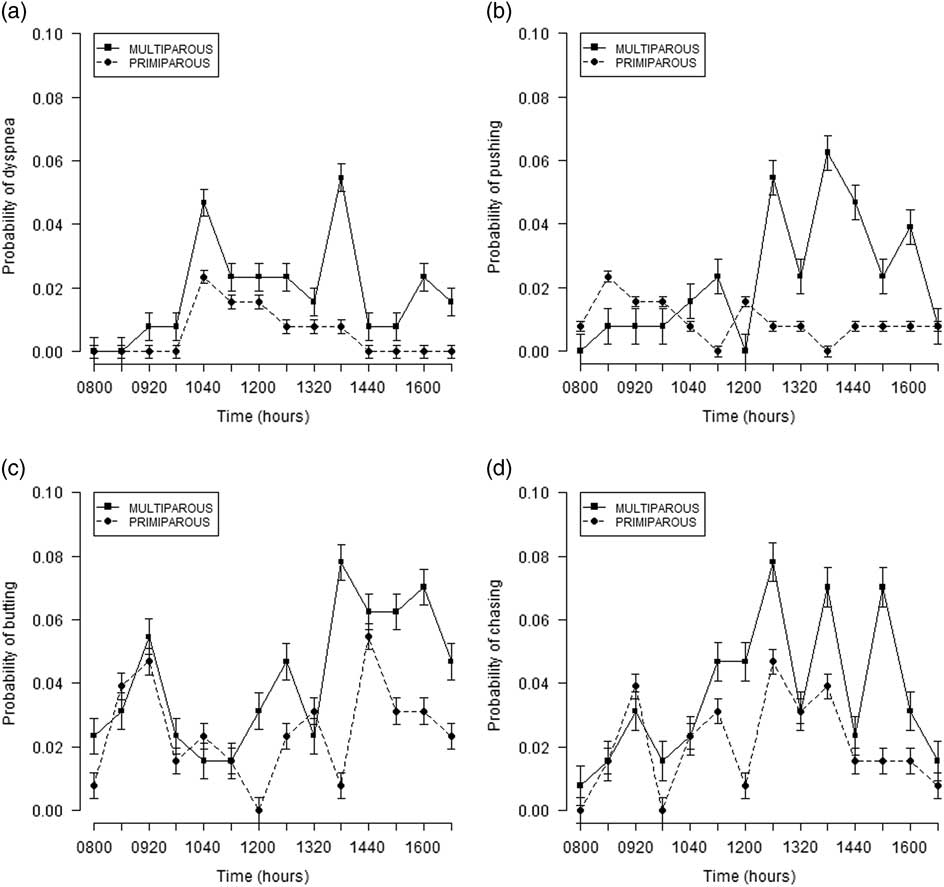
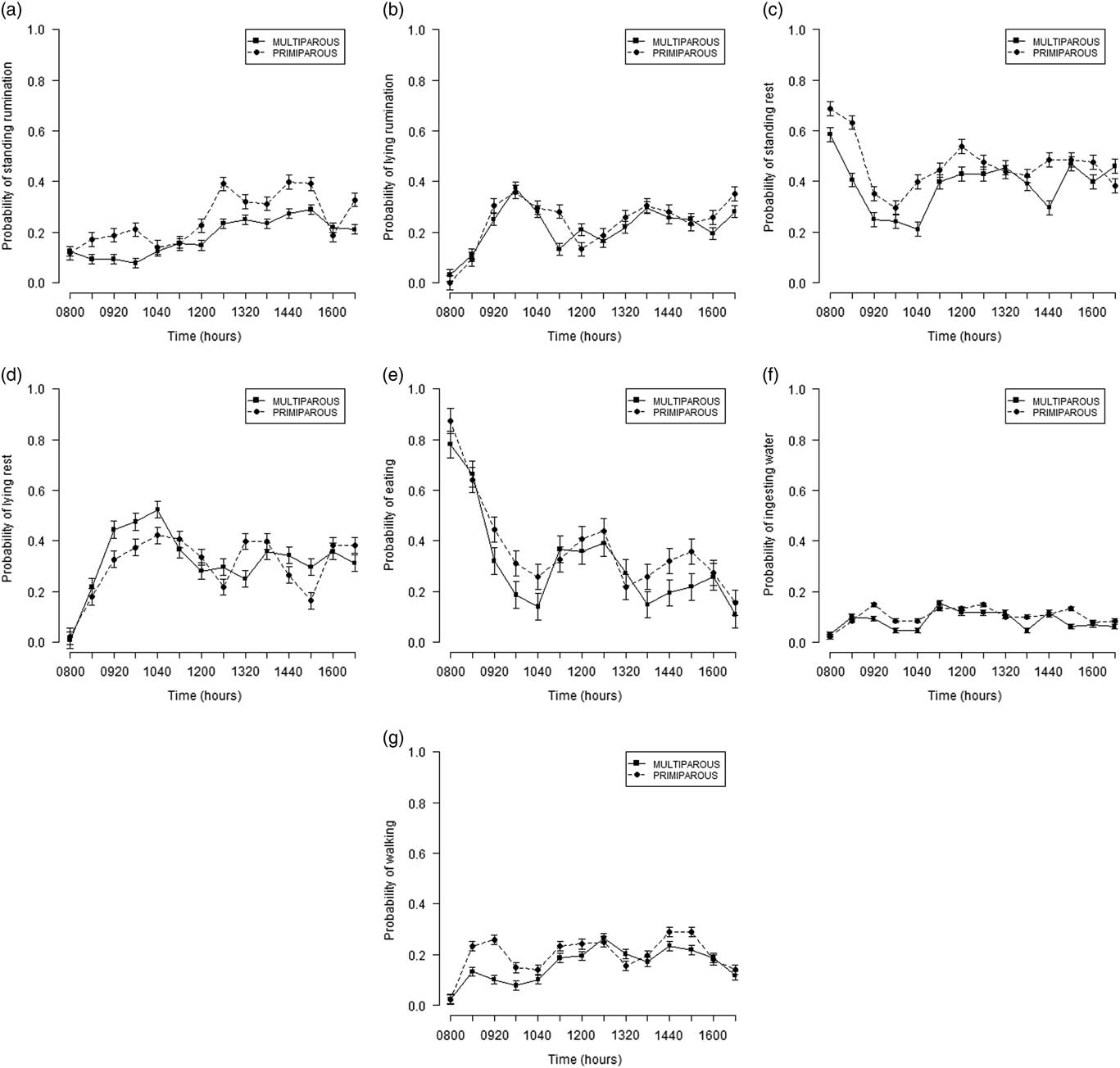
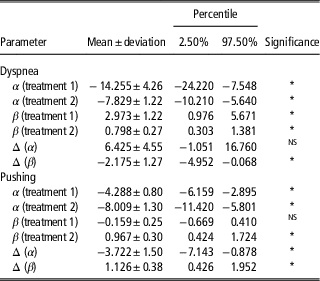
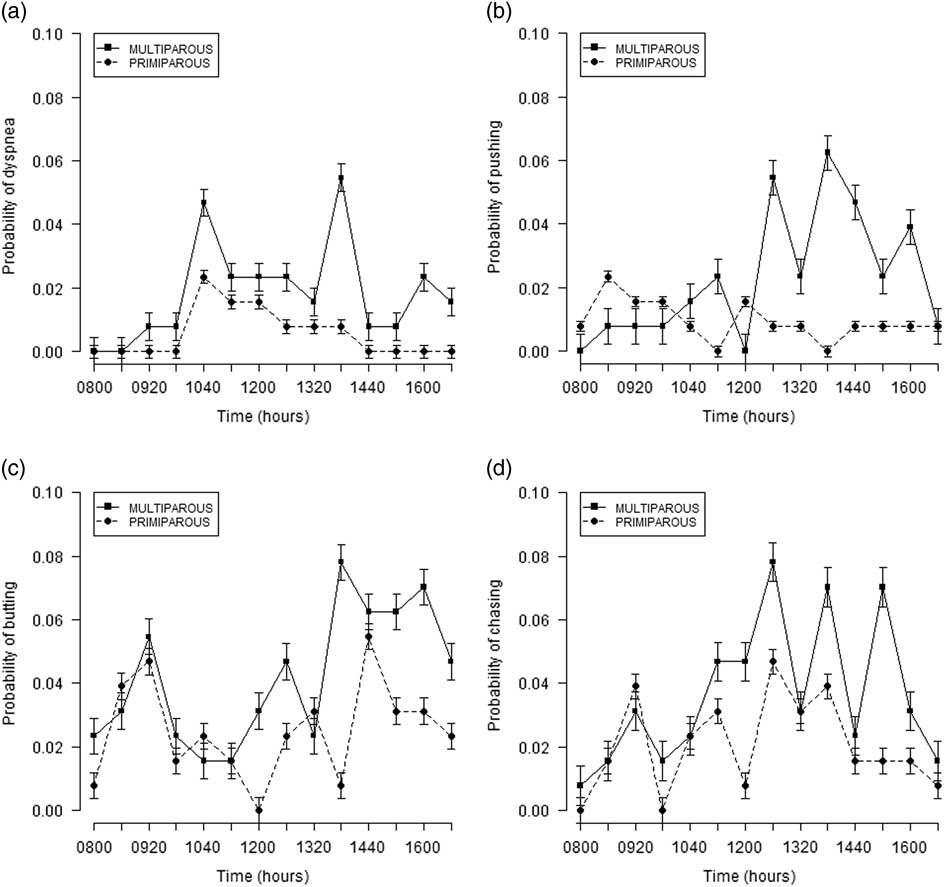
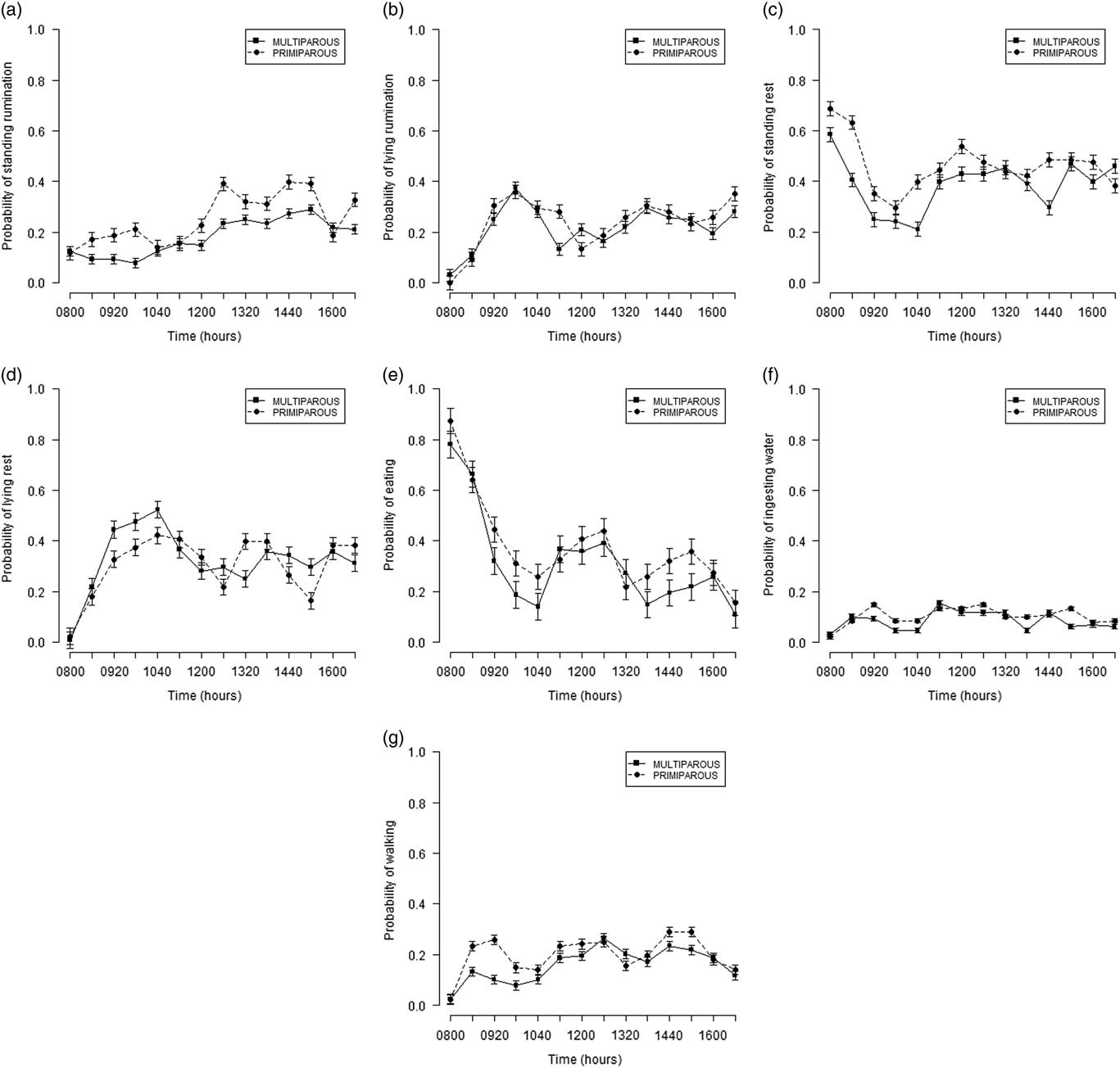
Dyspnea and pushing behaviors differed significantly (P<0.05) between primiparous and multiparous cows (Table 3). The probability of dyspnea (Figure 1a) and pushing behavior (Figure 1b) was higher for multiparous cows, and it increased with increasing air temperature (Table 2). The same was true for aversive butting (Figure 1c) and chasing (Figure 1d) behaviors, which also increased during times of potential heat stress. The probability of standing rumination increased (Figure 2a) during the hottest periods of the day (Table 2). There was a higher probability of lying rest behavior between 0920 and 1120 h (Figure 2d). Eating behavior had the highest probability (0.8 at 0800 h) among the observed behaviors (Figure 2e), and water ingestion (Figure 2f) and walking (Figure 2g) peaked between 0840 and 0920 h, 1120 and 1240 h, and 1440 and 1520 h.
Probability of the occurrence of dyspnea (a), pushing (b), butting (c) and chasing (d) behaviors of primiparous (--●--) and multiparous (–■–) cows during the course of the experiment.
Probability of the occurrence of standing rumination (a), lying rumination (b), standing rest (c), lying rest (d), eating (e), ingesting water (f) and walking (g) behaviors of primiparous (--●--) and multiparous (–■–) cows during the course of the experiment.
A posteriori estimates of parameters (mean±SD and credibility intervals) of dyspnea and pushing behaviors of primiparous and multiparous cows
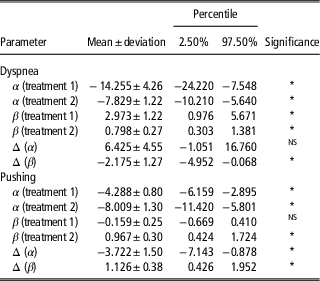
Treatment 1=primiparous cows; Treatment 2=multiparous cows; NS=not significant.
*Statistically different based on Bayesian comparisons (P<0.05).
Hygiene and lameness
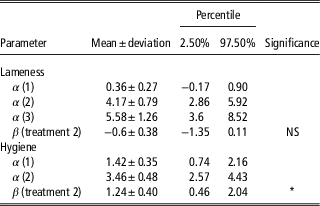
As stated before the parameter β is called proportional odds ratio and can be interpreted, after exponentiation, pretty much as odds ratios from a binary logistic regression. In our model, it will express the odds ratio of treatment 2 (multiparous) over treatment 1 (primiparous).
For lameness, no difference was observed between multiparous and primiparous as the credibility interval for β includes zero (Table 4).
A posteriori estimates of parameters (mean±SD and credibility intervals) of Lameness and hygiene of primiparous and multiparous cows
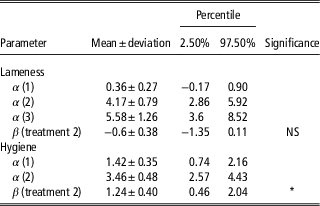
α (1), α (2), α (3)=α j parameters of lameness and hygiene categorical scores; Treatment 1=primiparous cows; Treatment 2=multiparous cows; NS=not significant.
*Statistically different based on Bayesian comparisons (P<0.05).
On other hand, for hygiene the credible interval did not include zero and therefore the behavior of multiparous cows were different of the primiparous cows.
According to the results showed on Table 4 the odds of treatment 2 over the odds of treatment 1 is exp (1.24)=3.45. In terms of percentage one can say that the odds of get high scores for multiparous cows is 245% greater than for primiparous cows.
Discussion
The increased probability of dyspnea in multiparous cows indicated greater sensitivity to thermal stress. Increased respiratory rates in multiparous cows (probabilities of up to 0.05 at 1040 h and 0.06 at 1410 h) were influenced by body size and weight, combined with high air temperature and relative humidity (Reece, Reference Reece2015), as well as a higher metabolic rate that resulted from increased milk production (Kadzere et al., Reference Kadzere, Murphy, Silanikove and Maltz2002), thus suggesting thermal stress conditions. During the hottest times of the day (maximums up to 35.9°C and THI of 83 at 1500 h, Table 2), cows crowded into areas with mixing fans blowing on them. In the present study, this stress pattern may have triggered disputes over resources such as ventilation, water and space, resulting in a higher frequency of agonistic behaviors (e.g. pushing) exhibited by multiparous cows.
In some situations, dominance becomes an impediment for low-level cows seeking unrestricted access to resources, and it also increases the number of agonistic interactions in the herd (Coimbra et al., Reference Coimbra, Machado Filho and Hötzel2012). The general determining factors in the social hierarchy of cows are age and weight (Sárová et al., Reference Sárová, Spinka, Stehulová, Ceacero, Simecková and Kotrba2013). These factors were confirmed in the present study in that multiparous cows had priority access to resources most of the time. Motivation is also a factor that contributes to competition among animals (Val-Laillet et al., Reference Val-Laillet, Veira and von Keyserlingk2008). For instance, resources such as ventilation and water are a higher priority for animals under thermal stress conditions. However, when cows find themselves in environments with temperatures within their zone of thermal comfort, other resources such as food take priority, and there may be disputes between animals at the time of feeding. In this study, low stocking (16.4 m2/animal) and an adequate number of feeders influenced the social stability of cows when food was provided.
For dairy cows, rest has a higher priority than eating behaviors and social contact. This is due to the fact that the animals are able to compensate for a portion of food consumption by increasing the speed of food intake (Munksgaard et al., Reference Munksgaard, Jensen, Pedersen, Hansen and Matthews2005). In the present study, cows preferred to lie down in the morning. This preference is related to temperatures and THI measurements above the comfort zone of dairy cows in the afternoon. Stone et al. (Reference Stone, Jones, Becker and Bewley2017) demonstrated that multiparous cows decreased the time spent lying down relative to increased THIs, while primiparous cows exhibited a slight increase in time spent lying down. The authors also concluded that the time cows remained lying down increased with the number of parities. Under thermal discomfort conditions, cattle stood longer to facilitate both convective and evaporative heat loss, thereby using the larger surface of the body to influence thermal changes within the environment.
Regarding primiparous cows, the initial lactation stage and decreased time spent lying down are factors that increase the risk of the animals becoming dirtier (Nielsen et al., Reference Nielsen, Thomsen and Sørensen2011). For the current study, it is possible that social hierarchy may have affected hygiene, because multiparous cows may have been under conditions in which they preferred to lie down, leaving primiparous cows to occupy the remaining spaces. This inability to choose may have led to primiparous cows carried out a greater number of standing activities. Furthermore, primiparous cows spent less time during each activity, and they laid down and got up more frequently than multiparous cows, thus increasing the possibility of getting clean. Thus, the hygiene scores of primiparous cows were low, with higher absolute frequencies for scores 1 and 2, which represented no dirt and slightly dirty with a dirty area of 2% to 10%, respectively. Cows with hygiene scores of 3 and 4 (moderately dirty, 10% to 30% and very dirty, more than 30%, respectively) were 1.5 times more likely to develop subclinical mastitis, because of greater contact with clinical pathogens of importance (Schreiner and Ruegg, Reference Schreiner and Ruegg2003).
As with hygiene, the lameness score calculated in this study was also low. The highest absolute frequency for scores 1 and 2 indicated that the system provided comfortable conditions for cows. Cows with locomotion scores greater than or equal to 3 are considered clinically lame (Barberg et al., Reference Barberg, Endres, Salfer and Reneau2007). Regarding the CB system, the authors found lameness prevalence values ranging from 0% to 22% and 7.8% of the cows represented clinical cases of lameness. The present study found fewer clinical cases of lameness, as the absolute frequency was 1 for scores 3 and 4. In another study, the prevalence of lameness in the CB system was lower (4.4%) relative to two types of free stall systems (13.1% and 15.9%) (Lobeck et al., Reference Lobeck, Endres, Shane, Godden and Fetrow2011). Some factors such as the type of tread and high stocking rates can increase the standing time of cows (Krawczel et al., Reference Krawczel, Mooney, Dann, Carter, Butzler, Ballard and Grant2012), so multiparous cows (Lobeck et al., Reference Lobeck, Endres, Shane, Godden and Fetrow2011) or cows of low hierarchy can be affected more than others (Galindo and Broom, Reference Galindo and Broom2000). In the CB system, it is likely that even if cows spend more time standing in response to high stocking rates, the soft bed surface can lessen impacts on their joints.
In conclusion, multiparous cows were more sensitive under thermal stress conditions that led to agglomeration of the cows, thus causing disputes over resources such as ventilation, space and water. Therefore, thermal stress may potentially influence the social behavior of dairy cows even in confinement systems with low stocking. Multiparous cows were also more likely to exhibit pushing behavior, suggesting that they represent the highest hierarchical level. In the CB system, hygiene and lameness scores were low, and multiparous cows were dirtier than primiparous cows. This result may be connected to hierarchy, as the cows spent more time in lying activities. Furthermore, primiparous cows carried out a greater number of standing activities, which increased the possibility of becoming clean.
Moreover, this study examined the implications associated with the management of dairy cattle using CB systems under hot and humid conditions, and these results could influence the use of this type of system in areas with warmer climates.
Acknowledgments
The authors would like to thank the owners of the compost barn, Leonilde Bedra Bin and Nerci Bin, for allowing them to conduct research. They also thank Coordination for the Improvement of Higher Education Personnel (CAPES) for granting a scholarship.
Declaration of interest
All authors declare no conflict of interest and nor competing interest.
Ethics statement
The experimental procedures were approved by the Ethics Committee on the use of Animals of the Federal University of Technology – Paraná (CEUA-UTFPR), Paraná, Brazil, protocol no. 2015/014.
Software and data repository resources
None of the data were deposited in an official repository.