By shaping the collective action of political parties, ballot structure exerts a critical impact on the depth and nature of political competition. Does competition occur only between parties or also within them? Ballot structure also enables (or constrains) the ability of voters to monitor and sanction the performance of individual legislators, thus shaping the balance between individual and collective accountability.
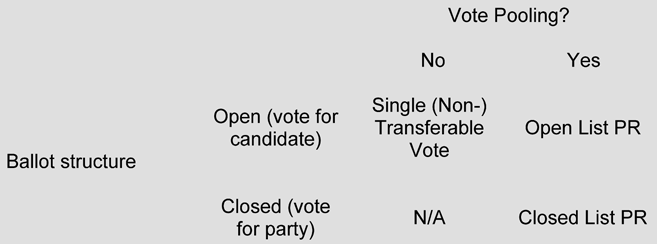
Before turning to these relationships, it is worth asking what, exactly, is ballot structure? When we speak of ballot structure, our attention is drawn to one critical variable: does the ballot permit voters to cast a vote below the party level or only at that level? Do voters have a choice of candidates within a party, or not? Where the ballot permits a candidate-level vote, there are “open” ballots. In a “closed” ballot structure, the vote is strictly at the party level. The second dimension of ballot structure considers what happens after the vote is cast. Does it stay only with the candidate for whom it was cast, or does it “pool” at the level of the party? If there is vote pooling, the vote is counted not only toward the individual candidate but also toward a list of candidates nominated by a party (or alliance of parties). The two dimensions of ballot structure are depicted in Figure 2.
Two dimensions of ballot structure

These differences in ballot structure shape the collective action of political parties. A party is like any other collective actor: it functions as a unitary organization only to the extent that the incentives of its individual members are aligned with whatever are the collective goals of the organization. The dominant collective goal of a party is to win seats in the legislature. Most other party goals, such as forming or affecting the support of governments, passing policy, etc., are subordinate to this task. The key impact of ballot structure lies in its potential to reinforce or undercut this goal. If ballot structure permits votes below the party level, it may undermine to varying degrees the alignment of these collective goals and the individual goals of its candidates and legislators.
Open ballot structure—even with, but especially without, vote-pooling—potentially threatens the collective action of political parties by pitting a party's candidates against one another for seats whenever the party has more candidates than seats it could possibly win. In multi-seat districts, such as those used for either type of PR or for Single Non-Transferable Vote (SNTV) or Single Transferable Vote (STV) systems, parties need to reconcile the incentives of their competing candidates with the collective pursuits of the party as a whole.
This is not to say that the collective action of political parties is determined only by ballot structure. The electoral system—of which ballot structure is a critical variable—is not destiny. There are other factors of party organization and the broader political context that also may work to reinforce or undermine collective action. Some parties are organized around a specific ideology or programmatic agenda; in such parties, organizational tools such as candidate selection rules and disciplinary tactics (e.g., offering or denying desirable intra-legislative or executive posts) may be used to stymie the careers of the insufficiently committed, and in any case, potential candidates will tend to self-select based on their commitment to the party's broader political goals. Other parties are more loosely identified with any specific policy commitments, or are “clientelistic” (organized around the exchange of material benefits). In addition, the executive format shapes the individual–collective balance in parties independently of the electoral system, with parliamentary systems enhancing collective cohesion more than presidential systems.Footnote 79 For all these reasons and more, we should not be overly disappointed when a direct link between ballot structure and various outcome variables of interest is not immediately apparent. We must be cognizant of what it is that ballot structure does, as well as how it fits into the broader context.
The Impact of District Magnitude
District magnitude, M, is the number of seats in a district. When we have single-seat districts, M=1, and only one candidate per party, then any limitations on collective action of a party are not the result of ballot structure. Candidates may have a strong incentive to emphasize their personal qualities, but not for the purpose of standing out from copartisans in the general election. Thus this section will focus on variation in district magnitude among those systems with M>1. The main systems using multi-seat districts can be arrayed on a continuum from most party-centric to increasingly candidate-centric as follows:Footnote 80
Closed list > Semi-open lists > Open lists > STV > SNTV
When lists are closed, the only competition within the party occurs in advance of the election, over who gets the best (or “safest”) list ranks. Thus, once the election comes around, we have perfectly aligned incentives between individual candidates and their party: if the party prospers, as a collective actor with a brand identity among voters, the candidate's chances of election increase. Candidates thus have an overriding incentive to cultivate a party vote.Footnote 81
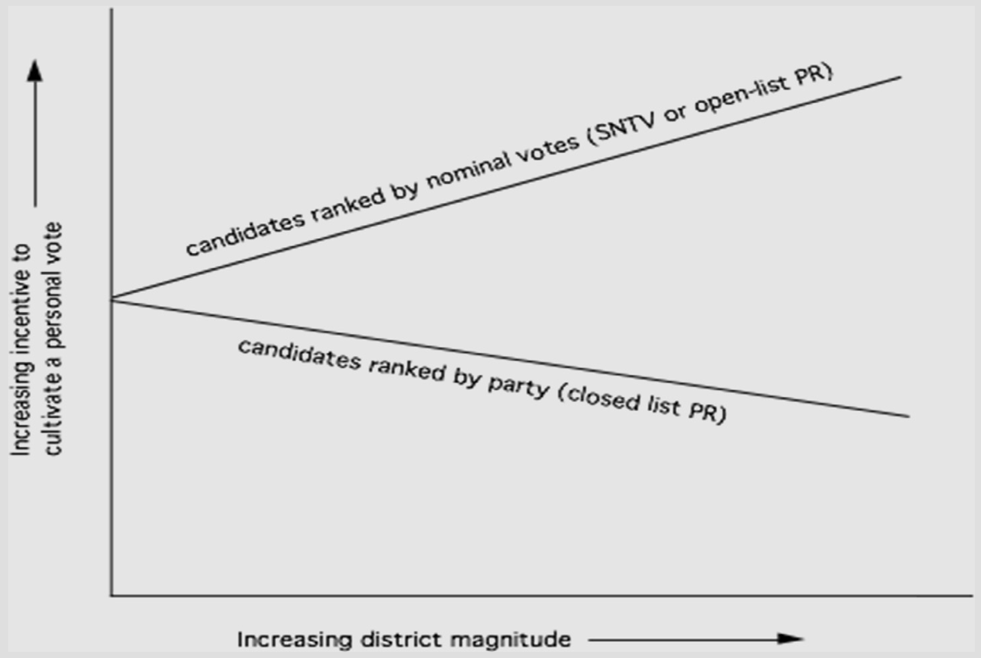
However, with any other ballot structure, there is at least some chance that candidates' entrepreneurial activities can increase their election chances independent of the party reputation. The greater the weight the rules put on candidate votes rather than a pre-fixed list order (if there is one), the more the candidates have an incentive to cultivate a personal vote. As Carey and Shugart noted, when there is vote pooling as well as open ballots (i.e., open and semi-open lists), the incentive to cultivate a personal vote would tend to be somewhat lower than in the pure candidate-based systems, STV and SNTV.Footnote 82 Of these, the former allows copartisan candidates to exchange preferences with one another and run as teams, whereas the latter maximizes the direct competition between individuals. When we bring district magnitude into the picture, as in the simplified form of Carey and Shugart's hypothesis depicted in Figure 3, we see that the incentive to cultivate a personal vote is shown decreasing with district magnitude with closed ballots, and increasing with magnitude with open ballots.
The differential effect of district magnitude on the intraparty dimension

Given closed ballots, the value of the personal vote decreases as magnitude increases, because only pre-election party ranks, rather than personal campaigning, affect the election of candidates. However, given small magnitude, with a correspondingly smaller number of candidates, the activities of the leading (and perhaps also marginal) candidates to highlight their personal record or characteristics may affect their election chance by drawing voters who would not otherwise have voted for the party.
On the other hand, when ballots are open, increased magnitude increases the incentive to cultivate a personal vote. When candidate-preference votes determine candidates' order of election, as under open lists, SNTV, or STV, only those candidates who are successful at drawing votes to themselves are likely to prosper. As M increases, typically each candidate in a party must compete against a greater number of copartisans. As a result, higher M implies increasing incentive to distinguish onself in order to stand out in the larger crowd. The effect should be similar under semi-open lists, albeit attenuated, to the extent that the rules may permit many candidates to win based on having “safe” list ranks provided by their party.
Impact on Legislative Behavior
The literature regarding the effect of electoral institutions on the behavior in the legislative arena is an established and fast-growing sub-field.Footnote 83 Now, I will examine the impact of ballot structure on democratic accountability, specifically on whether legislative structure and behavior are geared towards legislators' desire to be personally recognized by, and rewarded by, groups of voters (individual accountability) or towards enhancing the collective reputations of parties (collective accountability).
With open ballots, the threat to an individual legislators' pursuit of reelection—or to any new candidate's prospects of first election—come primarily from other candidates of the same party (or political “camp”). This threat supplies the motivational drive to use the scarce perquisites of office in order to nurture a personal reputation.Footnote 84 Ballot structure enables and constrains voters' abilities to monitor and sanction legislators' performance and shapes the balance of individual vs. collective accountability. For instance, if parties control nominations but voters determine ranks on a list, legislators answer to multiple principals, which creates potential problems for the cohesiveness of the party in the legislature.Footnote 85
The legislator who is the sole representative of the district bears the responsibility of promoting its interests.Footnote 86 In those circumstances constituents have only the actions of one legislator to monitor, increasing the name recognition of the legislator.Footnote 87 When constituents are represented by many legislators, on the other hand, the cost of monitoring quickly exceeds the time and effort rationally ignorant voters will typically devote to politics.Footnote 88
Where ballots are closed, voters have no means to sanction individuals even if they are aware of undesirable traits or actions by one or more of them; all they can do is sanction the party as a whole by voting for a different one next time. Thus the collective accountability of parties should be at its maximum extent (other things equal) when we have the combination of relatively high magnitude and closed ballots. When ballots are open, in principle voters have the option to sanction an incumbent for poor performance and vote for a co-partisan instead. However, there is often a tension between competitiveness and accountability: on the one hand, higher intra-party competition implies a strong incentive for individual legislators to cultivate ties to voters (as argued in the previous section). On the other hand, the more candidates who are in competition for a limited number of seats, the less effective individual “credit-claiming” for services rendered can be. When responsibility is divided among several legislators, each seeking personal votes, the ability to hold any one of them accountable for his or her actions is lessened.
Empirical research linking incentives to cultivate a personal vote with legislative behavior faces a fundamental problem: while the incentives of different ballot structure can be clearly articulated, incentives, per se, are unobservable. They can be inferred only from the behavioral patterns they instigate.Footnote 89 Some legislators initiate bills or amendments that primarily benefit their local community; others hold frequent surgeries and redress constituents' grievances; and still others take positions defying the party whip. It is important to recognize that, though one personal vote-seeking strategy may be substituted for another,Footnote 90 most research has focused on a single indicator of personal vote-seeking at a time,Footnote 91 thereby risking an underestimation of personal vote-seeking.Footnote 92
As noted above, there are tensions between collective and individual incentives in political parties. Nonetheless, it is important to remember that party leaders frequently have the ability directly to affect the behavioral repertoires that a legislators' personal reputation is built on. The ability to prevent legislators' personal-vote activity from undermining the party as a whole critically depends on the means at the disposal of the party leadership to monitor and sanction individual behavior: career advancement, staff allocation, procedural advantages in the legislative arena (e.g., through committee assignment and agenda control).Footnote 93 More importantly, parties often control access to the party label by controlling nominations.
Conclusion
Ballot structure can reinforce or undermine the collective action of political parties. When ballots permit voters to make only a single choice, the structure reinforces the collective action of a party by aligning the incentives of the candidate (get more votes, be more electorally secure) with those of the party (win another seat). When the ballot structure is open, voters are able to make one or more choices of candidates below the level of the party. This structure tends to undermine the collective action of a party because it pits candidates of the same party against one another. Variations within open ballots—for example, open and semi-open (flexible) lists, ranked-choice ballots, non-transferable votes that are not also party votes—can further shape the degree to which ballot structure affects parties. Numerous other factors also shape parties' collective action, and thus ballot structure is not destiny. It does, however, critically shape the relationships among voters, candidates, and political parties.