Knowledge management and environmental education among nature-based tourism operators
Knowledge management (KM) regards knowledge as the most valuable organisational asset (Nonaka & Takeuchi, Reference Nonaka and Takeuchi1995; Nonaka, Toyama, & Hirata, Reference Nonaka, Toyama and Hirata2008; Mills & Smith, Reference Mills and Smith2011; Sokhanvar, Matthews, & Yarlagadda, Reference Sokhanvar, Matthews and Yarlagadda2014). In 1986, Karl Wiig coined knowledge management as an organisational concept and defined it as the ‘explicit, systematic, strategic, application and renewal of knowledge to optimize effectiveness and returns’ (Wigg, Reference Wiig1997, p. 6; Cavaleri, Reference Cavaleri2004). This means that tacit and explicit knowledge must be shared for organisational effectiveness and returns (Nonaka et al., Reference Nonaka, Toyama and Hirata2008). According to Nonaka and Takeuchi (Reference Nonaka and Takeuchi1995), tacit knowledge consists of know how (experience, skills, beliefs and passion) and explicit knowledge consists of know what (facts and information). Both tacit and explicit knowledge reside in core competency knowledge, which is defined as a set of activities that a firm performs efficiently (Leonard-Barton, Reference Leonard-Barton1992) and must be shared in order for knowledge to be considered the most critical business asset (Grant & Baden-Fuller, Reference Grant and Baden-Fuller1995). Core competency knowledge provides firms with sustainable competitive advantage and the ability to innovate (Leonard-Barton, Reference Leonard-Barton1992).
In a real-world context, managers are reluctant to share specific business and technical knowledge, both within and beyond their organisational boundaries (Foss, Husted, & Michailova, Reference Foss, Husted and Michailova2010; Hass & Cummings, Reference Haas and Cummings2015). Cases of core competency knowledge being generously shared with staff, customers, business partners, competitors and the public (hereafter referred to as ‘stakeholders’) are rare in the KM and environmental education literatures (Bock, Zmud, Kim, & Lee, Reference Bock, Zmud, Kim and Lee2005; Davenport & Prusak, Reference Davenport and Prusak1998; Heizmann & Olsson, Reference Heizmann and Olsson2015). In view of the current environmental sustainability zeitgeist, KM can enable businesses to operate sustainably, provided that knowledge of their environmental sustainability activities is shared with all stakeholders. However, knowledge dissemination between just one stakeholder, let alone all, is difficult for myriad reasons, such as business secrecy, lack of trust, fear of losing power, or economic advantage (Casimir, Lee, & Loon, Reference Casimir, Lee and Loon2012; Husted & Michailova, Reference Husted and Michailova2002). In the current era of increased environmental concern, environmental sustainability is a major strategic imperative for business and research, especially in the context of depleted resources, increased energy costs, increased levels of pollution, and damage to the natural environment (Ip-Soo-Ching & Zyngier, Reference Ip-Soo-Ching, Zyngier and Ordóñez de Pablos2014; Maher, Reference Maher1986; Walker & Redmond, Reference Walker and Redmond2014). As ecotourism operators are concerned with both economic returns and environmental sustainability management (Lundberg, Friedman, & Wall-Reinius, Reference Lundberg, Fredman and Wall-Reinius2014), they provide the platform upon which to investigate knowledge sharing in the form of environmental sustainability knowledge (ESK) by using a KM approach among ecotourism operators, because they depend on the sustained quality of the natural environment for their existence and success (Brookes, Reference Brookes1999; North & Hutson, Reference North and Hutson2011).
The contributions of this research support KM and environmental education in practice as they demonstrate: (1) the philosophical premise of KM, that knowledge is the most valuable organisational asset that can be shared openly among all stakeholders; (2) how ESK is a valuable resource for ecotourism operators; (3) that ecotourism operators openly share ESK with their stakeholders. In demonstrating that ESK can be openly shared among stakeholders, this research articulates a KM approach to environmental education through the development and testing of an ESK framework from which research questions and discussion are generated.
Environmental sustainability knowledge and ecotourism operators
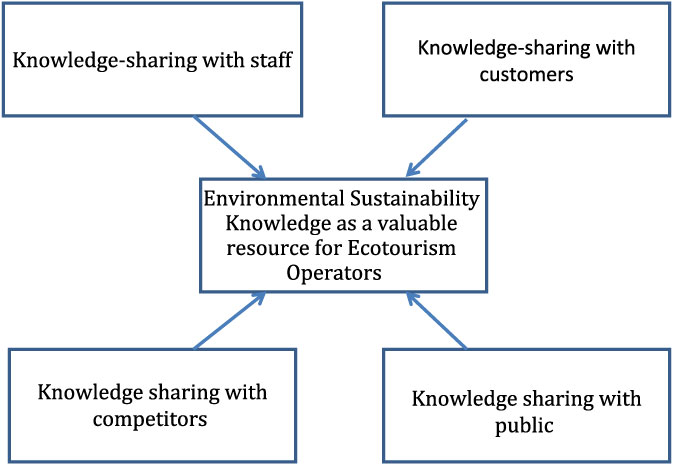
Ecotourism operators operate in and depend on the natural environment for continuing success, which Lundberg et al. (Reference Lundberg, Fredman and Wall-Reinius2014) found to be as important as economic returns. Ecotourism operators generate ESK through their business operations (hospitality, management and environmental practices) in natural environments. ESK is defined in this research as knowledge of protecting the natural environment within an environmentally focused mindset, and a strategic organisational resource and essential societal resource (Ip-Soo-Ching & Zyngier, Reference Ip-Soo-Ching, Zyngier and Ordóñez de Pablos2014). ESK is directed at actions to mitigate environmental impacts, such as reducing CO2 emissions, reducing energy and water consumption, adopting renewable energy sources, recycling, maintaining and protecting biodiversity, educating staff, and technological and process innovations (Ip-Soo-Ching & Zyngier, Reference Ip-Soo-Ching, Zyngier and Ordóñez de Pablos2014; Murphy, Watson, & Moore, Reference Murphy, Watson and Moore1991; Thomas, Jennings, & Lloyd, Reference Thomas, Jennings and Lloyd2008). Businesses now recognise the critical importance of sharing knowledge within their value chain but can still be reluctant to share their core competency knowledge among all their stakeholders (Bock et al., Reference Bock, Zmud, Kim and Lee2005; Hau, Kim, Lee, & Kim, Reference Hau, Kim, Lee and Kim2013; Spender, Reference Spender1993; Yang & Maxwell, Reference Yang and Maxwell2011). This attitude prevents firms in many industries having access to a valuable knowledge base. Through sharing their ESK with stakeholders, ecotourism operators are able to combine their business knowledge and ESK. This form of knowledge sharing among ecotourism operators augments their ESK and supports their environmental sustainability strategies because the more ESK is shared among stakeholders, the more value is accrued to the natural environment. This can be regarded as contributing to existing theory within KM, environmental education, and ecotourism. Figure 1 depicts the conceptual framework, built upon KM, environmental education and ecotourism to illustrate ESK sharing with staff, customers, competitors and the public.
Knowledge sharing supporting environmental sustainability.

Ecotourism operators are often aware of the need to tread with caution in natural environments but voluntarily or involuntarily fail because of conflict between business and environmental objectives (Brookes, Reference Brookes1999; Cater & Lowman, Reference Cater and Lowman1994). The main elements of ecotourism, as suggested by Karagiannis and Apostolou (Reference Karagiannis and Apostolou2004), involve specific knowledge of biodiversity, conservation, and cultural heritage that supports the protection of the natural environment. ESK develops into environmental sustainability capability, which is the collective learning that a company performs effectively (Prahalad & Hamel, Reference Prahalad and Hamel1990) and resides in employees’ knowledge and skills, technical systems, managerial systems, and values and norms (Leonard-Barton, Reference Leonard-Barton1992). Therefore, this specialised form of knowledge allows ecotourism operators to reduce their CO2 emissions, attain competitive advantage, and obtain additional benefits such as recognition for promoting environmental causes.
The natural environment is a key differentiating asset of the tourism industry in Australia and South East Asia (Malaysia and Thailand; Hall & Page, Reference Hall and Page2011; Newsome, Moore, & Dowling, Reference Newsome, Moore and Dowling2013). The Great Barrier Reef, Sipadan Island, and coral reefs and coastal environments of Australia, Malaysia and Thailand are key tourism assets in Australia and South East Asia. The Great Barrier Reef is the world’s most extensive coral reef ecosystem (Great Barrier Reef Marine Park Authority [GBRMPA], 2011). It has been listed as a World Heritage area by UNESCO (Australian Government Department of Sustainability, Environment, Water, Population and Communities, 2010). The Great Barrier Reef is a main reason for many visitors choosing Australia as their travel destination, which makes the continued conservation of this natural asset by government authorities and tourism operators critical (GBRMPA, 2011, 2014). Likewise, Sipadan Island in Malaysia is a coral reef ecosystem with a very high level of biodiversity. In the television documentary Borneo: The Ghost of the Sea Turtle, Jacques Yves Cousteau (Reference Cousteau1991), the oceanographer, said: ‘I have not seen other places like Sipadan Island. Now we have found again an untouched piece of art.’
However, there is trouble in ‘paradise’, because Sipadan Island is no longer an untouched piece of art, for it has become a major destination for scuba divers that could threaten its biodiversity (Musa, Reference Musa2002). The coastal environment is a natural asset that Thailand wants to protect and promote, and it is under grave danger of unabated development, pollution and mismanagement of natural resources (Green, Reference Green2005; Wong, Reference Wong1998; Wongthong & Harvey, Reference Wongthong and Harvey2014). The Great Barrier Reef, Sipadan Island, and the coastal environment of Thailand are under threat of an increasing number of visitors; pollutants in the form of rubbish, agricultural and oil discharge (Bryant, Reference Bryant2011; Kennedy, Reference Kennedy2012); coral bleaching and coral harvests (Kennedy, Reference Kennedy2012); and illegal fishing and a decreasing biodiversity (Sabah Parks, 2017). The natural environments in Australia, Malaysia and Thailand that risk being damaged by tourism and other industries are the coastal areas (e.g., lagoons and reefs, and marine fauna and flora), which are the natural attractions that tourists expect to enjoy (Hall & Page, Reference Hall and Page2011).
In response to these environmental dangers and damages, government authorities, tourism operators and tourists often claim that they do not know of the detrimental results of their actions on the natural environment. This could mean that they do not have the knowledge of related implications, or they are aware of the issues but ignore them because of high implementation costs. Therefore, an ESK sharing approach could enable ecotourism operators to better protect and maintain the natural environment in which they operate.
Research methodology: aims and objectives
This research employs an interpretive approach to provide insights about the meaning and processes of ecotourism operators’ ESK sharing activities (Rabinow & Sullivan, Reference Rabinow and Sullivan1988). To better understand the specific instances of ESK sharing, this research used in-depth interviews, which provided a rich understanding of the reasons for ecotourism operators to share knowledge with stakeholders (Denzin & Lincoln, Reference Denzin and Lincoln2005; Schofield, Reference Schofield, Huberman and Miles2002). A comprehensive and integrated analysis of ESK sharing gradually became clear from the readings and analysis of the data obtained from interviews conducted with ecotourism operators and supported by observations (Deshpande, Reference Deshpande1983; Thompson, Locander, & Pollio, Reference Thompson, Locander and Pollio1989). A case study approach (Yin, Reference Yin1984) was also employed to find out the answers to why and how ecotourism operators share their ESK.
Research questions
This research articulates a link between KM, environmental education, and ecotourism. Thus, the aims of this research consist of investigating the phenomena of ESK sharing among stakeholders. Three research questions regarding ESK sharing were developed. Q1: Do ecotourism managers regard ESK as a valuable resource? Q2: Why do ecotourism managers partake in the dissemination of ESK with stakeholders (staff, customers, business partners, competitors and the public)? Q3: How do ecotourism managers share ESK with stakeholders (staff, customers, business partners, competitors and the public)?
Sampling and procedure
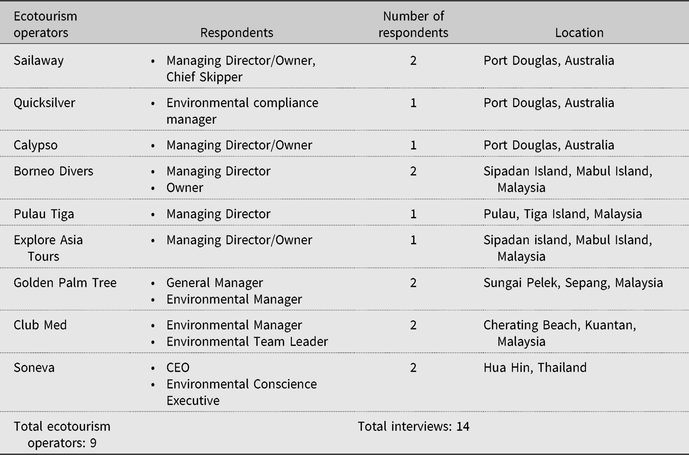
Prior research in environmental sustainability and industry involvement provided the researchers with executive-level contacts with Australian, Malaysian and Thai government tourism marketing organisations. Referrals from Tourism Tropical North Queensland, Tourism Malaysia and Sabah Parks facilitated acceptance from nine ecotourism operators to participate. Marshall (Reference Marshall1996, p. 523) warns that random sampling in qualitative research is not the most effective way of developing an understanding of complex human and organisational behaviour due to theoretical and practical reasons. This means that qualitative researchers can employ non-random sampling and recognise that some informants and organisations harbour specific behaviour and knowledge and these participants are more likely to provide valuable information to specific research questions (Marshall, Reference Marshall1996, p. 523). Therefore, a judgment sampling approach was selected. As such, the researchers actively sought ecotourism operators who were engaged in environmental sustainability activities to answer the knowledge-sharing research questions. Fifteen ecotourism operators were contacted to participate, based on their involvement in environmental sustainability projects and being located in the natural environments of the Great Barrier Reef (Australia), Sipadan Island, Mabul Island, Pulau Island, Sungai Pelek, Cherating Beach (Malaysia) and Hua Hin (Thailand). From these 15 ecotourism operators, 9 organisations agreed to participate. Table 1 provides information about the respondents and their organisations.
Respondents’ details

Data collection and analysis
On-site interviews were conducted with chief executive officers (CEOs), directors, owners, managers and key staff comprising marine biologists, skippers and team leaders from November 2011 to June 2013. Each interview lasted approximately two hours and was recorded using a digital voice recorder and documented on paper notes. The interview questions were clearly understood by the respondents, who provided extensive information on their ESK sharing actions. To support the reliability and validity of the data, the researchers conducted observations on location at the nine ecotourism organisations. Each field observation lasted approximately eight hours, based on obtaining prior agreement to be at locations to conduct interviews, note down observations, attend meetings, and photograph evidences. The field observations supplemented the participants’ responses because the researchers were able to witness processes, observe equipment and technologies employed, and attend meetings that were associated with ESK. Theoretical saturation was achieved as common patterns emerged in the responses after interviewing 14 senior managers and specialist staff at nine ecotourism operations through on-site, in-depth interviews and observations (Eisenhardt & Graebner, Reference Eisenhardt and Graebner2007; O’Gorman, MacLaren, & Bryce, Reference O’Gorman, MacLaren and Bryce2014; Rakić & Chambers, Reference Rakić and Chambers2010). Since theoretical saturation was achieved, and due to the financial costs associated with conducting on-site interviews and observations, it was decided not to recruit further participants.
A company in Melbourne that specialises in academic transcriptions transcribed the interviews. The researchers coded the transcriptions and identified themes using NVivo 9®, which is a qualitative research software. A theoretical thematic analysis of the data (Braun & Clarke, Reference Braun and Clarke2006) was employed by the researchers to code the following main themes pertaining to ESK sharing: (1) knowledge management, (2) knowledge sharing, (3) environmental sustainability, (4) competency knowledge.
A thematic analysis of these coded themes reveals nine further subthemes associated with KM, knowledge sharing, environmental sustainability, and competency knowledge. These subthemes emerged from the interviews as participants gave consistent and recurrent examples pertaining to education, biodiversity and CO2 emissions that supported their knowledge-sharing activities through their implementation of environmental sustainability programs, teams, culture and structure. These emergent themes were identified and coded: (1) education and training, (2) CO2 emissions and resource consumptions, (3) CO2 sequestration, (4) biodiversity, (5) video messages and nature documentaries, (6) organisational structure and teams, (7) environmental sustainability culture, (8) environmental sustainability programs, (9) educating children.
These themes were highlighted and coded within the transcriptions and interpretatively analysed for their relevance, impacts and implications regarding ESK sharing among stakeholders. This research analyses concepts, definitions, views, strategies and practices of ESK sharing from the perspectives of the respondents consisting of CEOs, managing directors, owners, managers and key staff; and it describes and analyses the realities of ESK sharing based on the socially constructed realities of the respondents (Glesne & Peshlin, Reference Glesne and Peshkin1992).
Findings and discussion
Importance of environmental sustainability knowledge for ecotourism operators
All nine ecotourism operators confirmed that ESK is a valuable resource that supports their environmental objectives. Managers at the Great Barrier Reef explained that they would not be able to operate there without this specialised knowledge, as there are financial costs and heavy penalties for not complying with environmental laws. An example of a salient support was given by a respondent at Calypso:
If we did not have the knowledge then we would not have much to show to people tomorrow … I think that in the area that we operate in, knowledge is very critical because if we are not operating as we are supposed to, then we receive heavy fines.
According to the Environmental Conscience Executive at Soneva, ESK is a critical resource for any ecotourism operator:
It’s an essential resource. If a tourism operator does not have the knowledge or doesn’t get the knowledge, it will not be able to operate successfully, and as we see it, you need to operate sustainably because that’s the right business model that’s going to give you the most return on investment and better profitability in the long term.
For Sailaway at Port Douglas, ESK and the protection of the Great Barrier Reef are combined assets. According to its director:
The area is low impact, so we manage education. We balance education with the protection of the reef. We do that with qualified marine biologists to increase environmental sustainability knowledge for visitors to the reef.
ESK is firmly grounded within the business models of ecotourism operators. Since ESK is a valuable resource for ecotourism operators, self-interest for business survival in the competitive tourism industry risks preventing managers from sharing this critical knowledge with their stakeholders. However, as ecotourism operators depend on the natural environment, they share the common belief of protecting it from environmental degradation. Sharing ESK among stakeholders advances environmental sustainability as a business and academic field because ecotourism operators depend on the ongoing quality of the natural environment for their sustainable business success. All 14 respondents agreed that without ESK, an ecotourism operator would not be able to operate sustainably and efficiently. Despite differences in economic development levels among Australia, Malaysia and Thailand, ecotourism managers in all three countries do share ESK with stakeholders, demonstrating that managers can indeed disseminate knowledge openly irrespective of the national culture within their competitive tourism industry, to the benefit of all stakeholders. The ecotourism products of the nine operators are similarly positioned in ecotourism quality and targeted to similar ecotourist segments. Albeit as a qualitative research, the findings suggest that there are no major national differences between Australian, Malaysian and Thai ecotourism operators because they are managed by leaders (CEOs, directors and managers) who are often Australians, Europeans and Western-educated Malaysians and Thais. Innovative ecotourism operators such as Soneva, Club Med, Sailaway, Explore Asia Tours and Borneo Divers have an entrenched environmental sustainability culture and philosophy that facilitates sustainability objectives and may not necessarily be driven by the nationality and country of origin of the ecotourism operators. Nevertheless, this research found that the ecotourism operators in Australia, Malaysia and Thailand openly share their ESK with staff, customers, competitors and the public.
Environmental sustainability knowledge sharing with staff
Education and training
The skipper at Sailaway mentioned that environmental sustainability became a topical issue for all reef operators and their staff in the last two decades. He said that in the 1960s, 1970s and mid 1980s, tour operators would cut out and remove pieces of coral and clam to feed fish. Divers would remove and take clams from the sea. He has witnessed the complete change of behaviour among divers towards protecting marine life. Nowadays, reef operators do not touch corals, clams and fish. His crew tells tourists not to interfere with the creatures of the Great Barrier Reef.
The skipper believes that having a leader who attends sustainability conferences enables Sailaway to share ESK among staff. He said:
These days, Steve is attending a lot of meetings and becoming very active [in] state and federal organisations. Steve goes off to many conferences and comes back with lots of environmental knowledge. He shares that knowledge with everybody. We have folders on the boat, with things that he has picked up, knowledge along the way, and that is produced in a folder and on the boat.
When compared with the ecotourism operators at the Great Barrier Reef, the respondents in Malaysia and Thailand (Club Med, Golden Palm Tree, Pulau Tiga Resort, Borneo Divers and Soneva) revealed that it was common for staff to lack ESK upon commencing their employment. This revealed that ESK among the public in Malaysia and Thailand is not as developed as in Australia. As ESK is acknowledged as a core competency by all ecotourism operators, they are duty-bound to provide staff with ESK and skills to ensure their survivability, profitability and sustained competitive advantage. To sceptics, these training programs could be considered as self-serving business objectives, but although ecotourism operators do not openly share their ESK based on their altruism, they are compelled to act as such to motivate and educate their staff. Regardless of this argument, this research found that managers and staff do indeed share ESK openly within an organisational environment in which the enrichment of ESK among staff is highly valued. Managers believe that staff should be trained in environmental sustainability; thus, ecotourism operators share ESK openly among staff. The environmental manager at Club Med in Malaysia lamented that staff need to be trained in environmental sustainability in their daily lives. The manager believes that educating staff about the importance of environmental sustainability is necessary for business success:
The employees don’t see the impact of sustainability in their daily life and their future; they don’t see their whole life. It is our job to explain to them why we need to use less electricity and water, why the garbage needs to be selected; it is our job to tell them why we have to use different chemicals for washing. Some workers take a longer time to be convinced. But people have to realise the importance of environmental sustainability at some stage in their future, and their children’s future. That’s why it takes a lot of time and effort, and it’s not yet automatic in people’s minds.
The director of Pulau Tiga Resort in Malaysia indicated:
Environmental awareness is something that we need to continue to impart to our future generations. I hope that maybe in 20, 30 years from now, people will be very conscious about the environment. There will be a shift in the mindset of the people towards environmental sustainability.
The findings indicate that ecotourism operators share ESK openly with staff because they see it as their duty to inform and educate.
CO2 emissions and resource consumption
At Club Med, CO2 emissions data are captured by Tech Care®, an environmental reporting system (ERS). Managers analyse emissions data and set benchmarks to reduce consumption of energy and water, and reduce CO2 emissions. The data are then used to educate staff, with the organisational aim of reducing their on-duty and off-duty CO2 emissions. An argument can be made that non-tourism organisations such as manufacturers and banks also share such data among their staff in order to reduce CO2 footprints. Therefore, ecotourism operators are not particularly different in their knowledge-sharing objectives. However, the operators regard knowledge sharing of CO2 emissions as critical organisational knowledge because CO2 emissions have direct negative impacts on the natural environment, which is detrimental to tourism success (Patterson, Bastianoni, & Simpson, Reference Patterson, Bastianoni and Simpson2006). Through the data collected by Tech Care®, Club Med is able to educate staff about recycling and consuming less electricity and water. In this vein, Club Med ensure that staff are made aware of their CO2 footprints and take steps toward its reduction. The statement from the environmental manager supports this:
This information has to be disseminated to all staff and needs to be done on a regular basis … environmental sustainability strategies are based on constant training and constant reminders because the mindset of staff and customers must change…. In a sense it’s to educate staff about environmental sustainability and implementing it over time, it is a continuous effort. We manage by explaining to staff on a regular basis and we keep track of their trainings.
Sailaway implements its ESK through recycling activities, the use of biodiesel and a carbon sequestration program. Alex, the skipper, indicated: ‘We manage our waste, sewage, rubbish. It is all sorted. We sail as much as possible and we use biodiesel, so we do as much as we can.’
Video messages and nature documentaries
The CEO of Soneva delivers monthly environmental sustainability video messages to all staff members. Commenting on this knowledge-sharing practice, the social conscience executive said:
Every month the CEO delivers a video address in which he explains the situation in the company and environmental sustainability strategies. Every host needs to see, so everyone in the company sees the videos, so there is direct contact with the CEO…. In every video we talk about environmental sustainability. It is part of our business model. It is part of our core purposes, our core values, so it is always mentioned in the videos.
According to the respondent it is compulsory for every staff member to watch the video messages: ‘It is actually mandatory. We have records of it and so everyone needs to see it because we want to share knowledge so that’s an important part.’
CEO’s video message of environmental sustainability to staff, customers and the public.
Source: Six Senses.

Despite the argument that ecotourism operators could be perceived as force-feeding ESK to their staff, this research uses the example of Soneva’s monthly video messages to suggest that ecotourism operators ensure that ESK is shared and instilled among all staff, regardless of underlining business objectives that could be attributed to branding, differentiation and other competitive advantages. Figure 2 depicts the CEO of Soneva in one of his video messages:
Our video messages are available for viewing on YouTube for the purpose of our staff, clientele and public to learn about our environmental sustainability belief and actions. (CEO, Soneva)
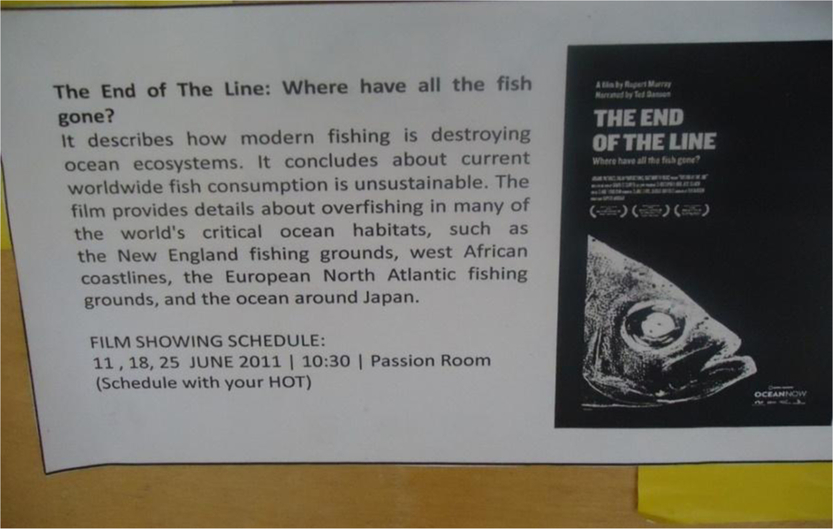
ESK is also disseminated through nature documentaries at Soneva and Club Med. The nature documentary The End of the Line: Where Have All the Fish Gone? is screened at Soneva resorts. Posters promoting the screenings are placed on noticeboards (figure 3).
We have screenings of environmental documentaries at the properties as part of our trainings. We invite everyone. We have to show it many times to cater to everyone. We bring them into our training rooms, show it to 10, 20 people at a time and sometimes we have to show it, stop it and then translate it in the local languages, Vietnamese, Divehi and Arabic, so there’s the training and the team will have to explain when necessary. (Social Conscience Executive, Soneva)
Ecotourism operators want their staff to be cognisant of environmental dangers such as overfishing, deforestation, pollution and other problems. Knowledge of these issues is not directly connected to hospitality and customer services duties, yet ecotourism operators extend their resources in training their staff. Screening nature documentaries for viewing by staff suggests that ecotourism operators generously share ESK with their personnel. Figure 3 is an evidence of Soneva’s usage of nature documentaries for the purpose of ESK training. The poster promotes the screening of a nature documentary on declining fish numbers and overfishing.
Poster promoting the protection of biodiversity.

Club Med regularly screens An Inconvenient Truth, directed by Davis Guggenheim (Reference Guggenheim2006), to its multinational staff.
We show An Inconvenient Truth and we have a discussion about it afterwards. It has English subtitles, it has Japanese subtitles, it has Korean subtitles, Malay subtitles … when we are working in such a multicultural environment, but the environmental message is always there, even if there is a political agenda behind it. (Team Leader, Club Med)
The CEO of Soneva believes that his staff should be made aware of nature documentaries. This is supported by his comments:
We have eco films; there is a list of the eco films. So they have meetings and apart from DVDs, there are also films that we distribute, there’s a list of environment films, which the hosts should watch….We encourage staff to watch eco films on DVDs and read books during their free time and to organise discussion groups … staff recommend that their relatives and friends watch eco documentaries before coming to job interviews at our resorts.
Job candidates at Soneva and Club Med are questioned by managers on their level of ESK. Job seekers with environmental sustainability experience and qualifications are given preference. Furthermore, the respondent at Club Med believes that documentaries such as An Inconvenient Truth have made staff aware of environmental problems:
Training staff, first we have benefitted enormously from the cultural shift that is happening around the world towards being more careful to the environment. The more people go and see Al Gore’s movie, the more people who see the news, with forests burning in the Amazon, Indonesia and Malaysia, the more people are put off and they suddenly make the connection between the burning of forests and what we are trying to achieve.
Knowledge sharing of environmental sustainability through documentaries is not necessarily connected to hospitality and resort management activities; nevertheless, ecotourism operators believe that their staff must possess knowledge of the plight of the natural environment. This is further evidence that ecotourism operators generously educate their staff with the aim of developing their ESK.
Organisational structure and teams
At the time of data collection, Soneva had an organisational structure (see figure 4), that enabled ESK to be shared between its inner and outer spheres; that is, from the CEO, managers, team leaders and hosts, and vice versa, without regard to staff status or position within the organisation.
We have an inner core. We think of it as an analogy of planet Earth ‘Gaia’ where you have the globe. We have the inner core, where the CEO and senior management are located. Then we have what we call the core. That is, the head of departments, head of teams as we call it, supervisors, and then we have the atmosphere, so the whole sphere, and that is where the majority of the hosts are and they are the ones who often have direct contact with customers or guest relation officers, housekeepers and waiters and waitresses. That is how the organisational structure shares knowledge from side to side — using the analogy of Planet Earth. (Social Conscience Executive, Soneva).
Leadership structure at Soneva.

Environmental sustainability knowledge sharing with customers
Based on statements from all respondents, this research found that ecotourism operators share ESK with customers, thus supporting the following factors: environmental sustainability culture, environmental sustainability programs, educating children, biodiversity, and CO2 sequestration.
Environmental sustainability culture
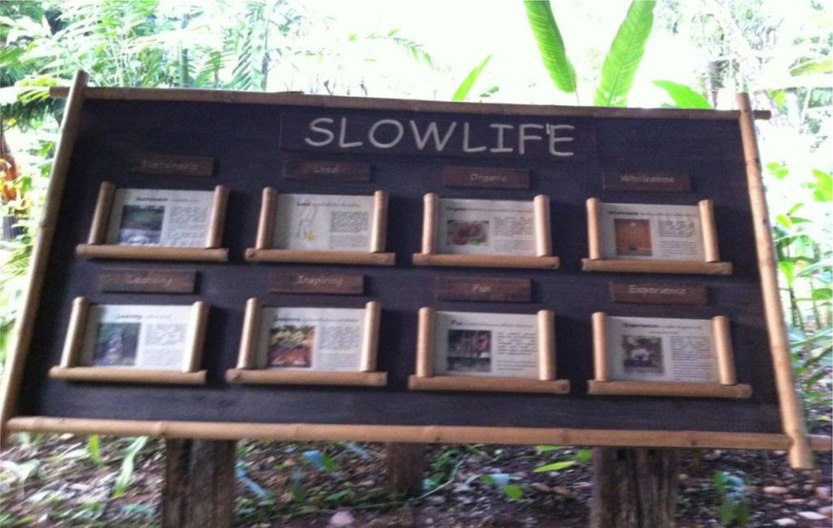
A philosophy of environmental and social conscience is firmly entrenched at Soneva and enables knowledge sharing with customers. This philosophy is endemic to Soneva and at all its resorts, including in Thailand. Soneva coined its environmental sustainability culture ‘Slow Life’, inspired by the Italian ‘Slow Food Movement’. In explaining how the values of Soneva were embedded in Slow Life, the social conscience executive commented:
We have a term that we call ‘Slow Life’. That’s how we do it in terms of ‘Sustainable’, ‘Local’, ‘Organic’, ‘Wholesome’ and how we do it is through ‘Learning’, ‘Inspiring’, ‘Fun’ and ‘Experience’.
‘Slow Life’ involves environmental and societal values (Sustainable, Local, Organic and Wholesome) being transmitted through knowledge-sharing terms (Learning, Inspiring, Fun and Experience). According to the social conscience executive, Slow Life is incorporated in the company’s mission, core values, structure and objectives. He provided a well-reasoned justification to explain how Slow Life supports the environmental sustainability objectives of Soneva:
Slow Life is the main part of our core purpose. Our core purpose is to create an innovative and enlightening experience that rejuvenates our customers’ love of Slow Life. So it’s really part of what we’re doing and how we’re doing it and so then it’s incorporated into our mission, our core values; so it’s really part of our structure and objective.
Soneva communicates its environmental sustainability values, culture and ideologies with placards placed in high-traffic areas at its resorts. The placards serve as ‘shrines’ that facilitate ESK sharing among both staff and customers. Figure 5 shows the placards to support ESK sharing at Soneva, and how the concept of Slow Life is explained to customers and staff. Slow Life provides the organisational culture that supports the sharing of ESK among customers and staff. The core principles of Slow Life are communicated through placards, websites, training and books. According to the social conscience executive, Soneva arranges regular Slow Life discussions and activities involving customers and staff:
With support from the CEO, we have what we call ‘Slow Life’ meetings that consist of workshops on paper-making from recycling papers, organic gardening and screening of environmental documentaries, where we sit together and discuss and share new ideas among staff and customers.
Through these workshops and discussions, ESK is extensively shared among customers and staff.
Placard of environmental sustainability knowledge-sharing at Soneva promoting ‘Slow Life’.

Environmental sustainability programs
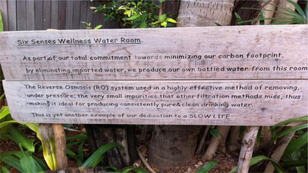
Club Med, Soneva, Explore Asia Tours, Borneo Divers and Sailaway have implemented environmental sustainability programs such as reverse osmosis systems (see figure 6), kitchen gardens, artificial reefs, CO2 sequestration and alternative energy usage. From the ESK obtained from these programs, the ecotourism operator Soneva shares its knowledge with customers using large placards placed in high-congregation and traffic areas. In this way, the ecotourism operator shares its knowledge of recycling, biodiversity and CO2 reductions with customers, with the aim of changing their attitudes and simultaneously building their brand, reputation and goodwill (Ip-Soo-Ching & Veerapa, Reference Ip-Soo-Ching and Veerapa2015).
Placard of environmental knowledge sharing of CO2 minimisation (reverse osmosis system) at Soneva/Six Senses.

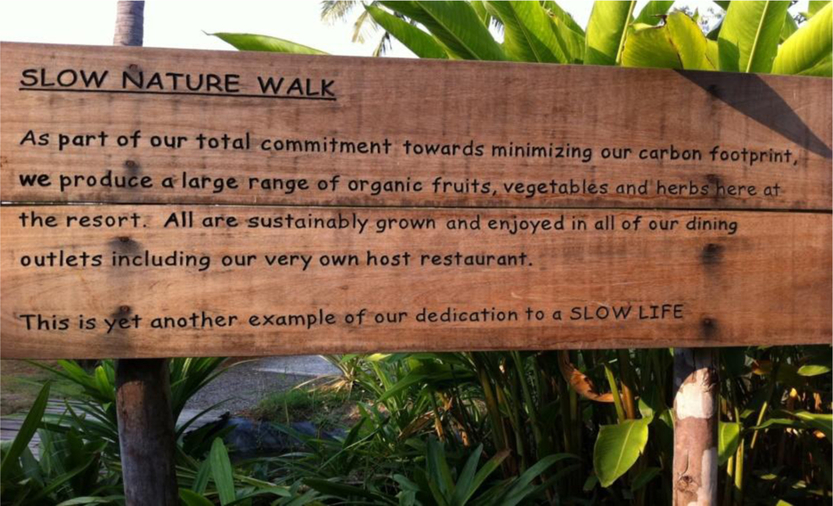
Soneva wants customers to understand that the company is active in environmental sustainability programs. The rationale for implementing a reverse osmosis system to produce potable water served in glass bottles instead of purchasing and using plastic bottles is shared with customers. A placard (figure 7) outlining Soneva’s commitment to reduce its CO2 footprint by growing organic fruits and vegetables is another relevant example of ESK sharing with customers, who receive in-situ education on the benefits of organic gardening when walking and relaxing in the kitchen gardens. They can also receive advice from gardeners.
Placard depicting the implementation of kitchen garden at Soneva/Six Senses.

Educating children
Research by Bos, McCabe, and Johnson (Reference Bos, McCabe and Johnson2015) suggests that children learn while on holidays. Ecotourism operators educate customers and their children about the natural environment and sustainability. As an example, children at Club Med receive an activity book on environmental sustainability. The activity book Rainforest Treasures (2009), written by Daphne Lee and illustrated by Wee Tian Beng and Goh Hoong Moon, was published exclusively for Club Med: ‘They get a small book from the Kids’ Club and we give them activities about environmental sustainability’ (Environmental Manager, Club Med).
The environmental manager believes that educating children about environmental sustainability also educates their parents. He gave an example of children at Club Med criticising their parents’ littering mistakes: ‘Kids say to their parents “Don’t do this or put this in the recycling bin.” We are starting to see that at Club Med.’
He believes that environmental sustainability must be taught to both adults and children:
I think this can take 5–10 years before people really understand. So what we do is training, and what we say during the training is not just for you, you also have to train your kids … and I believe kids teach their parents about environmental sustainability in turn.
Coral education
According to the respondent at Explore Asia Tours, the ecotourism operator has been successful in implementing an artificial reef structure that serves as a shelter for the marine life surrounding the resort and as an attraction and educational artifact for divers and marine biologists. He believes that the implementation of the artificial reef had been successful as an environmental sustainability project and for sharing ESK in the form of coral education to tourists. He commented:
We are successful because the results prove it. Things are growing and people are coming all the way to see this happening. We are protecting the environment. Marine life is growing. It is recovering, it proves that it works, our knowledge gained and shared from our observation and implementation.
Borneo Divers also share ESK derived from a smaller scale artificial reef project. The director of Borneo Divers said:
We had no experience in coral planting. We took damaged coral and then we replanted them on cement. Later we transferred the coral to a big area for replanting. We found that this did not work, because the damaged coral that we took and replanted did not survive. We learned from the trials. We studied them for many years and then when the coral grew on the seabed, we measured the growth rate and then we started documenting the type of coral.
On the topic of knowledge sharing of coral education, the same respondent at Borneo Divers said:
We actually did a lot, based on trial and error. Through our experience of observing things that we have done a lot over the years we develop this knowledge while we implement it…. I consider our coral transplant a very successful project for us and although we are not doing it on a large scale, simply because we are not 100% satisfied yet. We will when we have the correct formula in the cement mixing and the temperature and the depth, and the sunlight. We would like to explain to the rest of the world, hey this works.
Quicksilver, Sailaway, Calypso and Soneva employ marine biologists to interpret and teach marine life to customers. The environmental compliance manager at Quicksilver described the duties of marine biologists: ‘Primary roles of marine biologists are to present a suitable interpretation of the reef to our clients so that when people leave the reef, their level of understanding of how the reef works has increased.’
The director of Sailaway commented that the two marine biologists at Sailaway actively share their knowledge of the natural environment with customers:
We have qualified marine biologists. They have a passion for specific knowledge and they are keen to be part of an organisation with a good philosophy and belief. They are involved in delivering the environmental message every day to our customers.
The marine biologists are responsible for observing and reporting on the state of the marine environment:
The marine biologists provide checks and balances and report on the threats that the reef is encountering…. They also act as environmental watchdogs so they have a good understanding of threats so if they see operations that are not meeting the requirements that we have, so people like me will alert managers to that fact and we will conduct investigations. (Respondent, Quicksilver)
CO2 sequestration
Sailaway has implemented its CO2 sequestration program by planting trees on lands that were previously sugar cane fields. The skipper at Sailaway said: ‘Sailaway is producing a neutral CO2 footprint. Steve is doing that by planting trees on his property to cancel out our CO2 footprint. We are aiming for a long-term zero CO2 footprint by learning more from our current actions.’
On the topic of knowledge sharing of CO2 sequestration, the director of Sailaway said:
We use our website to spread knowledge with very little resources. We can outline our beliefs within our website on what we do. Our beliefs and action have exposure to visitors who are receptive. Within our website we explain our tree-planting program and our climate action award. We use our website to share our knowledge very easily with low resources to many people.
Environmental sustainability knowledge sharing with competitors
The environmental sustainability programs, technologies, and processes of ecotourism operators are openly visible for competitors to observe and replicate. The findings of this research indicate that ecotourism operators openly share ESK with their direct competitors by holding regular meetings and seminars during which they demonstrate their latest environmental projects (e.g., CO2 reductions, renewable energy, recycling, and biodiversity), discussing problems (e.g., pollution, environmental damage and biodiversity), and exchanging ideas (e.g., best practices and lessons learned). On first impressions, this type of open knowledge sharing can be perceived as a form of coopetition, which is a business strategy of simultaneously competing against competitors and collaborating with them. However, on closer analysis, the findings provide evidence that ecotourism operators collaborate by openly sharing their ESK with their competitors, thus advancing the field of environmental sustainability and collectively protecting the natural environment on which they all depend because of shared and mutual interests.
Ecotourism operators at the Great Barrier Reef Marine Park are motivated by innovative environmental sustainability practices. They share their ESK with competing tourism organisations by regularly delivering seminars on environmental sustainability practices. Through these platforms, they share innovative knowledge with competitors. Unlike other industry gatherings, such as seminars, conferences and tradeshows where rival firms showcase their knowledge for prestige and publicity, ecotourism operators use their industry meetings as forums to share ideas and lessons learned, and to receive advice on how to operate in the natural environment. Quicksilver shared its ESK among fellow ecotourism operators in this way:
Yes, we regularly sit on the local Marine Advisory Committee. We host reef operators’ meetings and seminars on board our vessels. All the reef operators can get together with the managers and discuss environmental issues. We invite them and have workshops and forums where we can discuss environmental issues, innovations and discuss solutions among ourselves. (Respondent, Quicksilver)
Sailaway, Quicksilver and Calypso are active participants in the GBRMPA’s ‘Eye on the Reef’ program, which enables them to share ESK with fellow reef operators. Sailaway, Quicksilver and Calypso provide information to the GBRMPA, based on their in-situ observations of the marine park. The information from the Eye on the Reef program was shared through a data management and reporting system that was managed by the GBRMPA (2009). Ecotourism operators and GBRMPA share up-to-date information on coral bleaching, protected species, and early warnings of invasion from the crown of thorns starfish, Acanthaster planci (GBRMPA, 2009)
The importance of Eye on the Reef is supported by the director of Sailaway who said: ‘We participate in Eye on the Reef for Great Barrier Reef Marine Park Authority. We observe, we are guardian and stakeholders, and we are educating.’
The ecotourism operators participate in regular meetings with the GBMPA and other reef operators. The director of Sailaway said:
It is very important to listen and learn and be part of an environment to know what is going on around you. I am involved in various areas voluntarily within the local marine advisory committee for GBRMPA and within the areas of involvement as stakeholder for Low Isles.
The skipper at Sailaway commented:
Steve does that through attending a lot of meetings and getting himself on board many organisations, discussing with people and sharing and receiving more knowledge … any knowledge that he gains he brings and shares with the crew.
In a similar vein, ecotourism operators in Malaysia also share their knowledge with competitors. The director of Pulau Tiga Resort said: ‘This is how we share knowledge, when we have our meetings with all the other organisations we share knowledge. We share knowledge and we learn about environmental sustainability.’
Unlike other industries where firms are secretive about sharing their core competency knowledge with rivals, this research demonstrates that ecotourism operators freely share core competency ESK among competing ecotourism operators. The knowledge that is shared keeps ecotourism operators in the knowledge loop of each other’s environmental sustainability activities, even though projects, activities and processes can be copied. Ecotourism operators engage in coopetition and also share ESK for the sake of collectively protecting the natural environment with which they have a symbiotic dependence. Despite the potential criticism that ecotourism operators share ESK with rival firms based on collaboration to enlarge their market, this research demonstrates that ecotourism operators in Australia, Malaysia and Thailand openly share their knowledge with their competitors. This therefore cannot be dismissed as simply coopetition. However, although ecotourism operators openly share ESK with competitors, this research found that managers in Australia, Malaysia and Thailand can be jealous of the environmental sustainability advancements of other competing ecotourism operators. In instances when an ecotourism operator was more innovative in its environmental sustainability program, managers at other ecotourism operators expressed jealousy, which motivated them to achieve parity or surpass their rivals. There were rare instances when ecotourism operators preferred to keep knowledge for themselves. For example, the specific skills needed to establish an artificial coral reef at ecotourism operators were not immediately shared because having a better (i.e., larger and more established) ‘privately owned’ artificial coral reef enabled ecotourism operators to demonstrate to tourists that they had a more attractive asset than competing ecotourism operators. The race to outperform competing ecotourism operators in environmental sustainability projects can be viewed as beneficial for the advancement of environmental sustainability. Alternatively, managers responded that should a competing ecotourism operator fall behind in their environmental sustainability activities, then they would have no reservations about reporting such actions to regulators.
Environmental sustainability knowledge sharing with communities and the public
This research found that ecotourism operators share ESK with communities and the public. The respondents at Borneo Divers, Explore Asia Tours and Pulau Tiga Resort believe that the public in Malaysia must be educated about major environmental problems such as littering and illegal fishing. However, the relevance of environmental sustainability, while gaining recognition in Australia, is still not perceived to be so relevant to the public in developing economies such as Malaysia and Thailand. Therefore, ecotourism operators educate communities surrounding their resorts about environmental problems and actions to mitigate its impacts. The directors of Borneo Divers and Pulau Tiga commented: ‘So education is important. Everybody must have a life skill educational program. The public must be educated about environmental sustainability.’ And:
We need to educate the people who come here. They just can’t understand the reasons for the rules and regulations that have been set by Sabah Parks. Rubbish is still being thrown all over the place and we have to clean the beach. Outsiders come in without our knowledge and create all kinds of problems. They dump their rubbish here. (Director, Pulau Tiga Resort)
The Director of Explore Asia Tours believes that educating the public is important and that governments and ecotourism operators can provide environmental sustainability education: ‘I think community knowledge is lacking. We have to teach the community and have a long-term view and commitment and we have to work hand in hand with everybody.’
Although illegal fishing, dynamite and cyanide fishing are no longer conducted by locals on a large scale, these problems nevertheless persist on Mabul Island, Kapalai Island and Mataking Island in Malaysia. The respondent at Explore Asia Tours believes that fishermen must be educated about environmental sustainability and that that they must see its relevance and value to them:
You have to educate fishermen about dynamite fishing and then fishermen get involved with the tourism business. They start to turn their properties into lodges or homestay so in a way it helps because they also want their customers to be able to see the marine life, but they still lack a lot of knowledge about environmental sustainability.
Furthermore, respondents in Australia, Malaysia, and Thailand strongly support the idea of educating students about environmental sustainability at primary and secondary school levels. Students are taught diving, with the added objective of appreciating the marine environment surrounding the resorts. The social conscience executive at Soneva believes that high school students must understand and value the natural environment surrounding their archipelago:
Every year we bring a group of students into the resort to show them the environmental wealth and richness, and a lot of these kids, even though they are surrounded by the ocean, they don’t know how to swim and have never seen coral or haven’t seen nature because they live in the city … therefore biodiversity education is very important.
The environmental compliance manager at Quicksilver delivers presentations on environmental sustainability to schools, special interests and the public: ‘I am happy to go to schools and explain what we are doing, likewise special interest groups. Last week, I gave a presentation to a series of volunteers, again about what we are doing regarding our CO2 footprint.’
Conclusion
Ecotourism operators are passionate believers of environmental sustainability and benevolently share the associated knowledge with staff, customers, competitors and communities (stakeholders). ESK is shared among stakeholders using the mechanisms of education, training, organisational culture, environmental reporting systems and sustainability programs through which knowledge of resource consumption, biodiversity, recycling, and CO2 emissions and sequestrations is conveyed. For ongoing business success, ecotourism operators are dependent upon the sustained quality of the natural environments in which they operate. Therefore, it is vital that they freely share their knowledge with all stakeholders to safeguard the natural environment. If ESK is not shared, then staff, customers, competitors and communities will continue practices that have negative and damaging environmental impacts. Thus, the failure to learn from failures risks being perpetuated. Therefore, ecotourism operators cannot be possessive or secretive of their ESK, because the more it is shared, the more value is accrued to the natural environment in which they operate and depend. This research provides evidence that valuable knowledge in the form of ESK can be benevolently shared among all stakeholders. This supports the knowledge-based view of the firm, which posits that knowledge as an asset becomes more valuable the more it is shared. The conceptual framework (figure 1) supported by the findings and discussion strongly suggest that ESK is a valuable resource for ecotourism operators and is openly shared among staff, customers, competitors and the public. The framework can be applied at ecotourism destinations in both developed and developing economies. The findings have academic and practical implications in KM, environmental education and tourism, and could also support the implementation of environmental education in non-tourism industries.
It is suggested that future research use a mixed-methods approach, using a quantitative scale across industry sectors that may test and strengthen the enhanced framework (figure 1) of this research. Furthermore, this research was unable to quantify all KM and environmental sustainability components. Further research in this area requires more precise definitions to be broadly accepted and for these definitions to provide the basis of some measurement procedure.
Jean Marie Ip Soo Ching’s PhD titled The Salience of External Knowledge, Leadership and Action in the Knowledge Management Life Cycle of Nature-Based Tourism Operators was awarded at La Trobe University, Melbourne, Australia in October 2014. He has lectured in Marketing, Management and Information Systems at La Trobe University and Swinburne University from 2006 to 2018. His research interests are knowledge management, environmental sustainability, marketing and marketing automation.
Suzanne Zyngier is an education consultant and independent academic, and is immediate past Associate Dean (International) at La Trobe University, Australia. Dr Zyngier publishes internationally and has authored and co-authored journal articles, and book chapters. Suzanne has held academic appointments at the University of Melbourne, Monash University and Swinburne University of Technology. Her research centres on the governance of knowledge management and knowledge sharing strategies. She is also interested in information ethics, privacy and security. Suzanne has been a conference track leader at the Hawaiian International Conference on the Systems Sciences (2011–2014), and at International Conference on Information Systems Development (2011, 2012).
Tahmid Nayeem completed his PhD in the area of Consumer Behaviour at Swinburne University of Technology. Prior to joining Charles Sturt University where he is currently a Lecturer in Marketing, Tahmid gained more than 12 years’ teaching experience in the United Kingdom, Australia and Singapore.