Implications
Pigs born small due to intrauterine growth restriction (IUGR) have a reduced daily gain and feed intake and a slightly increased feed conversion ratio (kg feed/kg gain) compared with pigs born large. A novel finding is that although, the pigs born small had a lower growth capacity, they did not respond less to an approximately 30% reduction in dietary protein in the postnatal stage in terms of daily gain and feed conversion ratio compared with pigs born large as no birth body weight by dietary protein interactions were observed. The shear force was increased in male pigs born small and in pigs fed a low-dietary protein. These results suggest that the efficiency of piglets born small cannot be changed by a lower dietary protein level. Therefore, studies are needed in order to prevent development of IUGR.
Introduction
Intrauterine growth restriction (IUGR), which is naturally occurring in pigs, causes a large economical loss worldwide due to lower postnatal growth potential and efficiency of growth (Wu et al., Reference Wu, Bazer, Wallece and Spencer2006). In addition, this has been exacerbated during the last decades where intensive selection for increased litter size in pig production has led to larger litter variation in birth body weight (BW) with the consequences that more piglets are stillborn and born small with a low survival rate (Milligan et al., Reference Milligan, Fraser and Kramer2002). Furthermore, low birth body weight (LBW) pigs, as a result of IUGR, may have some (Nissen et al., Reference Nissen, Jorgensen and Oksbjerg2004; Gondret et al., Reference Gondret, Lefaucheur, Juin, Louveau and Lebret2006; Morise et al., Reference Morise, Louveau and Le Huërou-Luron2008; Rehfeldt et al., Reference Rehfeldt, Tuchscherer, Hartung and Kuhn2008) negative consequences on carcass and meat-quality traits like pH, drip loss, tenderness and meat colour.
Postnatal feed intake and dietary protein level have a great impact on growth and carcass composition, and some effects on meat quality are observed (Millet et al., Reference Millet, Ongenae, Hesta, Seynaeve, De Smet and Janssens2006; Ruusunen et al., Reference Ruusunen, Partanen, Pösö and Puolanne2007). Thus, reduced dietary level of protein or amino acids fed to growing pigs generally causes lower growth rates and an increased feed conversion ratio, and higher carcass fat content (Goerl et al., Reference Goerl, Eilert, Mandigo, Chen and Miller1995; Ruusunen et al., Reference Ruusunen, Partanen, Pösö and Puolanne2007; Hinson et al., Reference Hinson, Schinckel, Radcliffe, Allee, Sutton and Richert2009; Kamalakar et al., Reference Kamalakar, Chiba, Divakala, Rodning, Welles, Bergen, Kerth, Kuhlers and Nadarajah2009), which is not beneficial for the meat industry. However, because small birth weight littermates have lower daily gain their requirements for dietary protein may be lower than their heavier birth body weight (HBW) littermates. Thus, if the reduction in daily gain is lesser in LBW compared with HBW pigs following a reduction in dietary protein level this may indicate a lower dietary protein requirement. In other words, an interaction between birth BW and postnatal dietary protein level, which is largely unexplored, may exist, and could have potential benefits for the pig industry and the environment. Thus, we hypothesize that LBW pigs with a lower capacity for growth will respond less to a reduction in dietary protein compared with HBW pigs in terms of gain and nutrient utilization.
The objective of this study was therefore to elucidate the interaction between birth BW, and two postnatal dietary protein levels, in relation to performance, organogenesis, muscle metabolism and meat quality.
Material and methods
Animals and treatments
This experiment was carried out after permission from the Danish Animal Experiments Inspectorate.
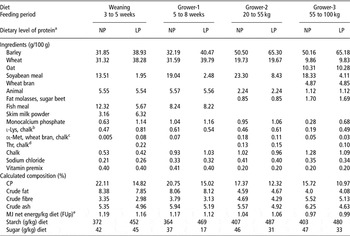
Offspring from 16 Danish Landrace gilts mated to Danish Landrace boars were used in this study. Twice daily during gestation, the sows were fed 1 kg of a diet containing 16 MJ/kg of metabolizable energy (ME) and 130 g of crude protein (CP)/kg feed (Nissen et al., Reference Nissen, Jorgensen and Oksbjerg2004). On an average, the litter size (piglets born alive) was 13.0 of which 2.2 piglets died from birth to weaning at 28 days. Thus, at weaning the mean litter size was 11.8 piglets. After farrowing, the gilts were fed a lactation diet ad libitum containing 16.7 MJ/kg ME and 172 g of CP/kg feed (Nissen et al., Reference Nissen, Jorgensen and Oksbjerg2004). At birth, the BW (male pigs: 1.37 kg ± 0.26 (0.92 to 1.89); female pigs: 1.33 ± 0.26 (0.78 to 1.86)) and the crown–rump length (CRL) were recorded. At weaning (day 28), the LBW male and female pigs and the HBW male and female pigs within each litter (a total of four pigs per litter) were penned individually, and fed ad libitum either according to requirement for dietary protein (normal level of protein, NP) or a diet in which the protein level was reduced by 30% (lower protein, LP) but the diet was isocaloric compared with the NP diet until slaughter at 150 days of age (Table 1). The dietary protein was reduced along the period of growth in relation to the reduced protein recommendation for optimal growth (Table 1; see Nissen et al., Reference Nissen, Jorgensen and Oksbjerg2004). Entire male pigs were used in this study. Weaning BW, slaughter weight and feed intake were recorded. If the smallest piglet of each gender died between birth and weaning it was substituted with the second smallest piglet at birth. Three pigs died after weaning of which two (a male and a female) were low birth weight and was allocated to the LP diet, and one (female) was LBW and was allocated to the NP diet.
Dietary composition and calculated amounts of nutrients and energy in diets fed to pigs in various time periods of growth

NP = normal level of protein; LP = lower protein.
aNP diet contains a normal level for pig performance, whereas the LP diet contains 30% less protein than the NP diet.
bIn the form of 40% lysine and 50% chalk.
cIn the form of 40% methionine, 25% wheat bran and 35% chalk.
dIn the form of 50% threonine and 40% chalk.
e1 FUp = 7.72 MJ net energy.
Slaughter procedure
All four pigs within each litter were slaughtered the same day (day 150 of age). From the experimental barn facilities, the pigs were transported approximately 500 m to the experimental slaughterhouse. The pigs were stunned by CO2 and bled. Immediately after bleeding, a muscle biopsy of approximately 500 mg was taken from the right the Longissimus dorsi muscle (LD) at the level of the last rib curvature and snap frozen in liquid nitrogen. Approximately 45 min post mortem, muscle samples from the right LD were collected too, and frozen in liquid nitrogen. Hot carcass weight, the weight of the semitendinosus muscle (ST), of internal organs (liver, kidneys, pancreas and heart), blood and leaf fat were recorded.
Meat-quality analyses
Meat-quality traits were measured on samples from LD. The pH was measured both 45 min and 24 h post mortem in the right LD at the last rib curvature. The pH was measured with a pH meter (Radiometer PHM210, Copenhagen, Denmark) equipped with an insertion glass electrode (Model 704, Metrohm, Herisau, Switzerland). The day after slaughter, meat samples were collected from the right LD caudally from the last rib curvature for drip loss, colour and texture measurements. Drip loss was measured over 48 h (from 24 to 72 h post mortem) on approximately 100 g of meat using the plastic bag method (Honikel, Reference Honikel1998). Following 24 h post mortem, colour was measured using a Minolta Chroma Meter CR-300 (Osaka, Japan) calibrated against a white tile (lightness, L* = 92.30; redness, a* = 0.32 and yellowness, b* = 0.33). The samples were allowed to bloom for 1 h at 4°C before measuring the colour at five different places on each sample. The samples for texture analyses were measured using the Warner–Bratzler shear force equipment. The samples were vacuum-packed, aged for 2 days and then stored at −20°C before measurements. The thawing loss was measured after 24 h thawing in a 4°C water bath. After thawing, the samples were vacuum-packed and heated in a water bath to a core temperature of 70°C. After cooking, the muscle sample was cut into eight 1 × 1 × 5 cm pieces along the fibre direction and sheared perpendicularly to the fibre direction according to Møller (Reference Møller1981) with an Instron testing machine (Model 4301, INSTRON Limited, Buckinghamshire, UK), except for the fact that a square blade (12.0 mm wide, 1.1 mm thick) was used in this study.
Enzyme activities
Activities of lactate dehydrogenase (LDH) and citrate synthase (CS) were measured on the LD biopsy samples taken immediately after bleeding. Calpastatin activity was measured in the LD muscle samples taken approximately 45 min post mortem. For LDH and CS activity measurements, approximately 10 mg muscle tissue was homogenized on ice in 0.1 mol/l of phosphate buffer (pH = 7.1) with a glass homogenizer. Enzyme activities were determined by measuring the NAD+/NADH reactions by spectrophotometer (340 nm) as described by Oksbjerg et al. (Reference Oksbjerg, Petersen, Sorensen, Henckel and Agergaard1995). The activities are expressed in μmol/g of wet muscle per min. The activity of calpastatin was determined by the method described by Thompson et al. (Reference Thompson, Saldaña, Cong and Goll2000) with modification by Therkildsen (Reference Therkildsen2005). In brief, 150 mg muscle was homogenized on ice in 1.0 ml pre-rigor extraction buffer (pH = 8.3). The inhibitory activity of calpastatin was determined by subtracting the activity of μM-calpain (Calbiochem, catalogue no. 2087129) in wells with samples containing calpastatin from the activity of μM-calpain in wells without samples. The inhibitory activity of calpastatin was expressed as fluorescence per gram of muscle tissue.
Statistical analyses
Statistical analyses were performed by means of the SAS version 9.2 (SAS Institute Inc., Cary, NC, USA) using the MIXED procedure. The model included the fixed effects of gender, birth weight group (LBW or HBW) and diet (NP or LP). Also interactions among the fixed effects were included. The sow was included as a random factor. Slaughter weight was included as a covariate in the model for meat-quality and muscle enzyme analyses when significant. Differences with probabilities of P < 0.1 and P < 0.05 were considered as a tendency or as significant, respectively. Data are presented as LSMeans ± pooled s.e.
Results
Performance (Table 2)
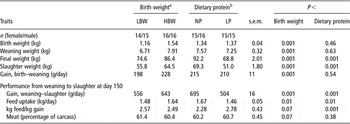
No birth BW group by dietary protein level interactions were observed. Therefore, the main effect of the birth BW and dietary level of protein are presented. Birth BW differed significantly (P < 0.001) between LBW and HBW pig littermates as was the intention of the study. The difference in birth BW was also evident at weaning (P < 0.001). Average daily gain from birth to weaning was higher (P < 0.001) in HBW pigs compared with LBW pigs. Daily gain from weaning to slaughter at day 150 was also higher (P < 0.001) in HBW pigs compared with LBW pigs, and highest (P < 0.001) in pigs fed the NP diet compared with LP fed pigs. The feed intake from weaning to slaughter at day 150 was reduced (P < 0.01) in LBW pigs compared with HBW pigs and also reduced (P < 0.01) in LP fed pigs. The feed conversion ratio (kg feed/kg gain) from weaning to slaughter tended to be increased (P < 0.07) in LBW pigs compared with HBW pigs and also increased (P < 0.01) in LP fed pigs compared with NP fed pigs. Live BW at slaughter and hot carcass weight were significantly (P < 0.001) influenced by birth BW and postnatal diet.
The influence of birth weight and postnatal dietary protein level on the performance of pigs

LBW = low birth body weight; HBW = high birth body weight; NP = normal level of protein; LP = lower protein.
As no interactions between birth weight and dietary level of protein were observed main effects are presented as LSMeans with pooled s.e.
aBirth weight: LBW is the smallest littermate and HBW is the largest littermate.
bNP diet contains a normal level for optimal pig performance, whereas the LP diet contain 30% less protein compared with the NP diet.
Absolute and relative organ weights (Table 3)
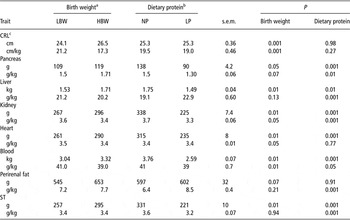
At birth, LBW pigs had a shorter CRL (cm, P < 0.001) but a higher relative CRL (cm/kg, P < 0.001) than HBW pigs (Table 3). At slaughter, the weight of pancreas (P < 0.05), liver (P < 0.01), kidneys (P < 0.05), heart (P < 0.01) and the ST (P < 0.01) were lower in LBW compared with HBW pigs, and also lower in LP compared with NP fed pigs (all P < 0.001). The weight of leaf fat was not significantly affected by treatments.
The influence of birth weight and dietary protein on absolute and relative weight of organs in pigs following slaughter at day 150 of age

LBW = low birth body weight; HBW = high birth body weight; NP = normal level of protein; LP = lower protein; CRL = crown–rump length; ST = semitendinosus muscle.
As no interactions between birth weight and dietary level of protein were observed main effects are presented as LSMeans with pooled s.e.
aBirth weight: LBW is the smallest littermate and HBW is the largest littermate.
bNP diet contains a normal level for optimal pig performance, whereas the LP diet contains 30% less protein compared with the NP diet.
cCRL was measured at birth, whereas all other traits were measured at slaughter day 150.
A higher relative weight (g/kg BW) of kidneys (P < 0.05), heart (P < 0.05) and blood volume (P < 0.01) were found in LBW compared with HBW pigs. The relative weight of pancreas (P < 0.01), kidneys and blood (P < 0.05) were decreased, while the relative weight of liver (P < 0.001) and perirenal fat were lower in LP fed pigs compared with NP fed pigs. For the relative weight of perirenal fat, a diet by gender interaction was observed (P < 0.05). This interaction shows that the relative weight of perirenal fat was similar between the genders after feeding the NP diet (6.7 v. 6.1 g/kg in male and female pigs), while female pigs had a higher relative weight of perirenal fat after feeding the LP diet (7.8 v. 9.2 in male and female pigs).
Meat-quality traits (Table 4)
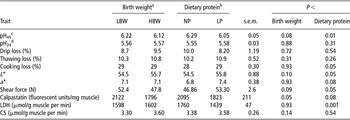
The pH45 of LD tended (P < 0.07) to be lower in HBW pigs compared with LBW pigs and feeding the NP diet resulted in a higher pH45 (P < 0.01) compared with pigs fed the LP diet.
The influence of birth BW and dietary protein on some meat-quality traits and enzyme activities following slaughter at day 150 of age

LBW = low birth body weight; HBW = high birth body weight; NP = normal level of protein; LP = lower protein; LDH = lactate dehydrogenase; CS = citrate synthase.
As no interactions between birth weight and dietary protein was observed, main effects are presented as LSMeans with pooled s.e.
aBirth weight: LBW is the smallest littermate and HBW is the largest littermate.
bNP diet contains a normal level for pig performance, whereas the LP diet contains 30% less protein compared with the NP diet.
cpH measured 45 min post mortem.
dpH measured 24 h post mortem.
pH24hpost mortem was not affected by birth weight or diet. Lightness (L*) tended (P = 0.10) to be higher in meat from HBW than from LBW pigs: a tendency (P < 0.08) for a higher a* (redness) in LP compared with NP fed pigs was observed. Shear force was found to be (P < 0.05) higher in LP compared with NP fed pigs, and a tendency (P = 0.08) for a higher shear force in LBW compared with HBW pigs was also observed. However, the effect of birth weight on shear force was mainly attributed to male pigs because LBW male pigs had higher shear force than HBW male pigs, while female pigs from the two birth weight groups produced meat with similar shear force (gender by birth weight group interaction; P < 0.08). The relative weight of the ST muscle was lower in LP fed pigs compared with HP fed pigs (P < 0.001).
Enzyme activities (Table 4)
The activity of LDH was significantly (P < 0.001) affected by diet in LD 2 min post mortem and was lower in muscles from LP compared with NP fed pigs. No effect of birth weight was found on LDH activity. The activity of CS was unrelated to treatments. Calpastatin activity in LD was significantly (P < 0.05) higher in LBW compared with HBW pigs. Also a tendency (P = 0.08) towards lower LD calpastatin inhibition was observed in LP fed compared with NP fed pigs.
Gender (Table 5)
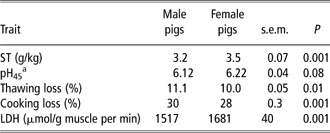
A few gender-dependent traits were found. Thus, the relative weight of the ST muscle was higher (P < 0.001) in female than in male pigs. The pH45 (P < 0.1) was lower and the thawing loss (P < 0.01) and cooking loss (P < 0.001) were higher in male pigs compared with female pigs. Finally, the activity of LDH was lower (P < 0.001) in male than in female pigs.
Gender differences in some muscle and meat-quality traits following slaughter at day 150

ST = semitendinosus muscle; LDH = lactate dehydrogenase.
apH measured 45 min post mortem.
Discussion
In this study, we examined the hypothesis that LBW littermate pigs with a lower capacity for growth compared with HBW pigs will respond less to a reduction in dietary protein because of a lower requirement for dietary protein. To test this hypothesis we fed the pigs either a diet sufficient in protein or a diet with 30% reduction for protein and isocaloric. The reduction by 30% was chosen for the following reasons. Firstly, a linear relationship between daily gain and dietary protein concentration when the latter was limiting (93 to 175 g/kg diet) was observed (Campbell et al., Reference Campbell, Taverner and Curic1984), and secondly, this study showed that a change in dietary protein by 1 g/kg diet caused a change in daily gain by 2.5 g/day. Next, we assumed that the daily gain of LBW pigs would be reduced by 100 g/day compared with HBW pigs and that this difference of 100 g correspond to a reduction in dietary protein requirement of approximately 40 g of protein/kg diet (100/2.5), which is approximately 30%.
However, feeding the LP diet in this study from weaning to slaughter reduced daily gain, feed intake and increased feed conversion ratio to a similar extent in LBW and HBW pigs as no significant interactions were found between birth weight and dietary protein level in general. However, because the feed intake was changed in LBW pigs and in LP fed pigs this could influence the effect of dietary protein on performance traits like daily gain and the feed conversion ratio. Consequently, we included the feed intake as a covariate in the statistical model. These analyses did not cause any interaction between birth BW and dietary protein level. Altogether, these observations argue in favour of a rejection of our hypothesis.
This study further showed the well-known variation in birth BW and CRL within a litter of pigs. The increased CRL/kg birth BW (cm/kg) suggests disproportionate foetal growth in LBW piglets compared with HBW piglets, and that LBW piglets are thinner at birth. This is in agreement with findings in animal and human foetuses subjected to IUGR (Godfrey and Barker, Reference Godfrey and Barker2000). Consequently, we suggest that undernutrition during foetal development is at least partly responsible for the LBW of the LW piglets. However, genetic factors may also contribute to LBW. Thus, it was recently reported that genetic variants with predisposition to type 2 diabetes also reduces BW at birth (Freathy et al., Reference Freathy, Bennett, Ring, Shields, Groves, Timpson, Weedon, Zeggini, Lindgren, Lango, Perry, Pouta, Ruokomem, Hyppönen, Power, Elliott, Strachan, Järvelin, Smith, McCarthy, Fraling and Hattersley2009).
As shown by others (Nissen et al., Reference Nissen, Jorgensen and Oksbjerg2004; Gondret et al., Reference Gondret, Lefaucheur, Juin, Louveau and Lebret2006; Bérard et al., Reference Bérard, Kreuzer and Bee2008; Rehfeldt et al., Reference Rehfeldt, Tuchscherer, Hartung and Kuhn2008) and in this study, the foetal growth restriction in LBW pigs has negative consequences for postnatal performance as the daily gain and feed intake were lower, and the feed conversion ratio was higher in LBW pigs compared with HBW pigs. An intrinsic regulator of feed uptake may be the muscle fibre number, which is correlated with postnatal growth performance (Dwyer et al., Reference Dwyer, Fletcher and Stickland1993; Pedersen et al., Reference Pedersen, Oksbjerg, Karlsson, Busk, Bendixen and Henckel2001) and has been shown to be less in LBW pigs compared with HBW pigs (Nissen et al., Reference Nissen, Jorgensen and Oksbjerg2004; Gondret et al., Reference Gondret, Lefaucheur, Juin, Louveau and Lebret2006).
Birth BW had a permanent effect on some organs, suggesting that IUGR causes not just a proportionate reduction in size, but actually causes disproportionate growth of some organs and tissues. Interestingly, the relative weights of kidney, heart and blood were larger in LBW compared with HBW pigs at slaughter. This suggests that these organs were either not as affected by IUGR as other tissues in the body, or that these organs have overcompensated in size due to metabolic adaptations to IUGR. The latter suggestion is further emphasized in that neither leaf fat nor ST relative weights were affected by birth BW. In agreement, Lösel et al. (Reference Lösel, Kalbe and Rehfeldt2009) found a higher proportion of internal organs in LBW than in middle birth BW pigs at 27 days of age.
In this study, a postnatal LP diet induced a decrease in the relative weight of pancreas, kidneys and blood, whereas the relative weight of the liver was increased. The relative weight of the heart was not affected. The negative effect of LP on the relative weight of kidneys is in agreement with other studies. Thus, Chen et al. (Reference Chen, Lewis, Miller and Yen1999) showed an increased relative kidney weight following an increase in the dietary protein level from 13% to 25%. Also Kerr et al. (Reference Kerr, Yen, Nienaber and Easter2003) found an increased relative weight of kidney when the dietary protein level increased from 12% to 16%. In contrast, no difference between low- and high-protein diet was found in the relative weight of the kidneys by Ruusunen et al. (Reference Ruusunen, Partanen, Pösö and Puolanne2007). In the study by Chen et al. (Reference Chen, Lewis, Miller and Yen1999), also pancreas and liver weight increased with increasing protein, whereas Kerr et al. (Reference Kerr, Yen, Nienaber and Easter2003) and Ruusunen et al. (Reference Ruusunen, Partanen, Pösö and Puolanne2007) found no difference. In all these studies, protein level did not affect the relative weight of the heart, which is in agreement with our results. There are some contradictions between studies especially in relation to the effect on the liver. These differences may well be related to the exact levels of protein studied, overall composition of the diets as well as the genetics of the animals. Also the relative weights of leaf fat and the ST muscle were affected by dietary protein level in this study, as the leaf fat was higher, and the ST muscle was lower in LP fed pigs. This is in contrast to observations by Chen et al. (Reference Chen, Lewis, Miller and Yen1999), who found no differences in the relative weight of leaf fat among dietary protein levels. In the studies by Kerr et al. (Reference Kerr, Yen, Nienaber and Easter2003) and Ruusunen et al. (Reference Ruusunen, Partanen, Pösö and Puolanne2007), other measurements of fat content in the carcass have been found to be negatively related to dietary protein levels, and positive relations have been found between muscle or protein content in the carcass and dietary protein level, which is well in agreement with the findings in this study.
The influence of birth weight on meat quality has been studied by several others, but contradictory results are often found. In this study, HBW pigs tended to have a lower pH45 compared with LBW pigs and LP fed pigs produced meat with a lower pH45 than the NP fed pigs. A fast pH decline most often relates to increased L* and drip loss, but in this study no effect of the low pH45 on L* or drip loss was found. The enzymatic activity of LDH is linked to the production of lactic acid post mortem, and a high activity could cause a faster pH decline. The activity of LDH was lower in pigs fed the LP diet independently on birth weight. The lower activity of LDH should in principle lead to a slower pH decrease and therefore a higher pH45, but in this study the opposite was observed in HBW pigs. The explanation for this is not obvious.
It has been found that muscle hypertrophy during growth was associated with increases in LDH activity (Oksbjerg et al., Reference Oksbjerg, Henckel, Rolph and Erlandsen1994). However, although there were large differences in BW at slaughter, this cannot explain the lower LDH activity in LP fed pigs as we included the slaughter weight as a covariate in the model.
An important part of meat quality in relation to consumer acceptance is tenderness. In this study, tenderness was evaluated by Warner–Bratzler shear force and tended to be higher in LBW compared with HBW pigs in LD. However, the difference in shear force between birth BW groups could be explained solely by the fact that the LBW male pigs produced meat with a higher shear force than the HBW male pigs as evidenced by the interaction between birth weight group and gender. Tenderisation of meat is the result of post-mortem degradation of myofibrillar proteins, and depends on the intrinsic activity of proteolytic enzymes in muscles after slaughter. The proteolytic enzymes, μ- and mM-calpains, are limiting factors for protein degradation and therefore limiting for the tenderization processes during meat ageing (Koohmaraie et al., Reference Koohmaraie, Kent, Shackelford, Veiseth and Wheeler2002). The activity of calpains is regulated by the inhibitor, calpastatin. In this study, LBW pigs had a higher activity of calpastatin than HBW pigs in LD. In addition, Du et al. (Reference Du, Zhu, Means, Hess and Ford2004) found an increased calpastatin activity in muscles from IUGR offspring in cattle, while the μM-calpain and mM-calpain activities were unchanged. Thus, male LBW pigs seem to have a lower tenderness of LD than male HBW pigs, which at least partly, can be explained by a higher calpastatin activity and consequently a lower post-mortem protein degradation rate. Why the influence of birth weight group on shear force is restricted to male pigs is not obvious. However, other factors like intramuscular fat and connective tissue also affect meat tenderness and intramuscular fat was recently shown to be largest in the smaller littermates (Rehfeldt et al., Reference Rehfeldt, Tuchscherer, Hartung and Kuhn2008). Thus, intramuscular fat may counteract the influence of calpastatin on shear force. Moreover, Gondret et al. (Reference Gondret, Lefaucheur, Juin, Louveau and Lebret2006) found a higher score for meat tenderness evaluated by sensory analyses in HBW compared with LBW pigs. In the study by Bérard et al. (Reference Bérard, Kreuzer and Bee2008), shear force was found to differ significantly between LBW and HBW pig littermates in the ST muscle, whereas no difference was found in the LD muscle.
It would be reasonable to assume that the LP diet can have an impact on protein turnover in the muscle and consequently affect meat tenderness. In agreement with this, shear force of LP fed pigs was significantly higher than of NP fed pigs in this study. The calpastatin activity tended to be different in the LD muscle between LP and NP fed pigs. Even though there was a tendency towards a difference in calpastatin, this cannot explain the difference in shear force, as LP fed pigs had a higher shear force, but a lower calpastatin activity. However, this does not exclude the calpain system from being involved. Thus, results from earlier studies have suggested that variation in protein degradation among animals is regulated by variation in calpastatin, while variation in protein degradation due to feeding level is caused by variation in μM-calpain (Koohmaraie et al., Reference Koohmaraie, Kent, Shackelford, Veiseth and Wheeler2002; Therkildsen et al., Reference Therkildsen, Vestergaard, Busk, Jensen, Riis, Karlsson, Kristensen, Ertbjerg, Aaslyng and Oksbjerg2004). Although calpain activity was not measured in this study, the results on calpastatin activity are in agreement with the above statement.
Only a few traits were affected by gender. Thawing and cooking loss were significantly higher in male than in female pigs in this study, which is in line with the lower pH45. In relation to cooking loss, Millet et al. (Reference Millet, Ongenae, Hesta, Seynaeve, De Smet and Janssens2006) found no significant difference between barrows and gilts, and Nissen et al. (Reference Nissen, Pedersen, Therkildsen and Oksbjerg2009) found no difference in thawing or cooking loss between gilts and barrows. The explanation for the findings in this study is not obvious.
The LDH activity is generally higher in female compared with male pigs. However, this was unrelated to thawing loss and cooking loss. In contrast to Millet et al. (Reference Millet, Ongenae, Hesta, Seynaeve, De Smet and Janssens2006) and Nissen et al. (Reference Nissen, Pedersen, Therkildsen and Oksbjerg2009), we used entire male pigs in this study.
In conclusion, the hypothesis that LBW pigs have a lower daily gain and therefore a lower dietary protein requirement for optimal growth is rejected by these results as we found no birth BW group by dietary protein level interaction regarding performance compared with HBW pigs. LBW pigs had a lower daily gain and feed uptake and a slightly higher feed conversion ratio with a disproportionate growth pattern. Further, LBW male pigs produced meat with a higher shear force, which is probably due to elevated inhibition of calpastatin compared with HBW pigs. Low-dietary protein resulted in a lower daily gain, feed uptake, larger food conversion ratio and larger shear force.
Acknowledgements
This research was funded by the Danish Council for Strategic Research. The authors gratefully acknowledge the delivery of gilts used in the experiment from Pig Research Centre, Danish Agriculture and Food Council. Technical assistance by Anne-Grete Dyrvig Petersen, Jens Askov Jensen and Inge Lise Sørensen regarding slaughtering and laboratory analyses is very much appreciated. We also thank Ole Olsen for help with diet formulation.