


1 Introduction
Whether morphology is word-based or morpheme-based is one of the most central debates in morphological theory. The key arguments against the morpheme-based approach come from non-concatenative morphology, i.e. from morphological alternations that do not involve adding additional segmental material to morphologically complex forms, but rather manipulate base forms (for instance, in German umlaut, e.g. [fogl] ‘bird’ vs. [føgl] ‘birds’). Proponents of word-based approaches often claim that morpheme-based models have trouble accounting for non-concatenative processes in a principled way, as discussed by Matthews (Reference Matthews1974), Anderson (Reference Anderson1992, Reference Anderson2017), Booij (Reference Booij2007, Reference Booij2010), Haspelmath & Sims (Reference Haspelmath and Sims2010) and Jackendoff & Audring (Reference Jackendoff, Audring, Audring and Masinito appear), among many others.
Haspelmath & Sims (Reference Haspelmath and Sims2010: 54) concisely summarise the most common arguments against the morpheme-based approach, stating that the morpheme-based model requires ‘unmotivated rules of allomorphy’ to deal with non-concatenative morphology, that the word-based model ‘allows for a more straightforward explanation’ of such patterns and that it is ‘thus empirically more satisfactory’. They explicitly acknowledge, however, that ‘the morpheme-based model is more restrictive’. Assuming that restrictiveness is a desirable feature of scientific theories, the main concern thus seems to be that the morpheme-based model undergenerates and/or needs to make reference to unmotivated assumptions.
Over the past four decades, however, it has been shown that autosegmental phonological representations (Goldsmith Reference Goldsmith1976) allow a substantially increased empirical coverage within morpheme-based approaches. In principle, autosegmental phonology can successfully capture various non-concatenative patterns via affixation of segmental features, tones or metrical templates. Yet there still remains the issue of subtractive morphology, i.e. cases where morphologically complex words contain less segmental material than their corresponding simplex words. Such patterns are an obvious challenge for any model that assumes morphology to be additive. An example of a widespread type of subtractive singular–plural alternation in dialects of German is shown in (1). The example is taken from the Nußbach dialect, as displayed in the linguistic map Hund/Hunde ‘dog/dogs’ from Bellmann et al. (Reference Bellmann, Herrgen and Schmidt2002), a German dialect atlas.
(1)


In (1), the singular form of the word, [hʊnt], contains more segmental material than the corresponding plural form, [hʊn]. If morphology is generally additive, as the morpheme-based approach predicts, then how can we analyse cases where morphologically more complex forms contain less segmental material than morphologically simplex ones? More concretely, what is the (phonological) content of the plural morpheme in such alternations, indicated in (1) with a question mark? I argue here that the surface subtraction of word-final /d/, as well as a number of related phenomena, can best be analysed as an epiphenomenon resulting from the affixation of a disyllabic foot templatic. Throughout this paper, I aim to show that incorporating the foot template can have various non-concatenative effects on surface representations, such as deletion of word-final consonants in apparently subtractive plural forms. Note that I use the term ‘deletion’ only for descriptive convenience. As will be discussed in §3.1, the large majority of relevant instances can be treated as cases of coalescence.
In a broad sense, this paper thus presents an argument for more complex phonological representations, in order to simplify the morphological grammar. Essentially, my analysis suggests that a sophisticated theory of representations allows us to adopt a more restrictive approach to morphology. In doing so, I adopt a morpheme-based model of morphology (cf. e.g. Siegel Reference Siegel1974, Kiparsky Reference Kiparsky, van der Hulst and Smith1982, Lieber Reference Lieber1992, Stonham Reference Stonham1994, Trommer Reference Trommer2011, Bermúdez-Otero Reference Bermúdez-Otero and Trommer2012, Bye & Svenonius Reference Bye and Svenonius2012, Zimmermann Reference Zimmermann2017). In the terminology of Bermúdez-Otero, I adopt Generalised Non-linear Affixation, ‘a line of research that seeks to reduce the role of morphology in all instances of apparently nonconcatenative exponence to the insertion of pieces of nonlinear phonological representation whose existence is independently motivated’ (Reference Bermúdez-Otero and Trommer2012: 53). The analysis is compatible with approaches to the morphology–phonology interface that emphasise the role of metrical templates in underlying representations. Some examples are Saba Kirchner (Reference Saba Kirchner2010, Reference Saba Kirchner2013), who argues that reduplication can best be analysed as being triggered by affixing prosodic templates, as well as Iosad (Reference Iosad2016) and Köhnlein (Reference Köhnlein2016), whose approach to what they refer to as ‘contrastive metrical structure’ is based on the premise that diverse metrical representations can trigger metrically conditioned surface oppositions between different types of words, for example segmental, tonal or durational contrasts.
With regard to subtraction in particular, my analysis builds on previous work which has claimed that subtractive morphology can be analysed as an epiphenomenon resulting from phonological affixation. This possibility is suggested in Bye & Svenonius (Reference Bye and Svenonius2012) and, more explicitly with regard to prosodic affixation, in work by, for example, Trommer (Reference Trommer2011), Trommer & Zimmermann (Reference Trommer and Zimmermann2014) and Zimmermann (Reference Zimmermann2017). Here, I focus mainly on Trommer & Zimmermann (Reference Trommer and Zimmermann2014), which addresses subtraction in German dialects in detail. I agree with Trommer & Zimmermann that prosodic affixation is a promising tool for the analysis of subtraction; however, a closer look at the German facts reveals that their approach fails to account for the full set of relevant data (see §4 for further discussion). To overcome these shortcomings, I propose a refinement to the metrical analysis of the phenomena in question.
The relevant facts are as follows. Dialects with word-final consonant subtraction in plural formation display related phenomena that are directly connected to the subtraction data. For instance, in all varieties with word-final consonant subtraction, such as that in (1), any segment undergoing word-final deletion also deletes in the onset of a word-medial unstressed syllable. Furthermore, word-final consonant deletion in plurals coincides with vowel shortening in some dialects, as well as with accentual changes in Franconian dialects with tonal accent (data will be introduced in §2). Franconian dialects with tonal accent are spoken in parts of Belgium, Germany and the Netherlands, and have a distinctive tonal contrast between two word accents. All the varieties investigated in this paper are dialects of German, but I refer to tone-accent dialects as ‘Franconian’ rather than ‘German’. I argue that, if we take these additional facts into account, subtraction can best be analysed as an epiphenomenon resulting from prosodic affixation that results in word-final empty-headed syllables, which I derive via affixation of disyllabic trochaic foot templates. The analysis will be formalised in an Optimality Theory framework (Prince & Smolensky Reference Prince and Smolensky1993, McCarthy & Prince Reference McCarthy, Prince, Beckman, Dickey and Urbanczyk1995).
The paper is organised as follows. §2 presents the relevant phenomena, and §3 provides a metrical analysis of the phenomenon. §4 compares my approach to alternative accounts, with particular focus on Trommer & Zimmermann's (Reference Trommer and Zimmermann2014) representational proposal, the constraint-based analysis of Golston & Wiese (Reference Golston and Wiese1996) and Knaus (Reference Knaus2003) and the paradigm-based approach proposed in Birkenes (Reference Birkenes2011, Reference Birkenes2014). §5 concludes the paper.
2 Subtractive morphology in German dialects
Various dialects of German delete word-final plosives in plural forms, one example being the alternation provided in (1). This section presents some additional facts that serve to illustrate the main patterns which any analysis of subtraction should account for. A comprehensive overview of subtractive pluralisation across varieties of German is provided in Birkenes (Reference Birkenes2014); various examples from Hessian can also be found in Golston & Wiese (Reference Golston and Wiese1996).
The precise contexts in which subtraction is found differ among dialects. It is most likely to occur in sequences of nasals and homorganic plosives; of these, /nd/ is by far the most widely attested.Footnote 1 In modern dialects, other typical though more rarely attested segmental contexts for subtraction are plosives in the sequences /ld rg Vg/, as well as some instances of /Vd/ (found in certain Low German dialects) and a few isolated cases of /Vb/ (attested in Hessian), as summarised in Birkenes (Reference Birkenes2014). In this paper, I focus on the sequence /nd/, the default context for the relevant alternations, but I will also provide other examples when appropriate. §2.1 presents data that illustrate the interaction of word-final and word-medial deletion. §2.2 focuses on the interaction of subtraction and vowel shortening, and §2.3 on the interaction of subtraction and tonal accent.
Before I introduce the data, a few general remarks are in order. First, in line with previous literature on the subject, I represent lenis plosives with the IPA symbols for voiced consonants (e.g. /d/, [d]), even though they are phonetically realised in most German subtraction dialects as partially or fully voiceless, rather than as ‘truly’ voiced. Along the same lines, the IPA symbols for voiceless consonants (e.g. /t/, [t]) will be used for fortis plosives, which are usually aspirated. For the older sources (Heilig Reference Heilig1898, Alles Reference Alles1907–08), I transcribe the representations used by the authors in IPA. As discussed in Birkenes (Reference Birkenes2014: 46, 83), this may sometimes be problematic with regard to transcriptional details, but the examples of subtraction discussed here do not seem to suffer from this. Second, cases of plosive deletion in plural forms appear to be restricted to underlying lenis plosives; that is, fortis plosives do not delete, though they can be weakened to lenis plosives in certain dialects. For instance, in many Hessian dialects, the word for ‘winter’ is pronounced as [vɪndɜ], not *[vɪnɜ] or *[vɪntɜ]. As this issue does not directly concern subtractive pluralisation, I will not discuss it in further detail. Assuming that non-deleting plosives are underlyingly specified as fortis (e.g. with a feature [spread glottis]), their behaviour can be accounted for in a stratal approach to Optimality Theory, for example (see Bermúdez-Otero Reference Bermúdez-Otero and Trommer2012 for an overview). The patterns could be formalised by arguing that deletion affects /d/ but not /t/ at the word level, and that /t/-lenition operates at the postlexical level. Third, Golston & Wiese (Reference Golston and Wiese1996) observe that word-final consonant subtraction in the varieties they studied only occurs in cases where place features of subtracted consonants are preserved in the preceding segment. I return to this observation in §3.1. Lastly, some alternations to be discussed also involve umlauting of the stressed vowel. I will not consider umlaut here in any further detail, as I assume that it is not immediately relevant for the analysis of subtraction; for autosegmental approaches to German umlaut, see Lieber (Reference Lieber1992) and Wiese (Reference Wiese1996).
2.1 Interaction with word-medial deletion
Varieties that show deletion of word-final consonants upon pluralisation also display deletion of the same consonants in the onset of unstressed, posttonic schwa syllables (e.g. /ˈVndər/ → [ˈVnər], /ˈVldər/ → [ˈVlər], etc.); this generalisation is mentioned in Schirmunski (Reference Schirmunski1962: §17). Previous theoretical discussion of subtractive pluralisation in German has mostly ignored this, with the notable exception of Holsinger & Houseman (Reference Holsinger and Houseman1999). Given the topic of this paper, I focus on examples from morphological alternations to illustrate relevant patterns; however, the generalisation itself is not restricted to plural forms, but applies as a static generalisation throughout the lexicon. For instance, typical Hessian pronunciations of the cognates of Standard German Wunder ‘miracle’, Kalender ‘calendar’ and Zylinder ‘cylinder’ all surface without /d/, i.e. as [vʊnɜ], [kalεnɜ] and [tsilɪnɜ], unlike in the standard variety.
The correlation of word-final and word-medial deletion can also be observed in Bellmann et al. (Reference Bellmann, Herrgen and Schmidt2002). For instance, the Nußbach dialect, which displays word-final subtraction, as shown in (1), also has word-medial deletion (see (2)), as seen in the map giving realisations of the alternation Kind/Kinder ‘child/children’.
(2)

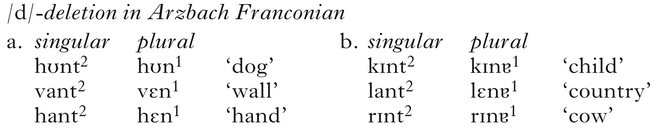
In (3), I provide some more relevant examples from Arzbach Franconian.Footnote 2 (3a) displays deletion in word-final plurals; (3b) shows examples of deletion in posttonic prevocalic position. Arzbach Franconian also has a tone-accent opposition between Accent 1 and Accent 2, indicated with superscripts. The relevance of the accents will be discussed in §2.3. The examples in (3b) also show that subtractive pluralisation is not the only pluralisation strategy found in Arzbach; this is generally true of German dialects. Other typical strategies across dialects involve zero plurals, umlaut plurals or plurals ending in schwa, /-n/ or -er (which can have different surface pronunciations depending on the dialect, e.g. [ɐ ər ɜ]).
(3)
Some German dialects also display subtraction in dative singulars. Synchronic examples of such patterns are much more rarely attested than subtractive plurals, but they do exist. As discussed in Birkenes (Reference Birkenes2011: 127), it is likely that the pattern was common in many subtracting dialects at some point in their history. However, neutralisation towards the nominative form, a general tendency in German varieties (e.g. Hotzenköcherle Reference Hotzenköcherle1962), has presumably led to the disappearance of relevant alternations in many dialects. Birkenes also points out that most German dialect grammars do not focus very strongly on the description of dative forms, which makes it more difficult to locate relevant dialects.
With regard to present-day varieties, relevant paradigms are described by Reuter (Reference Reuter1989), for example, for the Horath dialect, which also has a tone-accent distinction.Footnote 3 Again, I focus solely on the relationship between word-final and word-medial deletion, and ignore the accents for the present. As shown in (4), Horath Franconian displays relevant alternations between nominative singulars, dative singulars and plural forms (Reuter Reference Reuter1989: 132–133, 139–140). In (4a), we see cases where both the dative singular and the plural show subtraction. (4b) shows examples where only the dative singulars display word-final plosive deletion, while the plurals show /-ər/-suffixation and word-medial plosive deletion. These alternations also confirm the observation that word-final plosive deletion implies word-medial deletion.
(4)

From a diachronic perspective, the parallelism between word-medial and word-final deletion is related to the fact that subtractive plurals typically derive from schwa-final forms which were later apocopated (Schirmunski Reference Schirmunski1962, Haas Reference Haas1988, Birkenes Reference Birkenes2011, Reference Birkenes2014), a prototypical trajectory being hunde > hunne > hun ‘dogs’. Furthermore, German dialects use more than one pluralisation strategy. In this context, one might wonder whether the diachronic scenario itself should be regarded as the ‘proper’ explanation of subtraction and the similarities between subtractive forms and disyllables, and whether the patterns should not simply be regarded as synchronically suppletive. In the case at hand, the parallelism between subtracted forms and ‘overt’ disyllables has been a robust synchronic property of thousands of subtracting local dialects for centuries (Birkenes Reference Birkenes2011: 150 estimates that subtractive forms have existed for around 500 years). Crucially, there is no evidence of a process that would only delete final consonants and leave word-medial consonants intact in any subtracting dialect. The synchronic robustness of this correlation suggests that the phenomenon has synchronic relevance. Yang (Reference Yang2016: ch. 4) explicitly argues that minority patterns can be the result of productive pluralisation strategies in Standard German, and there is no reason to assume that the same could not be true for subtractive plurals in German dialects. Yet even if subtractive alternations were generally non-productive, that would not imply that the patterns should therefore necessarily be regarded as morphologically unrelated. As pointed out by Jackendoff & Audring (forthcoming), the learner cannot know in advance whether an alternation they observe will be productive or not, and will thus have to form hypotheses about possibly productive alternations. Jackendoff & Audring argue that even in cases where an observed pattern turns out not to be productive, there seems little reason to expunge non-productive information; in other words, learners might well hold on to non-productive patterns. While Jackendoff & Audring frame their considerations within a constructionist framework, it seems to me that the same general reasoning can in principle be applied to morpheme-based models of morphological learning – particularly given certain assumptions about the relationship between storage and computation.
For instance, with regard to allomorphy in German plurals in general, speakers will undoubtedly have to learn certain singular–plural pairs by heart, but they may still be able to extract morphological patterns emerging from the respective alternations. As discussed by Bermúdez-Otero (Reference Bermúdez-Otero and Trommer2012: §2.3; see also references therein), there are good reasons to assume that word-level derivatives can be stored as one lexical entry while still retaining their structural complexity. Bermúdez-Otero, who refers to this type of storage as ‘analytic listing’ (Reference Bermúdez-Otero and Trommer2012: 18), demonstrates that this notion is perfectly compatible with a morpheme-based approach to morphology (see also Köhnlein Reference Köhnlein2015 for an application of this concept to the analysis of complex place names in Dutch). Concerning subtractive pluralisation in particular, we are talking about millions of speakers, who, over a period of hundreds of years, have successfully acquired sets of subtractive singular–plural pairs. That is, if one were to argue that all of these forms are strictly suppletive, this would necessarily imply that not even a subset of speakers ever had any morphological awareness of these patterns, despite the obvious phonological similarity. Strictly speaking, even one ‘aware’ speaker might be sufficient to indicate such linguistic competence. Therefore, given the fact that the patterns under discussion have been stable for a long time and have been acquired by many speakers, and given that it seems reasonable to assume that speakers have the ability to decompose non-productive alternations and can store complex words analytically, I argue that the subtractive patterns under discussion warrant a synchronic analysis. Furthermore, as shown in the following sections, in many dialects consonant subtraction is accompanied by additional predictable phonological correlates, which I believe should be accounted for synchronically.
2.2 Interaction with vowel-length alternations
Consonant deletion is not the only type of subtraction attested in German dialects. Some dialects also show alternations between items with a long vowel in the singular and a short vowel in the plural. A case in point is Taubergrund German, which features prominently in Trommer & Zimmermann (Reference Trommer and Zimmermann2014), who discuss vowel-length alternations such as those in (5) (examples from Trommer & Zimmermann Reference Trommer and Zimmermann2014: 479).
(5)

A close inspection of Heilig's (Reference Heilig1898) historical grammar, the original source of the Taubergrund data, reveals additional facts that have not been considered in the theoretical literature so far. Scattered throughout Heilig's book are examples of singular–plural alternations that display not only one but two types of subtraction – vowel shortening and word-final plosive deletion after nasals. Some examples are provided in (6); predictable vowel nasalisation in Taubergrund is omitted in the transcriptions. These facts show that multiple subtraction leaves the nasal between the shortened vowel and the deleted plosive intact; in this sense, subtraction affects segments that are non-adjacent. As far as I am aware, such cases of ‘multiple non-adjacent subtraction’ have so far not been considered in the theoretical literature on subtraction.
(6)

Multiple subtraction is also attested in various other German dialects. For instance, the linguistic map Hand/Hände ‘hand/hands’ from Bayer-Weghake et al. (Reference Bayer-Weghake, Simon and Herbst2008) documents realisations for 182 dialects, 37 of which show vowel shortening and consonant deletion in plural forms. Furthermore, Alles (Reference Alles1907–08) provides some relevant examples from Hessian, such as those in (7); note that (7b) once again illustrates the interaction of word-final and word-medial subtraction discussed in §2.1.
(7)

2.3 Interaction with tonal accent
As mentioned in §1, some varieties of Franconian contrast two tonal accents. The phenomenon is relevant for this paper, since some tone-accent dialects also display subtractive pluralisation. The main correlate of tonal accent is a lexically distinctive pitch contrast, other correlates typically being durational differences and interactions with segmental quality and quantity (see Köhnlein Reference Köhnlein2011, Reference Köhnlein, Page and Putnamforthcoming for overviews). To begin, consider the three segmentally identical tone-accent minimal pairs from Mayen Franconian (Schmidt Reference Schmidt1986: 136, 157, 175) in (8). These examples demonstrate that tonal accent serves to distinguish lexical (a, b) and grammatical units (c), as well as monosyllabic (a, c) and polysyllabic minimal pairs (b).Footnote 4
(8)

Crucially, it appears to be the case that, across tone-accent dialects with subtraction, word-final consonant deletion in plural forms always coincides with an accent switch from a singular form with Accent 2 to a plural form with Accent 1, to the exclusion of other logically possible alternations (*singular Accent 1 → subtractive plural Accent 1; *singular Accent 2 → subtractive plural Accent 2; *singular Accent 1 → subtractive plural Accent 2). Once more, the generalisation can be observed in the Hund/Hunde map from Bellmann et al. (Reference Bellmann, Herrgen and Schmidt2002). The map features 252 tone-accent dialects with subtraction; in all of these dialects, consonant deletion is accompanied by a switch from Accent 2 to Accent 1. The generalisation can also be observed for the Arzbach and Horath facts reported in §2.1. For instance, as seen in (3), Arzbach displays alternations such as [vant2] ~ [vεn1]; the Horath dialect, data from which were provided in (4), has alternations of the type [bant2] ~ [bεn1].Footnote 5
3 Analysis
The goal of this section is to provide a unified morpheme-based analysis of the systematic patterns provided in §2, i.e. word-final consonant deletion in plural forms, as well as interactions with word-medial deletion in all dialects (§2.1), vowel shortening in some dialects (§2.2) and tonal accent in some dialects (§2.3). This section is organised as follows. §3.1 discusses my representational assumptions, and analyses the processes that occur in all dialects, viz. subtractive pluralisation and word-medial deletion. The central claim is that subtractive plurals contain a disyllabic foot template. In the absence of a posttonic vowel, this template creates a word-final empty-headed syllable. As a consequence, consonant deletion always occurs in the onset of a posttonic syllable, which is sometimes empty-headed and sometimes has a vocalic head. In §3.2, I show that this analysis also captures independent phenomena that accompany word-final subtraction in some varieties. §3.3 shows that alternations in paradigms with subtractive datives can be accounted for without further adjustments. §3.4 summarises and discusses the analyses.
3.1 Word-final and word-medial contexts
3.1.1 Basic assumptions and analysis
As discussed in §2.1, Golston & Wiese (Reference Golston and Wiese1996) observe that subtraction typically occurs in environments where place features can be preserved. To capture this generalisation, which appears to hold for the large majority of dialects, I formalise the processes as instances of coalescence, rather than as consonant deletion in weak positions (although both approaches would be feasible). In the appropriate environment, a postnasal plosive coalesces with a preceding homorganic sonorant (typically a nasal), leaving only the sonorant behind (e.g. /n1d1/ → [n111]). Before considering the coalescence analysis, however, we should note that in order to account for sequences of subtraction in /Vg/ contexts which is found in some dialects, this analysis requires that all vowels have a (redundant) feature [dorsal] that they share with [g] (as assumed by Golston & Wiese). Furthermore, as discussed in §2, there are Low German dialects where /d/ is subtracted after vowels. Such cases would arguably have to be analysed as deletion processes, rather than as coalescence.
My central representational claim is that forms with word-final subtraction are not monosyllabic but disyllabic, and that a final plosive which undergoes coalescence in a subtracting plural would not be syllabified as a coda, but as an onset of a weak posttonic syllable. This weak syllable is empty-headed, i.e. it does not contain a vowel, but an unpronounced nucleus. In other words, I propose that singular forms without subtraction, such as [hʊnt], end in a coda consonant, while plural forms with subtraction, such as [hʊn], end in the onset of an empty-headed syllable. There is a robust literature on empty-headed syllables as analytical devices in phonology (see Côté Reference Côté, van Oostendorp, Ewen, Hume and Rice2011 and Cavirani & van Oostendorp Reference Cavirani, van Oostendorp and Samuels2017 for overviews). For purposes of illustration, (9) shows the proposed surface representations for the opposition between the singular and plurals forms for ‘dog’ in the Nußbach dialect in (1). I represent the plural form with a singleton [n]. (Vertical lines indicate heads.)
(9)

As a first step in the analysis, the fact that some consonant-final forms end in a coda and others in an onset must be explained. I propose that in varieties with subtractive pluralisation, the default syllabification for a word-final consonant is in the coda. For the alternation in (9), this means that the underlying form /hʊnd/ will be realised as monosyllabic [hʊnt] in the singular (with final devoicing); here, metrical structure is assigned by default. If the presence of an empty-headed syllable is indeed responsible for subtraction in plural forms, this implies that some metrical property must prevent default syllabification of the word-final consonant as a coda. I derive the metrical difference between singulars and subtracted plurals forms from a suffix whose phonological content is the metrical template in (10) – a disyllabic trochaic foot. In running text, I represent this template as (σ s.σ w).
(10)

Consider again the proposed representations of the singular–plural alternation in (9). By default, word-final /d/ in the singular is syllabified in the coda, final devoicing applies and the word is realised as monosyllabic [hʊnt]. In the plural, the templatic plural morpheme (σ s.σ w) forces /d/ into the onset of a weak (empty-headed) syllable. I argue that this surface structure is prohibited in dialects with subtractive pluralisation, leading to coalescence. Language-internally, further evidence for this claim comes from the observation that subtracting dialects display the same behaviour word-medially (§2.1). As an example, recall the alternation between [kɪnt] and [kɪnɐ] in Nußbach German in (2). In this case, the plural morpheme /ɐ/ creates a disyllabic sequence of two headed syllables, and thereby a locus for coalescence.
Thus my claim is that metrically, the plural forms [hʊn] and [kɪnɐ] are comparable, in the sense that they both constitute disyllabic sequences.Footnote 6 In both cases, /d/ would have to be syllabified in the onset of a non-foot-initial syllable, which is dispreferred, and the more sonorous /n/ takes over the onset position in the posttonic syllable. The process is in line with the cross-linguistic observation that word-medial unstressed syllables tend to disprefer low-sonority onsets (see Lavoie Reference Lavoie2001 and Katz Reference Katz2016 for discussions of the issue), and is one of many Germanic lenition phenomena that target onsets of non-foot-initial syllables. Some well-known examples from English are flapping, non-aspiration of plosives, the distribution of /h/ (all discussed in Davis & Cho Reference Davis and Cho2003), fricative voicing (Honeybone Reference Honeybone, Nevalainen and Traugott2012) and non-rhoticity (Harris Reference Harris2013); see Honeybone (Reference Honeybone, Nevalainen and Traugott2012) for a general overview of lenition in English. The arguably most closely related example from American English concerns the (optional) deletion of /t/ after /n/ if /t/ would otherwise occur in the onset of a weak posttonic syllable (e.g. Iverson & Ahn Reference Iverson and Ahn2007, Hayes Reference Hayes2009). Hayes (Reference Hayes2009: 131) discusses the fact that word pairs such as stun and stunt can become homonyms after ing-suffixation, since /t/ in stunting can delete, resulting in [stʌnɪŋ].Footnote 7 Lastly, it should also be noted that weakening or deletion of postnasal onset plosives is a common phonological process across languages, particularly in cases of /n/ followed by a homorganic plosive (e.g. Hyman Reference Hyman, Hume and Johnson2001, Hamann & Downing Reference Hamann and Downing2017). The lenition pattern proposed here is therefore perfectly in line with cross-linguistic tendencies.
In the German cases under discussion, coalescence is triggered by the desire to avoid a low-sonority element (here a plosive) in the onset of a non-foot-initial syllable. The resulting surface forms for the two plural alternations discussed in this section are given in (11); the dot indicates a syllable boundary, and the mora in the empty-headed second syllable is represented as ‘•μ’. In (11a), /d/ is subject to coalescence, since it would occur in the onset of a posttonic empty-headed syllable; the same applies to /d/ in (11b) in the onset of a posttonic headed syllable. This analysis thus captures that word-final coalescence (i.e. subtractive pluralisation) implies word-medial coalescence in the same phonotactic context.
(11)

3.1.2 OT implementation
The OT implementation of the basic analysis presented in §3.1.1 has to account for four generalisations. For the singular forms of noun stems like /hʊnd/ [hʊnt] in Nußbach German, it has to show that syllabification as monosyllables is preferred over syllabification as disyllables, and that final devoicing applies. For corresponding subtractive plural forms like [hʊ.n], we have to ensure that the plural morpheme, a disyllabic trochaic foot template, is preserved on the surface, and account for the fact that a non-sonorant onset in a weak, non-foot-initial syllable is dispreferred, leading to coalescence. I first provide an analysis of [hʊnt] vs. [hʊ.n], and then show that the approach extends to [kɪnt] vs. [kɪ.nɐ] without further adjustments.
For ease of exposition, I start with the analysis of the subtractive plural forms. As argued in §3.1.1, plurals are formed by adding a templatic plural morpheme, a disyllabic trochee. We have seen that in the default case word-final consonants are syllabified as codas in the varieties in question, which can be modelled with the constraint in (12a), *Empty, which prohibits empty-headed syllables (see e.g. Harris & Gussmann Reference Harris and Gussmann2002, Barlow Reference Barlow and Eddington2005, van Oostendorp Reference Oostendorp and Kehrein2018). However, since subtractive plurals surface with an empty-headed syllable, the templatic plural morpheme must be protected by faithfulness. To ensure this, I use HeadMatch (McCarthy Reference McCarthy1995, Reference McCarthy2000, Köhnlein Reference Köhnlein2016), a constraint that preserves metrical heads (in this case the stressed first syllable of a disyllabic trochee); HeadMatchFt in (12b) outranks *Empty.
(12)

Constraint violations for HeadMatchFt are assessed as follows. Following Köhnlein (Reference Köhnlein2016), I assume that headedness is determined at the highest level where the foot can branch. Thus the head of a disyllabic trochee is the first syllable, because the foot branches at the syllable level (the second syllable is the dependent). The head of a monosyllabic, bimoraic trochee is the first mora, because it is not binary at the syllable level (only one syllable), but branches at the moraic level (two moras; the second mora is the dependent). Deleting the second syllable of a disyllabic trochee would violate HeadMatchFt, because the foot would then consist of only one syllable; consequently, the foot-head would not be the first syllable (as in the underlying template), but the first mora.Footnote 8
To account for lenition, I first define the high-ranked constraint in (13a), which militates against onset plosives that are not located in foot-initial position. From a broader perspective, this constraint is best regarded as part of a general tendency to lenite in non-prominent positions of a foot, such as non-foot-initial onsets.Footnote 9 In running text, I will sometimes use the shorthand term ‘weak onset’ to refer to non-foot-initial onsets.
For the case under discussion, Lenition is violated by /d/ as an onset, but is satisfied by a sonorant segment. Since Lenition is satisfied by coalescence, this operation violates the constraint in (13b), Uniformity (McCarthy & Prince Reference McCarthy, Prince, Beckman, Dickey and Urbanczyk1995). Depending on how exactly we define segmental features, having /d/ correspond to [n] will violate certain Max and/or Ident constraints, such as a constraint that penalises /d/ corresponding to a sonorant, more specifically a nasal. These constraints are all low-ranked, and will not be displayed in the tableaux below.
(13)

This set of constraints is sufficient to account for the subtraction facts. The evaluation of the plural form [hʊ.n] is displayed in (14). Candidate (c) is optimal, since it satisfies the two high-ranked constraints Lenition and HeadMatchFt, and violates only low-ranked *Empty and Uniformity. Candidate (a) does not realise the disyllabic template, leading to a violation of undominated HeadMatchFt; candidate (b) has /d/ in the onset of the posttonic syllable, fatally violating Lenition.Footnote 10 (I indicate foot boundaries with parentheses.)
(14)

I now turn to the singular form, [hʊnt]. Since at least most of the varieties in question have an opposition between plain and aspirated plosives, I model word-final devoicing in the singular [hʊnt] as a process of final fortition that aspirates plain plosives (e.g. Iverson & Salmons Reference Iverson and Salmons2007, Beckman et al. Reference Beckman, Jessen and Ringen2013). Final fortition thus adds a feature [spread glottis]. This is enforced by the constraint in (15a), which penalises the occurrence of plain obstruents in final position, and outranks the faithfulness constraint in (b), which militates against adding the feature [spread glottis] (McCarthy & Prince Reference McCarthy, Prince, Beckman, Dickey and Urbanczyk1995).
(15)

With these two additional constraints, we can derive the default mapping in singular forms, as in (16). Candidate (c) is optimal, since it satisfies all constraints except for low-ranked Dep[spr gl]. Candidate (a) loses because it fails to satisfy undominated FinalFortition. Candidate (b), which is identical to the plural form, is out because the singular form does not contain a disyllabic foot template in the input; the violation of *Empty is therefore fatal. Lastly, (d) is not optimal because it subtracts word-final /d/ in a coda, rather than devoicing it. This shows that Uniformity must outrank Dep[spr gl].
(16)

The alternation between [kɪnt] and [kɪ.nɐ] can be implemented in OT in the same way. The only difference is that constraints related to empty-headed syllables are not relevant here, because the second syllable has a vowel. For illustration, I provide tableaux for [kɪnt] and [kɪ.nɐ] in (17). I have not added a metrical template to the representation of the plural morpheme – since the form surfaces as disyllabic because of the posttonic vowel, the template would have no empirical effects in this case.
(17)

3.1.3 Plurals without subtraction
As discussed in §2.1, varieties of German have different ways of forming plurals; in dialects with subtraction, we typically find plurals without overt suffixes that end in plosives (either zero plurals or, more often, umlaut plurals). I provide two relevant examples from Alles (Reference Alles1907–08) in (18). These examples do not contain singular–plural pairs both ending in [nt] (corresponding to the most frequent subtraction sequence /nd/), since such pairs seem to be absent in Hessian and other subtracting varieties.
(18)

For [baŋk] ~ [bεŋk], I assume that the underlyingly form is stored with a fortis plosive /k/ (following Golston & Wiese Reference Golston and Wiese1996 and Knaus Reference Knaus2003). It is to be expected that the plural morpheme is an umlaut marker; yet even if this form occurred with a disyllabic foot template, the fortis specification would block coalescence with the nasal: again essentially following Golston & Wiese (Reference Golston and Wiese1996) and Knaus (Reference Knaus2003), I assume that (i) the feature [spread glottis] has to be preserved (19a), and (ii) nasals cannot be aspirated (19b). These faithfulness constraints prevent lower-ranked Lenition, the constraint triggering subtraction, from being satisfied.
(19)

The evaluation of an input /baŋk/ with a plural template (σ s.σ w) and potential disyllabic outputs is provided in (20). Candidate (a) wins because it satisfies undominated Max[spr gl] and *Son[s11, while (b) loses because it fatally violates Max[spr gl], and (c) incurs a violation of *Son[s11.
(20)

Coalescence is also blocked in pairs like [balk] ~ [bεlk], because coronal [l] and dorsal [k] are not homorganic. Even if the underlying form were to be stored with an underlying /g/ and a disyllabic plural template, word-final devoicing would devoice /g/ to [k], and the two forms would surface with [k]. To capture the fact that /l/ and /k/ do not coalesce, in (21) I introduce the high-ranked constraint Max[place], which prohibits the deletion of place features, and outranks Lenition.
(21)

I provide a tableau for the underlying form /balg/ in (22). Candidate (a) wins, because it satisfies all high-ranked constraints. The coalescence candidate, (b), violates undominated Max[place], while (c) violates FinalFortition. Crucially, none of these newly added constraints has a bearing on the analysis of coalescence in subtractive forms. Max[spr gl] and *Son[s11 are irrelevant, because only lenis plosives participate in subtraction, and Max[place] is not violated when nasal and plosive are homorganic, as in subtraction from /nd/ to [n].
(22)

As stated in §3.1.1, some dialects show deletion in /Vg/ contexts, such as Hessian /krog/ [krok] ‘jug’ vs. [kre] ‘jugs’, while other dialects do not. Such variation can be captured by assuming that some dialects allow a hiatus-creating coalescence of vowels and consonants, while other dialects block it. Lastly, a reviewer mentions that in some dialects, subtractive plurals coexist with zero plurals for certain forms (as discussed in Girnth Reference Girnth2000 on the basis of linguistic maps from Bellmann et al. Reference Bellmann, Herrgen and Schmidt2002; see also Birkenes Reference Birkenes2014). I would argue that in such cases a templatic plural (leading to subtraction) and a zero plural (no subtraction) coexist for the respective forms. Having multiple plural forms for certain words is not atypical in varieties of German; for instance, Standard German has three plural allomorphs for the word Bonus ‘bonus’: Bonus, Bonusse and Boni. Furthermore, as Girnth (Reference Girnth2000) discusses, the linguistic maps in question indicate that the distribution of the allomorphs is typically not random. First, variation usually occurs in border areas between subtracting and non-subtracting dialects. Moreover, older speakers, who typically speak the local dialect, usually use the subtractive plural form, while younger speakers, who typically speak a more regional dialect, use the zero plural. What this seems to indicate, then, is that zero plurals tend to be preferred in regional varieties that are closer to Standard German (which does not have subtractive plurals), but that subtractive plurals are perfectly acceptable in local dialects. In spite of this general tendency, however, the maps also indicate that there are dialects where younger speakers introduce novel subtractive forms that are not present in the dialect of the older generations.
3.2 Interaction with other phenomena
This section demonstrates how the analysis of consonant subtraction provided in §3.1 can be extended to two phenomena that co-occur with subtraction in some dialects: vowel shortening (§3.2.1) and tonal accent (§3.2.2).
3.2.1 Interaction with vowel shortening: multiple non-adjacent subtraction
As described in §2.2, subtraction is accompanied by vowel shortening in some dialects, such as Taubergrund German. [riːs] vs. [ris] in (5) is a case where the vowel is long in the singular but short in the corresponding plural; in [huːnt] vs. [hyn] in (6), the long–short alternation is accompanied by word-final subtraction in the plural form.
I argue that it is possible to account for vowel shortening with the same representational tools that were proposed in §3.1 for the analysis of consonant coalescence. Along these lines, I claim that plural forms with vowel shortening end in an empty-headed syllable, triggered by a plural morpheme consisting of a disyllabic foot template. We have to add one restriction, viz. a constraint that militates against trimoraic feet, which triggers shortening. This well-known process is referred to in the literature as trochaic shortening (Hayes Reference Hayes1995). Its application is illustrated in (23). (23a) shows the singular form [riːs], which is parsed as a default monosyllabic word. The plural form, which contains the disyllabic foot template, cannot be *[riːs]; as shown in (c), this would result in an illicit trimoraic foot. The chosen repair is trochaic shortening, resulting in a bimoraic trochee with a monomoraic stressed vowel and one mora in the empty-headed syllable, and giving the surface form [ris] in (b) (see Köhnlein Reference Köhnlein2016 for a comparable analysis of vowel shortening in Weert Franconian).
(23)

In the analysis of word-final consonant deletion in §3.1, I argued that additional support for an analysis involving empty-headed syllables comes from the fact that word-final deletion in words with empty-headed syllables co-occurs with word-medial deletion in words with vocalic posttonic syllables. The argument works in the same way for vowel shortening in Taubergrund German. As shown in (24), vowels can also shorten in ‘overtly’ disyllabic words, i.e. in words where the second syllable contains a vowel (data from Trommer & Zimmermann Reference Trommer and Zimmermann2014: 479).
(24)

We can again assume that the vowel shortens in these plural forms because the dialect prohibits trimoraic feet. Accordingly, the plural of [nεːst] is not *[(nεμμ.stəμr)], since this would lead to a trimoraic trochee (subscripts here indicate moras that are linked to the preceding vowel). Trochaic shortening applies, resulting in [(nεμs.təμr)]. To sum up the discussion of the general patterns, (25) illustrates that vowel shortening applies in plurals with an empty-headed syllable, as in (a), as it does in structurally identical sequences in which the posttonic syllable contains a vowel, as in (b).
(25)

Implementing trochaic shortening in OT requires the two additional constraints in (26). (26a) is a constraint against uneven trochees (e.g. Hayes Reference Hayes1995), and outranks the constraint in (26b), which requires vowel length to be retained (McCarthy Reference McCarthy2008).
(26)

I begin with the evaluation of the plural form [ris]. The segmental input is /riμμs/, and the plural morpheme is a disyllabic foot template. The relevant constraint ranking is HeadMatchFt, *UnevenTrochee ⪼ Ident[long]. Furthermore, as established in §3.1.2, HeadMatchFt must outrank *Empty to ensure that the foot template will surface. In (27), candidate (b) is optimal, since it realises the metrical template (satisfying HeadMatchFt) and contains only two moras (satisfying *UnevenTrochee). Candidate (a) loses because it violates high-ranked HeadMatchFt; candidate (c) is out because its trimoraic foot fatally violates *UnevenTrochee.
(27)

The tableau in (28) demonstrates why the singular form [riːs] surfaces with a bimoraic monosyllabic trochee, as in candidate (a). Candidate (b) is out because it violates Ident[long] and *Empty.
(28)

To account for multiple subtraction, i.e. vowel shortening plus coalescence, we only need to combine the two analyses. This is demonstrated in (29), which shows the prosodic trees for the Taubergrund alternation between (a) singular [huːnt] and (b) plural [hyn]. The input for the singular is /huːnd/, which results in a long vowel plus a devoiced coda consonant. In the plural, /huːnd/ is combined with the templatic plural morpheme (σ s.σ w). As predicted by the analysis outlined in this section, realising the disyllabic template leads to a disyllabic bimoraic trochee with a shortened stressed vowel and a non-obstruent onset for the unstressed syllable.
(29)

In summary, this section has demonstrated that the analysis of subtractive pluralisation through coalescence can be extended to subtraction through vowel shortening without adding additional representational tools. Furthermore, in both cases, the analysis captures the observation that overtly disyllabic plurals behave identically to plurals with subtraction.
A reviewer wonders whether the Taubergrund vowel alternations could also be analysed as synchronic monosyllabic lengthening, rather than as shortening in the plural. This is the position taken in Seiler (Reference Seiler2008) and Trommer & Zimmermann (Reference Trommer and Zimmermann2014: 479); see also Seiler (Reference Seiler2009) for a general discussion of monosyllabic lengthening in Germanic. Their analysis is based on the claim that, in Taubergrund German, the vowel is always long in monomorphemic monosyllabic words of the type [riːs]. However, this is not in fact the case: Heilig (Reference Heilig1898) contains several counterexamples, e.g. [syn] ‘sin’, [glet] ‘slipperiness’, [nes] ‘wetness’, [kelt] ‘coldness’ and [ʃøf] ‘juror’ (Reference Heilig1898: 54, 114, 116).Footnote 11
3.2.2 Interaction with tonal accent
A different type of support for my analysis comes from Franconian tone-accent dialects. As shown in §2.3, many of these dialects show subtractive pluralisation, which coincides with a switch from Accent 2 to Accent 1. These facts can be straightforwardly integrated into the approach to subtraction proposed here if we adopt the foot-based analysis of Franconian tonal accent developed by Köhnlein (Reference Köhnlein2011, Reference Köhnlein2016, Reference Köhnlein and Kehrein2018) and van Oostendorp (Reference Oostendorp and Kehrein2018), who derive the opposition between the accents from a contrast between monosyllabic feet (corresponding to Accent 2) and disyllabic feet (corresponding to Accent 1, sometimes with an empty-headed second syllable).Footnote 12 As discussed in detail in Köhnlein (Reference Köhnlein2016), this approach successfully derives the tonal realisation of the accents, and also captures other predictable interactions of accent class with vowel quantity, vowel quality and consonant voicing. Here, I will only briefly discuss the tenets of tonal alignment in the foot-based approach, and refer the reader to the relevant literature for additional arguments in favour of the analysis.
I will use data from the Arzbach dialect to illustrate the interactions. Consider first the minimal pair in (30), which provides the tonal patterns for Accent 1 and Accent 2 in focused phrase-medial declaratives. The Accent-2 singular has a falling tone (HL). The Accent-1 plural is realised with a high-level tone (HH); a pitch fall to L occurs in postfocal position.
(30)

In Köhnlein's (Reference Köhnlein2011, Reference Köhnlein2016) analysis, these forms share a H*L declarative melody input. All tones are thus intonational, and the tonal surface differences are caused by the different foot structures of Accent 2 (monosyllabic, bimoraic trochee for (ba1iLn)2]) and Accent 1 (disyllabic trochee, in the case of the plural [ba1i1.n•μ)1] with an empty-headed syllable). There are several other contours, both in Arzbach Franconian and across dialects; the tonal melodies can vary depending on focal condition (focal, prefocal, postfocal), position in the phrase (non-final, final) and pragmatic context (e.g. declarative, interrogative), a discussion of which is beyond the scope of this paper. A detailed analysis of tonal associations across various pragmatic and prosodic contexts and for four different dialect types is provided in Köhnlein (Reference Köhnlein2011: 71–167), where it is shown that the foot-based approach generalises to all of the relevant data.
On the assumption that foot-binarity is established at the highest level where the foot can branch, the first mora is the foot-head in bimoraic (monosyllabic) Accent-2 feet, and the second mora is the foot-dependent. Conversely, in disyllabic Accent-1 feet, the first syllable is the foot-head, and the second, empty-headed, syllable is the foot-dependent. Essentially, Köhnlein (Reference Köhnlein2011) argues that the strong branch of the foot avoids low tone in Arzbach Franconian, since it is less prominent than high tone. This is derived from the high-ranked constraint *FtHd-L in (31) (de Lacy Reference de Lacy2002).
(31)

The general effect of high-ranked *FtHd-L on the tonal mapping is demonstrated in (32). (32a) shows that in the Accent-2 singular, the high tone associates with the ‘strong’ first mora, the foot-head (superscript ‘+’) and the low tone with the ‘weak’ second mora (superscript ‘―’). In the Accent-1 plural in (b), however, the association of the low tone to any of the moras in the accented syllable is blocked, since both are dominated by the head syllable of the foot, which makes them ‘strong’ at the foot level; the second, empty-headed, syllable is the dependent.
(32)

Using these representational tools, the analysis of subtraction developed in this section can be extended to tone-accent dialects without further adjustment. I again take the word for ‘dog’, /hʊnd/, as a prototypical example. As shown in (33a), [(hʊnt)2] in the Arzbach dialect is parsed as a monosyllabic bimoraic foot, and is therefore realised with Accent 2. The plural form [(hʊn.n•μ)1], which contains the templatic plural morpheme (σ s.σ w), is parsed as a disyllabic foot with an empty-headed syllable, triggering coalescence and leading to a realisation with Accent 1. (Köhnlein Reference Köhnlein2011, Reference Köhnlein2016 assumes that the disyllabic Accent-1 foot is generally the marked foot in Franconian, so words with Accent 2, whether they are monosyllabic or disyllabic, have default bimoraic monosyllabic trochees.) In (33b), I represent the [n] of the Accent-1 plural as ambisyllabic. This is not necessary for the analysis of this specific alternation, which would work equally well if the accented syllable in the plural were monomoraic (H would then be realised on only one mora, and coalescence would occur anyway). However, given that tonal assignment works in the same way for Accent-1 forms with long vowels and diphthongs (as demonstrated in (32b)), and given that most Franconian tone-accent dialects seem to employ a minimum of two (sonorant) moras to realise the accentual opposition, a representation with an ambisyllabic consonant seems appropriate.
(33)

The implementation in OT is straightforward. The constraints on subtraction work in exactly the same way as in other examples, and the tonal mapping follows from high-ranked *FtHd-L. To illustrate a ranking conflict regarding the tonal mapping, in (34) I introduce an additional constraint from Köhnlein (Reference Köhnlein2016), ConcatMorpheme, which penalises tonal mappings where tones in the same tonal morpheme are not realised in the same syllable. With regard to the examples discussed here, ConcatMorpheme is satisfied if both H* and L of the intonational declarative morpheme H*L are realised in the same syllable.
(34)

The tableau in (35) shows how tonal mapping and subtraction are computed for the plural form [(hʊn.n•μ)1]. To keep the size of the tableau manageable, I represent only the mora level to illustrate the tonal mapping, omitting the syllable and foot levels. Candidate (c) wins, because it realises the foot template (satisfying HeadMatchFt), lacks /d/ in the weak onset (satisfying Lenition) and does not have low tone on the strong second mora (satisfying *FtHd-L). Candidate (a) is out because it fails to realise the disyllabic foot template, violating undominated HeadMatchFt. Candidate (b) loses because it surfaces with /d/ in the onset of the weak syllable, incurring a fatal violation of Lenition. Lastly, candidate (d) loses because it realises a low tone on a strong mora, and thus fails to satisfy *FtHd-L.
(35)

Now consider (36), which shows the evaluation of the corresponding singular form [(hʊnt)2]. The monosyllabic candidate (a) is the winner, because it violates only low-ranked Dep[spr gl]. Candidate (b) loses because the word-final plosive does not devoice, violating undominated FinalFortition. Candidate (c), which is identical to the plural form, fatally violates *Empty because its empty-headed syllable is not protected by faithfulness. Candidate (d) is out because it fails to realise the low tone on the weak second mora of the accented syllable, violating ConcatMorpheme.
(36)

In sum, I hope to have demonstrated that the subtraction patterns in Franconian tone-accent dialects are compatible with the foot-based analysis of tonal accent established on the basis of entirely different phenomena.
3.3 Subtraction in dative singulars
As discussed in §2.1, some dialects display subtraction not only in plural formation but also in dative singulars. Two relevant examples from Horath Franconian are repeated in (37).
(37)

The analysis of subtraction developed in this section accounts for such paradigms without further adjustments. Consider first (37a), with subtraction in both the dative singular and the plural. Here we can assume that both dative singular [hon1] and plural [hen1] contain a disyllabic foot template, which has two independent correlates – coalescence and accent shift. In (b), the dative form [ken1] can be derived in the same way, by postulating a disyllabic foot template that triggers Accent 1 and coalescence. The plural form [kenər2] shows word-medial coalescence, as expected.Footnote 13
3.4 Summary and discussion of the analysis
In this section I have developed an analysis of subtractive pluralisation in German dialects that relies on the idea that subtraction is not a morphological operation, but an epiphenomenon resulting from a phonological process which is triggered by prosodic affixation and leads to empty-headed syllables on the surface. The coalescence process in question prevents certain plosives (as in the sequence /nd/) from surfacing in the onset of unstressed syllables, some of which are empty-headed. I have presented independent evidence that supports my analysis. First, I showed how my analysis derives the generalisation that dialects with word-final coalescence also show coalescence before posttonic vowels. Second, I demonstrated that the approach also accounts for cases of multiple subtraction (simultaneous coalescence and vowel shortening). Third, I showed that it also captures predictable interactions with tonal accent.Footnote 14 Hasse diagrams with constraint interactions for subtraction and related facts are given in (38).
(38)

4 Alternative analyses
This section briefly discusses alternative approaches to subtraction in varieties of German, all of which share the problem that they do not extend to the additional facts discussed in this paper (consonant deletion in word-medial position, interactions with vowel shortening, and tonal accent).
The ‘traditional’ analytical approach to subtractive pluralisation in German dialects is constraint-based, essentially requiring plural forms to end in a sonorant sound (a sonorant consonant or a vowel). This causes deletion in plural forms (e.g. /hʊnd/ → [hʊn]), but not in singular forms, where the constraint is vacuously satisfied (Golston & Wiese Reference Golston and Wiese1996, Knaus Reference Knaus2003). The analysis successfully accounts for singular–plural alternations with subtraction; it seems difficult to adapt it to the additional generalisations discussed in this paper. First, it cannot capture the fact that, in varieties with word-final consonant deletion, the consonants in question are also deleted in the onset of weak syllables. Second, the approach offers no explanation of vowel shortening in plural forms, which, as I have demonstrated, accompanies word-final deletion in some dialects. Third, the interaction with tonal accent cannot be accounted for with the constraint-based approach, at least not without additional machinery.
Trommer & Zimmermann (Reference Trommer and Zimmermann2014) provide an analysis of subtractive pluralisation in German that relies on the assumption that defectively integrated affixal moras are responsible for the non-realisation of word-final plosives. They suggest (Reference Trommer and Zimmermann2014: 489) that alternations of the type [hʊnt] vs. [hʊn], as well as other subtraction phenomena, can be analysed with mora suffixation. This suffixal mora links to the stem-final consonant, but a high-ranked constraint prohibits associating affixal moras with base syllables. As a consequence, the mora is not linked to a syllable node, and remains unpronounced. Again, the analysis works well for the basic facts. However, it does not account for word-medial /d/-deletion in alternations of the type [kɪnt] vs. [kɪnɐ]. Furthermore, it is not clear how Trommer & Zimmermann's approach would account for multiple subtraction, as well as for the interaction of subtractive pluralisation and tonal accent.
Birkenes (Reference Birkenes2011, Reference Birkenes2014), whose analysis uses a word-based model of morphology along the lines of Bybee (Reference Bybee1985), claims that plurals should be regarded as base forms in cases of subtractive pluralisation, and that singulars are marked by adding segmental material. He proposes that frequency effects might lead the learner to postulate that more frequent plural forms are in fact the more basic realisations. As Birkenes points out, the frequency argument works for some items (based on information from a frequency dictionary of German, Ruoff Reference Ruoff1981), though not for all relevant forms. Furthermore, Birkenes (Reference Birkenes2011: 150) acknowledges that his approach faces problems with regard to subtractive datives, which do not occur more frequently than nominatives, and which, presumably, should not be regarded as grammatically ‘more basic’ than nominatives. Furthermore, to cover all relevant facts, this approach would also have to be adapted to account for the additional, phonologically motivated interactions discussed in this paper.
Lastly, earlier analyses of the phenomenon have suggested that subtraction could be analysed either with a ‘negative’ plural morpheme of the type /‘Minus C’/ (Bergenholtz & Mugdan Reference Bergenholtz and Mugdan1979) or by assuming morphologically conditioned deletion rules (Wurzel Reference Wurzel1984). Such proposals are certainly able to express subtraction, but one of the points of this paper is to answer the question whether it is possible to derive the facts without making reference to negative morphological markers or morphologically conditioned cophonologies.
5 Conclusion
This paper has argued that subtractive pluralisation in varieties of German can be successfully analysed in a morpheme-based approach to morphology, as an epiphenomenon resulting from prosodic affixation that leads to the emergence of empty-headed word-final syllables. I have shown that my analysis successfully derives the basic subtraction data and also captures related facts, viz. word-medial consonant deletion, as well as interactions with vowel shortening and the assignment of tonal accent. My metrical analysis supports previous attempts to account for subtractive morphology via prosodic affixation; more concretely, I have derived empty-headed syllables from affixing disyllabic feet as metrical templates. While I suggested in §3.1 that it might be possible to derive empty-headed syllables in other ways, this is not central to the arguments in the paper. That is, the main point of this paper is to show that the analytical notion of empty-headed syllables makes it possible to provide a unified analysis of subtractive morphology and related phenomena in German dialects. With respect to morphological theory, this paper thus contributes to ongoing efforts to expand the empirical coverage of morpheme-based models to patterns that at first sight might seem problematic.


