INTRODUCTION
Children's first word forms have been found to be very similar across languages, with minor ambient language effects (Boysson-Bardies & Vihman, Reference Boysson-Bardies and Vihman1991; Vihman, Kay, Boysson-Bardies, Durand & Sundberg, Reference Vihman, Kay, Boysson-Bardies, Durand and Sundberg1994). This similarity in production can be ascribed to infants' limited articulatory skills (Davis & MacNeilage, Reference Davis and MacNeilage2000) and experience (Vihman, Reference Vihman2014). As children move into regular word production, however, cross-linguistic differences are observed (Stoel-Gammon, Williams & Buder, Reference Stoel-Gammon, Williams and Buder1994; Buder & Stoel-Gammon, Reference Buder and Stoel-Gammon2002; Vihman, Reference Vihman, Fougeron, Kühnert, D'Imperio and Vallée2010, Reference Vihman, MacWhinney and O'Grady2015). One early-emerging difference, for example, is the production of long consonants or, where consonantal length plays a phonologically contrastive role, geminates (which nevertheless need not be in any sense contrastive for the children).
Because child production is relatively slow or sluggish (Smith, Reference Smith1978; Payne, Post, Astruc, Prieto & Vanrell, Reference Payne, Post, Astruc, Prieto and Vanrell2012), long medial consonants can readily be heard (and measured) in the first words, even in the case of children exposed only to languages like English or French, where they are not contrastive and in fact rarely occur at all (Vihman & Velleman, 2000). To illustrate this, analysis of the word forms produced by five children each at the time of first word use (termed the 4-word point [4wp]: the first 30-minute recording session in which at least four different spontaneously produced words can be identified; mean age 0;11·15 for the American and French infants, 1;3 for the Finnish infants) revealed a mean consonant length for English of 208 ms (s.d. 82·5), for French, 150 ms (s.d. 43·7), and for Finnish, with its contrastive consonant length, 206 ms (s.d. 47) (Vihman & Velleman, Reference Vihman and Velleman2000).
As the children gain production skills and productive lexical knowledge of their language, however, the duration of medial consonants drops significantly in languages with no phonological contrast in consonant length. Thus, at the end of the single-word period (25-word point [25wp]; mean age 1;4 for the American infants, 1;5 for the French, 1;6 for the Finnish), the mean medial-consonant duration for the same five children learning English was 122 ms and for those learning French, 140 ms, with a drop in variability within each group as well (s.d. for English, 28·8, for French, 8·2); at the same time, medial consonants became longer and intra-group variability increased for the five Finnish children (mean 298 ms, s.d. 96·1).
In fact, in languages with geminates the use and overuse of these long consonants (i.e. their production even for singleton targets) is consistently reported for the single-word period (see, for Arabic: Khattab & Al-Tamimi, Reference Khattab, Al-Tamimi, Vihman and Keren-Portnoy2013; for Estonian: Vihman, Reference Vihman2016; for Finnish: Kunnari, Reference Kunnari2000; Savinainen-Makkonen, Reference Savinainen-Makkonen2000a, Reference Savinainen-Makkonen2000b, 2001, 2007; for Hindi: Bhaya Nair, Reference Bhaya Nair1991; for Italian: Keren-Portnoy, Majorano & Vihman, Reference Keren-Portnoy, Majorano and Vihman2009; Majorano, Rainieri & Corsano Reference Majorano, Rainieri and Corsano2013; and for Japanese: Kunnari, Nakai & Vihman, Reference Kunnari, Nakai and Vihman2001; Ota, Reference Ota2003). Finally, children learning Welsh, with its (phonetic) accentual lengthening of consonants, also make heavy use of long medial consonants in their early words (Vihman, Nakai & DePaolis, Reference Vihman, Nakai, DePaolis, Goldstein, Whalen and Best2006), although no significant increase in mean medial consonant duration is seen in this case over the period of single word use (Vihman & Kunnari, Reference Vihman and Kunnari2006), presumably because long consonants are not lexically contrastive in Welsh. That is, where consonant duration is a (non-contrastive) concomitant of the accentual pattern, its frequency of occurrence may be variable but should be consistently so over time and development. Where it is lexically tied, infants' increasing lexical knowledge results in a steady increase in representations of words with geminates. Thus, contrastive child use, as seen in Finnish, appears to be mediated by lexical advance.
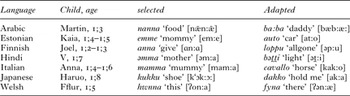
Examples of early words produced with long medial consonants in Arabic, Estonian, Finnish, Hindi, Italian, Japanese, and Welsh are presented in Table 1, where selected (or more or less accurately produced words) have a long consonant in the adult target as well as in the child form, whereas adapted words (modified to fit one of the child's favored production patterns) display ‘overuse’ of geminates. Here we observe that in their production of long consonants children may replace a VV sequence by CC (see both Martin's word form for Arabic ba:ba and Kaia's form for Estonian auto), omit the onset consonant (as in Joel's word for Finnish loppu; cf. also the Hindi and Japanese examples), ‘demote’ an onset consonant (replacing a supraglottal by a glottal segment: Fflur, Welsh example), or retain the length feature while changing the segmental quality (and word length) to fit a consonant-harmony constraint (as in Anna's word for Italian cavallo).
Child early word forms with long consonants

sources: Khattab & Al-Tamimi, Reference Khattab, Al-Tamimi, Vihman and Keren-Portnoy2013 (Arabic), Vihman, Reference Vihman2016 (Estonian), Savinainen-Makkonen, Reference Savinainen-Makkonen2007 (Finnish), Bhaya Nair, Reference Bhaya Nair1991 (Hindi), Keren-Portnoy et al., Reference Keren-Portnoy, Majorano and Vihman2009 (Italian), Kunnari, Nakai & Vihman, Reference Kunnari, Nakai and Vihman2001 (Japanese), Vihman, Reference Vihman, MacWhinney and O'Grady2015 (Welsh).
Interestingly, in most of these languages child overuse of the prosodic word shape <VCCV> can be observed (as in the examples from Joel, V, Haruo, and Fflur; Table 1), even when the adult target form includes an early-learned onset consonant such as a labial or coronal stop and the word is accentually trochaic (strong–weak accent), so that the omitted initial consonant is part of the accented syllable. In fact, Vihman and Velleman (Reference Vihman and Velleman2000) report that 31% of the tokens produced by five Finnish children at the 25wp were of the shape <VCCV>. Savinainen-Makkonen (Reference Savinainen-Makkonen2007), similarly, reports use of <VC(C)V> as an idiosyncratic child pattern or template in both selected and adapted words in her case study of the Finnish child Joel: anna ‘give’ [ɑn:ɑ], vettä ‘water’ [et:æ], tippu ‘fell’ [ip:o], lusikas ‘spoon’ [uki], nammi ‘candy/yummy’ [ɑmi], [mɑmi], [mɑm:i], nostaa ‘carry’ [ot:ɑ:] (cf. also Savinainen-Makkonen, Reference Savinainen-Makkonen2000b).
The frequent occurrence of the <VC(C)V> pattern in Finnish child forms is all the more striking since the corresponding pattern – VCV, with omitted onset consonant – is rare in the early word forms of children learning (primarily trochaic) English (Savinainen-Makkonen, Reference Savinainen-Makkonen2000b; Vihman & Croft, Reference Vihman and Croft2007), although not in those of children learning final-syllable-accented French (Wauquier & Yamaguchi, Reference Wauquier, Yamaguchi, Vihman and Keren-Portnoy2013) or primarily iambic (weak–strong) Hebrew (Keren-Portnoy & Segal, in press). This suggests that, in addition to the ease of articulation of geminates (due to the slow rate of early speech production), their greater segmental duration may make them particularly salient to children, which in turn might draw attention away from the onset consonant, as suggested by Savinainen-Makkonen (Reference Savinainen-Makkonen2000b).
This would be in accord with the whole-word phonology account, which argues that children's early words reflect child memory for the word as a whole, with production of certain salient elements, such as the accented syllable, at the expense of other aspects (Vihman, Nakai, DePaolis & Hallé, Reference Vihman, Nakai, DePaolis and Hallé2004; Vihman & Croft, Reference Vihman and Croft2007). The whole-word phonology model (Vihman & Keren-Portnoy, Reference Vihman, Keren-Portnoy, Vihman and Keren-Portnoy2013a) provides a usage- and exemplar-based perspective on phonological development that contrasts with linear, stage-like approaches that depend on Universal Grammar and parameter setting or markedness-constraint ranking to account for knowledge of linguistic structure (e.g. Kager, Pater & Zonneveld, Reference Kager, Pater and Zonneveld2004; Demuth, Culbertson & Alter, Reference Demuth, Culbertson and Alter2006). According to the whole-word phonology model, initial item learning, which targets ‘easy’ words and involves relatively accurate production, is followed by implicit ‘secondary’ distributional learning of the patterns inherent in the child's own first word forms (see Vihman, Reference Vihman2014, Ch. 2). In other words, once the child has produced a small collection of different words, she begins to implicitly pick up on the patterns inherent in those words, which reflect both the ambient language structures and the child's own starting point, commonly rooted in babbling experience (e.g. Vihman, Macken, Miller, Simmons & Miller, Reference Vihman, Macken, Miller, Simmons and Miller1985).
Implicit learning of patterns that become salient through a child's own production experience typically leads to a regression in accuracy (and so to a non-linear developmental path). Regression in accuracy is the result of the child generalizing the structural patterns inherent in the word forms they are using. The resultant patterns appear to constitute (unconscious or implicit) child responses to the phonological challenges posed by target word forms. In other words, the child's existing resources (familiar production routines) are deployed to deal with what is novel and thus difficult to bring to mind, plan, and produce as needed (Vihman & Keren-Portnoy, Reference Vihman and Keren-Portnoy2013b, p. 2). At the same time, when children learn languages like Arabic or Finnish, which contrast long and short (geminate and singleton) consonants, expressive lexical advance must play a key role in the acquisition of the structural contrast in medial consonant duration.
In this study we test Savinainen-Makkonen's hypothesis regarding the salience of geminates and the effect of that salience on the shape of early word forms by analyzing data from the acquisition of Italian, through both observational production and experimental perception studies. We focus on three research questions:
-
1. Will the frequency of occurrence of geminates in words used in child-directed speech be mirrored or accentuated in child selection of words to attempt or in their early word forms?
-
2. Do Italian children tend to omit word-initial consonants particularly in words with medial geminates?
-
3. Will perception experiments provide corroborating evidence of an effect of medial geminates on children's attention to the word-initial consonant? If so, this may be interpreted as evidence in favor of whole-word phonology, inasmuch as a segmental feature occurring later in the word is seen to affect infant processing of the beginning of the word.
We begin by considering the effect of geminates on child production in a study of thirty children seen with their parents for two recording sessions, at 1;3 and 1;9 (Study 1). We then test the last research question directly in three experiments involving untrained word-form recognition in 11-month-olds (Study 2).
STUDY 1: GEMINATES IN ITALIAN CHILDREN'S WORD PRODUCTION
To gain an idea of the role of geminates in Italian children's early word production we analyzed the words produced in two recording sessions by thirty children aged 1;3 at the first session, 1;9 at the second. We also considered the proportion of geminates in the words attempted by these children (target words) and in the child-directed speech of their mothers in the same two sessions. Finally, we examined the differential application of a <VC(C)V> template in the child word forms to targets with medial singletons vs. geminates.
METHOD
Participants
Thirty-six families were recruited through a letter given to parents of children attending municipal nurseries. Six children were later excluded because of missing data or because they failed to produce any words. In the final sample of thirty infants (16 males), nineteen (63%) were first-born, nine had one sibling, two had two. All came from monolingual Italian families; none had health issues or developmental disabilities. The mothers' mean age was 36 years, the fathers', 37. Sixteen mothers and fourteen fathers held university degrees. Parents gave informed consent for their children to participate in the study.
At the first observation the children were aged 1;3·10, on average (range 1;2·27–1;3·21), and at the second, 1;9·8 (range 1;8·28–1;9·17). Note that this was a longitudinal study, but with just two sessions, based on child age; it cannot usefully be compared with age-ranges at 4wp and 25wp in the English, French, and Finnish children mentioned earlier. (For the range of word types produced by the Italian children in the transcribed recordings of the 20-minute sessions, see Table 2b.)
Procedure
Each infant was observed for 20 minutes in each of two sessions at the observation laboratory, Department of Psychology, University of Parma; both parents were present in all cases. The ALB protocol (Assessing Linguistic Behaviour: Olswang, Stoel-Gammon, Coggins & Carpenter, Reference Olswang, Stoel-Gammon, Coggins and Carpenter1987) was followed. In each session four different sets of toys were presented, one at a time and in a set order, to elicit as large a sample as possible of words used spontaneously: farm set, ‘nurturing’ set (doll with bed and telephone), ‘food’ set (plastic fruit and vegetables, dishes, and cutlery), and cars and tractors. The parents were instructed to play with the children as at home but to try to maintain the children's attention on the toys.
Transcription, words analyzed and reliability. The sessions were recorded on video in a lab with four cameras (split video) and one microphone in the environment and another on the child. The experimenter broadly transcribed each child's vocal and verbal production, noting contextual elements (e.g. child interaction with objects, communicative gestures and gaze direction, and parental verbal production immediately preceding and following that of the children). Each completed session was transcribed using CHAT (Codes for the Human Analysis of Transcripts; MacWhinney, Reference MacWhinney2000). Note that in the analyses that follow we report only content word types (and tokens) for the children as well as the mothers: Italian function words (e.g. articles, pronouns, prepositions, conjunctions) include few if any geminates and are still relatively rare in the children's production at the ages we observed. Onomatopoeia, which rarely, if ever, includes geminates in Italian and whose adult form is often variable were excluded from all of our analyses.
Point-to-point agreement between the two transcribers on segmental identity, based on about 20% of each transcript, was ·87. Agreement on length of medial consonants in the child forms, based on 20% of the child forms, was ·85 at 1;3, ·82 at 1;9.
Coding. Words were identified following the procedures outlined in Vihman and McCune (Reference Vihman and McCune1994), with only spontaneously produced words included. For the analysis into templates we identified repeatedly used prosodic structures, following Vihman (Reference Vihman2016), focusing particularly on child ‘overuse’ or generalization of structures and distinguishing between selected and adapted words (Vihman & Velleman, Reference Vihman and Velleman2000). A word is considered to be selected, or relatively accurate, if it is produced correctly within the limits of the child's phonetic inventory (e.g. it counts as accurate in spite of consonant cluster or coda reduction or omission of /r/ or /s/, for example, if the child is not yet producing those sounds or structures); a word is considered to be adapted if it is modified with respect to the target, especially its prosodic structure.
Child-directed speech (CDS). In order to obtain an estimate of geminate use in Italian input speech we analyzed the content words produced by the mothers of the thirty children in each recorded session.
RESULTS
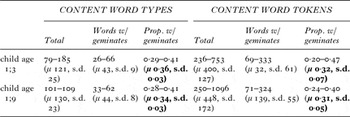
Table 2a shows the range, mean, and standard deviation of content words (both types and tokens) that the thirty mothers addressed to their children in each recording session. In addition, it shows the number and proportion of content words with geminates (in both types and tokens). Here we see that, in terms of either types or tokens, about one-third of the words the mothers produced in both sessions had geminates (see numbers in bold face). In all of the analyses the mothers are also quite similar to one another in their use of geminates, as is evident from the low standard deviation on proportion of geminates (also in bold).
Occurrence of geminates in Italian mother's content words (CDS), range (mean [μ] and standard deviation [s.d.]). prop. = proportion. Means and standard deviations for proportions of words with geminates are in bold face.

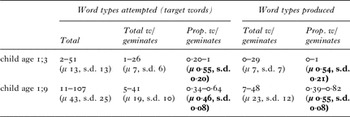
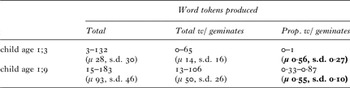
Table 2b provides the range, mean, and standard deviation of content words the children attempted overall (or of types produced, which is the same thing) at 1;3 and 1;9, while Table 2c provides the same information in relation to the tokens produced at each session. In addition, Table 2b shows the range, mean, and standard deviation of the target words attempted that had geminates at each age and the proportion of target words attempted that had geminates; it also shows the range, mean, and standard deviation of word types produced with geminates at each age and the proportion of types produced with geminates, while Table 2c gives the same information in relation to tokens.
Occurrence of geminates in children's content word types, range (mean and standard deviation): words attempted (i.e. target words) and produced. Means and standard deviations for proportions of words with geminates are in bold face.

Occurrence of geminates in children's content word tokens, range (mean and standard deviation). Means and standard deviations for proportions of words with geminates are in bold face.

In these tables we see that at 1;3, when most of the children are just beginning to produce words, the proportion of geminates is highly variable (shows a high standard deviation: in bold face) as regards both target words attempted (·20) and actual child forms produced (in terms of either types –·21 – or tokens –·27) as compared with both CDS (·03 and ·07, respectively, at the earlier session) and child words attempted (·08) and produced (in either types –·08 – or tokens –·10) at 1;9. The overall figures for the children's production (about half include geminates, at both ages and in terms of either types or tokens) correspond closely with findings based on the Italian Communicative Development Inventory (CDI: Caselli & Casadio, Reference Caselli and Casadio1995; Rinaldi, Barca & Burani, Reference Rinaldi, Barca and Burani2004), in which 23 of the 50 words most widely reported at 2;6 have medial geminates.
The key point to be gleaned from these tables is that geminate words attract disproportionate child attention and production: the children attempt and produce a higher proportion of words with geminates than the mothers present them with in their CDS. To test the significance of these differences we conducted a repeated-measures 2 × 3 ANOVA (dependent variable: proportion of geminates in types; within-subject factors: age, with two levels, 1;3 and 1;9, and words, with three levels, proportion of word types containing geminates in CDS, proportion of targets, and proportion of child forms). The analysis showed no main effect for age (F[1,58] = 1·77; p = ·19, η 2 = ·25), a significant effect for words (F[2,58] = 52·12; p < ·001, η 2 = ·99), and an interaction of age × words (F[2,58] = 3·8; p = ·03, η 2 = ·68). Post-hoc analyses indicated that at both 1;3 (p < ·01) and 1;9 (p < ·001) both the targets and the word forms children produced had (proportionately) significantly more geminates than were used in CDS word types. Furthermore, at 1;9 the child forms included a higher proportion of geminates than did the targets (p < ·001).
We also conducted a repeated-measures 2 × 2 ANOVA with proportion of geminates in tokens instead of types as our dependent variable and with two within-subject factors, each of them with two levels (age: 1;3 and 1;9, and words: proportion of word tokens containing geminates in CDS and in child forms). There was no effect for age (F[1,29] = 0·078, p = ·78, η 2 = ·06) and no interaction (F[1,29] = 0·049, p = ·83, η 2 = ·06). However, there was a highly significant effect for words (F[1,29] = 84·68, p < ·001, η 2 = ·99). Post-hoc analysis indicates that at both ages the child tokens included a significantly higher proportion of geminates than are seen in CDS word tokens (p < ·001).
To test whether there is an effect of individual mothers' CDS on their children's production of geminates we examined the results by dyad, as regards words attempted (targets), word types, and word tokens produced by the children in relation to both types and tokens produced by the mothers. We found no significant correlations when raw numbers were compared; in proportions, a single correlation was significant, between the proportion of child word tokens and CDS word tokens at 1;3 (r(30) = ·49; p < ·01). However, the results may not be reliable, given the relatively narrow range of variability in the CDS tokens, the ephemeral nature of the correlation (which disappears by 1;9), and the multiple correlations run in order to detect any possible relationship between child and adult use of words with geminates.
More generally, we see that the children both overselect and overproduce geminate words, in both types and tokens, compared to the usage we observe in CDS. These results suggest that the salience of geminates for Italian children is quite similar to what is observed in Finnish, where geminates occurred in about 38% of content words in input speech but made up 49% of words attempted by the five children observed in the single-word period and 55% of the word forms produced by the children in that period (Kunnari, Reference Kunnari2000; Vihman & Velleman, Reference Vihman and Velleman2000). Thus Italian children, like the smaller sample of Finnish children observed in earlier studies, both overselect and overproduce words with geminates, especially at 1;9, when their vocabularies are considerably larger.
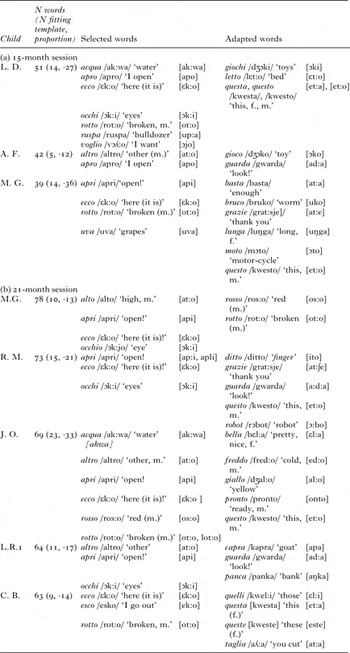
A <VC(C)V> pattern or template is commonly seen in Italian children. At 1;3, 9 of the 30 children had one or more word types adapted to fit the pattern; the mean proportion of such adapted word types per child was ·25. At 1;9, 26 of the 30 children adapted words to this template, with a mean proportion of ·23. Table 3 illustrates use of the template. It includes all the trochaic disyllables adapted by omission of the initial consonant by the three highest-producing children at 1;3 and the five highest-producing children at 1;9. Note that trochaic disyllables constitute the largest proportion of words attempted at both ages – 67% at 1;3, 63% at 1;9; monosyllables and iambs each make up fewer than 10% at both ages, while longer words are attempted in 19% of the words produced at 1;3, 25% at 1;9. These longer words are mainly trisyllabic at 1;3 but range up to five syllables at 1;9 (e.g. animaletti /animaˈlet:i/ ‘little animals’, produced by two children – as [let:i, amaˈlet:i] and [maˈlet:i]), aspettatemi /aspeˈt:atemi/ ‘wait (2pl.) for me’ [peˈt:atemi]).
Application of <VC(C)V> template by Italian children Words fitting template: the three highest-producing children at 15 months, the five highest-producing children at 21 months, ordered by child from most to least words produced (f. ‘feminine’, m. ‘masculine’, BT ‘babytalk form’). Only trochaic disyllabic targets are shown.

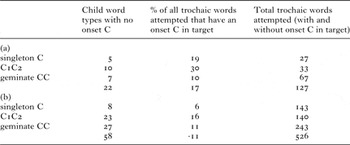
As shown in Table 4, at 1;3, the children targeted 127 trochaic disyllabic word types altogether, with or without onset consonants (last column, Table 4a); they produced 22 (17%) of these as <VC(C)V> (first column, Table 4a). Over half of the trochaic target words have medial geminates, but of the three types of medial consonant-slot filler (singleton, heterogeneous cluster, or geminate), the largest proportion produced without an onset consonant in this session (second column, Table 4a) were those with heterogeneous clusters (30%). It is worth noting, however, that the 23 target words with heterogeneous clusters produced with an onset consonant here were variably realized in the child form (based on types, not tokens) with medial singletons (3), clusters (nasal + stop only: 10) or geminates (10). Of the 10 words with heterogeneous clusters produced without an onset (first column, Table 4a, C1C2 word types), two of the child forms had a nasal + stop cluster, eight (80%) had a long medial consonant.
Child word types produced without an onset:a distribution by medial consonant or cluster. (a) child age 1;3, (b) child age 1;9

note: a The table includes only the data of those children who produced one or more disyllabic words adapted to a <VCV> template by omission of the initial consonant (at 1;3, 9, at 1;9, 21 children).
At 1;9, of the 526 trochaic disyllables targeted with onset consonants (last column, Table 4b), 58 (11%) were produced as <VC(C)V> (first two columns, Table 4b). At this point a greater proportion of word types with medial geminates in the adult target form (27, or 11%) were adapted to the template in comparison with word types with singletons (8, or 6%); the difference is significant by paired two-tailed t-test (t(29) = 2·775, p < 01). Word types with heterogeneous clusters (23, or 16%) are again the most often adapted to the template, but 16 of them (70%) are produced with long consonants. However, 64% of the heterogeneous clusters in word types that retain their onset in the child form are also realized as long consonants in this session. Thus at both ages long medial consonants predominate in child forms adapted to the template by onset-consonant omission; we cannot determine from these data whether some or all of the children perceived medial heterogeneous consonants as geminates.
An additional factor in initial consonant omission is the relatively large number of Italian target words that exceed the typical two-syllable length limit on early word production. At 1;3, 5 of the 28 word types adapted by initial-consonant omission (by 3 of the 9 children who so adapted words) were trisyllabic, 3 with onset omission only (from the first syllable: caduto /kaˈduto/ ‘has fallen’ [oˈduto], giraffa /dʒiˈraf:a/ ‘giraffe’ [eˈjap:a], macchina /maˈk:ina/ [ˈakja]), 2 with full initial syllable omission, leaving a disyllabic onsetless form (camicia /kaˈmitʃa/ ‘shirt’ [ˈiʧa], forchetta /forˈket:a/ ‘fork’ [ˈet:a]). At 1;9, 20 of the 26 children who adapted words by initial-consonant omission included three- or four-syllable words in this pattern; of 50 target words of more than two syllables the children omitted only the initial consonant in 14, maintaining the vowel of the first syllable (e.g. cavallo /kaˈval:o/ ‘horse’ [aˈval:o], vicino /viˈtʃino/ ‘near-by’ [iˈtʃino], zucchero /ˈtsuk:ero/ ‘sugar’ [ˈuk:elo]); in all but one of the remaining 36 words one or more of the pre-stress syllables were truncated, along with the onset to the first syllable included in the child form (bambolotto /bamboˈlɔt:o/ ‘dolly’ [oˈtot:o], pecorella /pekoˈrεl:a/ ‘lamb’ [oˈlεl:a], [εl:a]); the exception is aggiustala /aˈd:ʒustala/ [ˈaʤ:i] ‘fix it’, in which it is the post-stress syllables that are omitted. Note that this is the only four-syllable word attempted with stress on the antepenult, a stress pattern typical of trisyllabic verbs in the imperative with an affixed pronominal clitic (here, /la/). In 28 of these 50 words the child produced a long consonant.
DISCUSSION
We considered the words produced spontaneously by thirty Italian children in naturalistic play with their parents at two sampling points, at ages 1;3 and 1;9. We found that geminates, which occurred in about a third of the content words used by the mothers in speech directed to their children in the two sessions, were produced significantly more frequently by the children; in addition, at 1;9 a significantly greater proportion of words were produced with long consonants than were attempted, primarily due to long consonant production of heterogeneous clusters. Thus in Italian, as in Finnish, geminates are relatively frequent in input speech but are even more frequently selected by the children and are also preferentially produced. Furthermore, analysis of the children's use of a <VC(C)V> template showed that, again as in Finnish, word-initial consonants are frequently omitted even when that syllable is accented. And, finally, geminates as well as heterogeneous clusters predominate in the trochaic disyllables adapted to the template by omission of the initial consonant in the child form; the majority of words with either cluster type are produced with long consonants and may be so perceived. The same observation applies to words of three or more syllables adapted by omission of either the onset consonant alone or of one or more syllables as well as of the onset of the stressed syllable.
In short, the hypothesis suggested by Finnish data arises from the Italian data as well: the presence of medial geminates (like final-syllable lengthening in French or iambic accentual pattern in Hebrew) appears to pull attention away from the word-initial consonant, even when that consonant is part of the accented syllable. Study 2 was carried out to test that hypothesis.
STUDY 2: UNTRAINED WORD-FORM RECOGNITION
This study was undertaken to test the proposal that the presence of medial geminates leads to perceptual neglect of the onset consonant; this in turn is based on the hypothesis that omission of the onset consonant of adapted disyllables and longer words results, at least in part, from representational neglect. We draw here on the untrained word-form recognition paradigm introduced by Hallé and Boysson-Bardies (Reference Hallé and Boysson-Bardies1994) and since replicated with British English (Vihman et al., Reference Vihman2004), Dutch (Swingley, Reference Swingley2005), and American English (Seal, DePaolis, Baird, Kulsar, Keren-Portnoy & Vihman, Reference Seal, DePaolis, Baird, Kulsar, Keren-Portnoy and Vihman2012). In each of these studies 11-month-old infants were found to recognize words likely to be familiar from the home (although younger infants did not: Vihman et al., Reference Vihman2004; Vihman, Thierry, Lum, Keren-Portnoy & Martin, Reference Vihman, Thierry, Lum, Keren-Portnoy and Martin2007). In follow-up experiments French 11-month-olds were found to recognize words even when the word-initial consonant was changed (Hallé & Boysson-Bardies, Reference Hallé and Boysson-Bardies1996) (although not when it was omitted), but they were less likely to do so when it was the medial consonant (the onset to the accented syllable in French disyllables) that was changed. In English the reverse effect was found: initial consonant change blocked word-form recognition but medial consonant change did not (Vihman et al., Reference Vihman2004). Furthermore the consonant-change effect was stronger in English than in French, presumably because the English accented syllable is also word-initial and so processed first.
Following Vihman et al. (Reference Vihman2004), the preferential headturn procedure was used here in three experiments designed to test words expected to be familiar to the infants from frequent exposure in everyday life, with no specific training in the lab; these words were contrasted with ‘rare’ words, or words to which infants are unlikely to have been previously exposed. We reasoned that if it is the presence of medial geminates that leads to child reliance on <VCCV> templates in production, then changes to the onset consonant of words with geminates should not block word-form recognition in Italian 11-month-olds.
EXPERIMENT 1
The first experiment was designed to establish word-form recognition in Italian infants as a baseline.
METHOD
Participants
The participants were recruited through the nurseries of Comune di Parma. Each family received a letter and signed a consent form. Fifteen mothers and ten fathers had a university degree. The children were tested at the Observational Laboratory of the University of Parma. Twenty infants were tested (8 females; mean age 0;10·28, range, 0;10·17–0;11·10). Three children were excluded, two due to crying, one due to a technical problem. None of these infants had participated in Study 1.
Stimuli
In each list, familiar and rare, six words with singletons and six with geminates were chosen to serve as stimuli (see ‘Appendix’: first six words in ‘Unchanged, medial geminate’ and ‘Unchanged, medial singleton’ columns; available at http://dx.doi.org/10.1017/S0305000915000793). The familiar words were chosen from those most often identified on the Italian CDI as occurring in children's words within the first few months of word use; the rare words were chosen to provide a good phonotactic match to the familiar list, but as non-occurring in the Italian CDI (Caselli & Casadio, Reference Caselli and Casadio1995). All six familiar words with medial geminates and three with medial singletons had been produced in the recorded sessions by one or more of the children whose data are reported in Study 1. The frequency of the words was checked against the database or ‘basic lexicon’ (6,095 words) of Marconi, Ott, Pesenti, Ratti, and Tavella (Reference Marconi, Ott, Pesenti, Ratti and Tavella1994). The familiar words from our study that were included in this database (all of our familiar-word stimuli except tata) had a mean frequency of 476·82; the four rare words from our study that were included in the database (flotta, picco, leva, busto) had a mean frequency of 7·74.
Six variant lists of the twelve stimuli were recorded by a female native Italian speaker in a sound-treated room using a RODE NT2A condenser microphone connected to a Metrichalo soundcard sampling at 48 KHz-24 bits. The stimuli had an amplitude peak within ± 1·5 dB (using an integration time of 125 ms) of 60 dB and an inter-stimulus interval of 750 ms. The average duration of each word was 0·86 s (s.d. = 0·10).
Procedure
The experiment was conducted in accord with Kemler Nelson, Jusczyk, Mandel, Myers, Turk, and Gerken (Reference Kemler Nelson, Jusczyk, Mandel, Myers, Turk and Gerken1995). Infants were seated on their mother's lap in a three-sided test booth. A camera and red light were placed on the center panel and a blue light and speaker were mounted on the two side panels. The experimenter controlled presentation of the stimuli from a separate room, using a video monitor and PC.
The experiment included a familiarization phase, designed to acquaint the infants with the procedure, and a test phase. During the familiarization phase the two lists were presented once in full for each experiment. During the test phase twelve lists were presented, each made up of the six words of each type, familiar and rare, in pseudo-randomized order (alternating the top word or two in each trial, to ensure infant exposure to all words), for twelve trials.
Each trial started as soon as the flashing central light had captured the infant's gaze. At that point, one of the blue lights (chosen randomly by the program) would begin to flash and, once the infant's head (i.e. gaze) had turned toward the light, one of the randomly selected lists would begin to play after a 0·5 s delay. The experimenter recorded the infant's looking time in response to the list (not to individual words) by pressing a button on the computer as soon as the infant turned his or her head at least 30° towards the side light. Each trial ended when the infant turned away for more than 2 s.
To assess reliability, a second experimenter coded twelve infants' looking time off-line; inter-judge agreement was ·89 (Cohen's index).
RESULTS
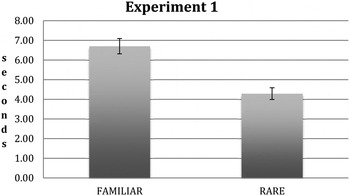
In this baseline experiment the mean looking time in response to the familiar-word lists was 6·70 s, to rare-word lists, 4·29 s (t(19) = 5·99, p < ·001, d = 1·54: see Figure 1). Seventeen of the 20 infants looked longer, on average, in response to familiar than to rare words. A split-half analysis revealed a steady decline in interest in both sets of stimuli over the course of the experiment, from a mean of 7·61 s (s.d. 2·39) for familiar, 4·98 s (s.d. 1·78) for rare in the first half to 5·79 s (s.d. 2·20) for familiar, 3·60 s (s.d. 1·65) for rare in the second half. This accords with the baseline results reported in Vihman et al. (Reference Vihman2004). Thus at 0;11 Italian children, like American, British, French, and Dutch children, respond with greater attention to untrained familiar words, or words heard frequently as part of everyday routines in the home, than to words that they are unlikely ever to have heard outside of the experimental context. Interest in both sets of stimuli declines at roughly the same rate over the course of the experiment.
Infant's responses (in seconds) to untrained familiar vs. rare words (mean and standard error).

Experiments 2 and 3 were designed to test whether Italian infants will recognize untrained familiar words in the face of a change to the first consonant in two contrasting sets of stimuli: nonwords based on familiar vs. rare words with medial geminates (Experiment 2) and nonwords based on familiar vs. rare words with medial singletons (Experiment 3).
EXPERIMENT 2
METHOD
Participants
Twenty infants were tested (9 females; mean age 0;10·26, range, 0;10·20–0;11·9). Two children were excluded, one due to crying, the other due to a technical problem. No infant had participated in Study 1 or Study 2: Experiment 1. Parental education was again high: fourteen mothers and ten fathers had a university degree.
Stimuli
In Experiment 2, twelve familiar and twelve rare words with medial geminates were presented as stimuli, all with changes to the first consonant (see ‘Appendix’: second column from the left under both familiar and rare, ‘medial geminate: Changed C1’; available at http://dx.doi.org/10.1017/S0305000915000793). Nine of the twelve familiar words had been produced in the recorded sessions by one or more of the children whose data are reported in Study 1. In Marconi et al. (1994) these twelve familiar words had a mean frequency of 571·75, the rare words (excluding ghetto, in addition to the Experiment 1 baseline words not listed in the database), 10·66.
Procedure
The procedure was the same as that used in Experiment 1.
RESULTS
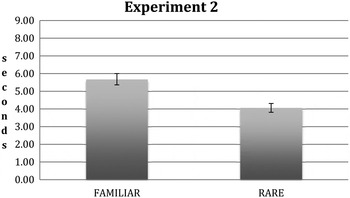
The mean looking time in response to lists of familiar words with a changed initial consonant was 5·68 s, to lists of rare words with changed initial consonant, 4·06 s, a significant difference (t(19) = 3·83, p = ·01, d = 1·29; see Figure 2). Sixteen of the 20 infants responded with longer attention to the familiar than to the rare nonwords. A split-half analysis again revealed a steady decline in interest in response to both sets of stimuli over the course of the experiment, from a mean of 7·04 (s.d. 2·02) for familiar, 4·64 (s.d. 1·21) for rare in the first half to 4·45 (s.d. 1·53) for familiar, 3·35 (s.d. 1·38) for rare in the second half.
Infant's responses (in seconds) to nonwords based on familiar vs. rare words with medial geminates with changed C1 (mean and standard error).

DISCUSSION
Study 2, Experiment 2 was designed to test whether the presence of medial geminates is enough to draw infant attention away from the word-initial consonant even in words with initial stress (trochaic words). When presented with nonword forms with medial geminates derived from familiar and rare words through changes to the initial consonant, infants showed significantly longer looking times to the familiar words despite the C1 change. Thus, change to the initial consonant (in the accented syllable) apparently failed to block word form recognition. Furthermore, there was no evidence of a delay in word recognition in this experiment in comparison with the baseline: mean looking time in either the first or second half was not appreciably lower than what was seen in Study 2, Experiment 1.
Failure to recognize familiar words with a changed onset consonant might have been expected, based on the findings of Vihman et al. (Reference Vihman2004). In that study, which included three experiments with infants exposed to British English and a reanalysis and comparison with the experiments reported by Hallé and Boysson-Bardies (Reference Hallé and Boysson-Bardies1994, Reference Hallé and Boysson-Bardies1996), split-half analysis of the baseline experiments showed, as here in both Experiments 1 and 2, a steady decline in infant response to the trials. However, when a change was made to the word-initial consonant, the split-half analyses revealed that English infants failed to distinguish familiar from rare words at any point in the experiment, while French infants, for whom it was the onset to the unstressed syllable that was changed, responded with more attention to familiar words only in the second half. In short, the results of this experiment suggest that the salience of the medial geminates may be sufficient to distract Italian infants' attention from the first consonant despite the fact that it falls in the accented syllable. To test whether this effect was truly related to the presence of the medial geminate, however, we conducted an additional experiment, changing the first consonant of words with medial singletons.
EXPERIMENT 3
METHOD
Participants
Twenty-one infants were tested (9 females; mean age 0;11;4, range, 0;10·17–0;11·12). Two children were again excluded, one due to crying, the other due to a technical problem. No infant had participated in Study 1 or Study 2, Experiments 1 or 2. Parental education was similar to that of the first two experiments: fourteen mothers and thirteen fathers had a university degree.
Stimuli
In Experiment 3, twelve familiar and twelve rare words with medial singletons were presented, with changes to the first consonant (see ‘Appendix’: last column on the right under both familiar and rare, ‘medial singleton: Changed C1’; available at http://dx.doi.org/10.1017/S0305000915000793; note, however, that among both the familiar and the rare words one word with a heterogeneous cluster was included in the ‘medial singleton’ list; based on Study 1, the perceptual status of heterogeneous clusters remains unclear, as indicated above – although these clusters seem more often to be treated as geminates than as singletons in the children's own forms). Seven familiar words had been produced in the recorded sessions by one or more of the children whose data are reported in Study 1. In Marconi et al. (Reference Marconi, Ott, Pesenti, Ratti and Tavella1994) these familiar words (again excluding tata) had a mean frequency of 700·81, the rare words (except mole and the baseline singleton words not listed in the database), 18·53. Thus, the familiar singleton words used in this experiment were somewhat more frequent, according to Marconi et al., than the familiar geminate words used in Experiment 2; the difference is not significant, however (t(21) = 0·175; p = ·863).
Note that the differences between the original and the changed initial consonants involved changes of from one to three features each (of manner, place, and voicing). The key criterion in designing these stimuli was to avoid creating a different real word, especially one that the children might possibly know. In the final choices made (as shown in the ‘Appendix’; available at http://dx.doi.org/10.1017/S0305000915000793), the familiar nonwords with medial geminates had slightly fewer featural differences from the unchanged forms (23 feature changes, or 1·92 per word) than the words with medial singletons (25 feature changes, or 2·08 per word), while the rare words of the two types had roughly the same number of changes (geminate words, 23, or 1·92 per word, singleton words, 24, or 2 per word).
Procedure
The procedure was the same as that used in Experiment 1.
RESULTS
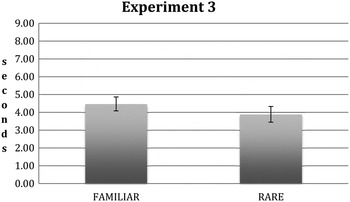
In Experiment 3, contrary to the preceding two experiments, infants failed to show significantly longer looking time in response to either list of words with medial singletons and changed initial consonants. The mean looking time in response to untrained familiar words was 4·47 s (s.d. = 1·81), to untrained rare words, 3·89 (s.d. = 2) (t(20) = 1·64; p = ·12, d = 0·30: see Figure 3). Thirteen out of 21 infants responded with longer looks, on average, to the familiar nonwords and 7 responded with longer looks, on average, to the rare nonwords. A split-half analysis revealed a steady decline in interest in both sets of stimuli over the course of the experiment, from a mean of 5·60 (s.d. 2·23) for familiar, 3·35 (s.d. 1·57) for rare in the first half to 5·14 (s.d. 2·17) for familiar, 3·22 (s.d. 1·75) for rare in the second half. Note that the inclusion in these lists of one familiar and one rare word with a medial cluster might have worked against the finding that infants fail to recognize words with initial consonant change, if the medial cluster in the familiar word, like the geminate clusters in Experiment 2, served to distract attention from the initial consonant. The presence of just one such stimulus word out of twelve (whose ordering rotated across the trials) was presumably insufficient to affect the overall outcome, however.
Infant's responses (in seconds) to nonwords based on familiar vs. rare words with medial singletons with changed C1 (mean and standard error).

DISCUSSION
Experiment 3 showed that, in the case of words with (mainly) singletons, change to the word-initial consonant, the onset of the accented syllable in all cases, was sufficient to block infant word-form recognition. This shows that where no geminates occur word-medially, the onset consonant of the accented syllable plays an important role in word-form recognition, as it does in English and French (Vihman et al., Reference Vihman2004). This supports our interpretation of the findings of Experiment 2, in which familiar words attracted significantly longer infant attention than rare words despite the change to the onset consonant: it appears to be the presence of the word-medial geminates in that experiment that led the children to overlook the unexpected onset consonant in otherwise familiar words.
GENERAL DISCUSSION
This study was designed to test a hypothesis suggested by previous studies of children's early word production in Finnish and other languages with geminates, replicated here with Italian in Study 1. The medial geminate in adult target words is commonly associated with infant adoption of a <VCCV> template, with children adapting to this template even words with an easily produced, early learned onset stop or nasal consonant such as labial /p/, /b/, or /m/ or coronal /t/, /d/, or /n/. Thus we reasoned that it might be the salience of the medial geminates that deflects attention from the onset consonant, resulting in ‘oversupply’ of early child word forms in <VCCV>. In the first study we examined closely the proportion of Italian words experienced, attempted, and produced with geminates and of those adapted to the onsetless pattern; in the second study we tested for a perceptual effect of geminates on onset consonants in trochaic disyllables.
In Study 2, Experiment 1 demonstrated that Italian infants aged 0;11, like infants exposed only to French, English, or Dutch, listen with greater attention to words heard frequently in the home (‘familiar words’) than to words unlikely to have been heard before the experiment (‘rare words’). Based on that baseline confirmation, we presented two other groups of infants of the same age with longer lists of familiar and rare words, restricting the stimuli to words with either medial geminates (Experiment 2) or (mainly) singletons (Experiment 3) and changing the initial consonant. Under these conditions – and unlike infants exposed to English, which shares with Italian the trochaic accentual pattern of most disyllables learned in the early-word period – the infants showed interest in the familiar words with changed onset consonant if the word form included a medial geminate. When the medial consonant was a singleton, however, word-form recognition was blocked by the change to the onset consonant, just as it is in English (Vihman et al., Reference Vihman2004).
These findings appear to validate our initial hypothesis: in a language with regular occurrence of geminates, their perceptual salience is such that children are led to disregard changes to the onset consonant in trochaic words when the word includes a medial geminate. Note, however, that although accent-based lengthening of the second syllable appears to draw infants' attention away from the onset consonant in French, as suggested by the fact that changes to that consonant fail to block word-form recognition, omission of the word-initial consonant (onset to the unaccented syllable in French) – not tested here – did block recognition in the French study (Hallé & Boysson-Bardies, Reference Hallé and Boysson-Bardies1996). Yet the early words of French children, like the Italian words reported here, often show initial-consonant omission. Thus the parallel between perception and production is a subtle one: the presence of non-initial syllable accent (as in French) or medial geminates (as in Italian) is associated with infants disregarding changes to that consonant in word-form recognition and omitting it in production, but when presented with forms like those they later produce themselves – e.g. lapin as /apε̃/ (Hallé & Boysson-Bardies, Reference Hallé and Boysson-Bardies1996, Table 4; compare Charles at 1;3 in Vihman, Reference Vihman, MacWhinney and O'Grady2015, Table 2: lapin [ɑpa]) – they fail to recognize the words.
Thus the <VCCV> template can be taken to derive from both the perceptual salience and the articulatory accessibility of long consonants. Before accepting this conclusion we should consider some additional complications, however. First, although more disyllabic trochaic words were targeted with geminates than with either medial singletons or heterogeneous consonant clusters at both age levels, the proportion of those with omitted onset consonant was highest among words with medial heterogeneous clusters in the target, not geminates, at both age levels (30% at 1;3, 16% at 1;9: see Table 4). As indicated above, the distinction between geminate and heterogeneous clusters is blurred by the fact that in the majority of forms produced in this study the Italian children realize both types of clusters as long consonants, and this is particularly characteristic of the forms with a missing onset consonant. This may or may not mean that heterogeneous clusters, like geminates, distract attention from the onset, a proposition not tested here. In English, with its many medial clusters (typically reduced to singletons until well into the third year of life: Grunwell, Reference Grunwell1982), we find no tendency to adopt a <VCV> template. However, there is evidence from Polish, a language with far more clusters than either English or Italian (and with fixed penultimate stress, so trochaic disyllables) but with no geminates, that at least the one child observed in Szreder (Reference Szreder, Vihman and Keren-Portnoy2013) initially focused his attention on the challenge of medial cluster production at the expense of the onset consonant or cluster.
Second, note that, as shown in Tables 1 and 3, children also produce target words with medial singletons (i.e. CVCV words) without the word-initial consonant. Although at 1;9 there is a significantly greater likelihood of onset consonant omission in child production of words with medial geminates than medial singletons, this is not the case at 1;3, when these contrasting target word shapes are about equally likely to be produced without an onset. Yet the results of Experiment 3 indicate that younger children hearing words with medial singletons do not disregard the onset consonant: Change to that consonant blocks word recognition. Thus the occurrence of CVCV target words adapted to a <VCV> template (e.g. giochi /dʒɔki/ ‘toys’ [ɔki], moto /mɔto/ ‘motorcycle’ [ɔto]) is not what we might expect, given the results of Experiment 3. One way of accounting for children's adaptation of words with singletons to an onsetless (<VCV>) word template is to infer that it reflects a generalization of the <VCCV> pattern, based on the infants' motoric experience or production routine with the very common (and overproduced) medial-geminate words. To determine whether this is a plausible interpretation we first consider some data from Finnish to ascertain the proportion of adaptation of words with medial geminates vs. singletons to a <VC(C)V> template.
In Finnish the <VC(C)V> template accounted for a mean of 31% of all tokens produced by ten children at the 25wp (based on data from Kunnari, Reference Kunnari2000). Four children produced over 33% of their words as VC(:)V (Vihman & Velleman, Reference Vihman and Velleman2000). Eight out of ten children adapted words with initial consonants to fit the template. Of these adaptations, nineteen had medial geminates in the target form, seven had singletons; no child adapted only words with singletons. In two case studies, Sini adapted seven of her first fifty-seven words to VCCV, two to VCV (Savinainen-Makkonen, Reference Savinainen-Makkonen2001); Joel adapted five of his first fifty words to VCCV, one to VCV (Savinainen-Makkonen, Reference Savinainen-Makkonen2007). Thus in Finnish the adaptation to <VCV> of words with medial singletons is a relatively minor phenomenon.
Returning to Italian, we discussed above the findings shown in Table 4, which indicate that although target disyllables with all three types of medial consonants or clusters are sometimes adapted to the onsetless pattern, most of the words involved have heterogeneous clusters at both ages, and words with geminates are not significantly different from words with singletons in this regard at 1;3 but make up a significantly larger proportion at 1;9. Furthermore, whereas at 1;3 five of the seven words with medial singletons that are adapted to the pattern have disyllabic targets, at 1;9 only eight of the twenty-three words with singletons adapted to the pattern have disyllabic targets; the remaining fifteen have three- or four-syllable long target forms. In other words, the omission of the onset consonant, rare in words with singletons in Finnish, may occur more frequently in Italian in part due to the presence of large numbers of basic vocabulary words that exceed the children's typical production limit of two syllables. (Note that Finnish also includes many long words, particularly in comparison with English. However, Finnish long words are often morphologically complex – e.g. nuku-maan ‘sleep-ing’; cf. nuku-u ‘sleep-s’; Savinainen-Makkonen, Reference Savinainen-Makkonen2000a, Reference Savinainen-Makkonen2000b.)
This suggests that the challenge of producing three- and four-syllable words constitutes an additional factor contributing to onset consonant omission in Italian.
Both the increase in use of the <VC(C)V> template seen in the session recorded six months later for the same children and the evidence of significantly greater use of initial consonant omission in words with geminates than in words with singletons in that later session are consistent with the interpretation proposed here, that disregard of the onset consonant is a perceptual response to medial geminates. The extension of this pattern to words with singletons, despite the experimental evidence that onset consonants constitute an important part of children's representations of such words, appears then to be traceable to two factors: the challenge of producing words that exceed the children's length constraint in production and the motoric experience of producing words without an onset consonant that may be the long-term result of the selection and adaptation of words with geminates to the <VCCV> template.
The findings reported here provide additional support for the whole-word phonology model described above by demonstrating the effect of a feature occurring word-medially on both production and perception of the word as a whole. Many experimental studies of word recognition have been taken to demonstrate the ‘phonetically (or phonologically) detailed’ nature of early word representations (for a review, see Vihman, Reference Vihman2014, Ch. 7). Nevertheless, the evidence of an effect of medial geminates on infant attention to the word-initial consonant suggests that some aspects of these early representations are more accurate than others. These findings also suggest that these representations reflect, like adult memory for unfamiliar proper nouns (James & Fogler, Reference James and Fogler2007), the salience for the listener of parts of words that are either prosodically heightened (i.e. accented syllables, geminates) or motorically familiar (based on existing representations and routines), or both.
SUPPLEMENTARY MATERIALS
To view supplementary material for this article, please visit http://dx.doi.org/10.1017/S0305000915000793.