An increasing number of medical conditions are being treated in the outpatient setting. In addition, the use of outpatient infusion therapies via central venous catheters (CVCs) has increased to discharge patients from the hospital, address patient convenience, improve cost-effectiveness, and potentially reduce risk from hospital-acquired harm.Reference Chary, Tice, Martinelli, Liedtke, Plantenga and Strausbaugh 1 Data describing mechanical complications and central line-associated bloodstream infection (CLABSI) rates related to outpatient CVCs are limited. Applying traditional CLABSI surveillance methods to outpatient settings can be very challenging, including the capture of signs and symptoms of an infection and the calculation of device days. The published data detailing the burden of CLABSI in outpatient settings have noted lower CLABSI rates when compared to inpatient infection rates.Reference Rinke, Milstone and Chen 2 , Reference Walshe, Malak, Eagan and Sepkowitz 3 This observation likely reflects a larger device-day denominator, as patients in the outpatient setting tend to have longer catheter dwell times. Even with lower rates, the absolute number of events are substantial.Reference Rinke, Milstone and Chen 2 , Reference Tokars, Cookson, McArthur, Boyer, McGeer and Jarvis 4 In addition, such patients are at risk for other medically attended catheter-associated complications (CACs), such as infusate toxicity, loss of catheter patency, and other mechanical and thrombotic complications.Reference Grau, Clarivet, Lotthe, Bommart and Parer 5 – Reference Keller, Williams and Gavgani 8 Descriptions of the burden of these CACs in outpatients with a CVC are limited.
It is important to understand the burden of these CACs and the risk of outpatient CLABSI to elucidate the true impact of these events. We performed a retrospective observational cohort study in the population of patients with a CVC discharged from a tertiary-care medical center (Vanderbilt University Medical Center [VUMC]) who received outpatient CVC care through the primary VUMC home care affiliate, Vanderbilt Home Care Services (VHCS).
METHODS
Study Population
Data were retrospectively collected on patients discharged from VUMC with a CVC in place and admitted into the care of VHCS. VUMC is a tertiary-care, university-affiliated medical center where >55,000 adult and pediatric patients are admitted annually. Approximately 1,000 patients are discharged from VUMC requiring CVC infusion services annually, and >80% of these patients are referred to VHCS for CVC care.
All adult and pediatric patients who were discharged from VUMC with a CVC in place and who had home-health skilled nursing provided by VHCS between July 1, 2012, and September 30, 2013, were eligible for inclusion. Eligible patients were identified using current procedural terminology (CPT) codes that denoted insertion of a CVC during the hospitalization and associated VHCS electronic clinical documentation that indicated postdischarge skilled nursing visits for infusion therapy had been performed (CPT codes are listed in the Appendix). A CVC was defined as either a catheter or a subcutaneous port with the proximal catheter tip located in a central vein, ie, the superior vena cava or the inferior vena cava. Patients with the presence of a CVC on discharge but no record of care via VHCS were excluded from the study population.
Risk Factors
A full chart review was performed once CVC presence was verified. The chart includes outpatient medical records within the Vanderbilt system or affiliates. Data abstracted consisted of patient characteristics including age, sex, history of organ transplantation (solid or hematologic), neutropenia (absolute neutrophil count <500/µL) at time of CVC insertion, recent chemotherapy for cancer (within 4 weeks of CVC insertion), diagnosis of chronic inflammatory bowel disease (eg, Crohn’s disease, ulcerative colitis, celiac disease, etc), and prescription for an immune suppressant (see Appendix). The CVC characteristics collected included documented indication for the CVC, anatomic (vascular) location, type of catheter (ie, peripherally inserted, subcutaneous port, centrally inserted nontunneled or tunneled, or number of lumens), and frequency of line access per day during outpatient care. The frequency of daily access of the CVC was determined by the infusate order (eg, ertapenem once daily equals CVC accessed once daily, cefepime every 8 hours equals 3 times daily). Information regarding postdischarge healthcare encounters within the medical center was also collected. CVC removals were not documented by VHCS or the supervising provider in way that could be abstracted; thus, line days were not included in the analysis.
Outcomes
The primary study outcome was the frequency of CACs, defined as a complication heralded by an unexpected medical visit to an outpatient clinic, emergency department (ED) or inpatient admission, where the complication was related to the CVC or infusion therapy. Outpatient CLABSI was defined utilizing the National Healthcare Safety Network (NHSN) definition of CLABSI as described in January 2014 protocols with a modified timeframe shifting the date of the event to be on or after day 3 of discharge to identify events in the outpatient setting.Reference Rinke, Bundy and Chen 9 , Reference Kelly, Conway, Wirth, Potter-Bynoe, Billett and Sandora 10 A single investigator (S.S.) reviewed each case and ascertained the presence of an outpatient CLABSI. A common procedure for VHCS was to direct any patient to the ED if the home health nurse elicited any signs or symptoms of sepsis. Thus, we were able to abstract data on possible infections from the ED or outpatient clinic visits.
CVC Insertion Procedures
The insertion of all the peripherally inserted central catheters (PICC) at VUMC is performed by a specially trained procedure nurse or an interventional radiologist. The decision regarding which peripheral vein to access is typically made by the proceduralist; however, the decision regarding type of line and number of lumens is initiated by the ordering provider in consultation with the procedure team. The subcutaneous ports and centrally inserted CVCs were placed by an interventional radiologist or a surgeon (typically a vascular, pediatric, or general surgeon). These were placed in either the subclavian or internal jugular veins at the proceduralist’s preference.
Statistical Analysis
Differences in the proportion of patients in risk-factor groups by each binary outcome were assessed using the χ2 test. Adjusted odds ratios (OR) and associated 95% confidence intervals (95% CI) for risk-factor–outcome associations were generated by multivariable logistic regression models with robust variances. Age was modeled using a restricted cubic spline with 4 knots to allow nonlinearity in the age–outcome relationship.Reference Harrell 11
RESULTS
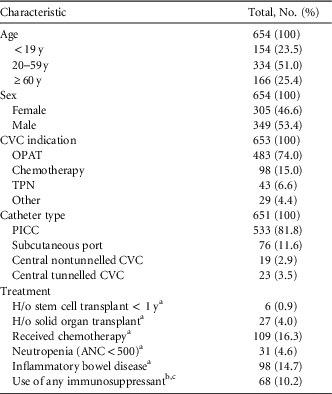
During the study period, a total of 740 CVCs were used in 654 unique patients. This cohort included 349 (53.4%) males, and median age of 44 years. Most CVCs were indicated for outpatient parenteral antimicrobial therapy (OPAT; 483 patients, 74.0%), but 98 (15.0%) were placed for delivery of chemotherapy, and 43 (6.6%) for total parenteral nutrition (TPN). PICCs were used for 533 (81.8%) patients, while the rest had subcutaneous ports (n=76, 11.6%), tunneled CVCs (n=23, 3.5%), and nontunnelled centrally inserted CVCs (n=19, 2.9%). In addition, most PICCs (97.7%) were placed in the basilic or brachial veins, and only 12 (2.3%) were placed in the cephalic veins.
For 357 (53.4%) patients, CVCs were accessed once daily or less frequently; however, for 186 patients (27.8%), CVCs were accessed > or = 3 times per day, and for 32 (5%), CVCs were accessed 5 times per day.
Characteristics of the Population of Patients and Their CVCs

NOTE. CVC, central venous catheter; OPAT, outpatient parenteral antimicrobial therapy; TPN, total parenteral nutrition; PICC, peripherally inserted central catheter; H/o, hematology/oncology; ANC, absolute neutrophil count.
a Missing data for 18 patients (2.7%).
b Missing data for 14 patients (2.1%).
c Steroid ≥20 mg prednisone, biologic/monoclonal antibody, methotrexate, azathioprine, hydroxychloroquine, calcineurin inhibitor, mTOR inhibitor, cyclosporin, mycophenolate.
Primary Outcome for CACs
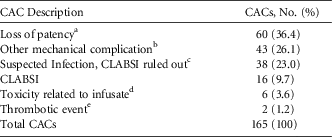
A CAC developed in 143 of the patients (21.9%), totaling 165 CACs. Of these, 76 (46%) required at least 1 visit to the ED or an inpatient admission, while the remaining 89 (54%) required an outpatient clinic visit. The frequency of specific types of CACs are noted in Table 2. Overall, 60 CACs (>36% of all CACs) were due to a loss of CVC patency, and almost 10% were related to an outpatient CLABSI. Notably, 14.3% of patients with a CAC ultimately needed a new catheter placed.
Description and Quantity of Medically Attended Catheter-Associated Complications (CACs)

NOTE. CLABSI, central-line–associated bloodstream infection.
a Defined as inability to infuse.
b Includes catheter pulled out partially or wholly, broken external parts, problem with the dressing, and 1 case of a broken olecranon after tripping over tubing of catheter.
c Defined as patient presented with signs or symptoms concerning for sepsis but blood cultures were negative.
d Includes renal injury, severe nausea/vomiting, diarrhea, drug eruption or other hypersensitivity.
e Determined by ultrasound as venous thrombosis related to the catheter.
Among the 60 CACs with loss of patency, 31 resolved with tissue plasminogen activator (tPA) administration, and 29 ultimately required a new CVC. Among the 76 CACs requiring an ED or inpatient admission, 54 were due to a suspected infection, but only 16 ultimately met the definition of an outpatient CLABSI. Among the CACs that required an outpatient clinic visit, all 89 were due to a loss of patency or other mechanical complication (see Table 2 footnotes).
Risk Factors for CACs
In the regression analysis, patients with TPN as an indication for CVC were significantly more likely to develop a CAC than those with OPAT as an indication (odds ratio [OR], 4.27; 95% CI, 1.75–10.41; P<.01). Of the 43 study patients with a CVC indication of TPN, 42% developed a CAC and 9.3% developed a CLABSI. Of the 98 patients with chemotherapy as the CVC indication, 20.4% developed a CAC and 4.1% developed a CLABSI.
The risk for developing a CAC significantly increased as the number of CVC lumens increased (OR, 2.24; 95% CI, 1.50–3.34; P < .001 per unit increase). Males were less likely than females to develop a CAC, with an odds ratio of 0.62 (95% CI, 0.42–0.91; P<.05).
Description of CLABSIs
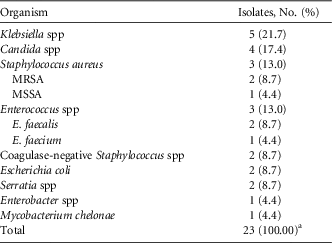
The absolute number of CLABSIs identified in the study population was small at 16 (2.4% of the total cohort). In the multivariable analysis for CLABSI as an outcome, TPN as an indication for CVC (OR, 7.90; 95% CI, 1.00–62.46), male sex (OR, 1.9; 95% CI, 0.63–5.17), neutropenia at the time of CVC insertion (OR, 1.71; 95% CI, 0.24–12.28), and the number of CVC lumens (OR,1.68; 95% CI, 0.57–4.99) were not statistically significant. Younger age was the only factor significantly associated with an increased risk for the development a CLABSI, as patients 5 years of age had nearly 5 times the odds of CLABSI compared to patients of the median age (OR, 4.80; 95% CI, 1.06–21.75 vs 44-year-olds). There seemed to be a protective factor for CLABSIs (crude OR, 0.57; 95% CI, 0.33–0.99; P<.05) when the CVC was accessed more than once daily. Of the 16 CLABSIs, the most common organism isolated was Klebsiella spp (n=5 events), followed by Candida spp (n=4) (Table 3). Also, 1 CLABSI was due to Mycobacterium chelonae in a patient receiving TPN.
List of Organisms Causing Outpatient CLABSI

NOTE. CLABSI, central-line–associated bloodstream infection; MRSA, methicillin-resistant Staphylococcus aureus; MSSA, methicillin-sensitive Staphylococcus aureus.
a 6 of the CLABSIs were polymicrobial, and 1 polymicrobial infections grew 3 different pathogens.
DISCUSSION
We revealed a substantial rate of CACs in patients who left the hospital with a CVC in place, with 1 in 5 patients requiring at least 1 medically attended visit because of the CVC or infusate. Fortunately, formal CLABSI events were rare. We did find that certain groups were more likely to develop a CAC, such as those with CVCs with >1 lumen, females, and those receiving TPN as the infusate. Further investigation is needed to determine modifiable risk factors in these groups.
The most common reason for a CAC was loss of patency, prohibiting infusion. Currently, the policies of many home health agencies prohibit carrying tPA into the patient’s home due to concerns for accidental infusion by the patient; thus, all tPA has to be administered in a clinic or the emergency department. The second most common reason for a CAC was a mechanical complication, which ranged from accidentaly breaking or removing the external parts of the CVC or pulling it out partially to problems with the dressing that could not be remedied by the home health nurse. The etiologies of many of these mechanical complications may be related to patient education or health literacy, the degree to which patients can obtain, process, and understand basic health information and services needed to make appropriate healthcare decisions. 12 Further study into this potential association between health literacy and CACs in CVC patients is needed.
Female sex has been associated with a higher risk of catheter associated-urinary tract infection but not necessarily other healthcare-associated infection.Reference Garibaldi, Burke, Dickman and Smith 13 This finding of increased risk of developing a CAC among female patients in the outpatient CVC population was surprising and without a clear pathophysiologic explanation. On the other hand, the finding of increased risk of CAC with multiple lumens is consistent with the literature. Multiple lumens carry an increased risk of CLABSI as well as other complications such as catheter-associated thrombosis.Reference Chopra, Ratz, Kuhn, Lopus, Chenoweth and Krein 14 , Reference Chopra, Ratz, Kuhn, Lopus, Lee and Krein 15
An increased risk of CLABSI with TPN and chemotherapy has been noted previously, and we found increased odds of CLABSI among those receiving TPN (OR, 9.81; 95% CI, 2.53–38.04; P < .001) and chemotherapy (crude OR, 4.07; 95% CI, 1.07–15.45; P < .05) compared to OPAT.Reference Santarpia, Buonomo and Pagano 16 This risk did not remain significant in the multivariable regression analysis when we adjusted for comorbidities, including current malignancy, chronic inflammatory bowel disease, receipt of any immunosuppressant, and neutropenia. A study examining a pediatric oncology cohort found that the absolute number of outpatient CLABSIs was about twice the number of inpatient CLABSIs in the same period of time.Reference Allen, Holdsworth and Johnson 17 Our cohort did not have similar findings, likely due to the lower number of patients with cancer. However, 7 of the 16 CLABSIs occurred in the pediatric population, suggesting that this population could be prioritized for the development of innovative maintenance bundles.
The microbiology of the outpatient CLABSIs was remarkable in that 10 events were due to gram-negative bacteria and 4 were due to Candida spp. Of these 4 Candida CLABSIs, all were associated with PICC lines, and 3 occurred in patients receiving OPAT. Broad-spectrum antimicrobial exposure and CVCs are both major factors for candidemia.Reference Kullberg and Arendrup 18 According to a recent multistate point prevalence study, Candida spp are the most common pathogens causing healthcare-associated bloodstream infections; however, 4 Candida infections among 16 total events is still a higher rate than has been noted in previous studies.Reference Magill, Edwards and Bamberg 19
A striking discovery in this study was the number of times the CVCs were accessed each day. Almost 44% of the patients were required to access the CVC ≥2 times per day, and 27.8% were required to access the line ≥3 times per day. Many inpatient CLABSI prevention bundles tend to include maintanence recommendations that minimize access of the catheter, as well as other attempts to minimize catheter-hub microbial contamination.Reference Chesshyre, Goff, Bowen and Carapetis 20 , Reference Marschall, Mermel and Fakih 21 Tomar et alReference Tomar, Lodha, Das, Sood and Kapil 22 found that pediatric ICU patients with a CLABSI had their CVC accessed an average of 18.46 vs 11.7 times per day in the cohort without a CLABSI. Thus, we hypothesized that increased frequency of access per day would increase the risk of CLABSI or other complications, especially because the person accessing the CVC is typically not a trained healthcare professional nor is aware of standard infection prevention practices. However, when comparing the number of times the CVC was accessed daily (or frequency of access), there seemed to be a protective factor for CLABSIs (crude OR, 0.57; 95% CI, 0.33–0.99; P < .05) when the CVC was accessed more than once daily. A possible explanation for this finding could ultimately be in the reason for the multiple catheter accessions in the inpatient CVC versus outpatient CVC. Typically, outpatient lines are accessed for the sake of blood draws only once per week, and blood sampling from the CVC has been reported as a risk for the development of CLABSI.Reference Buchman, Opilla, Kwasny, Diamantidis and Okamoto 23 , Reference Freeman, Goldmann, Smith, Sidebottom, Epstein and Platt 24 Possibly, those patients or caregivers administering infusions more frequently were more accustomed to good catheter-hub cleaning technique. This study did not find a significant effect of frequency of line access on developing a CAC.
This study does have some potential limitations. It is a single-center study and may be susceptible to local practices regarding patient education on CVC maintenance. Patient data were collected from VUMC records only; thus, there is a risk of missing a CLABSI or a CAC that required an inpatient admission elsewhere. We believe this risk was low because VCHS would have initiated a new admission into their care after an inpatient admission, and the redundant case records would have triggered a review by study personnel. It is possible that a CAC requiring an outpatient visit with a non-Vanderbilt provider would not be captured by the study methods; however, this is unlikely because the care for the CVC would have been ordered by a Vanderbilt provider at hospital discharge, and complications would tend to be managed by that provider. Unfortunately, we were unable to collect data on total catheter days because the exact date of CVC discontinuation was not documented consistently. CVC duration is a known risk factor for CLABSI; thus, it a likely confounder when interpreting the risk analysis for outpatient CLABSI. Most healthcare systems do not routinely collect catheter days on outpatient CVCs, except for cohorts of stem-cell patients. Thus, we emphasize the need for improved formal surveillance mechanisms in outpatients with CVCs.
While CVCs are helpful and effective at allowing certain patients to leave the hospital and still receive their prescribed infusions, these CVCs have a substantial rate of complications. This study is among the largest describing purely outpatient complications secondary to CVCs and the infusate. The most common complication was due to obstruction that either required tPA or replacement of a catheter. Some institutional procedures assist in preventing these unexpected encounters. Fortunately, outpatient CLABSIs were rare. Further study and formal surveillance of patients in the outpatient setting would help elucidate modifiable risk factors for CACs and CLABSIs.
ACKNOWLEDGMENTS
Financial support: No financial support was provided relevant to this article.
Potential conflicts of interest: All authors report no conflicts of interest relevant to this article.
APPENDIX
Current procedural terminology (CPT) codes used were 86.07 (insertion of totally implantable vascular access device), 86.06 (insertion of totally implantable infusion pump), 38.97 (central venous catheter placement with guidance), and 38.93 (venous catheterization). Immune suppressant=steroid≥20mg prednisone daily, biologic/monoclonal antibody, methotrexate, azathioprine, hydroxychloroquine, calcineurin inhibitor, M-TOR inhibitor, cyclosporin, or mycophenolate.