INTRODUCTION
Anomalously pigmented cetaceans are seldom reported, and only seven detailed records of anomalously white harbour porpoises (Phocoena phocoena L.) have been published in the past 100 years (Keener et al., Reference Keener, Szczepaniak, Adam, Webber and Stern2011). Only two records have been published from the Scottish North Sea—one of an 86 cm female calf (MackIntosh, Reference MacIntosh1912) and another of a partially white sub-adult seen repeatedly in the Shetland Isles between 1992 and 1994 (Evans, Reference Evans1997). Furthermore, an all-white harbour porpoise was sighted off the Dutch and German coast in February 2012 (Kees Rebel, personal communication). The present contribution, however, provides the first photographs of an anomalously white adult from the northern North Sea, as encountered and photographed during a dedicated boat survey in the Moray Firth (for methodology, see Robinson et al., Reference Robinson, Baumgartner, Eisfeld, Clark, Culloch, Haskins, Zapponi, Whaley, Weare and Tetley2007).
RESULTS AND DISCUSSION
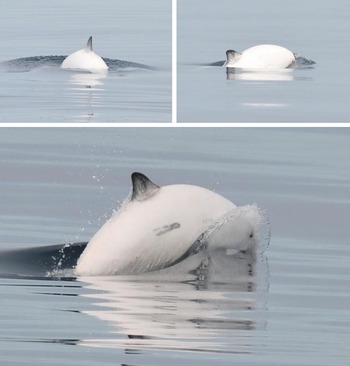
The Moray Firth individual was sighted along with seven, normally-pigmented adults on 24 August 2012, approximately 12 miles from the southern shore of the firth (57°55′N 02°38′W) at a water depth of 61 m. Digital photographs of the right and left hand sides of the animal were taken over the course of 3 to 4 minutes (Figure 1), during which more than a dozen surfaces were observed. With the exception of a contrastingly darker grey and black dorsal fin and a couple of linear grey marks on the animal's right flank (presumed scarring), the head, back, sides and pectoral fins of this individual were uniformly white with a slightly pinkish hue. In contrast to other white individuals described by Keener et al. (Reference Keener, Szczepaniak, Adam, Webber and Stern2011), no dark patches or smudges were observed around the eyes, blowhole or melon, although we were unable to confirm the eye colour in this individual to establish whether or not it had the red eyes characteristic of a true albino. Nonetheless, since albino cetaceans completely lack melanin, they have totally white skin, including the dorsal fin and tail flukes (Fertl & Rosel, Reference Fertl, Rosel, Perrin, Würsig and Thewissen2002). In view of its darker dorsal fin (and possibly the tail fluke margins too), this Moray Firth animal could therefore best be described as leucistic or hypo-pigmented.
Anomalously white harbour porpoise (Phocoena phocoena) photographed in the Moray Firth on 24 August 2012. The head, back, sides and pectoral fins appear uniformly pinkish white against a contrastingly darker grey/black dorsal fin (photographs: Kevin Robinson).

In spite of the rareness of this condition, anomalously pigmented cetaceans have been recorded in at least 22 different species to date (Hain & Leatherwood, Reference Hain and Leatherwood1982; Fertl et al., Reference Fertl, Pusser and Long1999, Reference Fertl, Barros, Rowlet, Estes and Richlen2004; Visser et al., Reference Visser, Fertl and Todd Pusser2004; Stockin & Visser, Reference Stockin and Visser2005; Nascimento et al., Reference Nascimento, Spinelli, Santos, Queiroz, Pansard, Medeiros, Gondim, Jesus, Silva and Yamamoto2008; De Boer, Reference De Boer2010), with variations ranging from albinism, to piebaldism, to fully melanistic or all-black individuals (e.g. Visser et al., Reference Visser, Fertl and Todd Pusser2004). Little is currently known about the costs associated with such conditions, but leucistic animals are evidently more conspicuous to predators (lacking the counter-shading of their counterparts), more prone to sunburn or skin cancer (due to the lack of melanin in the skin), and may have thermoregulatory limitations (through reduced heat absorption) in colder waters as a result (e.g. Hain & Leatherwood, Reference Hain and Leatherwood1982; Forestell et al., Reference Forestell, Paton, Hodda and Kaufman2001; Fertl & Rosel, Reference Fertl, Rosel, Perrin, Würsig and Thewissen2002). Added to this, hypo-pigmented individuals may have greater difficulty in finding a mate—their abnormal coloration resulting in reduced attractiveness (Caro, Reference Caro, Stevens and Merilaita2011). Indeed, the melanocortin system in vertebrates has been strongly linked to testosterone production (e.g. Ducrest et al., Reference Ducrest, Keller and Roulin2008), with the major evidence implying that darker, eumelanic males are demonstrably more dominant and/or sexually aggressive than their lighter coloured conspecifics. All the same, no unusual or agonistic intra-specific behaviour was observed during the present sighting or in any other published reports of anomalously pigmented harbour porpoises to date (Peters, Reference Peters1929; Quigley & Flannery, Reference Quigley and Flannery2002; Keener et al., Reference Keener, Szczepaniak, Adam, Webber and Stern2011).
Whilst each of the above considerations might be significant for the ontogenetic survival of hypo-pigmented individuals, it is interesting to note that (with an estimated body length of 1.5 m) the present animal had clearly survived to adulthood, regardless of its condition. Of the seven white harbour porpoises also listed by Keener et al. (Reference Keener, Szczepaniak, Adam, Webber and Stern2011), remarkably six of these were also adults, confirming the longevity of these animals in the wild. Since harbour porpoise are notoriously difficult to track using conventional mark capture–recapture techniques (due to their general lack of natural markings), it is presently unclear whether or not they show site fidelity for particular areas, undertake wide-ranging movements from one area to another, or exhibit a combination of the two. Thus, the prospective recapture of rare, anomalously pigmented individuals, such as the animal described herein, could potentially augment our current understanding of the movements of this species in the northern North Sea and beyond. A greater understanding of the range, as well as the fine-scale spatial and temporal movements, of these coastal cetaceans is necessary for the adequate assessment and management of detrimental human impacts upon the species, as strictly required under the European Habitats and Species Directive (92/43/EEC).
ACKNOWLEDGEMENTS
Many thanks to the CRRU research team (Becca, Carl, Emma, Jago and Anna) who assisted on this survey. Sarah Dolman and Colin MacLeod provided helpful comments which greatly improved this manuscript. We further thank Care for the Wild International for ongoing support with the CRRU's long-term research and conservation programme. All survey work was carried-out under licence from Scottish Natural Heritage (License No. 12999).