Significant outcomes
• Patients with acute schizophrenia consistently exhibited reduced mean RR interval and heart rate variability (HRV) levels in a supine rest and standing position compared with healthy volunteers.
• We found a negative correlation between cardiac vagal control and the severity of psychotic symptoms, especially positive symptoms.
Limitations
• We did not use non-linear techniques to measure HRV, which may provide important information about alterations in the heart rate (HR) dynamics not detected by conventional spectral techniques in patients with schizophrenia.
• We did not have the information concerning the menstrual cycle of our female participants; however, HRV was shown to fluctuate during different phases of female menstrual cycle.
Introduction
Patients with schizophrenia have reduced life span and increased mortality (Reference Brown, Inskip and Barraclough1). Aside from suicide, increased cardiovascular morbidity and mortality seem to play an important role (Reference Hennekens, Hennekens, Hollar and Casey2,Reference Curkendall, Mo, Glasser, Rose Stang and Jones3). Although definite mechanisms for increased cardiac vulnerability in schizophrenia are unknown, it is assumed that an altered cardiac autonomic regulation is at least one important pathophysiological factor. For example, cardiac autonomic alterations have been implicated in the increased cardiovascular mortality (Reference Hennekens, Hennekens, Hollar and Casey2). Moreover, decreased vagal modulation is associated with increased cardiac mortality after myocardial infarction (Reference Carpeggiani, Emdin and Bonaguidi4) and the development of serious ventricular arrhythmias (Reference Smith, Kukielka and Billman5). Hence, it is necessary to determine whether there is cardiac autonomic dysregulation in schizophrenia.
Frequency-domain analysis of HRV, with its standard procedure and interpretation first reported in 1996, is a sophisticated and non-invasive tool for detection of the autonomic nervous system (ANS) regulation of the heart (6). Besides being a non-invasive study procedure, an important advantage of frequency-domain analysis of HRV is that it utilises spontaneous fluctuations in the HR to estimate tonic ANS functions. In the last two decades, short-term frequency-domain analysis of HRV has been developed as a useful tool to probe the peripheral autonomic output in the cardiovascular territory (Reference Boettger, Hoyer, Falkenhahn, Kaatz, Yeragani and Bar7). More recent studies suggested the use of short-term frequency-domain analysis of HRV during the supine–standing–supine test as evidence of cardiovascular autonomic neuropathy (Reference Galuszka, Opavsky, Lukl, Stejskal, Zapletalova and Salinger8,Reference Kojecky, Bernatek, Horowitz, Zemek, Bakala and Hep9). During the test, the electrocardiogram (ECG) was recorded under standardised conditions for 5 min in supine, standing and repeated supine positions (Reference Boulton, Vinik and Arezzo10). This test measures the dynamic loading of the ANS in the form of a sequential increase in the sympathetic activity and concomitant decrease in the vagal activity in the standing position, and also decrease in the sympathetic and increase in the vagal activity in the second supine position after lying back. The short-term HRV analysis allows to predominantly evaluate ANS activity and the baroreflex-mediated changes in the ANS developing immediately after the onset of physiological stress, for example, in response to orthostasis (Reference Galuszka, Opavsky, Lukl, Stejskal, Zapletalova and Salinger8).
Previous investigations concerning HRV in schizophrenia revealed inconsistent results. For example, cardiac autonomic dysregulation as reflected by increased HR and reduced vagal modulation was detected in schizophrenia using short-term analysis of HRV (Reference Okada, Toichi and Sakihama11,Reference Toichi, Kubota and Murai12). On the contrary, Rechlin et al. (Reference Rechlin, Claus and Weis13) reported no significant differences in HRV between schizophrenic patients and controls. In any case, the aforementioned studies were conducted in chronic schizophrenic patients receiving neuroleptic treatment. Thus, it is difficult to discern the extent to which the effect is inherent to schizophrenia versus a consequence of either lifestyle factors associated with chronic disorder or treatment effects. Indeed, there are many potentially confounding variables affecting autonomic tone in studies on schizophrenia patients including medication, physical health, habitual physical activity, smoking and psychiatric comorbidities (Reference Cohen, Matar, Kaplan and Kotler14). Failure to avoid confounding effects may contribute to mixed results. Among these variables, the influence of antipsychotic treatment on cardiac autonomic function is under particular debate (Reference Hennessy, Bilker and Knauss15). For instance, antipsychotic treatment was associated with increased HR (Reference Birkhofer, Geissendoerfer and Alger16) or corrected QT time interval prolongation (Reference Su, Shen, Chuang, Chen and Chen17) in schizophrenia patients. Therefore, antipsychotics must be taken into account in any study on the effect of schizophrenia on HRV. Several studies published so far have demonstrated reduced resting parasympathetic tone in unmedicated schizophrenic patients (Reference Boettger, Hoyer, Falkenhahn, Kaatz, Yeragani and Bar7,Reference Valkonen-Korhonen, Tarvainen and Ranta-Aho18,Reference Bär, Letzsch, Jochum, Wagner, Greiner and Sauer19). In individual studies, however, either sample size was insufficient or patient populations were heterogeneous in clinical symptoms or genetic background. In addition, no study has probed the autonomic reaction to physiological stress in acute schizophrenic patients, necessitating prompt investigation. To address these concerns as mentioned above, we analysed with larger sample sizes and better methodology. Taken together, the following hypotheses were tested:
1. Unmedicated patients with acute schizophrenia will have decreased HRV levels during the supine–standing–supine test as compared with healthy controls.
2. The severity of psychopathology will be negatively correlated with HRV levels.
Aims of study
The aim of this study was to compare frequency-domain indices of HRV during the supine–standing–supine test in unmedicated schizophrenia patients with that of age- and sex-matched controls. The obtained results were evaluated in association with psychopathological symptoms.
Methods
Participants recruitment and study population
This study was approved by the Institutional Review Board for the Protection of Human Subjects at the Tri-Service General Hospital, a medical teaching hospital of the National Defense Medical Center in Taipei, Taiwan. We obtained written informed consent from all participants and fully explained the procedures of the study. Initial study entry criteria: age 18–65. After detailed questionnaire screening, clinical examination and chart review, we excluded subjects with pregnancy, smoking, diabetes, cancer, neuropathy, hypertension, cardiac arrhythmia or other cardiovascular diseases that affect HRV or engaging in regular physical training exceeding 10 h a week. Subjects who used psychotropic medication or any medication that have been reported to affect the ANS functioning for at least 2 weeks before the beginning of the study evaluation were also excluded.
In total, we recruited 723 subjects. The patient group comprised 314 patients with acute schizophrenia, who were recruited from clinical settings. On the basis of the same methodology in our previous study (Reference Chang, Lu and Lin20–Reference Chang, Chang and Chen23), each patient was initially evaluated by an attending psychiatrist (H.A.C.) and then interviewed by a well-trained psychologist, using the Chinese version of the modified Schedule of Affective Disorder and Schizophrenia-Lifetime (SADSL) (Reference Endicott and Spitzer24) to reach DSM-IV criteria for a primary diagnosis of schizophrenia. The inter-rater reliability κ values of the Chinese version of the modified SADSL were as follows: major depression, 0.79; bipolar disorder, 0.71; anxiety disorder, 0.86; schizophrenia, 0.95; and substance abuse and dependence, 0.82 (Reference Chang, Lu and Lin20,Reference Chang, Lu, Shy, Chang, Lee and Huang21). The severity of schizophrenia symptoms was assessed with the Positive and Negative Syndrome Scale (PANSS) (Reference Kay, Fiszbein and Opler25). Only patients having a minimum baseline PANSS score of 70 and being drug-naive or drug-free for at least 1 month entered the study.
The normal control group included 409 healthy volunteers, recruited from the community. They were selected to match patient's gender and age. We used the modified Chinese version of SADSL (Reference Endicott and Spitzer24) to exclude individuals with psychiatric conditions. Control subjects were considered free of past or present major or minor mental illnesses (affective disorder, schizophrenia, anxiety disorder, personality disorder, substance use disorders, etc.).
Experimental set-up and measurements of HRV
The standard procedure has previously been described elsewhere (Reference Galuszka, Opavsky, Lukl, Stejskal, Zapletalova and Salinger8,Reference Kojecky, Bernatek, Horowitz, Zemek, Bakala and Hep9). In short, all participants were examined in the daytime in a silent room maintained at a temperature of 22–26°C. They were asked to empty bowel and bladder before the tests. After 10 min of rest and stabilisation of the HR, the subjects remained in a supine position for the recording of RR intervals in three intervals: the first supine position; orthostasis (after changing of the position from lying to standing during 5 s); and the second supine position (after changing of posture from standing to lying during 5 s). The participants remained in each position for 5 min during supine–standing–supine test to record at least 300 RR intervals recommended by Task Force standards for short-term HRV analysis (6). Detailed procedures for the analysis of HRV have been reported previously (Reference Kuo, Lin, Yang, Li, Chen and Chou26,Reference Liu, Kuo and Yang27). An HRV analyser (SSIC, Enjoy Research Inc., Taipei, Taiwan) acquired, stored and processed ECG signals. Under a sampling rate of 512 Hz, signals were recorded using an 8-bit analogue-to-digital converter. Stationary RR interval values were resampled and interpolated at a rate of 7.11 Hz to produce the continuity in a time domain.
Power spectral analysis of HRV
Power spectral analysis was performed using a non-parametric method of fast Fourier transformation. The direct current component was deleted and a Hamming window was used to attenuate the leakage effect (Reference Kuo, Lin, Yang, Li, Chen and Chou26). The power spectrum was then quantified into standard frequency-domain measurements defined previously (6,Reference Kuo, Lin, Yang, Li, Chen and Chou26,Reference Liu, Kuo and Yang27), which consisted of variance (variance of RR-interval values), low frequency (LF: 0.04–0.15 Hz), high frequency (HF: 0.15–0.40 Hz) and the ratio of LF to HF (LF/HF). All of the measurements were logarithmically transformed to correct skewed distribution (Reference Kuo, Lin, Yang, Li, Chen and Chou26,Reference Liu, Kuo and Yang27). Vagal control of HRV is represented by HF, whereas both vagal and sympathetic control of HRV is jointly represented by LF. The LF/HF ratio is considered by some investigators to mirror sympathovagal balance or sympathetic modulations, with a larger LF/HF ratio indicating a greater predominance of sympathetic activity over cardiac vagal control (6).
Statistical analyses
SPSS (version 13.0, SPSS, Taipei, Taiwan) statistical software was used for all analyses. Discrete variables in patients and controls were compared using χ2-test, and continuous variables were compared with an independent sample t-test. Two-way analysis of variance with one repeated measures factor was used for data analysis with Gaussian distribution. Post hoc univariate F-test was used for between-group comparison. The Mann–Whitney test was used for between-group comparison of variables with non-Gaussian distribution. The associations between HRV measures and age, body mass index (BMI) and habitual physical activity were analysed with product–moment correlations, whereas point–biserial correlations were used to assess relationships with gender. Results of the point–biserial correlations were identical to those arising from comparisons using t-tests. To pick out the association of HRV parameters and ratings of psychopathological scales (PANSS), the Pearson's correlation analysis was established. Linear regression analyses were used to primarily assess associations of ratings of psychopathological scales (PANSS) with HRV indices. To control the effect of confounding, we used multiple regressions on the HRV indices, with gender, age, BMI and habitual physical activity as covariables. All results are two-tailed, and a probability value of p < 0.05 was considered statistically significant.
Results
Demographics and clinical characteristics
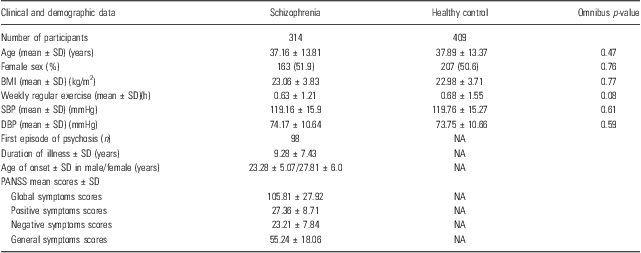
As can be seen in Table 1, schizophrenic patients and controls were similar with respect to demographic data, BMI, resting systolic/diastolic blood pressure and habitual physical activity.
Sample characteristics
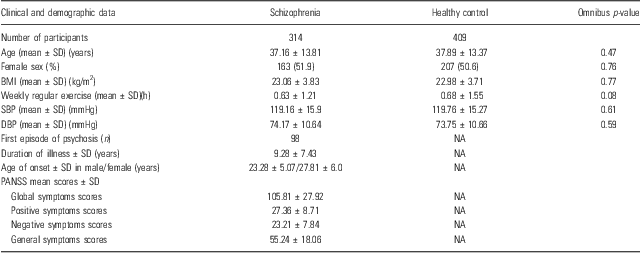
BMI, body mass index (calculated as weight in kilograms divided by height in metres squared); DBP, diastolic blood pressure; NA, not applicable; PANSS, Positive and Negative Syndrome Scale; SBP, systolic blood pressure; SD, standard deviation.
HRV parameters
The main effect of both positions changing (the response to orthostasis and clinostasis) on HRV parameters was significant for mean RR interval (F = 1959.6; p < 0.001), LF power (F = 2457.4; p < 0.001), HF power (F = 3282.9; p < 0.001), variance (F = 1348.7; p < 0.001) and LF/HF ratio (F = 49.29; p < 0.001). The effect of group (schizophrenia vs. control) was significant for mean RR interval (F = 4.68; p = 0.031), variance (F = 3.3; p = 0.047), LF power (F = 5.1; p = 0.025) and HF power (F = 6.9; p = 0.0009) and non-significant for LF/HF ratio (F = 1.0; p = 0.32). No significant interactions between main factors (body position vs. group) were found.
HRV parameters in the first supine rest (resting HRV)
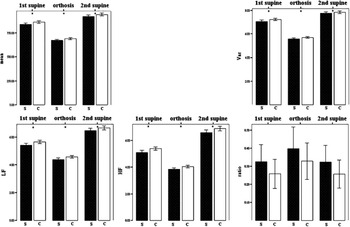
Schizophrenic patients had significantly faster HRs (shorter mean RR interval) than controls (841 ± 130 vs. 865 ± 143 ms, p = 0.019). The parameters of spectral HRV analysis (Fig. 1) showed a significant reduction of HRV magnitude (p = 0.036 for variance, p = 0.012 for LF power and p = 0.004 for HF power, respectively) in the schizophrenia group compared with controls. No significant difference was found in LF/HF ratio (p = 0.29) in the schizophrenia patients compared with controls.
Mean RR interval and spectral heart rate variability indices in patients with acute schizophrenia (S) compared with healthy age- and sex-matched controls (C). *Significant between-groups differences, p < 0.05. HF, high-frequency power; LF, low-frequency power.

HRV parameters in the standing period (orthostasis)
The mean RR interval was significantly shorter in the schizophrenia group compared with controls (673 ± 104 vs. 691 ± 113 ms, p = 0.022). The parameters quantifying HRV magnitude (variance, LF and HF powers; Fig. 1) were significantly lower in the schizophrenia patients (p = 0.029, 0.009 and 0.004, respectively). Again, there is no significant difference in LF/HF ratio (p = 0.38) between the schizophrenic patients and controls.
HRV parameters in the second supine position
The mean RR interval was significantly shorter in the schizophrenia group compared with controls (919 ± 142 vs. 943 ± 155 ms, p = 0.036). The spectral HRV analysis revealed a significant reduction of HRV magnitude (p = 0.026 for variance, p = 0.007 for LF power, and p = 0.002 for HF power, respectively) and no difference for LF/HF ratio (p = 0.28) in the schizophrenia patients compared with controls (Fig. 1).
Factors associated with resting HRV
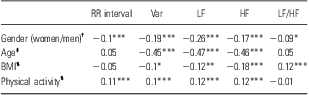
Associations between resting HRV measures and those potentially confounding variables are summarised in Table 2. Men had significantly faster HRs (shorter RR interval) and lower variance, LF, HF and LF/HF ratio than women. Older participants had reduced variance, LF and HF. Participants with higher BMI had lower variance, LF and HF and greater LF/HF ratio. Participants who were habitually more physically active had significantly slower HRs (longer RR interval) and greater variance, LF and HF.
Factors associated with resting HRV indices among all participants
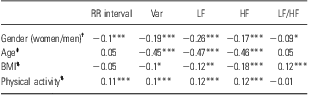
HF, high-frequency power [ln(ms2)]; HRV, heart rate variability; LF, low-frequency power [ln(ms2)]; LF/HF, ratio of LF to HF [ln(ratio)]; Var, total variance [ln(ms2)].
†Point-biserial correlations; first category in parenthesis is the reference group.
‡Product–moment correlations.
*p < 0.05; **p < 0.01; ***p < 0.001.
Association between the psychotic symptom severity and resting HRV
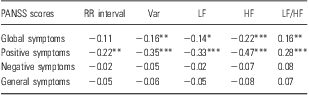
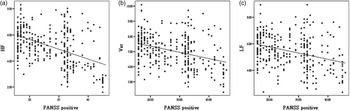
To avoid multiple testing of the same hypothesis, the analysis of the relationship between the psychotic symptom severity and HRV parameters was based on only resting HRV indices. As can be seen in Table 3, patients with more positive psychopathology of PANSS had significantly faster HRs (shorter RR interval). In addition, there was a significant correlation between all resting HRV indices and PANSS global or positive symptom scores. To analyse the specific influence of psychotic symptom severity, we performed a stepwise multiple regression with PANSS and its subscales as predictors of all resting HRV indices. Regressions of global and positive psychopathology of PANSS on HRV measures showed significant effects for all resting HRV indices. The overall model fit ranged from r 2 = 0.02 to 0.049 (global symptoms scores) and from r 2 = 0.079 to 0.221 (positive symptoms scores) for the different HRV measures, but in no case was the PANSS negative or general symptom scores a significant factor. The PANSS positive symptom scores accounted for 22.1%, 12%, 10.9% and 7.9% of the variation in HF, variance, LF and LF/HF ratio, respectively (top three magnitudes of the correlations are illustrated in Fig. 2). To a lesser extent, the PANSS global symptom scores accounted for 4.9%, 2.7%, 2.4% and 2% of the variation in HF, variance, LF/HF ratio and LF, respectively. Further adjustment for gender, age, BMI and physical activity did not alter the above-mentioned association in a meaningful way (data not shown).
The correlation between the ratings of PANSS and resting HRV indices among patients with acute schizophrenia
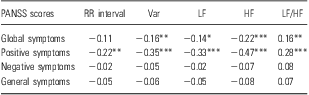
HF, high-frequency power [ln(ms2)]; HRV, heart rate variability; LF, low-frequency power [ln(ms2)]; LF/HF, ratio of LF to HF [ln(ratio)]; PANSS, Positive and Negative Syndrome Scale; Var, total variance [ln(ms2)].
*p < 0.05; **p < 0.01; ***p < 0.001.
Positive psychopathology of Positive and Negative Syndrome Scale (PANSS) explained significantly the variation of high-frequency (HF) power [(a) r 2 = 0.221, F(1, 312) = 88.74, p < 0.001, b = −0.471], variance [(b) r 2 = 0.12, F(1, 312) = 42.55, p < 0.001, b = −0.346] and low-frequency (LF) power [(c) r 2 = 0.109, F(1, 312) = 38.2, p < 0.001, b = −0.33] in patients with acute schizophrenia.

Discussion
As far as we know, this is the first adequately powered study that examines the relationship between cardiac autonomic regulation and acute schizophrenia in a large sample of unmedicated and physically healthy participants by using frequency–domain measurements of HRV during the supine–standing–supine test. The main results of our study may be summed as follows.
Patient group had significantly faster HRs and lower HRV levels in a supine rest and standing position compared with control group. We believe that this main result is reliable on the basis of the following strengths of the present study. We have excluded subjects with psychiatric and physical comorbidities that could potentially confound the association between schizophrenia and cardiac autonomic function. The participants with acute schizophrenia and controls were interviewed with the modified Chinese version of SADSL (Reference Endicott and Spitzer24) to rule out psychiatric comorbidity and psychiatric disorders, respectively. Thus, a false-positive result due to the inclusion of anxiety disorders or substance-use disorder in our case group is presently unlikely. We have also controlled other confounding factors that may suppress or magnify the true effects of schizophrenia on HRV, including medication, smoking, BMI and physical activity levels (Reference Rottenberg28). Moreover, as ethnic stratification among study samples may lead to resetting population HRV patterns (Reference Li, Snieder and Su29,Reference Martin, Doster and Critelli30), it might produce a false-positive or false-negative result by chance rather than reveal a direct relation. However, all our subjects were unrelated Han Chinese subjects, matched for age and sex and drawn from a population pool in Taiwan that is known to be genetically homogeneous (Reference Chang, Lu and Lin20,Reference Chang, Lu, Shy, Chang, Lee and Huang21). All of the biological grandparents of our recruited subjects were of Han Chinese ancestry. Therefore, it is less likely that ethnic stratification bias produced a false-positive result in our study. Taken as a whole, our finding indicates that the neurocardiac regulation is impaired in unmedicated patients with acute schizophrenia.
In the present study, participants underwent the supine–standing–supine test during which they were exposed to physiological stress, for example, in response to orthostasis that can evoke the change in sympathovagal balance. Our data showed no significant interaction between posture and group. That is, the change in cardiac control system balance induced by orthoclinostatic load was comparable for both groups. However, we found between-group differences in the mean RR intervals and spectral HRV indices (Fig. 1). This finding is reflective of a reduction in tonic ANS function and a potential abnormal dynamic activation of the ANS induced by posture change in patients with acute schizophrenia. It also corroborates previous reports of a significantly increased HR in unmedicated schizophrenic patients (Reference Rechlin, Claus and Weis13,Reference Agelink, Majewski and Wurthmann31,Reference Chang, Yoo and Yi32). We relate increased HR in the acute stage of schizophrenia to diminished cardio-vagal modulation as indexed by significantly reduced HF power (Fig. 1). Similarly, several prior reports observed diminished cardio-vagal modulation in schizophrenia (Reference Boettger, Hoyer, Falkenhahn, Kaatz, Yeragani and Bar7,Reference Valkonen-Korhonen, Tarvainen and Ranta-Aho18,Reference Bär, Letzsch, Jochum, Wagner, Greiner and Sauer19,Reference Bär, Wernich and Boettger33). Notably, recent studies reported that unmedicated schizophrenia patients exhibited decreased HF power compared with normal comparison subjects, but did not show differences in LF power (Reference Valkonen-Korhonen, Tarvainen and Ranta-Aho18,Reference Bär, Letzsch, Jochum, Wagner, Greiner and Sauer19,Reference Chang, Yoo and Yi32,Reference Malaspina, Bruder and Dalack34). However, our study showed that schizophrenic patients had decreased LF and HF power in a supine rest and standing position. This finding warrants comment. First, the traditional interpretations of the HRV measures used in our study are that HF power estimate vagal tone, whereas LF power reflects both vagal and sympathetic influences (6,Reference Kuo, Lin, Yang, Li, Chen and Chou26,Reference Liu, Kuo and Yang27). However, it has also been reported that when LF power is assessed in the supine position, administration of atropine, a potent inhibitor of parasympathetic muscarinic receptors, eliminates most of the LF region of the power spectrum (Reference Pomeranz, Macaulay and Caudill35). This does not occur when LF power is assessed in the sitting position, and suggests that resting supine LF power in our study may primarily reflect vagal influences (Reference Sloan, McCreath, Tracey, Sidney, Liu and Seeman36). Second, as the LF spectral activity is likely a poor marker of sympathetic outflow (Reference Moak, Goldstein and Eldadah37), conclusions regarding changes in sympathetic branch could not be drawn from the short-term spectral HRV analysis. Correlations with other clearly sympathetic measures, such as skin conductance, skin temperature or muscle sympathetic nerve activity, should be investigated in the future. Altogether, we assumed that the adverse effect of acute schizophrenia on HRV was mediated at least partly by suppression of parasympathetic input.
Previous studies have reported that cardiac autonomic dysregulation is often related to the severity of psychotic symptoms (Reference Bär, Wernich and Boettger33,Reference Bar, Koschke and Berger38,Reference Jindal, Mackenzie, Baker and Yeragani39). For example, Bär et al. (Reference Bär, Wernich and Boettger33) found that schizophrenic patients displaying stronger psychotic symptoms as assessed by the Brief Psychiatric Rating Scale exhibited more severe cardiac ANS disturbances compared with controls. Furthermore, Bär et al. (Reference Bär, Letzsch, Jochum, Wagner, Greiner and Sauer19) showed that very low-frequency (VLF) power of HRV correlated with positive symptoms of schizophrenia and specifically with the delusional subscale of the scale for the assessment of positive symptoms in unmedicated patients. As a 5-min short-term ECG may not be adequate in obtaining reliable values of VLF in our study and as the definite physiological meaning of VLF is under debate (Reference Lombardi40), further studies are needed to clarify the definite relationship between this frequency band and the psychopathological state. Here we showed that spectral HRV indices inversely correlated with psychotic symptom severity in unmedicated patients with acute schizophrenia. This finding further complements our first main result regarding lower HRV levels among the patient population. Statistically, the PANSS positive symptom scores accounted for >20% of the variation in HF power (Fig. 2a). In contrast, neither PANSS negative nor general symptom scores were related to any spectral HRV parameter. These findings implied a more robust association between the positive symptom severity and the parasympathetic activity in acute schizophrenia. Although definite mechanisms for this association are unknown, our findings have the support from the results of a recent study examining within-subject changes in HRV indices in acutely ill patients with schizophrenia treated with risperidone (Reference Chang, Yoo and Yi32). The authors found negative correlations between the changes in vagal activity and the changes in the PANSS total and the positive symptom scores and concluded that reduction of LF/HF ratio, an indicator of improved autonomic modulation, may be associated with the stabilisation of psychotic symptoms induced by risperidone treatment. The following explanation was proposed. As the antipsychotic effects of risperidone may be implicated in neuronal changes in prefrontal cortex (PFC) (Reference Mackowiak, Dudys, Chocyk and Wedzony41,Reference Mcnamara, Able, Jandacek, Rider and TSO42), and as it is assumed that an altered autonomic neurocardiac regulation in schizophrenia is driven by the failure of the PFC to inhibit the amygdala (Reference Jindal, Keshavan, Eklund, Stevens, Montrose and Yeragani43,Reference Williams, Das and Harris44), a region involved in modulating the vagal efferent outflow to the heart (Reference Wong, Masse, Kimmerly, Menon and Shoemaker45,Reference Ziegler, Dahnke, Yeragani and Bar46), changes in PFC induced by risperidone might modify the sympathovagal imbalance in schizophrenic patients. Consistent with this model is the evidence that the use of repetitive transcranial magnetic stimulation over PFC has been reported to reduce HR or sympathovagal balance (Reference Jenkins, Shajahan, Lappin and Ebmeier47) and cause vagal reaction (Reference Grossheinrich, Rau and Pogarell48) in healthy volunteers. Taken together, further research is needed to clarify neurological abnormalities that could mediate ANS dysregulation associated with schizophrenia.
Our data demonstrated low parasympathetic activity (thus an overall reduction in HRV) in unmedicated patients with acute schizophrenia, which might be a possible cardiac risk factor. The reduction of HRV is a strong predictor of death after myocardial infarction (Reference Carpeggiani, Emdin and Bonaguidi4), presumably because decreased parasympathetic innervation exposes the heart to unopposed stimulation by sympathetic nerves. Further investigation is therefore required to establish whether decreased cardiac vagal control might contribute to the reported increase of cardiac mortality in schizophrenia (Reference Appleby, Thomas, Ferrier, Lewis, Shaw and Amos49). In addition, we observed greater reductions in HRV levels in patients with more severe psychopathology. However, Bär et al. (Reference Bär, Letzsch, Jochum, Wagner, Greiner and Sauer19) reported that most antipsychotics failed to resolve reductions in HRV, despite reduction in psychopathological symptoms. Although the effects of antipsychotic treatment on cardiac autonomic regulation are still elusive, there are much data indicating that some antipsychotics cause reduction in HRV among schizophrenic patients (Reference Rechlin, Claus and Weis13,Reference Birkhofer, Geissendoerfer and Alger16,Reference Agelink, Majewski and Wurthmann31). In addition, the usage of antipsychotics is associated with an increased risk of sudden cardiac death for indications other than schizophrenia (Reference Ray, Chung, Murray, Hall and Stein50). Thus, for clinicians, paying attention to cardiac autonomic dysregulation when treating patients with acute schizophrenia is a worthwhile effort. For instance, an autonomic function examination such as HRV analysis can be conducted to provide a rapid screening of systemic autonomic disturbance. Our findings also reinforce prior reports urging caution in the prescription of clozapine in schizophrenic patients with cardiovascular dysfunction because its potent anticholinergic properties can lead to reduced vagal tone and HRV (Reference Rechlin, Claus and Weis13,Reference Agelink, Majewski and Wurthmann31,Reference Cohen, Loewenthal, Matar and Kotler51). In contrast, antipsychotic treatment that increases cardiac vagal activity appears to be beneficial in terms of cardiovascular safety and autonomic flexibility. For example, antipsychotics with minimal anticholinergic effects and intrinsic serotonergic activity may result in a reduction of cardiac risk (Reference Silke, Campbell and King52). Indeed, Chang et al. (Reference Chang, Yoo and Yi32) found that, in acutely ill patients with schizophrenia, the mean RR interval was prolonged and cardiac sympathovagal balance was shifted towards parasympathetic predominance after 6 weeks of treatment with risperidone. Moreover, Wang et al. (Reference Wang, Yang, Bai and Kuo53) showed significant increases in the mean of RR intervals, variance and HF in schizophrenia patients who were switched from typical antipsychotics to amisulpride for 3 months, suggesting that amisulpride has a vagotonic effect when subjects are switched from typical antipsychotic agents. Further studies using larger patient groups and controlled therapeutics may better understand the influence of antipsychotic treatment on cardiac autonomic regulation in schizophrenia.
In the present study, we did not use non-linear techniques to measure HRV. However, non-linear techniques may provide important information about alterations in the HR dynamics not detected by conventional spectral techniques in patients with schizophrenia (Reference Bar, Boettger and Koschke54,Reference Bar, Boettger and Schulz55). Another limitation of our study might be the lack of information concerning the menstrual cycle of our female participants because HRV was shown to fluctuate during different phases of female menstrual cycle (Reference Sato, Miyake, Akatsu and Kumashiro56).
Acknowledgements
This study was supported by Tri-Service General Hospital Grant TSGH-C98-91 (H.A.C.) and TSGH-C102-123 (H.A.C.).