Implications
Hop cones (Humulus lupulus L.) contain several antimicrobial substances that can modify rumen fermentation. Our results show that increasing quantities of hop cones from two hop varieties, differing in α- and β-acid contents, affected the in vitro activity of rumen microorganisms by decreasing the extent and rate of gas production. However, only the highest quantities of hop cones affected total and individual short-chain fatty acid production (SCFA), especially acetic acid and butyric acid production, decreasing the proportion of acetic acid to propionic acid, suggesting that the hop cones affected predominantly rumen fibre-degrading bacteria. There are indications that the effect of hop cones on acetic acid production depends on the diet composition; however, this assumption needs to be further confirmed by other in vitro and in vivo trials.
Introduction
The ban on the use of antibiotic additives such as ionophores, lasalocid and monensin from 2006 onwards stimulated research on alternative chemical substances that could modulate or improve rumen fermentation. Commercial interest in alternatives to antibiotics is increasing and research has demonstrated the effectiveness of secondary plant metabolites. Among them, attention has been devoted to plant essential oils (Benchaar et al., Reference Benchaar, Petit, Berthiaume, Whyte and Chouinard2006; Calsamiglia et al., Reference Calsamiglia, Busquet, Cardozo, Castillejos and Ferret2007), flavonoids (Serra et al., Reference Serra, Macia, Romero, Reguant, Ortega and Motilva2012) and tannins (Mueller-Harvey, Reference Mueller-Harvey2006).
Large surpluses of hop cones (Humulus lupulus L.) in the world market and the reduction in their prices (Pavlovič, Reference Pavlovič2012) have increased interest in using hop cones in animal nutrition in addition to the brewing industry. Hop cones are mainly used in beer production, where they are used add bitterness to the beer and to increase its resistance to microbial spoilage (Sakamoto and Konings, Reference Sakamoto and Konings2003). The principal antimicrobial substances of hop cones are heat-labile α-acids and more stable β-acids (Van Cleemput et al., Reference Van Cleemput, Cattor, De Bosscher, Haegeman, De Keukeleire and Heyerick2009), acting mainly against Gram-positive bacteria, while Gram-negative bacteria, yeasts and fungi are not inhibited (Srinivasan et al., Reference Srivasan, Goldberg and Haas2004). Larson et al. (Reference Larson, Yu, Lee, Price, Haas and Johnson1996), Sağdiç et al. (Reference Sağdiç, Karahan, Özcan and Özkan2003), Jirovetz et al. (Reference Jirovetz, Bail, Buchbauer, Denkova, Slavchev, Stoyanova, Schmidt and Geisser2006) and Van Cleemput et al. (Reference Van Cleemput, Cattor, De Bosscher, Haegeman, De Keukeleire and Heyerick2009) found that hop acids inhibited Gram-positive species such as Lactobaccilus spp., Streptococcus spp., Micrococcus spp., Bacillus spp., Listeria monocytogenes and Staphylococcus aureus. Srinivasan et al. (Reference Srivasan, Goldberg and Haas2004) found remarkable activity of hop cone acids also against protozoa, especially against ciliates and flagellates, while amoebae were more resistant. Flythe (2009) and Narvaez et al. (Reference Narvaez, Wang, Zhonjou, Alexander, Garden and McAllister2013) demonstrated that hop cones and their secondary compounds also inhibited rumen bacteria, and thus rumen fermentation. The effects of hop cones on cumulative gas production and SCFA synthesis have often been studied, and Narvaez et al. (Reference Narvaez, Wang, Zhonjou, Alexander, Garden and McAllister2013) compared the effects of three hop varieties with contrasting α- and β-acids on rumen fermentation. The aim of this study was to assess the effect of two Slovenian hop varieties, Aurora and Dana, differing in their proportions of α- and β-acid contents, on the kinetics of in vitro rumen fermentation with regard to their increasing concentration in the rumen fluid. Because of inconsistent effects of hop cones on the amounts and/or concentrations of total and individual SCFA reported in the literature, we also wanted to ascertain the effect of the hop variety and its concentration in rumen fluid on SCFA production.
Material and methods
Diet and hop varieties
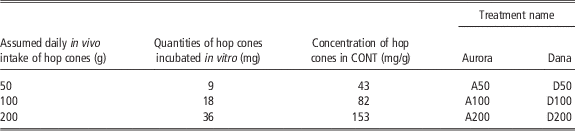
The total mixed ration composition for cows producing 30 kg of milk was used as substrate (CONT) for in vitro gas production and SCFA determination. CONT was prepared (on a dry matter (DM) basis) with 495 g maize silage, 123 g grass silage, 63 g wheat straw, 19 g grass hay, 83 g wheat grain, 83 g maize grain, 87 g sunflower meal, 34 g soya bean and 13 g mineral and vitamin mix (limestone, salt, vitamins and micro minerals) and contained (g/kg DM) 158 g CP, 40 g ether extract, 385 g NDF and 52 g crude ash. CONT was dried at 60°C for 48 h and ground to pass a 1-mm screen. It is supposed that active components of hops act on rumen microorganisms and not on the feed substrate. Therefore, the amounts of hop cones were related to rumen fluid volume. Assuming a rumen fluid volume of 180 l for a 650 kg cow (Van Soest, Reference Van Soest1994; Kirchgessner, Reference Kirchgessner1997) and a daily intake of 50, 100 and 200 g of hop cones, 9, 18 and 36 mg hop cones were used for in vitro incubation with 30 ml buffered rumen liquor. Dry hop cones of varieties Aurora (A; 115.0 g α-acids and 48.5 g β-acids/kg DM) and Dana (D; 147.6 g α-acids and 43.8 g β-acids/kg DM; Slovenian Institute of Hop Research and Brewing, Žalec, Slovenia) were milled just before their supplementation to CONT and the respective quantities were added to 200 mg of CONT (Table 1). The prepared substrates were kept in a freezer at −20°C until the start of in vitro studies.
Treatment names in in vitro gas and SCFA production trial

SCFA=short-chain fatty acids.
In vitro gas production
The animals used and their diets were as described by Lavrenčič et al. (2014). Two mature castrated rams weighing on average 70 kg and fitted with permanent rumen cannula were used as rumen fluid donors. They received a daily ration containing approximately 1.0 kg average quality hay ad libitum and 0.5 kg of commercial compound feed daily (180 g/kg CP), supplemented with mineral and vitamin mix (25 g) once a day. The diet was calculated according to the German metabolizable energy and utilizable protein requirements (nXP; DLG Futterwerttabellen, 1997) to cover the energy and protein requirements for maintenance and to balance the energy-to-protein ratio in the rumen.
In vitro gas production was determined according to the procedure described by Menke and Steingass (Reference Menke and Steingass1988). Each substrate was anaerobically incubated in four 100-ml glass syringes containing 30 ml mixture (2 : 1) of phosphate-bicarbonate buffer and rumen fluid. The production of gas resulting from microbial fermentation was measured manually after 0, 2, 4, 6, 8, 10, 12, 24, 36, 48, 72 and 96 h. The syringes were emptied only if the volume of gas produced in the first 36 h exceeded 80 ml of the total syringe volume. After 24 h, two of the four syringes of each substrate were withdrawn, their contents were poured into 50-ml plastic tubes and kept in a freezer at −20°C until short-chain fatty acids (SCFA) analysis. The in vitro incubation was repeated once more in the following week. Altogether, in two runs, we incubated eight syringes with each substrate (four for gas production and four for SCFA determination). In each run, two syringes with blank samples and two syringes with standard hay were also incubated. At the end of the trial, the mean and standard deviation of standard hay gas yields between runs were calculated. The coefficient of variation between runs was always lower than 4%; therefore, no corrections of gas production of feed samples were made.
The extracts for the SCFA were prepared according to the modified method of Holdeman et al. (Reference Holdeman, Cato and Moore1977). SCFA were analysed using a gas chromatograph (Hewlett Packard 5890 A; Hewlett Packard, Bellefonte, Pennsylvania, USA) equipped with split/splitless injector and FID detector. For the SCFA separation, a 30-m NUKOL TM, FUSED SILICA capillary column (SUPELCO, Bellefonte, Pennsylvania, USA) was used.
Calculations and statistical analysis
The calculation of gas production kinetic parameters was performed according to Lavrenčič et al. (Reference Lavrenčič, Stefanon and Susmel1997). In brief, the net volume of gas produced at each incubation time was calculated as the difference between total volume of gas produced and volume of gas produced from the blank sample at each time of incubation. Net volumes at each time of incubation were adjusted afterwards to 1 g of substrate DM. The obtained in vitro gas production data were then fitted with the Gompertz model (Lavrenčič et al., Reference Lavrenčič, Stefanon and Susmel1997):
 $$Y_{t} {\rm \, =} \, B{\times}e^{{{\minus}c{\times}e^{{{\minus}D{\times}t}} }} ,$$
where Y t is the gas produced (ml/g DM) at time ‘t’, ‘B’ the asymptotic amount of produced gas (total potential gas production (ml/g DM)); ‘C’ the specific gas production rate as affected by ‘t’, governed by a constant ‘D’, describing the decay in specific gas production rate (caused by the diminishing growth rate of microorganisms and increasing substrate limitation as reflected in gas production); and ‘t’ the time in hours. Parameter values and curve fitting were estimated by the Marquardt compromise for a non-linear regression method (PROC NLIN; Statistical Analysis System Institute (SAS), 1994).
Amounts of gas produced in 24 h were calculated by inserting this fixed time (24h) in the Gompertz model. The variation of gas production rates was obtained from the first derivative of the Gompertz model with respect to the time of incubation. Times of maximum fermentation rates (TMFR) were calculated by setting the second derivative of the Gompertz model to zero (0) and solving for ‘t’ (estimated with equation
 $${\rm TMFR}=\left( {{1 \over D}} \right){\times}{\rm log}_{e} (C)$$
). Maximum fermentation rates (MFR) were then calculated using the appropriate value of TMFR in the first derivative equation (
 $${\rm MFR}=B{\times}C{\times}D{\times}e^{{{\minus}D{\times}{\rm TMFR}}} {\times}e^{{{\minus}C{\times}e^{{{\minus}D{\times}{\rm TMFR}}} }} $$
).
The net amount of total and individual SCFA produced after 24 h of incubation was calculated by subtraction of the average amount of total and individual SCFA produced from blank samples at a corresponding incubation time and by adjusting the total and individual SCFA production to 1 g of substrate DM. Data concerning fermentation kinetic parameters (parameters ‘B’, ‘C’, ‘D’, MFR, TMFR and Gas24) and SCFA concentrations were tested for significance using the Scheffe test: Y ijk =μ+V i +C j +VC ij +e ijk , where Y ijk is the value, µ the mean, V i the effect of hop cone variety, C j the effect of hop cone concentration, VC ij the interaction between hop cone variety and concentration and e ijk the residual error. All statistical analyses were performed using the GLM procedure of the SAS (1994).
Results
In vitro gas production kinetics
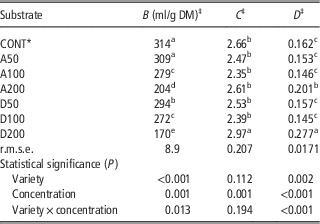
The total potential gas production (parameter ‘B’) decreased with increasing concentration of hop cones (P<0.001). It was the highest (314 ml/g DM) when CONT was incubated and the lowest when substrate D200 was incubated (170 ml/g DM; Table 2 and Supplementary Figure S1). Increasing the concentration of hop cones increased the parameter ‘D’ (P<0.001). The differences in CONT were the greatest when the highest concentration of hop cones was used. Parameter ‘C’ was also affected by the hop cone concentration (P=0.001), being the highest when substrate D200 was incubated. At all concentrations, substrates supplemented with hop cones of the variety Aurora had lower total potential gas production compared with substrates supplemented with hop cones of the variety Dana (245 and 264 ml/g DM for the hop cone varieties Aurora and Dana, respectively). The hop cone variety also had an effect on the parameter ‘D’, differing only in D200 and A200 (0.277 and 0.201, respectively).
In vitro gas production parameters of CONT and CONT supplemented with hop cones, estimated with the Gompertz model

r.m.s.e.=root mean square error.
a,b,c,d,e,f,gMeans in columns with different superscripts are significantly different at the level P=0.05.
‡ B=total potential gas production; C=specific gas production rate as affected by t, governed by a constant D (decay in specific gas production rate); gas production kinetic parameters were estimated with the equation Y t =B×exp(−C×exp(−D t )).
* CONT, A50, A100, A200, D50, D100 and D200 denote substrate (CONT) prepared for in vitro studies as a total mixed ration, incubated in the presence of hop varieties Aurora (A) and Dana (D), whose concentrations in the buffered rumen fluid represented a cow’s daily intake of 0, 50, 100 and 200 g of hop cones, respectively.
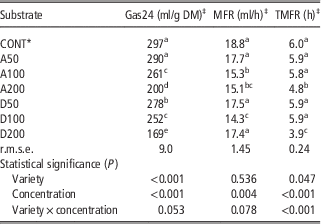
Increasing hop cone concentration decreased Gas24 (P<0.001) from 297 ml/g DM (CONT) to 200 ml/g DM (A200) and 169 ml/g DM (D200; Table 3). Hop cone concentration also decreased MFR (P=0.004; y-axis in Supplementary Figure S2) and shortened TMFR (P<0.001; x-axis in Supplementary Figure S2). Only the highest concentration of hop cones shortened TMFR, from about 6.0 (CONT, A50 and D50, A100 and D100) to 4.8 and 3.9 h (A200 and D200, respectively).
Amounts of gas produced after 24 h of incubation (Gas24), MFR and TMFR of CONT and CONT supplemented with hop cones

MFR=maximum fermentation rates; TMFR=times of maximum fermentation rate; DM=dry matter; r.m.s.e.=root mean square error.
a,b,c,dMeans in columns with different superscripts are significantly different at the level P=0.05.
‡ Gas24=amount of gas produced after 24 h of in vitro incubation; Gas24, MFR and TMFR were calculated with gas production kinetic parameters using the equations Gas24=B×exp(−C×exp(−D×24)), TMFR=(1/D)×log e (C) and MFR=B×C×D×exp(−D×TMFR)×exp(−C×exp(−D×TMFR)), respectively.
* CONT, A50, A100, A200, D50, D100 and D200 denote substrate (CONT) prepared for in vitro studies as a total mixed ration, incubated in the presence of hop varieties Aurora (A) and Dana (D), whose concentrations in the buffered rumen fluid represented a cow’s daily intake of 0, 50, 100 and 200 g of hop cones, respectively.
Both hop cone varieties decreased Gas24 (P<0.001) and shortened TMFR (P=0.047). Supplementing the CONT with hop cones of the variety Dana decreased Gas24 to a mean volume of 233 ml/g DM, whereas hop cones of the variety Aurora decreased Gas24 to a mean volume of 250 ml/g DM.
In vitro SCFA production
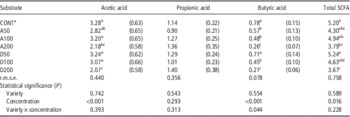
The SCFAs produced in 24 h of in vitro incubation are presented in Table 4. Increasing the hop cone concentration decreased the production of acetic (P<0.001) and butyric acid (P<0.001) and also total SCFA (P=0.016). Acetic acid production decreased only when the highest concentration of hop cones was used. In contrast, butyric acid production already decreased with the lowest concentrations of hop cones of the variety Aurora (P<0.05). The decrease in acetic acid and butyric acid production was reflected in the decrease of total SCFA.
SCFA concentrations (mmol/g DM) and their proportions (in parenthesis) in the buffered rumen fluid after 24 h of in vitro incubation of CONT and CONT supplemented with hop cones

DM=dry matter; SCFA=short-chain fatty acid; r.m.s.e.=root mean square error.
a,b,cMeans in columns with different superscripts are significantly different at the level P=0.05.
* CONT, A50, A100, A200, D50, D100 and D200 denote substrate (CONT) prepared for in vitro studies as a total mixed ration, incubated in the presence of hop varieties Aurora (A) and Dana (D), whose concentrations in the buffered rumen fluid represented a cow’s daily intake of 0, 50, 100 and 200 g of hop cones, respectively.
Molar proportions of individual SCFA did not differ between hop cone varieties within each concentration. Only the highest concentrations of both hop cone varieties lowered the proportions of acetic and butyric acids. Decreased proportions of acetic and butyric acids were reflected in an increased proportion of propionic acid.
Discussion
The decreased 24-h gas production concurs with the results of Narvaez et al. (Reference Narvaez, Wang, Zhonjou, Alexander, Garden and McAllister2013) who added 72 g of hop cones of different varieties/kg of substrates consisting of barley silage, barley grain and mineral-vitamin mix, and found that the addition of hop cones decreased daily production of gas. However, Staerfl et al. (Reference Staerfl, Kreuzer and Soliva2010) found only a slight decrease in 24-h gas production when hop cones were added in concentrations of 75 and 150 g/kg substrate DM to a diet consisting of maize silage, soya bean meal and wheat grain, whereas Garcia-Gonzales et al. (Reference Garcia-Gonzalez, Lopez, Fernandez, Bodas and Gonzalez2008) did not record any changes in the 24-h gas production when 450 mg of a diet consisting of lucerne hay, grass hay and barley grain was supplemented with 70 mg of hop cones (concentration 135 g hop cones/kg substrate). In contrast, Wang et al. (Reference Wang, Chaves, Rigby, He and McAllister2010) reported that in vitro gas production linearly increased when growing and finishing diets for steers, based on barley silage and barley grains, respectively, were supplemented with increasing amounts of hop cones. The conflicting results obtained by Wang et al. (Reference Wang, Chaves, Rigby, He and McAllister2010) may be a consequence of the very low amounts of hop cones added to diets (from 0.119 to 0.952 g/kg substrate), which are probably too low to a depressing effect on in vitro rumen fermentation. Furthermore, Wang et al. (Reference Wang, Chaves, Rigby, He and McAllister2010) thermally treated and pelleted the hop cones and stored them in the presence of air before the experiment. Both processes cause a significant deterioration in hop cone active components, especially β-acids (Siragusa et al., Reference Siragusa, Haas, Matthews, Smith, Buhr, Dale and Wise2008). Thus, the hop cone ingredients that remained after the oxidation and thermal degradation may have been even more fermentable. Schmidt and Nelson (Reference Schmidt and Nelson2006) added 1.25, 2.50 and 3.75 ppm of pure β-acids to barley grain and lucerne and Schmidt et al. (Reference Schmidt, Nelson, Michal and Westberg2006) added 16 and 33 ppm of pure β-acids to a diet consisting of 90% maize grain and 10% lucerne haylage. In both trials, hop cone β-acids decreased gas production. We presume that hop cone acids decrease gas production by reducing structural carbohydrate fermentation, thus reducing the production of CO2, which is produced contemporaneously with acetic and butyric acids (Moss et al., Reference Moss, Jouany and Newbold2000).
To the best of our knowledge, only the paper by Schmidt and Nelson (Reference Schmidt and Nelson2006) has reported the effect of hop cones (hop β-acids) on the rate of fermentation. They found that the addition of hop cone β-acids decreased the substrate fermentation rate, but they did not report the extent of this. In our study, the MFR decreased with an increasing concentration of hop cones in the inocula, whereas at least at the highest concentrations of hop cones the TMFR shortened. Narvaez et al. (Reference Narvaez, Wang, Zhonjou, Alexander, Garden and McAllister2013) and Flythe and Aiken (Reference Flythe and Aiken2010) reported that Gram-positive rumen bacteria (e.g. Streptococcus bovis) have cell membranes sensitive to hop cones and/or hop cone acids. In this case, microbes with Gram-negative cell membranes (e.g. Prevotella bryantii) could take advantage of the reduced competition by increasing their enzymatic activity, and thus utilizing a larger proportion of the substrate (Flythe and Aiken, Reference Flythe and Aiken2010; Narvaez et al., Reference Narvaez, Wang, Zhonjou, Alexander, Garden and McAllister2013). Reduced competition between microbes could result in a shorter time of maximum fermentation rate (TMFR). However, it seems that microbes that take an advantage of this have a lower fermentative capacity, resulting in lower total gas production and lower MFR.
The effects of hop cones on the amounts or concentrations of total and individual SCFA and the ratios between acetic and propionic acids produced from the substrate are not consistent between trials. Regarding the amounts of total SCFA produced, only Wang et al. (Reference Wang, Chaves, Rigby, He and McAllister2010) found an increase in the concentration of total SCFA when hop cones were added to the diet of finishing steers (barley grain-based diet) used as substrate in their in vitro study, whereas Schmidt and Nelson (Reference Schmidt and Nelson2006) are the only ones to have reported a decrease in total SCFA production by adding hop cone β-acids. Supplementing substrates with hop cones (Garcia-Gonzales et al., Reference Garcia-Gonzalez, Lopez, Fernandez, Bodas and Gonzalez2008; Staerfl et al., Reference Staerfl, Kreuzer and Soliva2010; Wang et al., Reference Wang, Chaves, Rigby, He and McAllister2010; Narvaez et al., Reference Narvaez, Wang, Zhonjou, Alexander, Garden and McAllister2013) or β-acids (Drouillard et al., Reference Drouillard, Uwituze, Shelor, Higgins and Garden2009; Flythe and Aiken, Reference Flythe and Aiken2010) did not affect total SCFA production. In our study, supplementing CONT with hop cones in amounts of 300 and 600 µg/ml of inocula (substrates A50, D50, A100 and D100 in our trial) gave similar results to those obtained in the above-mentioned trials. A higher concentration of hop cones in the inocula (1200 µg/ml of inocula in A200 and D200) decreased the total SCFA production, suggesting that the amounts of hop cones (and hop cone β-acids) used in the above-cited trials were too low to cause a considerable reduction in total SCFA production.
Among reports in the literature, the effects of hop cones on individual SCFA and on the ratio between acetic and propionic acids are also very unclear. Staerfl et al. (Reference Staerfl, Kreuzer and Soliva2010) and Drouillard et al. (Reference Drouillard, Uwituze, Shelor, Higgins and Garden2009) did not determine any effect of hop cones and hop β-acids, respectively, on individual SCFA and the proportions between acetic acid and propionic acid. Schmidt and Nelson (Reference Schmidt and Nelson2006) reported that when hop β-acids were added in concentrations of 1.25 and 3.75 ppm to the substrate, the amount of propionic and butyric acid increased. They also noted that the amount of acetic acid decreased when the substrate was barley and increased when the substrate was lucerne. Flythe and Aiken (Reference Flythe and Aiken2010) reported that the addition of 30 and 60 ppm of hop cone β-acids to a diet for steers consisting of maize silage, cracked maize and soya bean meal decreased the amount of acetic, butyric and propionic acids. In almost all of the above-mentioned studies, the main components of substrates (diets) were barley grain, barley or maize silage and other starch-containing feeds (Schmidt and Nelson, Reference Schmidt and Nelson2006; Flythe and Aiken, Reference Flythe and Aiken2010; Narvaez et al., Reference Narvaez, Wang, Zhonjou, Alexander, Garden and McAllister2013, respectively). These authors reported that the addition of hop cones reduced the production of acetic and butyric acids and increased the production of propionic acid. In contrast, when the substrate consisted only of lucerne (Schmidt and Nelson, Reference Schmidt and Nelson2006), the addition of hop cone β-acids increased the production of acetic and butyric acids. However, because of the limited number of studies, especially those in which the substrate consisted only of forages, such conclusions are not very reliable.
In an in vivo trial, Schmidt et al. (Reference Schmidt, Nelson, Michal and Westberg2006) observed that the ratio between acetic and propionic acids remained unchanged with the addition of hop cone β-acid. In contrast, in the in vitro studies of Narvaez et al. (Reference Narvaez, Wang, Zhonjou, Alexander, Garden and McAllister2013), who used hop cones, and Flythe and Aiken (Reference Flythe and Aiken2010), who used hop cone β-acids, the ratio between acetic and propionic acids decreased. We also observed a lower ratio between these acids but only when the highest amounts of hop cones were added to the inocula. Narvaez et al. (Reference Narvaez, Wang, Zhonjou, Alexander, Garden and McAllister2013) and Flythe and Aiken (Reference Flythe and Aiken2010) suggested that specific populations of rumen microbes (Gram-negative bacteria) took advantage of the decreased competition with Gram-positive bacteria and converted greater quantities of carbohydrates into propionic acid rather than into acetic acid. However, we assume that hop cones narrowed the ratio between acetic and propionic acids, because hop cones inhibited predominantly fibre-utilizing bacteria, which produced a lower amount of acetic acid, whereas the production of propionic acid from rapidly fermenting carbohydrates remained unaltered.
Conclusions
Supplementing the substrate with hop cones (varieties Aurora and Dana) in concentrations corresponding to a daily dairy cow (LW 650 kg) consumption of 50, 100 and 200 g (43, 82 and 153 mg of hop cones/g substrate) has the potential to alter rumen microbial activity by decreasing in vitro gas production, lowering MFR and shortening TMFR. Hop cones affected total and individual SCFA production and lowered the acetic acid to propionic acid ratio, although their effect was evident only when the highest amounts were applied. At equal amounts of added hop cones, the variety Dana had a greater effect on in vitro gas and SCFA production, demonstrating that alfa-acids notably contribute to the altered rumen fermentation. A lower gas and SCFA productions indicate a lower nutrient degradation in the rumen, which confirmed the results of our in vitro degradability trial (Lavrenčič et al., Reference Lavrenčič, Levart, Košir and Čerenak2014). In addition, Lavrenčič et al. (Reference Lavrenčič, Levart, Košir and Čerenak2014) demonstrated that in vitro digestibilities of DM and CP were not affected by increasing concentration of hop cones. Thus, we can conclude that the supplementation of cow diet with hop cones could be beneficial for the animal performance, as they increase the amount of digestible ‘bypass’ nutrients. These findings and assumptions should be confirmed with additional in vitro and in vivo studies.
Acknowledgement
The research was funded by the Ministry of Agriculture, Forestry and Food and Slovenian Research Agency (grant V4-1112).
Supplementary material
To view supplementary material for this article, please visit http://dx.doi.org/10.1017/S1751731114002936