Introduction
The closure of nursing, residential or care homes for older adults and the relocation of residents has been the focus of research interest for several decades (e.g. Castle Reference Castle2001; Kasl Reference Kasl1972; Le Mesurier and Littlechild Reference Le Mesurier and Littlechild2011; Pruchno and Resch Reference Pruchno and Resch1988). Reasons for care home closure (CHC) can be complex and often are a consequence of political, fiscal and social factors that have changed over time. When CHC was a focus of public interest a decade ago, reasons for CHC were linked to staffing issues, financial problems, regulatory changes and fluctuations in demand (Netten, Darton and Williams Reference Netten, Darton and Williams2003; Netten et al. Reference Netten, Williams, Darton and Netten2005). More recently, CHC in the United Kingdom has been linked to the pressure for health and social care to make financial savings, resulting in disinvestment and decommissioning of public-sector service care homes and a move to provision by independent providers (Robinson, Glasby and Allen Reference Robinson, Glasby and Allen2013). A changing landscape in the provision of residential care has also been recognised globally; 1.9 per cent of nursing homes in the United States of America (USA) closed between 1999 and 2005 (Castle et al. Reference Castle, Engberg, Lave and Fisher2009) in comparison to 0.7 per cent of homes closing between 1992 and 1999 (Castle Reference Castle2005). Nursing homes in the USA were more likely to close where there was: high deficiency, hospital-based facilities, low occupancy, high competition and high Medicaid occupancy (Castle et al. Reference Castle, Engberg, Lave and Fisher2009).
Sudden involuntary relocation can increase odds of dying one year after relocation by 4.65 times, when other factors, such as age and cognitive status, are taken into account (Laughlin et al. Reference Laughlin, Parsons, Kosloski and Bergman-Evans2007). Involuntary relocation has also been linked to deleterious changes in morbidity and psycho-social functioning (Castle Reference Castle2001), with relocation negatively affecting mood, life satisfaction, depression and social withdrawal (Laughlin et al. Reference Laughlin, Parsons, Kosloski and Bergman-Evans2007). Even residents who are voluntarily relocated experience elevated cortisol levels and decreased mood before moving (Hodgson et al. Reference Hodgson, Freedman, Granger and Erno2004). Despite the evidence base that suggests relocation can be harmful, there has been debate as to the quality of research methods used, with other studies identifying no difference in mortality post-relocation (Thorson and Davis Reference Thorson and Davis2000).
In cases where CHC can be thoroughly planned there exists a growing body of evidence that can guide practice to reduce potential risk to residents (e.g. Jolley et al. Reference Jolley, Jefferys, Katona and Lennon2011; Robinson, Glasby and Allen Reference Robinson, Glasby and Allen2013). For example, those who are given choices, control, individual preparation (Bekhet, Zauszniewski and Nakhla Reference Bekhet, Zauszniewski and Nakhla2011; Gallagher and Walker Reference Gallagher and Walker1990; Holzapfel et al. Reference Holzapfel, Schoch, Dodman and Grant1992; Thomasma, Yeaworth and McCabe Reference Thomasma, Yeaworth and McCabe1990) and who participate in decision-making (Brugler, Titus and Nypaver Reference Brugler, Titus and Nypaver1993) have been shown to have improved adjustment after relocation. In preparing for the move, a formal assessment of resident needs may help to reduce stress and improve outcomes (Jolley et al. Reference Jolley, Jefferys, Katona and Lennon2011), whilst residents and key workers visiting potential new homes can also reduce stress (Woolham Reference Woolham2001). These activities help to inform decisions about appropriate new homes and to identify residents who may require additional support (Woolham Reference Woolham2001) where the relocation poses a higher risk.
The time-scale of the CHC and relocation of residents is an essential consideration. Residents benefit from planned moves where they have time to adapt to the idea of moving (Mikhail Reference Mikhail1992). However, potential harm from relocation can begin at the time that the decision is announced that the care home will be closing (Manion and Rantz Reference Manion and Rantz1995) and it has been proposed that anticipation of the move may cause more harm than the actual move (Hodgson et al. Reference Hodgson, Freedman, Granger and Erno2004; Rowland Reference Rowland1977). A time-scale of two to six months has been suggested to minimise stress (Williams, Netten and Ware Reference Williams, Netten and Ware2003), allowing residents enough time to feel prepared to move, but not time for residents to begin to feel restless.
Ensuring continuity of care during the period of relocation has been linked to improved outcomes for residents (Korman and Glennerster Reference Korman and Glennerster1985; Williams, Netten and Ware Reference Williams, Netten and Ware2003). This includes the transfer of all resident information, moving staff along with residents, familiar people travelling with residents to the new home (Woolham Reference Woolham2001), moving groups of residents together and having a formal handover between the old and new home (Jolley et al. Reference Jolley, Jefferys, Katona and Lennon2011).
Managers and care home staff are responsible for ensuring there is sufficient planning and preparation of the relocation process. This includes the timely sharing of all information; keeping written records of all discussions and preparing detailed handover notes (Jolley et al. Reference Jolley, Jefferys, Katona and Lennon2011). In addition, staff should ensure that the new home helps residents to feel welcome, to orientate themselves, and that the residents feel valued and listened to in their new environment (Jolley et al. Reference Jolley, Jefferys, Katona and Lennon2011).
Residents may benefit from support in the form of informal discussions or counselling during the relocation process to help manage the impact of change and loss (Jolley et al. Reference Jolley, Jefferys, Katona and Lennon2011; McCourt Perring Reference McCourt Perring1993), although the authors do not expand upon what type of counselling should be delivered. Whilst there appear to be no trials of interventions for relocated older adult care home residents in the literature, it is possible that other counselling interventions for older adults in care homes could be applicable, which target self-efficacy, cognition and coping, though their efficacy is unproven (van Malderen, Mets and Gorus Reference van Malderen, Mets and Gorus2013). It is also important to conduct a formal review shortly after moving and to monitor the health of relocated residents to highlight any issues that may have resulted from the move (Jolley et al. Reference Jolley, Jefferys, Katona and Lennon2011).
Identifying residents who are at higher risk early in the process of CHC could direct additional support to the most in need. Risk to residents increases with age and is higher for men and those residents who have poor eyesight or hearing, low mobility, depression, anxiety or dementia (Hallewell, Morris and Jolley Reference Hallewell, Morris and Jolley1994; Jolley et al. Reference Jolley, Jefferys, Katona and Lennon2011; Manion and Rantz Reference Manion and Rantz1995; Rowland Reference Rowland1977; Woolham Reference Woolham2001). Similarly, reactions to announcements of CHC can be indicative of increased risk, particularly where residents are withdrawn, anxious or express feeling powerless (Jolley et al. Reference Jolley, Jefferys, Katona and Lennon2011).
As such, the literature to date provides guidance for CHC which can be used to develop processes and procedures aimed at minimising the risk to residents. However, there have been few formal studies exploring the application of this literature into practice and policy, and none providing a theoretical underpinning of how research-informed practice can influence residents' experiences of CHC. In a recent systematic review (Holder and Jolley Reference Holder and Jolley2012), a lack of research on how guidelines are implemented into practice was identified.
The aim of this study was to investigate multiple perspectives on the way in which a protocol for the relocation of older adult residents utilised by the local authority was adhered to in practice. This included an exploration of how the protocol subsequently influenced resident experiences of their relocation.
Description of the protocol
The purpose of this research was not to develop nor implement the protocol, and the following description is provided to give an overview of the protocol's purpose (the protocol is available online at http://www.york.gov.uk/downloads/file/1079/moving_homes_safely_protocol). The protocol takes the form of a process to be followed when a registered residential or nursing home faces planned closure and residents need to be relocated, and was designed by the local council.
The protocol provides information for everyone involved in the relocation of residents, including residents and their families. This includes details about what will happen during each of the stages and who will be involved in supporting the residents during what is acknowledged to be a difficult and stressful time. Basic principles underpinning the process include identifying residents' wishes, preferences and hopes, involving family, friends or an advocate, exploring options, and ensuring a timely and comprehensive re-assessment. The four stages included are: (1) re-assessment; (2) choosing a new home; (3) moving to a new home; and (4) reviewing the move.
1. Re-assessment consists of adult social services re-assessing the resident's needs and will work with family, friends, care home staff, health-care professionals and others that the resident wants to be involved. The re-assessment will cover mental health, emotional, cultural, spiritual and physical needs and contains a risk assessment.
2. Choosing a new home includes providing the resident with choice and control relating to the relocation. Broad options are presented to the resident, such as opting for a registered nursing/residential home, sheltered accommodation, independent/supported living, and living with family or others.
3. Moving to a new home describes what actions the local council will take when residents move, including informing relevant health-care professionals of a change of address, what choices residents have about furniture and visiting the new home and other support that will be provided.
4. Reviewing the move will occur 28 days after the relocation, and residents are informed that anyone they like can be involved in this review. It will consist of exploring what went well with the move, what is working well in the new home and anything that did not go well.
Design and methods
A purposive sampling framework was utilised to recruit individuals involved in the closure of two local authority-operated care homes and the relocation of 25 residents. Thirty-four semi-structured interviews were conducted with 11 residents, two relatives of residents, six care home managers, 13 staff and two independent advocates. The following eligibility criteria informed who was invited to participate in the interviews:
• Individuals who had the capacity to understand the nature of the research and give consent to participate.
• Those who were not deemed by a social worker to be at high risk of being caused emotional harm through being asked questions about the CHC and relocation process.
• Those who were well and at the home during the period of the interviews.
• Relatives of surviving residents who had no known health problems or safeguarding issues.
• Staff and managers who had moved from the two closed homes or who worked at receiving care homes.
• Staff or managers who worked at the advocacy services who supported residents during the CHC process.
Participants and care homes
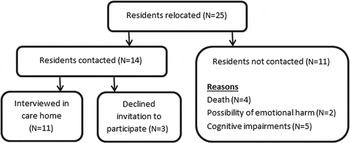
In total, 25 residents were relocated over a period of three months to eight receiving care homes. The interviews took place six months after the move where 14 of the 25 residents met the inclusion criteria and 11 of these agreed to be interviewed (79%; Figure 1). Thirteen care home staff were interviewed across seven receiving care homes, eight of which had relocated along with residents from one of the closing care homes. Six managers were interviewed, including four care home managers and two managers who took the lead on the care home relocation process. Two independent advocates were interviewed to represent the experiences of those residents who lacked capacity and did not have relatives who could support them during the move.
Flow chart displaying recruitment of residents into the study.

One relative was contacted by the researcher for each resident who had moved except where there were concerns about the relatives' health (n=2), the residents' health (n=1), safeguarding concerns (n=1) or they had no relatives (n=2). Two relatives agreed to be interviewed. Where possible, interviews were conducted face-to-face in the care homes with residents (n=11), managers (n=6) and staff (n=13). Advocacy representatives were interviewed in their workplace (n=1) or on the telephone (n=1). Telephone interviews were also conducted with relatives (n=2).
Interviews
Interview schedules were developed for residents, relatives, staff, managers and advocates. All interviews included questions that aimed to cover: the perceived impact of the relocation on the residents, the involvement of relatives and residents, and the residents' adjustment to their new home.
Each interview asked questions about the CHC and relocation across three time periods: before the move, moving day and after the move. The aim of the interviews was to understand the experiences of the consultation and relocation process, but the interview schedules were designed to be used as a guide that was flexible to the ability, knowledge and willingness of the participant. The interviews were developed with consideration to the review's key questions and were informed by examples of good practice available in the literature (e.g. Jolley et al. Reference Jolley, Jefferys, Katona and Lennon2011). All interviews were conducted by one researcher (AL), recorded using a digital voice recorder and transcribed verbatim.
Analysis
Transcriptions were analysed using framework analysis (Ritchie and Spencer Reference Ritchie, Spencer, Bryman and Burgess1994), allowing for the exploration of emerging themes whilst principally being informed by the research question, aims and objectives. Framework analysis comprised five stages: (a) familiarisation, (b) identifying a thematic framework, (c) indexing, (d) charting, and (e) mapping and interpretation (Ritchie and Spencer Reference Ritchie, Spencer, Bryman and Burgess1994). AL was familiar with the data through conducting and transcribing the interviews, and JS familiarised himself with the data by reading the transcriptions. During this process, both researchers made notes on potential themes, then together analysed one transcript from each group of participants and combined these with a priori issues, including the aims of the study and the protocol, to develop the thematic framework. AL then continued to index and input into a chart simultaneously, consulting with JS when items were found that did not fit into the current framework. Final interpretation was conducted by AL and JS, with discrepancies between AL and JS resolved through discussion during the mapping and interpretation stage.
Findings
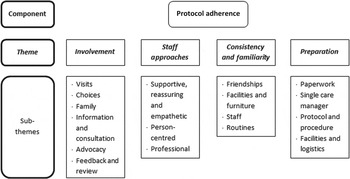
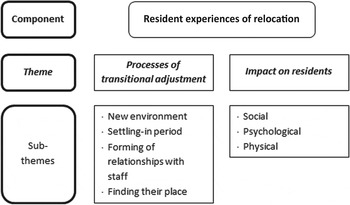
The findings will be presented in two components relating to the aims of the study: protocol adherence and resident experiences of relocation. Within the protocol adherence component, four themes were identified from the data-set, which encapsulate how the protocol was applied in practice. These themes were involvement, staff approaches, consistency and familiarity, and preparation. Within the experiences of relocation component there were two themes: processes of transitional adjustment and impact of relocation.
Protocol adherence
This section describes the component of protocol adherence. There are four themes within this component, consisting of involvement, staff approaches, consistency and familiarity and preparation. Figure 2 provides an overview of the themes and sub-themes within this component.
Themes and sub-themes of the ‘protocol adherence’ component.

Involvement.
Visits
It was reported that residents were encouraged to visit potential new homes before choosing where they would like to move to, though residents did not always take the opportunity out of choice. For those residents that did visit the homes, it was perceived that visits to care homes were short and could have been longer, as one member of staff reported,
‘they could've maybe done is maybe had a day in the home, rather than just coming for an hour visit because then they could see what day-to-day life is' (Staff 8).
Choices
Participants in all groups interviewed talked about how residents were able to make a choice about which care home they would like to move to and, in some cases, which bedroom they wanted. A resident who was not offered a choice of bedroom stated their disappointment, emphasising the importance of providing choices to residents,
‘we didn't have any say at all in the room, it would've been nice if we could've had a choice of rooms' (Resident 1).
In addition to having choices about the physical locations, social interactions were important in making choices. One manager suggested that residents' choice of care home may have been influenced by where peers were relocating to, rather than factors such as ability to meet enhanced care needs.
She wanted to move with [her friend], they have a friendship anyway at [their old home] so they moved together. Although whether she's rightly placed here or not remains to be see[n]. [She] would probably have benefited from nursing care but obviously wanted the continuity of friendship. (Staff 4)
Other factors influencing residents' decision-making included: previous knowledge of the care home, the atmosphere in the home, affiliations to staff members, the facilities on offer, the location of the home, the home's distance from relatives, the residents' care needs, and the room size, location and view. Some participants reflected on the difficulties of considering different factors when deciding where residents should move to:
I do think they were a bit worried you know um, where the rooms were, would they be able to get from the room … well certainly [one resident] because she's got [a mobility problem] … [I was] quite surprised that she's actually got a room upstairs but I believe it's the room she chose herself… (Staff 3)
Family
Family members were able to be involved in the decision-making process related to the relocation. Residents' relatives were able to choose the extent to which they were involved in the process, with staff viewing the families' involvement as being helpful to residents.
…some families are heavily involved and want to know everything that's going on, other families might be happy with an overall review and they perhaps haven't got the time or they live further away so they're not available so we have to then take more of a lead role on helping that move. (Manager 4)
Information and consultation
Providing information to, and consulting with residents and their relatives, was acknowledged to be of importance. Once appropriate information relating to the CHCs was given to managers, it was then shared quickly with residents. This included informing residents what was happening, why the decision had been taken to close homes and which homes were to be closed first. A resident reflected on how this information was conveyed and that this coincided with being able to visit the new home,
‘I think we were well informed about what it was and I came here a couple of times to look round. I don't think it could have been done any better’ (Resident 7).
Managers identified that consultation with residents occurred throughout the process, although two relatives and an advocate spoke about bias within the consultation process. This reflected the difference between informing and consulting with residents about the decision to close the homes, and which homes residents would be moving to.
I sort of felt yes it was a foregone conclusion really in that they were just going through the motions! I felt that yeah they were happy to discuss it and looked as though they were taking it all seriously but like I said the decisions had already been made so I didn't really feel it would make any difference. (Relative 1)
Advocacy
Advocates and managers discussed the role of the Independent Mental Capacity Advocates (IMCA) and Independent Mental Health Advocates in supporting the relocation process. In particular, managers reflected that advocacy involvement was useful to ensure that a neutral person could contribute to decision-making where residents lacked capacity and did not have relatives to support them.
We identified anybody that hadn't got any family and they were automatically given an IMCA, purely because we wanted to make sure that as hard as we tried we didn't influence their decisions and that there was somebody who was impartial to explain and offer choice. (Manager 5)
An advocate reported that staff and managers understood the role of advocacy services and the relevant referral pathway to the advocacy teams. Both advocates found the council staff and managers to be accommodating and spoke positively about the approach the council had taken with advocacy teams.
…the advocates who needed to make contact with the care managers found them to be very, very approachable, very willing to talk to the advocates ’cos sometimes advocates are seen as a bit of a threat to people, whether it's professionals or relatives, but in actual fact the line of communication was really good. (Advocate 2)
Feedback and review
Participants spoke about the ways in which residents had been given formal and informal opportunities to discuss how they were after the move, including a review 28 days after moving.
…how people are settling in is discussed in them [care reviews], you know the progress they're making and we had a review as part of the Moving Homes protocol that was set up once the resident who'd moved had been here about four weeks; the [social worker] set a review up for the resident, the family, myself and [the social worker] just to see how things were going and everybody was, there was no major problems in the reviews like we was expecting… (Manager 3)
There were also examples of how staff planned to or did respond to resident feedback, including passing it along a pathway to a more senior member of staff or making changes to the environment. A relative reflected on how changes were made to the environment in response to feedback that there were not enough chairs in the main lounge,
‘they tried to make a separate little sitting room, the only trouble with that is they've made it too far away’ (Relative 2).
Staff approaches.
Supportive, reassuring and empathetic
Staff offered residents support and reassurances throughout the process of the move,
‘whilst people were anxious, their anxieties were very well allayed by the homes and staff, by care management staff where appropriate’ (Advocate 2).
This was helped by positive relationships that existed between staff, residents and relatives. In particular, staff spoke of how they used the extra time they had available when residents began to move out to spend quality time with the remaining residents. Staff and managers also acknowledged that the process was likely to be difficult for the residents. They hoped that the moving process would be as efficient as possible and recognised that it takes time to build up relationships with new residents and their families.
…taking time for the family to trust us I guess, completely new home, new staff team and obviously I mean [the care home] closing was such a big thing that we really just needed to take that step back and try and support [the resident] and the family in the best way we possibly could, and I think we've done that well, but I think it's just taken a bit of time. (Manager 2)
Person-centred
Advocates, staff and managers discussed how the service delivered during the process of the CHCs and relocations was person-centred. In particular, staff and managers indicated making extra effort to deliver a service tailored to the individual needs of the residents:
…that's part of what the process is about, finding out what's important for that person really and then trying as much as possible to provide that and flagging that up … it was very individual led. (Manager 4)
Furthermore, managers attempted to pace the moves and provide flexibility to meet the needs of the individual, although the difficulty in capturing details of a resident within paperwork alone was acknowledged,
‘we tried to put as much information on the card, just so they knew and … it's hard putting someone on paper’ (Staff 12).
Professional
The closure of the care homes meant that existing staff were also moving to a new care home. It was highlighted that staff were able to separate their own concerns from the service they were offering the residents,
‘they were very, very good at separating their own staffing issues and the customer issues and to be honest never the two did meet, they were very good at that’ (Manager 5).
To facilitate this, staff were supported by managers and kept well informed about the modernisation plan. Staff used this knowledge when speaking to residents and relatives about the positive aspects of the plan, and it was thought that staff that transferred and settled well into their new roles would have a positive impact on residents,
‘I know it's not about me but I do think if your staff are happy then your residents are happy and I honestly didn't think that I would settle so quickly and I love it here’ (Staff 11).
Consistency and familiarity.
Friendships
Participants discussed friendships between residents that were maintained when moving to new homes. It was acknowledged that residents who moved from the same home and who spent time together following the move helped them to settle in:
If they knew people who had moved from [the care home], that was certainly clear, they tended to group together initially because it was somebody familiar to them. And I think, that that did help them settle. (Manager 1)
A manager also spoke of attempts made to move those who were friends within a short space of time, such as all in one day, so that friendships were not disrupted. Maintaining friendships was a factor for people when deciding on their new home, but on occasion this needed to be negotiated with changes in individual care needs. As well as the focus on creating continuity for existing friendships, a relative thought that more should have been done to introduce relocating residents to existing residents in care homes to support the development of new friendships;
…introducing the people who [moved] a bit more to the people who were already [living there] because it seems like the two have formed two separate groups and quite suspicious of each other! I think it might've been nice if there'd been a bit more attempt to integrate them, at least make introductions. (Relative 1)
Facilities and furniture
Similarities of the lay out of the building, the location of rooms and the layout within the rooms were deemed to be important by participants. They also discussed how residents were able to bring their own belongings, including furniture. A manager and a member of staff also discussed situations relating to room size; in some instances residents were pleased to be getting larger rooms, and in others managers attempted to make sure residents' new rooms matched the size of their old rooms. Changes were also made within the rooms to suit the needs of the residents, such as transferring existing phone numbers, making the room similar to the residents' previous room and ensuring continuity of newspaper delivery. Staff spoke of the residents' concerns before the move, such as what the food and rooms would be like in the new home and whether they would be able to bring their own belongings.
It went really well, because I had my own bed and my own big television and it was all done in one day, it was well organised. We just came in and my daughter unpacked for me and she packed it and unpacked for me so really I had nothing to do. As I say I don't think it could have been done better. (Resident 7)
Staff
All groups of participants discussed the benefits to residents of continuity of staff, who knew residents' routines and preferences. Managers of the receiving care homes had been to meet with residents several times before their move and had become familiar to them.
‘Well you know them [staff from the old care home] a bit, and you can ask them things. Yes I think it is really, it's nice to know somebody isn't it’ (Resident 3).
Once staff knew which homes they were going to be working in they used this information to reassure residents and alleviate their worries.
Routines
Residents spoke about how they were able to carry on the routine that they had at their previous care home, or that they were able to establish a routine in the new home. This was reflected in the way that staff perceived residents' routines,
‘some of the concerns were they wouldn't be in the same routine but they are, they are really’ (Staff 11).
This was supported by residents having the freedom to manage their own time, and residents were reassured before the move that they would be able to carry on their lives as normal.
Preparation.
Paperwork
The use of paperwork by the care homes, such as a checklist, the Alzheimer's Society (2012) This is Me documentation, care plans and risk assessments helped with the process of moving residents and benefited from being used consistently across all care homes. Residents perceived the paperwork to be quick to update and understood that it was transferred to the new care home. The transfer of paperwork was helped by the use of standardised documents across the care homes, as reflected upon by a manager.
…as with regards to paperwork, I don't think there was a great deal of paperwork to sort out ’cause they keep up to date with all the records. They had to transfer all the records. The records from one home to another. (Resident 1)
The residents' actual files are the same format that we use in all the homes … we had standardised paperwork so they were easy to follow… (Manager 3)
Single care manager
One Social Work care manager was employed to work full time on the CHCs and relocation process. The role of this worker was to co-ordinate the process, consult with residents and relatives, and complete assessments and reviews. A number of managers spoke of how having a single care manager offered clear leadership, communication and continuity:
‘It was very good having one care manager dealing with all of it. ’Cause it meant there was continuity, the whole thing stuck together well … having that one person meant that the whole co-ordination of it went really well’ (Manager 1).
The approach taken by the care manager in choosing to locate themselves within the closing care homes was discussed as facilitating positive working relationships and good accessibility for residents.
Protocol and procedure
The procedures related to the closure and relocation process, such as assessments, allocating staff to residents on their moving day, and the handover of residents' paperwork and documents, was supported by a checklist and protocol. The protocol had been developed using similar protocols from other regions and research evidence, and was tailored to suit the needs of this process. Managers discussed the planning that occurred before the consultations where the needs of each individual, friendships groups and staff were considered. An advocate spoke positively about the processes that were followed:
…every process that followed from that [consultation] was optimised and I certainly can't find a flaw, given the material that everybody had to work with in terms of time-scales and processes, logistics and taking into account the frailty of older people there I can't see that anything could have been done better. (Advocate 1)
Facilities and logistics
It was felt important to plan the timings of residents' moves, decide in which order to move residents, the number of residents to move over what period of time and scheduling the actual time of moves. Other considerations were the transport for the residents, their belongings and paperwork, and transporting residents to visit care homes. Managers talked about the need to arrange staffing levels so that a member of staff could travel with the resident to the new home and be there to settle them in. Managers of receiving care homes found this useful as it was an opportunity for information to be shared verbally between staff.
…some people wanted to be the first to move, others wanted to be the last to move and if we knew they were in a friendship group then we would stagger them so that they weren't any length of time in the new home without their friends joining them. (Manager 5)
As the move was in winter and near Christmas, it was felt that this increased the impact on residents if they were one of the first or last to move,
‘the ones who were left to the end of the month, it bothered them just as much, they were tearing their hair out at [the old care home], still being left there when the place was emptying…’ (Relative 2).
For moving days to be conducted in the most efficient way, and for key workers to be involved as much as possible, additional staff were scheduled to work. There was perceived to be an advantage of staff from the receiving care home coming over to meet and get to know residents before they moved, if no other residents or staff from closing homes had already transferred to facilitate the process:
…have staff come over to actually get to know [the residents] … get somebody in so there's a familiar face in case nobody from [the old care home] was going to be there when she arrived… (Staff 1)
Resident experiences of relocation
This section describes the component resident experiences of relocation, of which the two themes are process of transitional adjustment and impact on residents. Figure 3 provides an overview of the themes and sub-themes within this component.
Themes and sub-themes of the ‘resident experiences of relocation’ component.

Processes of transitional adjustment.
New environment
Most participants spoke about the impact of the new environment on the residents. This included how residents struggled with the facilities and furniture of the new home being unfamiliar, such as the size of the building and the arrangement of their bedroom. Residents made comparisons between their old and new home and staff and relatives commented on the residents' tendency to draw these comparisons, although these comparisons were not always quantified by residents. Two members of staff spoke about one of the closing care homes' culture being indulgent of the residents and this was linked to difficulties for residents adjusting to what might feel like a more restrictive culture.
…when you get somebody new in you do that little bit extra to try and get them settled but when that's settled down then they started to see things ‘well I like that, but I'm not so keen on that’, ‘oh well the food's better here, but the staff don't, they won't sit and do my nails like what I got at [my old home]’. So it's just little things like that what they've started to say as times gone on. (Staff 1)
Settling-in period
Residents appeared to settle at different paces, with this period of time being used by residents to learn about their new home, including becoming accustomed to their surroundings and routine. It was highlighted that residents' behaviour changed in the initial period after they had moved, such as they became more demanding of staff, they were less sociable or less talkative. A manager acknowledged the positive impact on relatives as residents began to settle in to their new home. Perceived improvements in health and behaviour returning to normal were also identified by some as signs that residents were settling,
‘the first few weeks she didn't want to come out [of her room] and when people were trying to encourage her to come out, she'd be snapping at them … but she's come round a lot more (Staff 12).
Forming of relationships with staff
Participants spoke of reciprocal learning that took place between staff and residents relating to the personalities and practices of each other. This extended to learning names and times that staff work, getting to know personalities,
‘the carers are getting to know me better. They're not treating me as they did at first you know as though I'm away with the fairies' (Resident 7).
Of particular importance to residents was that staff learnt how they preferred the most personal aspects of their care, such as being washed, dressed and helped with using the toilet. Some people commented that residents were asking for staff that they knew from their previous care home when they first moved. Conversely, some difficult relationships were mentioned by residents and the problems that arise from staff and residents not knowing each other:
…they've got some lovely elderly women who get us ready in the morning and spoil us, spoil us rotten as they say. And of course, there's this other woman and she definitely doesn't like me, not at all. I don't know why. (Resident 2)
Finding their place
There appeared to be a process of residents finding a role within the social structures in their new home, which may be different to the role they played in their previous home,
‘I like it in daytime to go to the downstairs lounge and I make my way to just inside the doors and you see what goes on and pass your opinion if it's asked for’ (Resident 4).
Finding a physical place in the home was also mentioned, for example residents finding a chair in communal areas and a seat at the dining table. This was linked by some to a sense of feeling settled and regaining a routine, however, it was also the cause of disputes and difficulties when this was disrupted.
…it was having their own seat, their own space within that home, ’cause even though people aren't supposed to, people do don't they, they always go back to the same place and … once people felt comfortable within their own space in the home I think that sort of helped. (Manager 4)
Impact on residents.
Social
The relocation had a negative impact on residents' social lives, with difficulties integrating into the new homes,
‘people talked together better in [the old care home]. We don't seem to mix all that well together here’ (Resident 3).
These difficulties appeared to be enhanced where residents moved to a home without any friends or ahead of friends moving, and where residents in the receiving care home had cognitive impairments that restricted their ability to interact. Residents with higher sociability appeared to positively affect their ability to integrate. Other factors thought to hinder integration were the layout of the communal living room, as residents were seated in rows, not being introduced to each other, and the level of interest in activities differing between care homes.
A manager spoke of difficulties in joining pre-existing friendship groups, and a member of staff spoke of how a resident had been excluded from their old friendship group because they were sitting in a different part of the lounge. Some residents spoke about feeling ‘cut off’ or being socially isolated since arriving in their new home. This reflected an apparent division between residents who had moved and the existing care home residents, where moving residents were socialising with others from their previous care home and the belief that residents in their new home were not speaking to them,
‘I don't even think that they attempt to sort of engage with some of the other residents at times, which is a shame ’cause there's some lovely residents here…’ (Staff 3).
However, participants also spoke about friendships and levels of social integration that had been sustained or improved since moving. One manager commented that personalities of the residents who had moved had integrated well with the existing personalities and culture in the home. A manager and a member of staff commented that existing residents had been friendly and welcoming to new residents.
Psychological
A number of participants discussed the emotional impact of the move. Anger, frustration and discontent were discussed in relation to the time taken between telling residents about the move and residents moving, allocation of rooms and how the move was managed. Anger was linked by many to the experience of being forced to relocate. Sadness, distress and upset were linked to losing a home that they loved, seeing the home as people were packing and moving, and waiting to be told more information once they knew the home would be closing. Anxiety, fear, worry, shock and stress were experienced by both residents and relatives before the move happened and a causal link was made by participants between these experiences and the length of time people knew about the move before it happened.
…they've taken something away from them that they can't replace, that's just because they decided to make these changes, and somebody had to suffer for it… (Relative 2)
Despite these negative psychological impacts on residents, participants also spoke about the resilience shown by the residents in the process of moving and adjusting to their new homes,
‘it's surprising the amount of readjusting you can do yourself’ (Resident 4); ‘I've settled in anyway. And it's happened and that's it, you've got to make the most of it’ (Resident 5).
Some participants commented on factors that may have facilitated this, including groups of residents moving together or moving with staff.
Physical
In some cases, participants believed that residents' health had improved or remained the same since moving. This included improvements on mobility, the amount of personal care they required from staff and comments on their general health:
…she's actually done better than I thought she might, she has all sorts of aches and pains and her memory's going really bad now but in a lot of respects she's better than she's been for a long time so you know I'm quite happy in that respect. (Relative 1)
Alternatively, others spoke about the deterioration in mobility, speech, general health and falls in residents since moving, which were exacerbated by medical conditions and impacted upon the residents' ability to settle in:
…the first few weeks were quite difficult … it was difficult transition [for the resident]. [They] had a nasty [infection] initially which knocked her off her feet and increased her confusion as well, and that really had an impact on her settling in and she had a couple of falls as well due to her [infection]. (Manager 2)
A relative commented that the resident not being known by staff meant that they were less able to notice deterioration in health. An advocate provided a similar statement, that re-assessment of residents' care needs and decision on level of care required did not take into consideration residents' deteriorating health, and as a result it was possible residents would require a second move within a short space of time,
‘if she's got to move why doesn't she move into a nursing home then we know she won't have to move again’ (Advocate 1).
Discussion
It was identified that the protocol was based on research-informed practice guidelines currently established within the literature (e.g. Jolley et al. Reference Jolley, Jefferys, Katona and Lennon2011), and was for the most part adhered to in practice to assist with the relocation and safe transfer of care home residents. In particular, data analysis revealed four themes relating to how the protocol was implemented into practice: involvement, staff approaches, consistency and familiarity, and preparation. This builds on recent work that highlighted a paucity of evidence on how research-informed practice guidelines are implemented into practice (Holder and Jolley Reference Holder and Jolley2012), highlighting that such protocols are able to influence practice.
The themes identified in this study resonate with ways in which previous research has identified how the risk of harm to residents can be reduced. This is particularly emphasised through the way residents were involved in the process, such as giving them choices, which has previously been shown to improve safety (Bekhet, Zauszniewski and Nakhla Reference Bekhet, Zauszniewski and Nakhla2011; Brugler, Titus and Nypaver Reference Brugler, Titus and Nypaver1993; Gallagher and Walker Reference Gallagher and Walker1990; Holzapfel et al. Reference Holzapfel, Schoch, Dodman and Grant1992; Thomasma, Yeaworth and McCabe Reference Thomasma, Yeaworth and McCabe1990; Woolham Reference Woolham2001). Similarly, continuity of care (identified within the consistency and familiarity theme) was provided to residents, which has been shown to minimise stress for residents (Korman and Glennerster Reference Korman and Glennerster1985; Williams, Netten and Ware Reference Williams, Netten and Ware2003; Woolham Reference Woolham2001).
Based on the experiences of those involved in the CHC, the findings highlight a number of areas for improvement, even when they have already been identified as being research-informed. These include increasing opportunities for residents and support staff to learn about and visit potential new homes, providing additional support to residents after announcements of CHC and screening for residents who are at increased risk of harm due to relocation. Whilst these areas of improvement are supported by good practice guidelines in existing literature (Jolley et al. Reference Jolley, Jefferys, Katona and Lennon2011; Robinson, Glasby and Allen Reference Robinson, Glasby and Allen2013), they highlight some nuances that require extra consideration. For example, feedback mechanisms for residents and families need to be accompanied by extra support and assurance of safety and fair treatment for those involved. Similarly, resident experience is linked closely to the relocation of staff from closing homes and where possible efficient decisions about staff movements would be of great benefit to relocating residents.
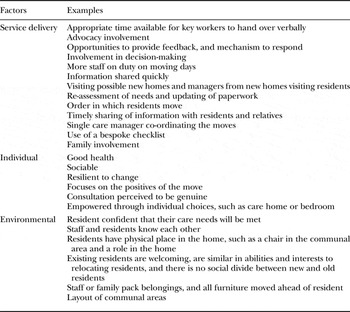
The findings of this study suggest that the service delivery, individual and environmental factors can influence how residents experience the involuntary relocation and transfer to a new care home. It was also identified that residents went through a process of readjustment following their move, and that the move had particular impacts upon residents, which were mitigated or aggravated by service delivery, individual and environmental factors. These factors, as identified in this study, are listed in Table 1. It is likely that this is not an exhaustive list and future research should attempt to identify other factors. Furthermore, the majority of the factors identified in this study appear to be positive, perhaps as a result of the use of a protocol. It is possible that a lack of one or more of these factors may lead to a negative experience for residents.
Examples of service delivery, individual and environmental factors that can influence residents' experience of care home closure

A model of opportunities and risks for residents' experiences of involuntary CHC
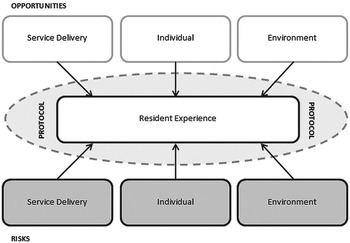
Based on these findings, a model that incorporates service delivery with individual and environmental factors is proposed (Figure 4). Within this model, the factors do not operate independently, but rather exist on continuums which fluctuate on an individual basis for residents. The factors provide either opportunities to improve residents' experiences of the involuntary relocation and transfer, or where they are missing, to increase the risk that residents will have a poor experience. The juxtaposition of opportunities and risks is important in order to avoid absolute risk aversion, as over-controlling the care of older people can lead to the creation of new and unforeseen risk (Buri and Dawson Reference Buri and Dawson2000). This in turn allows for positive outcomes for residents who are being involuntarily relocated. The role of the protocol within the model is to act as a barrier that will help to protect the residents' experiences from risk and enable opportunities to improve their experience. However, the broken line acknowledged that even when the protocol is in place, it is not always successful.
A model of risks and opportunities in residents' experiences of involuntary care home relocation.

It should also be noted that the factors identified in Table 1 are not definitive, and some are beyond the control of those who are managing the transition for residents. The model does not offer a solution to addressing the factors, and various solutions should be considered, consulted upon with residents and then tested in practice to determine their success. This follows the same principles of the systems approach to human error, where a single defence is likely to be unsuitable due to latent conditions and active failures that can reduce its effectiveness (Reason Reference Reason2000). As such, it is likely that a safe relocation and transfer is one that reduces risk and maximises opportunity to residents' experiences, even when the relocation is involuntary.
The model purposively focuses upon the resident experience, an important component of relocation that has been linked to improved outcomes. It does not attempt to incorporate other outcomes due to the complicated associations, although future research could investigate the multifactorial nature of residents' experiences and outcomes.
Limitations
A limitation of this study was that more professionals were interviewed than residents or relatives, which may have resulted in a biased perspective of the process and the impact of the process on the residents. However, this was taken into consideration during data analysis so that residents' views were not overpowered by those of professionals and that their perspectives were not under-represented in the findings and conclusions. Attempts were made to recruit more residents and relatives, but the research team were either unable to contact them during the study period or they did not volunteer to participate. A further limitation is that follow-up interviews were not conducted with participants at later dates, and some aspects of the protocol could not be evidenced from the interviews. It is therefore unknown the extent to which the proposed model extends beyond the immediacy of the relocation, or how those aspects relate to residents' experiences of the relocation process. These include: the manager and key worker from the old home visiting the resident in their new home within days or first weeks; the direction of residents and relatives to impartial information about care homes (e.g. the Care Quality Commission); deciding on the decoration of the new room (where possible); allowing the resident to choose the date of the move; and sorting out any worries or problems as soon as possible.
Conclusion
The aim of this study was to investigate multiple perspectives on the extent to which a protocol for the relocation of older adult residents, developed by a local authority in England, was based on research-informed guidelines, adhered to in practice and influenced residents' experiences. It was identified that the protocol incorporated existing research evidence aimed at reducing harm, and for the most part was adhered to during the CHC and the relocation and transfer of residents. Involvement of residents, relatives and advocates, extensive planning and a person-centred approach were of particular importance in improving resident experiences of relocation. The model proposed in this study explains how the use of a protocol provided opportunities to improve residents' experiences of the involuntary relocation and transfer and to reduce the risk that residents will have a poor experience. Future studies investigating experiences of CHCs and the involuntary relocation of older adult residents should explore how the model can be further enhanced, such as by incorporating physical, social and psychological outcomes.
Acknowledgements
We would like to express our gratitude to everyone who gave their time to participate in this study, including residents, relatives, staff, managers and the advocates. We would also like to thank the local authority for their assistance throughout. Ethical approval for the study was provided by York St John University Research Ethics Committee (reference UC/13/3/12/AR). This study was funded by a local city council. AL was involved in the design, analysis, interpretation of data and drafting the manuscript. JS was involved in the analysis, interpretation of data and drafting the manuscript. PD was involved in the conception, design, interpretation of data and critically revising the manuscript. All authors reviewed and approved the submitted manuscript. There were no conflicts of interest.