Antipsychotic drugs show great efficacy in relapse-prevention (Leucht et al., Reference Leucht, Tardy, Komossa, Heres, Kissling, Salanti and Davis2012), yet most individuals with schizophrenia experience multiple relapses over the course of the illness (Carbon and Correll, Reference Carbon and Correll2014). Treatment interruption plays an important role in psychosis relapse (Robinson et al., Reference Robinson, Woerner, Alvir, Bilder, Goldman, Geisler, Koreen, Sheitman, Chakos, Mayerhoff and Lieberman1999), but a relapse may still occur despite ongoing antipsychotic drug treatment (Alphs et al., Reference Alphs, Nasrallah, Bossie, Fu, Gopal, Hough and Turkoz2016). The phenomenon of psychosis relapse despite ongoing antipsychotic treatment is what we refer to by ‘Breakthrough Psychosis on Antipsychotic Maintenance Medication’ (BAMM) (Rubio and Kane, Reference Rubio and Kane2017).
The challenges in controlling for treatment adherence results in treatment non-adherence as a potential confound in this type of research, since the level of exposure to antipsychotic drugs at the time of relapse is uncertain (Kane et al., Reference Kane, Kishimoto and Correll2013). However, the study of this phenomenon in individuals continuously treated with long-acting injectable antipsychotics (LAIs), where drug exposure is assured, virtually removes this potential confounder (Rubio and Kane, Reference Rubio and Kane2017). In relapse-prevention controlled trials with these formulations (Kishimoto et al., Reference Kishimoto, Nitta, Borenstein, Kane and Correll2013, Reference Kishimoto, Robenzadeh, Leucht, Leucht, Watanabe, Mimura, Borenstein, Kane and Correll2014), the pooled relapse rate during ongoing treatment is 28% (95% confidence interval 24–31%) over a mean follow-up period of 71.5 (standard deviation = 37.0) weeks. This suggests that despite the established efficacy of these drugs in preventing relapse (Leucht et al., Reference Leucht, Tardy, Komossa, Heres, Kissling, Salanti and Davis2012), BAMM is a relatively common phenomenon in the treatment of schizophrenia.
Although controlled trials of LAIs provide a great level of detail of symptom severity and antipsychotic exposure, they may enroll a disproportionate number of patients with better treatment adherence and lower illness severity. How this incidence translates to the real-world is less well understood, since the replication of this research in settings with greater external validity or longer follow-up has been limited. In an influential study, Wunderink et al. (Reference Wunderink, Nieboer, Wiersma, Sytema and Nienhuis2013) followed individuals with early psychosis, some of whom were treated with antipsychotic maintenance, for up to 7 years. Among those with maintenance treatment, 68.6% relapsed. These high rates of relapse despite ongoing antipsychotic treatment have been replicated by other naturalistic samples (Harrow et al., Reference Harrow, Jobe and Faull2014), which has resulted in warnings about the potential risk of chronic antipsychotic treatment contributing to worse outcomes and breakthrough psychosis (Murray et al., Reference Murray, Quattrone, Natesan, van Os, Nordentoft, Howes, Di Forti and Taylor2016). However, these results remain controversial, as non-adherence with antipsychotic maintenance treatment cannot be ruled out, the cumulative exposure to antipsychotic drugs after diagnosis was not recorded in these studies, and selection and attrition bias may have influenced these estimates (Goff et al., Reference Goff, Falkai, Fleischhacker, Girgis, Kahn, Uchida, Zhao and Lieberman2017; Correll et al., Reference Correll, Rubio and Kane2018).
Data on the factors associated with BAMM are also limited. To date, only one post-hoc analysis of a randomized controlled trial of LAI risperidone for relapse prevention in schizophrenia has studied the risk factors for BAMM without the confounder of non-adherence. In this study Alphs et al. (Reference Alphs, Nasrallah, Bossie, Fu, Gopal, Hough and Turkoz2016) found that longer illness duration was associated with a greater likelihood of breakthrough psychosis. To our knowledge, data from epidemiologic samples where treatment exposure is assured is lacking. Epidemiologic studies of schizophrenia have found that worse premorbid functioning (Robinson et al., Reference Robinson, Woerner, Alvir, Bilder, Goldman, Geisler, Koreen, Sheitman, Chakos, Mayerhoff and Lieberman1999), cannabis use (Foti et al., Reference Foti, Kotov, Guey and Bromet2010), and treatment with first-generation antipsychotics (FGAs) (Mojtabai et al., Reference Mojtabai, Lavelle, Gibson and Bromet2003), are associated with greater risk of relapse after controlling for antipsychotic exposure. However, these associations might still be partly confounded by treatment interruptions since they adjusted for antipsychotic use in the entire cohort, instead of studying only individuals with continuous treatment. In particular, some of these studies have also suggested dopaminergic supersensitivity as a potential pathophysiological mechanism involved in the long-term reduction of antipsychotic efficacy (Murray et al., Reference Murray, Quattrone, Natesan, van Os, Nordentoft, Howes, Di Forti and Taylor2016). This theory assumes that the cumulative exposure to antipsychotics, all of which block the dopamine D2 receptor (Seeman and Lee, Reference Seeman and Lee1975), would result in a compensatory upregulation of the D2 receptor (Seeman et al., Reference Seeman, Weinshenker, Quirion, Srivastava, Bhardwaj, Grandy, Premont, Sotnikova, Boksa, El-Ghundi, O'dowd, George, Perreault, Männistö, Robinson, Palmiter and Tallerico2005). Although D2 receptor upregulation has been demonstrated in animal models (Samaha et al., Reference Samaha, Seeman, Stewart, Rajabi and Kapur2007), clinical evidence of this phenomenon has been limited (Leucht and Davis, Reference Leucht and Davis2017), resulting in controversy.
The characterization of BAMM is important to understand the long-term course of illness in individuals with psychosis receiving antipsychotic treatment, the mechanisms of relapse in psychosis, and the effectiveness of chronic antipsychotic treatment. However, this literature is limited by relatively short follow-up periods, insufficient monitoring of antipsychotic adherence and cumulative antipsychotic exposure, and possible selection or attrition bias. Furthermore, few clinical trials or naturalistic studies have examined the risk factors associated with this clinical outcome in individuals whose adherence to antipsychotic drugs can be confirmed.
National registries overcome some of these limitations. This epidemiological method allows for long-term observations that capture a substantial proportion of the course of illness of individuals with chronic conditions, while providing lifetime measurements of covariates and mitigating selection and attrition biases.
Here, we use the National Registry of Finland to expand on the descriptive epidemiology of relapse in psychosis. We analyze data from individuals with a schizophrenia spectrum disorder receiving >8 weeks of continuous antipsychotic treatment in the outpatient setting in Finland between 1996 and 2015, using hospitalization for psychosis as a proxy of BAMM. Our objective is to generate descriptive data on:
(1) Incidence rate and time to hospitalization for psychosis
(2) Associations between baseline and treatment-related characteristics and hospitalization for psychosis
(3) The relationship between the first and subsequent hospitalizations despite treatment
(4) The role of factors that could result in the inappropriate designation of BAMM in a naturalistic sample [i.e. treatment-resistant schizophrenia (TRS) or relatively short periods of clinical stability prior to hospitalization for psychosis].
Since the route of administration of antipsychotics is critical in the potential confounding of non-adherence (Kane et al., Reference Kane, Kishimoto and Correll2013), the analyses will be conducted separately for LAI and oral antipsychotic (OAP) treatment. Data for treatment episodes with OAPs will be adjusted for potential non-adherence using a predictive model, whereas this will not be necessary for LAIs, in which treatment exposure is assured.
Methods
Study population
The prevalent cohort from the nationwide population included all individuals residing in Finland with a schizophrenia spectrum diagnosis (ICD-10 F20, F25, ICD8-9295) contained in the Hospital Discharge register between 1 January 1996 and 31 December 2014. The incident cohort was the subset of individuals whose diagnosis occurred during 1996–2014 and had not used antipsychotics during the year preceding the index hospitalization. Since the Finnish healthcare system has a single payer, all the individuals in the country that were ever hospitalized were included.
Medication exposure
Medication use from the Prescription Register included reimbursed medication expenditures during outpatient care. Antipsychotics were categorized using the Anatomical Therapeutic Chemical (ATC) classification as ATC code N05A, excluding lithium (ATC code N05AN01). Treatment episodes of all antipsychotics, except clozapine (ATC code N05AH02), were included, as this antipsychotic is prescribed to patients with TRS who have already failed multiple previous trials (Hasan et al., Reference Hasan, Falkai, Wobrock, Lieberman, Glenthoj, Gattaz, Thibaut and Möller2012). Treatment episodes were further categorized by drug formulation into LAIs and OAPs. This allowed us to study the phenomenon during treatment episodes with a more conservative estimate of treatment continuity given the assured exposure and pharmacokinetic properties of LAIs (Correll et al., Reference Correll, Citrome, Haddad, Lauriello, Olfson, Calloway and Kane2016).
Only continuous treatment episodes were included in the analyses, which were defined as periods of outpatient treatment in which drugs had been dispensed uninterruptedly for at least 8 weeks, according to the PRE2DUP method. This method, explained in detail elsewhere (Tanskanen et al., Reference Tanskanen, Taipale, Koponen, Tolppanen, Hartikainen, Ahonen and Tiihonen2015), has substantial reliability predicting antipsychotic serum concentrations for OAPs (K = 0.69, 95% CI 0.65–0.72) (Forsman et al., Reference Forsman, Taipale, Masterman, Tiihonen and Tanskanen2018), and virtually exact reliability for LAIs. The minimum duration of 8 weeks is justified by the finding of most antipsychotic formulations achieving minimal therapeutic serum concentration within this period (even though steady state is not reached yet) (De Cuyper et al., Reference De Cuyper, Bollen, van Praag and Verstraeten1986; Baumann et al., Reference Baumann, Hiemke, Ulrich, Eckermann, Gaertner, Gerlach, Kuss, Laux, Müller-Oerlinghausen, Rao, Riederer and Zernig2004; Wilson, Reference Wilson2004; Mallikaarjun et al., Reference Mallikaarjun, Kane, Bricmont, McQuade, Carson, Sanchez, Forbes and Fleischhacker2013; Mitchell et al., Reference Mitchell, Kothare, Bergstrom, Zhao, Jen, Walker, Johnson and McDonnell2013; Rossenu et al., Reference Rossenu, Cleton, Hough, Crauwels, Vandebosch, Berwaerts, Eerdekens, Herben, De Meulder, Remmerie and Francetic2015). Switches between antipsychotics were treated as a single episode, as long as there were no interruptions in treatment. Combinations of LAIs and OAPs formulations were treated as LAI, as continuous antipsychotic exposure would have been delivered by the LAI, even if the OAP was not taken daily. The cumulative dose of antipsychotics was measured to account for the total antipsychotic exposure when LAIs and OAPs were combined. Switches between periods of LAI and OAP use were deemed separate episodes, even if they were continuous. This allowed taking into consideration the greater risk of non-adherence when there was a transition from LAIs to OAPs. The follow-up was censored at discontinuation of use, death, and end of study follow-up.
Outcomes
The primary outcome was hospitalization due to psychotic disorder (ICD-10 codes F20–29) after 8 weeks of continuous outpatient treatment. This was referred to as psychosis Breakthrough on Antipsychotic Maintenance Medication (BAMM). As a proxy, hospitalization for psychosis corresponds with high specificity with relapse (Addington et al., Reference Addington, Patten, McKenzie and Addington2013), and is commonly used as a criterion of relapse in maintenance trials (Csernansky et al., Reference Csernansky, Mahmoud and Brenner2002), and naturalistic studies (Tiihonen et al., Reference Tiihonen, Mittendorfer-Rutz, Majak, Mehtälä, Hoti, Jedenius, Enkusson, Leval, Sermon, Tanskanen and Taipale2017). The secondary outcomes were any psychiatric hospitalization and any hospitalization. Also, since the main outcome referred only to the first hospitalization in order to avoid over-representation of patients with multiple BAMM events, a BAMM event that was preceded by another BAMM event was added as a secondary outcome. Psychiatric and medical hospitalization data were derived from the Hospital Discharge Register as inpatient stay in a psychiatric ward ⩾24 h. The period of observation was 1 January 1996 to 31 December 2015.
Models and covariates
The study population was analyzed separately for LAI and OAP treatment episodes. For each one of these groups, we conducted a prospective cohort model in which covariates were measured at treatment onset, and a retrospective case–control model that measured exposure to covariates between beginning and end of the treatment episode. This allowed us to study individuals' characteristics at treatment onset (prospective analyses) and characteristics of the treatment (retrospective analyses) in their association with BAMM. We replicated the cohort model in the subset of individuals who were diagnosed after 1996 (incident cohort) (online Supplementary Table 1s). The case–control model was conducted in the incident cohort, as treatment characteristics were fully available only for this subset of the sample. The covariates included in the model were: gender, age, comorbidity, duration of illness, type of psychotic disorder, number of previous hospitalizations, time since last hospital discharge when the treatment episode was initiated, and co-treatment with other psychotropics. The following highly skewed continuous variables that did not allow parametric testing were categorized for the analyses as follows: age ⩽30, 31–40, 41–50, 51–60, >60 years old; number of hospitalizations 0–3, 4–6, >6; time since hospitalization <2, 2–12, >12 months; duration of treatment episode 2–6, 6–12, >12 months. Since categorization of skewed continuous variables can be arbitrary, we conducted a sensitivity analysis using the median split of these four non-normally distributed, continuous variables instead. For the retrospective case–control model, we measured cumulative drug doses over the course of treatment in defined daily doses (DDD) (WHO Collaborating Centre for Drug Statistics Methodology). A DDD of 1 reflects the typical therapeutic dose for a particular drug (correspondence with milligram dosing for each drug at https://www.whocc.no/atc_ddd_index/). Cumulative exposure was categorized in quartiles (with 1st corresponding to the lowest cumulative dose and 4th to the largest). Correspondence of each quartile to DDDs for each drug class can be found in online Supplementary Table 2s. Definitions of all the covariates are explained in detail in online Supplementary Table 3s.
Statistical analysis
We estimated the incidence rate of BAMM per 10 person-years of continued antipsychotic use, and the incidence of BAMM for secondary outcomes. Also, we calculated Kaplan–Meier survival curves for each model to estimate cumulative incidence rates and median treatment episode duration until BAMM. Only the first treatment episode for each individual was used for the analyses. Since the LAI and OAP groups were treated as separate analyses, individuals who were treated with LAI and OAP during the follow-up period contributed to the analyses with their first continuous treatment episode of either type as long as it was >8 weeks. Episodes were censored at the time of treatment discontinuation, switch between LAIs and OAPs, participant's death or end of follow-up. To estimate the risk of non-adherence between the last drug dispensing and the end of the treatment episode, we measured the time gap between these two events, and compared them between episodes ending in BAMM and those that did not, with the assumption that if BAMM was preceded by a longer period between treatment episodes than no BAMM, there would have been greater opportunity for non-adherence in the former.
After categorizing variables with skewed distribution, we conducted univariable and multivariable analysis for the prospective cohort model using a Cox proportional hazards regression, and a conditional logistic regression analysis for the retrospective nested case–control model. All models were conducted for LAIs and OAPs separately. Threshold for statistical significance was Bonferroni corrected for multiple comparisons (p value <0.05/23 covariates = 0.00217). Covariates significantly associated with BAMM, that were present in at least 1% of the sample for each category (BAMM and no BAMM) were entered in the multivariable analyses, as long as they were not correlated at r < 0.3, in which case the one with the lowest association was dropped to prevent multicollinearity.
Sensitivity analyses were conducted to examine the role of factors that could potentially contribute to an inappropriate designation of breakthrough psychosis (i.e. TRS or relatively short periods of stability prior to BAMM), in two conservative scenarios: (1) excluding subjects who had had ⩾3 different antipsychotics prescribed for >6 weeks during their lifetime (i.e. sensitive proxy for TRS) in the incident LAI and OAP groups, and (2) comparing the associations of covariates with BAMM events in treatment episodes with <median duration v. BAMM events in episodes with ⩾median duration, in prevalent LAI and OAP groups.
The analyses were not meant to serve as a comparison between LAI and OAP treatment, since the prognostic characteristics of these groups may not be comparable.
Results
Characteristics of continuous treatment episodes and incidence rates of BAMM
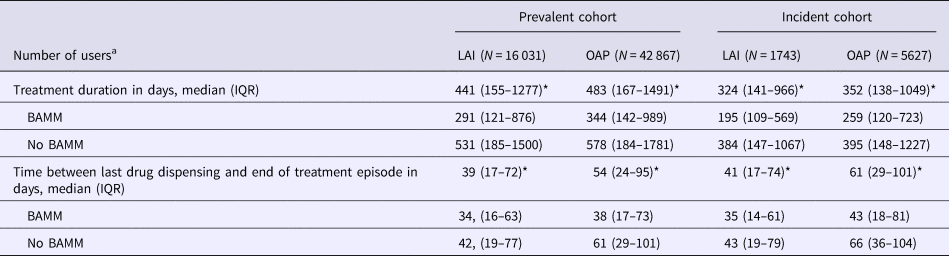
Altogether, 47 964 individual participants constituted the prevalent cohort. Over 20 years, there were a total of 16 031 continuous treatment episodes ⩾8 weeks, corresponding with 42 138 person-years in the LAI group, and 42 867 treatment episodes ⩾8 weeks, corresponding with 131 666 person-years in the OAP group. The median duration of all treatment episodes was 441 (IQR = 155–1277) and 483 (IQR = 167–1491) days respectively, in both cases being significantly shorter for individuals with BAMM (p < 0.001). The gap between the last drug dispensing and end of follow-up for all treatment episodes was a median of 39 days (IQR = 17–72) for LAIs and 54 days (IQR = 24–95) for OAPs. In both cases, treatment episodes ending in BAMM compared with those without BAMM had a significantly shorter (p < 0.001) gap between last dispensing and end of treatment episode (Table 1).
Timeline characteristics in days of continuous antipsychotic treatment episodes stratified according to Breakthrough Psychosis on Antipsychotic Maintenance (BAMM) status

*p value between BAMM and no BAMM <0.001.
a Only the first eligible treatment episode was included for each patient was included in the analysis. Since OAP and LAI were analyzed separately, individuals with LAI and OAP treatment episodes eligible for the analysis were included in both analyses. Therefore, the sum of individuals in the LAI (N = 16 031) and OAP (N = 42 867) model is larger than the total N of the cohort (N = 47 964).
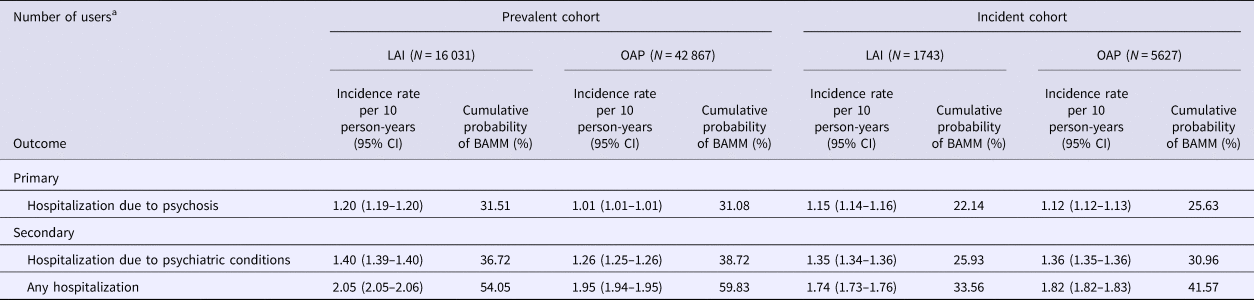
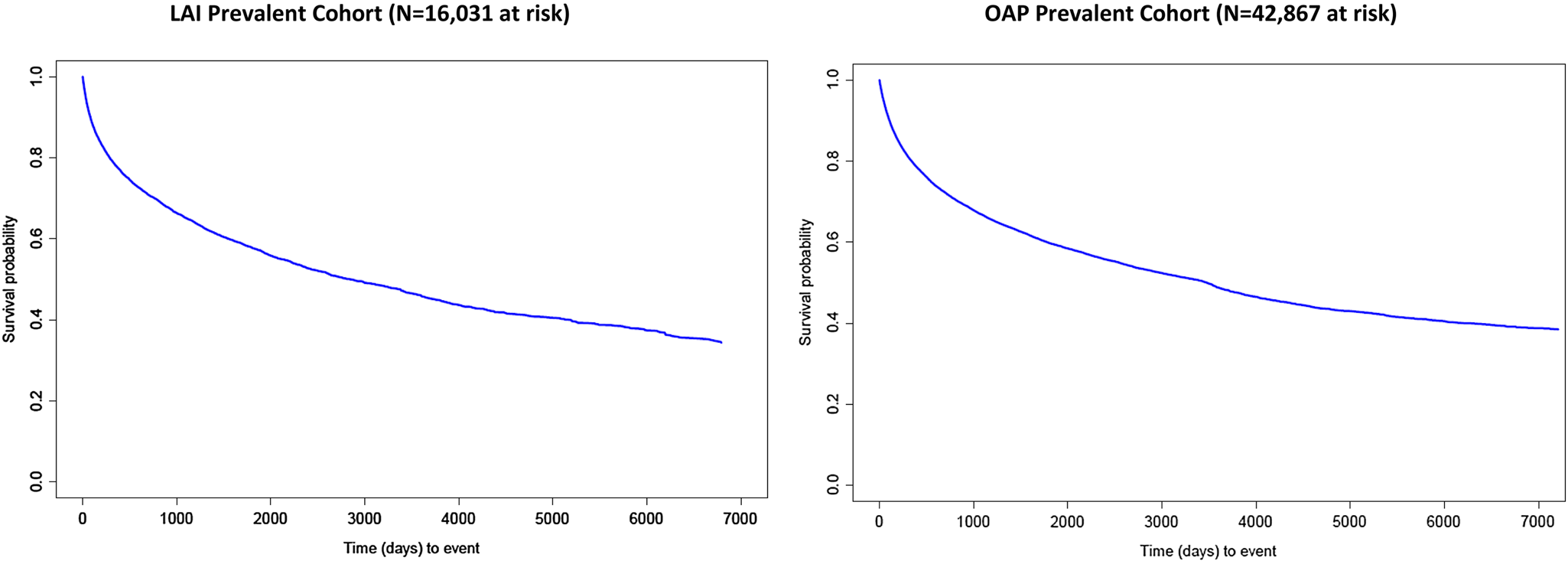
The incidence rate for BAMM per 10 person-years was 1.20 (95% CI 1.19–1.20) during LAI treatment episodes, and 1.01 (95% CI 1.01–1.01) during OAP episodes. The cumulative probability of BAMM was 31.5% during continuous LAI episodes, 31.1% during OAP episodes (Table 2). Consistently across all models, the cumulative incidence of BAMM over time had a concave-shaped survival curve (Fig. 1).
Incidence rates and cumulative probability of Breakthrough Psychosis on Antipsychotic Maintenance (BAMM) during continuous antipsychotic treatment

a Only the first eligible treatment episode was included for each patient was included in the analysis. Since OAP and LAI were analyzed separately, individuals with LAI and OAP treatment episodes eligible for the analysis were included in both analyses. Therefore, the sum of individuals in the LAI (N = 16 031) and OAP (N = 42 867) model is larger than the total N of the cohort (N = 47 964).
Kaplan–Meier survival curves for time to Breakthrough Psychosis on Antipsychotic Maintenance (BAMM) during continuous antipsychotic treatment.

Associations between characteristics at treatment onset and BAMM (prospective cohort model)
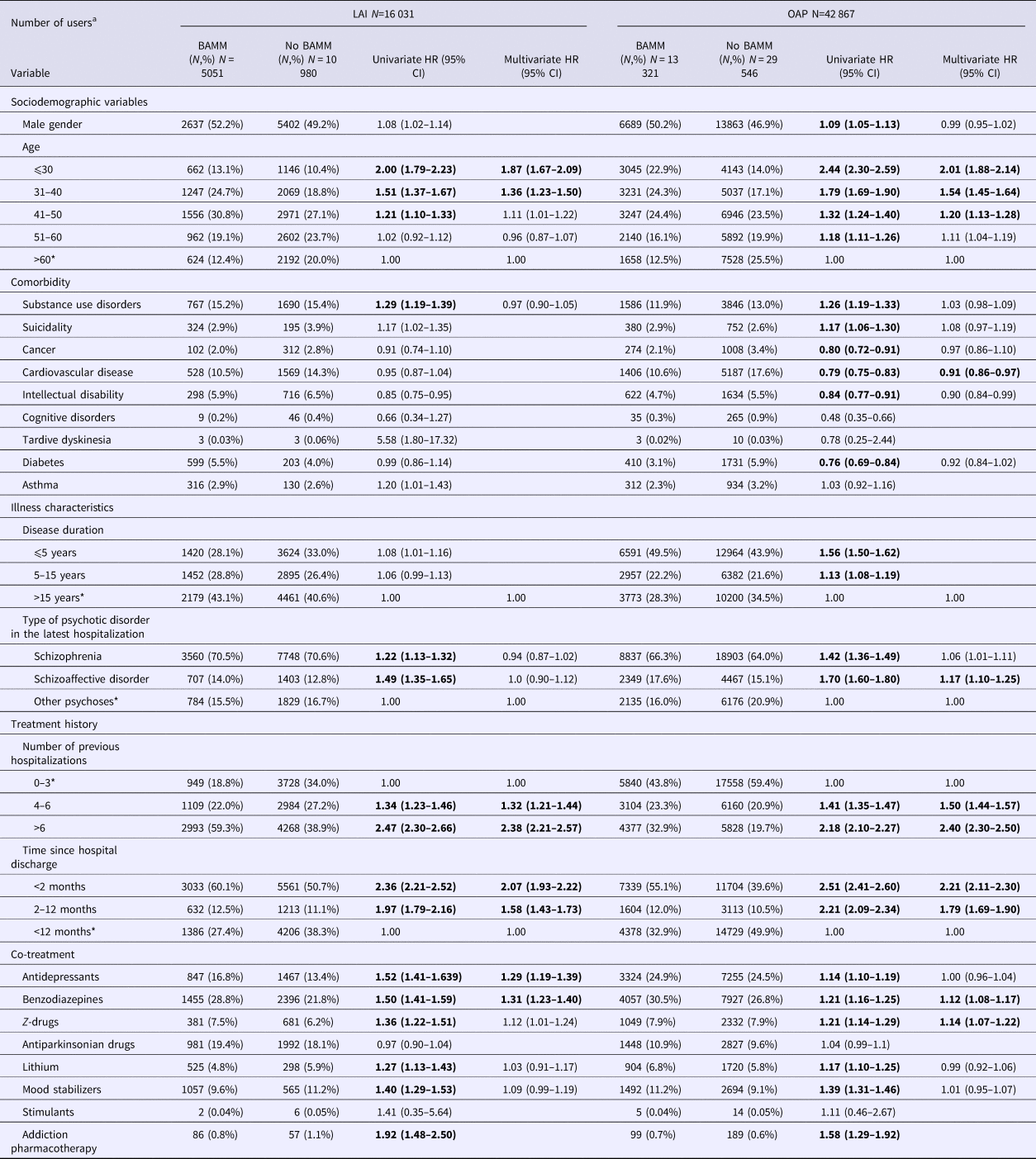
After adjusting for other covariates, BAMM was significantly associated with younger age, higher number of previous hospitalizations, shorter time since last discharge, and use of antidepressants and benzodiazepines at baseline in the LAI group. For the OAP group: younger age, schizoaffective disorder, higher number of previous hospitalization, shorter time since last discharge, and prescription of benzodiazepines and z-drugs at baseline were associated with greater risk of BAMM, while cardiovascular disease was associated with a lower risk of BAMM (Table 3).
Associations between characteristics at treatment onset and Breakthrough Psychosis on Antipsychotic Maintenance (BAMM) (prospective cohort model)

* Reference. Significant results after Bonferroni correction (p < 0.00217) are bolded.
a Only the first eligible treatment episode was included for each patient was included in the analysis. Since OAP and LAI were analyzed separately, individuals with LAI and OAP treatment episodes eligible for the analysis were included in both analyses. Therefore, the sum of individuals in the LAI (N = 16 031) and OAP (N = 42 867) model is larger than the total N of the cohort (N = 47 964).
In the incident cohort, only greater number of previous hospitalizations and antidepressant use at baseline were associated with greater risk of BAMM in the LAI group, whereas younger age, number of previous hospitalizations, and time since last discharge were associated with greater risk of BAMM in the OAP group (online Supplementary Table 1s).
Associations between characteristics of the treatment and BAMM (retrospective case–control model)
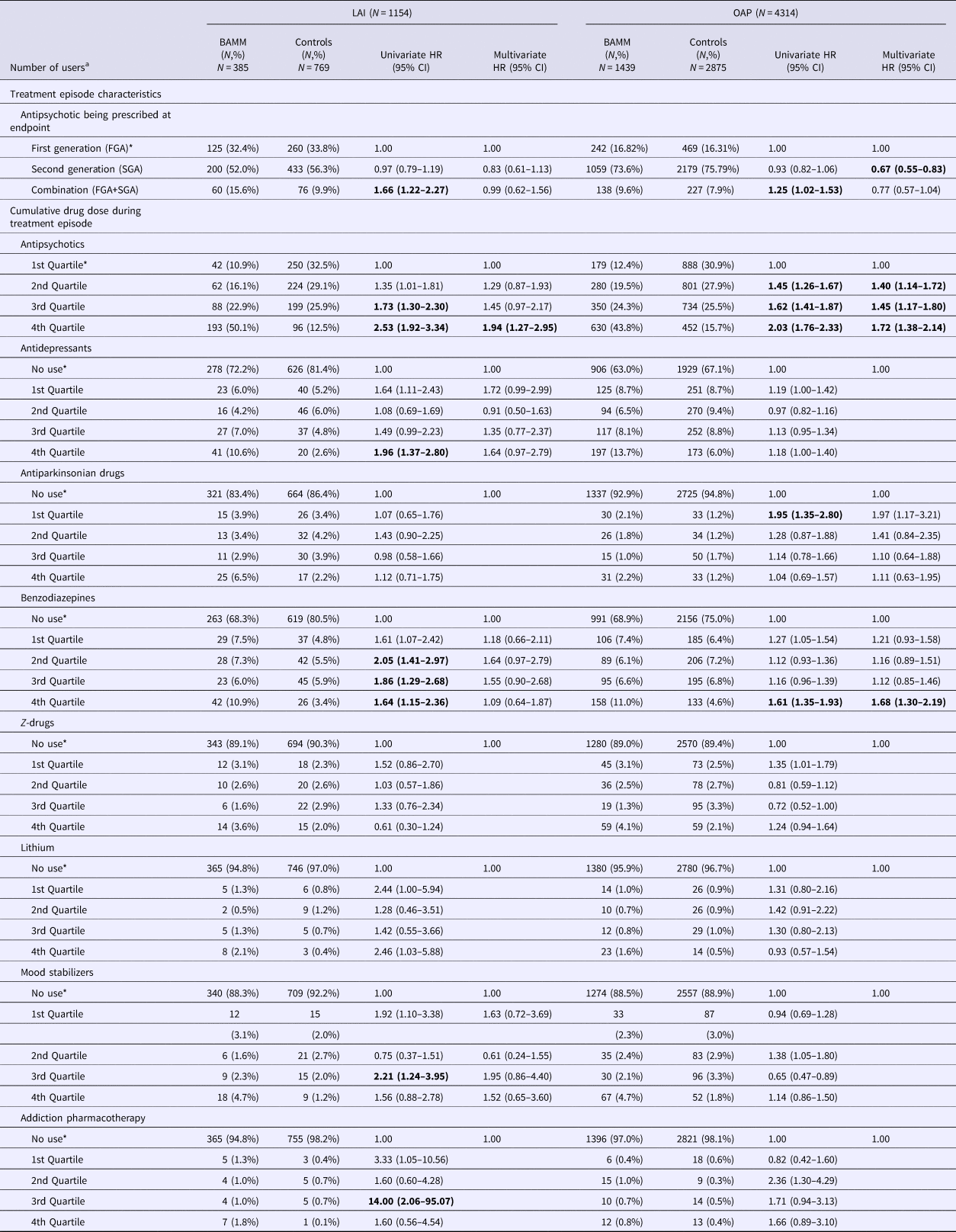
After adjusting for other covariates, in the LAI group, only the top quartile of cumulative antipsychotic exposure was significantly associated with BAMM. For OAPs, the risk was lower during continuous treatment with SGAs than with FGAs, there was a dose related risk of BAMM with cumulative antipsychotic exposure, and also risk was higher for individuals with the largest cumulative dose of benzodiazepines (Table 4).
Associations between treatment episode characteristics and Breakthrough Psychosis on Antipsychotic Maintenance (BAMM) among incident cases (retrospective case–control model)

* Reference. Baseline variables gender, age, comorbidities, number of previous hospitalizations, and time since last hospitalization were included to adjust for in multivariable analysis. Controls were matched for duration of treatment episode. Significant results after Bonferroni correction (p < 0.00217) are bolded.
a Only the first eligible treatment episode was included for each patient was included in the analysis. Since OAP and LAI were analyzed separately, individuals with LAI and OAP treatment episodes eligible for the analysis were included in both analyses. Therefore the sum of individuals in the LAI (N = 16 031) and OAP (N = 42 867) model is larger than the total N of the cohort (N = 47 964).
Characteristics of continuous treatment episodes and incidence rates of subsequent BAMM
Following a BAMM episode, individuals re-challenged with an antipsychotic other than clozapine presented with 3.32 (95% CI 3.31–3.34) events per 10 person-years and 49.7% cumulative probability of a following BAMM in LAI treatment episodes and 2.22 (95% CI 2.22–2.23) per 10 person-years and 53.5% cumulative probability of BAMM in OAP treatment episodes, with a median time to event of 172 (IQR = 96–394) days in the LAI group and 238 (IQR = 116–623) days in the OAP group (online Supplementary Table 4s and Figs 1s and2s).
Sensitivity analyses
A total of 29.1% (n = 507) of the LAI group and 7.7% (n = 432) of the OAP group in the incident cohort met the proxy criteria for TRS. In a multivariable model with the subjects that did not meet these criteria; younger age, greater number of hospitalizations, suicidality, and antidepressant treatment at baseline were associated with BAMM in the LAI cohort, whereas the same variables plus male gender, shorter time since last hospitalization, and top quartile of antipsychotic cumulative dose were associated with BAMM in the OAP group (online Supplementary Table 5s).
Greater than six previous hospitalizations and top quartile of antipsychotic and antidepressant cumulative dose were more likely to be associated ‘early’ than ‘late’ BAMM in a median split, whereas for the OAP group this was true for the same variables plus younger age, shorter time since last hospital discharge, and greater cumulative benzodiazepine dose (online Supplementary Table 6s).
Additionally, we measured the proportion of BAMM events that occurred in individuals without hospitalizations within the last year prior to treatment onset as a conservative measure of clinical stability, finding that this occurred in 27.4% (N = 1386) of the BAMM events in the LAI group, and 32.9% (N = 4378) of the OAP group, with a median time to BAMM of 780 (IQR = 309–1726) and 775 (IQR = 295–1879) days respectively (online Supplementary Table 7s).
In the sensitivity analysis that used median split instead of categorized age, number of hospitalizations, time since hospitalization, and duration of the treatment episode were basically unchanged to the categorized outcomes. Results for the LAI analyses in the prevalent cohort were: age <median HR = 1.40 (1.32–1.48), number of hospitalizations >median HR = 2.02 (1.90–2.14), and time since last hospitalization <median HR = 1.81 (1.70–1.92). Results for the OAP analyses were: age <median HR = 1.43 (1.38–1.49), number of hospitalizations >median HR = 1.82 (1.76–1.90), time since last hospitalization <median HR = 2.13 (2.05–2.21).
Discussion
This nationwide cohort of individuals with schizophrenia represents the largest epidemiological dataset to date of breakthrough psychosis. During up to 20 years of observation, about one-third of individuals continuously treated were hospitalized for psychosis, which highlights that this is a common phenomenon and a public health concern. These data suggest that a large proportion of these events concentrate early on after treatment onset and that factors related to illness instability play an important role; however, in a sizeable proportion of cases, relapse occurred despite long periods of continuous antipsychotic treatment.
National registries are the only currently available resource that can provide long-term precise data on cumulative antipsychotic exposure while mitigating selection and attrition biases, generating statistically powerful data with large external validity on questions regarding treatment exposure. That being said, several limitations need to be taken into account. First, the analyses make the assumption that all purchased OAPs were consumed, which could have resulted in some cases relapsing without sufficient antipsychotic exposure if this was not true. Nevertheless, the PRE2DUP method has substantial reliability predicting antipsychotic serum concentrations (Forsman et al., Reference Forsman, Taipale, Masterman, Tiihonen and Tanskanen2018), which makes this risk is relatively low, and virtually non-existent for LAIs. Furthermore, the gap between the last drug dispensing and end of the episode was shorter for individuals with BAMM, suggesting less opportunity for non-adherence. Second, since the entire population was included in the analyses, there were limitations inherent to lack of randomization. Therefore, the data did not allow comparisons between the LAI and OAP groups, but rather reflects on the characteristics of BAMM for each one of these treatments in the real world. The worse prognosis in the LAI group compared with the OAP group explains the similar event rates, although LAIs are known to perform better than OAPs in preventing relapse under equal prognostic circumstances upon treatment onset (Kishimoto et al., Reference Kishimoto, Robenzadeh, Leucht, Leucht, Watanabe, Mimura, Borenstein, Kane and Correll2014). Third, given the lack of data on symptom severity in national cohorts, symptom improvement over the initial 8 weeks of treatment or relapse upon hospitalization cannot be confirmed. However, the median time of continuous outpatient antipsychotic treatment prior to BAMM was over 9 months, reflecting reasonably long stability prior to relapse in the vast majority of the sample. Also, rather than by symptom severity, relapse was defined by hospitalization for psychosis. Nevertheless, hospitalization is a specific proxy of relapse (Addington et al., Reference Addington, Patten, McKenzie and Addington2013) and a criterion for relapse in most clinical trials (Csernansky et al., Reference Csernansky, Mahmoud and Brenner2002). Furthermore, hospitalization for psychosis excludes other reasons for hospitalization (i.e. suicidality). Some of these limitations may be overcome by using other approaches (i.e. relapse-prevention trials), yet at the expense of the external validity and shorter observation periods, so these approaches to study BAMM should be seen as complementary rather than competitive.
The survival curve revealed that most events concentrated within the initial 9 months of treatment, which along with the association of factors related with illness instability at treatment onset (i.e. time since last discharge and number of hospitalizations), suggests that in this sample a substantial proportion of the cases of hospitalization occurred in the context of limited clinical stability throughout treatment. However, the sensitivity analyses show that for individuals that surpassed 9 months of continuous treatment, clinical instability at baseline was less of a contributing factor, and about a third of events were in individuals whose last hospitalization had occurred >1 year before treatment onset. Failure to maintain months of clinical stability despite continuous antipsychotic treatment may be related to the clinical presentation of ‘late-onset TRS’, as it has been described and replicated in the Genetics And Psychosis (GAP) (Lally et al., Reference Lally, Ajnakina, Di Forti, Trotta, Demjaha, Kolliakou, Mondelli, Reis Marques, Pariante, Dazzan, Shergil, Howes, David, MacCabe, Gaughran and Murray2016) and the Aetiology and Ethnicity in Schizophrenia and Other Psychoses (AESOP-10) studies (Demjaha et al., Reference Demjaha, Lappin, Stahl, Patel, MacCabe, Howes, Heslin, Reininghaus, Donoghue, Lomas, Charalambides, Onyejiaka, Fearon, Jones, Doody, Morgan, Dazzan and Murray2017). In these studies, 30% and 16% of cases, respectively, had responded to antipsychotics prior to meeting criteria for TRS. This clinical presentation, in which there was an initial antipsychotic response, later followed by recurrence of symptoms despite antipsychotic exposure has been described before in relationship to relapse although not removing the confounder of treated non-adherence (Takeuchi et al., Reference Takeuchi, Siu, Remington, Fervaha, Zipursky, Foussias and Agid2018). This phenomenon could have different pathophysiological correlates than treatment responsive schizophrenia, or TRS from illness onset. Longitudinal studies of continuously treated patients that can characterize symptom severity and neurobiological correlates are necessary.
The only variable associated with a lower risk of BAMM was cardiovascular comorbidity in the OAP sample. Reasons for this potentially ‘protective’ effect could include greater antipsychotic adherence with a subsequent greater likelihood of adverse cardiovascular morbidity, or greater health care utilization and diagnosis of cardiovascular conditions, so that psychiatric worsening may be more likely to be contained in settings other than the psychiatric hospital.
The finding of substantially larger cumulative incidence and shorter time to event among individuals who were challenged with another antipsychotic other than clozapine after a BAMM episode suggests that in a relevant number of cases BAMM may be a manifestation of the development of TRS. However, the prognostic ability of BAMM to predict TRS remains an empirical question. If BAMM proves to be a sensitive predictor of TRS, it could be used to expedite this designation and treatment with clozapine, both of which are inordinately delayed (Thien and O'Donoghue, Reference Thien and O'Donoghue2018). Given recent recommendations by authors of acute trials in first episode psychosis to switch to clozapine after the first failed trial (Kahn et al., Reference Kahn, van Rossum I, Leucht, McGuire, Lewis, Leboyer, Arango, Dazzan, Drake, Heres, Díaz-Caneja, Rujescu, Weiser, Galderisi, Glenthøj, Eijkemans, Fleischhacker, Kapur and Sommer2018), this paradigm should be further investigated.
The long-term follow-up, representative sample, and measurement of cumulative antipsychotic exposure following the diagnosis of schizophrenia are strengths of the study to address the role of dopamine supersensitivity in BAMM. The finding that BAMM was more likely in younger individuals early in the course of illness and that most events concentrated early after treatment onset instead of later, when greater cumulative antipsychotic exposure has been accrued, does not support a causal association between chronic antipsychotic exposure and BAMM. This being said, we observed a dose-related risk between cumulative dose of antipsychotic and BAMM, which was not consistently replicated in most of the secondary analyses, and may be likely confounded by indication (i.e. sicker patients receiving higher doses) (Dold et al., Reference Dold, Fugger, Aigner, Lanzenberger and Kasper2015).
The questions raised by this research about the course of symptom severity in individuals with chronic antipsychotic treatment have translational implications. There is an accumulating body of evidence suggesting distinct pathophysiological mechanisms for treatment responsive psychosis and TRS (Demjaha et al., Reference Demjaha, Murray, McGuire, Kapur and Howes2012; Howes and Kapur, Reference Howes and Kapur2014; Mouchlianitis et al., Reference Mouchlianitis, Bloomfield, Law, Beck, Selvaraj, Rasquinha, Waldman, Turkheimer, Egerton, Stone and Howes2016). While psychotic symptoms in individuals who respond to antipsychotic treatment have been associated with dopaminergic mechanisms (Demjaha et al., Reference Demjaha, Murray, McGuire, Kapur and Howes2012), psychotic symptoms have been reported to be associated with dysfunction in non-dopaminergic systems in individuals with TRS (Mouchlianitis et al., Reference Mouchlianitis, Bloomfield, Law, Beck, Selvaraj, Rasquinha, Waldman, Turkheimer, Egerton, Stone and Howes2016). BAMM, in which psychosis recurs despite continuous blockade of dopamine D2 receptors, can be a paradigm that may help to disentangle the relationship between treatment responsive psychosis and TRS, and that may advance our understanding of the potentially heterogeneous mechanisms underlying psychotic symptoms. However, this biological research needs to be conducted in parallel with clinical research that better characterizes the phenotype of those who are assumed to have had a substantial clinical response to antipsychotics prior to relapse.
In conclusion, psychosis relapse despite ongoing continuous antipsychotic treatment was a common clinical presentation, affecting one in three individuals with continuous antipsychotic treatment. Although in a sizeable proportion of cases this may occur in the context of limited clinical stability at treatment onset, this is not always the case. There was insufficient evidence to suggest that cumulative antipsychotic exposure plays a causal role in this clinical manifestation, since it was not a consistent risk factor and furthermore BAMM was more likely among younger individuals and earlier in the course of treatment, instead of in older individuals and later in the course of treatment as it would have been expected. The mechanisms underlying relapse after long periods of clinical stability and its relationship with TRS needs to be further investigated to inform our understanding of the heterogeneous pathophysiological mechanisms of psychosis.
Author ORCIDs
Jose M. Rubio, 0000-0002-0056-4135
Supplementary material
The supplementary material for this article can be found at https://doi.org/10.1017/S0033291719001296
Financial support
This work was supported by Northwell Health (NY, USA), the Karolinska Institutet (Stockholm, Sweden), and the Academy of Finland (Grant numbers: 315969, 320107).
Conflict of interest
JMR received consulting honoraria and speaker fees from Lundbeck and Zero Copay Program. CUC has been a consultant and/or advisor to or has received honoraria from: Alkermes, Allergan, Angelini, Boehringer-Ingelheim, Gerson Lehrman Group, Indivior, IntraCellular Therapies, Janssen/J&J, LB Pharma, Lundbeck, MedAvante-ProPhase, Medscape, Merck, Neurocrine, Noven, Otsuka, Pfizer, Rovi, Servier, Sunovion, Supernus, Takeda, and Teva. He has provided expert testimony for Bristol-Myers Squibb, Janssen, and Otsuka. He served on a Data Safety Monitoring Board for Boehringer-Ingelheim, Lundbeck, Rovi, Supernus, and Teva. He received royalties from UpToDate and grant support from Janssen and Takeda. He is also a shareholder of LB Pharma. AT is a member of the advisory board for Janssen-Cilag. JMK has been a consultant and/or advisor to or has received honoraria from: Alkermes, Allergan, Bristol-Myers Squibb, Cephalon, Eli Lilly, Forum, Genentech, Gerson Lehrman Group, Intra-Cellular Therapies, Janssen/J&J, LB Pharma, Lundbeck, Medscape, Merck, Minerva, Neurocrine, Otsuka, Pierre Fabre, Pfizer, Reviva, Roche, Sunovion, Takeda, and Teva. JK is a shareholder of LB Pharma, and the Vanguard Research Group. JT reports personal fees from the Finnish Medicines Agency (Fimea), European Medicines Agency (EMA), Eli Lilly, Janssen-Cilag, Lundbeck, and Otsuka; and is a member of the advisory board for Lundbeck. JT, HT, and AT have participated in research projects funded by grants from Janssen-Cilag and Eli Lilly to their employing institution.